
Maps A map is a twodimensional or flatscale


- Slides: 13
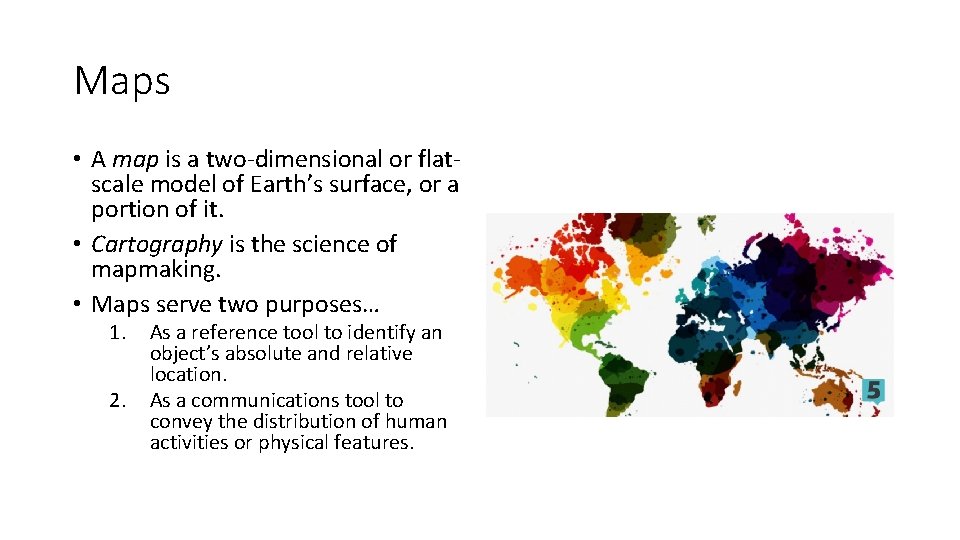
Maps • A map is a two-dimensional or flatscale model of Earth’s surface, or a portion of it. • Cartography is the science of mapmaking. • Maps serve two purposes… 1. 2. As a reference tool to identify an object’s absolute and relative location. As a communications tool to convey the distribution of human activities or physical features.
Early Map Making • Earliest maps were reference tools—simple navigation devices to show a traveler how to get from Point A to Point B. • First world map prepared by Eratosthenes (276– 194 B. C. ) • Improvements to world map later made by Ptolemy. • After Ptolemy, advancements in cartography primarily made outside of Europe by Chinese and Islamic world. • Mapmaking revived during the Age of Exploration and Discovery.
Eratosthenes, 194(? ) bce
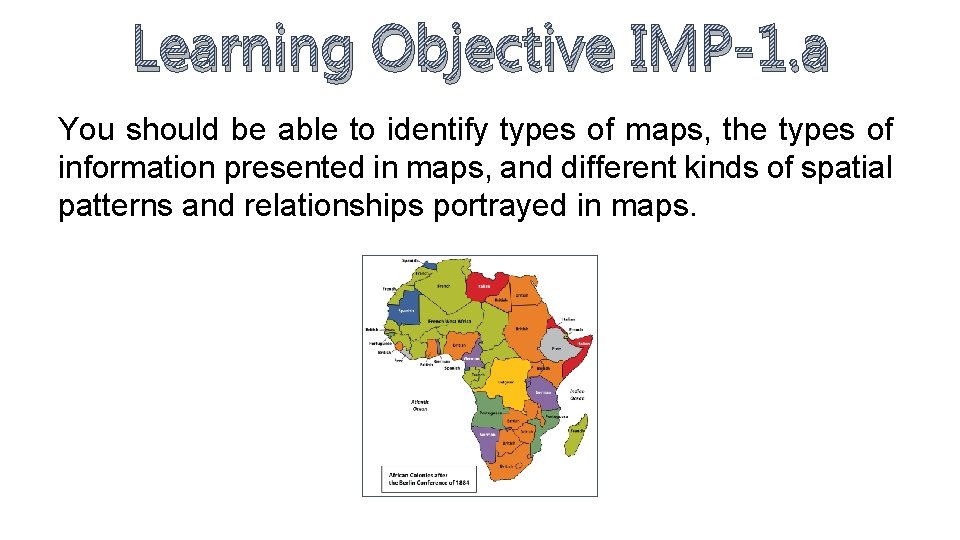
Learning Objective IMP-1. a You should be able to identify types of maps, the types of information presented in maps, and different kinds of spatial patterns and relationships portrayed in maps.
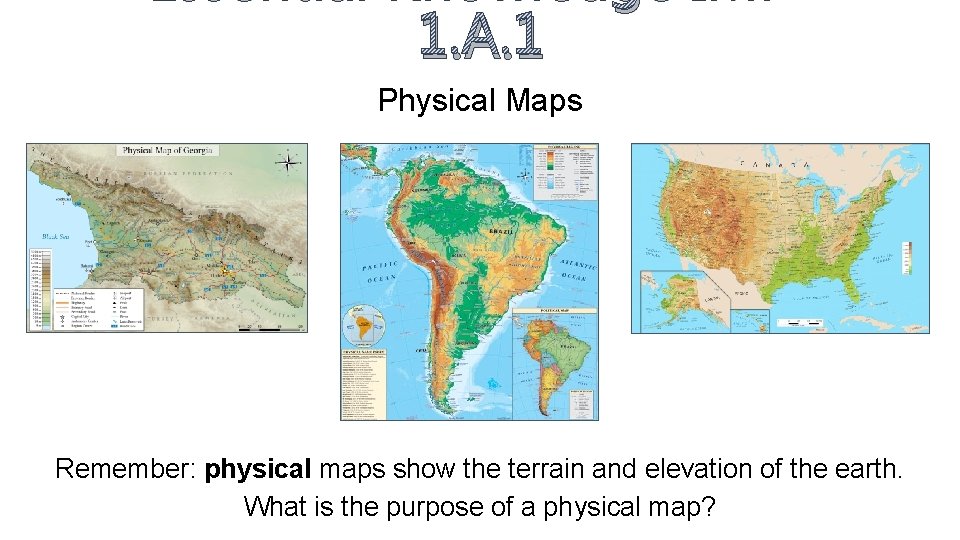
Essential Knowledge IMP 1. A. 1 Types of maps include reference maps and thematic maps. Reference maps are designed for people to refer to for general information about places. The two main reference maps are political and physical. Political Map Shows and labels the human-created boundaries and designations, such as countries, states, cities, and capitals. Physical Map Shows and labels the natural features, such as mountains, rivers, and deserts.
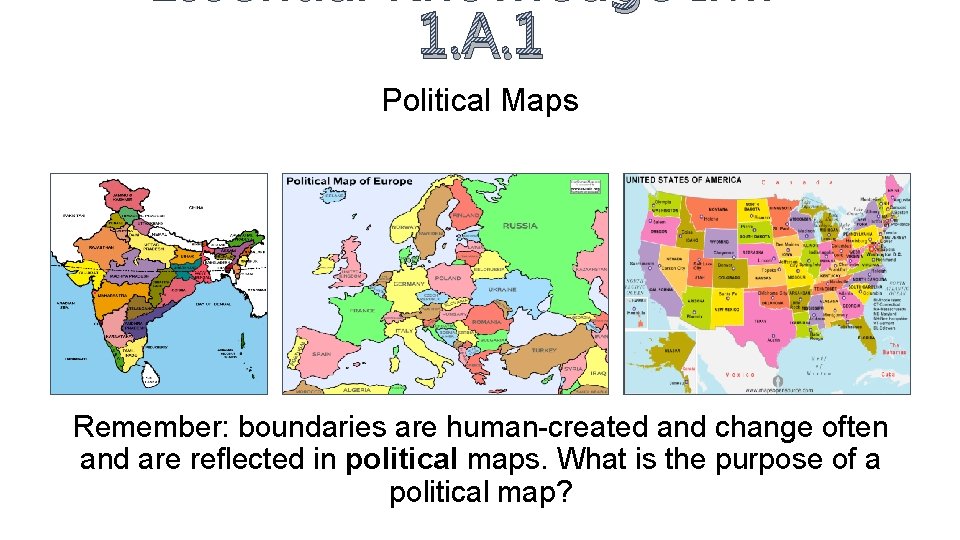
Essential Knowledge IMP 1. A. 1 Political Maps Remember: boundaries are human-created and change often and are reflected in political maps. What is the purpose of a political map?
Essential Knowledge IMP 1. A. 1 Physical Maps Remember: physical maps show the terrain and elevation of the earth. What is the purpose of a physical map?
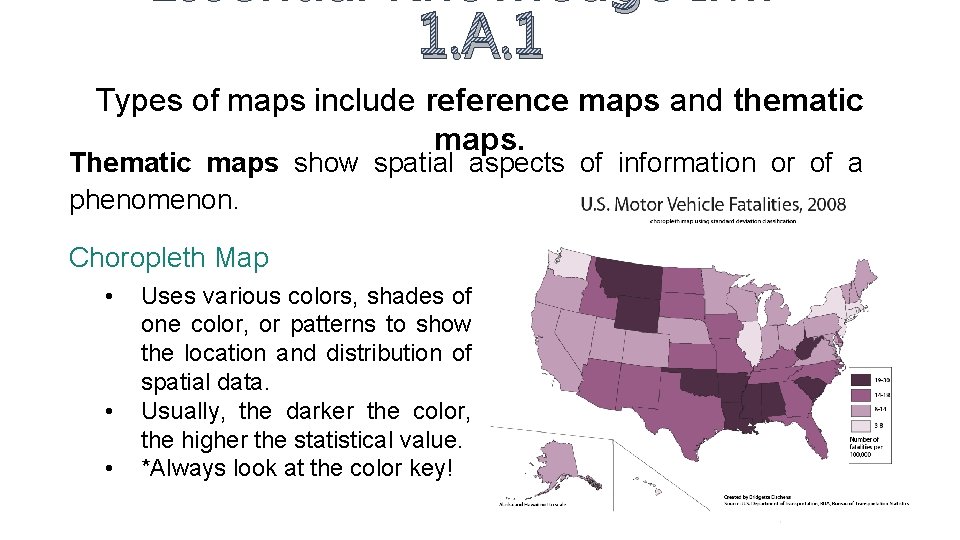
Essential Knowledge IMP 1. A. 1 Types of maps include reference maps and thematic maps. Thematic maps show spatial aspects of information or of a phenomenon. Choropleth Map • • • Uses various colors, shades of one color, or patterns to show the location and distribution of spatial data. Usually, the darker the color, the higher the statistical value. *Always look at the color key!
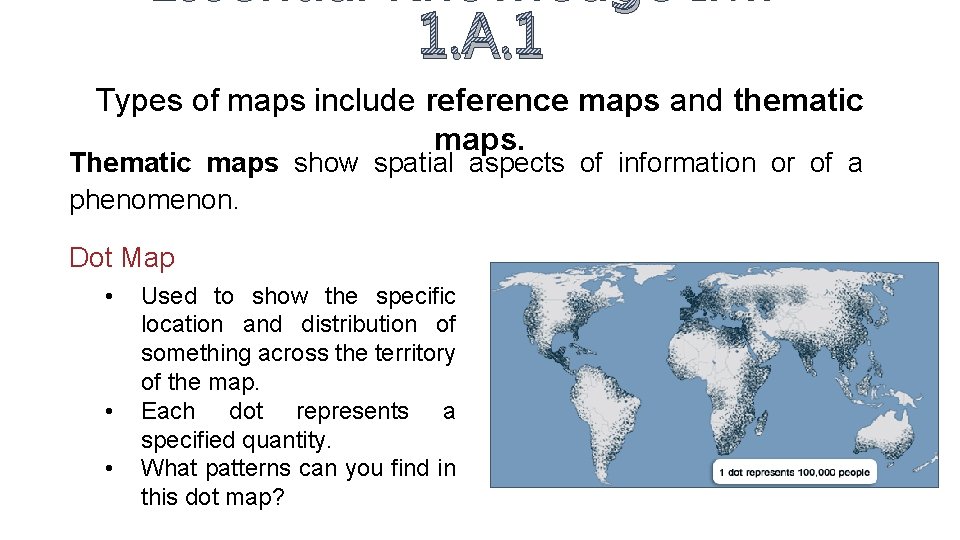
Essential Knowledge IMP 1. A. 1 Types of maps include reference maps and thematic maps. Thematic maps show spatial aspects of information or of a phenomenon. Dot Map • • • Used to show the specific location and distribution of something across the territory of the map. Each dot represents a specified quantity. What patterns can you find in this dot map?
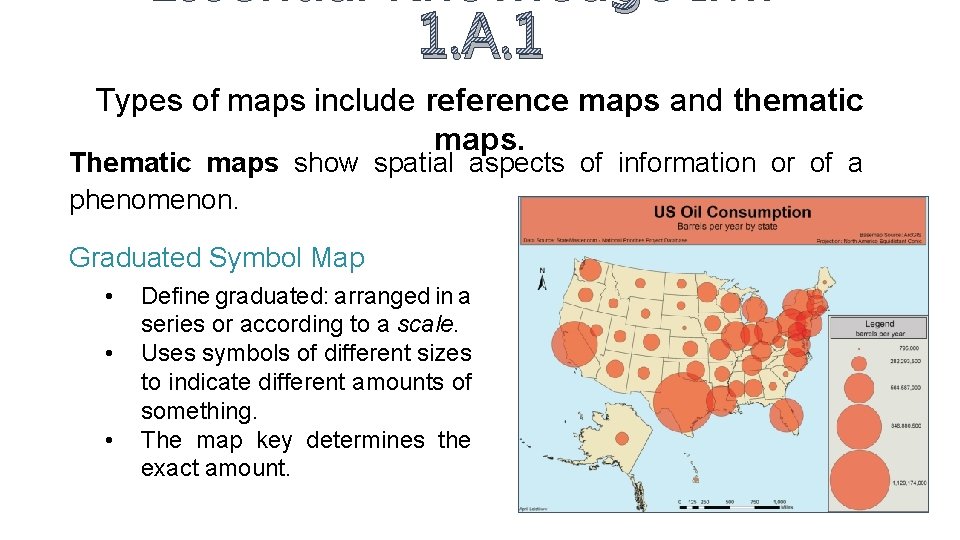
Essential Knowledge IMP 1. A. 1 Types of maps include reference maps and thematic maps. Thematic maps show spatial aspects of information or of a phenomenon. Graduated Symbol Map • • • Define graduated: arranged in a series or according to a scale. Uses symbols of different sizes to indicate different amounts of something. The map key determines the exact amount.
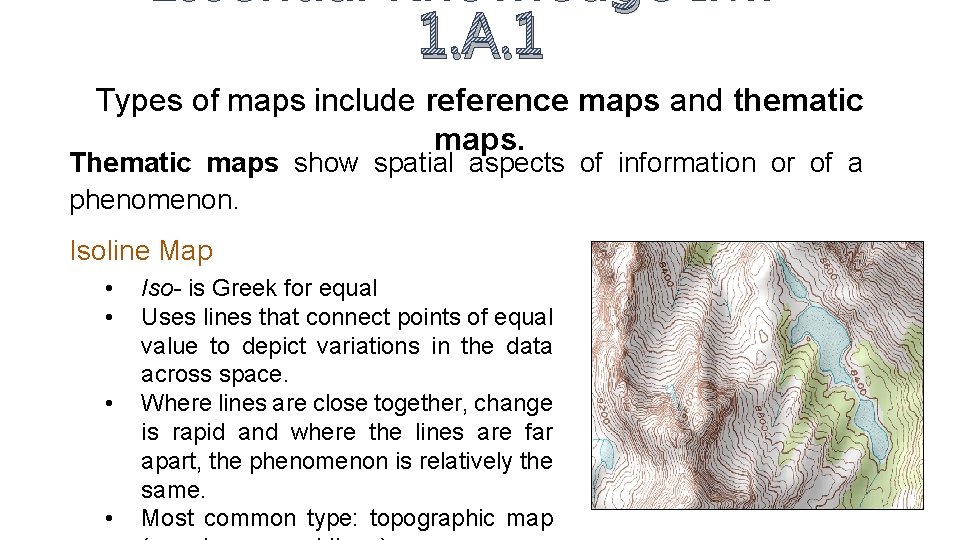
Essential Knowledge IMP 1. A. 1 Types of maps include reference maps and thematic maps. Thematic maps show spatial aspects of information or of a phenomenon. Isoline Map • • Iso- is Greek for equal Uses lines that connect points of equal value to depict variations in the data across space. Where lines are close together, change is rapid and where the lines are far apart, the phenomenon is relatively the same. Most common type: topographic map
Essential Knowledge IMP 1. A. 1 Types of maps include reference maps and thematic maps. Thematic maps show spatial aspects of information or of a phenomenon. Cartogram • Sizes of countries are shown according to some specific statistic. • Useful because they allow data to be compared, like a graph, and distance and distribution are also visible, like on a traditional map. • See the next two slides for examples.
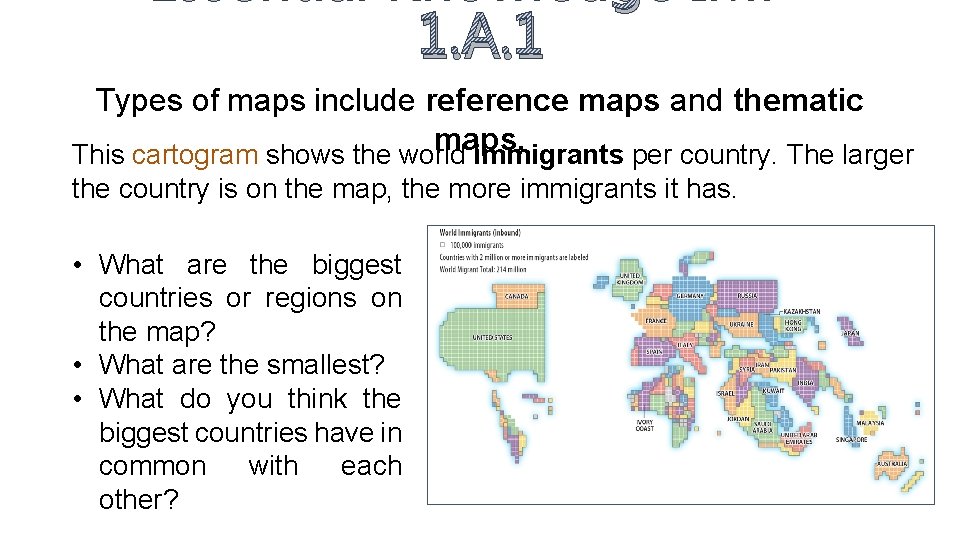
Essential Knowledge IMP 1. A. 1 Types of maps include reference maps and thematic maps. This cartogram shows the world immigrants per country. The larger the country is on the map, the more immigrants it has. • What are the biggest countries or regions on the map? • What are the smallest? • What do you think the biggest countries have in common with each other?