
MapReduce and Parallel Computing for LargeScale Media Processing

![References [1] Map-Reduce for Machine Learning on Multicore [2] A Map Reduce Framework for](https://slidetodoc.com/presentation_image_h2/6a00abcd508d55c48bc06624eefec47d/image-34.jpg "References [1] Map-Reduce for Machine Learning on Multicore [2] A Map Reduce Framework for")

- Slides: 35
Map-Reduce and Parallel Computing for Large-Scale Media Processing Youjie Zhou
Outline ► Motivations ► Map-Reduce Framework ► Large-scale Multimedia Processing Parallelization ► Machine Learning Algorithm Transformation ► Map-Reduce Drawbacks and Variants ► Conclusions
Motivations ► Why we need Parallelization? § “Time is Money” ►Simultaneously ►Divide-and-conquer § Data is too huge to handle ► 1 trillion (10^12) unique URLs in 2008 ►CPU speed limitation
Motivations ► Why we need Parallelization? § Increasing Data ►Social Networks ►Scalability! § “Brute Force” ►No approximations ►Cheap clusters v. s. expensive computers
Motivations ► Why we choose Map-Reduce? § Popular ►A parallelization framework Google proposed and Google uses it everyday ►Yahoo and Amazon also involve in § Popular Good? ►“Hides” parallelization details from users ►Provides high-level operations that suit for majority algorithms § Good start on deeper parallelization researches
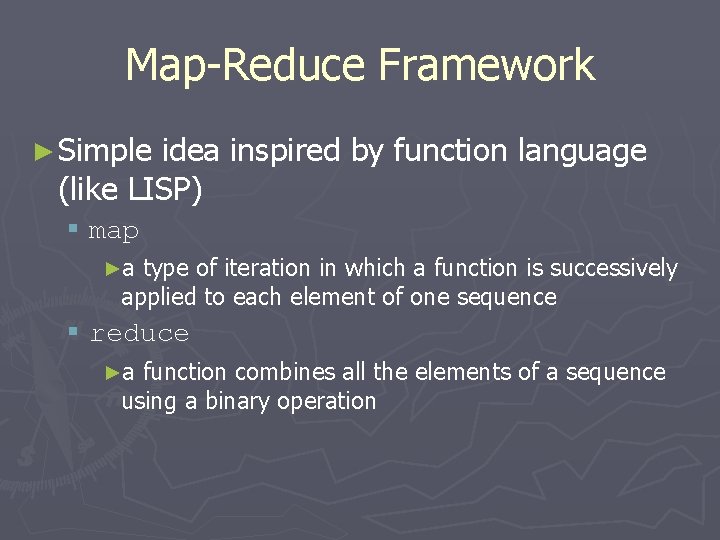
Map-Reduce Framework ► Simple idea inspired by function language (like LISP) § map ►a type of iteration in which a function is successively applied to each element of one sequence § reduce ►a function combines all the elements of a sequence using a binary operation
Map-Reduce Framework ► Data representation § <key, value> § map generates <key, value> pairs § reduce combines <key, value> pairs according to same key ► “Hello, world!” Example
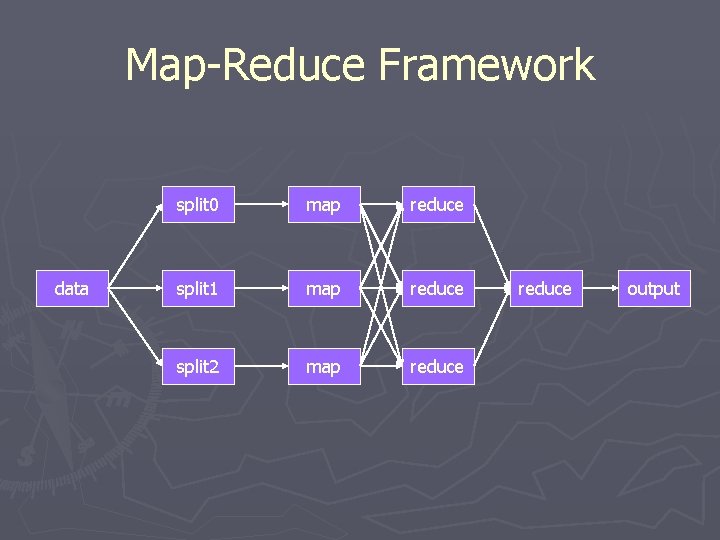
Map-Reduce Framework data split 0 map reduce split 1 map reduce split 2 map reduce output
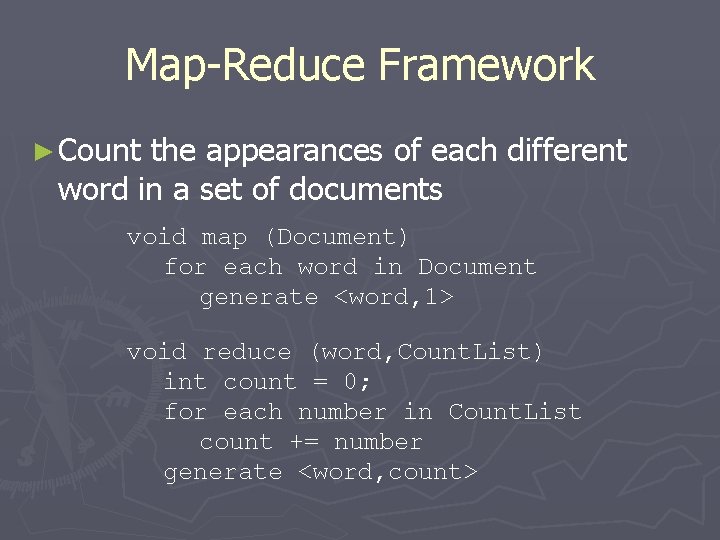
Map-Reduce Framework ► Count the appearances of each different word in a set of documents void map (Document) for each word in Document generate <word, 1> void reduce (word, Count. List) int count = 0; for each number in Count. List count += number generate <word, count>
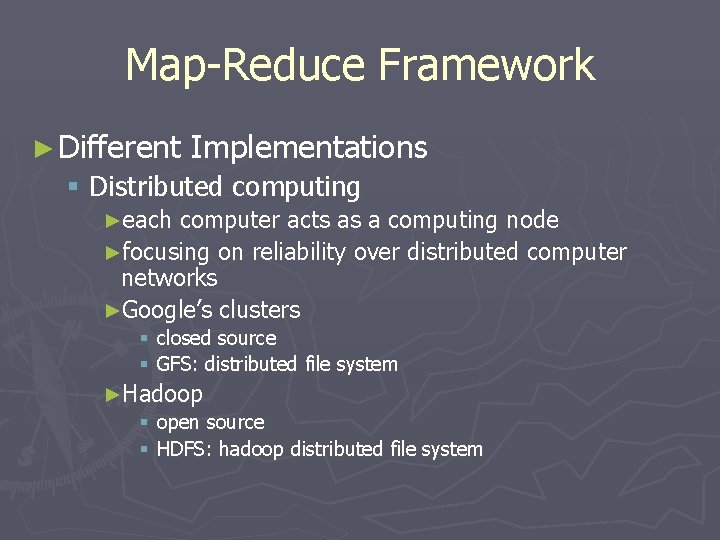
Map-Reduce Framework ► Different Implementations § Distributed computing ►each computer acts as a computing node ►focusing on reliability over distributed computer networks ►Google’s clusters § closed source § GFS: distributed file system ►Hadoop § open source § HDFS: hadoop distributed file system
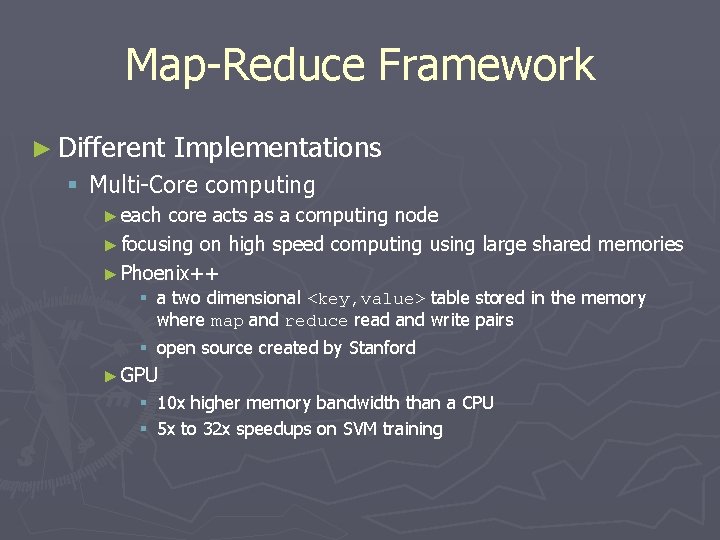
Map-Reduce Framework ► Different Implementations § Multi-Core computing ► each core acts as a computing node ► focusing on high speed computing using large shared memories ► Phoenix++ § a two dimensional <key, value> table stored in the memory where map and reduce read and write pairs § open source created by Stanford ► GPU § 10 x higher memory bandwidth than a CPU § 5 x to 32 x speedups on SVM training
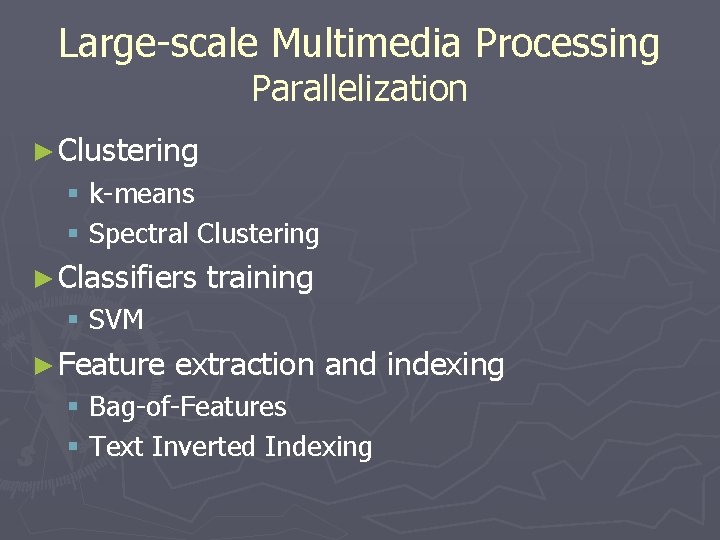
Large-scale Multimedia Processing Parallelization ► Clustering § k-means § Spectral Clustering ► Classifiers training § SVM ► Feature extraction and indexing § Bag-of-Features § Text Inverted Indexing
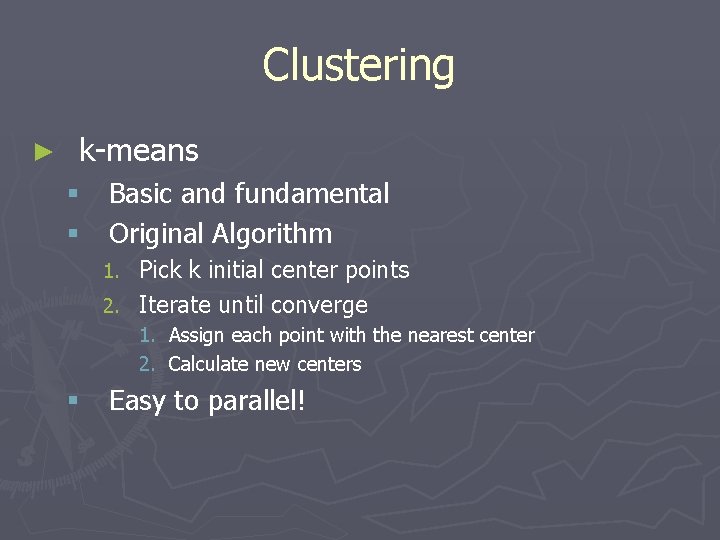
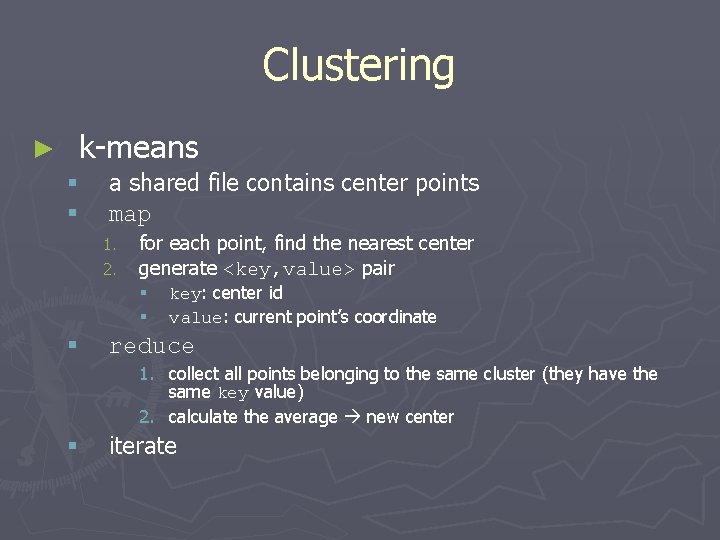
Clustering ► k-means § Basic and fundamental § Original Algorithm Pick k initial center points 2. Iterate until converge 1. Assign each point with the nearest center 2. Calculate new centers § Easy to parallel!
Clustering ► k-means § § a shared file contains center points map 1. 2. for each point, find the nearest center generate <key, value> pair § § § key: center id value: current point’s coordinate reduce 1. collect all points belonging to the same cluster (they have the same key value) 2. calculate the average new center § iterate
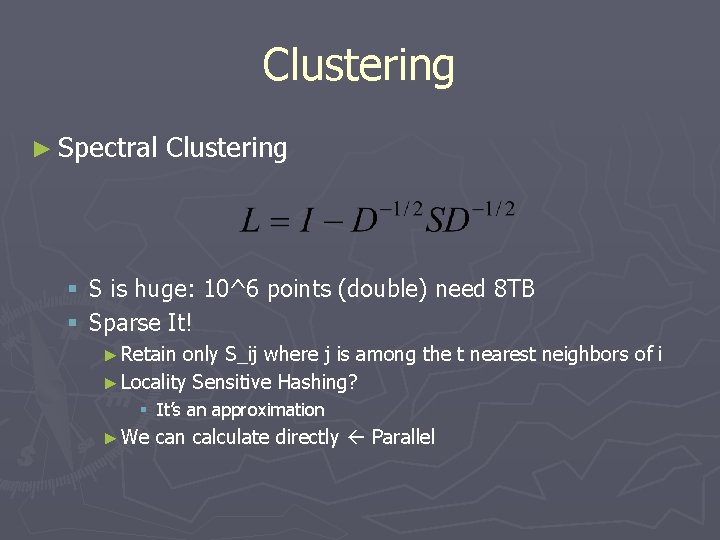
Clustering ► Spectral Clustering § S is huge: 10^6 points (double) need 8 TB § Sparse It! ► Retain only S_ij where j is among the t nearest neighbors of i ► Locality Sensitive Hashing? § It’s an approximation ► We can calculate directly Parallel
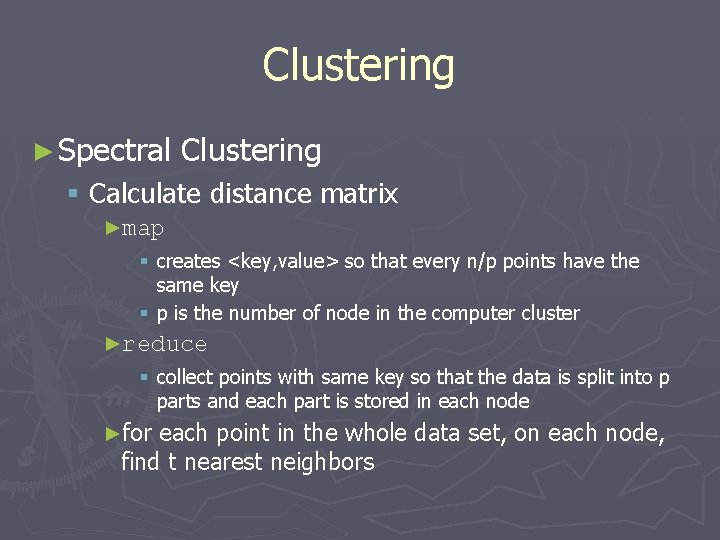
Clustering ► Spectral Clustering § Calculate distance matrix ►map § creates <key, value> so that every n/p points have the same key § p is the number of node in the computer cluster ►reduce § collect points with same key so that the data is split into p parts and each part is stored in each node ►for each point in the whole data set, on each node, find t nearest neighbors
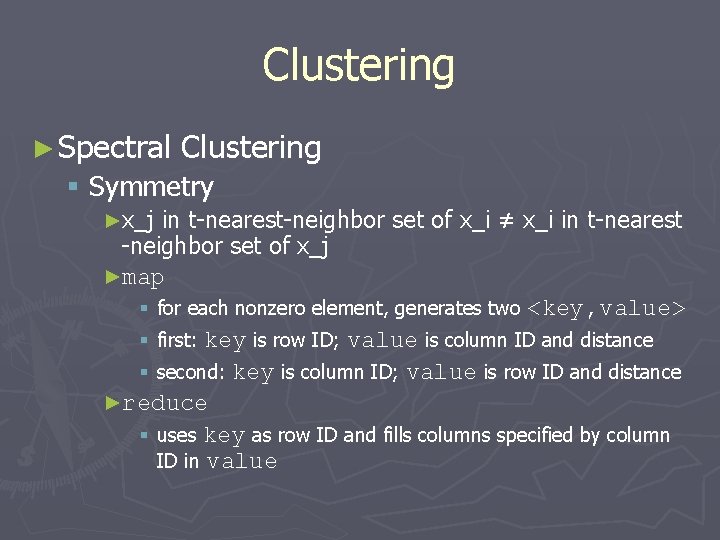
Clustering ► Spectral Clustering § Symmetry ►x_j in t-nearest-neighbor set of x_i ≠ x_i in t-nearest -neighbor set of x_j ►map § for each nonzero element, generates two <key, value> § first: key is row ID; value is column ID and distance § second: key is column ID; value is row ID and distance ►reduce § uses key as row ID and fills columns specified by column ID in value
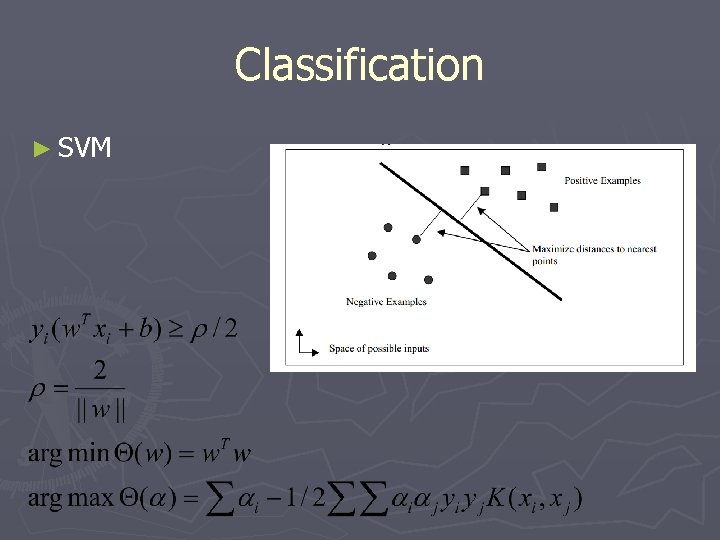
Classification ► SVM
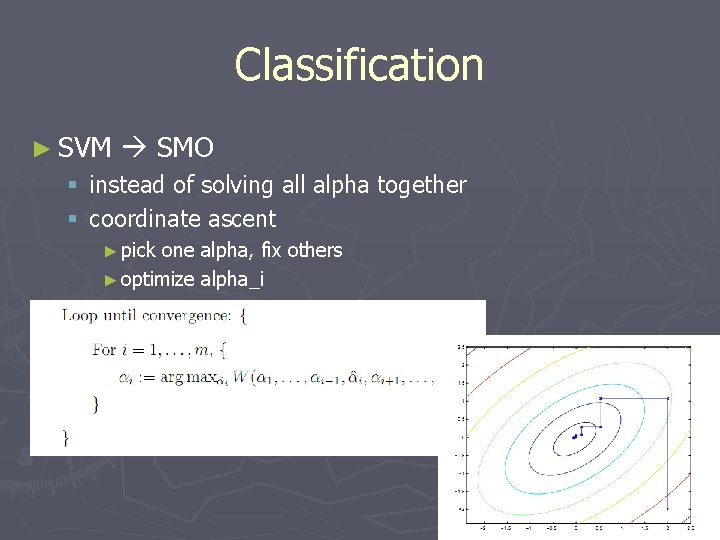
Classification ► SVM SMO § instead of solving all alpha together § coordinate ascent ► pick one alpha, fix others ► optimize alpha_i
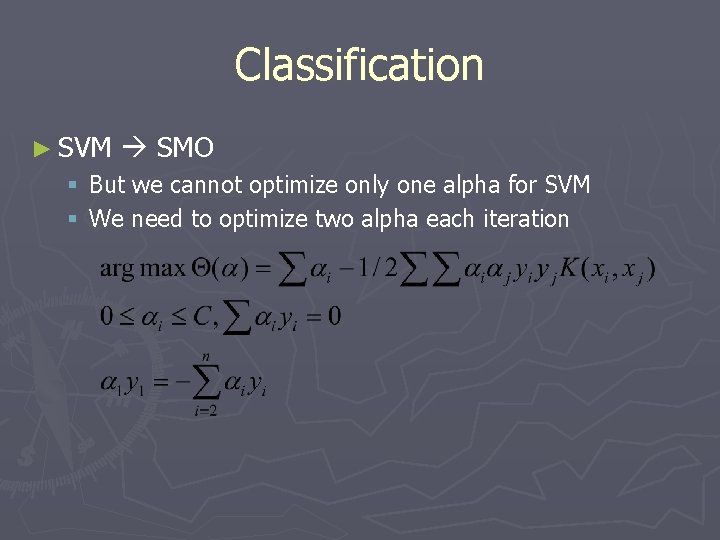
Classification ► SVM SMO § But we cannot optimize only one alpha for SVM § We need to optimize two alpha each iteration
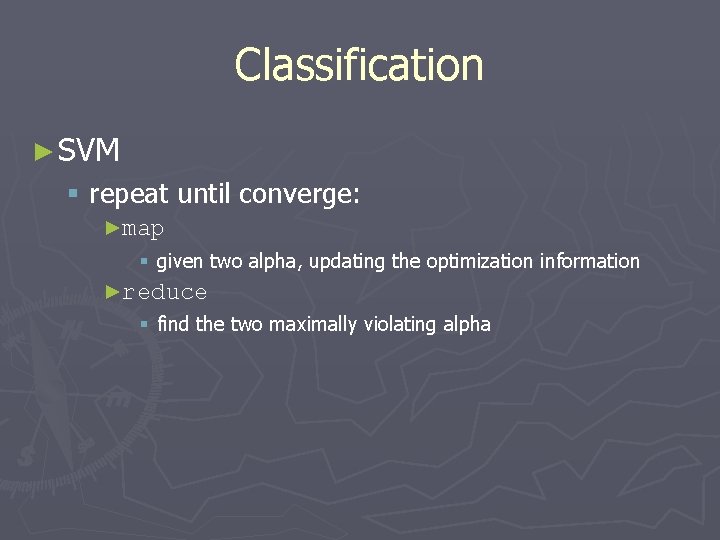
Classification ► SVM § repeat until converge: ►map § given two alpha, updating the optimization information ►reduce § find the two maximally violating alpha
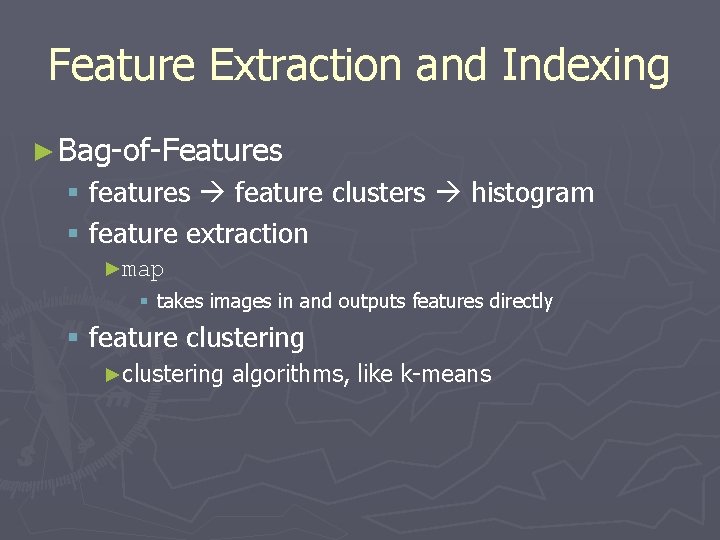
Feature Extraction and Indexing ► Bag-of-Features § features feature clusters histogram § feature extraction ►map § takes images in and outputs features directly § feature clustering ►clustering algorithms, like k-means
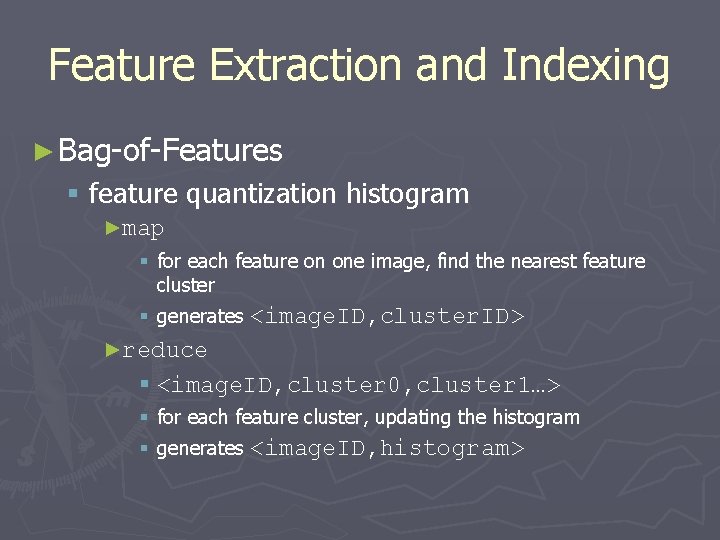
Feature Extraction and Indexing ► Bag-of-Features § feature quantization histogram ►map § for each feature on one image, find the nearest feature cluster § generates <image. ID, cluster. ID> ►reduce § <image. ID, cluster 0, cluster 1…> § for each feature cluster, updating the histogram § generates <image. ID, histogram>
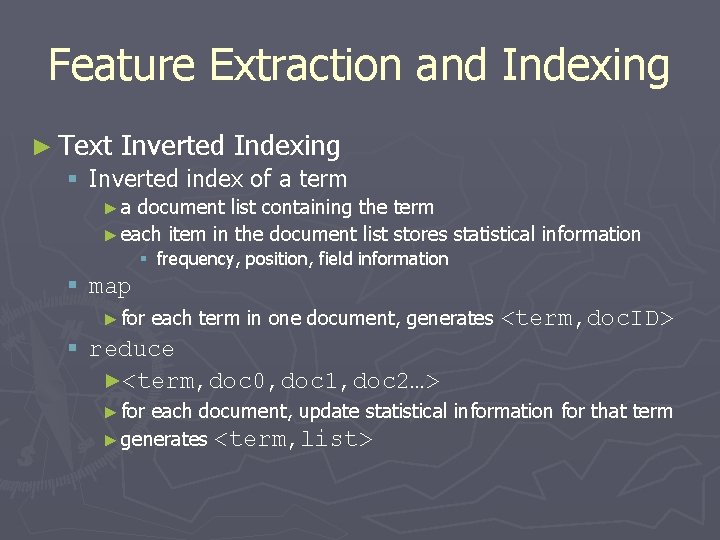
Feature Extraction and Indexing ► Text Inverted Indexing § Inverted index of a term ►a document list containing the term ► each item in the document list stores statistical information § frequency, position, field information § map ► for each term in one document, generates <term, doc. ID> § reduce ►<term, doc 0, doc 1, doc 2…> ► for each document, update statistical information for that term ► generates <term, list>
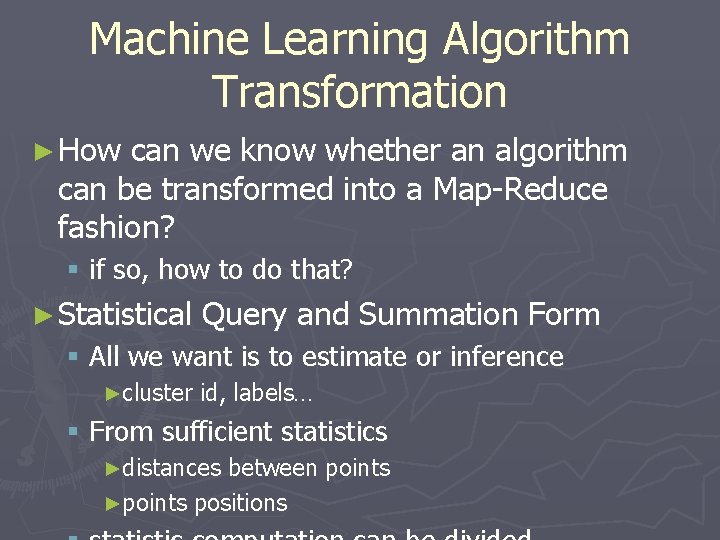
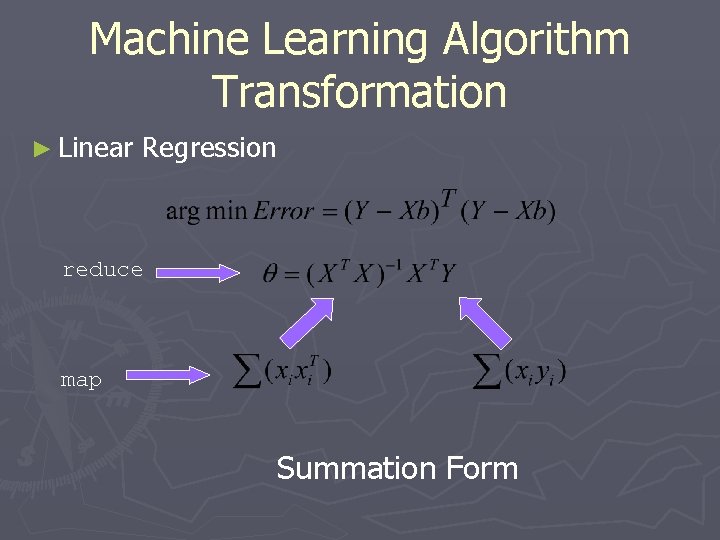
Machine Learning Algorithm Transformation ► How can we know whether an algorithm can be transformed into a Map-Reduce fashion? § if so, how to do that? ► Statistical Query and Summation Form § All we want is to estimate or inference ►cluster id, labels… § From sufficient statistics ►distances between points ►points positions
Machine Learning Algorithm Transformation ► Linear Regression reduce map Summation Form
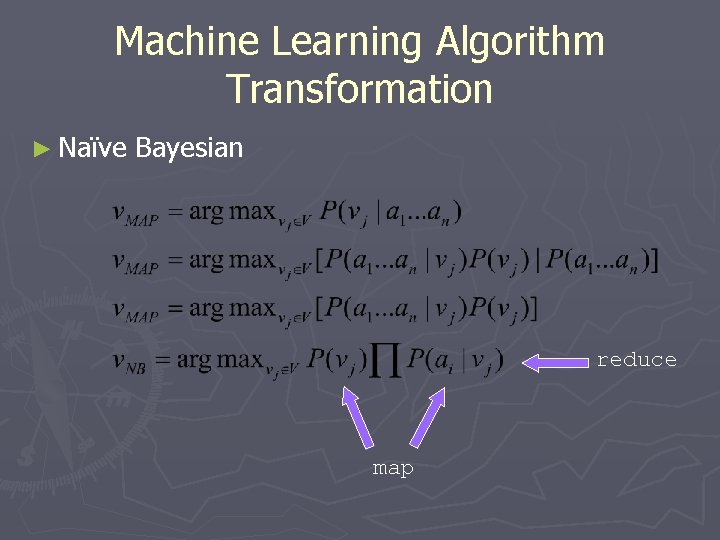
Machine Learning Algorithm Transformation ► Naïve Bayesian reduce map
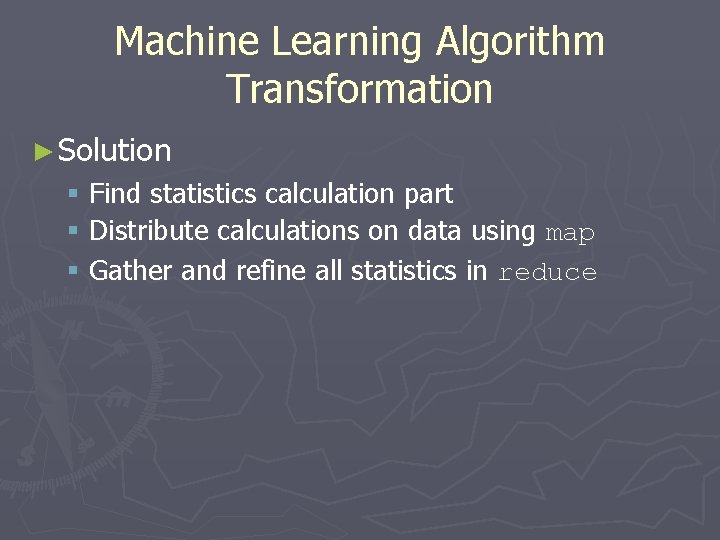
Machine Learning Algorithm Transformation ► Solution § Find statistics calculation part § Distribute calculations on data using map § Gather and refine all statistics in reduce
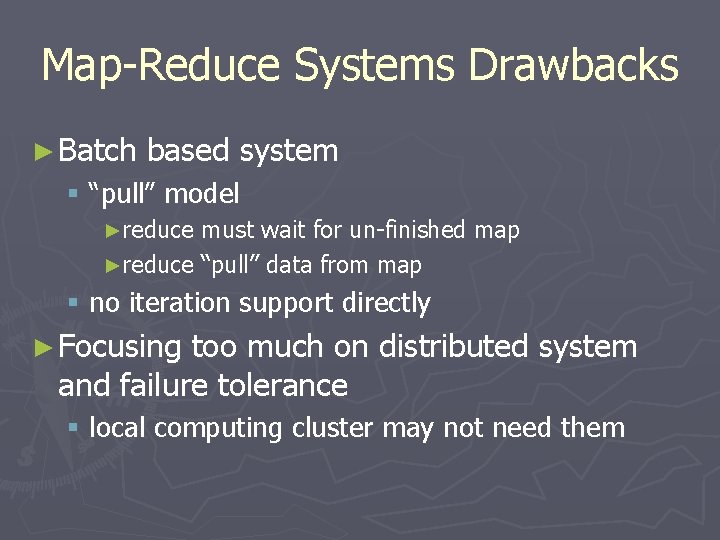
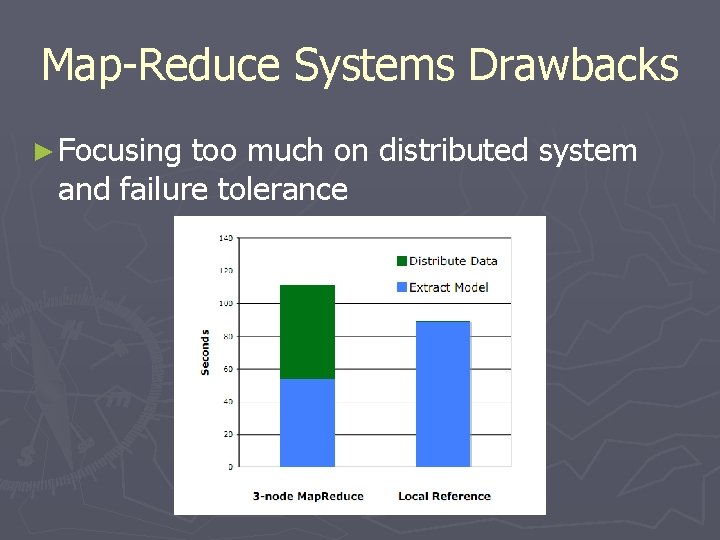
Map-Reduce Systems Drawbacks ► Batch based system § “pull” model ►reduce must wait for un-finished map ►reduce “pull” data from map § no iteration support directly ► Focusing too much on distributed system and failure tolerance § local computing cluster may not need them
Map-Reduce Systems Drawbacks ► Focusing too much on distributed system and failure tolerance
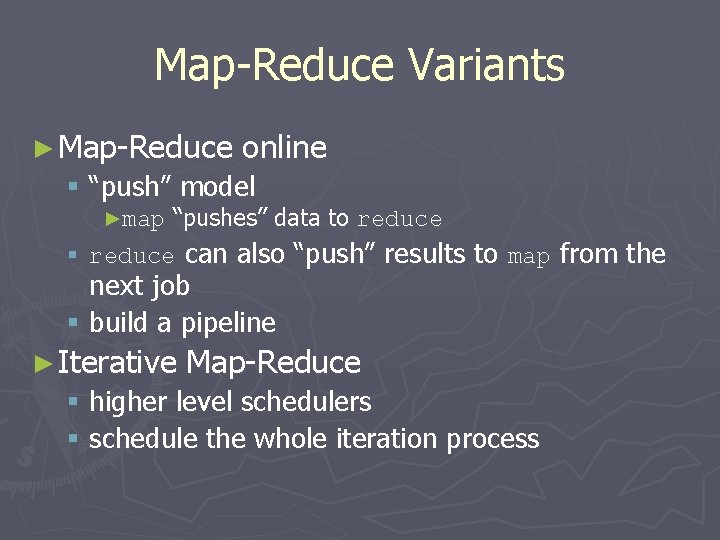
Map-Reduce Variants ► Map-Reduce online § “push” model “pushes” data to reduce § reduce can also “push” results to map from the ►map next job § build a pipeline ► Iterative Map-Reduce § higher level schedulers § schedule the whole iteration process
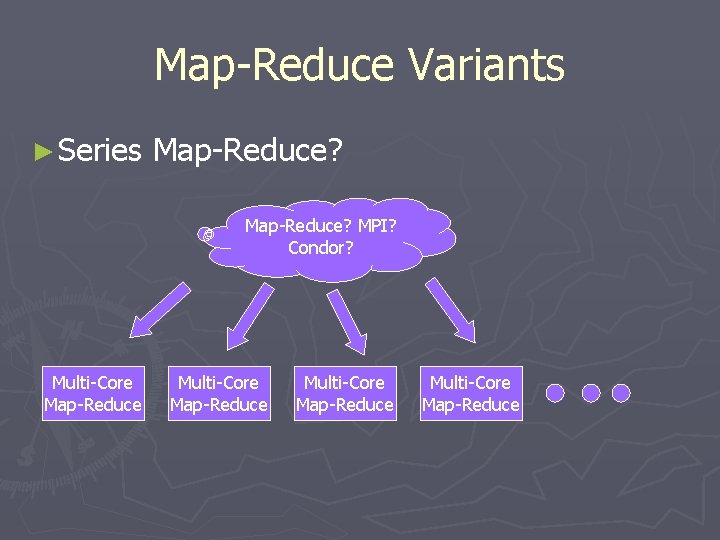
Map-Reduce Variants ► Series Map-Reduce? MPI? Condor? Multi-Core Map-Reduce
Conclusions ► Good parallelization framework § Schedule jobs automatically § Failure tolerance § Distributed computing supported § High level abstraction ►easy ► Too to port algorithms on it “industry” § why we need a large distributed system? § why we need too much data safety?
References [1] Map-Reduce for Machine Learning on Multicore [2] A Map Reduce Framework for Programming Graphics Processors [3] Mapreduce Distributed Computing for Machine Learning [4] Evaluating mapreduce for multi-core and multiprocessor systems [5] Phoenix Rebirth: Scalable Map. Reduce on a Large-Scale Shared-Memory System [6] Phoenix++: Modular Map. Reduce for Shared-Memory Systems [7] Web-scale computer vision using Map. Reduce for multimedia data mining [8] Map. Reduce indexing strategies: Studying scalability and efficiency [9] Batch Text Similarity Search with Map. Reduce [10] Twister: A Runtime for Iterative Map. Reduce [11] Map. Reduce Online [12] Fast Training of Support Vector Machines Using Sequential Minimal Optimization [13] Social Content Matching in Map. Reduce [14] Large-scale multimedia semantic concept modeling using robust subspace bagging and Map. Reduce [15] Parallel Spectral Clustering in Distributed Systems
Thanks Q&A