
Mapping the night sky Unit 3 2 1

- Slides: 11
Mapping the night sky Unit 3. 2. 1 • Demonstrate an understanding of the terms ‘right ascension’ and ‘declination’ • Recall the declination of Polaris (+90 degrees) and explain why Polaris appears fixed in the night sky • Demonstrate an understanding that the elevation of Polaris above the northern horizon is equal to the latitude of the observer
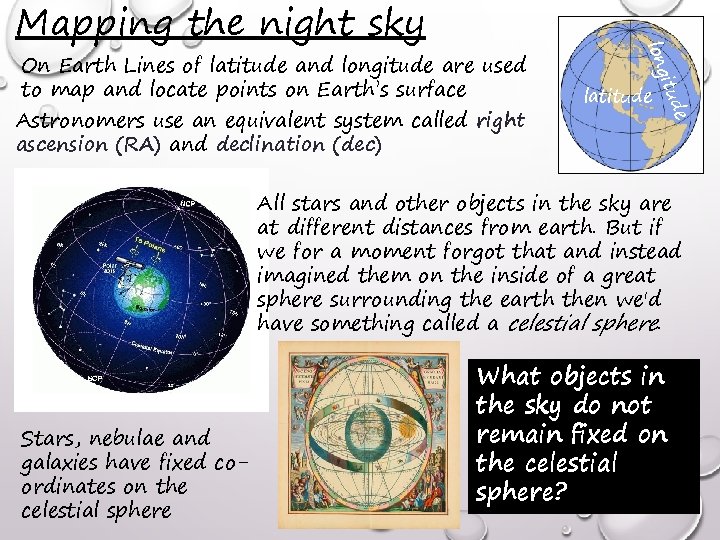
latitude de Astronomers use an equivalent system called right ascension (RA) and declination (dec) gitu On Earth Lines of latitude and longitude are used to map and locate points on Earth’s surface lon Mapping the night sky All stars and other objects in the sky are at different distances from earth. But if we for a moment forgot that and instead imagined them on the inside of a great sphere surrounding the earth then we'd have something called a celestial sphere. Stars, nebulae and galaxies have fixed coordinates on the celestial sphere What objects in the sky do not remain fixed on the celestial sphere?
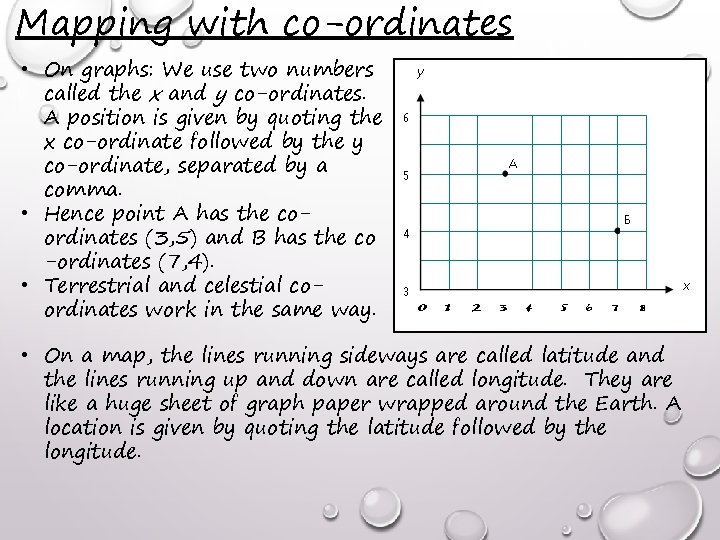
Mapping with co-ordinates • On graphs: We use two numbers called the x and y co-ordinates. A position is given by quoting the x co-ordinate followed by the y co-ordinate, separated by a comma. • Hence point A has the coordinates (3, 5) and B has the co -ordinates (7, 4). • Terrestrial and celestial coordinates work in the same way. 0 1 2 3 4 5 6 7 8 • On a map, the lines running sideways are called latitude and the lines running up and down are called longitude. They are like a huge sheet of graph paper wrapped around the Earth. A location is given by quoting the latitude followed by the longitude.
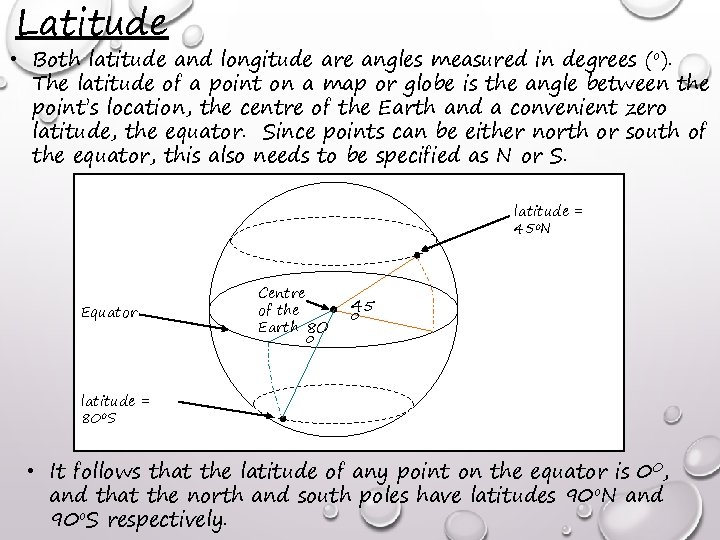
Latitude • Both latitude and longitude are angles measured in degrees (o). The latitude of a point on a map or globe is the angle between the point’s location, the centre of the Earth and a convenient zero latitude, the equator. Since points can be either north or south of the equator, this also needs to be specified as N or S. latitude = 45 o. N Equator Centre of the Earth 80 45 0 0 latitude = 80 o. S • It follows that the latitude of any point on the equator is 0 0, and that the north and south poles have latitudes 90 o. N and 90 o. S respectively.
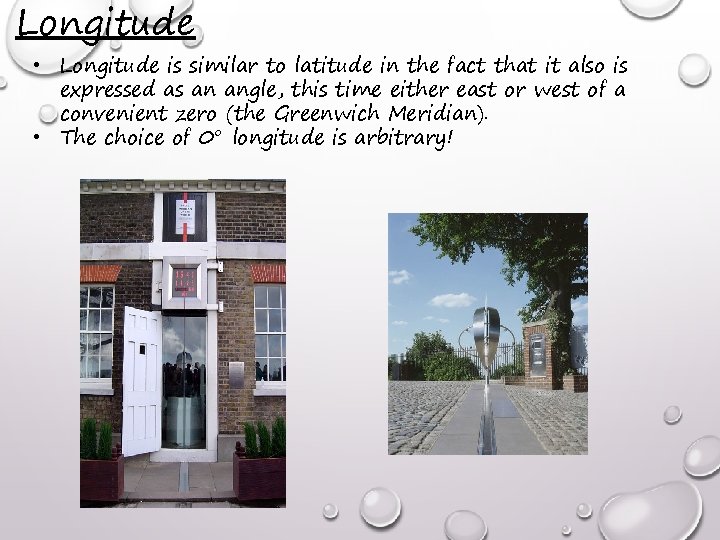
Longitude • Longitude is similar to latitude in the fact that it also is expressed as an angle, this time either east or west of a convenient zero (the Greenwich Meridian). • The choice of 0° longitude is arbitrary!
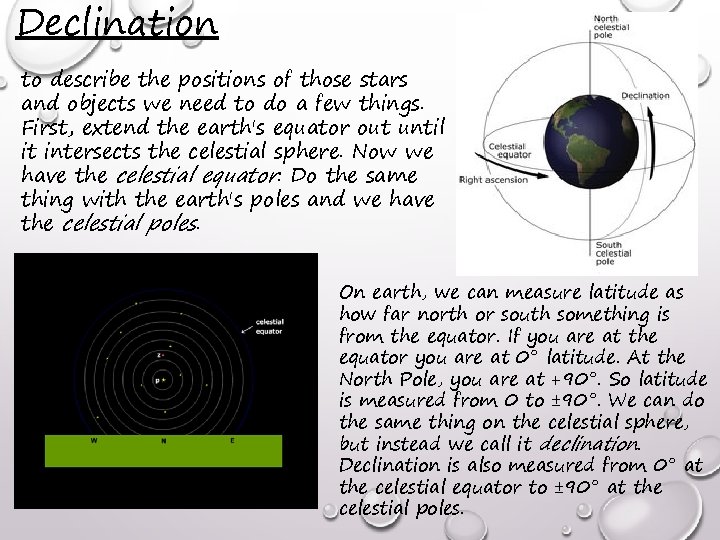
Declination to describe the positions of those stars and objects we need to do a few things. First, extend the earth's equator out until it intersects the celestial sphere. Now we have the celestial equator. Do the same thing with the earth's poles and we have the celestial poles. On earth, we can measure latitude as how far north or south something is from the equator. If you are at the equator you are at 0° latitude. At the North Pole, you are at +90°. So latitude is measured from 0 to ± 90°. We can do the same thing on the celestial sphere, but instead we call it declination. Declination is also measured from 0° at the celestial equator to ± 90° at the celestial poles.
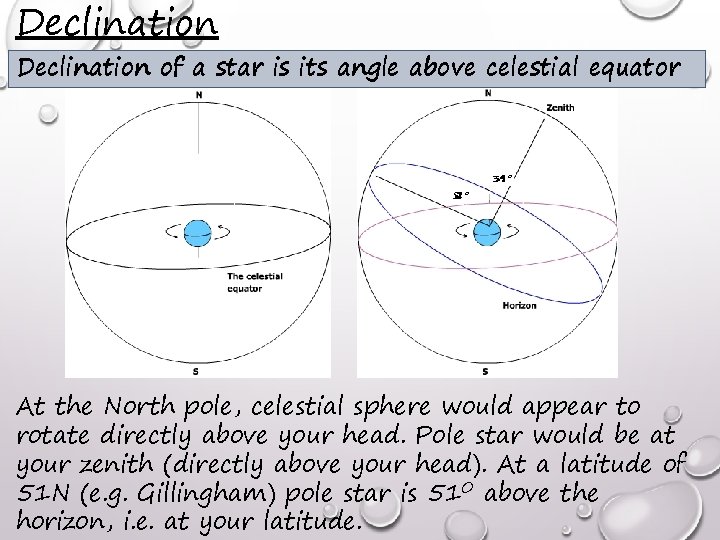
Declination of a star is its angle above celestial equator 51° 39° At the North pole, celestial sphere would appear to rotate directly above your head. Pole star would be at your zenith (directly above your head). At a latitude of 51 N (e. g. Gillingham) pole star is 510 above the horizon, i. e. at your latitude.
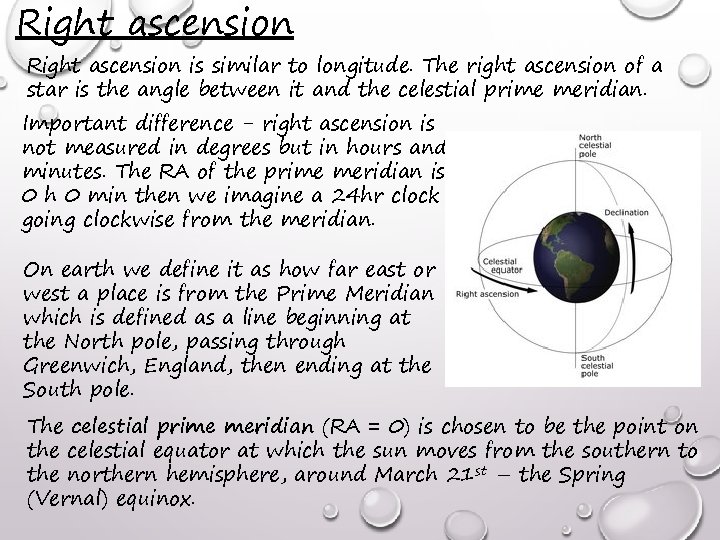
Right ascension is similar to longitude. The right ascension of a star is the angle between it and the celestial prime meridian. Important difference - right ascension is not measured in degrees but in hours and minutes. The RA of the prime meridian is 0 h 0 min then we imagine a 24 hr clock going clockwise from the meridian. On earth we define it as how far east or west a place is from the Prime Meridian which is defined as a line beginning at the North pole, passing through Greenwich, England, then ending at the South pole. The celestial prime meridian (RA = 0) is chosen to be the point on the celestial equator at which the sun moves from the southern to the northern hemisphere, around March 21 st – the Spring (Vernal) equinox.
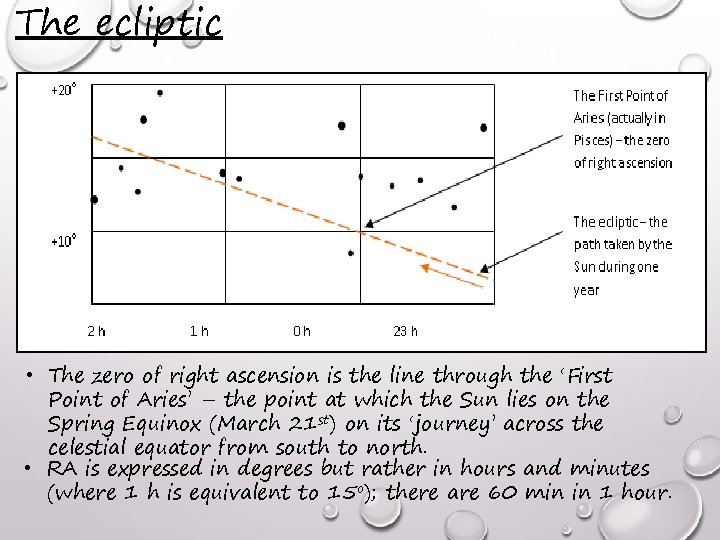
The ecliptic • The zero of right ascension is the line through the ‘First Point of Aries’ – the point at which the Sun lies on the Spring Equinox (March 21 st) on its ‘journey’ across the celestial equator from south to north. • RA is expressed in degrees but rather in hours and minutes (where 1 h is equivalent to 15 o); there are 60 min in 1 hour.
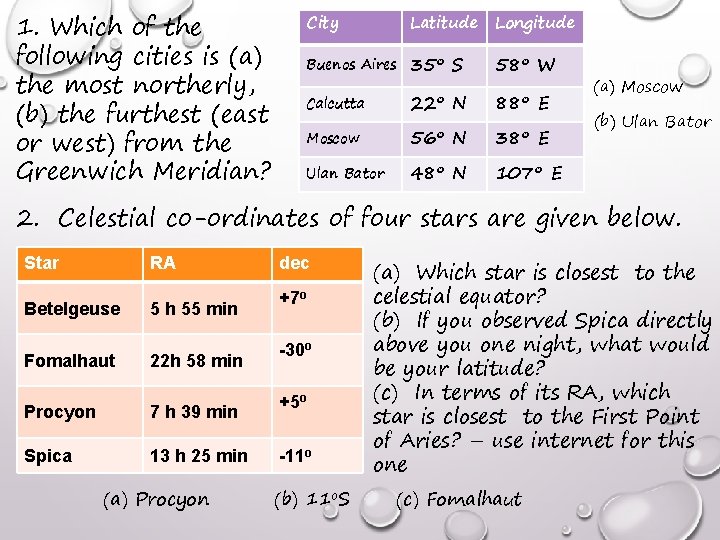
1. Which of the following cities is (a) the most northerly, (b) the furthest (east or west) from the Greenwich Meridian? City Latitude Longitude Buenos Aires 35° S 58° W Calcutta 22° N 88° E Moscow 56° N 38° E Ulan Bator 48° N 107° E (a) Moscow (b) Ulan Bator 2. Celestial co-ordinates of four stars are given below. Star RA Betelgeuse Fomalhaut 5 h 55 min 22 h 58 min Procyon 7 h 39 min Spica 13 h 25 min (a) Procyon dec +7 o -30 o +5 o -11 o (b) 11 o. S (a) Which star is closest to the celestial equator? (b) If you observed Spica directly above you one night, what would be your latitude? (c) In terms of its RA, which star is closest to the First Point of Aries? – use internet for this one (c) Fomalhaut
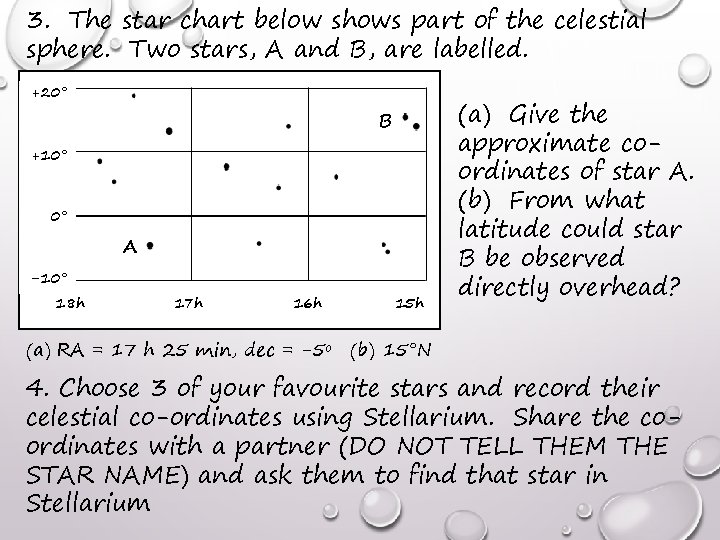
3. The star chart below shows part of the celestial sphere. Two stars, A and B, are labelled. +20° B +10° 0° A -10° 18 h 17 h 16 h (a) RA = 17 h 25 min, dec = -5 o 15 h (a) Give the approximate coordinates of star A. (b) From what latitude could star B be observed directly overhead? (b) 15°N 4. Choose 3 of your favourite stars and record their celestial co-ordinates using Stellarium. Share the coordinates with a partner (DO NOT TELL THEM THE STAR NAME) and ask them to find that star in Stellarium