
Mapping the connectivity of deep brain structures in
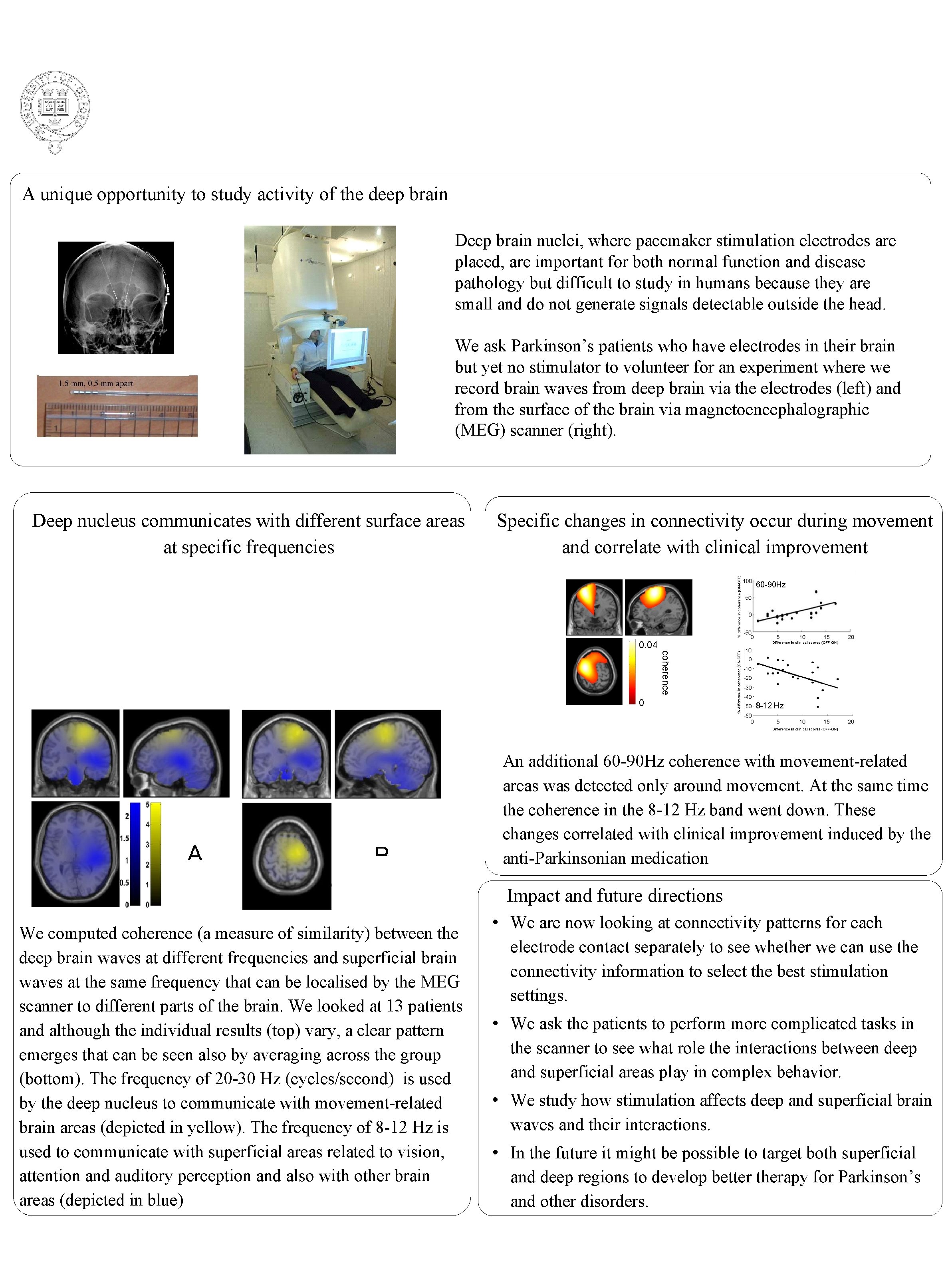
Mapping the connectivity of deep brain structures in patients The Wellcome Trust Centre for Neuroimaging, UCL Institute of Neurology, London, UK Nuffield Department of Clinical Neurology, University of Oxford, UK A unique opportunity to study activity of the deep brain Deep brain nuclei, where pacemaker stimulation electrodes are placed, are important for both normal function and disease pathology but difficult to study in humans because they are small and do not generate signals detectable outside the head. We ask Parkinson’s patients who have electrodes in their brain but yet no stimulator to volunteer for an experiment where we record brain waves from deep brain via the electrodes (left) and from the surface of the brain via magnetoencephalographic (MEG) scanner (right). Deep nucleus communicates with different surface areas at specific frequencies Specific changes in connectivity occur during movement and correlate with clinical improvement 60 -90 Hz 0. 04 coherence 0 8 -12 Hz An additional 60 -90 Hz coherence with movement-related areas was detected only around movement. At the same time the coherence in the 8 -12 Hz band went down. These changes correlated with clinical improvement induced by the anti-Parkinsonian medication Impact and future directions We computed coherence (a measure of similarity) between the deep brain waves at different frequencies and superficial brain waves at the same frequency that can be localised by the MEG scanner to different parts of the brain. We looked at 13 patients and although the individual results (top) vary, a clear pattern emerges that can be seen also by averaging across the group (bottom). The frequency of 20 -30 Hz (cycles/second) is used by the deep nucleus to communicate with movement-related brain areas (depicted in yellow). The frequency of 8 -12 Hz is used to communicate with superficial areas related to vision, attention and auditory perception and also with other brain areas (depicted in blue) • We are now looking at connectivity patterns for each electrode contact separately to see whether we can use the connectivity information to select the best stimulation settings. • We ask the patients to perform more complicated tasks in the scanner to see what role the interactions between deep and superficial areas play in complex behavior. • We study how stimulation affects deep and superficial brain waves and their interactions. • In the future it might be possible to target both superficial and deep regions to develop better therapy for Parkinson’s and other disorders. These studies were funded by the EU ((MEIF-CT-2006 038858) , Parkinson’s UK , MRC and NIHR-BRC For further details please contact Dr. Vladimir Litvak (v. litvak@ucl. ac. uk) ) or Prof. Peter Brown (peter. brown@ndcn. ox. ac. uk)
- Slides: 1