
Mapping standards for IUCN Red List assessments The
- Slides: 34
Mapping standards for IUCN Red List assessments The IUCN Red List of Threatened Species™
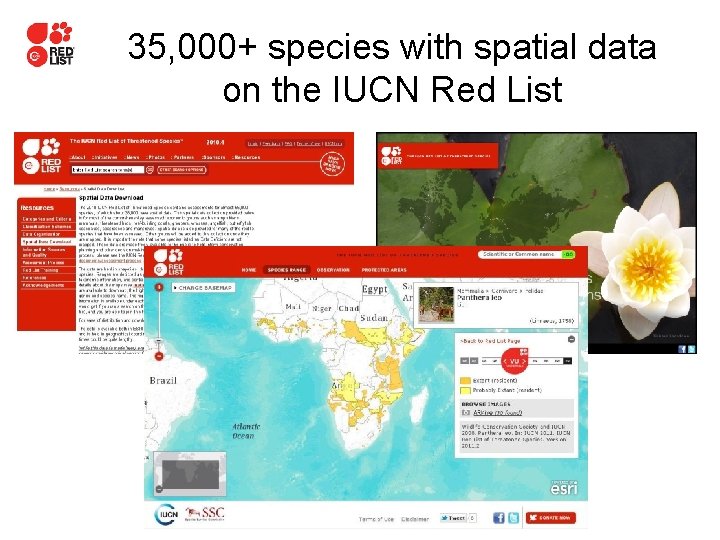
35, 000+ species with spatial data on the IUCN Red List
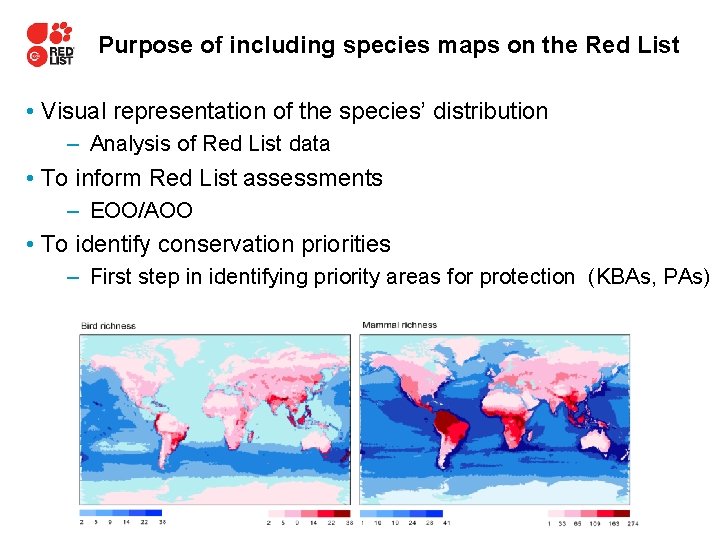
Purpose of including species maps on the Red List • Visual representation of the species’ distribution – Analysis of Red List data • To inform Red List assessments – EOO/AOO • To identify conservation priorities – First step in identifying priority areas for protection (KBAs, PAs)
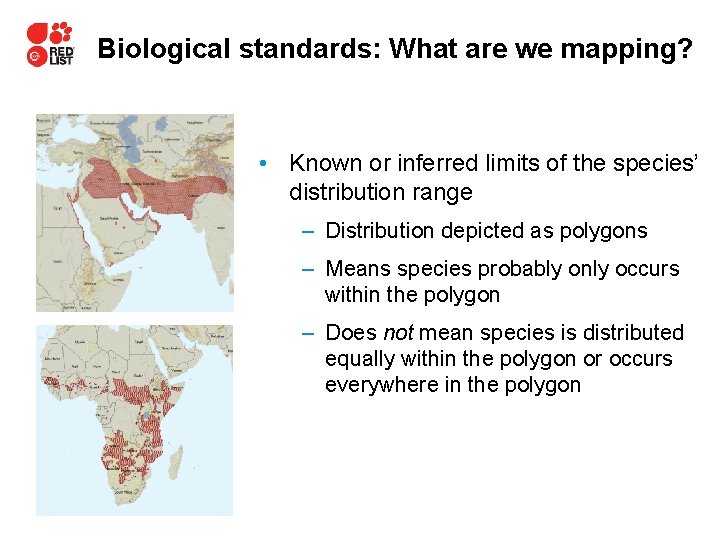
Biological standards: What are we mapping? • Known or inferred limits of the species’ distribution range – Distribution depicted as polygons – Means species probably only occurs within the polygon – Does not mean species is distributed equally within the polygon or occurs everywhere in the polygon
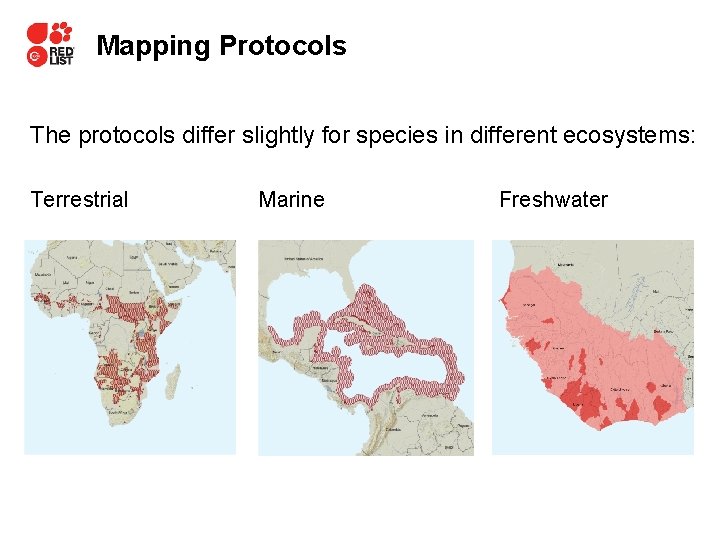
Mapping Protocols The protocols differ slightly for species in different ecosystems: Terrestrial Marine Freshwater
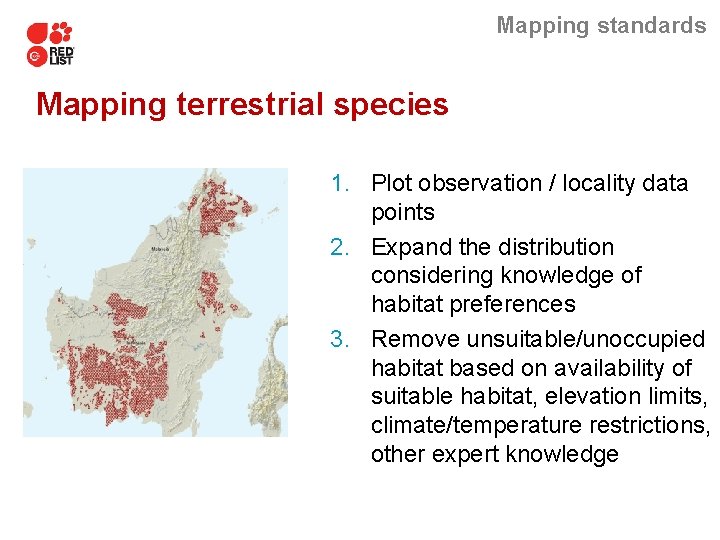
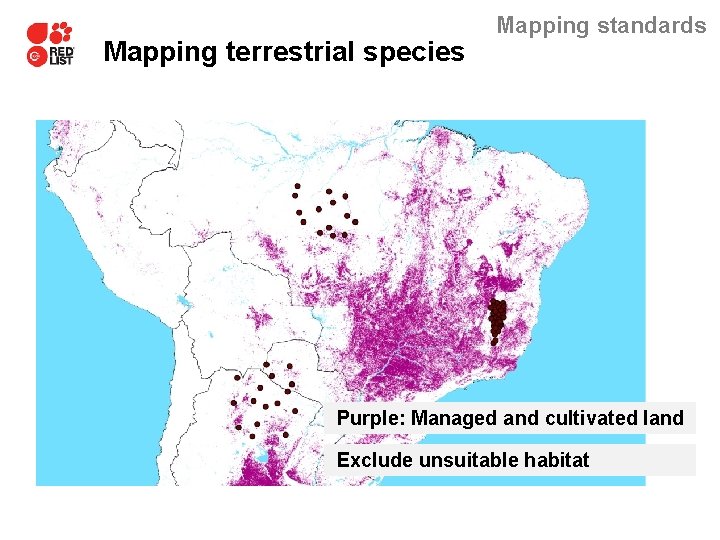
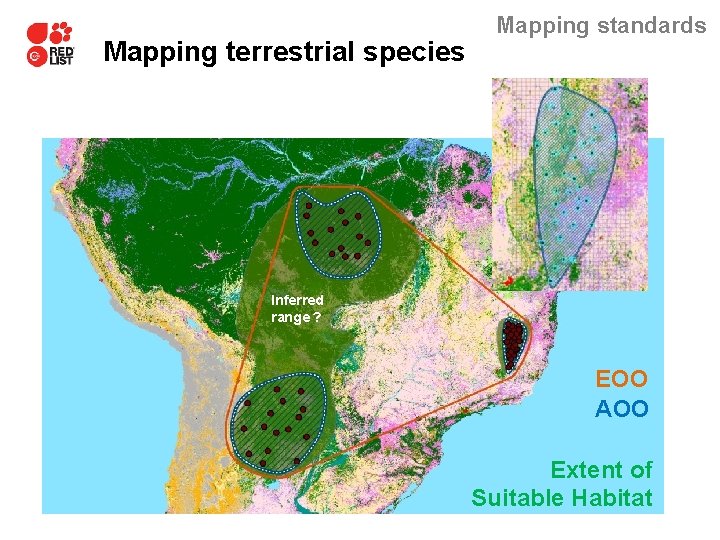
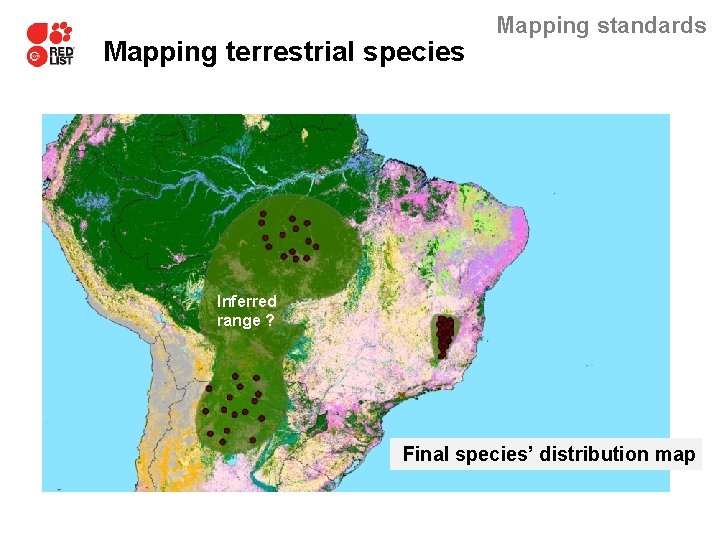
Mapping standards Mapping terrestrial species 1. Plot observation / locality data points 2. Expand the distribution considering knowledge of habitat preferences 3. Remove unsuitable/unoccupied habitat based on availability of suitable habitat, elevation limits, climate/temperature restrictions, other expert knowledge
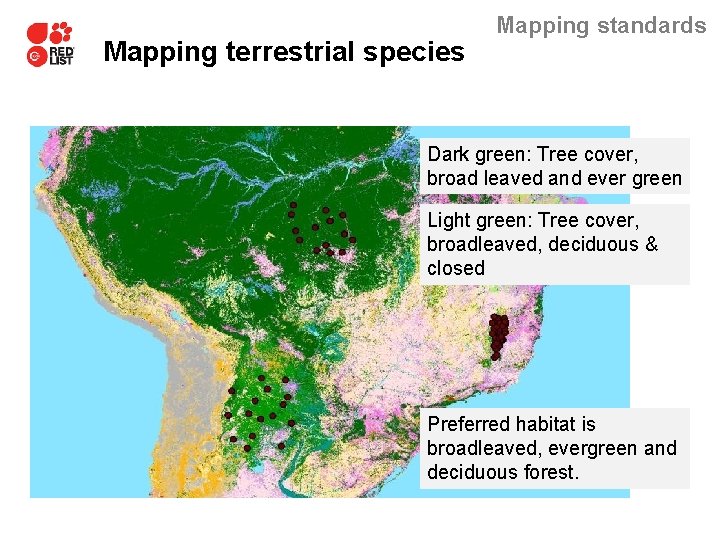
Mapping terrestrial species Mapping standards Dark green: Tree cover, broad leaved and ever green Light green: Tree cover, broadleaved, deciduous & closed Preferred habitat is broadleaved, evergreen and deciduous forest.
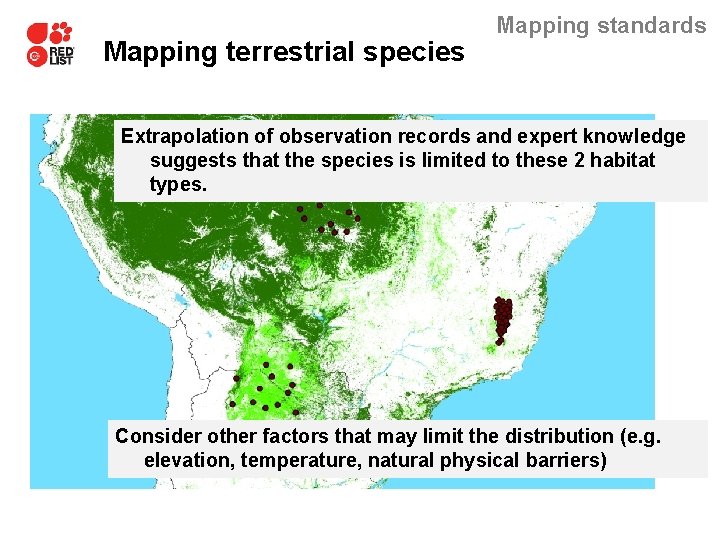
Mapping terrestrial species Mapping standards Extrapolation of observation records and expert knowledge suggests that the species is limited to these 2 habitat types. Consider other factors that may limit the distribution (e. g. elevation, temperature, natural physical barriers)
Mapping terrestrial species Mapping standards Purple: Managed and cultivated land Exclude unsuitable habitat
Mapping terrestrial species Mapping standards Inferred range ? EOO AOO Extent of Suitable Habitat
Mapping terrestrial species Mapping standards Inferred range ? Final species’ distribution map
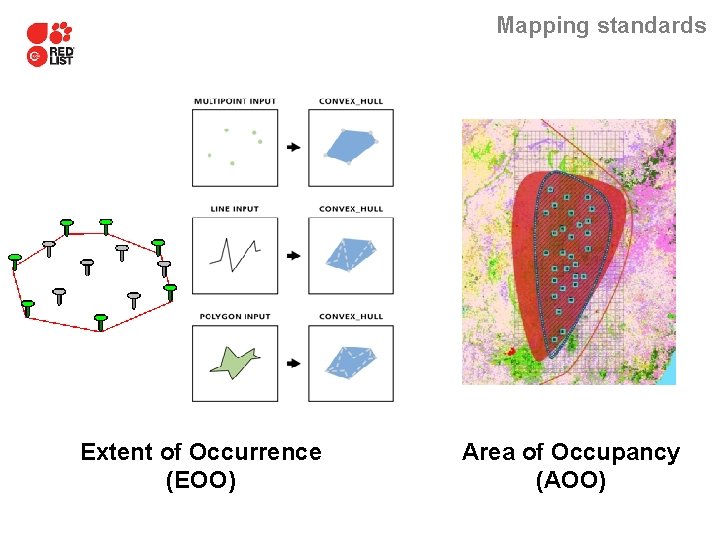
Mapping standards Extent of Occurrence (EOO) Area of Occupancy (AOO)
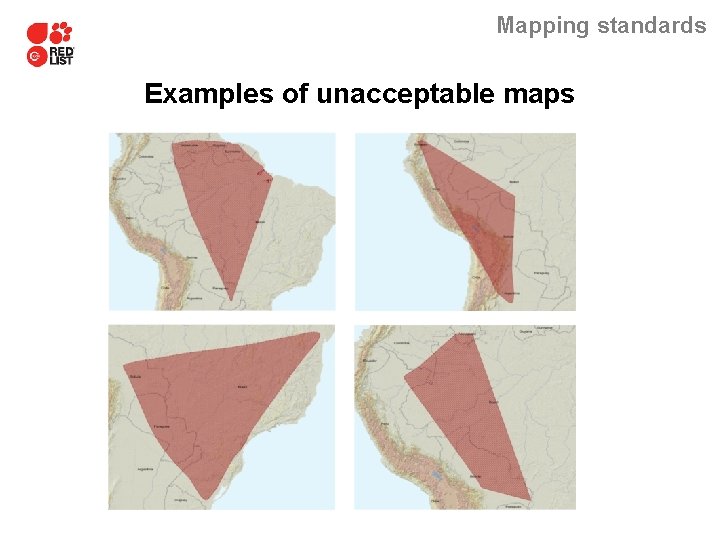
Mapping standards Examples of unacceptable maps
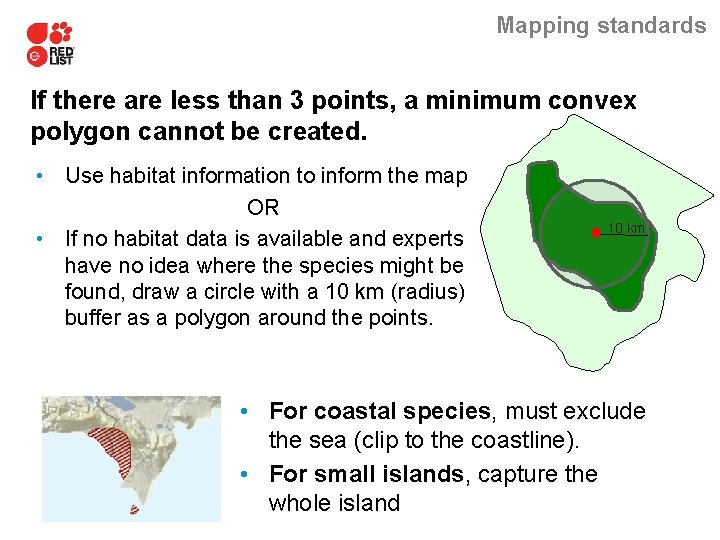
Mapping standards If there are less than 3 points, a minimum convex polygon cannot be created. • Use habitat information to inform the map OR • If no habitat data is available and experts have no idea where the species might be found, draw a circle with a 10 km (radius) buffer as a polygon around the points. 10 km • For coastal species, must exclude the sea (clip to the coastline). • For small islands, capture the whole island
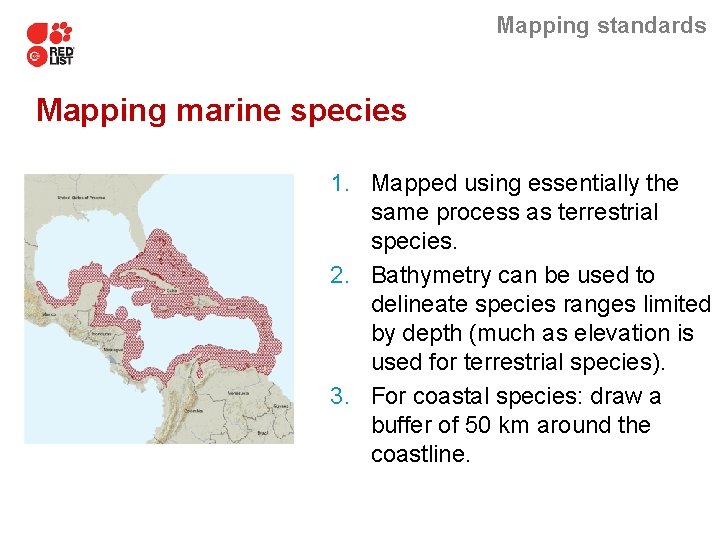
Mapping standards Mapping marine species 1. Mapped using essentially the same process as terrestrial species. 2. Bathymetry can be used to delineate species ranges limited by depth (much as elevation is used for terrestrial species). 3. For coastal species: draw a buffer of 50 km around the coastline.
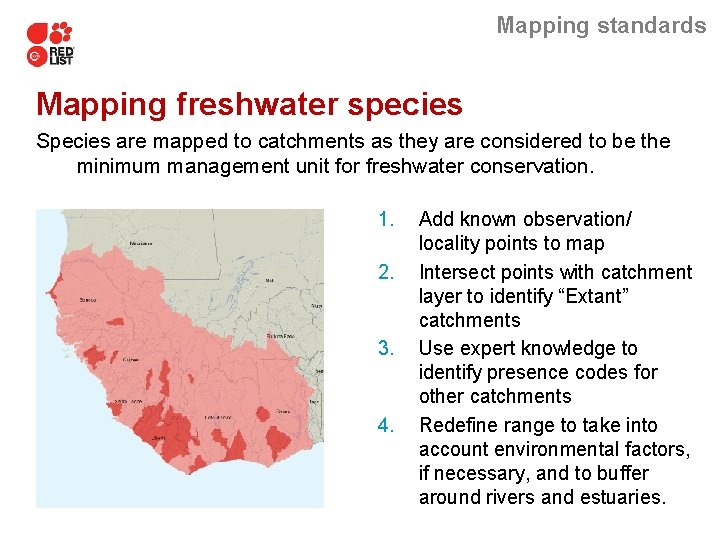
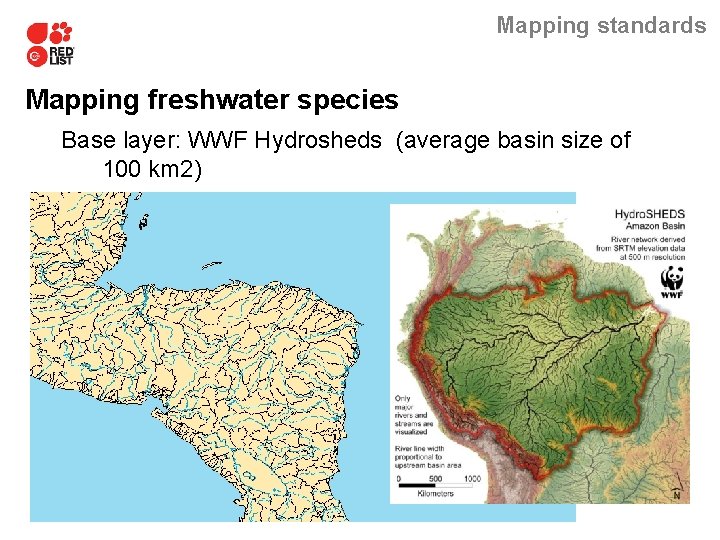
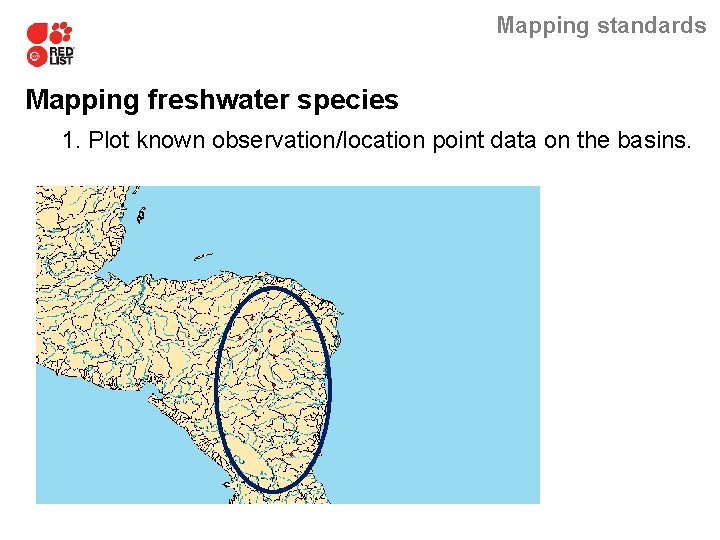
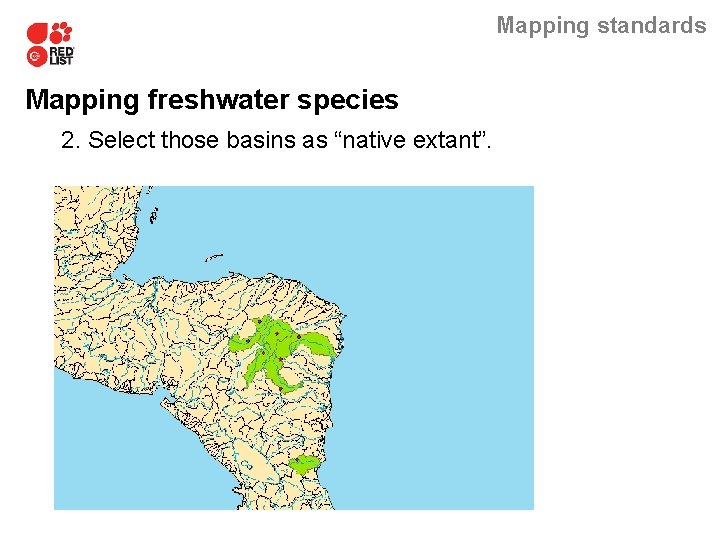
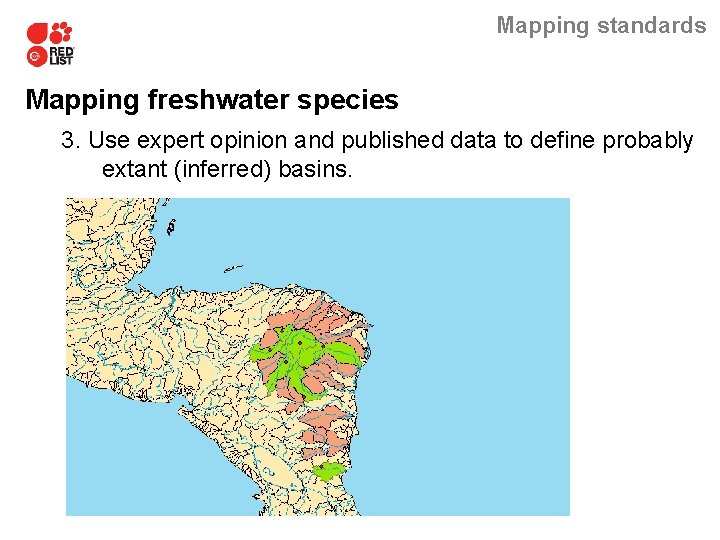
Mapping standards Mapping freshwater species Species are mapped to catchments as they are considered to be the minimum management unit for freshwater conservation. 1. 2. 3. 4. Add known observation/ locality points to map Intersect points with catchment layer to identify “Extant” catchments Use expert knowledge to identify presence codes for other catchments Redefine range to take into account environmental factors, if necessary, and to buffer around rivers and estuaries.
Mapping standards Mapping freshwater species Base layer: WWF Hydrosheds (average basin size of 100 km 2)
Mapping standards Mapping freshwater species 1. Plot known observation/location point data on the basins.
Mapping standards Mapping freshwater species 2. Select those basins as “native extant”.
Mapping standards Mapping freshwater species 3. Use expert opinion and published data to define probably extant (inferred) basins.
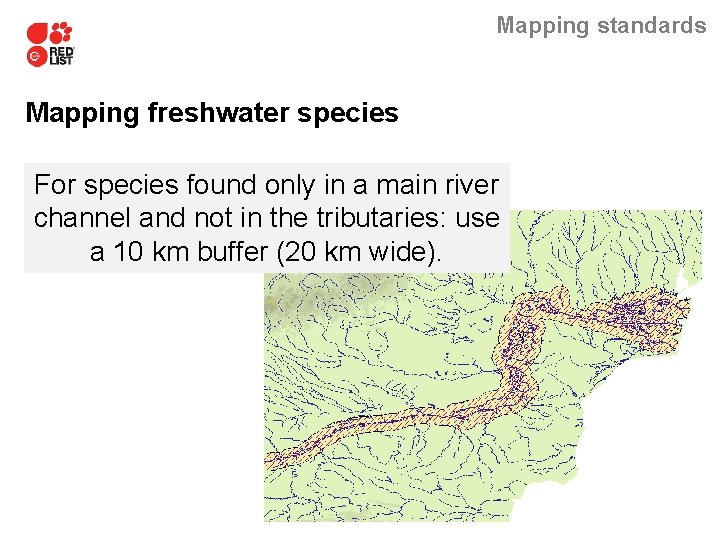
Mapping standards Mapping freshwater species For species found only in a main river channel and not in the tributaries: use a 10 km buffer (20 km wide).
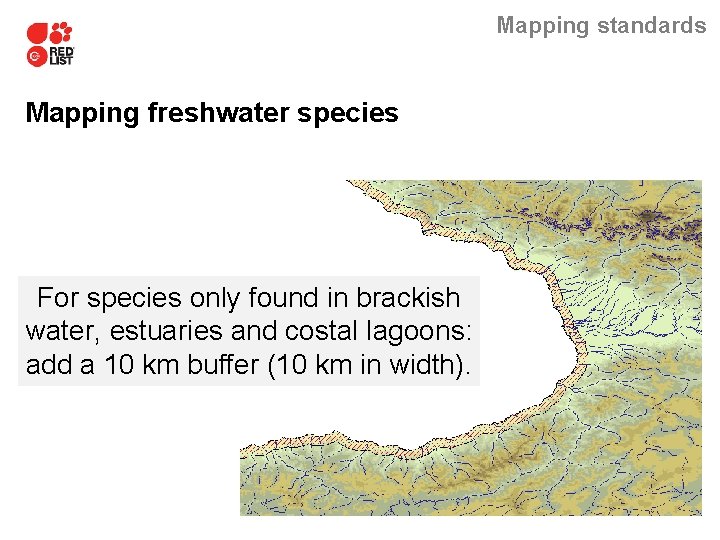
Mapping standards Mapping freshwater species For species only found in brackish water, estuaries and costal lagoons: add a 10 km buffer (10 km in width).
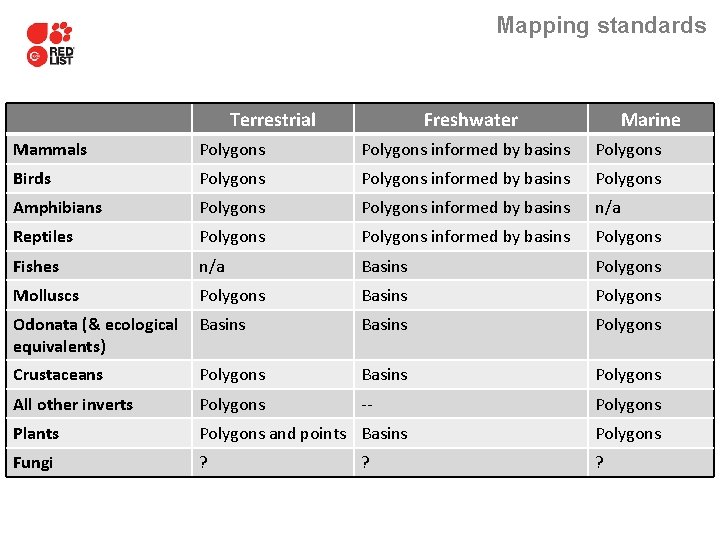
Mapping standards Terrestrial Freshwater Marine Mammals Polygons informed by basins Polygons Birds Polygons informed by basins Polygons Amphibians Polygons informed by basins n/a Reptiles Polygons informed by basins Polygons Fishes n/a Basins Polygons Molluscs Polygons Basins Polygons Odonata (& ecological equivalents) Basins Polygons Crustaceans Polygons Basins Polygons All other inverts Polygons -- Polygons Plants Polygons and points Basins Polygons Fungi ? ? ?
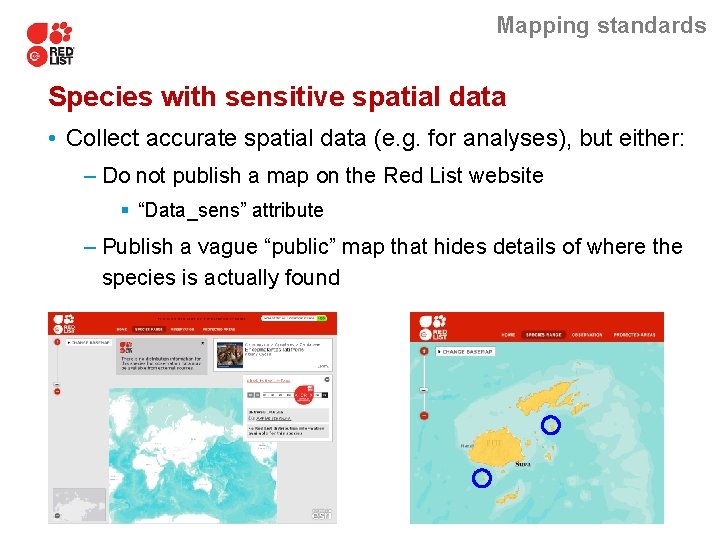
Mapping standards Species with sensitive spatial data • Collect accurate spatial data (e. g. for analyses), but either: – Do not publish a map on the Red List website § “Data_sens” attribute – Publish a vague “public” map that hides details of where the species is actually found
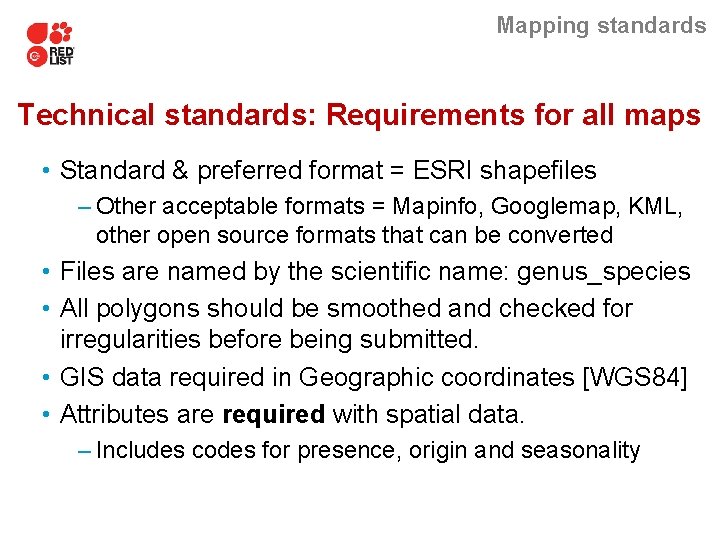
Mapping standards Technical standards: Requirements for all maps • Standard & preferred format = ESRI shapefiles – Other acceptable formats = Mapinfo, Googlemap, KML, other open source formats that can be converted • Files are named by the scientific name: genus_species • All polygons should be smoothed and checked for irregularities before being submitted. • GIS data required in Geographic coordinates [WGS 84] • Attributes are required with spatial data. – Includes codes for presence, origin and seasonality
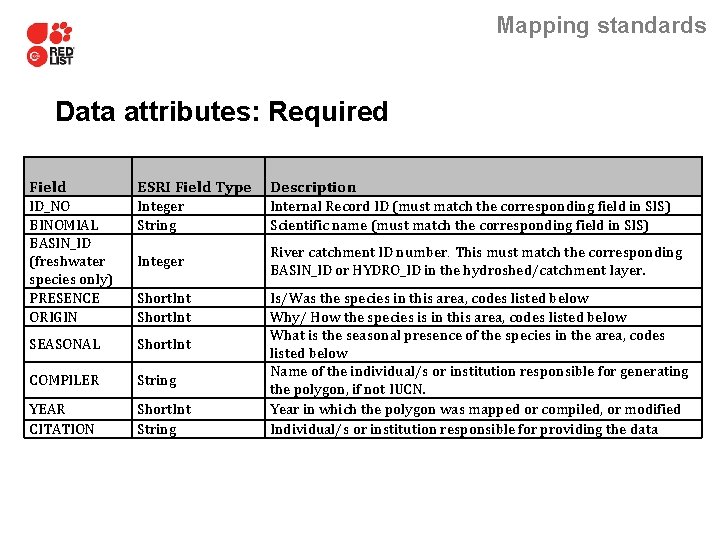
Mapping standards Data attributes: Required Field ESRI Field Type Description ID_NO BINOMIAL BASIN_ID (freshwater species only) PRESENCE ORIGIN Integer String Internal Record ID (must match the corresponding field in SIS) Scientific name (must match the corresponding field in SIS) Integer River catchment ID number. This must match the corresponding BASIN_ID or HYDRO_ID in the hydroshed/catchment layer. SEASONAL Short. Int COMPILER String YEAR CITATION Short. Int String Short. Int Is/Was the species in this area, codes listed below Why/ How the species is in this area, codes listed below What is the seasonal presence of the species in the area, codes listed below Name of the individual/s or institution responsible for generating the polygon, if not IUCN. Year in which the polygon was mapped or compiled, or modified Individual/s or institution responsible for providing the data
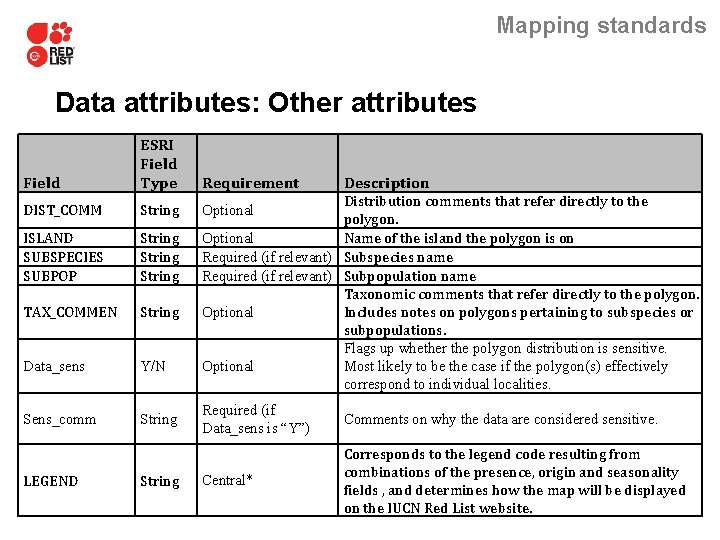
Mapping standards Data attributes: Other attributes Field ESRI Field Type Requirement DIST_COMM String Optional ISLAND SUBSPECIES SUBPOP String TAX_COMMEN String Data_sens Y/N Sens_comm String LEGEND String Description Distribution comments that refer directly to the polygon. Optional Name of the island the polygon is on Required (if relevant) Subspecies name Required (if relevant) Subpopulation name Taxonomic comments that refer directly to the polygon. Optional Includes notes on polygons pertaining to subspecies or subpopulations. Flags up whether the polygon distribution is sensitive. Optional Most likely to be the case if the polygon(s) effectively correspond to individual localities. Required (if Data_sens is “Y”) Comments on why the data are considered sensitive. Central* Corresponds to the legend code resulting from combinations of the presence, origin and seasonality fields , and determines how the map will be displayed on the IUCN Red List website.
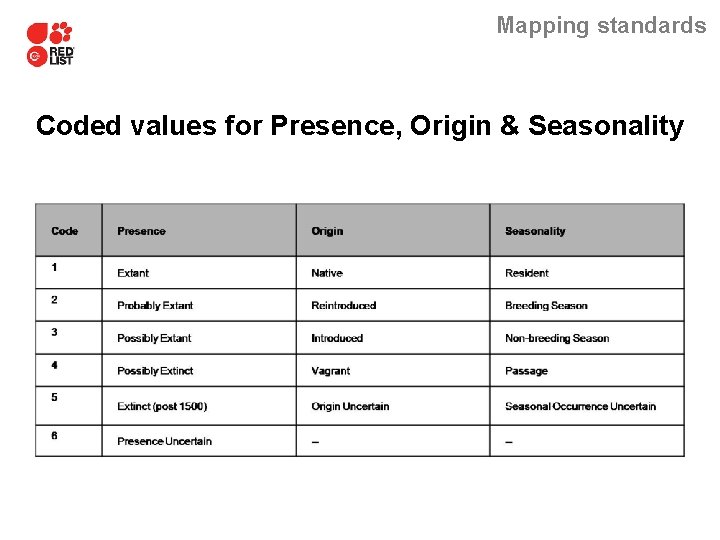
Mapping standards Coded values for Presence, Origin & Seasonality
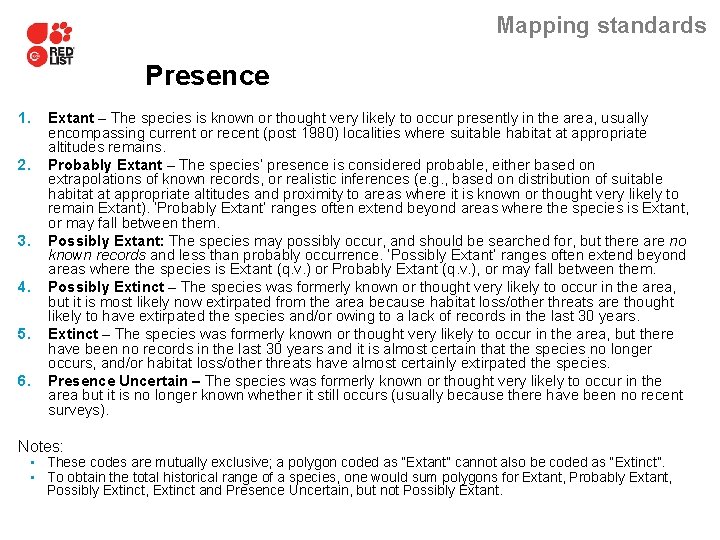
Mapping standards Presence 1. 2. 3. 4. 5. 6. Extant – The species is known or thought very likely to occur presently in the area, usually encompassing current or recent (post 1980) localities where suitable habitat at appropriate altitudes remains. Probably Extant – The species’ presence is considered probable, either based on extrapolations of known records, or realistic inferences (e. g. , based on distribution of suitable habitat at appropriate altitudes and proximity to areas where it is known or thought very likely to remain Extant). ‘Probably Extant’ ranges often extend beyond areas where the species is Extant, or may fall between them. Possibly Extant: The species may possibly occur, and should be searched for, but there are no known records and less than probably occurrence. ‘Possibly Extant’ ranges often extend beyond areas where the species is Extant (q. v. ) or Probably Extant (q. v. ), or may fall between them. Possibly Extinct – The species was formerly known or thought very likely to occur in the area, but it is most likely now extirpated from the area because habitat loss/other threats are thought likely to have extirpated the species and/or owing to a lack of records in the last 30 years. Extinct – The species was formerly known or thought very likely to occur in the area, but there have been no records in the last 30 years and it is almost certain that the species no longer occurs, and/or habitat loss/other threats have almost certainly extirpated the species. Presence Uncertain – The species was formerly known or thought very likely to occur in the area but it is no longer known whether it still occurs (usually because there have been no recent surveys). Notes: • These codes are mutually exclusive; a polygon coded as “Extant” cannot also be coded as “Extinct”. • To obtain the total historical range of a species, one would sum polygons for Extant, Probably Extant, Possibly Extinct, Extinct and Presence Uncertain, but not Possibly Extant.
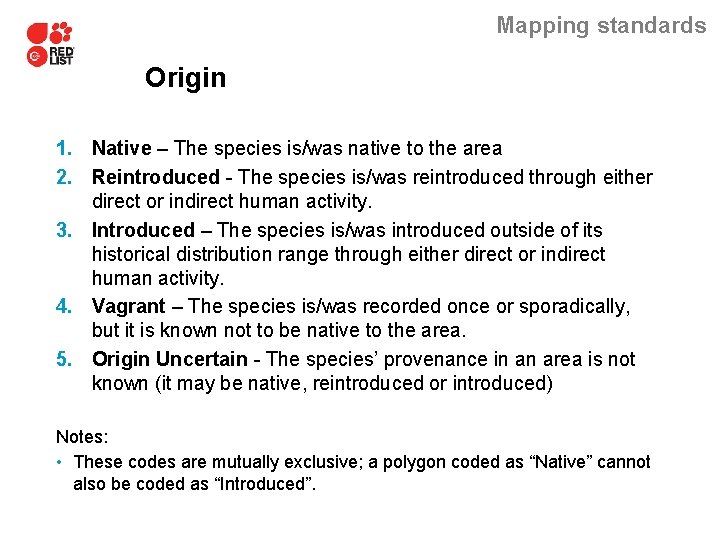
Mapping standards Origin 1. Native – The species is/was native to the area 2. Reintroduced - The species is/was reintroduced through either direct or indirect human activity. 3. Introduced – The species is/was introduced outside of its historical distribution range through either direct or indirect human activity. 4. Vagrant – The species is/was recorded once or sporadically, but it is known not to be native to the area. 5. Origin Uncertain - The species’ provenance in an area is not known (it may be native, reintroduced or introduced) Notes: • These codes are mutually exclusive; a polygon coded as “Native” cannot also be coded as “Introduced”.
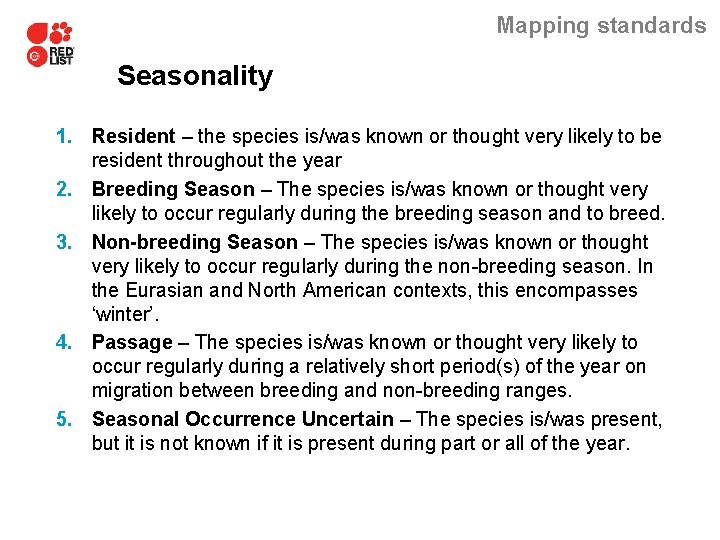
Mapping standards Seasonality 1. Resident – the species is/was known or thought very likely to be resident throughout the year 2. Breeding Season – The species is/was known or thought very likely to occur regularly during the breeding season and to breed. 3. Non-breeding Season – The species is/was known or thought very likely to occur regularly during the non-breeding season. In the Eurasian and North American contexts, this encompasses ‘winter’. 4. Passage – The species is/was known or thought very likely to occur regularly during a relatively short period(s) of the year on migration between breeding and non-breeding ranges. 5. Seasonal Occurrence Uncertain – The species is/was present, but it is not known if it is present during part or all of the year.
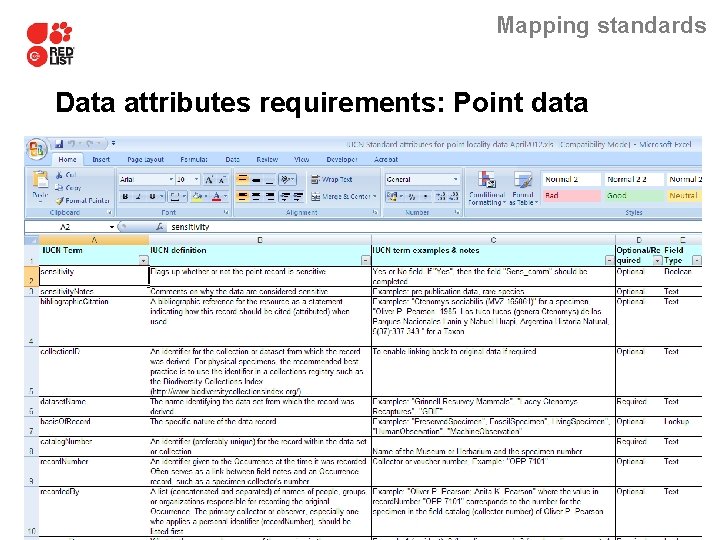
Mapping standards Data attributes requirements: Point data
Mapping standards Options for creating maps: • ESRI products (Arc. View GIS, Arc Editor, Arc. Info) – ESRI training courses (available through IUCN) – Extensions (Spatial Analyst, Geostatistical Analyst) • q. GIS • Googlemaps (create polygons in Google Earth) • Hand-drawn maps (absolute last resort!!) • Spatial data wiki: http: //speciesmapping. pbworks. com
Mapping standards Tools & resources available • Arc. GIS scripts and tools • Additional tools to help manage data and expedite map generation (X tools, ET, Hawths, Python, etc. ) • Tools specially developed to facilitate mapping in Arc. GIS – Consistency checking and validating data – Many different scripts and extensions (e. g. customized extension which creates empty file with req fields; consistency checks to ensure no req fields are empty) • Spatial data wiki: http: //speciesmapping. pbworks. com – Basedata, WGS 84, etc.