
Mapping Program Learning Outcomes to Curriculum Presentation to






- Slides: 15
Mapping Program Learning Outcomes to Curriculum Presentation to State Assessment Meeting June 21, 2013 Andrew Ray Program Chair – BCT, CSET & DDT
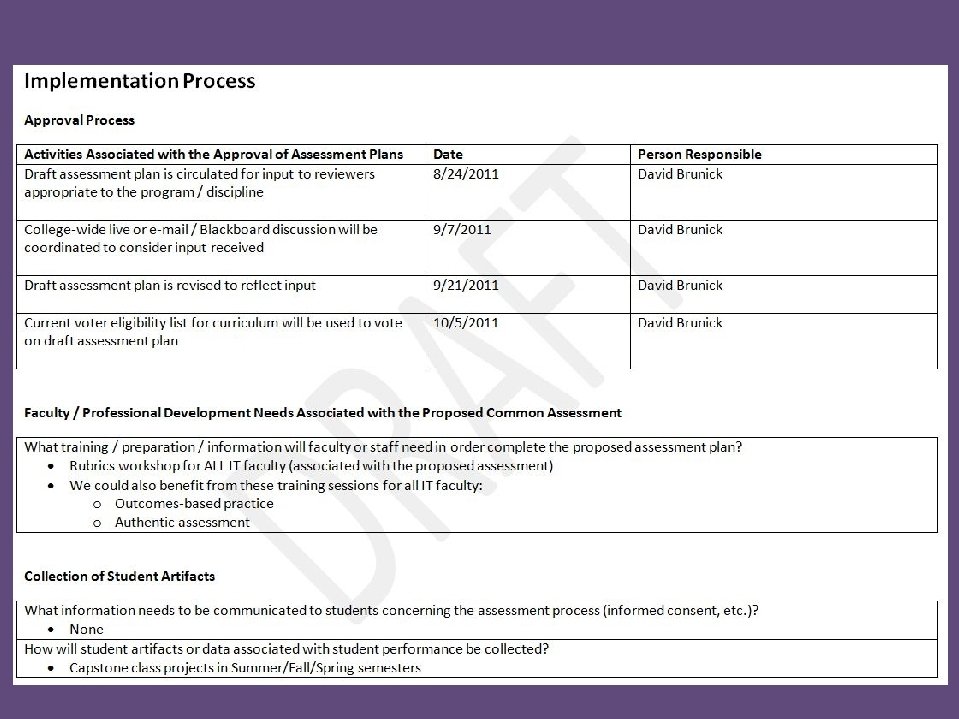
Why does this matter? • Institutional Effectiveness is part of Valencia’s Faculty Compensation Plan • Assessment Plans approved Oct. 2011 • Learning artifacts evaluated during Assessment Day May 2012 • Assessment methods revised and reevaluated during Assessment Day May 2013
How are your Program Learning Outcomes? • We got through it… • Developed college-wide Gen. Ed. outcomes • Each program identified specific outcomes • Mapping of outcomes over curriculum
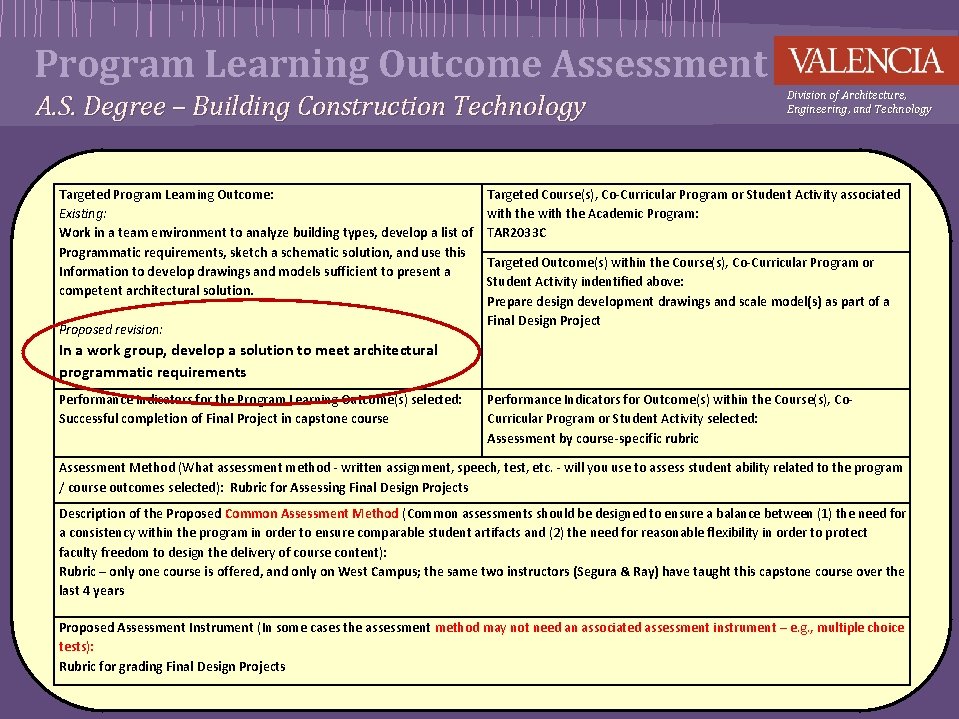
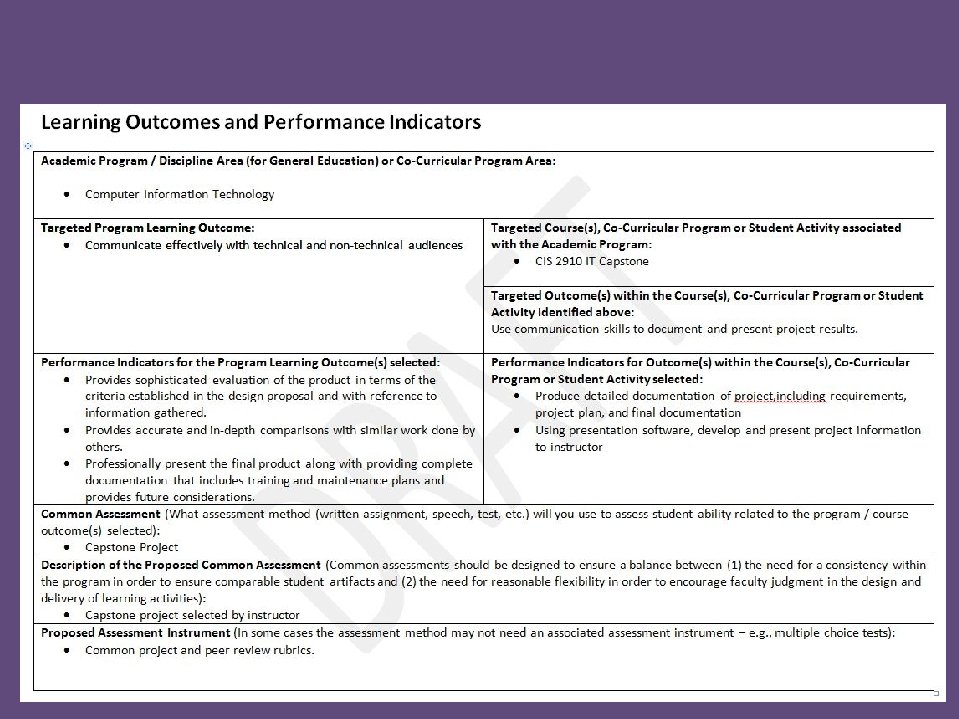
Program Learning Outcome Assessment A. S. Degree – Building Construction Technology Targeted Program Learning Outcome: Existing: Work in a team environment to analyze building types, develop a list of Programmatic requirements, sketch a schematic solution, and use this Information to develop drawings and models sufficient to present a competent architectural solution. Proposed revision: Division of Architecture, Engineering, and Technology Targeted Course(s), Co-Curricular Program or Student Activity associated with the Academic Program: TAR 2033 C Targeted Outcome(s) within the Course(s), Co-Curricular Program or Student Activity indentified above: Prepare design development drawings and scale model(s) as part of a Final Design Project In a work group, develop a solution to meet architectural programmatic requirements Performance Indicators for the Program Learning Outcome(s) selected: Successful completion of Final Project in capstone course Performance Indicators for Outcome(s) within the Course(s), Co. Curricular Program or Student Activity selected: Assessment by course-specific rubric Assessment Method (What assessment method - written assignment, speech, test, etc. - will you use to assess student ability related to the program / course outcomes selected): Rubric for Assessing Final Design Projects Description of the Proposed Common Assessment Method (Common assessments should be designed to ensure a balance between (1) the need for a consistency within the program in order to ensure comparable student artifacts and (2) the need for reasonable flexibility in order to protect faculty freedom to design the delivery of course content): Rubric – only one course is offered, and only on West Campus; the same two instructors (Segura & Ray) have taught this capstone course over the last 4 years Proposed Assessment Instrument (In some cases the assessment method may not need an associated assessment instrument – e. g. , multiple choice tests): Rubric for grading Final Design Projects
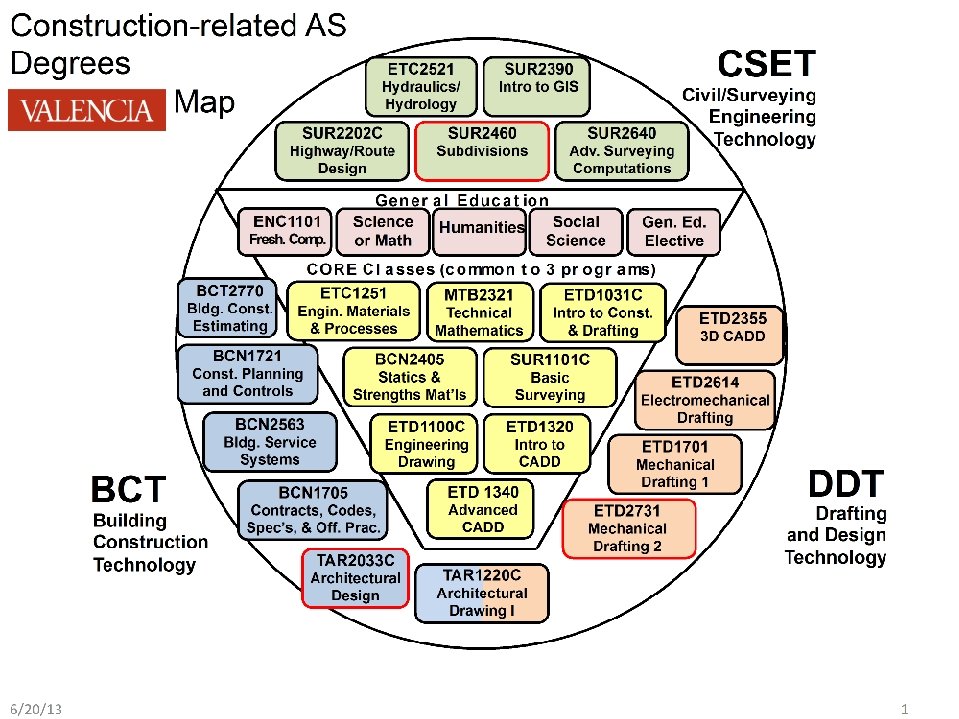
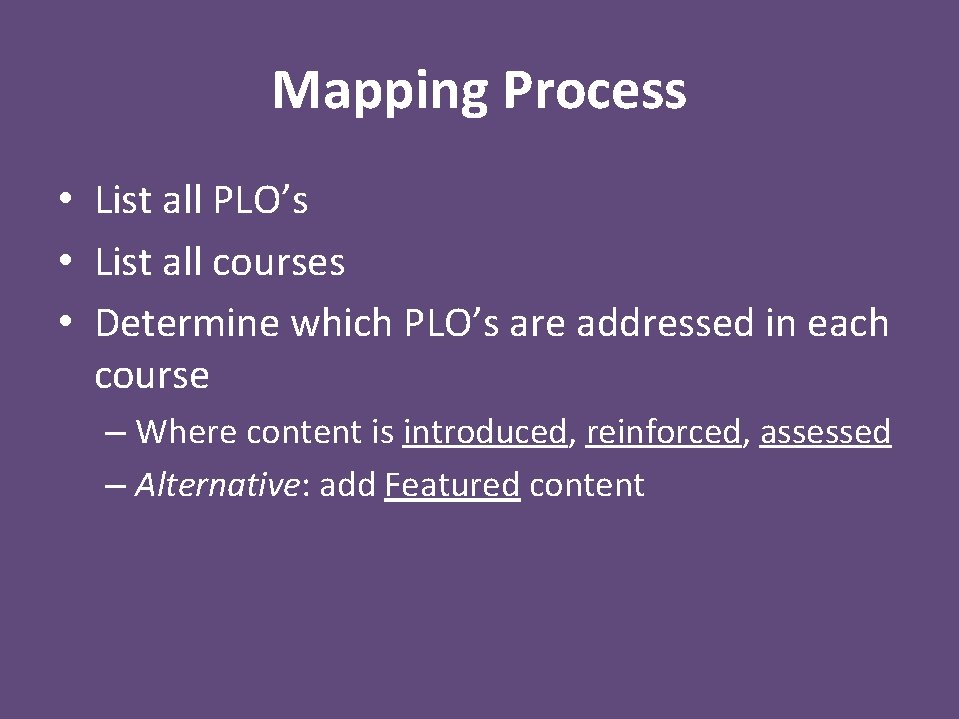
Mapping Process • List all PLO’s • List all courses • Determine which PLO’s are addressed in each course – Where content is introduced, reinforced, assessed – Alternative: add Featured content
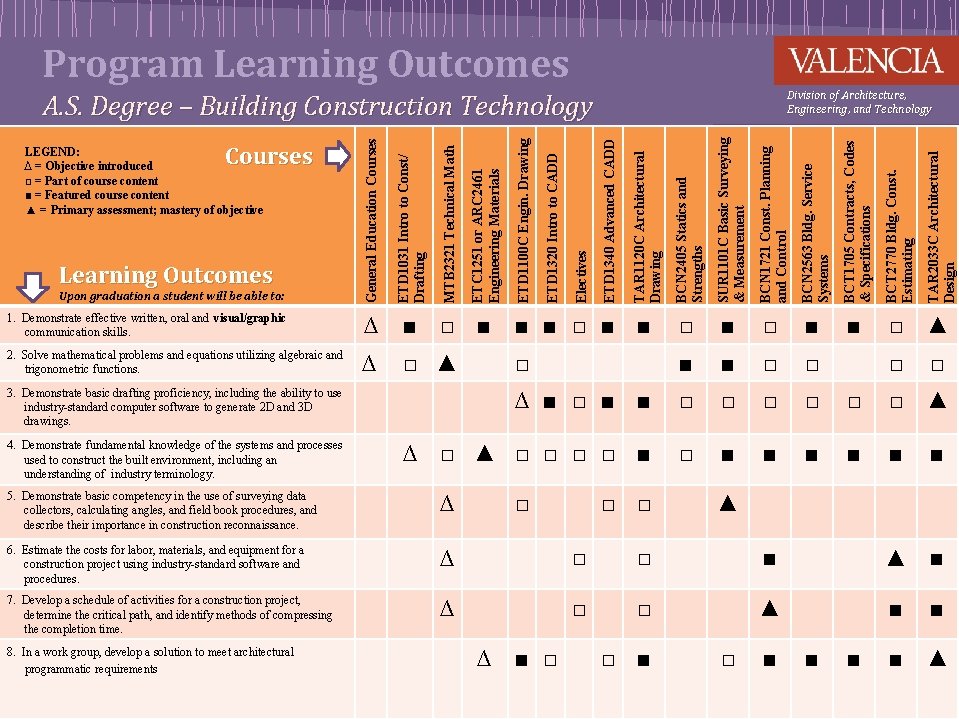
Program Learning Outcomes Division of Architecture, Engineering, and Technology BCN 1721 Const. Planning and Control BCN 2563 Bldg. Service Systems BCT 1705 Contracts, Codes & Specifications ∆ □ ▲ □ ■ ■ □ □ 3. Demonstrate basic drafting proficiency, including the ability to use industry-standard computer software to generate 2 D and 3 D drawings. ∆ ■ □ ■ ■ □ □ □ ▲ 4. Demonstrate fundamental knowledge of the systems and processes used to construct the built environment, including an understanding of industry terminology. ∆ □ ▲ □ □ ■ □ ■ ■ ■ TAR 2033 C Architectural Design SUR 1101 C Basic Surveying & Measurement 2. Solve mathematical problems and equations utilizing algebraic and trigonometric functions. BCT 2770 Bldg. Const. Estimating BCN 2405 Statics and Strengths ■ TAR 1120 C Architectural Drawing ■ ETD 1340 Advanced CADD □ Electives ■ ETD 1320 Intro to CADD □ ETD 1100 C Engin. Drawing ■ □ ■ ■ ETC 1251 or ARC 2461 Engineering Materials ∆ Learning Outcomes MTB 2321 Technical Math 1. Demonstrate effective written, oral and visual/graphic communication skills. Courses LEGEND: ∆ = Objective introduced □ = Part of course content ■ = Featured course content ▲ = Primary assessment; mastery of objective ETD 1031 Intro to Const/ Drafting Upon graduation a student will be able to: General Education Courses A. S. Degree – Building Construction Technology □ ▲ □ □ ■ 5. Demonstrate basic competency in the use of surveying data collectors, calculating angles, and field book procedures, and describe their importance in construction reconnaissance. ∆ 6. Estimate the costs for labor, materials, and equipment for a construction project using industry-standard software and procedures. ∆ □ □ ■ ▲ ■ 7. Develop a schedule of activities for a construction project, determine the critical path, and identify methods of compressing the completion time. ∆ □ □ ▲ ■ 8. In a work group, develop a solution to meet architectural programmatic requirements □ ∆ ■ □ □ ■ ▲ □ ■ ■ ■ ▲
“Hands-on” Activity! Pick ONE Program Learning Outcome and map it across the courses in your curriculum ALTERNATE: Pick ONE Gen Ed PLO and map it across the general education curriculum
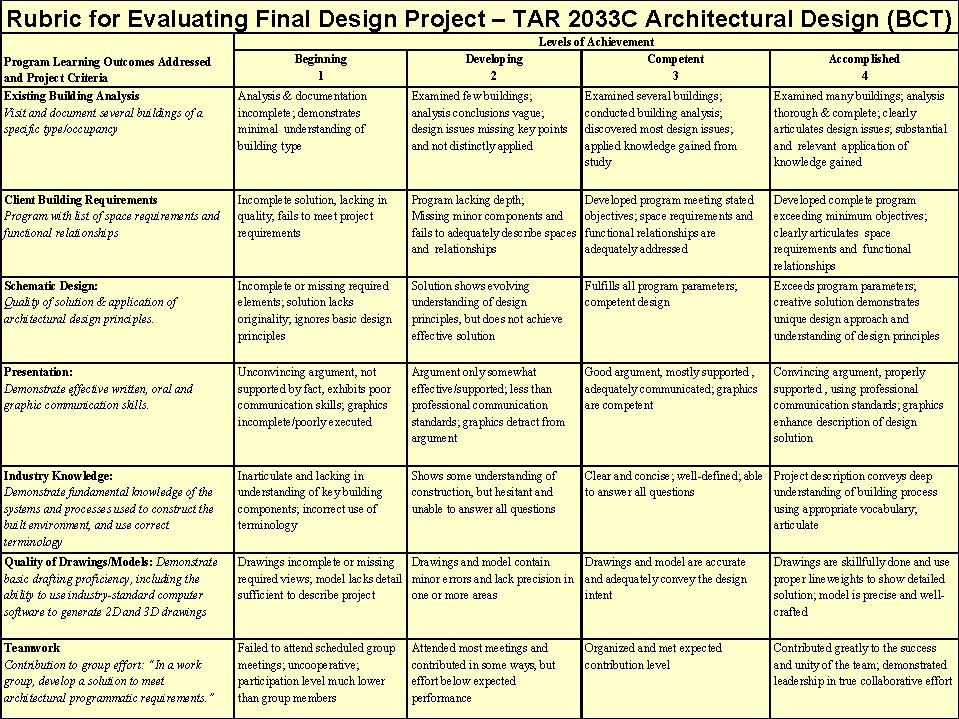
What is a good Rubric? • Clear, concise, specific description of student performance levels; preferably ONE page • Must address stated Learning Outcomes • Apply your favorite acronym – KISS (Keep It Simple Stupid) – SPAM (Simple, Practical, Achievable, Measureable)
Rubric for Evaluating Final Design Project – TAR 2033 C Architectural Design (BCT) Program Learning Outcomes Addressed and Project Criteria Beginning 1 Developing 2 Levels of Achievement Competent 3 Accomplished 4 Existing Building Analysis Visit and document several buildings of a specific type/occupancy Analysis & documentation incomplete; demonstrates minimal understanding of building type Examined few buildings; analysis conclusions vague; design issues missing key points and not distinctly applied Examined several buildings; conducted building analysis; discovered most design issues; applied knowledge gained from study Examined many buildings; analysis thorough & complete; clearly articulates design issues; substantial and relevant application of knowledge gained Client Building Requirements Program with list of space requirements and functional relationships Incomplete solution, lacking in quality, fails to meet project requirements Program lacking depth; Missing minor components and fails to adequately describe spaces and relationships Developed program meeting stated objectives; space requirements and functional relationships are adequately addressed Developed complete program exceeding minimum objectives; clearly articulates space requirements and functional relationships Schematic Design: Quality of solution & application of architectural design principles. Incomplete or missing required elements; solution lacks originality; ignores basic design principles Solution shows evolving understanding of design principles, but does not achieve effective solution Fulfills all program parameters; competent design Exceeds program parameters; creative solution demonstrates unique design approach and understanding of design principles Presentation: Demonstrate effective written, oral and graphic communication skills. Unconvincing argument, not supported by fact, exhibits poor communication skills; graphics incomplete/poorly executed Argument only somewhat effective/supported; less than professional communication standards; graphics detract from argument Good argument, mostly supported , adequately communicated; graphics are competent Convincing argument, properly supported , using professional communication standards; graphics enhance description of design solution Industry Knowledge: Demonstrate fundamental knowledge of the systems and processes used to construct the built environment, and use correct terminology Inarticulate and lacking in understanding of key building components; incorrect use of terminology Shows some understanding of construction, but hesitant and unable to answer all questions Clear and concise; well-defined; able Project description conveys deep to answer all questions understanding of building process using appropriate vocabulary; articulate Quality of Drawings/Models: Demonstrate basic drafting proficiency, including the ability to use industry-standard computer software to generate 2 D and 3 D drawings Drawings incomplete or missing Drawings and model contain Drawings and model are accurate required views; model lacks detail minor errors and lack precision in and adequately convey the design sufficient to describe project one or more areas intent Drawings are skillfully done and use proper lineweights to show detailed solution; model is precise and wellcrafted Teamwork Contribution to group effort: “In a work group, develop a solution to meet architectural programmatic requirements. ” Failed to attend scheduled group meetings; uncooperative; participation level much lower than group members Contributed greatly to the success and unity of the team; demonstrated leadership in true collaborative effort Attended most meetings and contributed in some ways, but effort below expected performance Organized and met expected contribution level
QUESTIONS?
FIN