
Mapping Our World Latitude and Longitude Cartography Science
- Slides: 10
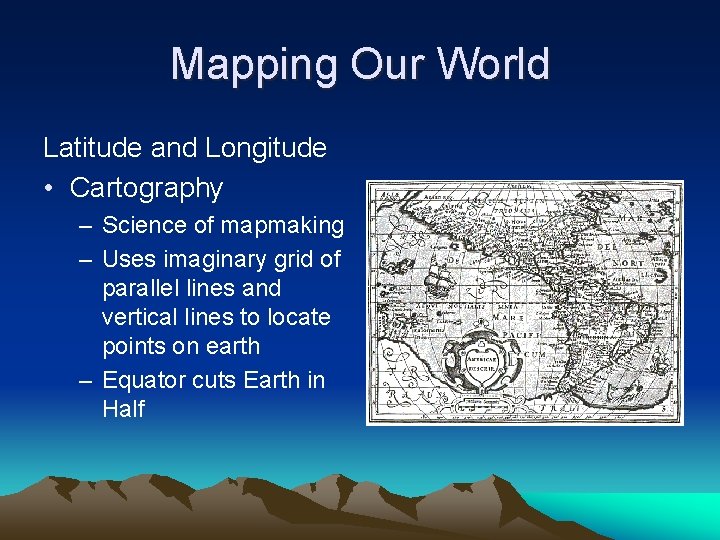
Mapping Our World Latitude and Longitude • Cartography – Science of mapmaking – Uses imaginary grid of parallel lines and vertical lines to locate points on earth – Equator cuts Earth in Half
Latitude: lines running to the equator dividing the globe vertically into degrees north and south of The equator • Each degree of latitude= 111 km on Earth’s surface • Each degree is further broken down into minutes and then seconds • Each minutes of latitude= 1. 85 km • Each second of latitude= 0. 031 km
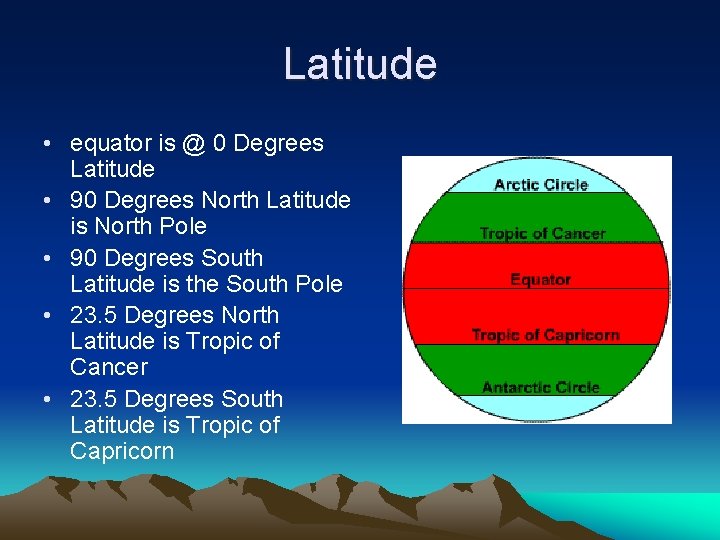
Latitude • equator is @ 0 Degrees Latitude • 90 Degrees North Latitude is North Pole • 90 Degrees South Latitude is the South Pole • 23. 5 Degrees North Latitude is Tropic of Cancer • 23. 5 Degrees South Latitude is Tropic of Capricorn
Longitude: lines used to locate positions East and West of the Prime Meridian • Each degree of longitude is 111 km at the Equator and is further broken down into minutes and seconds • Distance between lines of longitude change-largest at the equator and smallest at the poles. • Unlike lines of Latitude, lines of Longitude are not parallel but are semicircles running from pole to pole • Distance between degrees of longitude are not equal, unlike the distance between degrees of latitude; smaller distance closer to the poles. • When using coordinates to locate a specific point, degrees of latitude are given first followed by degrees of longitude
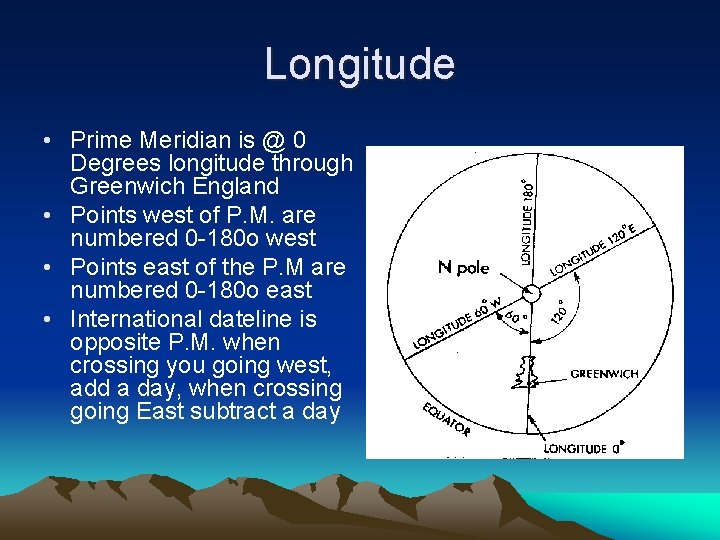
Longitude • Prime Meridian is @ 0 Degrees longitude through Greenwich England • Points west of P. M. are numbered 0 -180 o west • Points east of the P. M are numbered 0 -180 o east • International dateline is opposite P. M. when crossing you going west, add a day, when crossing going East subtract a day
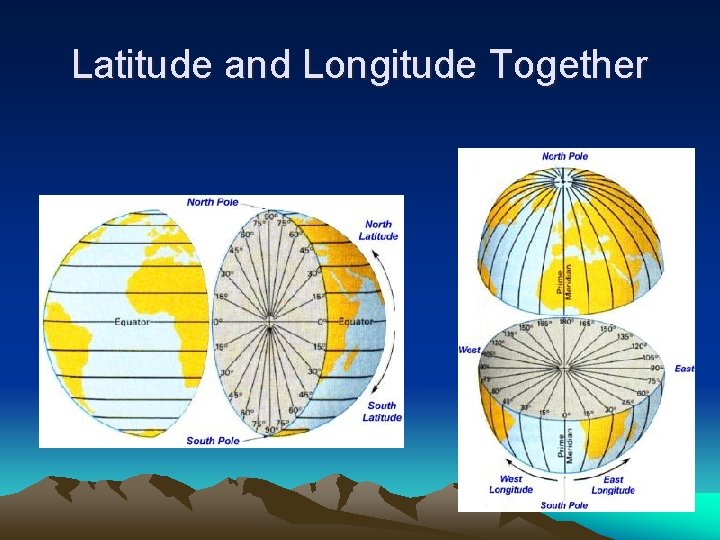
Latitude and Longitude Together
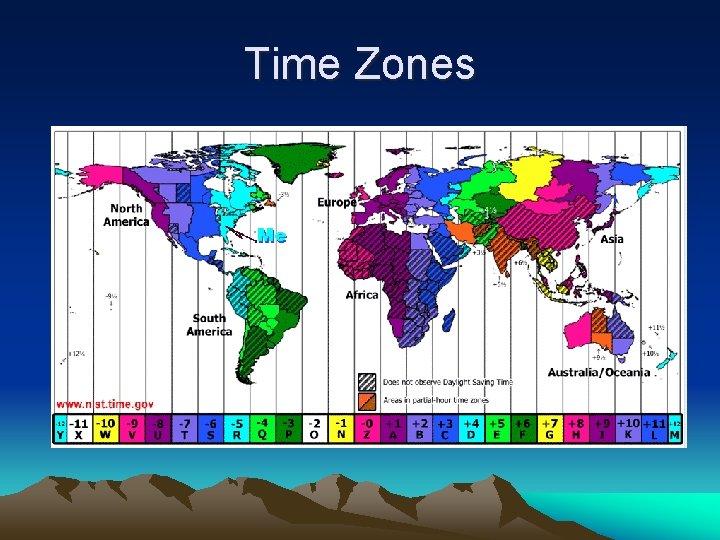
Time Zones: 24 different time zones on Earth, Why? (it takes the earth 24 hours for 1 rotation) • Each zone is = 15 Degrees wide, adjusted to local areas to reduce time zone confusion • United States has 6 time zones
Time Zones
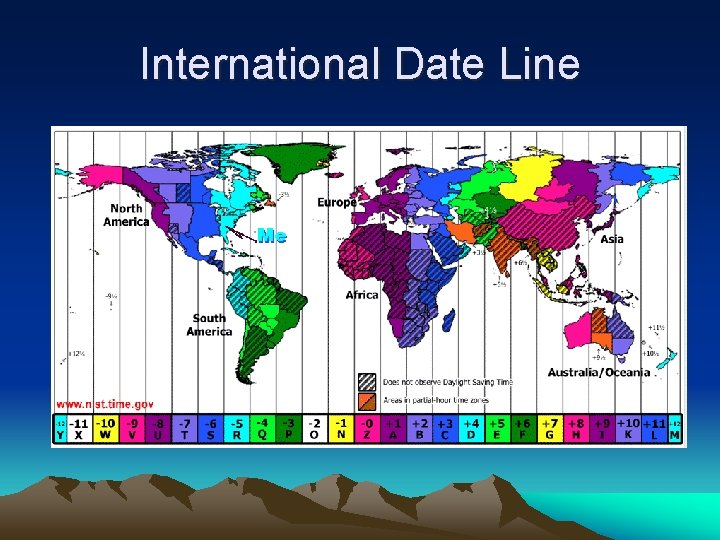
Need a Date for Homecoming ? Call the … International Date Line Calendar Dates: days based on Earth’s rotation, just as time zones are, so when passing through time zones, you either gain or lose time • On the international dateline, 180 Degrees from the Prime Meridian, days are lost and gained • Traveling west across the prime meridian you gain a day • Traveling east across the prime meridian you lose a day
International Date Line