
Mapping of the Australian National Curriculum Australian Curriculum
- Slides: 12
Mapping of the Australian National Curriculum
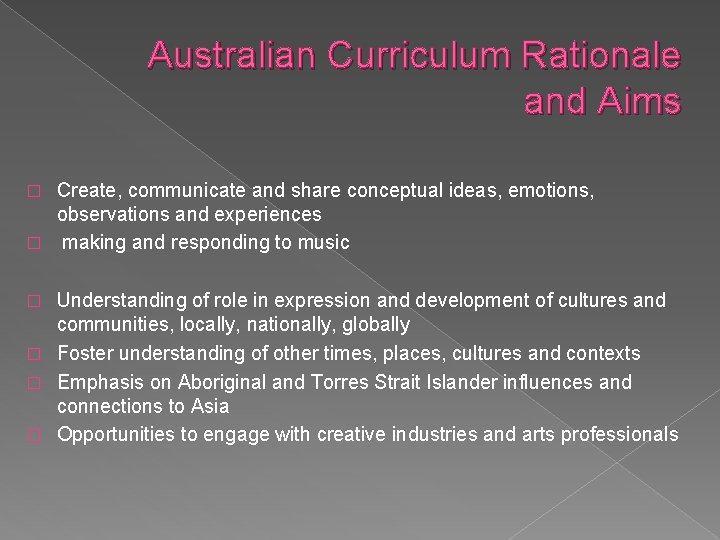
Australian Curriculum Rationale and Aims Create, communicate and share conceptual ideas, emotions, observations and experiences � making and responding to music � Understanding of role in expression and development of cultures and communities, locally, nationally, globally � Foster understanding of other times, places, cultures and contexts � Emphasis on Aboriginal and Torres Strait Islander influences and connections to Asia � Opportunities to engage with creative industries and arts professionals �
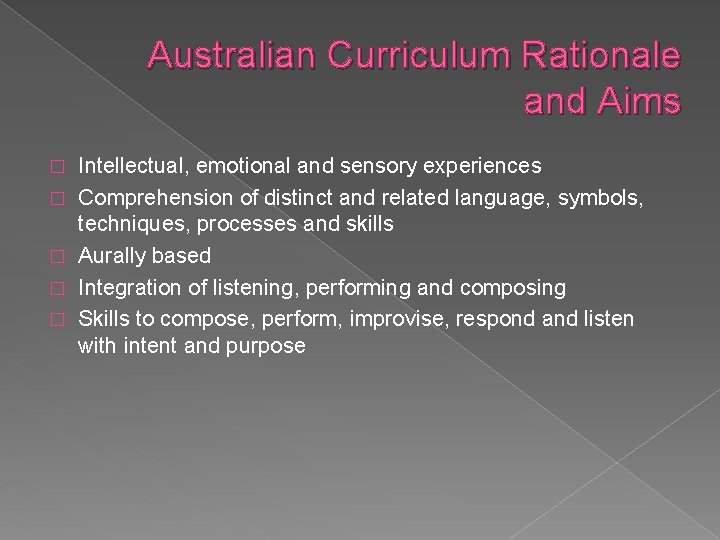
Australian Curriculum Rationale and Aims � � � Intellectual, emotional and sensory experiences Comprehension of distinct and related language, symbols, techniques, processes and skills Aurally based Integration of listening, performing and composing Skills to compose, perform, improvise, respond and listen with intent and purpose
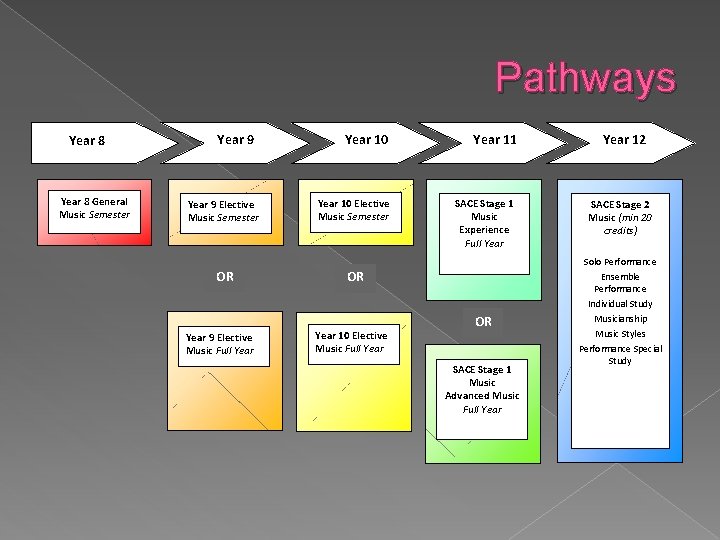
Pathways Year 8 General Music Semester Year 9 Elective Music Semester OR Year 9 Elective Music Full Year 10 Year 11 Year 10 Elective Music Semester SACE Stage 1 Music Experience Full Year OR Year 10 Elective Music Full Year OR SACE Stage 1 Music Advanced Music Full Year 12 SACE Stage 2 Music (min 20 credits) Solo Performance Ensemble Performance Individual Study Musicianship Music Styles Performance Special Study
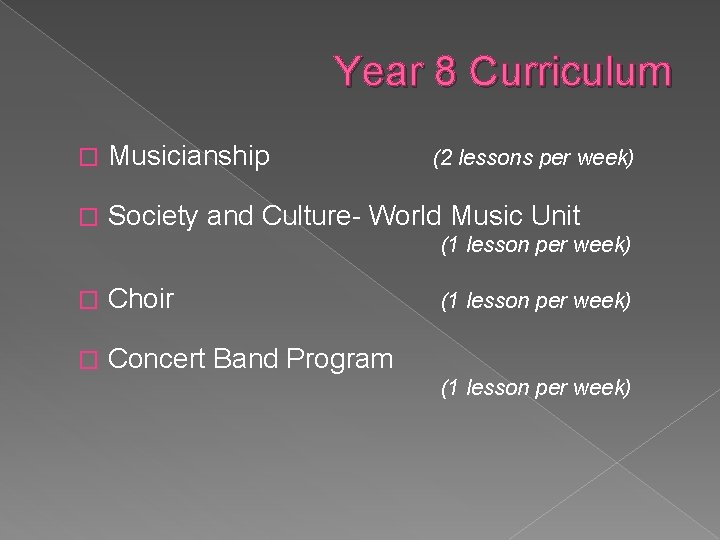
Year 8 Curriculum � Musicianship � Society and Culture- World Music Unit (2 lessons per week) (1 lesson per week) � Choir � Concert Band Program (1 lesson per week)
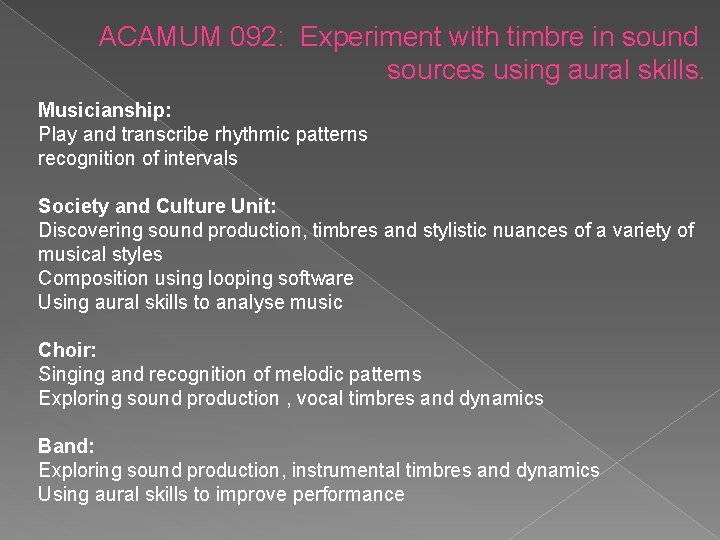
ACAMUM 092: Experiment with timbre in sound sources using aural skills. Musicianship: Play and transcribe rhythmic patterns recognition of intervals Society and Culture Unit: Discovering sound production, timbres and stylistic nuances of a variety of musical styles Composition using looping software Using aural skills to analyse music Choir: Singing and recognition of melodic patterns Exploring sound production , vocal timbres and dynamics Band: Exploring sound production, instrumental timbres and dynamics Using aural skills to improve performance
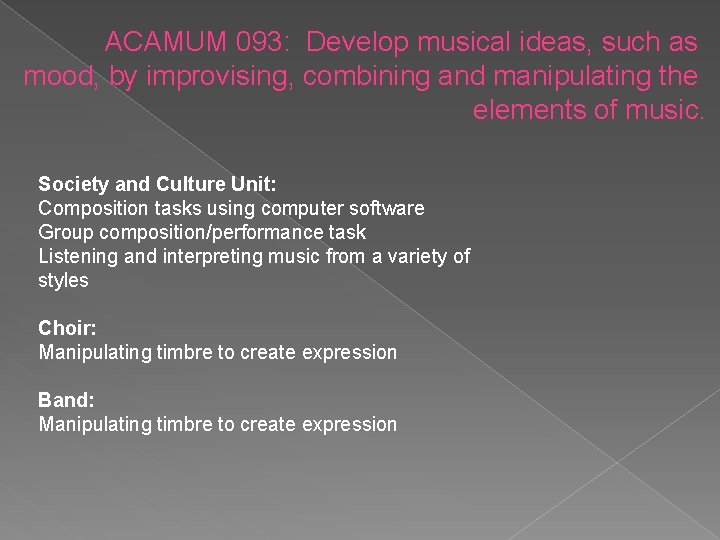
ACAMUM 093: Develop musical ideas, such as mood, by improvising, combining and manipulating the elements of music. Society and Culture Unit: Composition tasks using computer software Group composition/performance task Listening and interpreting music from a variety of styles Choir: Manipulating timbre to create expression Band: Manipulating timbre to create expression
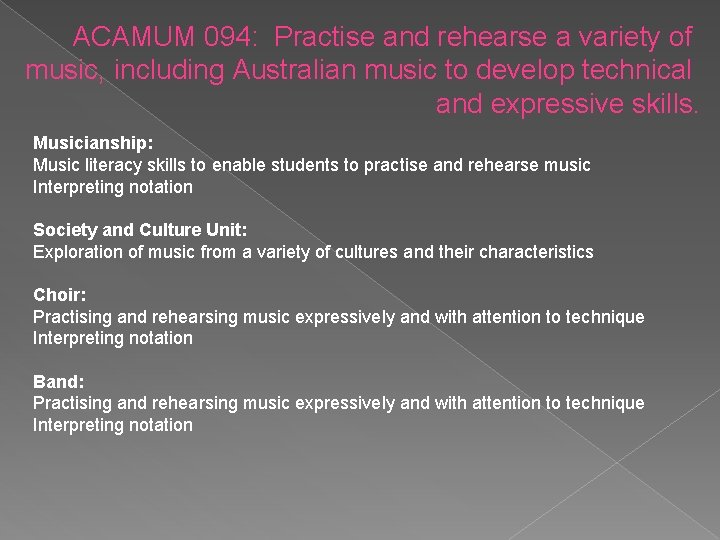
ACAMUM 094: Practise and rehearse a variety of music, including Australian music to develop technical and expressive skills. Musicianship: Music literacy skills to enable students to practise and rehearse music Interpreting notation Society and Culture Unit: Exploration of music from a variety of cultures and their characteristics Choir: Practising and rehearsing music expressively and with attention to technique Interpreting notation Band: Practising and rehearsing music expressively and with attention to technique Interpreting notation
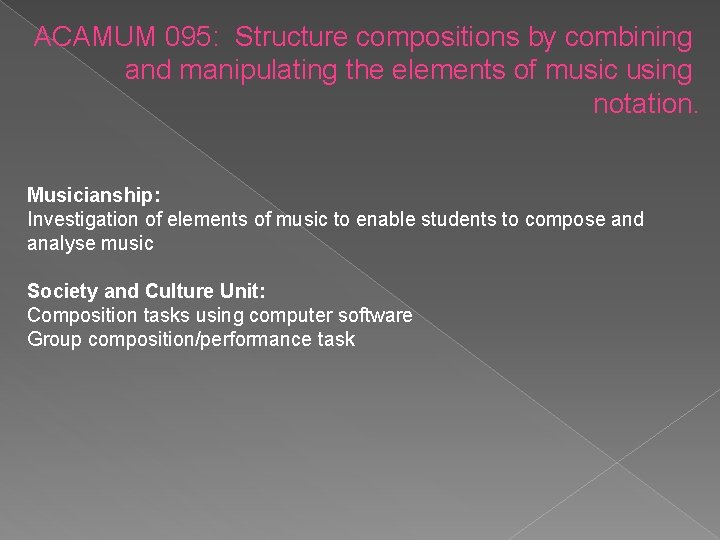
ACAMUM 095: Structure compositions by combining and manipulating the elements of music using notation. Musicianship: Investigation of elements of music to enable students to compose and analyse music Society and Culture Unit: Composition tasks using computer software Group composition/performance task
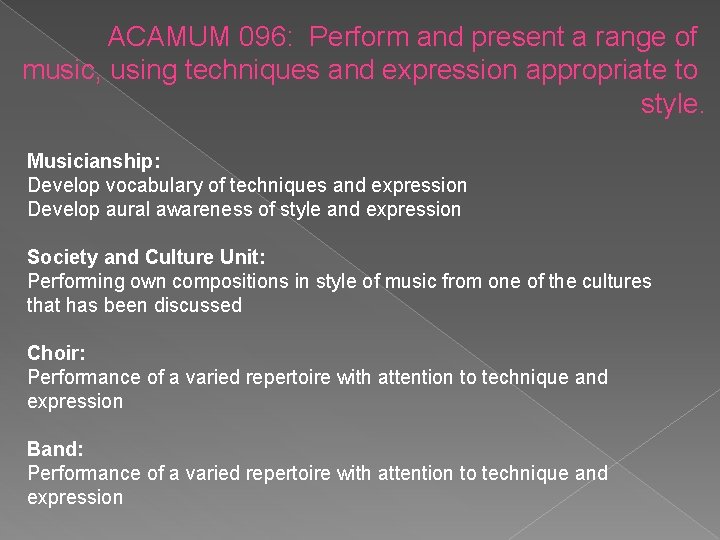
ACAMUM 096: Perform and present a range of music, using techniques and expression appropriate to style. Musicianship: Develop vocabulary of techniques and expression Develop aural awareness of style and expression Society and Culture Unit: Performing own compositions in style of music from one of the cultures that has been discussed Choir: Performance of a varied repertoire with attention to technique and expression Band: Performance of a varied repertoire with attention to technique and expression
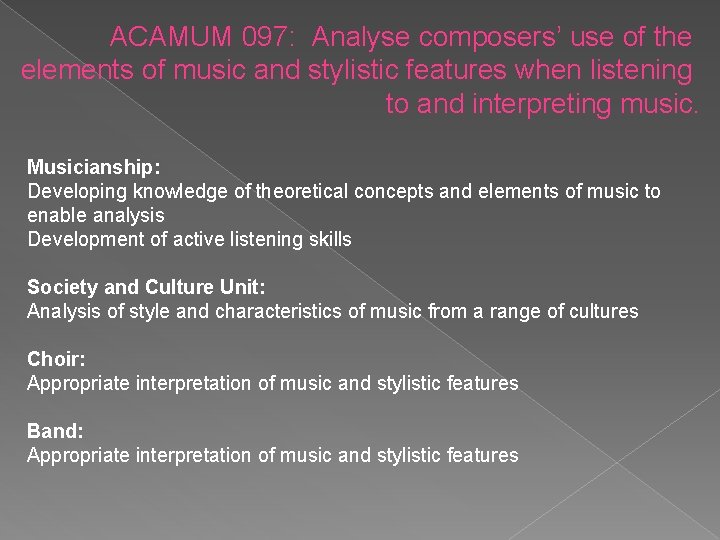
ACAMUM 097: Analyse composers’ use of the elements of music and stylistic features when listening to and interpreting music. Musicianship: Developing knowledge of theoretical concepts and elements of music to enable analysis Development of active listening skills Society and Culture Unit: Analysis of style and characteristics of music from a range of cultures Choir: Appropriate interpretation of music and stylistic features Band: Appropriate interpretation of music and stylistic features
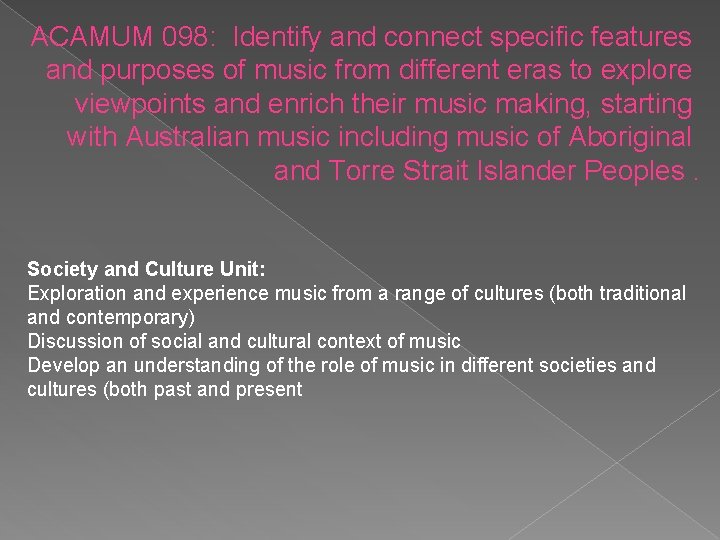
ACAMUM 098: Identify and connect specific features and purposes of music from different eras to explore viewpoints and enrich their music making, starting with Australian music including music of Aboriginal and Torre Strait Islander Peoples. Society and Culture Unit: Exploration and experience music from a range of cultures (both traditional and contemporary) Discussion of social and cultural context of music Develop an understanding of the role of music in different societies and cultures (both past and present