
Mapping of Methane Emissions from NaturallyOccurring Marine Seeps
- Slides: 1
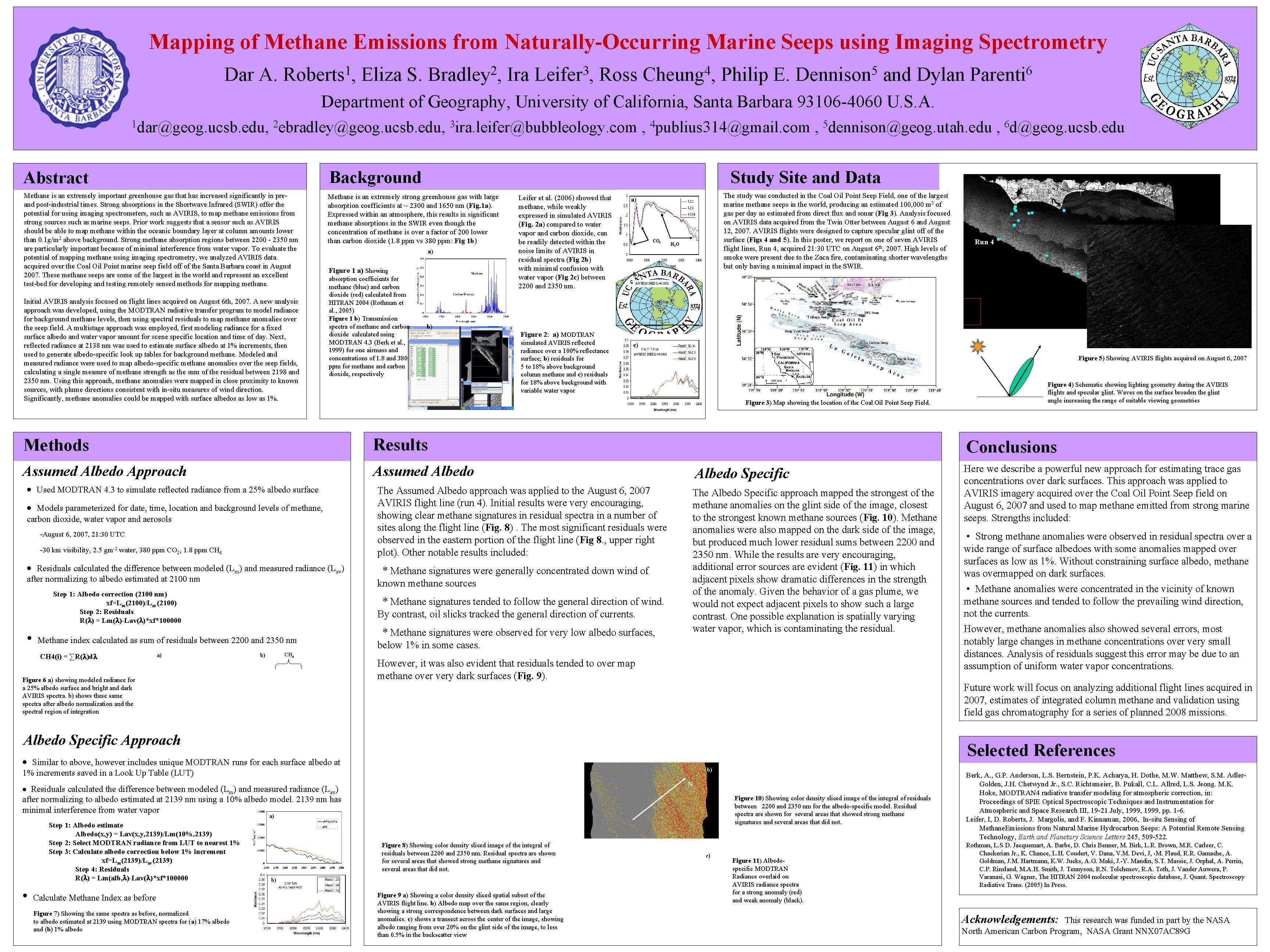
Mapping of Methane Emissions from Naturally-Occurring Marine Seeps using Imaging Spectrometry Dar A. 1 Roberts , Eliza S. 2 Bradley , Ira 3 Leifer , Ross 4 Cheung , Philip E. 5 Dennison and Dylan 6 Parenti Department of Geography, University of California, Santa Barbara 93106 -4060 U. S. A. 1 dar@geog. ucsb. edu, 2 ebradley@geog. ucsb. edu, 3 ira. leifer@bubbleology. com Background Methane is an extremely important greenhouse gas that has increased significantly in preand post-industrial times. Strong absorptions in the Shortwave Infrared (SWIR) offer the potential for using imaging spectrometers, such as AVIRIS, to map methane emissions from strong sources such as marine seeps. Prior work suggests that a sensor such as AVIRIS should be able to map methane within the oceanic boundary layer at column amounts lower than 0. 1 g/m 2 above background. Strong methane absorption regions between 2200 - 2350 nm are particularly important because of minimal interference from water vapor. To evaluate the potential of mapping methane using imaging spectrometry, we analyzed AVIRIS data acquired over the Coal Oil Point marine seep field off of the Santa Barbara coast in August 2007. These methane seeps are some of the largest in the world and represent an excellent test-bed for developing and testing remotely sensed methods for mapping methane. Methane is an extremely strong greenhouse gas with large absorption coefficients at ~ 2300 and 1650 nm (Fig. 1 a). Expressed within an atmosphere, this results in significant methane absorptions in the SWIR even though the concentration of methane is over a factor of 200 lower than carbon dioxide (1. 8 ppm vs 380 ppm: Fig 1 b) Initial AVIRIS analysis focused on flight lines acquired on August 6 th, 2007. A new analysis approach was developed, using the MODTRAN radiative transfer program to model radiance for background methane levels, then using spectral residuals to map methane anomalies over the seep field. A multistage approach was employed, first modeling radiance for a fixed surface albedo and water vapor amount for scene specific location and time of day. Next, reflected radiance at 2138 nm was used to estimate surface albedo at 1% increments, then used to generate albedo-specific look up tables for background methane. Modeled and measured radiance were used to map albedo-specific methane anomalies over the seep fields, calculating a single measure of methane strength as the sum of the residual between 2198 and 2350 nm. Using this approach, methane anomalies were mapped in close proximity to known sources, with plume directions consistent with in-situ measures of wind direction. Significantly, methane anomalies could be mapped with surface albedos as low as 1%. , 5 dennison@geog. utah. edu , 6 d@geog. ucsb. edu Study Site and Data Abstract a) Figure 1 a) Showing absorption coefficients for methane (blue) and carbon dioxide (red) calculated from HITRAN 2004 (Rothman et al. , 2005) Figure 1 b) Transmission spectra of methane and carbon dioxide calculated using MODTRAN 4. 3 (Berk et al. , 1999) for one airmass and concentrations of 1. 8 and 380 ppm for methane and carbon dioxide, respectively , 4 publius 314@gmail. com b) Leifer et al. (2006) showed that methane, while weakly expressed in simulated AVIRIS (Fig. 2 a) compared to water vapor and carbon dioxide, can be readily detected within the noise limits of AVIRIS in residual spectra (Fig 2 b) with minimal confusion with water vapor (Fig 2 c) between 2200 and 2350 nm. The study was conducted in the Coal Oil Point Seep Field, one of the largest marine methane seeps in the world, producing an estimated 100, 000 m 3 of gas per day as estimated from direct flux and sonar (Fig 3). Analysis focused on AVIRIS data acquired from the Twin Otter between August 6 and August 12, 2007. AVIRIS flights were designed to capture specular glint off of the surface (Figs 4 and 5). In this poster, we report on one of seven AVIRIS flight lines, Run 4, acquired 21: 30 UTC on August 6 th, 2007. High levels of smoke were present due to the Zaca fire, contaminating shorter wavelengths but only having a minimal impact in the SWIR. a) CO 2 H 2 O Run 4 b) AVIRIS NEDL=0. 002 Figure 2: a) MODTRAN simulated AVIRIS reflected radiance over a 100% reflectance surface; b) residuals for 5 to 18% above background column methane and c) residuals for 18% above background with variable water vapor c) AVIRIS NEDL=0. 002 Figure 5) Showing AVIRIS flights acquired on August 6, 2007 Figure 3) Map showing the location of the Coal Oil Point Seep Field. Figure 4) Schematic showing lighting geometry during the AVIRIS flights and specular glint. Waves on the surface broaden the glint angle increasing the range of suitable viewing geometries Methods Results Conclusions Assumed Albedo Approach Assumed Albedo Here we describe a powerful new approach for estimating trace gas concentrations over dark surfaces. This approach was applied to AVIRIS imagery acquired over the Coal Oil Point Seep field on August 6, 2007 and used to map methane emitted from strong marine seeps. Strengths included: · Used MODTRAN 4. 3 to simulate reflected radiance from a 25% albedo surface · Models parameterized for date, time, location and background levels of methane, carbon dioxide, water vapor and aerosols -August 6, 2007, 21: 30 UTC -30 km visibility, 2. 5 gm-2 water, 380 ppm CO 2, 1. 8 ppm CH 4 · Residuals calculated the difference between modeled (Lm) and measured radiance (Lav) after normalizing to albedo estimated at 2100 nm Step 1: Albedo correction (2100 nm) xf=Lm(2100)/Lav(2100) Step 2: Residuals R(l) = Lm(l)-Lav(l)*xf*100000 • a) * Methane signatures were generally concentrated down wind of known methane sources * Methane signatures tended to follow the general direction of wind. By contrast, oil slicks tracked the general direction of currents. Methane index calculated as sum of residuals between 2200 and 2350 nm CH 4(i) = ∑R(l)dl The Assumed Albedo approach was applied to the August 6, 2007 AVIRIS flight line (run 4). Initial results were very encouraging, showing clear methane signatures in residual spectra in a number of sites along the flight line (Fig. 8). The most significant residuals were observed in the eastern portion of the flight line (Fig 8. , upper right plot). Other notable results included: CH 4 b) Figure 6 a) showing modeled radiance for a 25% albedo surface and bright and dark AVIRIS spectra. b) shows these same spectra after albedo normalization and the spectral region of integration * Methane signatures were observed for very low albedo surfaces, below 1% in some cases. Albedo Specific The Albedo Specific approach mapped the strongest of the methane anomalies on the glint side of the image, closest to the strongest known methane sources (Fig. 10). Methane anomalies were also mapped on the dark side of the image, but produced much lower residual sums between 2200 and 2350 nm. While the results are very encouraging, additional error sources are evident (Fig. 11) in which adjacent pixels show dramatic differences in the strength of the anomaly. Given the behavior of a gas plume, we would not expect adjacent pixels to show such a large contrast. One possible explanation is spatially varying water vapor, which is contaminating the residual. However, it was also evident that residuals tended to over map methane over very dark surfaces (Fig. 9). a) Future work will focus on analyzing additional flight lines acquired in 2007, estimates of integrated column methane and validation using field gas chromatography for a series of planned 2008 missions. Albedo Specific Approach Selected References · Similar to above, however includes unique MODTRAN runs for each surface albedo at b) 1% increments saved in a Look Up Table (LUT) N · Residuals calculated the difference between modeled (Lm) and measured radiance (Lav) after normalizing to albedo estimated at 2139 nm using a 10% albedo model. 2139 nm has minimal interference from water vapor Figure 10) Showing color density sliced image of the integral of residuals between 2200 and 2350 nm for the albedo-specific model. Residual spectra are shown for several areas that showed strong methane signatures and several areas that did not. a) Step 1: Albedo estimate Albedo(x, y) = Lav(x, y, 2139)/Lm(10%, 2139) Step 2: Select MODTRAN radiance from LUT to nearest 1% Step 3: Calculate albedo correction below 1% increment xf=Lm(2139)/Lav(2139) Step 4: Residuals R(l) = Lm(alb, l)-Lav(l)*xf*100000 • Calculate Methane Index as before Figure 7) Showing the same spectra as before, normalized to albedo estimated at 2139 using MODTRAN spectra for (a) 17% albedo and (b) 1% albedo • Strong methane anomalies were observed in residual spectra over a wide range of surface albedoes with some anomalies mapped over surfaces as low as 1%. Without constraining surface albedo, methane was overmapped on dark surfaces. • Methane anomalies were concentrated in the vicinity of known methane sources and tended to follow the prevailing wind direction, not the currents. However, methane anomalies also showed several errors, most notably large changes in methane concentrations over very small distances. Analysis of residuals suggest this error may be due to an assumption of uniform water vapor concentrations. Figure 8) Showing color density sliced image of the integral of residuals between 2200 and 2350 nm. Residual spectra are shown for several areas that showed strong methane signatures and several areas that did not. b) Figure 9 a) Showing a color density sliced spatial subset of the AVIRIS flight line. b) Albedo map over the same region, clearly showing a strong correspondence between dark surfaces and large anomalies. c) shows a transect across the center of the image, showing albedo ranging from over 20% on the glint side of the image, to less than 0. 5% in the backscatter view c) Figure 11) Albedospecific MODTRAN Radiance overlaid on AVIRIS radiance spectra for a strong anomaly (red) and weak anomaly (black). Berk, A. , G. P. Anderson, L. S. Bernstein, P. K. Acharya, H. Dothe, M. W. Matthew, S. M. Adler. Golden, J. H. Chetwynd Jr. , S. C. Richtsmeier, B. Pukall, C. L. Allred, L. S. Jeong. M. K. Hoke, MODTRAN 4 radiative transfer modeling for atmospheric correction, in: Proceedings of SPIE Optical Spectroscopic Techniques and Instrumentation for Atmospheric and Space Research III, 19 -21 July, 1999, pp. 1 -6. Leifer, I, D. Roberts, J. Margolis, and F. Kinnaman, 2006, In-situ Sensing of Methane. Emissions from Natural Marine Hydrocarbon Seeps: A Potential Remote Sensing Technology, Earth and Planetary Science Letters 245, 509 -522. Rothman, L. S. D. Jacquemart, A. Barbe, D. Chris Benner, M. Birk, L. R. Brown, M. R. Carleer, C. Chackerian Jr. , K. Chance, L. H. Coudert, V. Dana, V. M. Devi, J, -M. Flaud, R. R. Gamache, A. Goldman, J. M. Hartmann, K. W. Jucks, A. G. Maki, J. -Y. Mandin, S. T. Massie, J. Orphal, A. Perrin, C. P. Rinsland, M. A. H. Smith, J. Tennyson, R. N. Tolchenov, R. A. Toth, J. Vander Auwera, P. Varanasi, G. Wagner, The HITRAN 2004 molecular spectroscopic database, J. Quant. Spectroscopy Radiative Trans. (2005) In Press. Acknowledgements: This research was funded in part by the NASA North American Carbon Program, NASA Grant NNX 07 AC 89 G