
Mapping of Coastal Wetlands via Hyperspectral AVIRIS Data
- Slides: 18
Mapping of Coastal Wetlands via Hyperspectral AVIRIS Data M. M. Crawford (1), A. L Neuenschwander (1), M. J. Provancha (2) (1) Center for Space Research, University of Texas at Austin (2) Dynamac Corporation, Kennedy Space Center, Florida Center for Space Research, University of Texas at Austin
CLASSIFICATION OF WETLANDS USING AVIRIS DATA Project Goal: Investigate the potential of AVIRIS data for wetland vegetation classification at the Kennedy Space Center in Florida. Monitor the effects of various marsh management strategies by mapping the vegetation distribution and its change over time. Center for Space Research, University of Texas at Austin
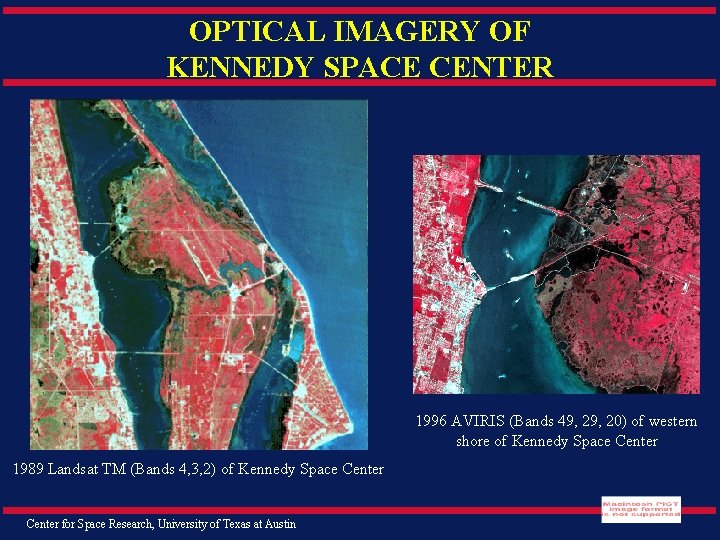
OPTICAL IMAGERY OF KENNEDY SPACE CENTER 1996 AVIRIS (Bands 49, 20) of western shore of Kennedy Space Center 1989 Landsat TM (Bands 4, 3, 2) of Kennedy Space Center for Space Research, University of Texas at Austin
GIS MAPS OF TEST SITE Map of Impoundments Center for Space Research, University of Texas at Austin Vegetation map derived from 89 TM and aerial photography
AVIRIS IMAGERY • Airborne Visible/Infrared Imaging Spectrometer flown by NASA’s Jet Propulsion Laboratory • 224 Bands with 10 nm wavebands • Measures visible and near infrared reflected energy (400 - 2500 nm) • Airborne Platform flown 20 km above surface • Highly calibrated instrument Center for Space Research, University of Texas at Austin
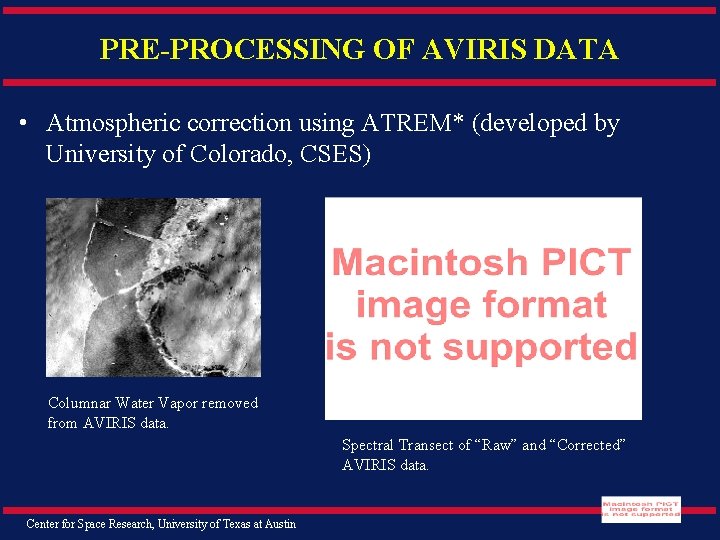
PRE-PROCESSING OF AVIRIS DATA • Atmospheric correction using ATREM* (developed by University of Colorado, CSES) Columnar Water Vapor removed from AVIRIS data. Spectral Transect of “Raw” and “Corrected” AVIRIS data. Center for Space Research, University of Texas at Austin
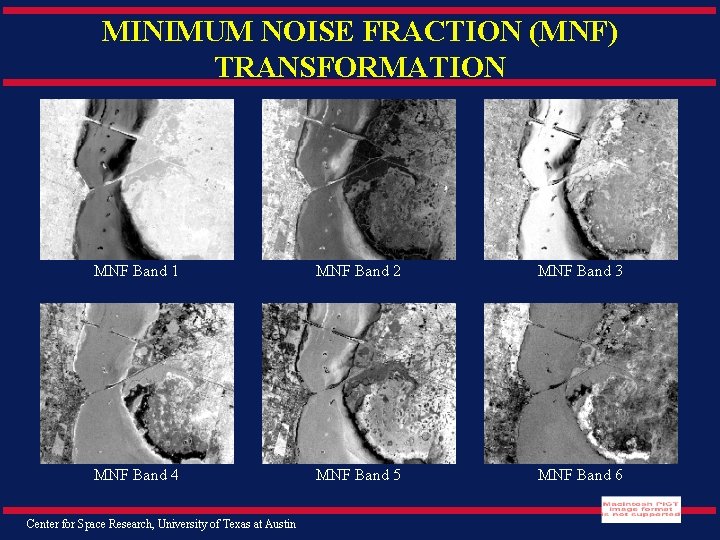
FEATURE EXTRACTION • Principal Components Analysis • Minimum Noise Fraction (MNF) Transformation – Orthogonal bands ordered by noise content – Developed specifically for analysis of multi-band remotely sensed data • Decision Boundary Feature Extraction Center for Space Research, University of Texas at Austin
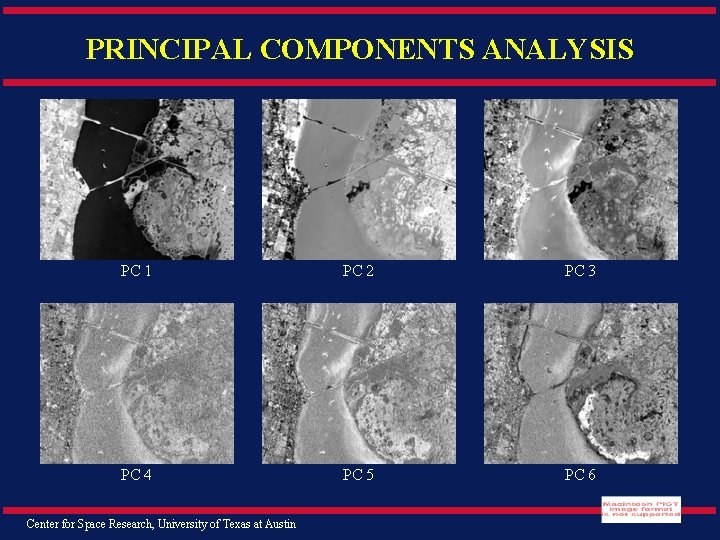
PRINCIPAL COMPONENTS ANALYSIS PC 1 PC 2 PC 3 PC 4 PC 5 PC 6 Center for Space Research, University of Texas at Austin
MINIMUM NOISE FRACTION (MNF) TRANSFORMATION MNF Band 1 MNF Band 2 MNF Band 3 MNF Band 4 MNF Band 5 MNF Band 6 Center for Space Research, University of Texas at Austin
CLASSIFICATION ALGORITHMS INVESTIGATED • Pixel-Based – Gaussian Maximum Likelihood – Neural Network: (Multi-Layered Perceptron with one hidden layer and Scaled Conjugate Gradient Training algorithm) – Canonical Analysis • Region-Based – Gaussian Markov Random Field Center for Space Research, University of Texas at Austin
HIERARCHICAL METHODOLOGY Level 1 Level 2 Level 3 Center for Space Research, University of Texas at Austin
CLASSIFIER INPUTS • Directly compare results of input combinations using a variety of classification algorithms – – 5 corrected AVIRIS Bands First 13 eigenvectors of MNF transformation 8 eigenvectors from Principal Components Analysis 32 upland 11 wetland features extracted from Decision Boundary Feature Extraction (DBFE) algorithm – 7 Upland 5 Wetland features extracted from Canonical Analysis (CA) Center for Space Research, University of Texas at Austin
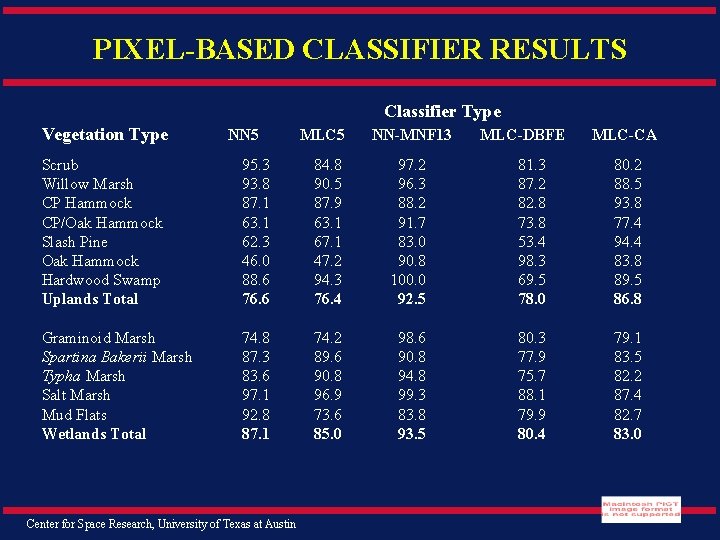
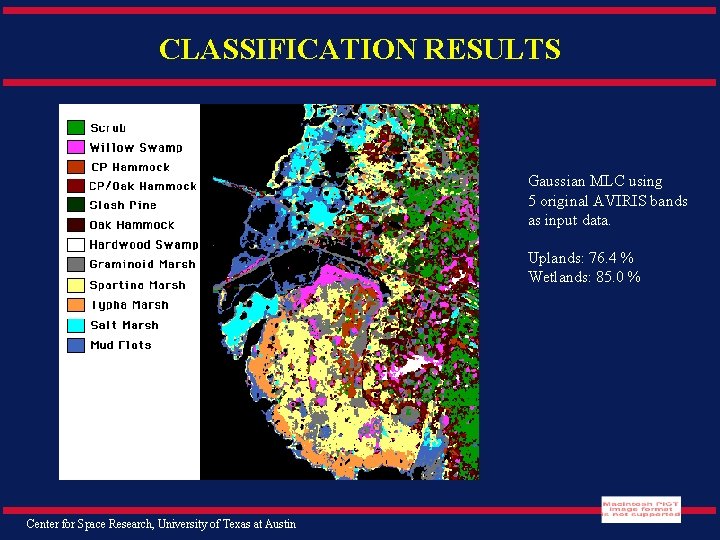
PIXEL-BASED CLASSIFIER RESULTS Classifier Type Vegetation Type NN 5 MLC 5 NN-MNF 13 MLC-DBFE MLC-CA Scrub Willow Marsh CP Hammock CP/Oak Hammock Slash Pine Oak Hammock Hardwood Swamp Uplands Total 95. 3 93. 8 87. 1 63. 1 62. 3 46. 0 88. 6 76. 6 84. 8 90. 5 87. 9 63. 1 67. 1 47. 2 94. 3 76. 4 97. 2 96. 3 88. 2 91. 7 83. 0 90. 8 100. 0 92. 5 81. 3 87. 2 82. 8 73. 8 53. 4 98. 3 69. 5 78. 0 80. 2 88. 5 93. 8 77. 4 94. 4 83. 8 89. 5 86. 8 Graminoid Marsh Spartina Bakerii Marsh Typha Marsh Salt Marsh Mud Flats Wetlands Total 74. 8 87. 3 83. 6 97. 1 92. 8 87. 1 74. 2 89. 6 90. 8 96. 9 73. 6 85. 0 98. 6 90. 8 94. 8 99. 3 83. 8 93. 5 80. 3 77. 9 75. 7 88. 1 79. 9 80. 4 79. 1 83. 5 82. 2 87. 4 82. 7 83. 0 Center for Space Research, University of Texas at Austin
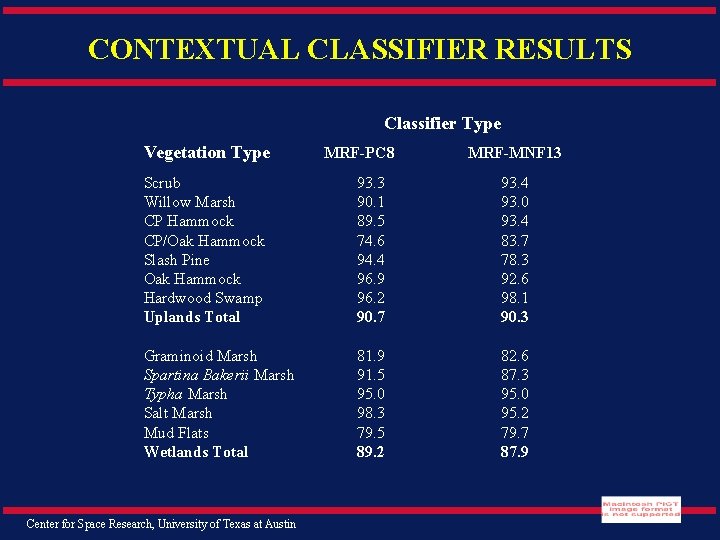
CONTEXTUAL CLASSIFIER RESULTS Classifier Type Vegetation Type MRF-PC 8 MRF-MNF 13 Scrub Willow Marsh CP Hammock CP/Oak Hammock Slash Pine Oak Hammock Hardwood Swamp Uplands Total 93. 3 90. 1 89. 5 74. 6 94. 4 96. 9 96. 2 90. 7 93. 4 93. 0 93. 4 83. 7 78. 3 92. 6 98. 1 90. 3 Graminoid Marsh Spartina Bakerii Marsh Typha Marsh Salt Marsh Mud Flats Wetlands Total 81. 9 91. 5 95. 0 98. 3 79. 5 89. 2 82. 6 87. 3 95. 0 95. 2 79. 7 87. 9 Center for Space Research, University of Texas at Austin
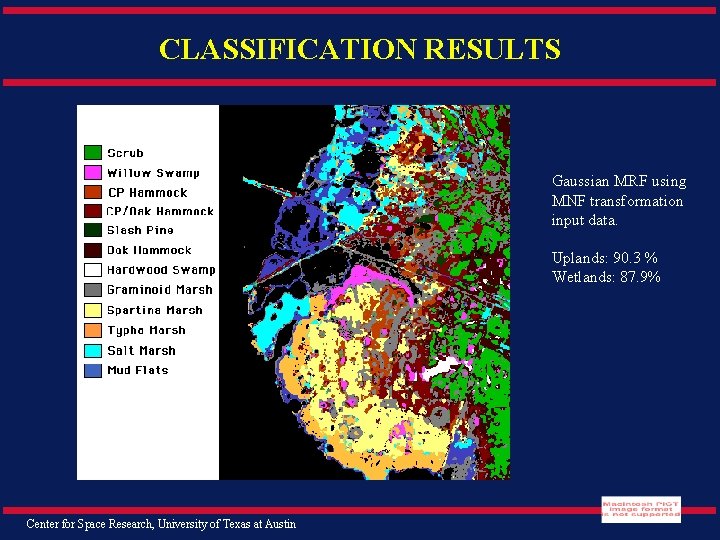
CLASSIFICATION RESULTS Gaussian MRF using MNF transformation input data. Uplands: 90. 3 % Wetlands: 87. 9% Center for Space Research, University of Texas at Austin
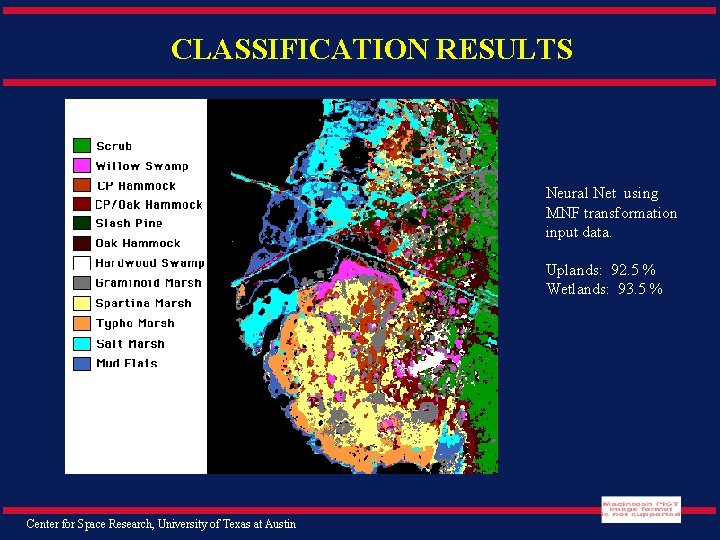
CLASSIFICATION RESULTS Neural Net using MNF transformation input data. Uplands: 92. 5 % Wetlands: 93. 5 % Center for Space Research, University of Texas at Austin
CLASSIFICATION RESULTS Gaussian MLC using 5 original AVIRIS bands as input data. Uplands: 76. 4 % Wetlands: 85. 0 % Center for Space Research, University of Texas at Austin
CONCLUSION • Hierarchical classification methodology was utilized • MNF Bands used as input to classifier yielded best results • Gaussian Markov Random Field contextual model classifier yielded best results • Hyperspectral imagery is effective for classification of coastal wetlands Center for Space Research, University of Texas at Austin