
Mapping OERs to the UKPSF 2011 a case



- Slides: 17
Mapping OERs to the UKPSF (2011) – a case study Gillian Janes L&T Consultant Teesside University
Overview • • Background The ‘journey’ Learning points Next steps
Background • JISC/OER OMAC 3 funded project • Open Learning Units – Distance Learning – Digital Literacies – Employability – Achieving HEA Individual Recognition • Previous experience of KSF (2004) mapping
Why map to UKPSF? • Enables staff to plan their learning and make informed choices • Provides practical guidance for managers undertaking professional development reviews with staff • Explicitly links professional development activity to national professional recognition BUT: - mapping comes with a HEALTH WARNING!
• Raises awareness of UKPSF which: – enables national recognition of staff commitment to professionalism in L&T in HE and is a portable asset with UK-wide relevance, increasingly recognised by HE and FE institutions – Provides an indicator of professional identity for HE practitioners, including the entitlement to use postnominal letters – AFHEA, SFHEA, PFHEA
UKPSF (2011)
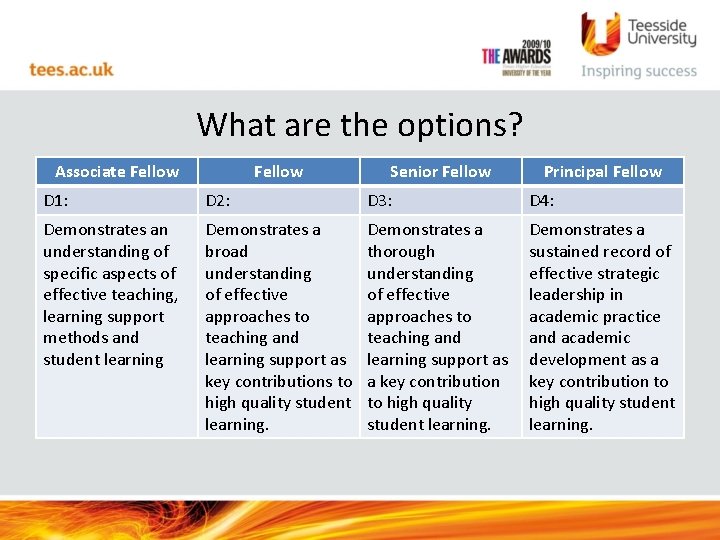
What are the options? Associate Fellow Senior Fellow Principal Fellow D 1: D 2: D 3: D 4: Demonstrates an understanding of specific aspects of effective teaching, learning support methods and student learning Demonstrates a broad understanding of effective approaches to teaching and learning support as key contributions to high quality student learning. Demonstrates a thorough understanding of effective approaches to teaching and learning support as a key contribution to high quality student learning. Demonstrates a sustained record of effective strategic leadership in academic practice and academic development as a key contribution to high quality student learning.
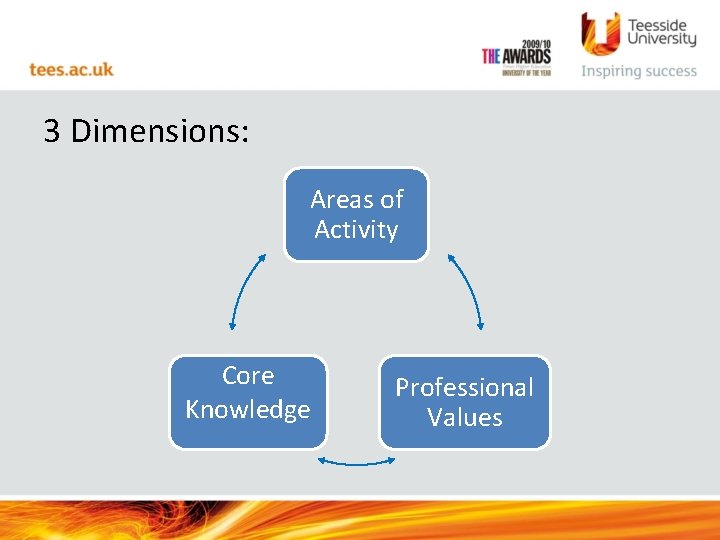
3 Dimensions: Areas of Activity Core Knowledge Professional Values
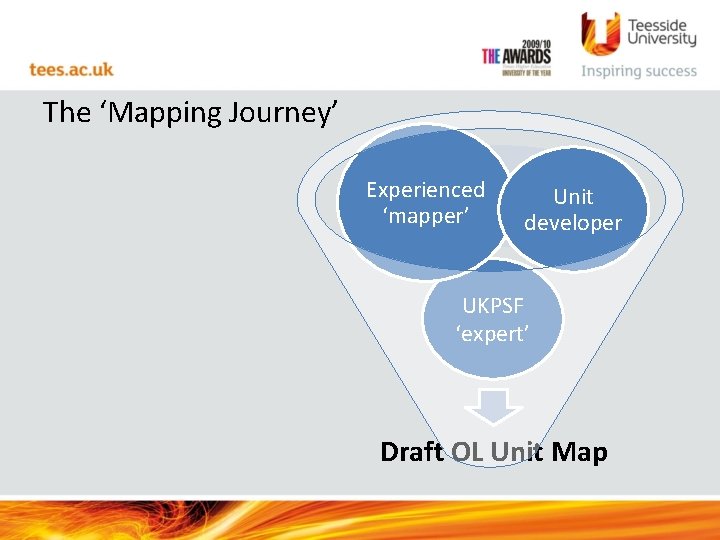
The ‘Mapping Journey’ Experienced ‘mapper’ Unit developer UKPSF ‘expert’ Draft OL Unit Map
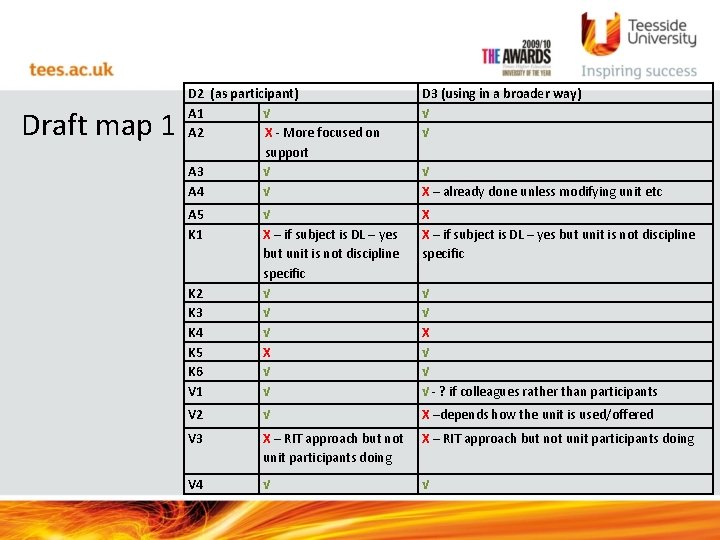
Draft map 1 D 2 (as participant) A 1 √ A 2 X - More focused on support A 3 √ A 4 √ D 3 (using in a broader way) √ √ A 5 K 1 X X – if subject is DL – yes but unit is not discipline specific K 2 K 3 K 4 K 5 K 6 V 1 √ X – if subject is DL – yes but unit is not discipline specific √ √ √ X √ √ V 2 √ X –depends how the unit is used/offered V 3 X – RIT approach but not unit participants doing V 4 √ √ √ X – already done unless modifying unit etc √ √ X √ √ √ - ? if colleagues rather than participants
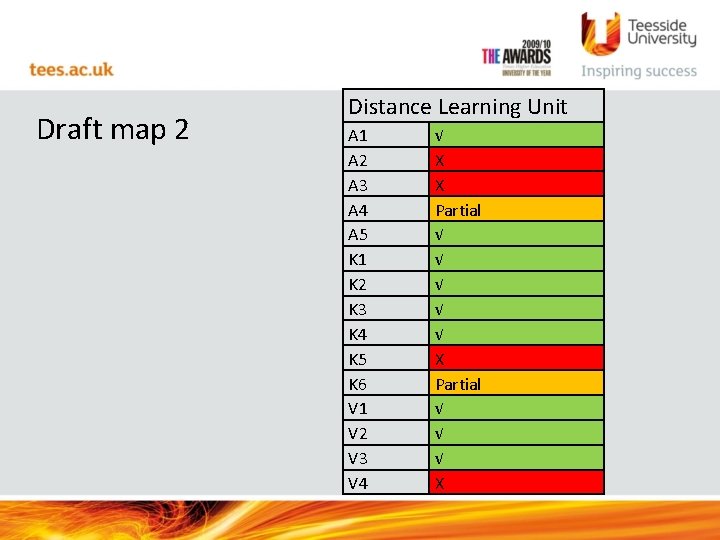
Draft map 2 Distance Learning Unit A 1 A 2 A 3 A 4 A 5 K 1 K 2 K 3 K 4 K 5 K 6 V 1 V 2 V 3 V 4 √ X X Partial √ √ √ X
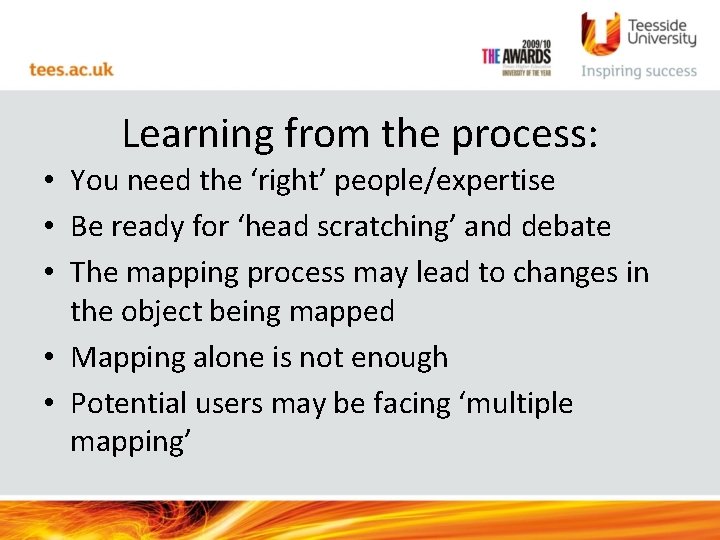
Learning from the process: • You need the ‘right’ people/expertise • Be ready for ‘head scratching’ and debate • The mapping process may lead to changes in the object being mapped • Mapping alone is not enough • Potential users may be facing ‘multiple mapping’
We’re not in a vacuum…. • What about other Professional Frameworks? – CMALT – AUA – VITAE – CILIP – Others…
Details of the draft CILIP Professional Knowledge and Skills Base professional framework have been removed. Please contact G. Janes@tees. ac. uk if you require further information on this.
Next steps • Piloting Open Learning Units and mapping guidance • Potential colloquium to consider joint mapping/synergies between Professional Frameworks
For further information or to get involved : Project blog: http: //eat. scm. tees. ac. uk/blog/ or contact G. Janes@tees. ac. uk