
Mapping Livability of lower income housing typologies in
Mapping Livability of lower income housing typologies in the City of Mumbai Researcher – Kimaya Keluskar BIn. UCom Presentation Vijaywada 2019 - Kimaya Keluskar
Research Questions : What is the disparity between the national/urban standards and norms for environmental sufficiency and the conditions of the informal settlements? Does their difference suggest an indicator of human adaptability? Are there limits to density of population and built up space that would be environmentally sustainable, given the typologies of building that are economically affordable? BIn. UCom Presentation Vijaywada 2019 - Kimaya Keluskar
What could be the economically affordable strategies of spatial re-arrangement and reconstruction, and methods of incorporating environmental services that would evolve into settlements that are healthy, safe, low-carbon and environmentally sustainable? What would be the strategies for innovating technological and management systems of re-cycling water and waste and local production of energy and nutrition that can be initiated locally? BIn. UCom Presentation Vijaywada 2019 - Kimaya Keluskar
Research Objects: Slum rehabilitation and redevelopment scheme Site and services Scheme • Informal settlement BIn. UCom Presentation Vijaywada 2019 - Kimaya Keluskar
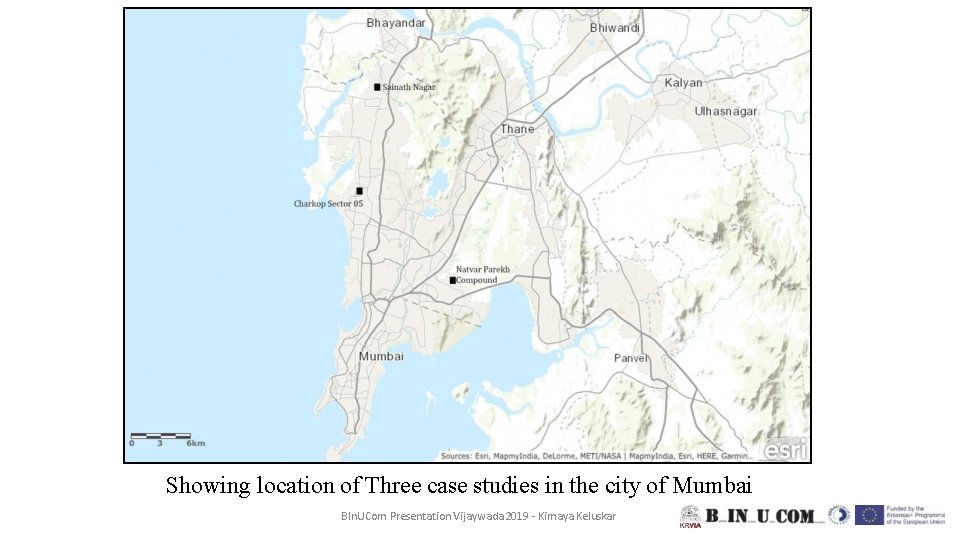
Showing location of Three case studies in the city of Mumbai BIn. UCom Presentation Vijaywada 2019 - Kimaya Keluskar
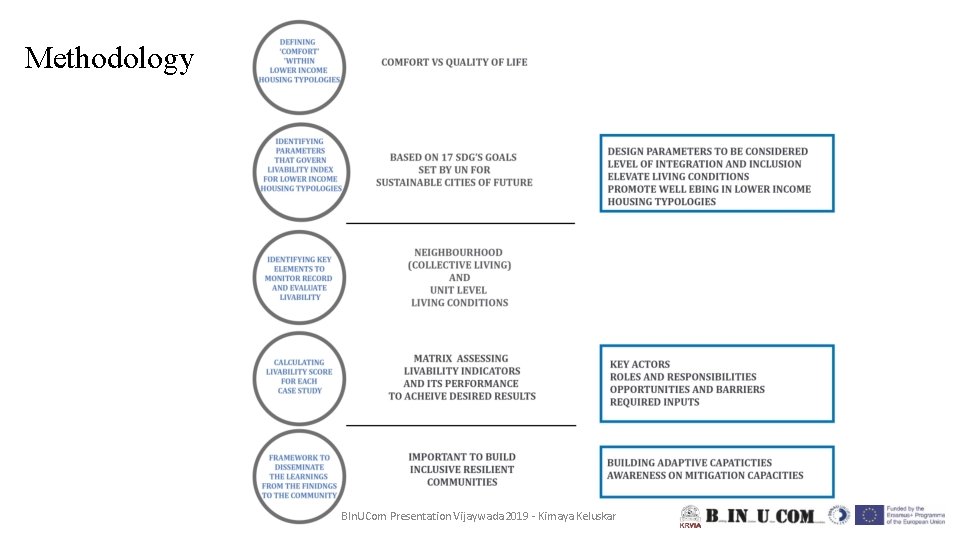
Methodology BIn. UCom Presentation Vijaywada 2019 - Kimaya Keluskar

LIVABILITY ‘Livability’ relates directly to quality of life and well-being in a particular location (Gerradbrown, 2006). In a residential colony livability depends on the immediate physical built environment around an individual and the neighbourhood where one walks along the streets to reach to the nearest bus station or rail station (Gerradbrown, 2006). Brooke Lyndhurst talks about different interpretation of livability depending on different continents. However he agrees that globally the idea of livability culminates into quality of Life, well-being and life satisfaction (Brook Lyndhurst, 2004). Accessibility: Access to minimum 5 basic amenities needed for day to day living like grocery store, fresh vegetable/meat market , bank, etc within 500 m radius. (CII, 2010). BIn. UCom Presentation Vijaywada 2019 - Kimaya Keluskar
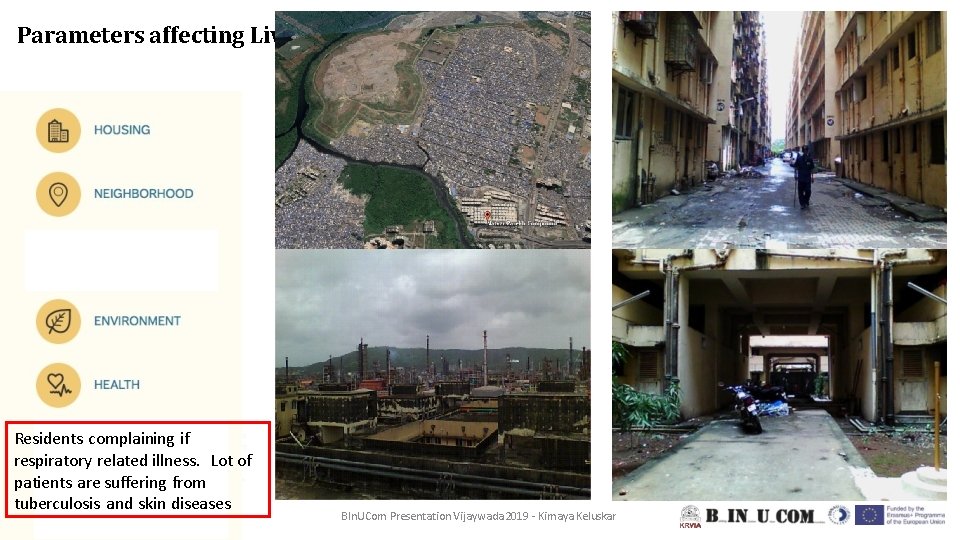
Parameters affecting Livability Residents complaining if respiratory related illness. Lot of patients are suffering from tuberculosis and skin diseases BIn. UCom Presentation Vijaywada 2019 - Kimaya Keluskar
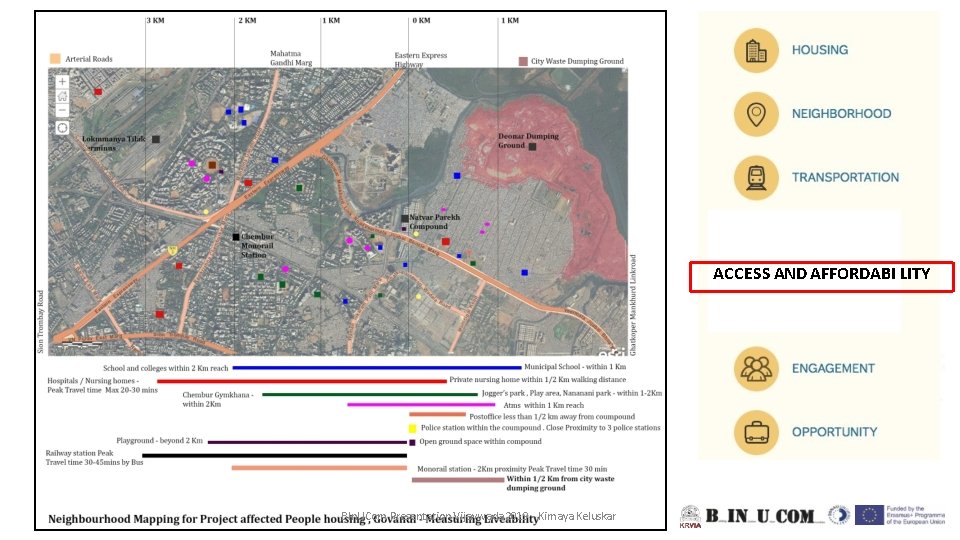
ACCESS AND AFFORDABI LITY BIn. UCom Presentation Vijaywada 2019 - Kimaya Keluskar
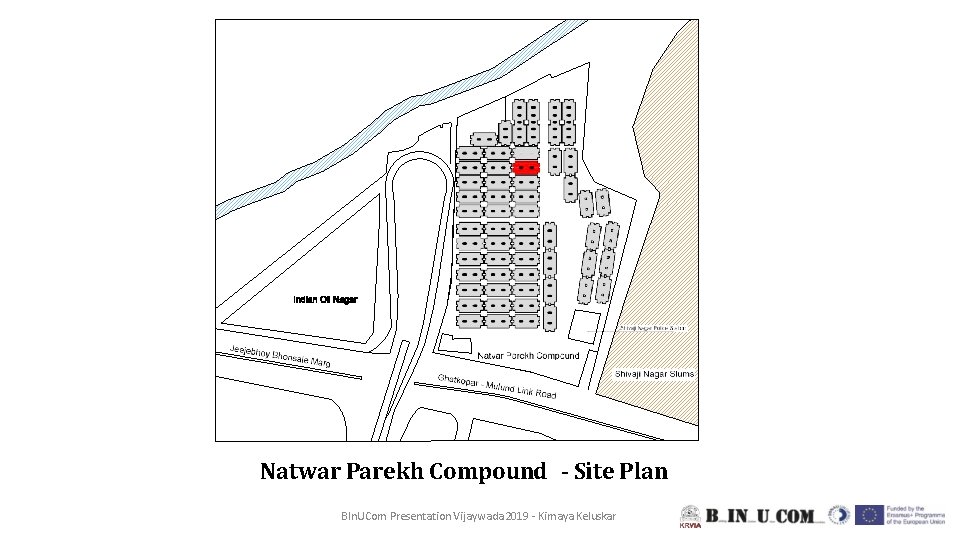
Natwar Parekh Compound - Site Plan BIn. UCom Presentation Vijaywada 2019 - Kimaya Keluskar
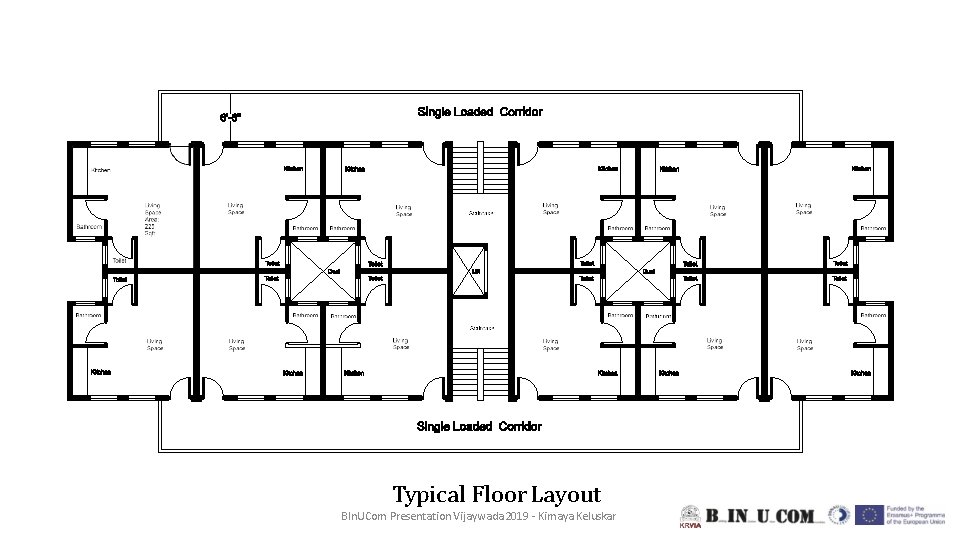
Typical Floor Layout BIn. UCom Presentation Vijaywada 2019 - Kimaya Keluskar
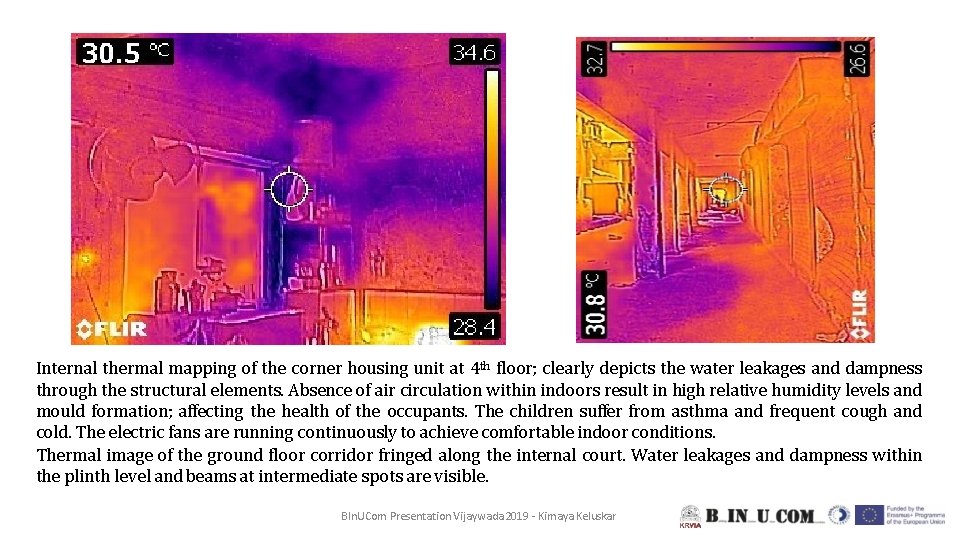
Internal thermal mapping of the corner housing unit at 4 th floor; clearly depicts the water leakages and dampness through the structural elements. Absence of air circulation within indoors result in high relative humidity levels and mould formation; affecting the health of the occupants. The children suffer from asthma and frequent cough and cold. The electric fans are running continuously to achieve comfortable indoor conditions. Thermal image of the ground floor corridor fringed along the internal court. Water leakages and dampness within the plinth level and beams at intermediate spots are visible. BIn. UCom Presentation Vijaywada 2019 - Kimaya Keluskar
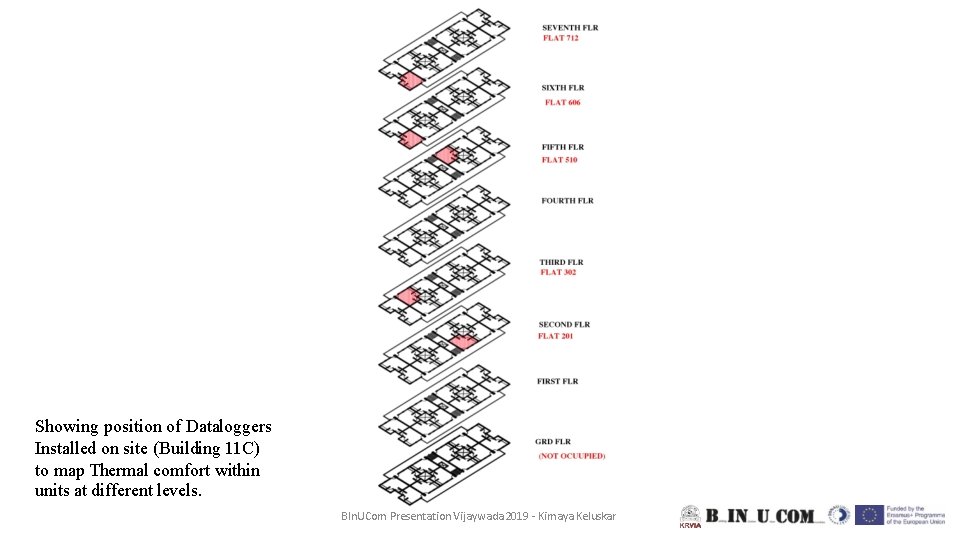
Showing position of Dataloggers Installed on site (Building 11 C) to map Thermal comfort within units at different levels. BIn. UCom Presentation Vijaywada 2019 - Kimaya Keluskar
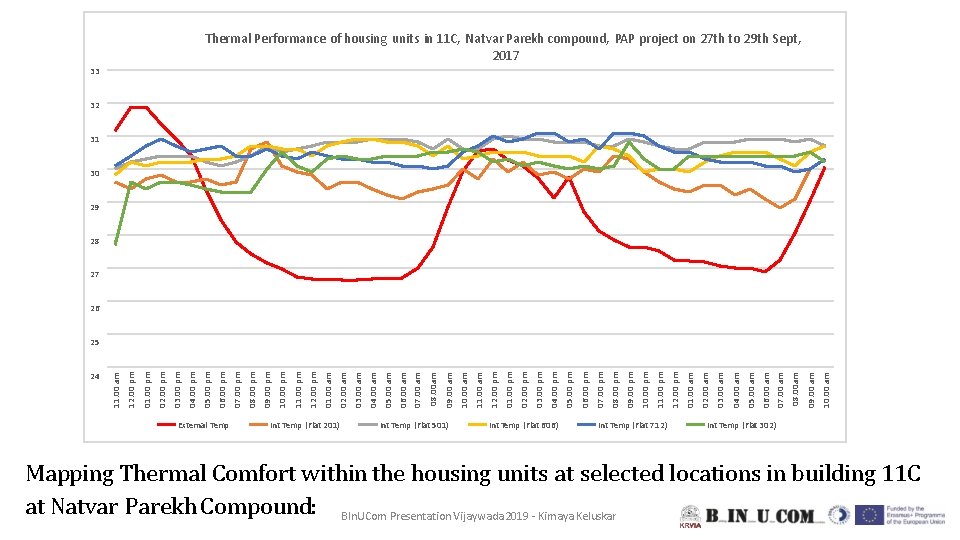
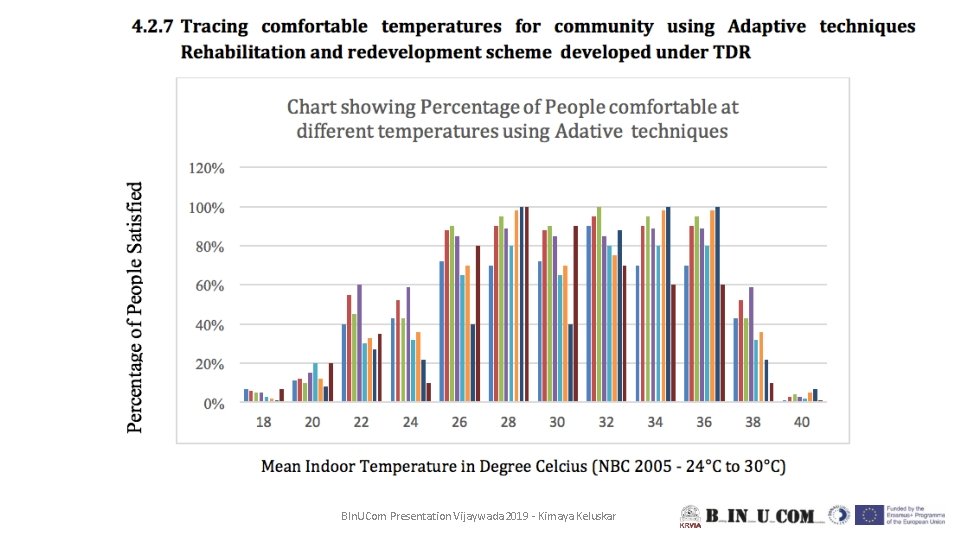
Thermal Performance of housing units in 11 C, Natvar Parekh compound, PAP project on 27 th to 29 th Sept, 2017 33 32 31 30 29 28 27 26 External Temp Int Temp (Flat 201) Int Temp (Flat 501) Int Temp (Flat 606) Int Temp (Flat 712) 10. 00 am 09. 00 am 08. 00 am 06. 00 am 07. 00 am 05. 00 am 04. 00 am 03. 00 am 02. 00 am 01. 00 am 12. 00 pm 11. 00 pm 10. 00 pm 09. 00 pm 08. 00 pm 07. 00 pm 06. 00 pm 05. 00 pm 04. 00 pm 03. 00 pm 02. 00 pm 01. 00 pm 12. 00 pm 11. 00 am 10. 00 am 09. 00 am 08. 00 am 07. 00 am 06. 00 am 05. 00 am 04. 00 am 03. 00 am 02. 00 am 01. 00 am 12. 00 pm 11. 00 pm 10. 00 pm 09. 00 pm 08. 00 pm 07. 00 pm 06. 00 pm 05. 00 pm 04. 00 pm 03. 00 pm 02. 00 pm 01. 00 pm 12. 00 pm 24 11. 00 am 25 Int Temp (Flat 302) Mapping Thermal Comfort within the housing units at selected locations in building 11 C at Natvar Parekh Compound: BIn. UCom Presentation Vijaywada 2019 - Kimaya Keluskar
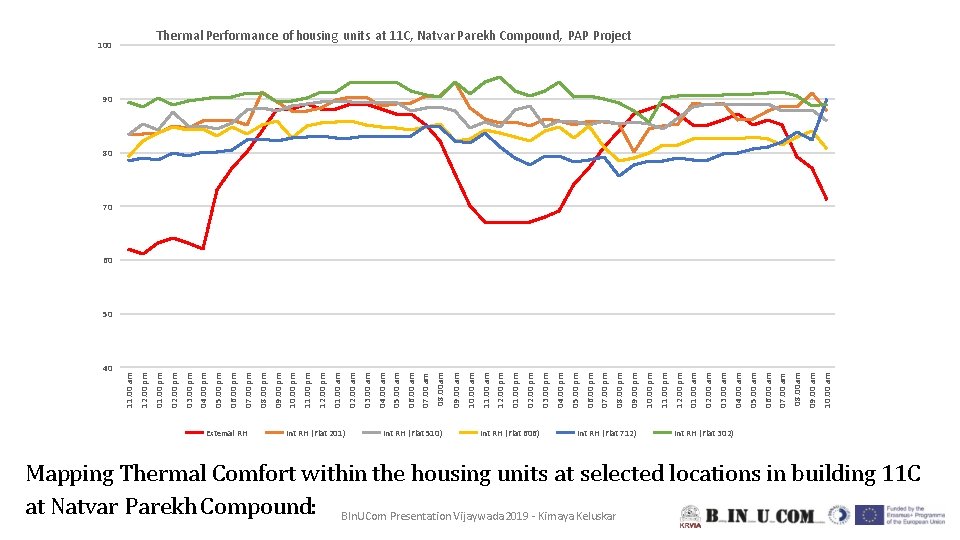
11. 00 am 40 External RH Int RH (Flat 201) Int RH (Flat 510) Int RH (Flat 606) Int RH (Flat 712) 10. 00 am 09. 00 am 08. 00 am 07. 00 am 06. 00 am 05. 00 am 04. 00 am 03. 00 am 02. 00 am 01. 00 am 12. 00 pm 11. 00 pm 10. 00 pm 09. 00 pm 08. 00 pm 07. 00 pm 06. 00 pm 05. 00 pm 04. 00 pm 03. 00 pm 02. 00 pm 01. 00 pm 12. 00 pm 11. 00 am 10. 00 am 09. 00 am 08. 00 am 07. 00 am 06. 00 am 05. 00 am 04. 00 am 03. 00 am 02. 00 am 01. 00 am 12. 00 pm 11. 00 pm 10. 00 pm 09. 00 pm 08. 00 pm 07. 00 pm 06. 00 pm 05. 00 pm 04. 00 pm 03. 00 pm 02. 00 pm 01. 00 pm 12. 00 pm 100 Thermal Performance of housing units at 11 C, Natvar Parekh Compound, PAP Project 90 80 70 60 50 Int RH (Flat 302) Mapping Thermal Comfort within the housing units at selected locations in building 11 C at Natvar Parekh Compound: BIn. UCom Presentation Vijaywada 2019 - Kimaya Keluskar
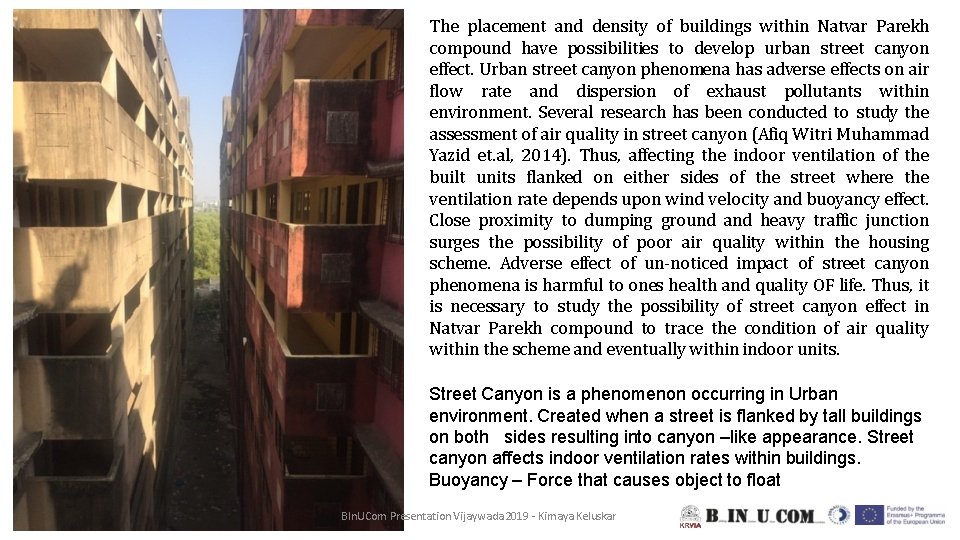
The placement and density of buildings within Natvar Parekh compound have possibilities to develop urban street canyon effect. Urban street canyon phenomena has adverse effects on air flow rate and dispersion of exhaust pollutants within environment. Several research has been conducted to study the assessment of air quality in street canyon (Afiq Witri Muhammad Yazid et. al, 2014). Thus, affecting the indoor ventilation of the built units flanked on either sides of the street where the ventilation rate depends upon wind velocity and buoyancy effect. Close proximity to dumping ground and heavy traffic junction surges the possibility of poor air quality within the housing scheme. Adverse effect of un-noticed impact of street canyon phenomena is harmful to ones health and quality OF life. Thus, it is necessary to study the possibility of street canyon effect in Natvar Parekh compound to trace the condition of air quality within the scheme and eventually within indoor units. Street Canyon is a phenomenon occurring in Urban environment. Created when a street is flanked by tall buildings on both sides resulting into canyon –like appearance. Street canyon affects indoor ventilation rates within buildings. Buoyancy – Force that causes object to float BIn. UCom Presentation Vijaywada 2019 - Kimaya Keluskar
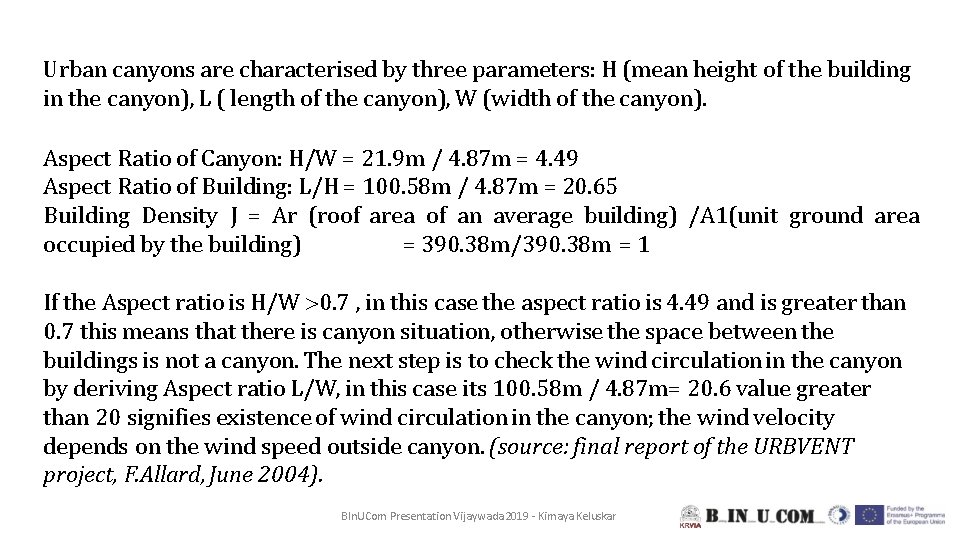
Urban canyons are characterised by three parameters: H (mean height of the building in the canyon), L ( length of the canyon), W (width of the canyon). Aspect Ratio of Canyon: H/W = 21. 9 m / 4. 87 m = 4. 49 Aspect Ratio of Building: L/H = 100. 58 m / 4. 87 m = 20. 65 Building Density J = Ar (roof area of an average building) /A 1(unit ground area occupied by the building) = 390. 38 m/390. 38 m = 1 If the Aspect ratio is H/W 0. 7 , in this case the aspect ratio is 4. 49 and is greater than 0. 7 this means that there is canyon situation, otherwise the space between the buildings is not a canyon. The next step is to check the wind circulation in the canyon by deriving Aspect ratio L/W, in this case its 100. 58 m / 4. 87 m= 20. 6 value greater than 20 signifies existence of wind circulation in the canyon; the wind velocity depends on the wind speed outside canyon. (source: final report of the URBVENT project, F. Allard, June 2004). BIn. UCom Presentation Vijaywada 2019 - Kimaya Keluskar
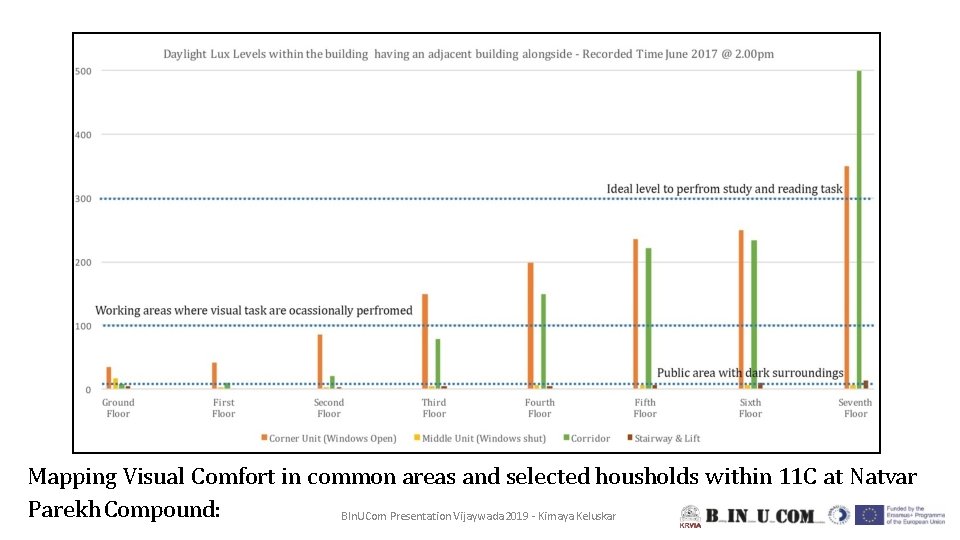
Mapping Visual Comfort in common areas and selected housholds within 11 C at Natvar Parekh Compound: BIn. UCom Presentation Vijaywada 2019 - Kimaya Keluskar
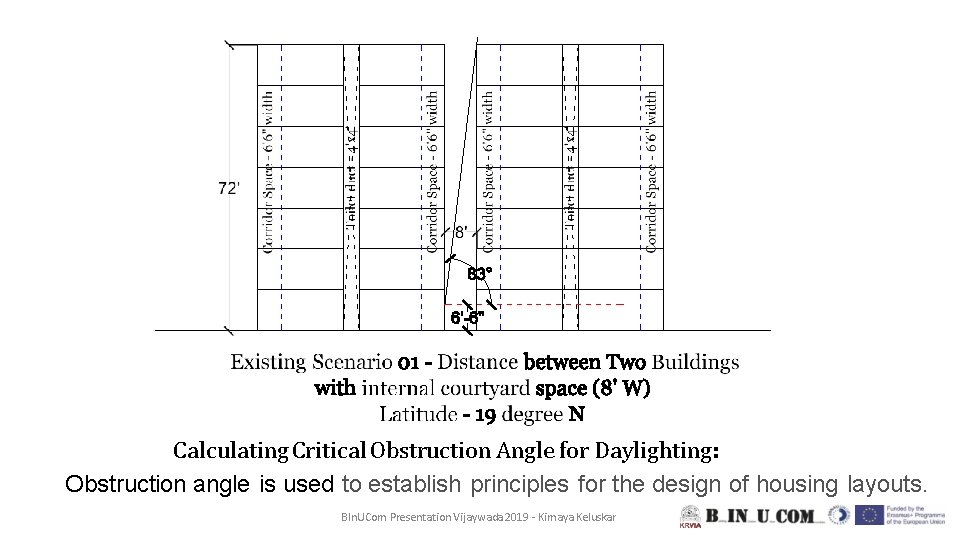
Calculating Critical Obstruction Angle for Daylighting: Obstruction angle is used to establish principles for the design of housing layouts. BIn. UCom Presentation Vijaywada 2019 - Kimaya Keluskar

Calculating Critical Obstruction Angle for Daylighting: Obstruction angle is used to establish principles for the design of housing layouts. BIn. UCom Presentation Vijaywada 2019 - Kimaya Keluskar

Calculating Critical Obstruction Angle for Daylighting: Obstruction angle is used to establish principles for the design of housing layouts. BIn. UCom Presentation Vijaywada 2019 - Kimaya Keluskar
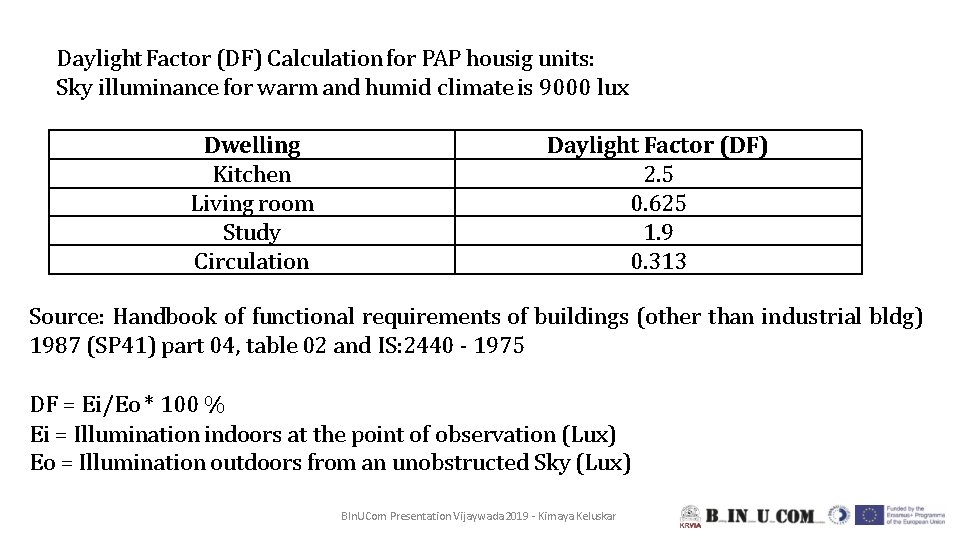
Daylight Factor (DF) Calculation for PAP housig units: Sky illuminance for warm and humid climate is 9000 lux Dwelling Kitchen Living room Study Circulation Daylight Factor (DF) 2. 5 0. 625 1. 9 0. 313 Source: Handbook of functional requirements of buildings (other than industrial bldg) 1987 (SP 41) part 04, table 02 and IS: 2440 - 1975 DF = Ei/Eo * 100 % Ei = Illumination indoors at the point of observation (Lux) Eo = Illumination outdoors from an unobstructed Sky (Lux) BIn. UCom Presentation Vijaywada 2019 - Kimaya Keluskar
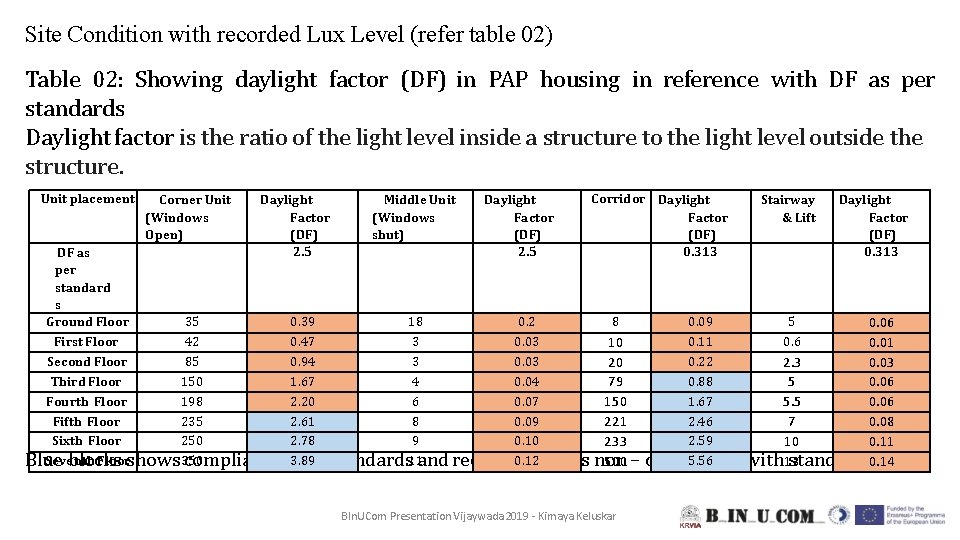
Site Condition with recorded Lux Level (refer table 02) Table 02: Showing daylight factor (DF) in PAP housing in reference with DF as per standards Daylight factor is the ratio of the light level inside a structure to the light level outside the structure. Unit placement Corner Unit (Windows Open) Daylight Factor (DF) 2. 5 DF as per standard s Ground Floor 35 First Floor 42 Second Floor 85 Third Floor 150 Fourth Floor 198 Fifth Floor 235 Sixth Floor 250 Seventh Floorshows 350 Blue blocks compliance Middle Unit (Windows shut) Daylight Factor (DF) 2. 5 0. 39 18 0. 2 0. 47 3 0. 03 0. 94 3 0. 03 1. 67 4 0. 04 2. 20 6 0. 07 2. 61 8 0. 09 2. 78 9 0. 10 3. 89 standards 11 and red block 0. 12 shows with Corridor Daylight Factor (DF) 0. 313 Stairway & Lift Daylight Factor (DF) 0. 313 0. 09 5 0. 06 0. 11 0. 6 10 0. 01 0. 22 20 2. 3 0. 03 0. 88 79 5 0. 06 1. 67 150 5. 5 0. 06 2. 46 221 7 0. 08 2. 59 233 10 0. 11 5. 56 non with 13 standards. 0. 14 500 – compliance 8 BIn. UCom Presentation Vijaywada 2019 - Kimaya Keluskar
BIn. UCom Presentation Vijaywada 2019 - Kimaya Keluskar
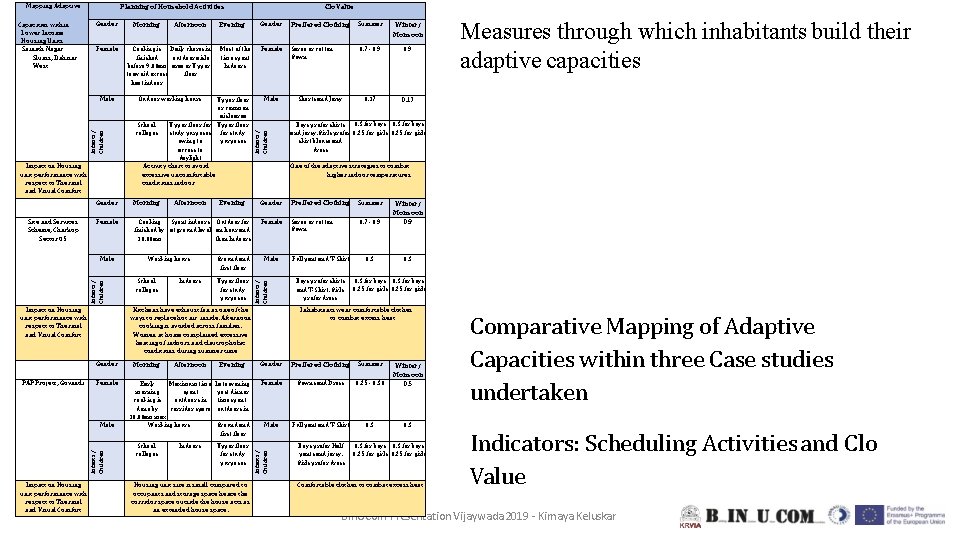
Mapping Adaptive Male Oudoor working hours Gender Preffered Clothing Summer Winter/ Monsoon Most of the time spent Indoors Female Saree or cotton Gown 0. 7 - 0. 9 0. 17 Upper floor or common aisle area School, Upper floor for Upper floor colleges study purposes for study owing to purposes access to daylight Activity chart to avoid excessive uncomfortable conditions indoor Gender Morning Female Cooking Spent indoors Outdoor finished by at ground level an hour and 10. 00 am then Indoors Infants / Children Afternoon Working hours School, colleges Indoors Evening Ground and first floor Upper floor for study purposes Male Female Infants / Children Male Morning Afternoon Early Maximum time morning spent cooking is outdoors in done by corridor space 10. 00 am max Working hours School, colleges Indoors Boys prefer shirts 0. 3 for boys and jersy. Girls prefer 0. 25 for girls skirt blouse and dress Gender Preffered Clothing Summer Female Saree or cotton Gown 0. 7 - 0. 9 Winter/ Monsoon 0. 9 0. 3 Male Kitchens have exhaust fan as one of the ways to replace hot air inside. Afternoon cooking is avoided across families. Women at home complained excessive heating of indoors and clautrophobic conditions during summer time Gender Shorts and Jersy Full pant and T-Shirt Boys prefer shirts and T-Shirt. Girls prefer dress 0. 3 for boys 0. 25 for girls Inhabitants wear comfortable clothes to combat excess heat Evening Gender Preffered Clothing Summer Late evening post dinner time spent outdoors in Female Gowns and Dress 0. 25 - 0. 30 Winter/ Monsoon 0. 5 Ground and first floor Male Full pant and T-Shirt 0. 3 Upper floor for study purposes Housing unit size is small compared to occupants and storage space hence the corridor space outside the house acts as an extended house space. Measures through which inhabitants build their adaptive capacities One of the adaptive strategies to combat higher indoor temperatures Infants / Children Impact on Housing unit performance with respect to Thermal and Visual Comfort Evening Infants / Children Cooking is Daily chores in finished outdoor aisle before 9. 00 am area or Upper to avoid excess floor heat indoor Male PAP Project, Govandi Afternoon Female Impact on Housing unit performance with respect to Thermal and Visual Comfort Site and Services Scheme, Charkop Sector 05 Morning Clo Value Infants / Children Gender Infants / Children Capacities within Lower Income Housing Units Sainath Nagar Slums, Dahisar West Planning of Household Activities Boys prefer Half pants and jersy. Girls prefer dress 0. 3 for boys 0. 25 for girls Comfortable clothes to combat excess heat Comparative Mapping of Adaptive Capacities within three Case studies undertaken Indicators: Scheduling Activities and Clo Value BIn. UCom Presentation Vijaywada 2019 - Kimaya Keluskar
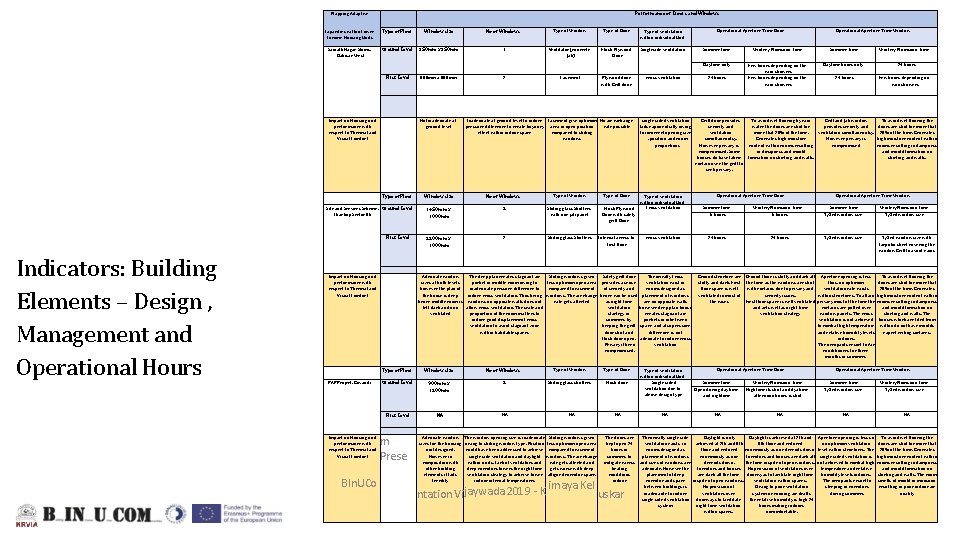
Mapping Adaptive Performance of Doors and Windows Capacities within Lower Income Housing Units Type of Floor Window size No of Windows Type of Window Type of Door Type of ventilation within individual Unit Sainath Nagar Slums, Dahisar West Ground Level 350 mm x 350 mm 1 Ventilator (concrete Jali) Flush Plywood Door Singleside ventilation First Level 600 mm x 600 mm 2 Casement Plywood door with Grill door cross-ventilation Impact on Housing unit performance with respect to Thermal and Visual Comfort Not inadequate at ground level Type of Floor Site and Services Scheme, Ground Level Charkop Sector 05 First Level Indicators: Building Elements – Design , Management and Operational Hours Impact on Housing unit performance with respect to Thermal and Visual Comfort Ground Level First Level Impact on Housing unit performance with respect to Thermal and Visual Comfort BIn. UCo Window size No of Windows Type of Window 1450 mm x 1000 mm 2 Sliding glass Shutters with one jali panel Type of Door Flush Plywood Door with safety grill Door 2200 mm x 1000 mm 2 Sliding glass Shutters Internal access to first floor single sided ventilation fails exponentially owing to incorrect opening size , position and room proportions Type of ventilation within individual Unit Cross ventilation cross-ventilation Adequate window The deep plan creates stagnant air Sliding windows given Safety grill door Theorically Cross sizes at both levels pocket in middle room owing to less optimum open area provides a sense ventilation exist in however the plan of inadequate pressure difference to compared to casement of security and rooms designed as the house is deep induce cross ventilation. Thus being windows. The air change hence can be used placement of windows hence middle room is windows on opposite walls does not rate gets affected as night time are on opposite walls left dark and non allow cross ventilation. The scale and ventilation however deep plan house ventilated proportion of the room matters to startegy in creates stagnant air induce good displacement cross summers by pockets in inbetween ventilation to avoid stagnant zone keeping the grill space and also pressure within habitable spaces door shut and difference is not flush door open. adequate to induce cross Privacy if been ventilation compromised. Type of Floor PAP Project, Govandi Inadequate at ground level to induce Casement give optimum No air exchange pressure difference to create buyoncy area in open position rate possible effect within indoor space compared to sliding windows m Prese No of Windows Type of Window Type of Door 900 mm x 1200 mm 2 Sliding glass shutters Flush door NA NA Window size NA Adequate window The window opening size is inadequate Sliding windows given sizes for the housing owing to sliding window type. Position less optimum open area unit designed. could have been addressed to achieve compared to casement However in single side ventilation and daylight windows. The air change composition within units. Lack of ventilators and rate gets affected and other building deep corridors lowers the night time gets worse with deep elements it fails ventilation strategy to acheive lower alligned corridor space. terribly indoor internal temperatures ntation Vi jaywada 2019 - K imaya Kel NA The doors are kept open 24 hours in summers to mitigate excess heating conditions indoor uskar Type of ventilation within individual Unit Single sided ventilation due to alcove design type NA Operational Aperture Time Door Operational Aperture Time Window Summer time Winter/ Momsoon time Summer time Daytime only Few hours depending on the rain showers Daytime hours only 24 hours Grill door provides security and ventilation simultaneoulsy. However privacy is compromised. Some houses do have fabric curtain over the grill to seek privacy. 24 hours Few hours depending on rain showers To avoid wet flooring by rain Grill and Jali window To avoid wet flooring the water the doors are shut for provides security and doors are shut for more that 70% of the time. ventilation simultaneoulsy. 70% of the time. Generates high moisture However privacy is high moisture content within rooms resulting compromised rooms resulting in dampness in dmapness and mould formation on skirting and walls. Operational Aperture Time Door Summer time 24 hours Winter/ Momsoon time Winter/Momsoon time Operational Aperture Time Window Summer time Winter/Momsoon time 1/3 rd window size 5 hours 1/3 rd window size 24 hours 1/3 rd window size Ground structure are Ground floor is stuffy and dark all Aperture opening is less stuffy and dark. First the time as the windows are shut thus, no optimum floor space is well with curtains due to privacy and ventilation rate exists ventilated in most of security issues. within structures. To attain the cases First floor space is well ventilated privacy most of the time the and acts well as night-time curtains are pulled over ventilation strategy window panels. The cross ventilation is not achieved to combat high temperature and relative humidity levels indoors. The occupants resort to Air conditioners for three months in summers Operational Aperture Time Door 1/3 rd window size with tarpolin sheet covering the window Grill to avoid rains To avoid wet flooring the doors are shut for more that 70% of the time. Generates high moisture content within rooms resulting in dampness and mould formation on skirting and walls. The houses which are tiled from within do not have moulds expect ceiling surfaces. Operational Aperture Time Window Summer time Winter/Momsoon time Open during daytime and nightime Nightime its shut and dyatime afternoon hours is shut 1/3 rd window size NA NA Theorically single side Daylight is only Daylight is achieved at 7 th and ventilation exists in achieved at 7 th and 6 th floor and reduced rooms designed as floor and reduced enormously as one decends down. placement of windows enormously as one Corridors and houses are dark all and sizes of windows are decends down. the time inspite of open windows. adequate. However the Corridors and houses No provision of ventilators over placement of deep are dark all the time doorwyas to facilitate night time corridor and space inspite of open windows. ventilation within spaces. between buildings is No provision of Owing to poor ventilation inadeqaute to induce ventilators over system or running air drafts single sided ventilation doorways to facilitate the relative humidity is high 24 system night time ventilation hours making indoors within spaces. uncomfortable. NA NA Aperture opening is less so no optimum ventilation level within structures. The single sided ventilation is not achieved to combat high temperature and relative humidity levels indoors. The occupants resort to sleeping in corridors during summers To avoid wet flooring the doors are shut for more that 70% of the time. Generates high moisture content within rooms resulting in dampness and mould formation on skirting and walls. The room smells of mould in monsoon resulting in poor indoor air quality
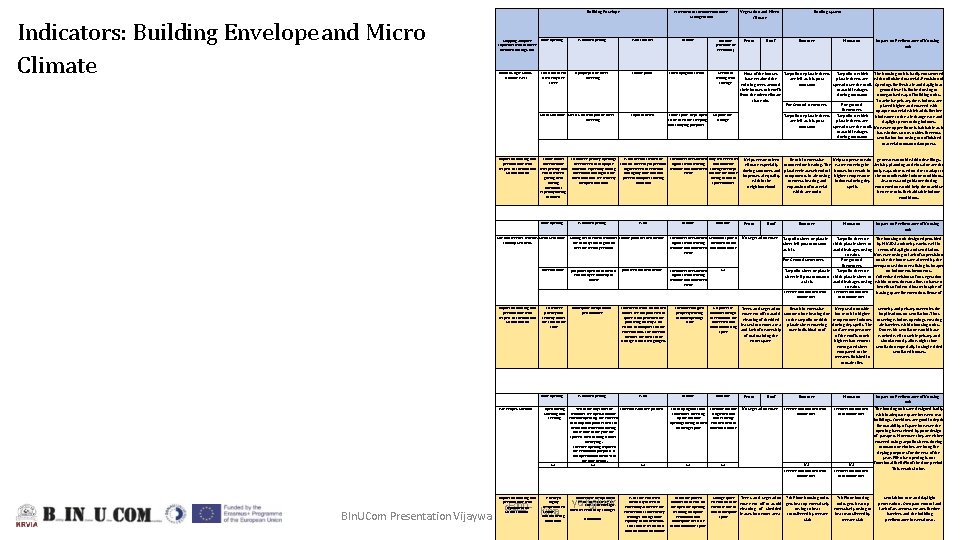
Builidng Envelope Indicators: Building Envelope and Micro Climate Mapping Adaptive Capacities within Lower Income Housing Units Door Opening Sainath Nagar Slums, Dahisar West Curtain made of used Polyster saree Window Opening Wall Finishes Opaque plastic sheet covering Colour paint Metal Grill door Metal Grill with plastic sheet covering Impact on Housing unit Fabric allows performance with intermediate respect to Thermal and level privacy and Visual Comfort cuts off excess glaring heat during afternoons espcially during summers Door Opening Site and Services Scheme, Metal Grill Door Charkop Sector 05 Internal door Placement of Furniture and other Storage means To achieve privacy openings are covered with opaque materials especially during afternoons and night time when outdoors are scarecly occupied and dark Window Opening Exposed brick Lined up against walls Floor space kept open to be used for sleeping and studying purposes Outdoor (corridor or verandah) Verandah seating with storage No place for storage Walls are not treated or Furnitures are Stacked Only water vessles finishes correctly to perfrom against walls leaving and footware higher levels of refletion window and door area storage are kept during day time and also clear outside the house prevent dampness during owing to lack of monsoon space indoors Wall Sliding or Casement windows Colour paint or tiled surface are usually shut at ground level for security reasons Jali panel open with internal curtain layer made up of fabric Indoor plastered finshed surface Indoor Outdoor Furnitures are Stacked Verandah space is against walls leaving included within window and door area individual house clear Furnitures are Stacked against walls leaving window and door area clear Roofing system Vegetation and Micro Climate Front Roof Summer To achieve privacy and security doors are shut all the time Door Opening PAP Project, Govandi Open during Morning and Evening NA Inadequate for optimum performance Inbetween walls within two houses are not plastered as space is not provided for plastering activity. This results in dampness on the external wall. The internal surfaces are tiled so the damage is not been gauged. Window Opening Wall External Walls are painted 70% of the day time the windows are open. Outdoor corridor openings are covered with tarpolin plastic sheets to avoid rain water and during other time of the year the space is used to hang clothes for drying. Effective opening required for ventilation purposes is not operational for 80% of the time period. NA NA Furniture alligned properly leaving window openings clear The housing unit is badly constructed with unfinished material. Provision of Openings for fresh air and daylight at ground level is limited owing to unorganised way of building units. To acheive privacy the windows are placed higher and covered with opaque material which adds further hindrance to the air change rate and daylight penetrating indoors. However upper floor is habitable as it has windows on two sides for cross ventilation but owing to unfinished material monsoon dampness Helps create micro Result in excessive Helps to prevent rain climate especially summertime heating. The water entering the during summers and plastic releases chemical houses but result in improves air quality components in air owing higher temperature within the to excess heating and indoors during dry neighbourhood expansion of material spells which are toxic. generates mould within dwellings. Activity planning and clo value are the only ways observed on site to adapt to the uncomfortable indoor conditions. Awarness and guidance during construction would help them achive better results for habitable indoor conditions. Front Roof No vegetation cover NA Indoor No psace for outdoor storages as verandahs are converted into additional living space Outdoor Lined up against wall Corridor has one sometimes covering single bed and up the window some storage openings owing to lack cabinets next to of storage space individual house NA Summer BIn. UCom Presentation Vijaywa Privacy is highly compromised tochiev a e comfort living conditions da 2019 - Kima re spec t to. Term h al an d Visual Comfort ya Kar elusk Inadequate for optimum performance owing to and Alcove design barriers created by storages limitations Walls are Plastered inetrnally as well as externally. However the corner units suffer heavy leakages owing to low cquality of construction. This further result into mould formation Indoor Furniture placed indoors often cuts off the aperture opening resulting into poor ventilation and inadeqaute fresh air within habitable space Monsoon Tarpolin sheet or plastic sheet left post monsoon as it is Tarpolin sheet or thick plastic sheet to avoid leakages owing to rains For Ground structures For ground Structures Tarpolin sheet or plastic Tarpolin sheet or sheet left post monsoon thick plastic sheet to as it is avoid leakages owing to rains Terrace slab finished with mosaic tiles Impact on Performance of Housing unit The housing unit designed provided by MHADA authority works well in terms of daylight and ventilation. However owing to lack of supervision on site the houses are altered by the occupants without realising its imapct on indoor enviornments. Collective decisions of no vegetation within courts doesnt allow to harvest benefits of micro climate; inspite of having space for execution. Sense of Trees and vegetation Result in excessive Keeps rain outside security and privacy overrules the cover cut off to avoid summertime heating due but result in higher implications on ventilation. Thus cleaning of shedded to the tarpolin or thich temperature indoors covering window openings creating leaves into court area plastic sheet covering during dry spells. The air barriers within housing units. and lack of ownership over individual roof surface temperature Door with ventilator would have of maintaining the of the roof is much worked well to tackle privacy and court space higher than cement simulateously allow night time corrugated sheet ventilation expecially in single sided compared to the ventilated houses. terraces finished in mosaic tiles Front Roof No vegetation cover NA Summer Terrace slab finished with mosaic tiles NA Terrace slab finished with mosaic tiles Impact on Housing unit performance with Impact on Performance of Housing unit Most of the houses Tarpolin or plastic sheets Tarpolin or thick have retained the are left as it is post plastic sheets are existing trees around monsoon spread over the roofs their houses to benefit to avoid leakages from the micro climate during monsoon that exits For Ground structures For ground Structures Tarpolin or plastic sheets Tarpolin or thick are left as it is post plastic sheets are monsoon spread over the roofs to avoid leakages during monsoon Terrace slab finished with mosaic tiles Impact on Housing unit performance with respect to Thermal and Visual Comfort Monsoon Storage space Trees and vegetation extends into the cover cut off to avoid corridor due to cleaning of shedded lack of adequate leaves into court area space 7 th Floor housing units gets heat up excessively owing to heat transferred by terrace slab Monsoon Impact on Performance of Housing unit Terrace slab finished with mosaic tiles The housing units are designed badly with inadequate space between two buildings. Corridors are good in depth for usuability of space however the opening is restricted by poor design of parapett. Moreover they are either covered using tarpolin sheets during monsoon or clothes are hung for drying purposes for the rest of the year. Effective opening is not functional for 80% of the time period. This results in low NA Terrace slab finished with mosaic tiles 7 th Floor housing units gets heat up excessively owing to heat transferred by terrace slab ventialtion rate and daylight penetration. Occupant control and lack of awareness creates further barriers and the building performance lowers down.
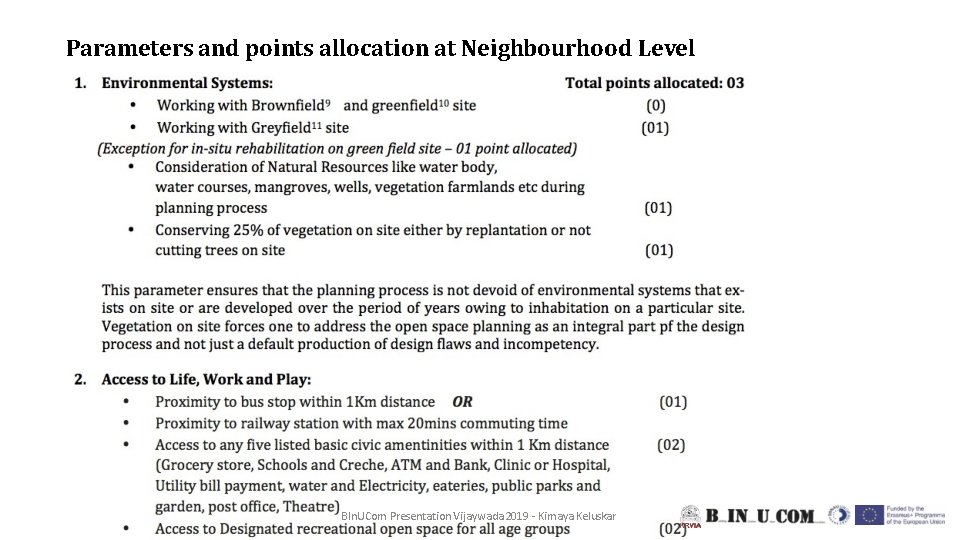
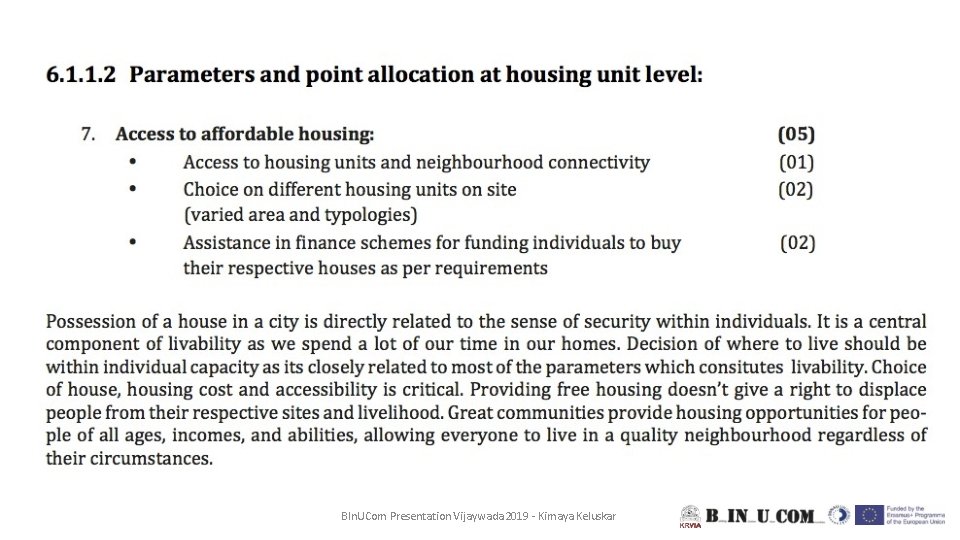
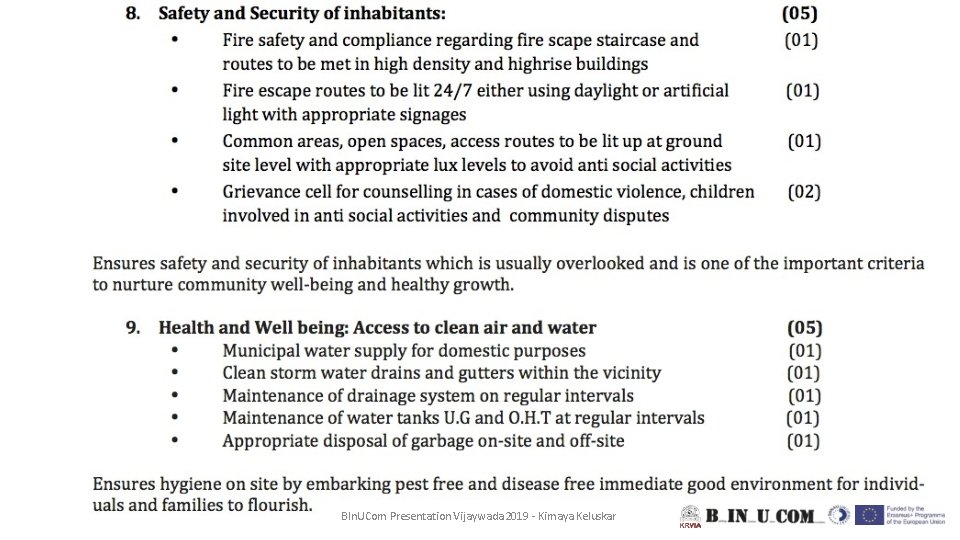
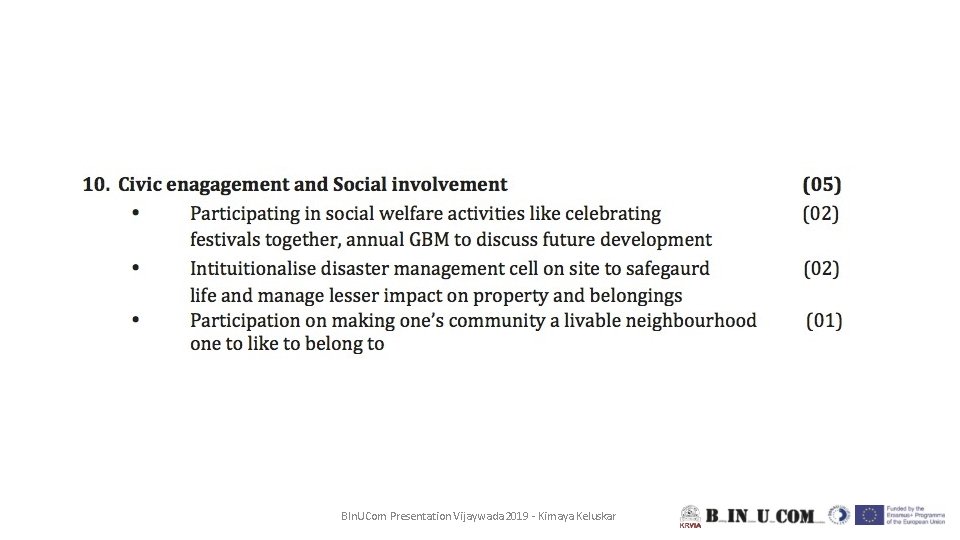
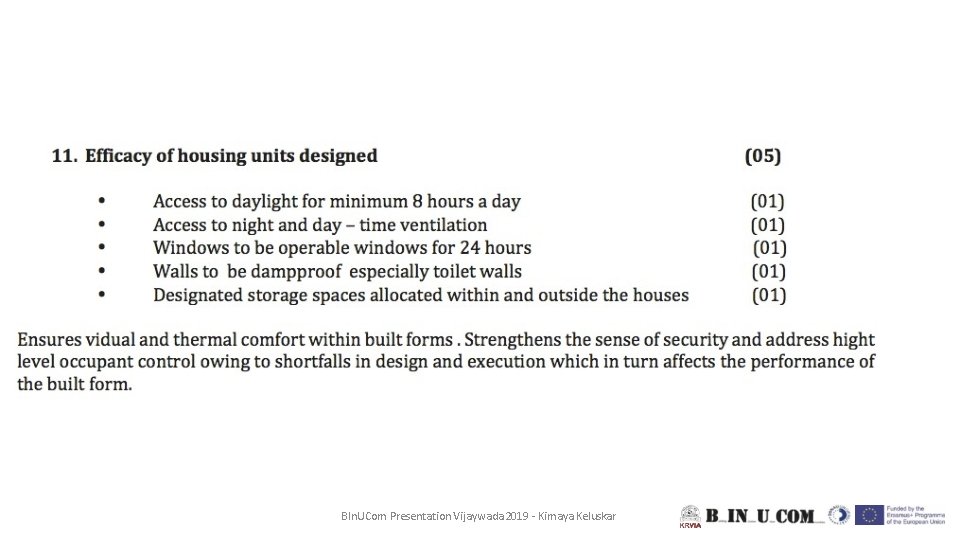
Parameters and points allocation at Neighbourhood Level BIn. UCom Presentation Vijaywada 2019 - Kimaya Keluskar
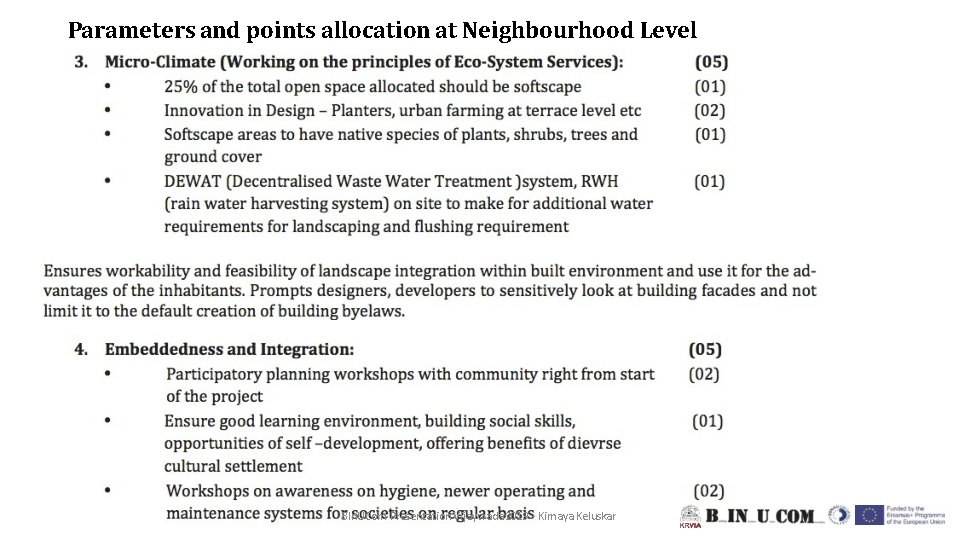
Parameters and points allocation at Neighbourhood Level BIn. UCom Presentation Vijaywada 2019 - Kimaya Keluskar
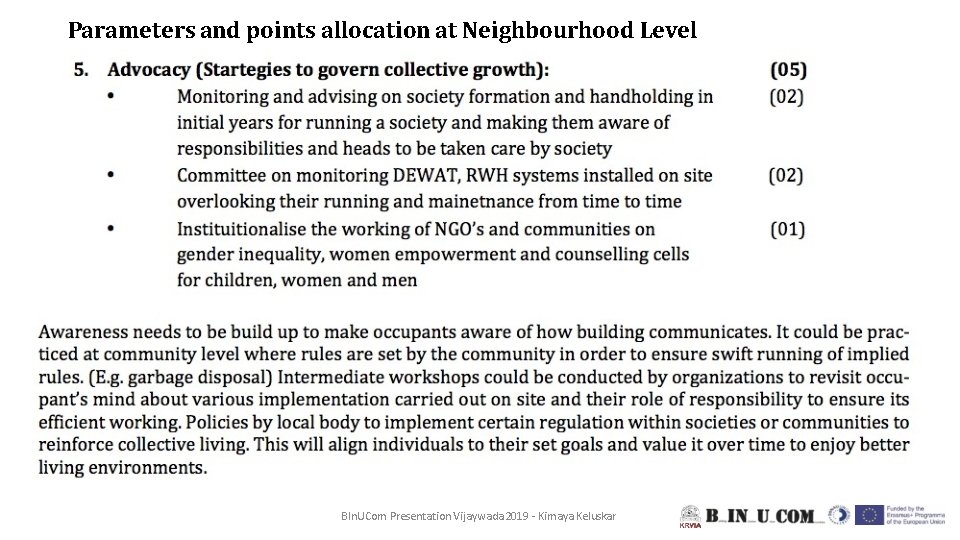
Parameters and points allocation at Neighbourhood Level BIn. UCom Presentation Vijaywada 2019 - Kimaya Keluskar
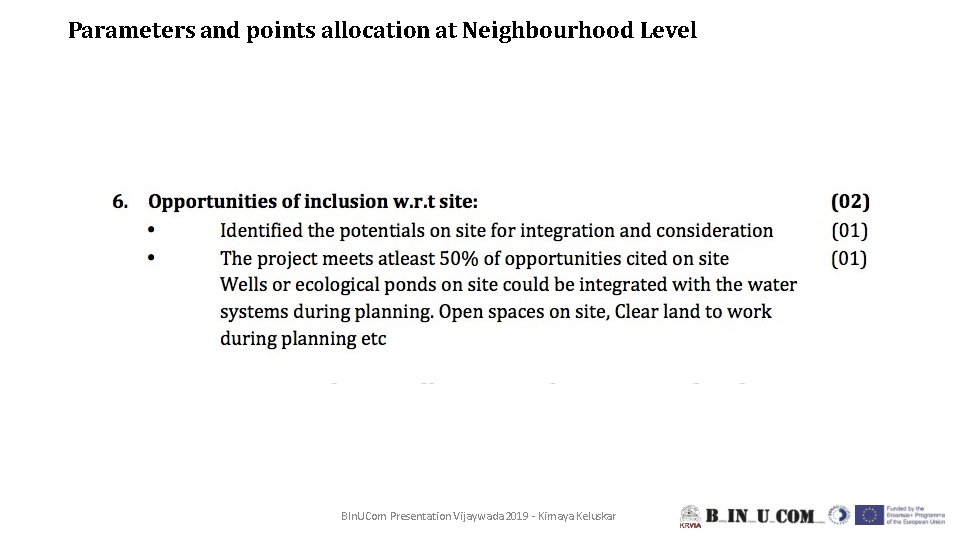
Parameters and points allocation at Neighbourhood Level BIn. UCom Presentation Vijaywada 2019 - Kimaya Keluskar
BIn. UCom Presentation Vijaywada 2019 - Kimaya Keluskar
BIn. UCom Presentation Vijaywada 2019 - Kimaya Keluskar
BIn. UCom Presentation Vijaywada 2019 - Kimaya Keluskar
BIn. UCom Presentation Vijaywada 2019 - Kimaya Keluskar
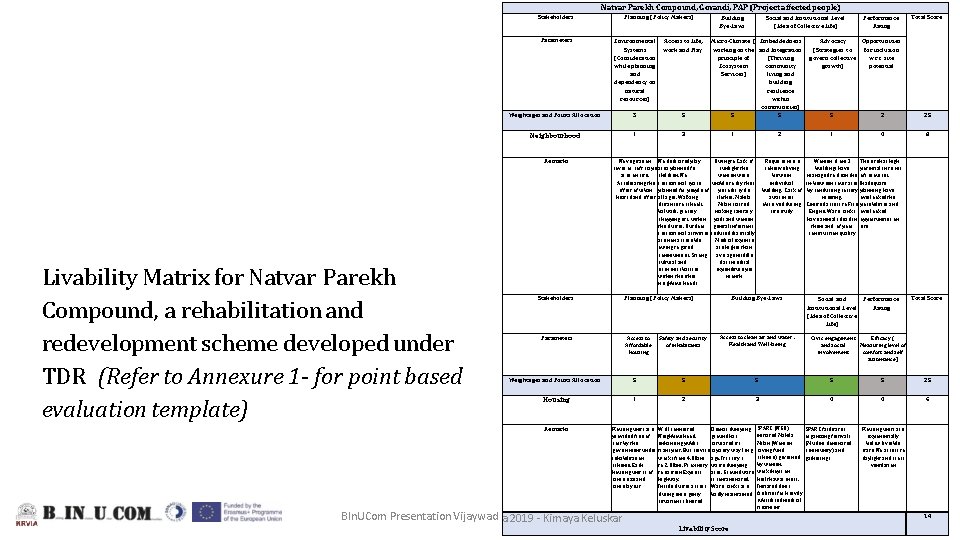
Natvar Parekh Compound, Govandi, PAP (Project affected people) Stakeholders Parameters Livability Matrix for Natvar Parekh Compound, a rehabilitation and redevelopment scheme developed under TDR (Refer to Annexure 1 - for point based evaluation template) Planning (Policy Makers) Environmental Systems (Consideration while planning and dependency on natural resources) Access to Life, work and Play Weightages and Points Allocation 3 5 Neighbourhood 1 3 Remarks No vegetation No dedicated play cover or soft scape area planned for area on site. children. No Accelerating the recreational space effect of urban planned for people of heat island effect all ages. Walking distance to schools, balwadi, grocery shopping etc. within the cluster. Outdoor recreational activities are non accessible owing to gated communities. Strong cultural and economic barrier within the other neighbourhoods Stakeholders Planning (Policy Makers) Building Bye-Laws Social and Institutional Level (Idea of Collective Life) Micro-Climate ( Embeddedness working on the and Integration principle of (Thriving Ecosystem community Services) living and building resilience within communities) 5 5 1 2 Total Score Advocacy Opportunities (Strategies to for inclusion govern collective w. r. t site growth) potential 5 2 25 1 0 8 Owing to Lack of Requires more Women from 3 sunlight the cohesive living buildings have women were between managed to clean the unable to dry their individual in-between court area periodic cycle building. Lack of by conducting society clothes. Mahila awareness meeting. Milan started observed during Limited access to Fire making sanitary site study Engine. Water tanks pads and women have animals dead in genital infections them and of poor reduced drastically. construction quality Medical expense are higher than average middle class medical expenditure per month Building Bye-Laws Performance Rating Social and Institutional Level (Idea of Collective Life) The site has high potential in terms of resources. Inadequate planning have overlooked the possibilities and overlooked opportunities on site Performance Rating Total Score Safety and security of inhabitants Access to clean air and water. Health and Well-being 5 5 5 25 Housing 1 2 3 0 0 6 Remarks Housing units are provided free of cost by the government under rehabilitation scheme. Each housing unit is of same size and same layout Parameters Access to Affordable housing Weightages and Points Allocation BIn. UCom Presentation Vijaywad a 2019 - Kimaya Keluskar Well connected Deonar dumping SPARC (NGO) initiated Mahila Neighbourhood, ground has Milan (Women enhancing public saturated its transport. Bus service capacity way long saving fund scheme) governed works from 4. 00 am ago. It is city's by women, to 2. 00 am. Proximity waste dumping to eastern Express area. Ground water workshops on highway. is contaminated. health awareness. Initiated clinic Inside cluster access Water tanks are during emergency badly maintained facilities for heavily subsidised medical situation is limited treatment Civic engagement Efficacy ( and social Measuring level of involvement comfort and self sustenance) SPARC facilitates organizing festivals (Muslim dominated community) and gatherings Housing units are exponentially below liveable state. No access to daylight and cross ventilation 14 Livability Score
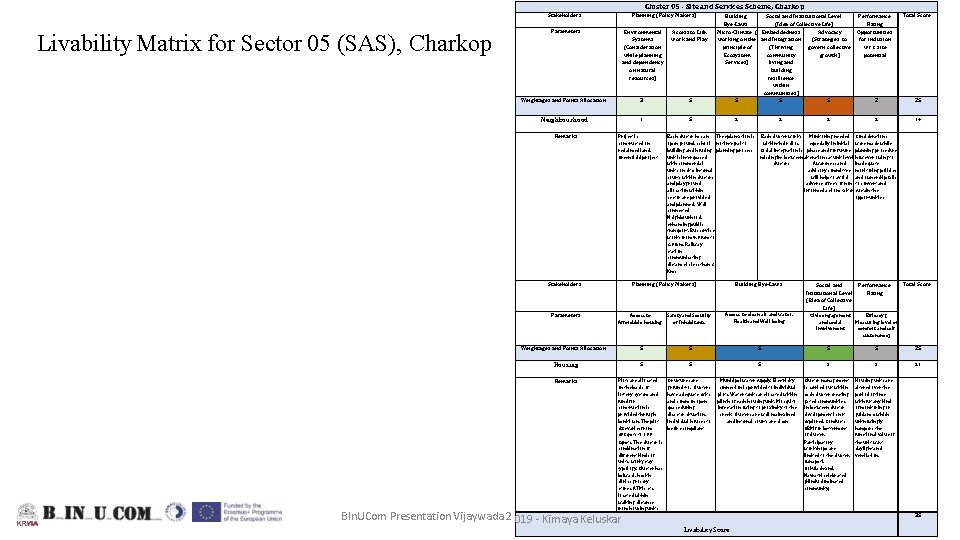
Cluster 05 - Site and Services Scheme, Charkop Stakeholders Livability Matrix for Sector 05 (SAS), Charkop Planning (Policy Makers) Parameters Environmental Systems (Consideration while planning and dependency on natural resources) Access to Life, work and Play Weightages and Points Allocation 3 5 Neighbourhood 1 5 Remarks Project is constructed on reclaimed land. Green field project Stakeholders Parameters 2 Each cluster has an Tree plantation is open ground, school not integral to building and housing planning process unit is interspaced with commercial units on site. Internal courts within clusters and playground allocation within sector are provided and planned. Well connected Neighbourhood, enhancing public transport. Bus service works from 4. 00 am to 2. 00 am. Railway station communicating distance is less than 2 Kms Planning (Policy Makers) Access to Affordable housing Weightages and Points Allocation Housing Remarks Building Social and Instituitional Level Bye-Laws (Idea of Collective Life) Micro-Climate ( Embeddedness Advocacy working on the and Integration (Strategies to principle of (Thriving govern collective Ecosystem community growth) Services) living and building resillience within communities) 5 5 5 2 Total Score 2 25 2 14 Each cluster works Monitoring needed Considerations within their silos. especially in initial were made while Social integration is phase and for future planning procedure missing in- between alterations at unit level. however owing to clusters Awareness and inadequate advisory committee monitoring policies will help to avoid and ownership fails adverse effects of non to convert and informed actions taken sustain the opportunities Building Bye-Laws Access to clean air and water. Health and Well-being Social and Institutional Level (Idea of Collective Life) Performance Rating Total Score Civic engagement Efficacy ( and social Measuring level of involvement comfort and self sustenance) 5 5 5 25 5 3 3 21 Plots are allocated on the basis of lottery system and fund for construction is provided through bank loan. The plot size varies from 30 Sqmts to 100 Sqmts. The cluster is combination of different kinds of units. work/stay typology. Cluster has balwadi, health clinics grocery stores, ATMs etc. located within walking distance from housing units BIn. UCom Presentation Vijaywada 2 019 - Kimaya Keluskar Safety and Security of Inhabitants 2 Performance Rating Opportunities for inclusion w. r. t site potential Structures are ground +1. Clusters have adequate exits and common open space during disaster situation. Individual houses to be fire compliant Municipal water supply, Electricity connection is provided to individual plots. Water tanks are located within plinth of each housing unit. Mosquito infestation owing to proximity to the creek. Clusters are well maintained and internal courts are clean Cluster management is carried out within each cluster creating gated communities. In-between cluster development is not explored. Conducts GBM for betterment of cluster. Participatory workshops are limited to the cluster. Ganapati, Gokulashtami, Navratri celebrated (Hindu dominated community) Housing units are altered over the period of time without any kind of monitoring or guidance, which unknowingly hampers the functional value of the unit w. r. t daylight and ventilation. 35 Livability Score
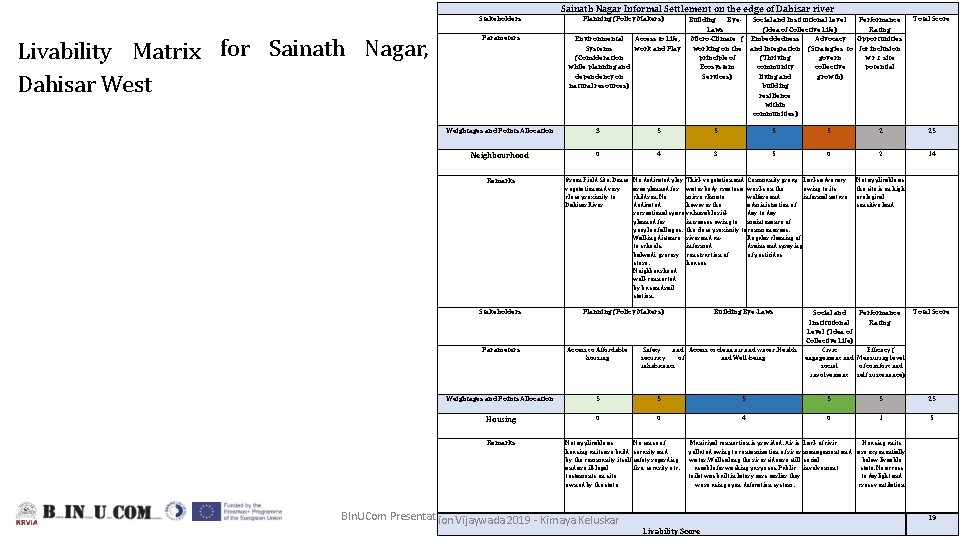
Sainath Nagar Informal Settlement on the edge of Dahisar river Livability Matrix for Sainath Nagar, Dahisar West Stakeholders Planning (Policy Makers) Parameters Environmental Access to Life, Systems work and Play (Consideration while planning and dependency on natural resources) Building Bye. Social and Institutional Level Performance Laws (Idea of Collective Life) Rating Micro-Climate ( Embeddedness Advocacy Opportunities working on the and Integration (Strategies to for inclusion principle of (Thriving govern w. r. t site Ecosystem community collective potential Services) living and growth) building resilience within communities) Total Score Weightages and Points Allocation 3 5 5 2 25 Neighbourhood 0 4 3 5 0 2 14 Remarks Green Field Site. Dense vegetation and very close proximity to Dahisar River No dedicated play area planned for children. No dedicated recreational space planned for people of all ages. Walking distance to schools, balwadi, grocery store. Neighbourhood well-connected by bus and rail station. Stakeholders Thick vegetation and Community group Lacks advocacy water body creates a works on the owing to its micro climate welfare and informal nature however the administration of vulnerable risk day to day increases owing to maintenance of the close proximity to common areas. river and un. Regular cleaning of informed drains and spraying construction of of pesticides houses Planning (Policy Makers) Building Bye-Laws Not applicable as the site is on high ecological sensitive land Social and Performance Institutional Rating Level (Idea of Collective Life) Total Score Parameters Access to Affordable housing Weightages and Points Allocation 5 5 5 25 Housing 0 0 4 0 1 5 Remarks Not applicable as housing units are build by the community itself and are ill-legal testaments on site owned by the state BIn. UCom Presentat ion Vijaywada 2019 - Kimaya Keluskar Safety and Access to clean air and water. Health security of and Well-being inhabitants No sense of security and safety regarding fire, security etc. Municipal connection is provided. Air is polluted owing to contamination of river water. Wells along the river side are still useable for washing purposes. Public toilet was built in later years, earlier they were using open defecation system. Civic Efficacy ( engagement and Measuring level social of comfort and involvement self sustenance) Lack of civic Housing units management and are exponentially social below liveable involvement state. No access to daylight and cross ventilation 19 Livability Score
Recommendations: Building Bye-laws and Design imperatives: Building on the Lines of Ecosystem Services for proposed constructions and retrofitting of existing schemes: Need for setting up Landscape green infrastructure in urban climate especially in high density areas. 1 b. 1: Impact on Urban climate: 1 b. 2: Impact on Health and well-being: Necessity of Advocacy and Embeddedness: BIn. UCom Presentation Vijaywada 2019 - Kimaya Keluskar

BIn. UCom Presentation Vijaywada 2019 - Kimaya Keluskar
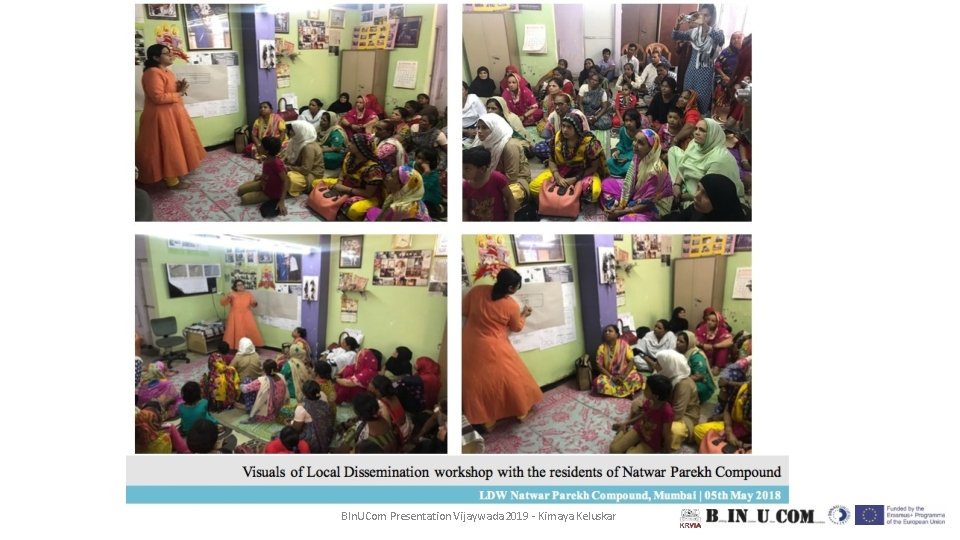
BIn. UCom Presentation Vijaywada 2019 - Kimaya Keluskar
Methodology: Mapping is conducted under various key indicators listed below which work towards enhancing the quality of life within a neighbourhood. 1. Module 01: Basic Needs and Standard of living 2. Module 02: Health and Wellness 3. Module 03: Environment and Sustainability 4. Module 04: Energy and Climate 5. Module 05: Accessibility and Social interaction 6. Module 06: Community and Belonging BIn. UCom Presentation Vijaywada 2019 - Kimaya Keluskar
Learning Outcomes: Understanding building design performance with respect to climate and its impact on occupant’s health. Occupant behaviour patterns and techniques of adaptation to achieve comfort within buildings. How comfort is being underrated within extreme living conditions and why individuals especially in economical weaker sections fails to realise the deteriorated health conditions once rehabilitated in high-rise typologies of buildings. How livability gets affected by social economical and environmental stresses within a living condition and how empirical data helps explain the anecdotal observation and act as first step towards creating framework forming guidelines to improve social environmental and economic conditions of communities making them more inclusive and resilient. Learning how to use various monitoring devices to acquire data and using analytical tools to assess the data for creating significantly substantiated observations and recommendations. BIn. UCom Presentation Vijaywada 2019 - Kimaya Keluskar
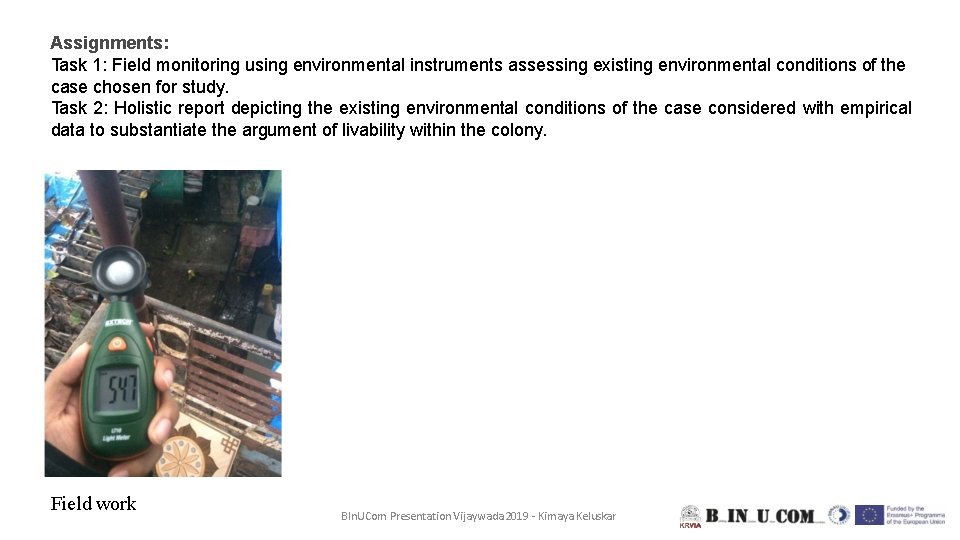
Assignments: Task 1: Field monitoring using environmental instruments assessing existing environmental conditions of the case chosen for study. Task 2: Holistic report depicting the existing environmental conditions of the case considered with empirical data to substantiate the argument of livability within the colony. Field work BIn. UCom Presentation Vijaywada 2019 - Kimaya Keluskar
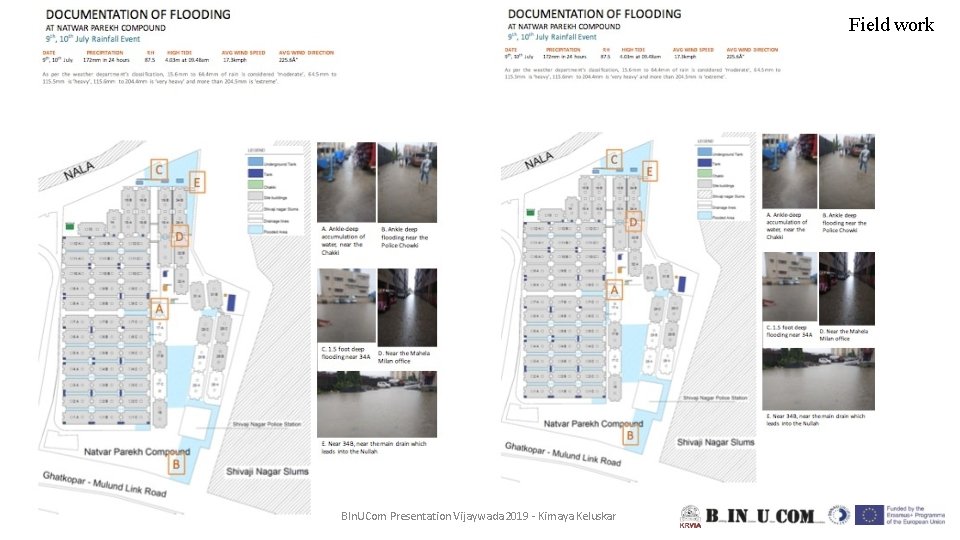
Field work BIn. UCom Presentation Vijaywada 2019 - Kimaya Keluskar
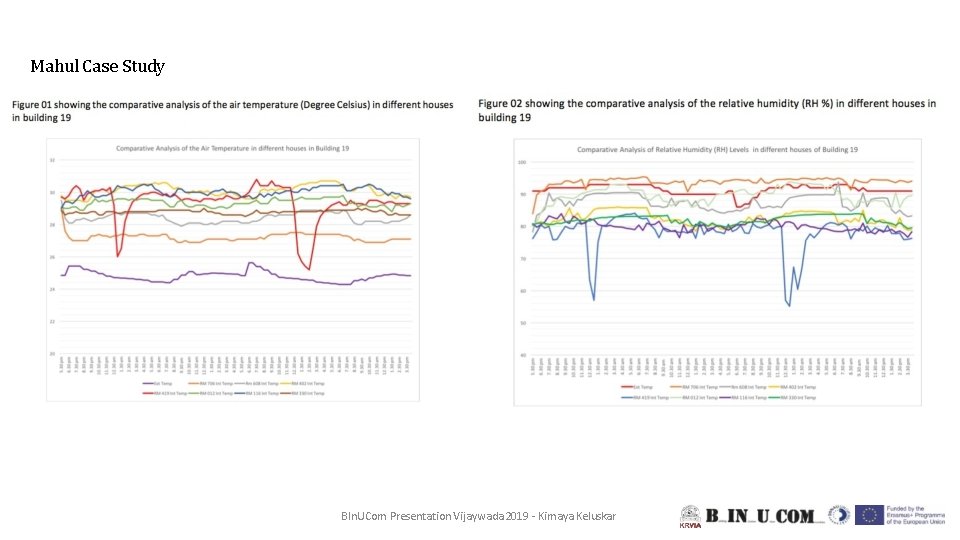
Mahul Case Study BIn. UCom Presentation Vijaywada 2019 - Kimaya Keluskar
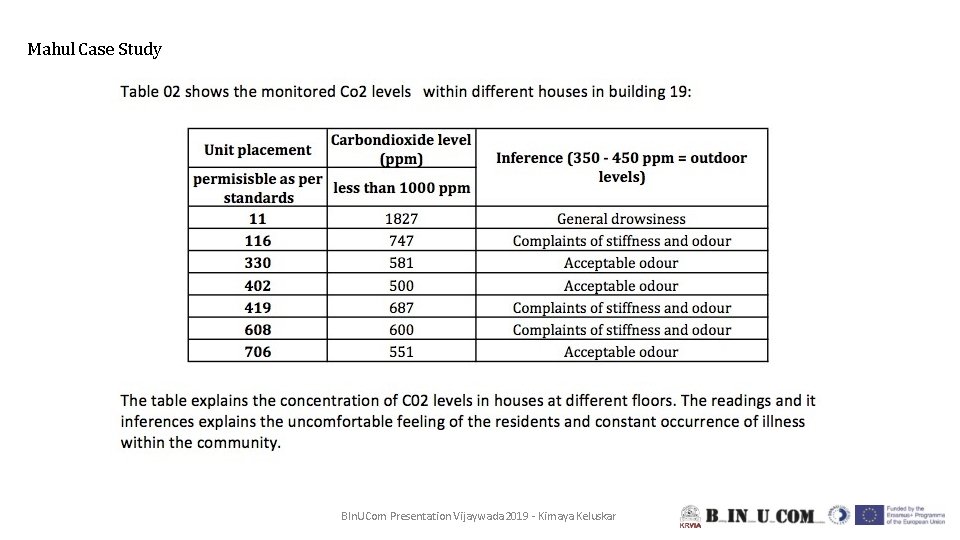
Mahul Case Study BIn. UCom Presentation Vijaywada 2019 - Kimaya Keluskar

BIn. UCom Presentation Vijaywada 2019 - Kimaya Keluskar
- Slides: 48