
Mapping Information Landscapes the methodology of the Bibliotek
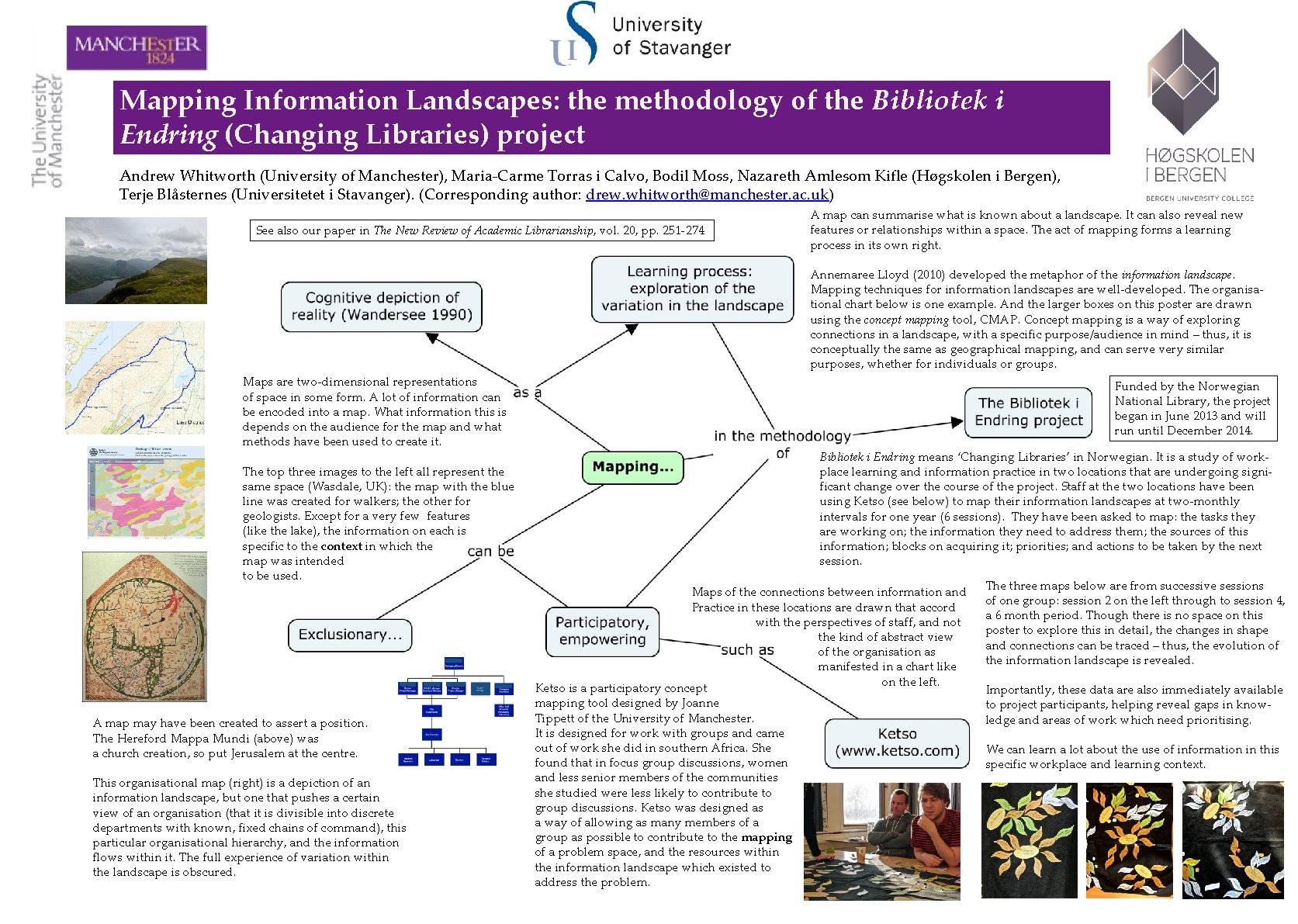
Mapping Information Landscapes: the methodology of the Bibliotek i Endring (Changing Libraries) project Andrew Whitworth (University of Manchester), Maria-Carme Torras i Calvo, Bodil Moss, Nazareth Amlesom Kifle (Høgskolen i Bergen), Terje Blåsternes (Universitetet i Stavanger). (Corresponding author: drew. whitworth@manchester. ac. uk) See also our paper in The New Review of Academic Librarianship, vol. 20, pp. 251 -274 A map can summarise what is known about a landscape. It can also reveal new features or relationships within a space. The act of mapping forms a learning process in its own right. Annemaree Lloyd (2010) developed the metaphor of the information landscape. Mapping techniques for information landscapes are well-developed. The organisational chart below is one example. And the larger boxes on this poster are drawn using the concept mapping tool, CMAP. Concept mapping is a way of exploring connections in a landscape, with a specific purpose/audience in mind – thus, it is conceptually the same as geographical mapping, and can serve very similar purposes, whether for individuals or groups. Maps are two-dimensional representations of space in some form. A lot of information can be encoded into a map. What information this is depends on the audience for the map and what methods have been used to create it. The top three images to the left all represent the same space (Wasdale, UK): the map with the blue line was created for walkers; the other for geologists. Except for a very few features (like the lake), the information on each is specific to the context in which the map was intended to be used. A map may have been created to assert a position. The Hereford Mappa Mundi (above) was a church creation, so put Jerusalem at the centre. This organisational map (right) is a depiction of an information landscape, but one that pushes a certain view of an organisation (that it is divisible into discrete departments with known, fixed chains of command), this particular organisational hierarchy, and the information flows within it. The full experience of variation within the landscape is obscured. Funded by the Norwegian National Library, the project began in June 2013 and will run until December 2014. Bibliotek i Endring means ‘Changing Libraries’ in Norwegian. It is a study of workplace learning and information practice in two locations that are undergoing significant change over the course of the project. Staff at the two locations have been using Ketso (see below) to map their information landscapes at two-monthly intervals for one year (6 sessions). They have been asked to map: the tasks they are working on; the information they need to address them; the sources of this information; blocks on acquiring it; priorities; and actions to be taken by the next session. Maps of the connections between information and Practice in these locations are drawn that accord with the perspectives of staff, and not the kind of abstract view of the organisation as manifested in a chart like on the left. Ketso is a participatory concept mapping tool designed by Joanne Tippett of the University of Manchester. It is designed for work with groups and came out of work she did in southern Africa. She found that in focus group discussions, women and less senior members of the communities she studied were less likely to contribute to group discussions. Ketso was designed as a way of allowing as many members of a group as possible to contribute to the mapping of a problem space, and the resources within the information landscape which existed to address the problem. The three maps below are from successive sessions of one group: session 2 on the left through to session 4, a 6 month period. Though there is no space on this poster to explore this in detail, the changes in shape and connections can be traced – thus, the evolution of the information landscape is revealed. Importantly, these data are also immediately available to project participants, helping reveal gaps in knowledge and areas of work which need prioritising. We can learn a lot about the use of information in this specific workplace and learning context.
- Slides: 1