
Mapping for Political Strategy Stephen Page Associate Professor
- Slides: 16
Mapping for Political Strategy Stephen Page, Associate Professor University of Washington Evans School of Public Policy & Governance sbp@uw. edu
To accomplish great things, we must not only act but also dream; not only plan but also believe. - Anatole France You have to maintain a diagnostic mindset on a changing reality… To see what is happening to you and your initiative as it is happening…. takes discipline and flexibility. Heifetz and Linsky, Leadership on the Line -
Learning Objectives 1. Analyze the politics of a situation 2. Identify strategic purpose 3. Map and utilize channels of political influence and communication 4. Build support and reduce opposition to pursue your agenda
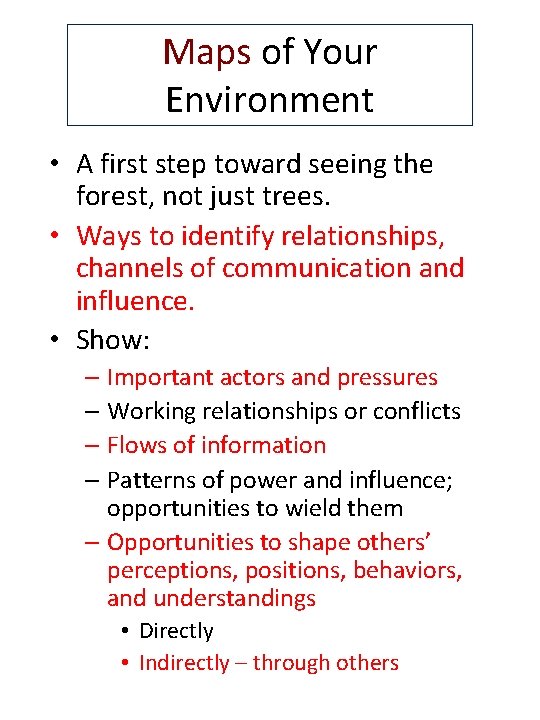
Maps of Your Environment • A first step toward seeing the forest, not just trees. • Ways to identify relationships, channels of communication and influence. • Show: – Important actors and pressures – Working relationships or conflicts – Flows of information – Patterns of power and influence; opportunities to wield them – Opportunities to shape others’ perceptions, positions, behaviors, and understandings • Directly • Indirectly – through others
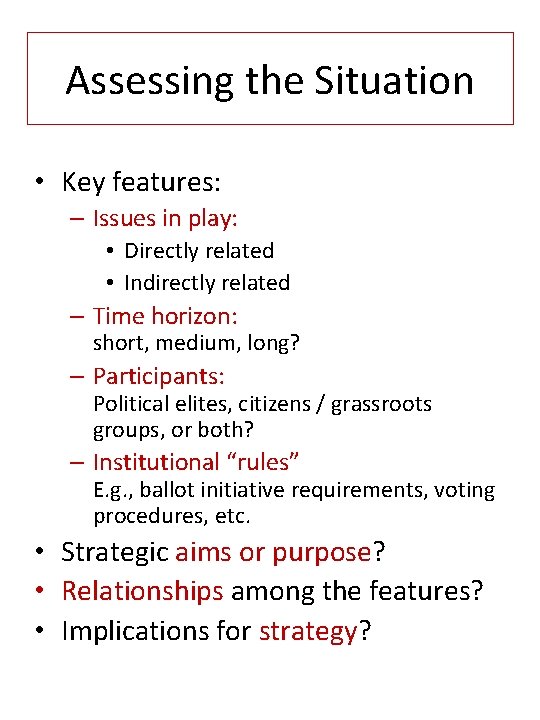
Assessing the Situation • Key features: – Issues in play: • Directly related • Indirectly related – Time horizon: short, medium, long? – Participants: Political elites, citizens / grassroots groups, or both? – Institutional “rules” E. g. , ballot initiative requirements, voting procedures, etc. • Strategic aims or purpose? • Relationships among the features? • Implications for strategy?
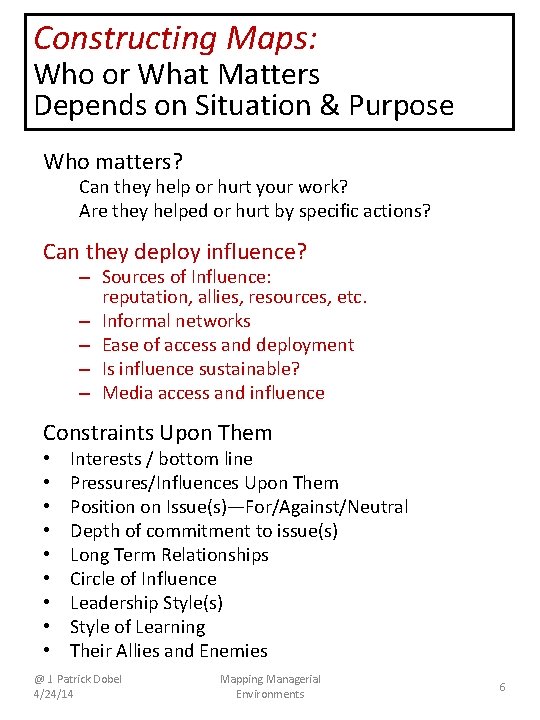
Constructing Maps: Who or What Matters Depends on Situation & Purpose Who matters? Can they help or hurt your work? Are they helped or hurt by specific actions? Can they deploy influence? – Sources of Influence: reputation, allies, resources, etc. – Informal networks – Ease of access and deployment – Is influence sustainable? – Media access and influence Constraints Upon Them • • • Interests / bottom line Pressures/Influences Upon Them Position on Issue(s)—For/Against/Neutral Depth of commitment to issue(s) Long Term Relationships Circle of Influence Leadership Style(s) Style of Learning Their Allies and Enemies @ J. Patrick Dobel 4/24/14 Mapping Managerial Environments 6
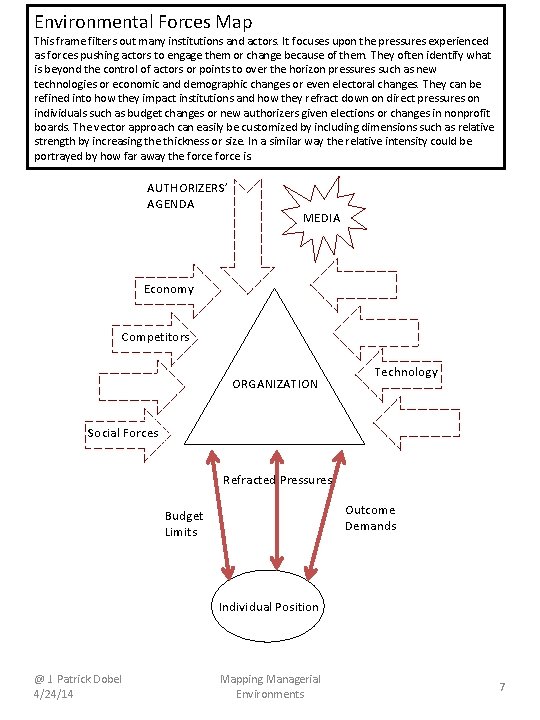
Environmental Forces Map This frame filters out many institutions and actors. It focuses upon the pressures experienced as forces pushing actors to engage them or change because of them. They often identify what is beyond the control of actors or points to over the horizon pressures such as new technologies or economic and demographic changes or even electoral changes. They can be refined into how they impact institutions and how they refract down on direct pressures on individuals such as budget changes or new authorizers given elections or changes in nonprofit boards. The vector approach can easily be customized by including dimensions such as relative strength by increasing the thickness or size. In a similar way the relative intensity could be portrayed by how far away the force is. AUTHORIZERS’ AGENDA MEDIA Economy Competitors ORGANIZATION Technology O S Social Forces Refracted Pressures Outcome Demands Budget Limits Individual Position @ J. Patrick Dobel 4/24/14 Mapping Managerial Environments 7
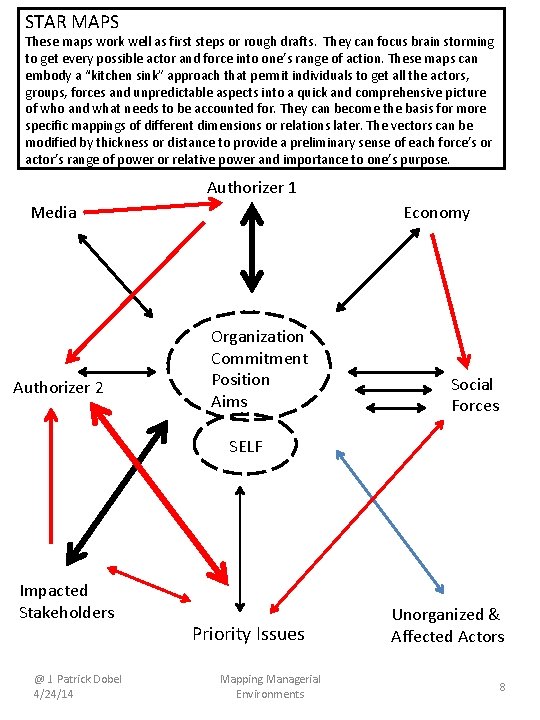
STAR MAPS These maps work well as first steps or rough drafts. They can focus brain storming to get every possible actor and force into one’s range of action. These maps can embody a “kitchen sink” approach that permit individuals to get all the actors, groups, forces and unpredictable aspects into a quick and comprehensive picture of who and what needs to be accounted for. They can become the basis for more specific mappings of different dimensions or relations later. The vectors can be modified by thickness or distance to provide a preliminary sense of each force’s or actor’s range of power or relative power and importance to one’s purpose. Authorizer 1 Media Authorizer 2 Economy Organization Commitment Position Aims Social Forces SELF Impacted Stakeholders @ J. Patrick Dobel 4/24/14 Priority Issues Mapping Managerial Environments Unorganized & Affected Actors 8
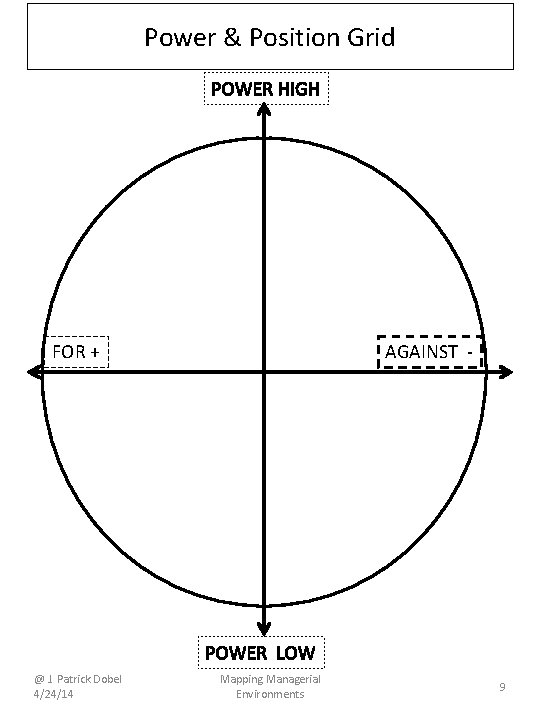
Power & Position Grid POWER HIGH FOR + AGAINST - POWER LOW @ J. Patrick Dobel 4/24/14 Mapping Managerial Environments 9
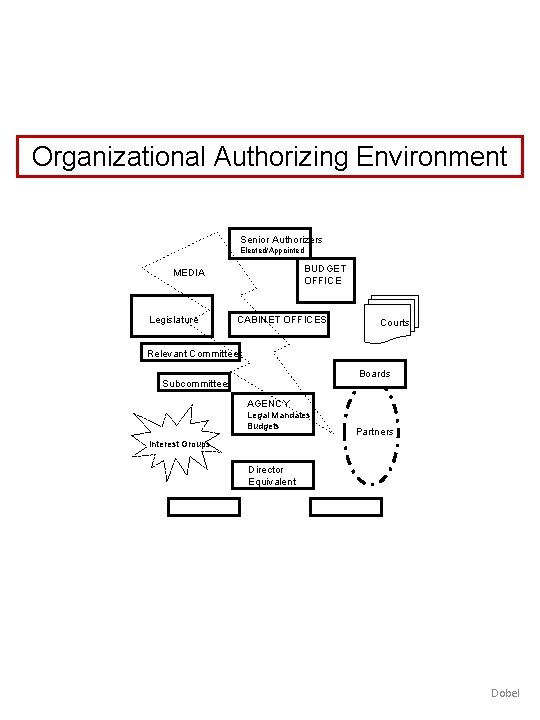
Organizational Authorizing Environment Senior Authorizers Elected/Appointed BUDGET OFFICE MEDIA Legislature CABINET OFFICES Courts Relevant Committees Boards Subcommittees AGENCY Legal Mandates Budgets Partners Interest Groups Director Equivalent Dobel
SWOT Analysis • Strength: an internal resource or capacity to achieve objectives • Weakness: an internal limitation, fault or defect that prevents achieving objectives • Opportunity: an external favorable condition, trend, change, need that increases demand for organization • Threat: an external unfavorable situation, barrier, constraint that thwarts effectiveness
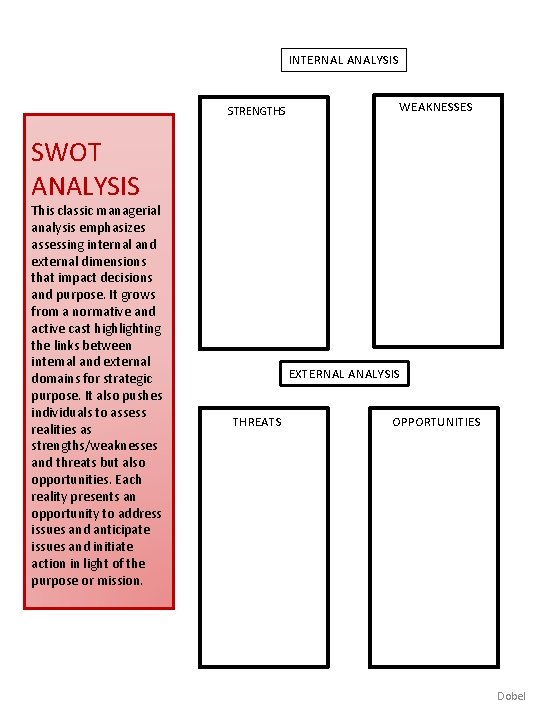
INTERNAL ANALYSIS STRENGTHS WEAKNESSES SWOT ANALYSIS This classic managerial analysis emphasizes assessing internal and external dimensions that impact decisions and purpose. It grows from a normative and active cast highlighting the links between internal and external domains for strategic purpose. It also pushes individuals to assess realities as strengths/weaknesses and threats but also opportunities. Each reality presents an opportunity to address issues and anticipate issues and initiate action in light of the purpose or mission. EXTERNAL ANALYSIS THREATS OPPORTUNITIES Dobel
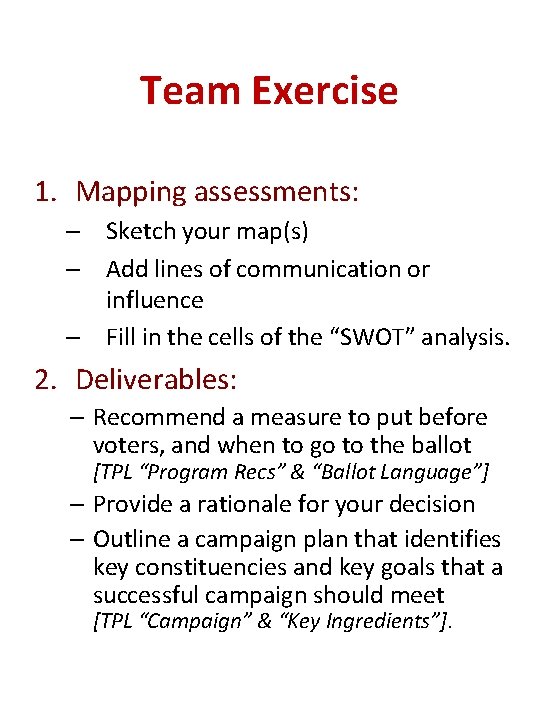
Team Exercise 1. Mapping assessments: – Sketch your map(s) – Add lines of communication or influence – Fill in the cells of the “SWOT” analysis. 2. Deliverables: – Recommend a measure to put before voters, and when to go to the ballot [TPL “Program Recs” & “Ballot Language”] – Provide a rationale for your decision – Outline a campaign plan that identifies key constituencies and key goals that a successful campaign should meet [TPL “Campaign” & “Key Ingredients”].
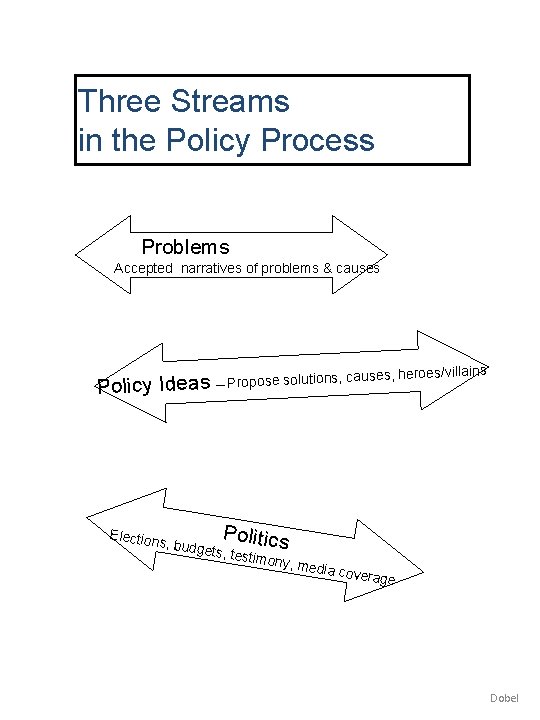
Three Streams in the Policy Process Problems Accepted narratives of problems & causes Policy Ideas Election s , budge tions, caus — Propose solu es, heroes/villains Politics ts, testim ony, me dia cov erage Dobel
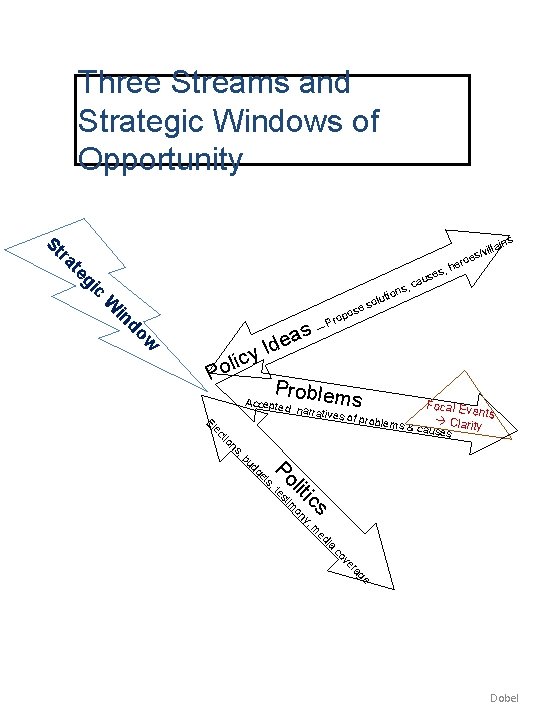
Three Streams and Strategic Windows of Opportunity St ra er gi te , c ons in W e w do y lic o P s a e Id os rop P — uti sol Problem s ec El Accepte d narra tives of proble h es, s u ca /v oes illa ins Focal Ev ents ms & c Clarity s ed ic y, m lit imon Pots, test ge ud , b ns tio auses ia ge ra ve co Dobel
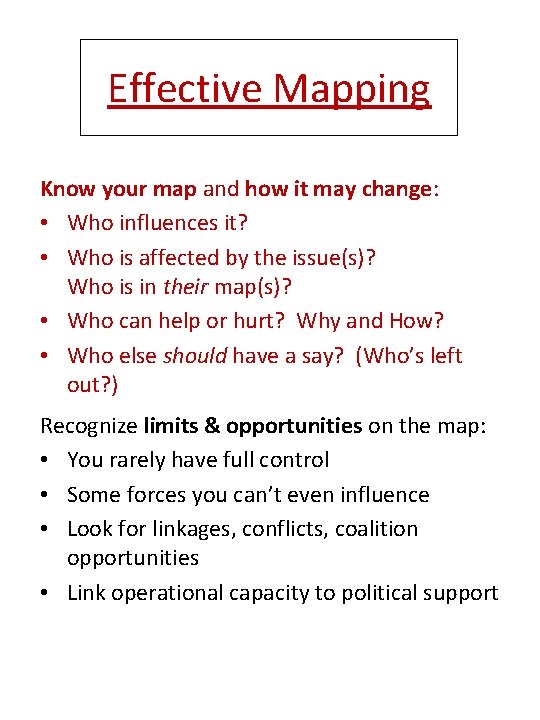
Effective Mapping Know your map and how it may change: • Who influences it? • Who is affected by the issue(s)? Who is in their map(s)? • Who can help or hurt? Why and How? • Who else should have a say? (Who’s left out? ) Recognize limits & opportunities on the map: • You rarely have full control • Some forces you can’t even influence • Look for linkages, conflicts, coalition opportunities • Link operational capacity to political support