
Mapping Communication Layouts to Network Hardware Characteristics on




- Slides: 33
Mapping Communication Layouts to Network Hardware Characteristics on Massive-Scale Blue Gene Systems Pavan Balaji*, Rinku Gupta*, Abhinav Vishnu+ and Pete Beckman* * Argonne National Laboratory + Pacific Northwest National Laboratory
Power and Cost Constraints on Large-scale Machines § Massive scale machines available today – Machines with 500, 000 cores already available – Upcoming machines expected to have a few million cores (e. g. , the Sequoia BG/Q machine at LLNL is expected to have 1. 6 million cores) – Exascale machines might have close to a billion cores § For machines of this scale, it is impractical to assume that all system resources will increase at the same rate – Caches, memory, floating point units, instruction decoders § Network is no exception: – Many of the largest machines in the world are moving away from fattree topologies to “scalable” topologies (typically torus topologies) • Lesser bisection bandwidth, but linearly increasing cost Pavan Balaji, Argonne National Laboratory ISC (06/22/2011)
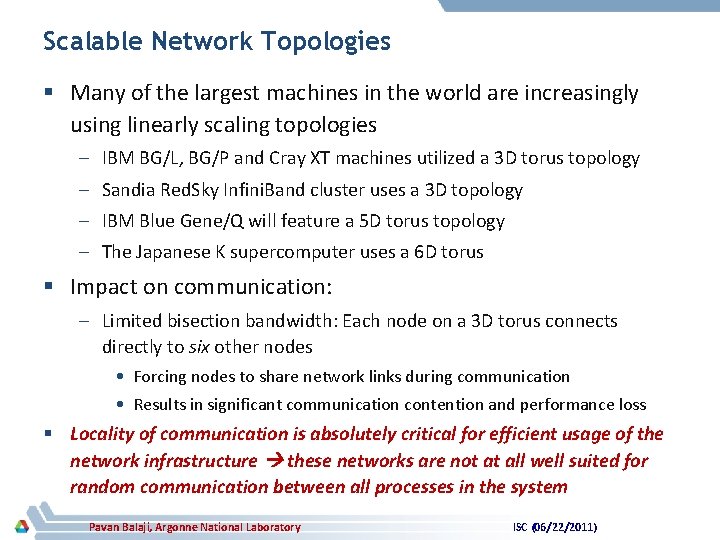
Scalable Network Topologies § Many of the largest machines in the world are increasingly using linearly scaling topologies – IBM BG/L, BG/P and Cray XT machines utilized a 3 D torus topology – Sandia Red. Sky Infini. Band cluster uses a 3 D topology – IBM Blue Gene/Q will feature a 5 D torus topology – The Japanese K supercomputer uses a 6 D torus § Impact on communication: – Limited bisection bandwidth: Each node on a 3 D torus connects directly to six other nodes • Forcing nodes to share network links during communication • Results in significant communication contention and performance loss § Locality of communication is absolutely critical for efficient usage of the network infrastructure these networks are not at all well suited for random communication between all processes in the system Pavan Balaji, Argonne National Laboratory ISC (06/22/2011)
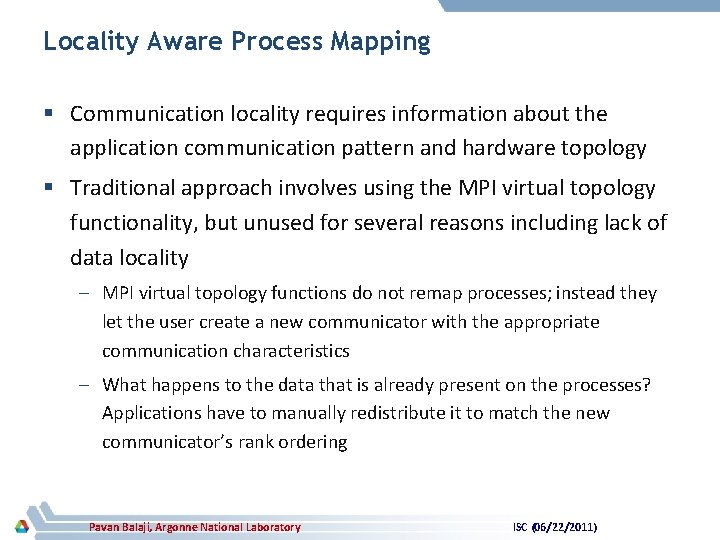
Locality Aware Process Mapping § Communication locality requires information about the application communication pattern and hardware topology § Traditional approach involves using the MPI virtual topology functionality, but unused for several reasons including lack of data locality – MPI virtual topology functions do not remap processes; instead they let the user create a new communicator with the appropriate communication characteristics – What happens to the data that is already present on the processes? Applications have to manually redistribute it to match the new communicator’s rank ordering Pavan Balaji, Argonne National Laboratory ISC (06/22/2011)
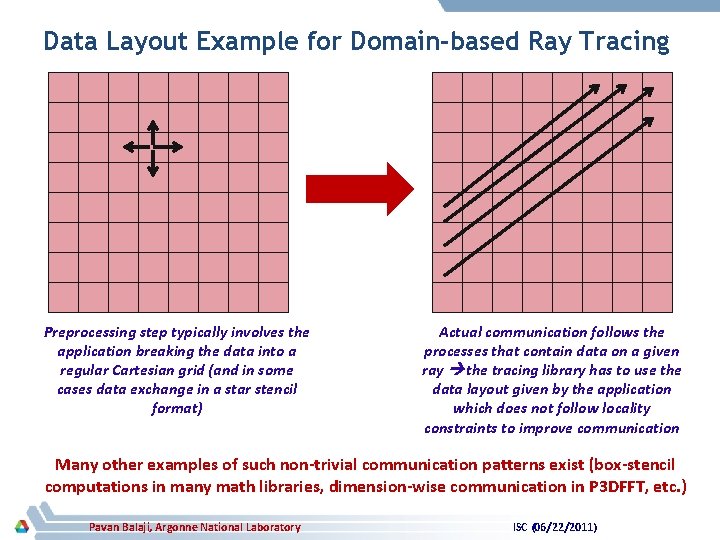
Data Layout Example for Domain-based Ray Tracing Preprocessing step typically involves the application breaking the data into a regular Cartesian grid (and in some cases data exchange in a star stencil format) Actual communication follows the processes that contain data on a given ray the tracing library has to use the data layout given by the application which does not follow locality constraints to improve communication Many other examples of such non-trivial communication patterns exist (box-stencil computations in many math libraries, dimension-wise communication in P 3 DFFT, etc. ) Pavan Balaji, Argonne National Laboratory ISC (06/22/2011)
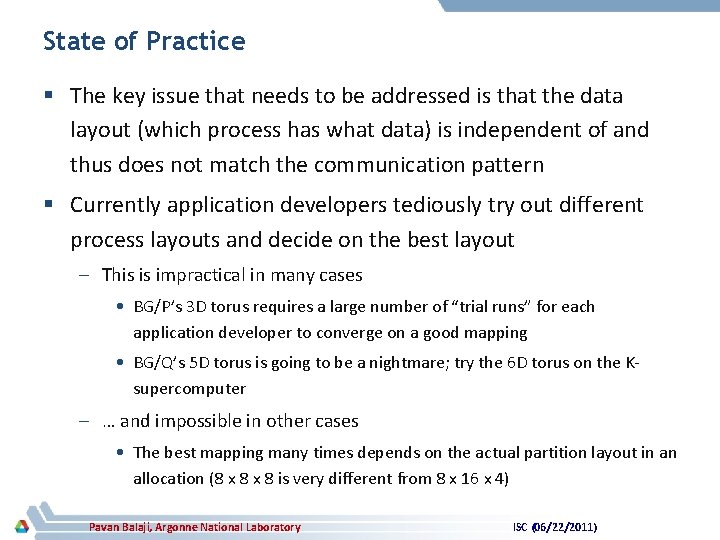
State of Practice § The key issue that needs to be addressed is that the data layout (which process has what data) is independent of and thus does not match the communication pattern § Currently application developers tediously try out different process layouts and decide on the best layout – This is impractical in many cases • BG/P’s 3 D torus requires a large number of “trial runs” for each application developer to converge on a good mapping • BG/Q’s 5 D torus is going to be a nightmare; try the 6 D torus on the Ksupercomputer – … and impossible in other cases • The best mapping many times depends on the actual partition layout in an allocation (8 x 8 is very different from 8 x 16 x 4) Pavan Balaji, Argonne National Laboratory ISC (06/22/2011)
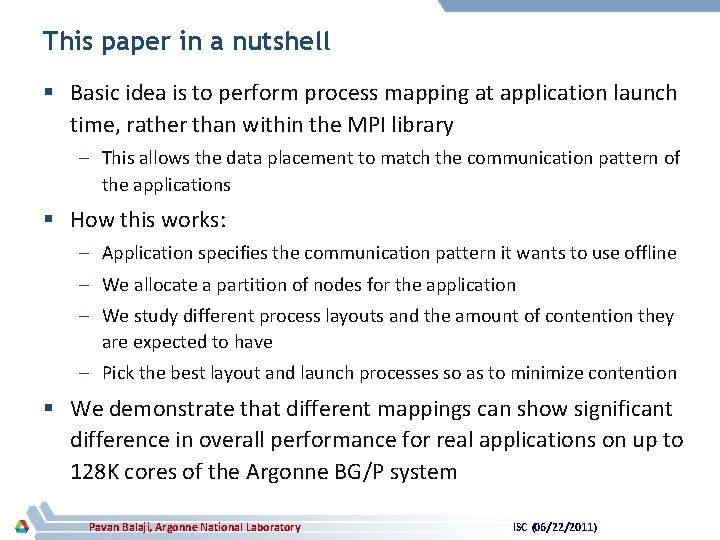
This paper in a nutshell § Basic idea is to perform process mapping at application launch time, rather than within the MPI library – This allows the data placement to match the communication pattern of the applications § How this works: – Application specifies the communication pattern it wants to use offline – We allocate a partition of nodes for the application – We study different process layouts and the amount of contention they are expected to have – Pick the best layout and launch processes so as to minimize contention § We demonstrate that different mappings can show significant difference in overall performance for real applications on up to 128 K cores of the Argonne BG/P system Pavan Balaji, Argonne National Laboratory ISC (06/22/2011)
Presentation Roadmap § Motivation § Understanding the Complexity in Process Mapping § Contention Analysis § Experiments and Analysis § Concluding Remarks Pavan Balaji, Argonne National Laboratory ISC (06/22/2011)
Complexity in Process Mapping § Most communication libraries (like MPI) hide physical layout of system from applications to improve portability § Applications form logical topologies on the processes available to match their problem – E. g: for climate modeling applications, data representation is typically 2 D plane, 3 D volume or multi-dimensional unstructured grid – Each process gets a part of the overall data – Local data computation depends on partially evaluated results from neighboring processes on the logical process grid formed by application § Applications rely on the logical process layout without any information about the physical placement or mapping of actual processes Pavan Balaji, Argonne National Laboratory ISC (06/22/2011)
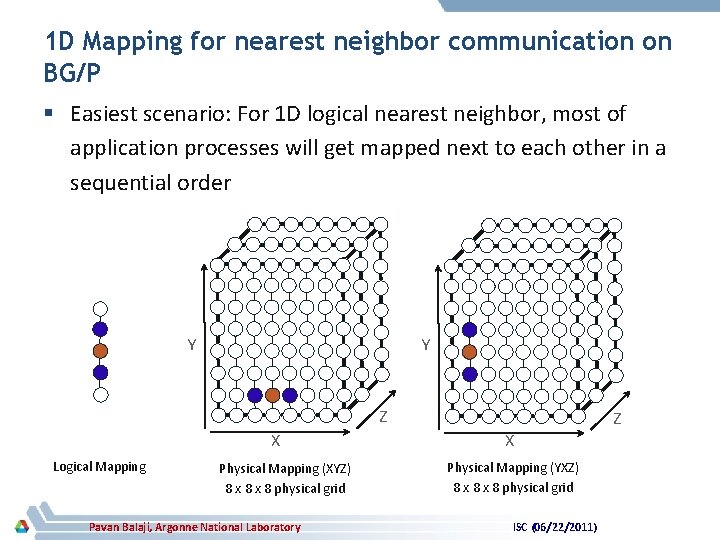
1 D Mapping for nearest neighbor communication on BG/P § Easiest scenario: For 1 D logical nearest neighbor, most of application processes will get mapped next to each other in a sequential order Y Y Z X Logical Mapping Physical Mapping (XYZ) 8 x 8 physical grid Pavan Balaji, Argonne National Laboratory Z X Physical Mapping (YXZ) 8 x 8 physical grid ISC (06/22/2011)
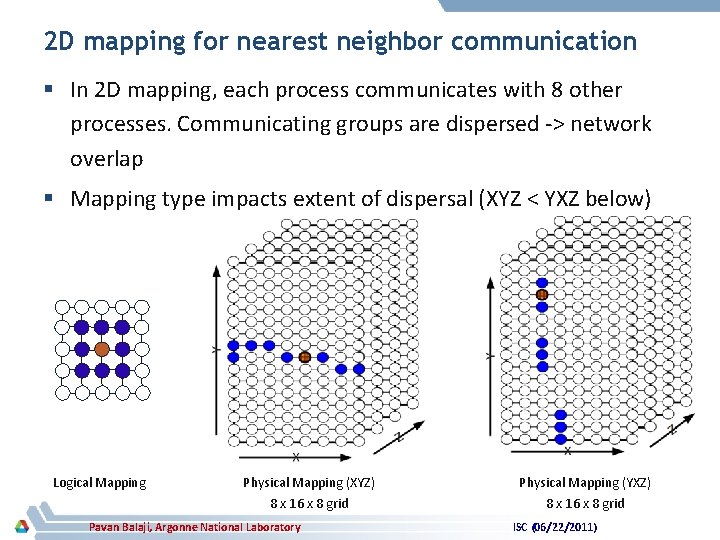
2 D mapping for nearest neighbor communication § In 2 D mapping, each process communicates with 8 other processes. Communicating groups are dispersed -> network overlap § Mapping type impacts extent of dispersal (XYZ < YXZ below) Logical Mapping Physical Mapping (XYZ) 8 x 16 x 8 grid Pavan Balaji, Argonne National Laboratory Physical Mapping (YXZ) 8 x 16 x 8 grid ISC (06/22/2011)
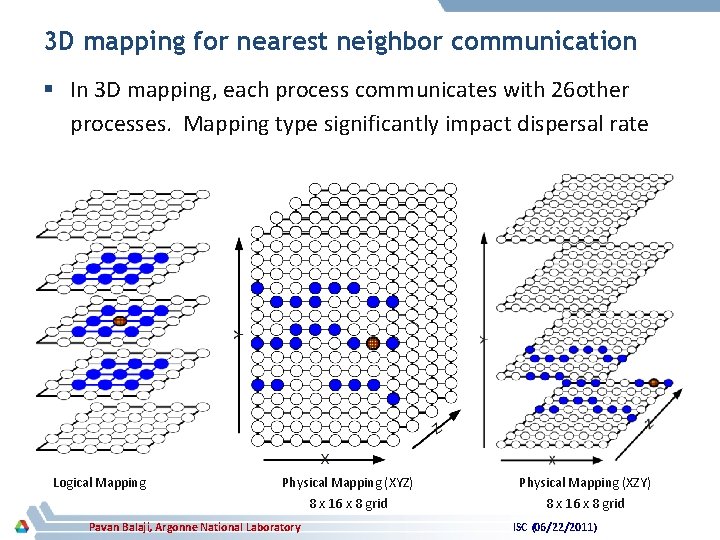
3 D mapping for nearest neighbor communication § In 3 D mapping, each process communicates with 26 other processes. Mapping type significantly impact dispersal rate Logical Mapping Physical Mapping (XYZ) 8 x 16 x 8 grid Pavan Balaji, Argonne National Laboratory Physical Mapping (XZY) 8 x 16 x 8 grid ISC (06/22/2011)
Presentation Roadmap § Motivation § Understanding the Complexity in Process Mapping § Contention Analysis § Experiments and Analysis § Concluding Remarks Pavan Balaji, Argonne National Laboratory ISC (06/22/2011)
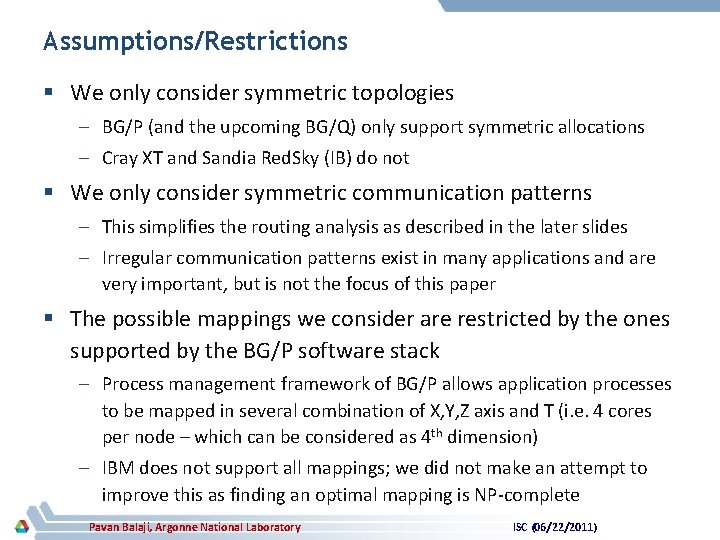
Assumptions/Restrictions § We only consider symmetric topologies – BG/P (and the upcoming BG/Q) only support symmetric allocations – Cray XT and Sandia Red. Sky (IB) do not § We only consider symmetric communication patterns – This simplifies the routing analysis as described in the later slides – Irregular communication patterns exist in many applications and are very important, but is not the focus of this paper § The possible mappings we consider are restricted by the ones supported by the BG/P software stack – Process management framework of BG/P allows application processes to be mapped in several combination of X, Y, Z axis and T (i. e. 4 cores per node – which can be considered as 4 th dimension) – IBM does not support all mappings; we did not make an attempt to improve this as finding an optimal mapping is NP-complete Pavan Balaji, Argonne National Laboratory ISC (06/22/2011)
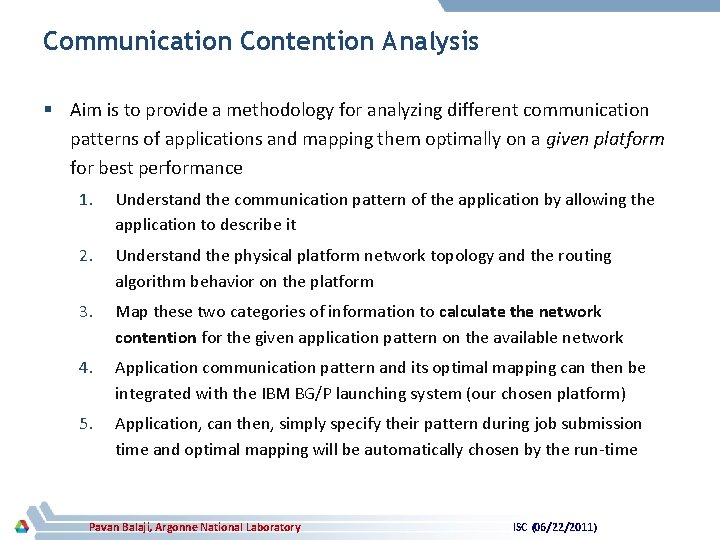
Communication Contention Analysis § Aim is to provide a methodology for analyzing different communication patterns of applications and mapping them optimally on a given platform for best performance 1. Understand the communication pattern of the application by allowing the application to describe it 2. Understand the physical platform network topology and the routing algorithm behavior on the platform 3. Map these two categories of information to calculate the network contention for the given application pattern on the available network 4. Application communication pattern and its optimal mapping can then be integrated with the IBM BG/P launching system (our chosen platform) 5. Application, can then, simply specify their pattern during job submission time and optimal mapping will be automatically chosen by the run-time Pavan Balaji, Argonne National Laboratory ISC (06/22/2011)
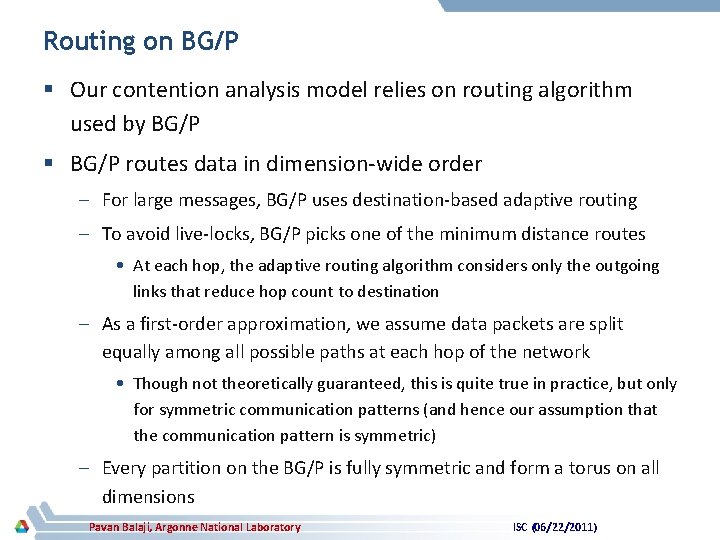
Routing on BG/P § Our contention analysis model relies on routing algorithm used by BG/P § BG/P routes data in dimension-wide order – For large messages, BG/P uses destination-based adaptive routing – To avoid live-locks, BG/P picks one of the minimum distance routes • At each hop, the adaptive routing algorithm considers only the outgoing links that reduce hop count to destination – As a first-order approximation, we assume data packets are split equally among all possible paths at each hop of the network • Though not theoretically guaranteed, this is quite true in practice, but only for symmetric communication patterns (and hence our assumption that the communication pattern is symmetric) – Every partition on the BG/P is fully symmetric and form a torus on all dimensions Pavan Balaji, Argonne National Laboratory ISC (06/22/2011)
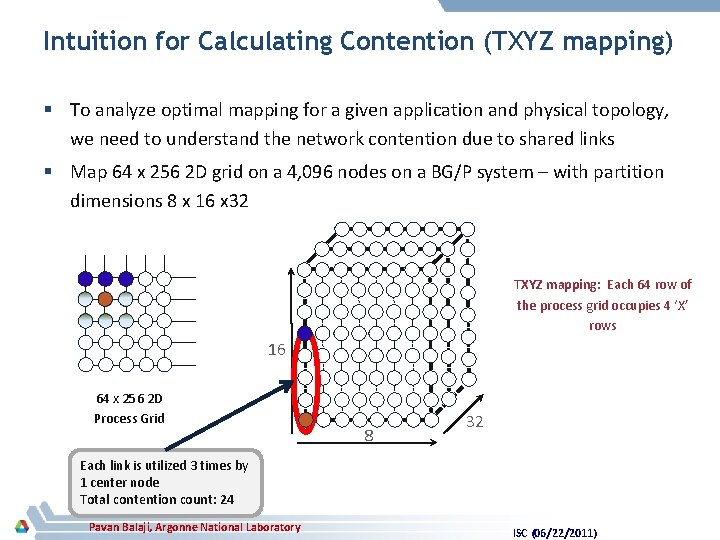
Intuition for Calculating Contention (TXYZ mapping) § To analyze optimal mapping for a given application and physical topology, we need to understand the network contention due to shared links § Map 64 x 256 2 D grid on a 4, 096 nodes on a BG/P system – with partition dimensions 8 x 16 x 32 TXYZ mapping: Each 64 row of the process grid occupies 4 ‘X’ rows 16 64 x 256 2 D Process Grid 8 32 Each link is utilized 3 times by 1 center node Total contention count: 24 Pavan Balaji, Argonne National Laboratory ISC (06/22/2011)
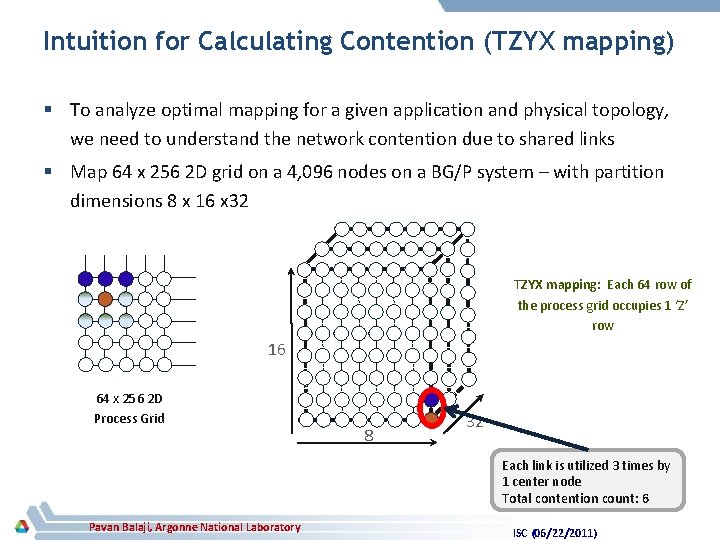
Intuition for Calculating Contention (TZYX mapping) § To analyze optimal mapping for a given application and physical topology, we need to understand the network contention due to shared links § Map 64 x 256 2 D grid on a 4, 096 nodes on a BG/P system – with partition dimensions 8 x 16 x 32 TZYX mapping: Each 64 row of the process grid occupies 1 ‘Z’ row 16 64 x 256 2 D Process Grid 8 32 Each link is utilized 3 times by 1 center node Total contention count: 6 Pavan Balaji, Argonne National Laboratory ISC (06/22/2011)
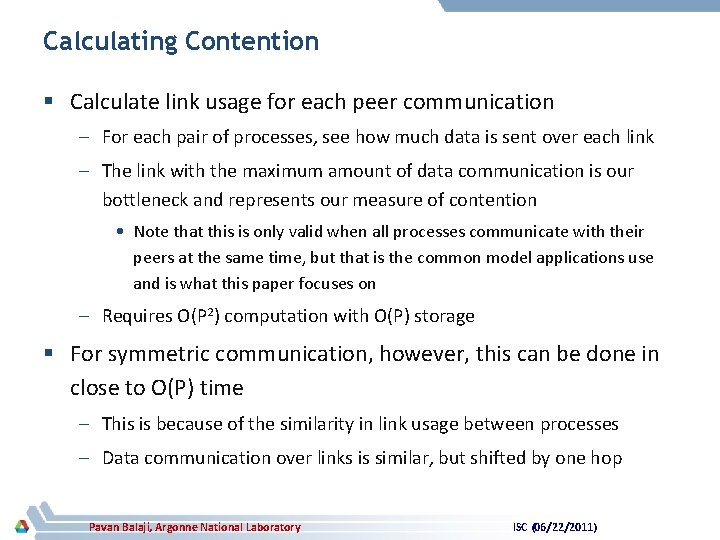
Calculating Contention § Calculate link usage for each peer communication – For each pair of processes, see how much data is sent over each link – The link with the maximum amount of data communication is our bottleneck and represents our measure of contention • Note that this is only valid when all processes communicate with their peers at the same time, but that is the common model applications use and is what this paper focuses on – Requires O(P 2) computation with O(P) storage § For symmetric communication, however, this can be done in close to O(P) time – This is because of the similarity in link usage between processes – Data communication over links is similar, but shifted by one hop Pavan Balaji, Argonne National Laboratory ISC (06/22/2011)
Presentation Roadmap § Motivation § Understanding the Complexity in Process Mapping § Contention Analysis § Experiments and Analysis § Concluding Remarks Pavan Balaji, Argonne National Laboratory ISC (06/22/2011)
Experiments and Analysis § Study and analyze the impact of various mappings with varying system size – Micro-benchmarks – Applications § Demonstrates the performance achieved by our automatic process mapping model Pavan Balaji, Argonne National Laboratory ISC (06/22/2011)
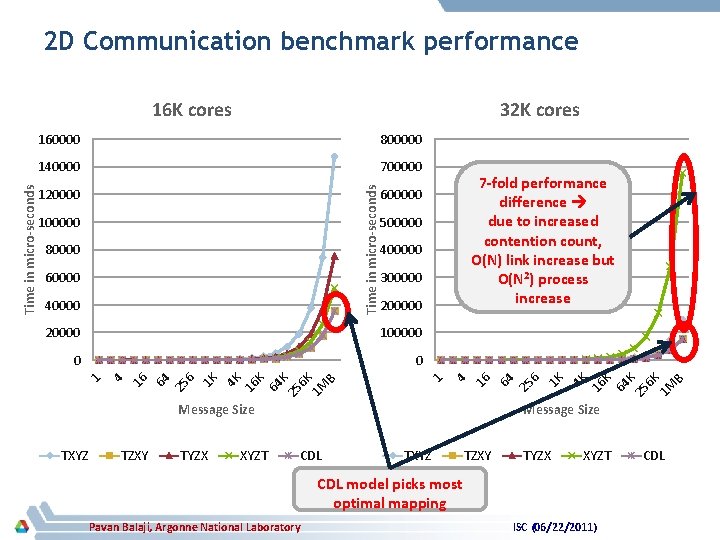
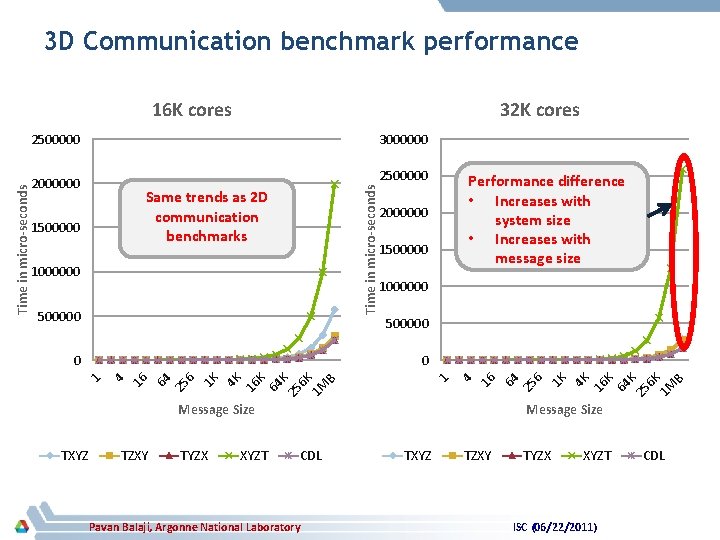
Micro-benchmark-based Evaluation § 2 D logical nearest neighbor communication § 3 D logical nearest neighbor communication – Both use star stencils each process has (3 d-1) neighbors, where d is logical process grid dimensionality § Nearest neighbor communication – Each process does point-to-point exchange of some data with its logical neighbors in 2 D or 3 D plane – In real applications, this data (typically) corresponds to ghost cells, bordering data points between two processes § Studied effects of varying data size on up to 128 K cores with various mappings Pavan Balaji, Argonne National Laboratory ISC (06/22/2011)
2 D Communication benchmark performance 32 K cores Message Size TXYZ TZXY TYZX XYZT 6 K 1 M B K 25 64 1 25 6 K 1 M B K K 64 16 4 K 1 K 25 6 0 64 0 16 100000 4 20000 K 200000 16 40000 300000 4 K 60000 400000 1 K 80000 500000 6 100000 7 -fold performance difference due to increased contention count, O(N) link increase but O(N 2) process increase 600000 4 120000 25 700000 64 140000 16 800000 Time in micro-seconds 160000 1 Time in micro-seconds 16 K cores Message Size CDL TXYZ TZXY TYZX XYZT CDL model picks most optimal mapping Pavan Balaji, Argonne National Laboratory ISC (06/22/2011) CDL
3 D Communication benchmark performance 16 K cores 32 K cores 3000000 Time in micro-seconds 2500000 2000000 Same trends as 2 D communication benchmarks 1500000 1000000 500000 Performance difference • Increases with system size • Increases with message size 2000000 1500000 1000000 500000 Message Size TXYZ TZXY TYZX XYZT K 64 K 25 6 K 1 M B 16 4 K 1 K 6 25 64 16 4 1 25 6 K 1 M B K K 64 16 4 K 1 K 6 25 64 16 0 4 0 1 Time in micro-seconds 2500000 Message Size CDL Pavan Balaji, Argonne National Laboratory TXYZ TZXY TYZX XYZT ISC (06/22/2011) CDL
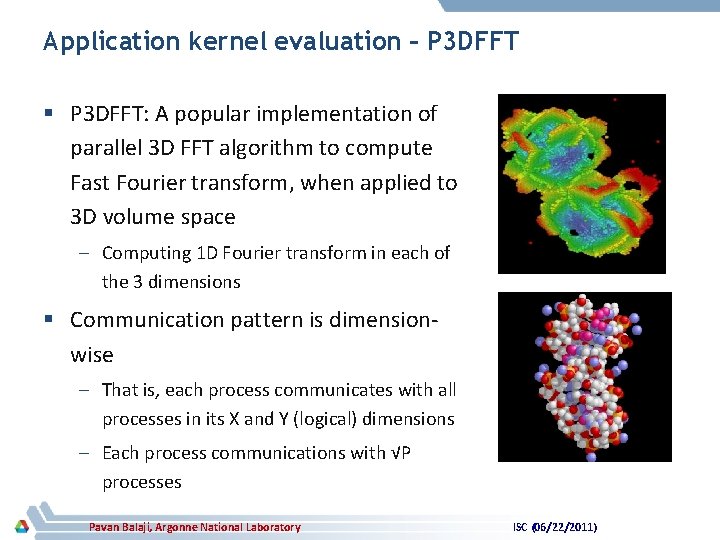
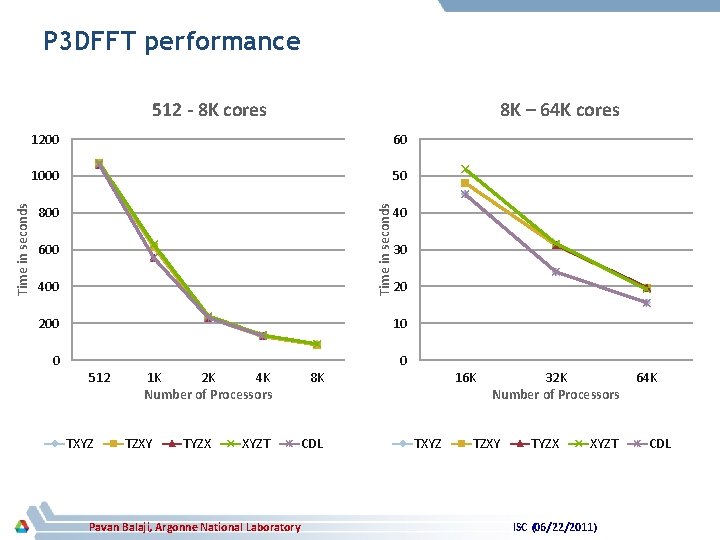
Application kernel evaluation – P 3 DFFT § P 3 DFFT: A popular implementation of parallel 3 D FFT algorithm to compute Fast Fourier transform, when applied to 3 D volume space – Computing 1 D Fourier transform in each of the 3 dimensions § Communication pattern is dimensionwise – That is, each process communicates with all processes in its X and Y (logical) dimensions – Each process communications with √P processes Pavan Balaji, Argonne National Laboratory ISC (06/22/2011)
P 3 DFFT performance 8 K – 64 K cores 1200 60 1000 50 Time in seconds 512 - 8 K cores 800 600 40 30 20 200 10 0 0 512 TXYZ 1 K 2 K 4 K Number of Processors TZXY TYZX XYZT Pavan Balaji, Argonne National Laboratory 8 K CDL 16 K TXYZ 32 K Number of Processors TZXY TYZX XYZT ISC (06/22/2011) 64 K CDL
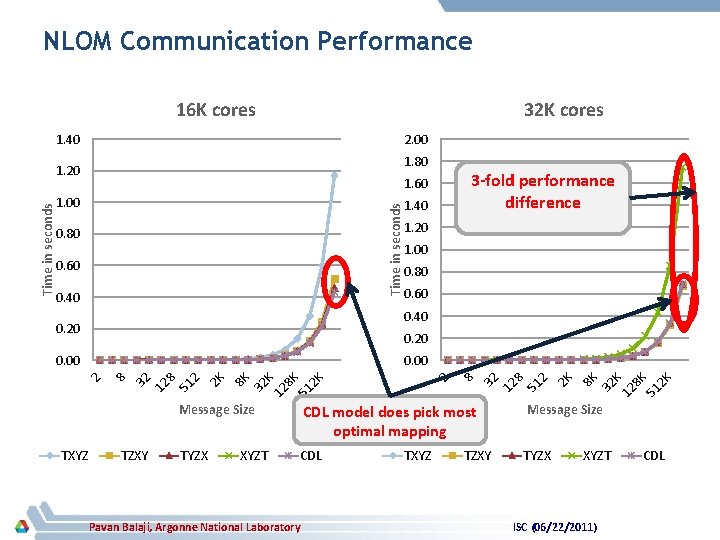
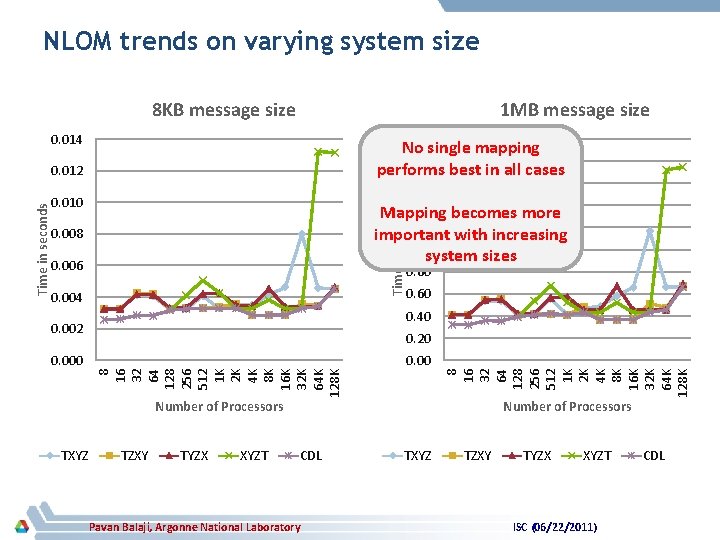
NLOM Ocean Modeling Application § NLOM application is used for ocean simulations; with focus on semi-enclosed seas, ocean basins and the global ocean § Bandwidth sensitive when run on large system size § We study it with varying system size and message size Pavan Balaji, Argonne National Laboratory ISC (06/22/2011)
NLOM Communication Performance 16 K cores 32 K cores 1. 40 2. 00 1. 80 3 -fold performance difference 1. 60 Time in seconds 1. 00 0. 80 0. 60 0. 40 1. 20 1. 00 0. 80 0. 60 0. 40 0. 20 TXYZ TZXY Message Size CDL model does pick most optimal mapping Message Size TYZX CDL TYZX XYZT Pavan Balaji, Argonne National Laboratory TXYZ TZXY XYZT ISC (06/22/2011) 2 K 8 K 51 K 12 32 8 K 2 K 8 51 2 12 32 8 2 2 K 8 K 51 K 12 32 8 K 2 K 2 51 8 12 32 0. 00 8 0. 00 2 Time in seconds 1. 20 CDL
NLOM trends on varying system size 8 KB message size 1 MB message size 0. 014 2. 00 No single mapping 1. 80 performs best in all cases 1. 60 0. 010 Time in seconds 1. 40 Mapping becomes more 1. 20 important with increasing 1. 00 system sizes 0. 008 0. 006 0. 004 0. 80 0. 60 0. 40 0. 002 0. 20 0. 00 8 16 32 64 128 256 512 1 K 2 K 4 K 8 K 16 K 32 K 64 K 128 K Time in seconds 0. 012 Number of Processors TXYZ TZXY TYZX XYZT CDL Pavan Balaji, Argonne National Laboratory Number of Processors TXYZ TZXY TYZX XYZT ISC (06/22/2011) CDL
Presentation Roadmap § Motivation § Understanding the Complexity in Process Mapping § Contention Analysis § Experiments and Analysis § Concluding Remarks Pavan Balaji, Argonne National Laboratory ISC (06/22/2011)
Concluding Remarks § Locality aware process mapping is critical in large-scale systems § We studied how mappings can significantly impact application performance and designed a contention model analysis tool to identify the mapping with the least contention § Experiments done on 128 K cores of BG/P demonstrate significant impact on performance § Future work: Non-symmetric communication patterns require improved analysis, but form a big fraction of applications Pavan Balaji, Argonne National Laboratory ISC (06/22/2011)
Thank you! Contact: Email: balaji@mcs. anl. gov Web: http: //www. mcs. anl. gov/~balaji
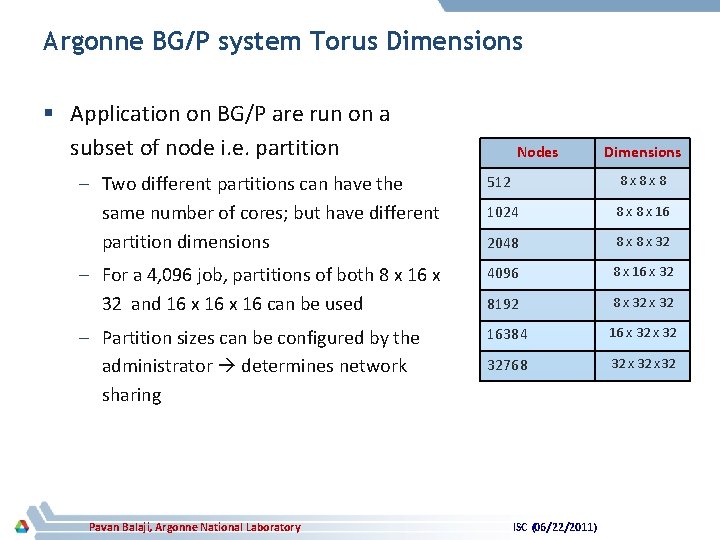
Argonne BG/P system Torus Dimensions § Application on BG/P are run on a subset of node i. e. partition Nodes Dimensions – Two different partitions can have the same number of cores; but have different partition dimensions 512 8 x 8 x 8 1024 8 x 16 2048 8 x 32 – For a 4, 096 job, partitions of both 8 x 16 x 32 and 16 x 16 can be used 4096 8 x 16 x 32 8192 8 x 32 – Partition sizes can be configured by the administrator determines network sharing 16384 16 x 32 32768 32 x 32 Pavan Balaji, Argonne National Laboratory ISC (06/22/2011)