
Mapping civil society A tool for engaging with

- Slides: 15
Mapping civil society A tool for engaging with non state actors Training seminar 4 -8 July 2011
MAPPING, A NEW TOOL ? GUIDELINES ON PRINCIPLES AND GOOD PRACTICES FOR THE PARTICIPATION OF NSA IN THE DEVELOPMENT DIALOGUE AND CONSULTATION (2004) HANDBOOK ON PROMOTING GOOD GOVERNANCE IN EC DEVELOPMENT AND COOPERATION (2004) CAPITALISATION STUDY OF 9 TH EDF (2009) ENPI CIVIL SOCIETY FACILITY 2011 FORSEES THE FINANCING OF MAPPING
CHALLENGES FOR GOVERNANCE NSA called to play a role in domestic accountability and ownership; New roles might be: advocate specific group’s interest; increase social ownership (capacity to mobilise social actors); strenghten governance and accountability; service delivery ; quality of services assessment « New » aid modalities (budget support and SPSP) apply different and upgraded roles for NSA and require improved knowledge of CSOs
Mapping, what is it about ? Mapping is a tool that applies to different needs • Call for proposal on civil society • Preparation of a capacity building programme for CSOs • Sectorial programmes (SPSP) • Political dialogue on country strategy or mid term review • Preparation of a Poverty reduction strategic paper • Human Rights policy dialogue • Component of the « political economy » analysis
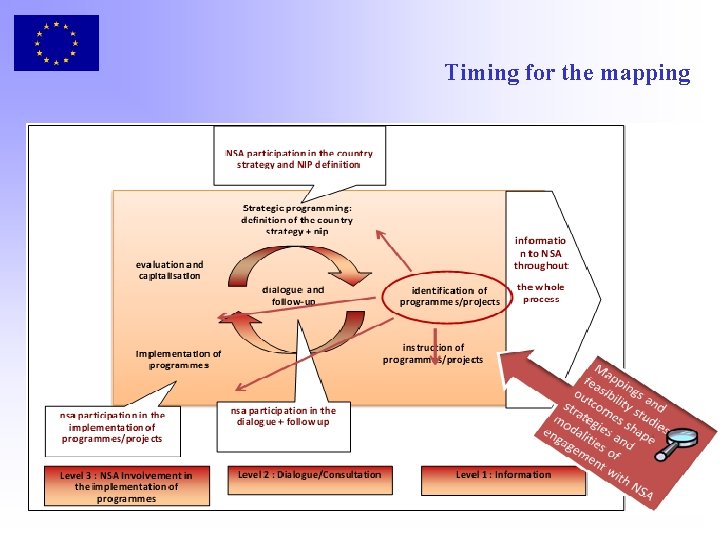
Timing for the mapping
About objectives If there is a proper understanding of the objectives that originate the mapping of civil society actors, the mapping scope will be better defined and its findings will better meet the expectations Well defined objectives will be translated in clear To. R
Components of a mapping To have a global vision of the institutional actors acting in the country State, economic and civil society spheres. To have a historical vision of the activities of these actors in connection with the main economic, social and political events of the country or region. To have a vision of the social actors in the various sectors relating to cooperation with the European Union, their connections and respective weight. To help decision-makers in identifying, formulating and implementing policies and strategies.
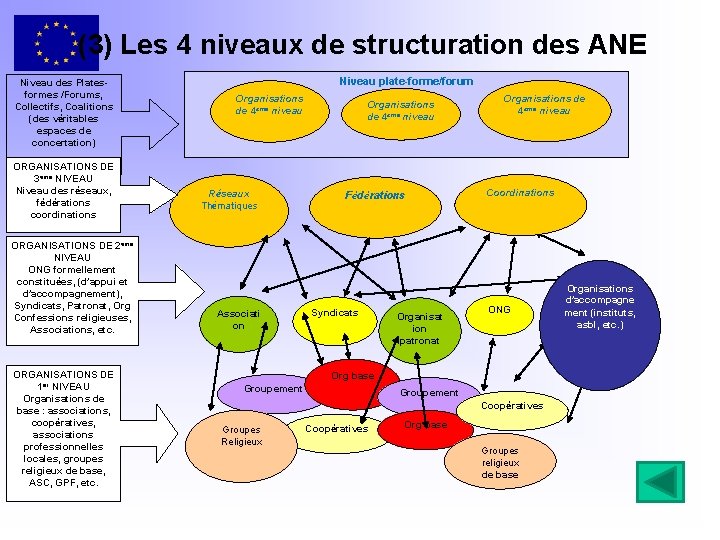
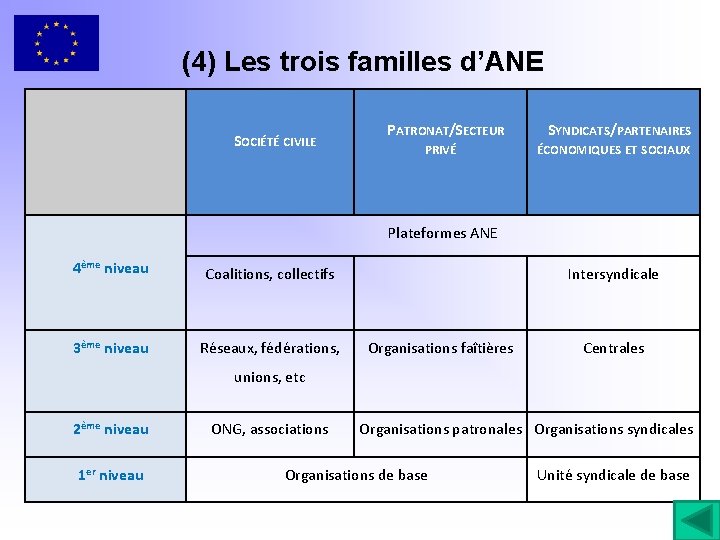
Mapping what ? Types of Matrix q Types of Actors (state, economy, civil society) in general and per sector q Timelines and legal frameworks q Dynamics/Contradictions/tensions q Levels of structuration of CSOs (represent different level of interest. . ) q Geographical map: (concentration/gaps)
(3) Les 4 niveaux de structuration des ANE Niveau des Platesformes /Forums, Collectifs, Coalitions (des véritables espaces de concertation) ORGANISATIONS DE 3ème NIVEAU Niveau des réseaux, fédérations coordinations ORGANISATIONS DE 2ème NIVEAU ONG formellement constituées, (d’appui et d’accompagnement), Syndicats, Patronat, Org Confessions religieuses, Associations, etc. ORGANISATIONS DE 1 er NIVEAU Organisations de base : associations, coopératives, associations professionnelles locales, groupes religieux de base, ASC, GPF, etc. Niveau plate-forme/forum Organisations de 4ème niveau Réseaux Thématiques Associati on Organisations de 4ème niveau Fédérations Syndicats Organisat ion patronat Organisations de 4ème niveau Coordinations ONG Org base Groupement Coopératives Groupes Religieux Coopératives Org base Groupes religieux de base Organisations d’accompagne ment (instituts, asbl, etc. )
(4) Les trois familles d’ANE SOCIÉTÉ CIVILE PATRONAT/SECTEUR PRIVÉ SYNDICATS/PARTENAIRES ÉCONOMIQUES ET SOCIAUX Plateformes ANE 4ème niveau Coalitions, collectifs 3ème niveau Réseaux, fédérations, Intersyndicale Organisations faîtières Centrales unions, etc 2ème niveau 1 er niveau ONG, associations Organisations patronales Organisations syndicales Organisations de base Unité syndicale de base
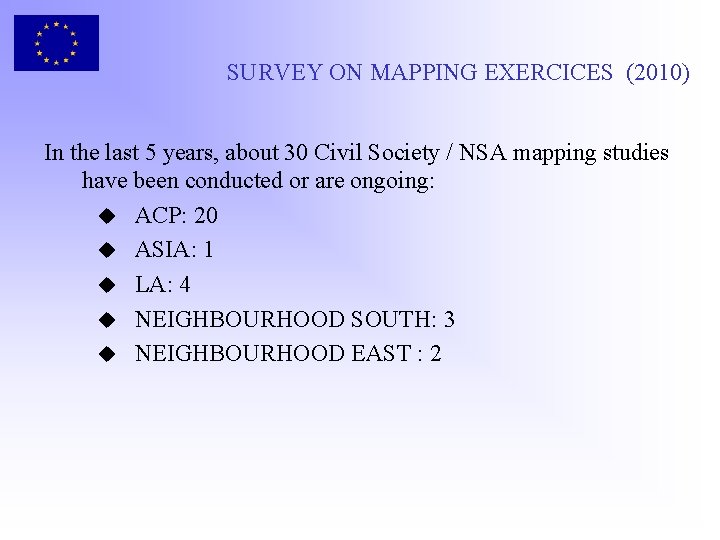
SURVEY ON MAPPING EXERCICES (2010) In the last 5 years, about 30 Civil Society / NSA mapping studies have been conducted or are ongoing: u ACP: 20 u ASIA: 1 u LA: 4 u NEIGHBOURHOOD SOUTH: 3 u NEIGHBOURHOOD EAST : 2
Strenghts (2010) The mappings prove to be useful in the diagnosis and in the preparation of action fiches (AAP) both for thematic and geographic programmes. However, mapping studies proved to be more relevant in the identification than in the programming phase; In light of the 'budget support' (General BS or SPSP), the mapping studies could be extremely useful to engage NSA in the New Aid Modalities (NAM) [1]; Mapping allows formal and informal knowledge of the local society; it might be a tool to analyze the "actors" side of a local society in the 'Political Economy' analysis scheme; In some countries, the mapping is completed with a comprehensive data base, eventually made by other donors (CIVICUS). [1] Reference Document n° 12 "Engaging Non-State Actors in New Aid Modalities" (to be published)
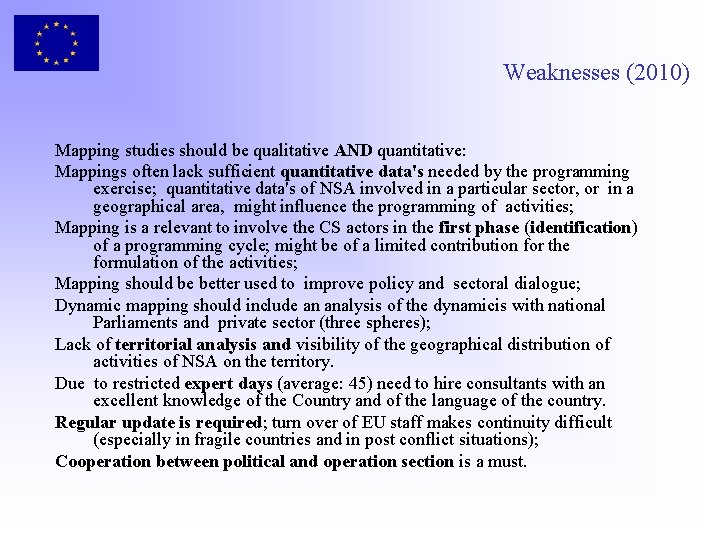
Weaknesses (2010) Mapping studies should be qualitative AND quantitative: Mappings often lack sufficient quantitative data's needed by the programming exercise; quantitative data's of NSA involved in a particular sector, or in a geographical area, might influence the programming of activities; Mapping is a relevant to involve the CS actors in the first phase (identification) of a programming cycle; might be of a limited contribution for the formulation of the activities; Mapping should be better used to improve policy and sectoral dialogue; Dynamic mapping should include an analysis of the dynamicis with national Parliaments and private sector (three spheres); Lack of territorial analysis and visibility of the geographical distribution of activities of NSA on the territory. Due to restricted expert days (average: 45) need to hire consultants with an excellent knowledge of the Country and of the language of the country. Regular update is required; turn over of EU staff makes continuity difficult (especially in fragile countries and in post conflict situations); Cooperation between political and operation section is a must.
Sources for the session CISOCH web site /www. cc. cec/dgintranet/europeaid/activities/thematic/e 4/ci vil_society/key_tools_guidelines_en. htm 9 th EDF Capitalization study
Thank you for your attention !