
Mapping Bias By Sophia Ferens Importance of Mapping
Mapping & Bias By Sophia Ferens
Importance of Mapping ❖ Help visualize and represent real and imagined places ❖ Put locations into context ➢ Might not realize distance or significance of an area until you see the visual representation of it ➢ Simplify otherwise hard to understand questions (better than words) ❖ Can be used to chart significant data and see overarching themes ➢ Ex. Which parts of the U. S. are experiencing the highest Covid-19 infection rates? ❖ Give historical context ➢ How did people in the past understand geography? What assumptions were made that are now proven true or false?
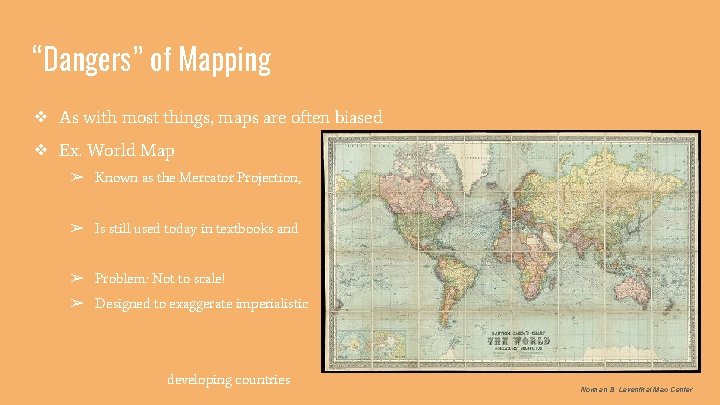
“Dangers” of Mapping ❖ As with most things, maps are often biased ❖ Ex. World Map ➢ Known as the Mercator Projection, this map was created in 1569 ➢ Is still used today in textbooks and media (even Google Maps) ➢ Problem: Not to scale! ➢ Designed to exaggerate imperialistic power at the expense of “inferior” developing countries Norman B. Leventhal Map Center
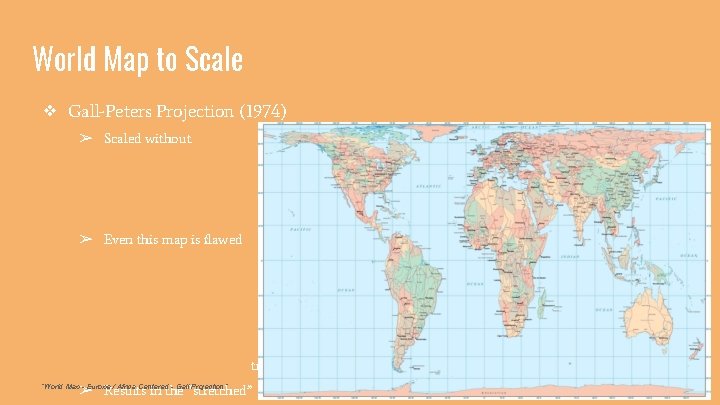
World Map to Scale ❖ Gall-Peters Projection (1974) ➢ Scaled without topographical bias ➢ Even this map is flawed since there's not enough land to effectively translate onto a flat map ➢ Results in the “stretched” “World Map - Europe / Africa Centered - Gall Projection”

Side-by-side Comparison Gall peters projetion vs mercator projection Friendly Atheist
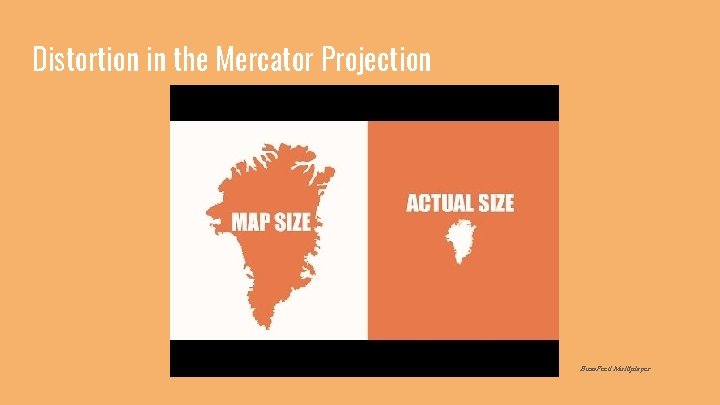
Distortion in the Mercator Projection i Buzz. Feed Multiplayer
Things to Keep in Mind when Viewing a Map ❖ Author/ Publisher ➢ May hint at bias or intent ❖ Area of Publication ➢ Potential nationalistic views, publication language (potential translation issues) ❖ Date ➢ Can put map into chronological context, know if you’re viewing a current map or old one when forming opinions/ looking at data and trends ❖ Audience & Point of View ➢ What message is the map creator trying to send ❖ Data Source ➢ Where are they getting the info the map is based around? Inaccurate data = inaccurate map ❖ Was it simplified? ➢ Can’t show all aspects of a map, so what is being left out
Endnotes ❖ “No map is perfect — a two-dimensional reflection of a spherical world will always be flawed” (Hitchings-Hales). ❖ By recognizing bias in mapping you can not only learn how to see past this bias but also understand the cultures and attitudes that influenced the map
Bibliography “ 10 Reasons Why Maps Are Important - The Map Shop. ” The Map Shop, 25 July 2019, www. mapshop. com/10 -reasons-why-maps-are-important/. Accessed 14 Nov. 2020. Buzz. Feed Multiplayer. “Maps That Prove You Don’t Really Know Earth. ” You. Tube, 10 Feb. 2015, www. youtube. com/watch? v=KUF_Ckv 8 Hb. E&feature=emb_logo. Accessed 14 Nov. 2020. Friendly Atheist. “Goodbye, Old Map of the World: The Boston Public Schools Are Embracing the Gall–Peters Projection. ” Friendly Atheist, 20 Mar. 2017, friendlyatheist. patheos. com/2017/03/20/goodbye-old-map-of-the-world-the-boston-public-schools-are-embracing-the-gall-peters-projection/. Accessed 15 Nov. 2020. Hitchings-Hales, James. “Your World Map Is Wrong. So Wrong. See How The World Really Looks. ” Global Citizen, 18 Apr. 2018, www. globalcitizen. org/en/content/world-map-wrong-mercator-peters-projection-boston/. Accessed 14 Nov. 2020. “Mapping. ” DGST 101, 22 Mar. 2016, dgst 101. net/mod/mapping/. Accessed 15 Nov. 2020. “World Map - Europe / Africa Centered - Gall Projection. ” Map Resources, 2014, www. mapresources. com/products/world-digital-vector-object-map-gallxx 781684. Accessed 15 Nov. 2020.
- Slides: 9