
Mapping and understanding the external engagement of the
- Slides: 1
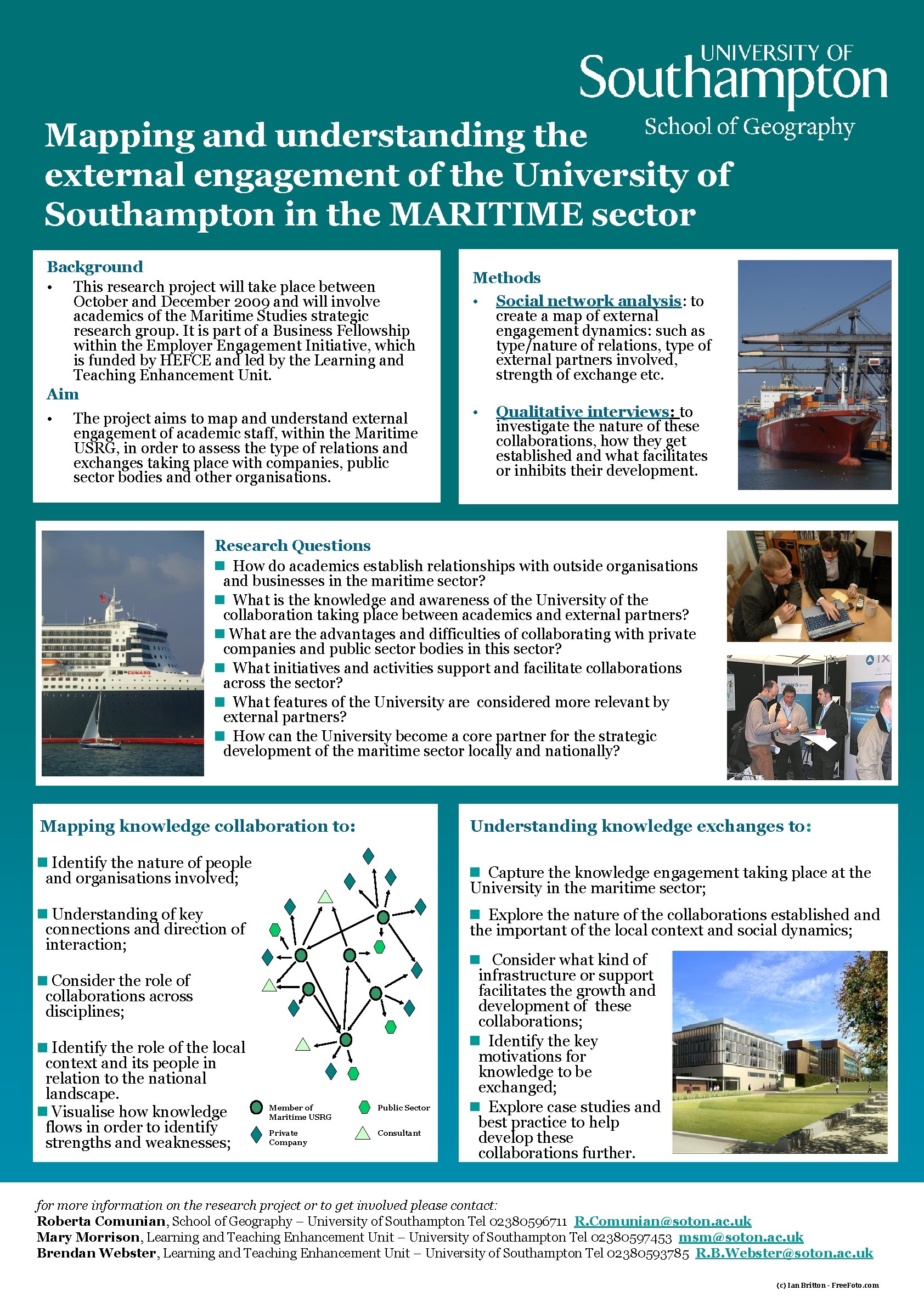
Mapping and understanding the external engagement of the University of Southampton in the MARITIME sector Background • This research project will take place between October and December 2009 and will involve academics of the Maritime Studies strategic research group. It is part of a Business Fellowship within the Employer Engagement Initiative, which is funded by HEFCE and led by the Learning and Teaching Enhancement Unit. Aim • The project aims to map and understand external engagement of academic staff, within the Maritime USRG, in order to assess the type of relations and exchanges taking place with companies, public sector bodies and other organisations. Methods • Social network analysis: to create a map of external engagement dynamics: such as type/nature of relations, type of external partners involved, strength of exchange etc. • Qualitative interviews: to investigate the nature of these collaborations, how they get established and what facilitates or inhibits their development. Research Questions How do academics establish relationships with outside organisations and businesses in the maritime sector? What is the knowledge and awareness of the University of the collaboration taking place between academics and external partners? What are the advantages and difficulties of collaborating with private companies and public sector bodies in this sector? What initiatives and activities support and facilitate collaborations across the sector? What features of the University are considered more relevant by external partners? How can the University become a core partner for the strategic development of the maritime sector locally and nationally? Mapping knowledge collaboration to: Understanding knowledge exchanges to: Identify the nature of people and organisations involved; Capture the knowledge engagement taking place at the University in the maritime sector; Understanding of key connections and direction of interaction; Explore the nature of the collaborations established and the important of the local context and social dynamics; Consider the role of collaborations across disciplines; Identify the role of the local context and its people in relation to the national landscape. Visualise how knowledge flows in order to identify strengths and weaknesses; Member of Maritime USRG Public Sector Private Company Consultant Consider what kind of infrastructure or support facilitates the growth and development of these collaborations; Identify the key motivations for knowledge to be exchanged; Explore case studies and best practice to help develop these collaborations further. ¬ Creative Industries (CI), Artist (A), Public funding Organisations (PO), Public Arts organisations (PA), Funding Programme (F) and others could be read as a complex socio-economic network. ¬ Analysing these networks, their density and their complexity could provide knowledge on the flow of information, knowledge and fundings within the wider cultural sector, expecially highlighting the on going relationship between private and public (in both directions). for more information on the research project or to get involved please contact: Roberta Comunian, School of Geography – University of Southampton Tel 02380596711 R. Comunian@soton. ac. uk Mary Morrison, Learning and Teaching Enhancement Unit – University of Southampton Tel 02380597453 msm@soton. ac. uk Brendan Webster, Learning and Teaching Enhancement Unit – University of Southampton Tel 02380593785 R. B. Webster@soton. ac. uk (c) Ian Britton - Free. Foto. com