
Map Reduce HighLevel Languages WPI Mohamed Eltabakh 1
Map. Reduce High-Level Languages WPI, Mohamed Eltabakh 1
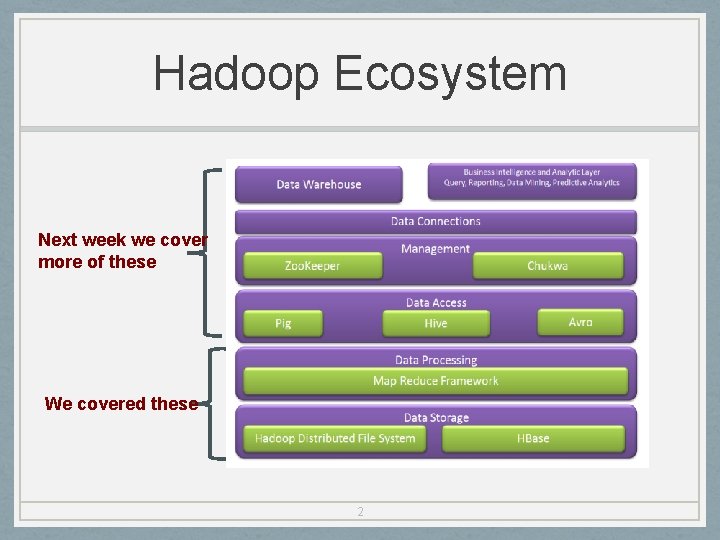
Hadoop Ecosystem Next week we cover more of these We covered these 2
Query Languages for Hadoop • Java: Hadoop’s Native Language • Pig: Query and Workflow Language • Hive: SQL-Based Language • HBase: Column-oriented Database for Map. Reduce 3
Java is Hadoop’s Native Language • Hadoop itself is written in Java • Provided Java APIs • For mappers, reducers, combiners, partitioners • Input and output formats • Other languages, e. g. , Pig or Hive, convert their queries to Java Map. Reduce code 4
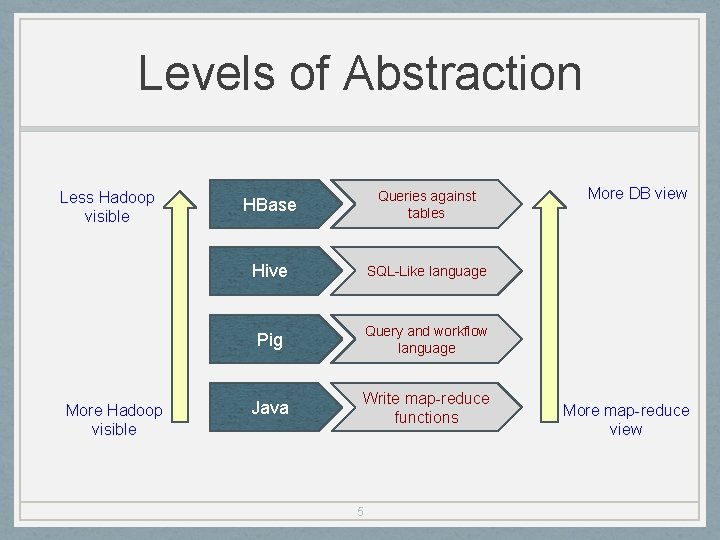
Levels of Abstraction Less Hadoop visible More Hadoop visible HBase Queries against tables Hive SQL-Like language Pig Query and workflow language Java Write map-reduce functions 5 More DB view More map-reduce view
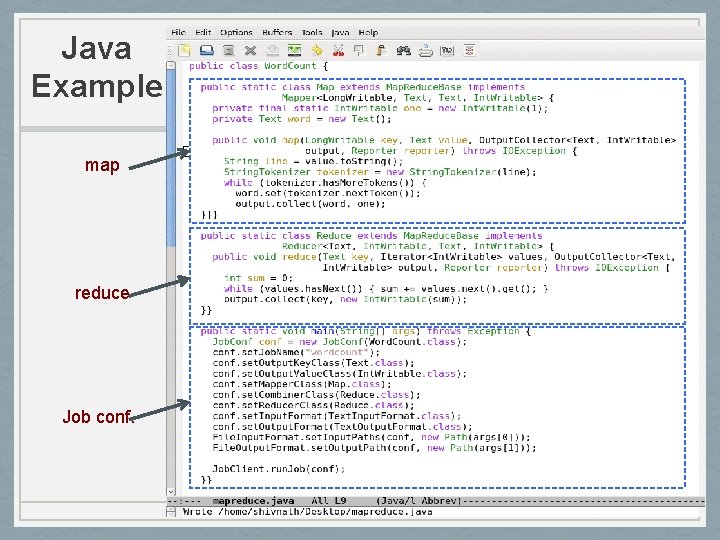
Java Example map reduce Job conf. 6
Apache Pig 7
What is Pig A platform for analyzing large data sets that consists of a high-level language for expressing data analysis programs. Compiles down to Map. Reduce jobs Developed by Yahoo! Open-source language 8
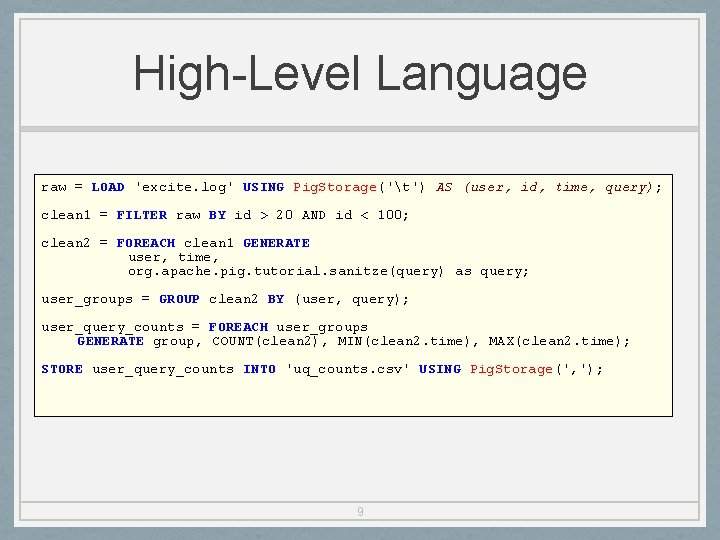
High-Level Language raw = LOAD 'excite. log' USING Pig. Storage('t') AS (user, id, time, query); clean 1 = FILTER raw BY id > 20 AND id < 100; clean 2 = FOREACH clean 1 GENERATE user, time, org. apache. pig. tutorial. sanitze(query) as query; user_groups = GROUP clean 2 BY (user, query); user_query_counts = FOREACH user_groups GENERATE group, COUNT(clean 2), MIN(clean 2. time), MAX(clean 2. time); STORE user_query_counts INTO 'uq_counts. csv' USING Pig. Storage(', '); 9
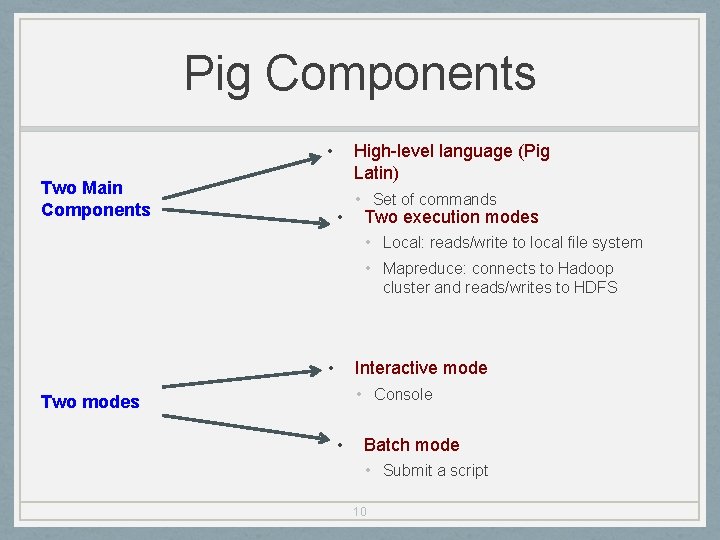
Pig Components • Two Main Components High-level language (Pig Latin) • • Set of commands Two execution modes • Local: reads/write to local file system • Mapreduce: connects to Hadoop cluster and reads/writes to HDFS • Interactive mode • Console Two modes • Batch mode • Submit a script 10
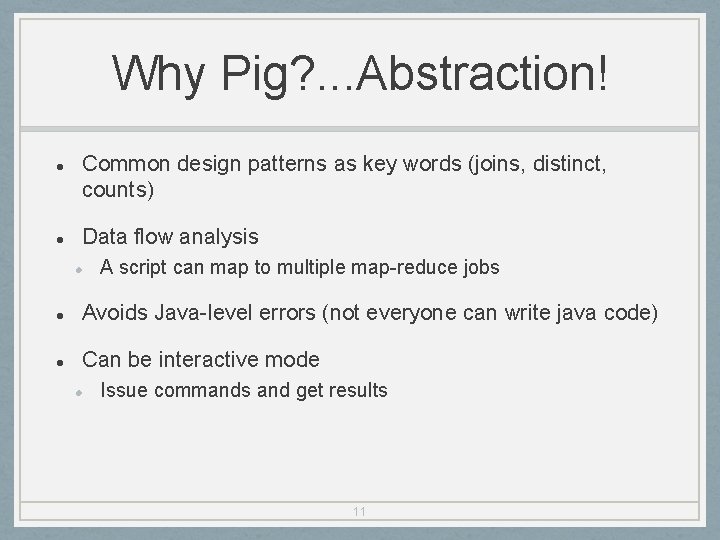
Why Pig? . . . Abstraction! Common design patterns as key words (joins, distinct, counts) Data flow analysis A script can map to multiple map-reduce jobs Avoids Java-level errors (not everyone can write java code) Can be interactive mode Issue commands and get results 11
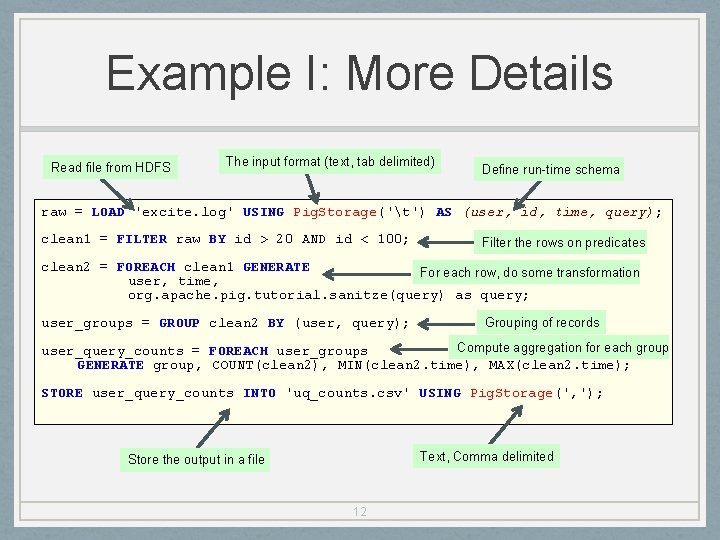
Example I: More Details Read file from HDFS The input format (text, tab delimited) Define run-time schema raw = LOAD 'excite. log' USING Pig. Storage('t') AS (user, id, time, query); clean 1 = FILTER raw BY id > 20 AND id < 100; Filter the rows on predicates clean 2 = FOREACH clean 1 GENERATE For each row, do some transformation user, time, org. apache. pig. tutorial. sanitze(query) as query; user_groups = GROUP clean 2 BY (user, query); Grouping of records Compute aggregation for each group user_query_counts = FOREACH user_groups GENERATE group, COUNT(clean 2), MIN(clean 2. time), MAX(clean 2. time); STORE user_query_counts INTO 'uq_counts. csv' USING Pig. Storage(', '); Text, Comma delimited Store the output in a file 12
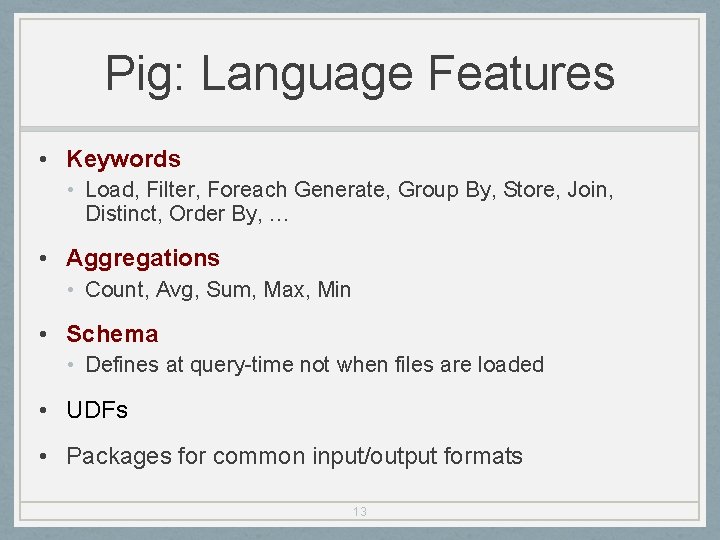
Pig: Language Features • Keywords • Load, Filter, Foreach Generate, Group By, Store, Join, Distinct, Order By, … • Aggregations • Count, Avg, Sum, Max, Min • Schema • Defines at query-time not when files are loaded • UDFs • Packages for common input/output formats 13
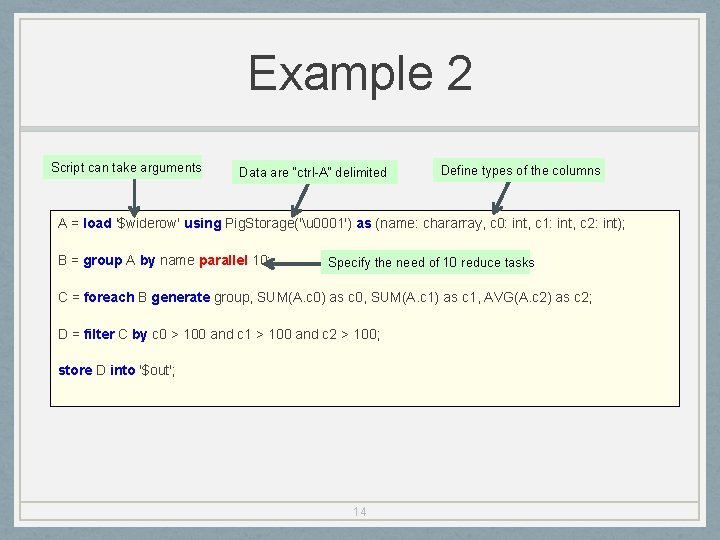
Example 2 Script can take arguments Data are “ctrl-A” delimited Define types of the columns A = load '$widerow' using Pig. Storage('u 0001') as (name: chararray, c 0: int, c 1: int, c 2: int); B = group A by name parallel 10; Specify the need of 10 reduce tasks C = foreach B generate group, SUM(A. c 0) as c 0, SUM(A. c 1) as c 1, AVG(A. c 2) as c 2; D = filter C by c 0 > 100 and c 1 > 100 and c 2 > 100; store D into '$out'; 14
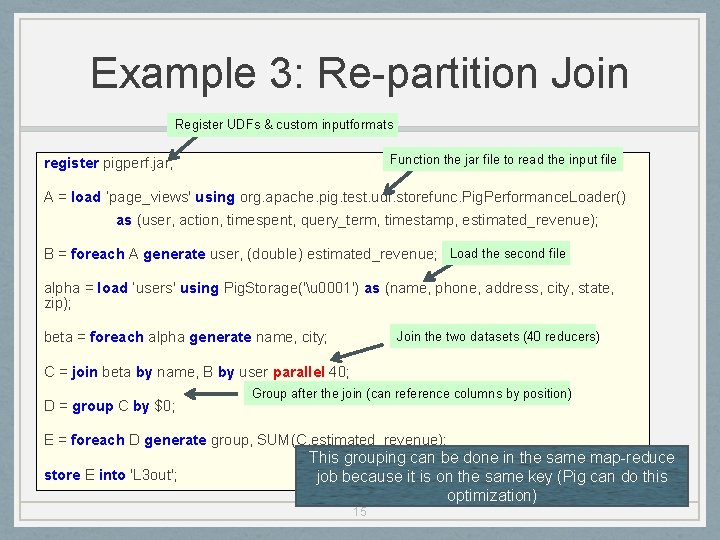
Example 3: Re-partition Join Register UDFs & custom inputformats Function the jar file to read the input file register pigperf. jar; A = load ‘page_views' using org. apache. pig. test. udf. storefunc. Pig. Performance. Loader() as (user, action, timespent, query_term, timestamp, estimated_revenue); B = foreach A generate user, (double) estimated_revenue; Load the second file alpha = load ’users' using Pig. Storage('u 0001') as (name, phone, address, city, state, zip); beta = foreach alpha generate name, city; Join the two datasets (40 reducers) C = join beta by name, B by user parallel 40; D = group C by $0; Group after the join (can reference columns by position) E = foreach D generate group, SUM(C. estimated_revenue); store E into 'L 3 out'; This grouping can be done in the same map-reduce job because it is on the same key (Pig can do this optimization) 15
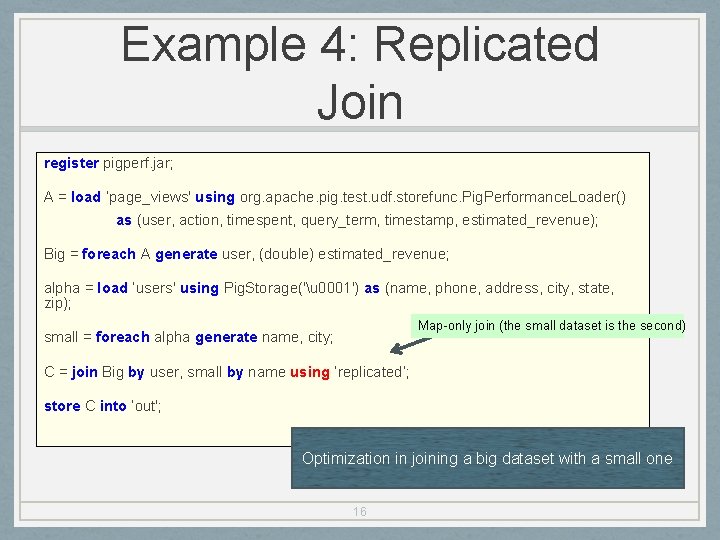
Example 4: Replicated Join register pigperf. jar; A = load ‘page_views' using org. apache. pig. test. udf. storefunc. Pig. Performance. Loader() as (user, action, timespent, query_term, timestamp, estimated_revenue); Big = foreach A generate user, (double) estimated_revenue; alpha = load ’users' using Pig. Storage('u 0001') as (name, phone, address, city, state, zip); Map-only join (the small dataset is the second) small = foreach alpha generate name, city; C = join Big by user, small by name using ‘replicated’; store C into ‘out'; Optimization in joining a big dataset with a small one 16
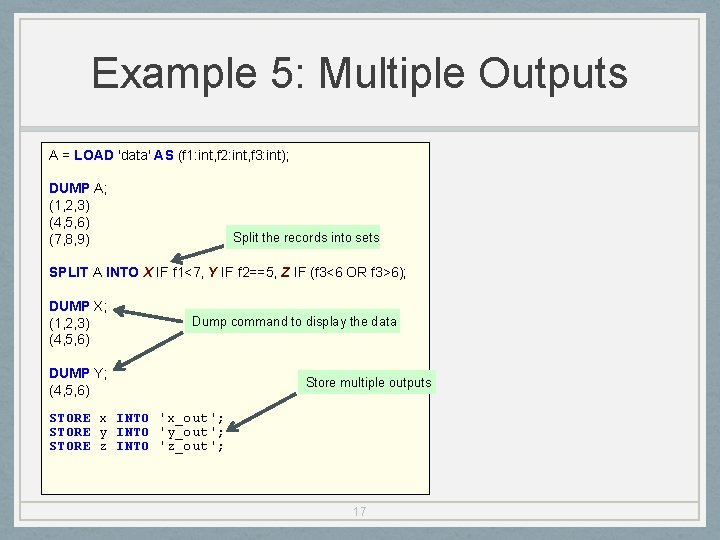
Example 5: Multiple Outputs A = LOAD 'data' AS (f 1: int, f 2: int, f 3: int); DUMP A; (1, 2, 3) (4, 5, 6) (7, 8, 9) Split the records into sets SPLIT A INTO X IF f 1<7, Y IF f 2==5, Z IF (f 3<6 OR f 3>6); DUMP X; (1, 2, 3) (4, 5, 6) Dump command to display the data DUMP Y; (4, 5, 6) Store multiple outputs STORE x INTO 'x_out'; STORE y INTO 'y_out'; STORE z INTO 'z_out'; 17
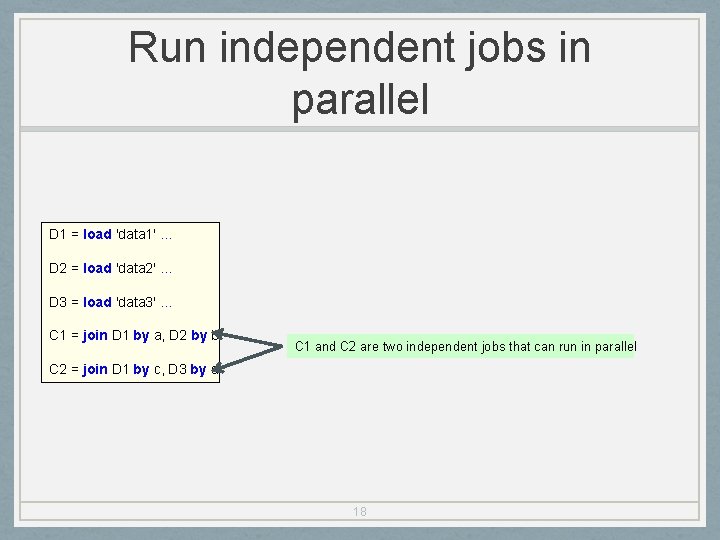
Run independent jobs in parallel D 1 = load 'data 1' … D 2 = load 'data 2' … D 3 = load 'data 3' … C 1 = join D 1 by a, D 2 by b C 1 and C 2 are two independent jobs that can run in parallel C 2 = join D 1 by c, D 3 by d 18
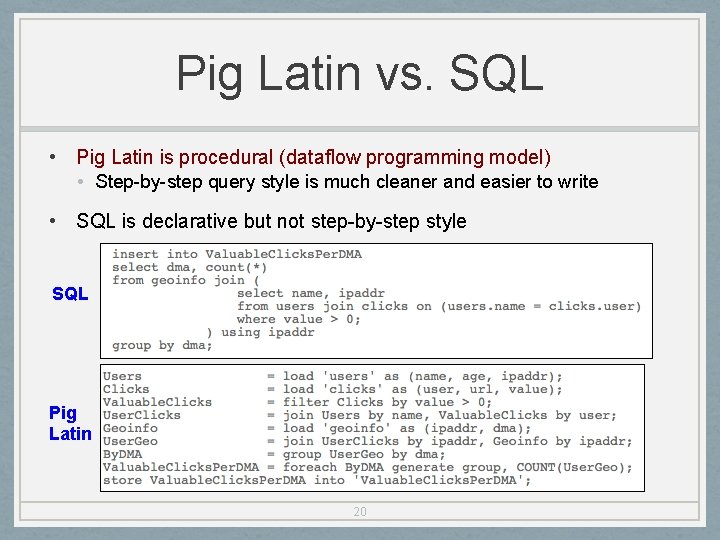
Pig Latin vs. SQL • Pig Latin is procedural (dataflow programming model) • Step-by-step query style is much cleaner and easier to write • SQL is declarative but not step-by-step style SQL Pig Latin 20
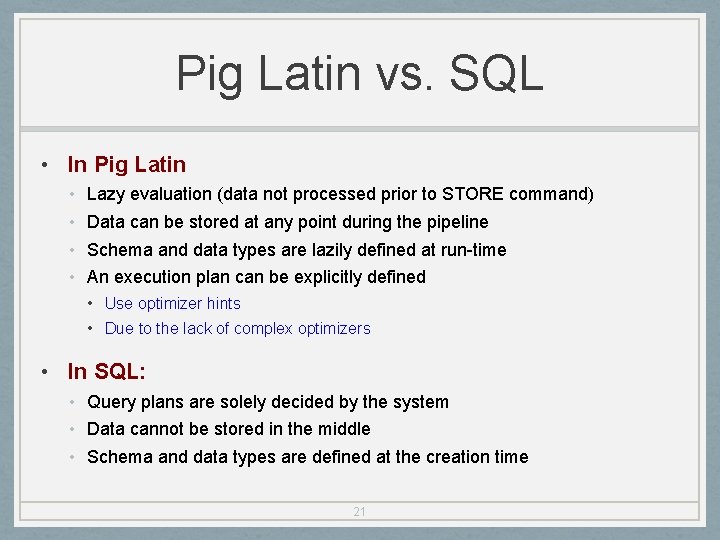
Pig Latin vs. SQL • In Pig Latin • • Lazy evaluation (data not processed prior to STORE command) Data can be stored at any point during the pipeline Schema and data types are lazily defined at run-time An execution plan can be explicitly defined • Use optimizer hints • Due to the lack of complex optimizers • In SQL: • Query plans are solely decided by the system • Data cannot be stored in the middle • Schema and data types are defined at the creation time 21
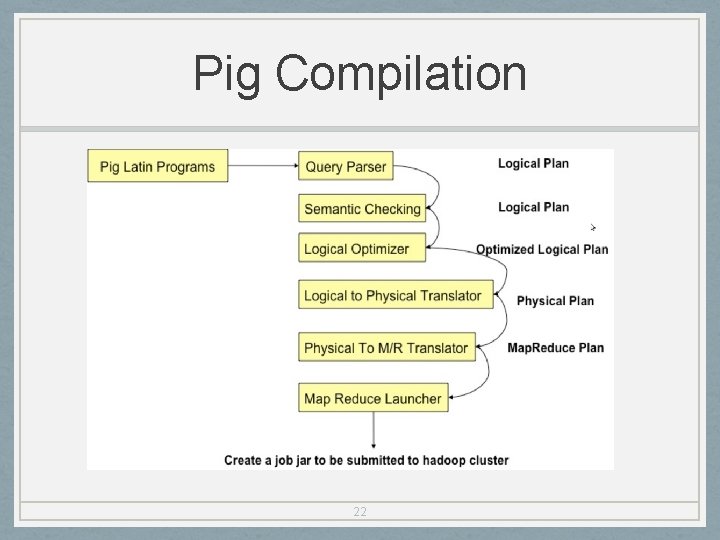
Pig Compilation 22
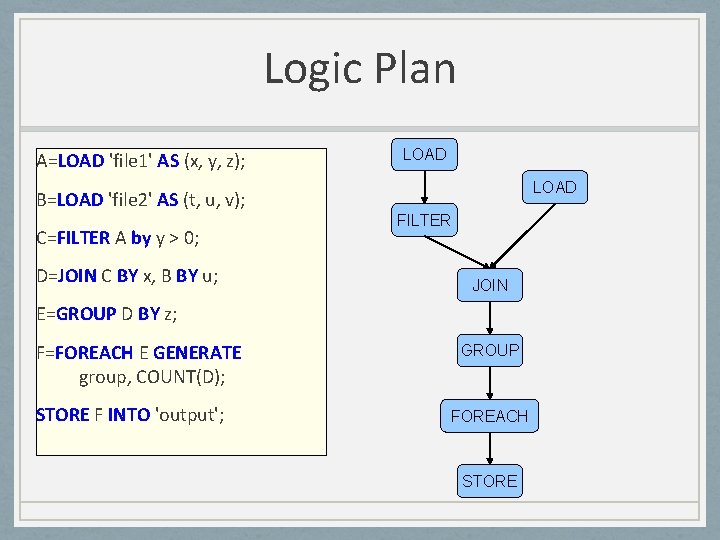
Logic Plan A=LOAD 'file 1' AS (x, y, z); LOAD B=LOAD 'file 2' AS (t, u, v); C=FILTER A by y > 0; D=JOIN C BY x, B BY u; FILTER JOIN E=GROUP D BY z; F=FOREACH E GENERATE group, COUNT(D); STORE F INTO 'output'; GROUP FOREACH STORE
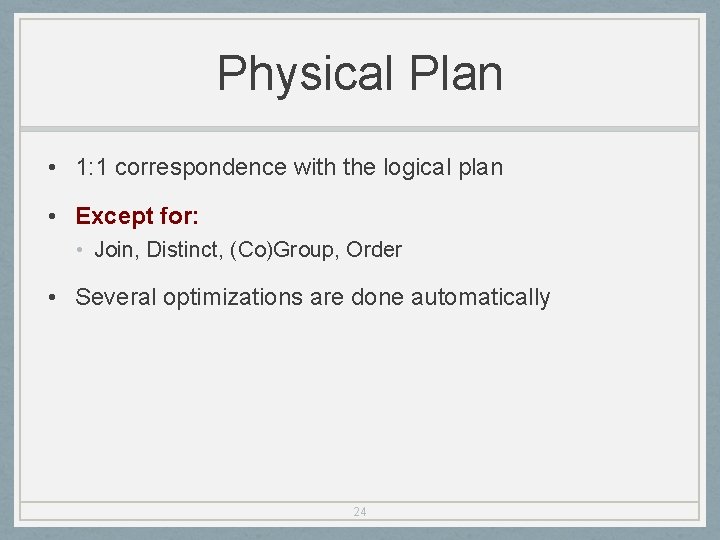
Physical Plan • 1: 1 correspondence with the logical plan • Except for: • Join, Distinct, (Co)Group, Order • Several optimizations are done automatically 24
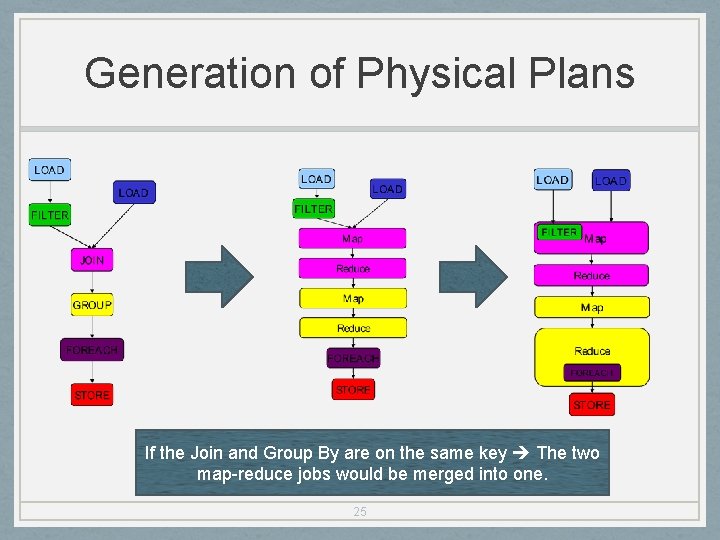
Generation of Physical Plans If the Join and Group By are on the same key The two map-reduce jobs would be merged into one. 25
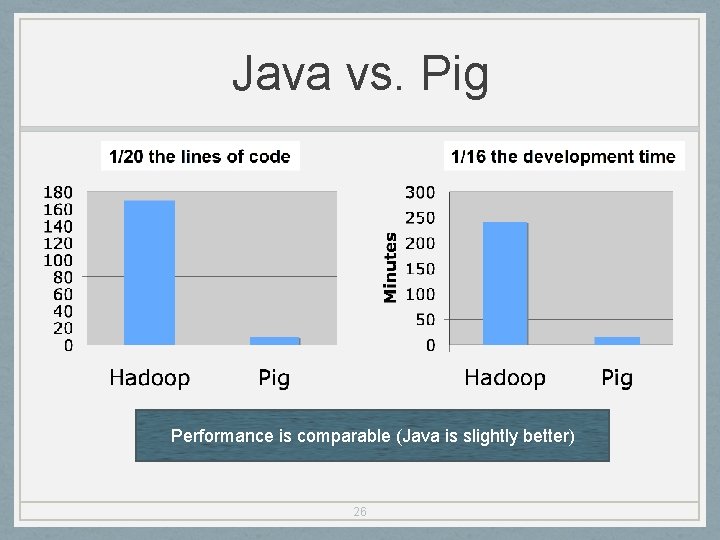
Java vs. Pig Performance is comparable (Java is slightly better) 26
Pig References • Pig Tutorial • http: //pig. apache. org/docs/r 0. 7. 0/tutorial. html • Pig Latin Reference Manual 2 • http: //pig. apache. org/docs/r 0. 7. 0/piglatin_ref 1. html • Pig Latin Reference Manual 2 • http: //pig. apache. org/docs/r 0. 7. 0/piglatin_ref 2. html • Pig. Mix Queries • https: //cwiki. apache. org/PIG/pigmix. html 27
Apache Pig 28
- Slides: 27