
Map Reading Navigation Presentation Overview How to use
- Slides: 45
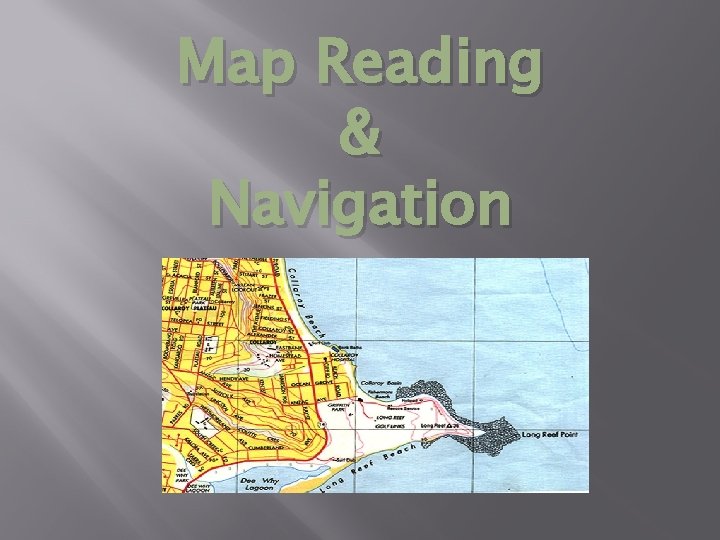
Map Reading & Navigation
Presentation Overview � How to use various maps � � � Scale, Grid references, Ground shape, Gradient etc Compasses & Bearings Cross country navigation
Aim of Map Reading. . . � � To navigate & recognize features on the ground & map. To picture the ground even though it hasn’t been seen. To understand pass information quickly. Determine and plan a safe route.
Definition of a Map… � � Its a scaled representation of the earths surface shown on a plane surface. It shows natural and/or artificial features. Used as a form of communication, used to convey land features. However, its only accurate at time of aerial photo or field revision.
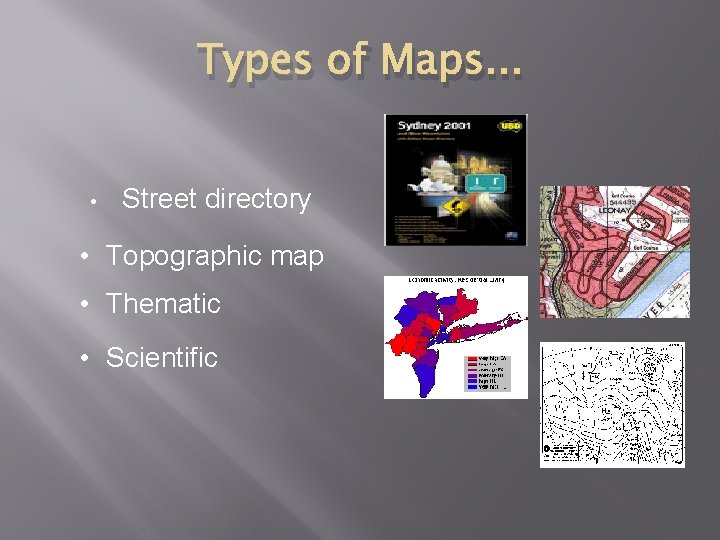
Types of Maps. . . • Street directory • Topographic map • Thematic • Scientific
Street Directory � � � Edition Key map Suburb index � � � Facility index Street index Map & reference
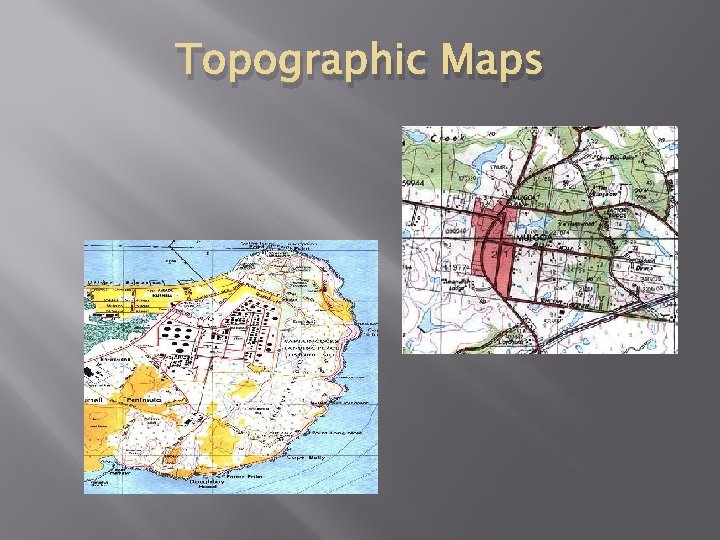
Topographic Maps
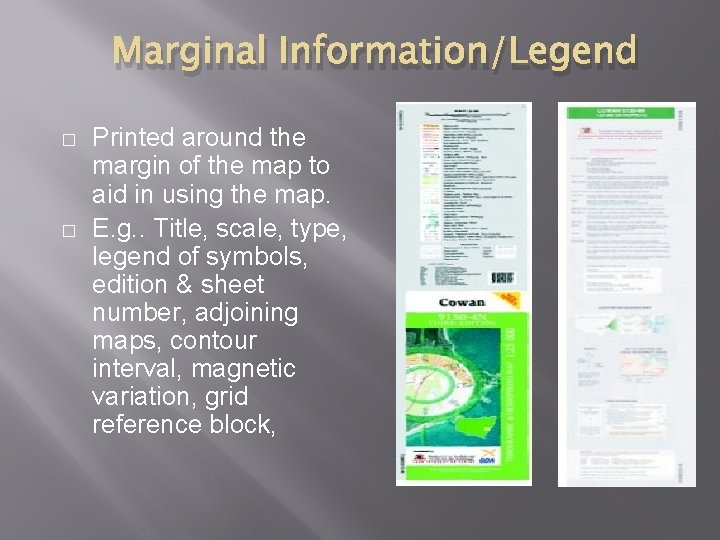
Marginal Information/Legend � � Printed around the margin of the map to aid in using the map. E. g. . Title, scale, type, legend of symbols, edition & sheet number, adjoining maps, contour interval, magnetic variation, grid reference block,
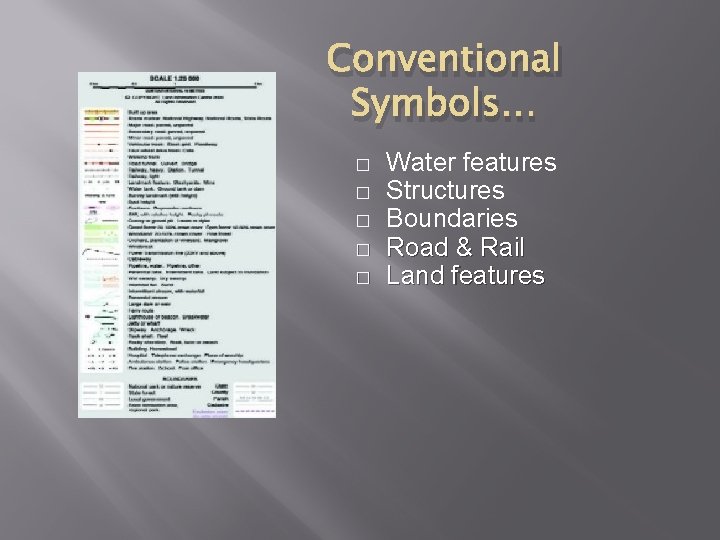
Conventional Symbols… � � � Water features Structures Boundaries Road & Rail Land features
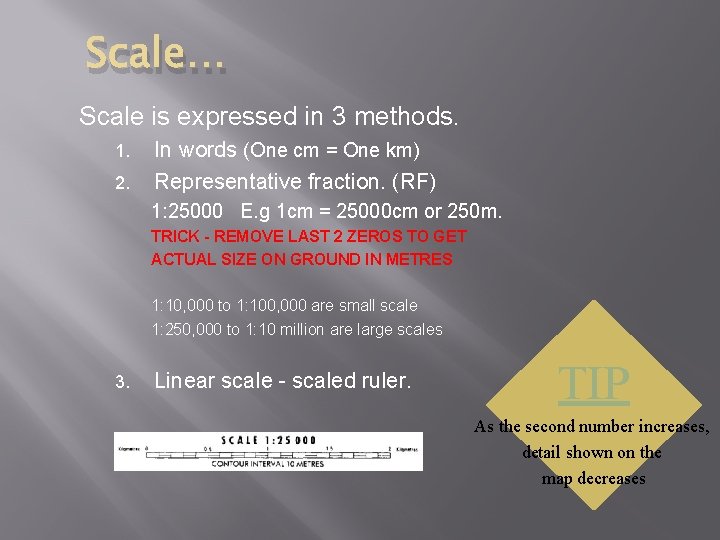
Scale… Scale is expressed in 3 methods. 1. 2. In words (One cm = One km) Representative fraction. (RF) 1: 25000 E. g 1 cm = 25000 cm or 250 m. TRICK - REMOVE LAST 2 ZEROS TO GET ACTUAL SIZE ON GROUND IN METRES 1: 10, 000 to 1: 100, 000 are small scale 1: 250, 000 to 1: 10 million are large scales 3. Linear scale - scaled ruler. TIP As the second number increases, detail shown on the map decreases
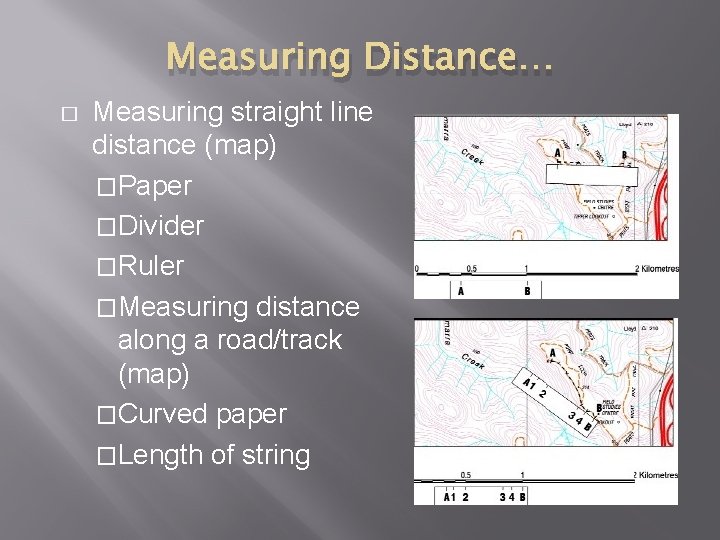
Measuring Distance… � Measuring straight line distance (map) �Paper �Divider �Ruler �Measuring distance along a road/track (map) �Curved paper �Length of string
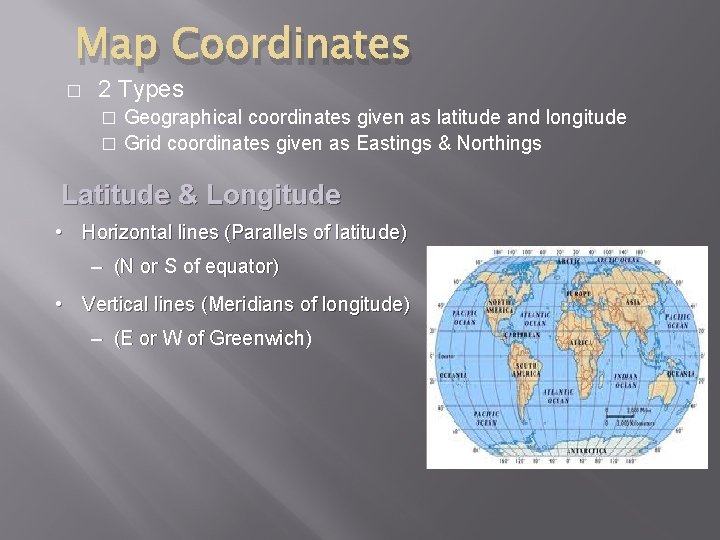
Map Coordinates � 2 Types Geographical coordinates given as latitude and longitude � Grid coordinates given as Eastings & Northings � Latitude & Longitude • Horizontal lines (Parallels of latitude) – (N or S of equator) • Vertical lines (Meridians of longitude) – (E or W of Greenwich)
Grid Coordinates � � � Used to accurately locate/position objects on a map. Two sets of numbered parallel lines (vertical & horizontal) intersecting at right angles to form squares on a map. Superimposed over the map to provide a reference system. 2. Grid squares are generally 1 km Grid lines are defined as ‘Eastings’ & ‘Northings. ’
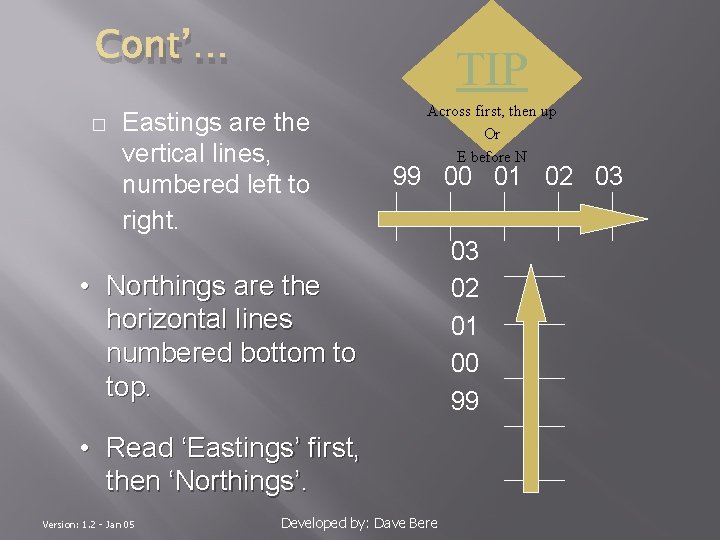
Cont’… � TIP Eastings are the vertical lines, numbered left to right. Across first, then up Or E before N 99 00 01 02 03 • Northings are the horizontal lines numbered bottom to top. • Read ‘Eastings’ first, then ‘Northings’. Version: 1. 2 - Jan 05 Developed by: Dave Bere 03 02 01 00 99
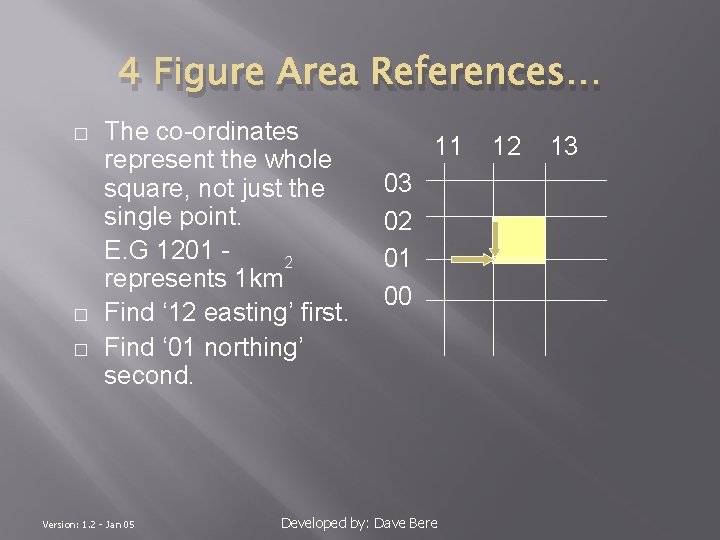
4 Figure Area References… � � � The co-ordinates represent the whole square, not just the single point. E. G 1201 2 represents 1 km Find ‘ 12 easting’ first. Find ‘ 01 northing’ second. Version: 1. 2 - Jan 05 11 03 02 01 00 Developed by: Dave Bere 12 13
GPS… � Global Positioning System (satellite based navigation) � Features included: Your position on the Earth’s surface Your current height - ASL Your speed and direction of travel Lat/Long or UTM Different world datums � � �WGS 84 � � Developed by US Defence system Uses 24 satellites orbiting the Earth twice a day Version: 1. 2 - Jan 05 � � Signal doesn’t penetrate buildings or thick scrub. Uses triangulation principle to pinpoint location. Minimum of 4 satellites are needed for an accurate 3 D position Typical accuracy is within 30 m - 95% of the time Interfaces with your PC and mapping software Consult users guide for operating instructions Developed by: Dave Bere
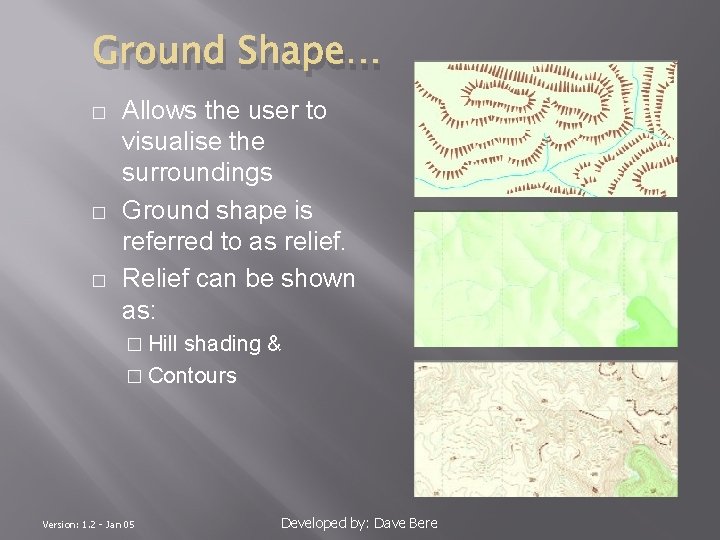
Ground Shape… � � � Allows the user to visualise the surroundings Ground shape is referred to as relief. Relief can be shown as: � Hill shading & � Contours Version: 1. 2 - Jan 05 Developed by: Dave Bere
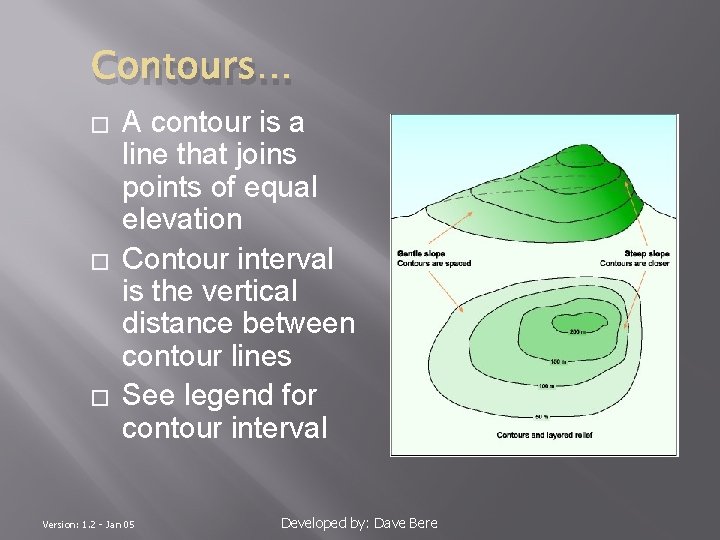
Contours… � � � A contour is a line that joins points of equal elevation Contour interval is the vertical distance between contour lines See legend for contour interval Version: 1. 2 - Jan 05 Developed by: Dave Bere
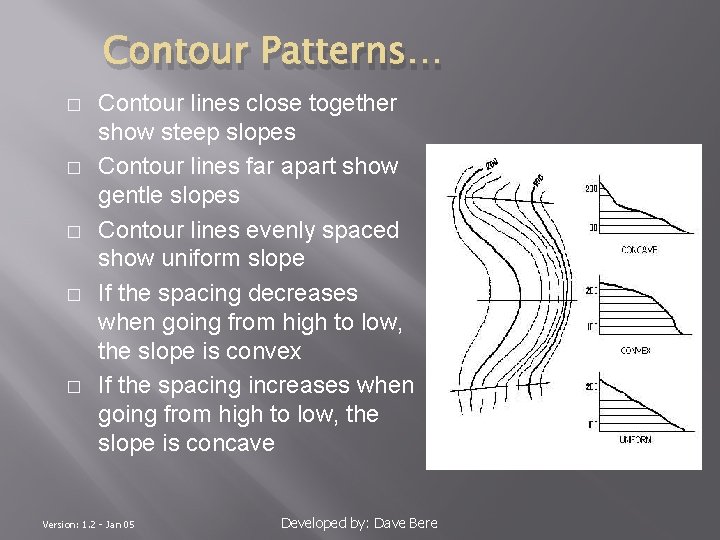
Contour Patterns… � � � Contour lines close together show steep slopes Contour lines far apart show gentle slopes Contour lines evenly spaced show uniform slope If the spacing decreases when going from high to low, the slope is convex If the spacing increases when going from high to low, the slope is concave Version: 1. 2 - Jan 05 Developed by: Dave Bere
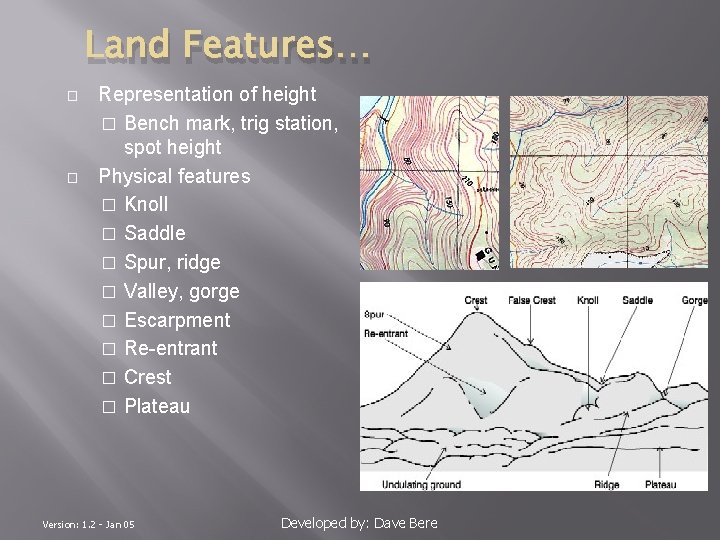
Land Features… � � Representation of height � Bench mark, trig station, spot height Physical features � Knoll � Saddle � Spur, ridge � Valley, gorge � Escarpment � Re-entrant � Crest � Plateau Version: 1. 2 - Jan 05 Developed by: Dave Bere
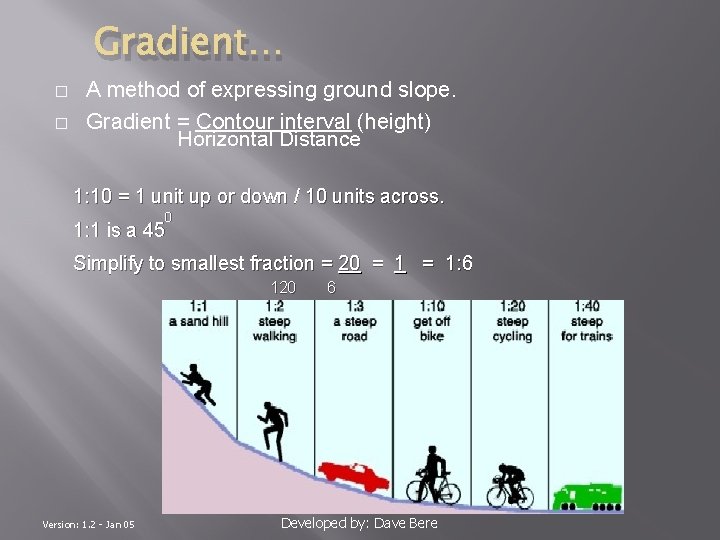
Gradient… � � A method of expressing ground slope. Gradient = Contour interval (height) Horizontal Distance 1: 10 = 1 unit up or down / 10 units across. 0 1: 1 is a 45 Simplify to smallest fraction = 20 = 1: 6 120 Version: 1. 2 - Jan 05 6 Developed by: Dave Bere
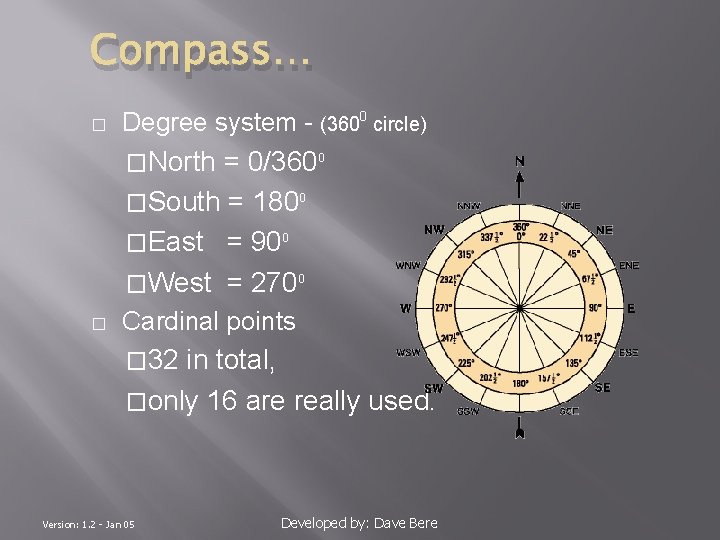
Compass… � Degree system - (3600 circle) �North = 0/3600 �South = 1800 �East = 900 �West = 2700 � Cardinal points � 32 in total, �only 16 are really used. Version: 1. 2 - Jan 05 Developed by: Dave Bere
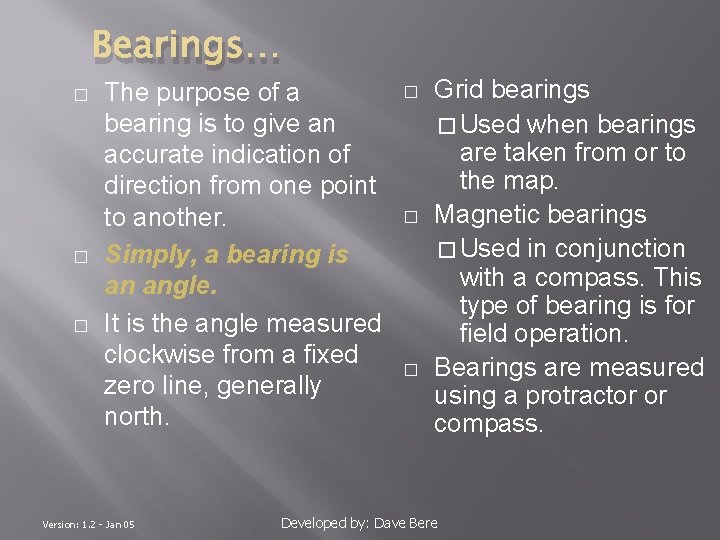
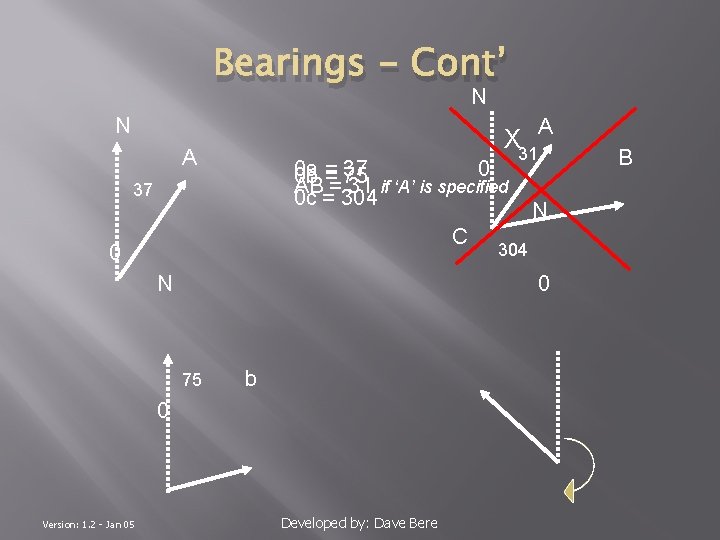
Bearings… � � � The purpose of a bearing is to give an accurate indication of direction from one point to another. Simply, a bearing is an angle. It is the angle measured clockwise from a fixed zero line, generally north. Version: 1. 2 - Jan 05 � � � Grid bearings � Used when bearings are taken from or to the map. Magnetic bearings � Used in conjunction with a compass. This type of bearing is for field operation. Bearings are measured using a protractor or compass. Developed by: Dave Bere
Bearings - Cont’ N N A X 31 A 0 a = 37 0 0 b = 75 AB = 31 if ‘A’ is specified 0 c = 304 37 C 0 304 0 N 75 b 0 Version: 1. 2 - Jan 05 N Developed by: Dave Bere B
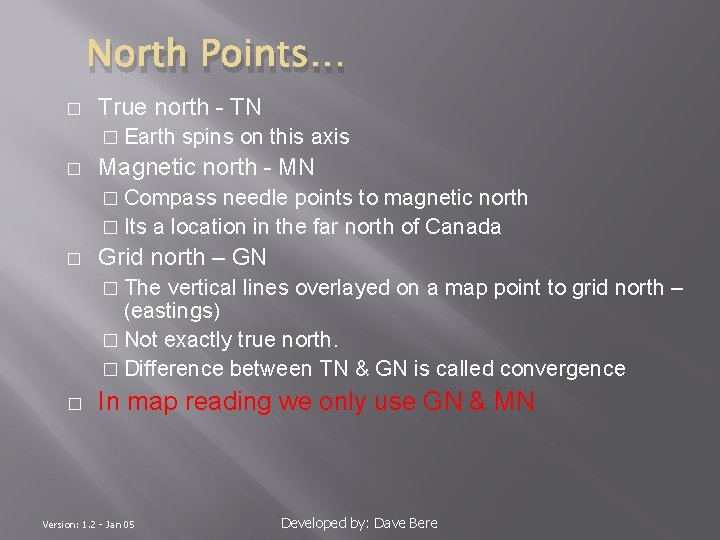
North Points… � True north - TN � Earth � spins on this axis Magnetic north - MN � Compass needle points to magnetic north � Its a location in the far north of Canada � Grid north – GN � The vertical lines overlayed on a map point to grid north – (eastings) � Not exactly true north. � Difference between TN & GN is called convergence � In map reading we only use GN & MN Version: 1. 2 - Jan 05 Developed by: Dave Bere
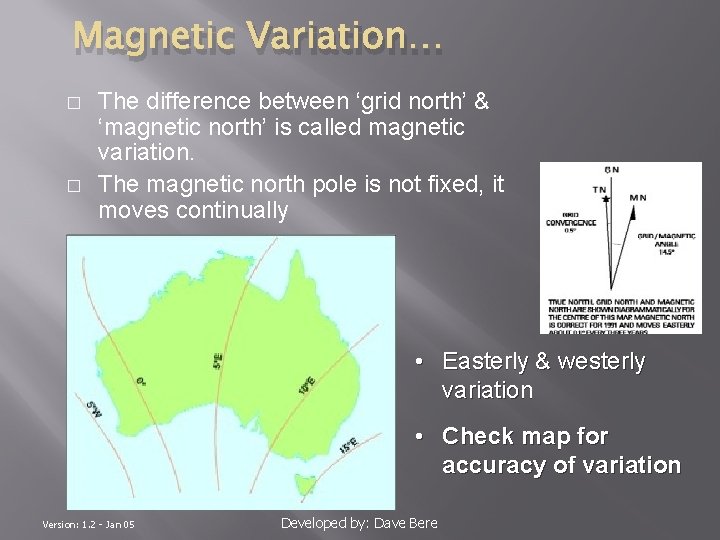
Magnetic Variation… � � The difference between ‘grid north’ & ‘magnetic north’ is called magnetic variation. The magnetic north pole is not fixed, it moves continually • Easterly & westerly variation • Check map for accuracy of variation Version: 1. 2 - Jan 05 Developed by: Dave Bere
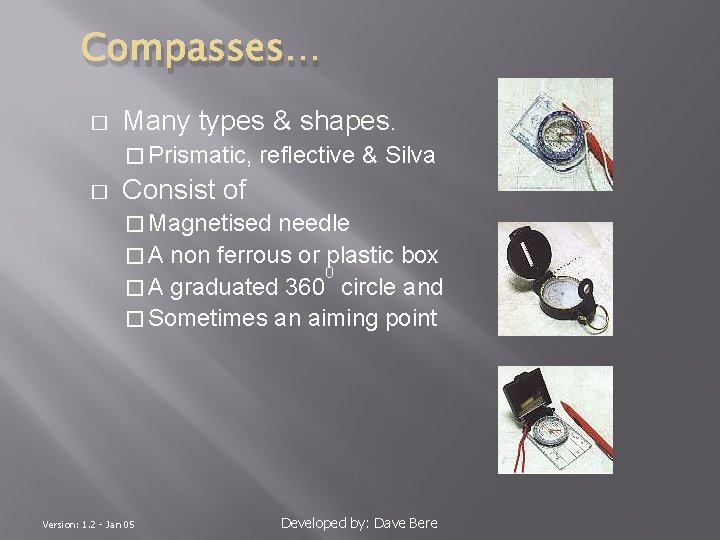
Compasses… � Many types & shapes. � Prismatic, � reflective & Silva Consist of � Magnetised needle � A non ferrous or plastic box 0 � A graduated 360 circle and � Sometimes an aiming point Version: 1. 2 - Jan 05 Developed by: Dave Bere
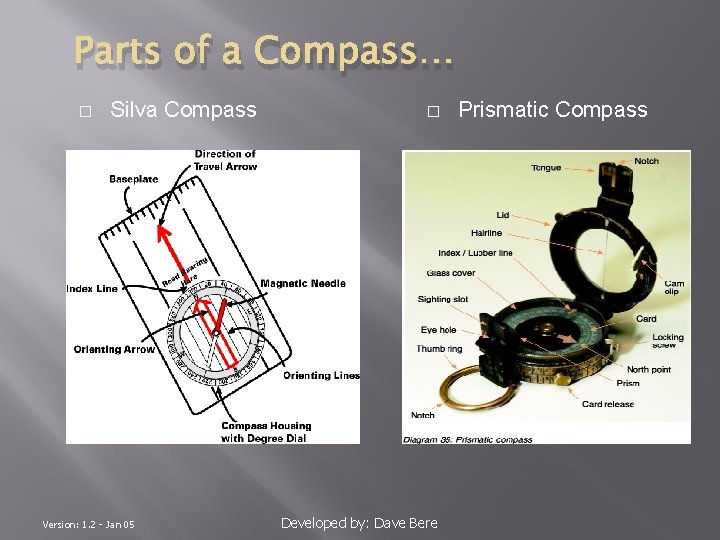
Parts of a Compass… � Silva Compass Version: 1. 2 - Jan 05 � Developed by: Dave Bere Prismatic Compass
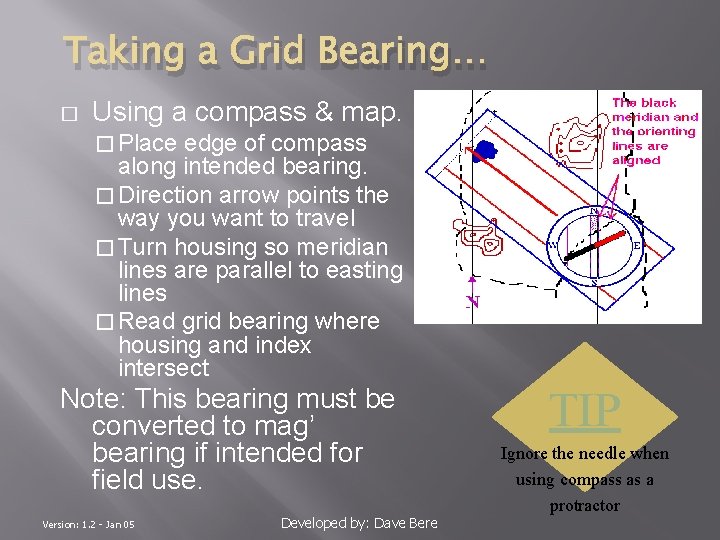
Taking a Grid Bearing… � Using a compass & map. � Place edge of compass along intended bearing. � Direction arrow points the way you want to travel � Turn housing so meridian lines are parallel to easting lines � Read grid bearing where housing and index intersect Note: This bearing must be converted to mag’ bearing if intended for field use. Version: 1. 2 - Jan 05 Developed by: Dave Bere TIP Ignore the needle when using compass as a protractor
Magnetic Bearings � Setting a Magnetic bearing � Hold compass flat in palm � Set bearing on compass by rotating housing � Turn yourself till red needle lines up with north � Now walk in direction of directional arrow Version: 1. 2 - Jan 05 � Developed by: Dave Bere Taking a Magnetic bearing � Hold compass with directional arrow pointing at intended object/direction � Rotate housing till north aligns with red arrow � Read bearing where index lines intersects
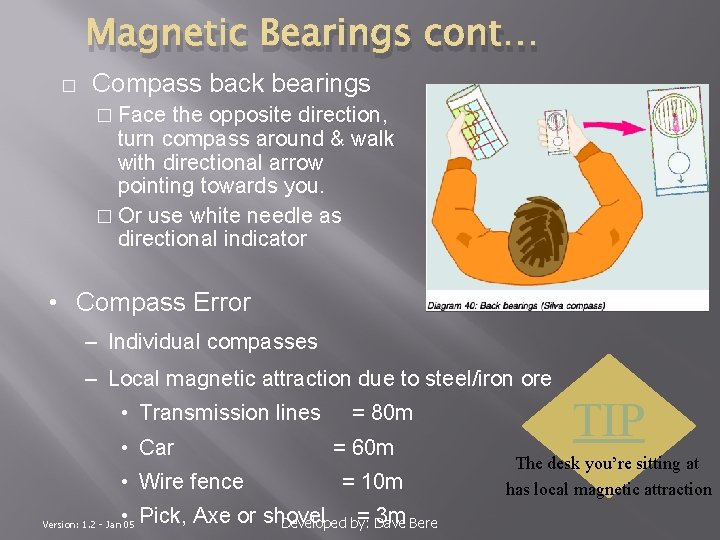
Magnetic Bearings cont… � Compass back bearings � Face the opposite direction, turn compass around & walk with directional arrow pointing towards you. � Or use white needle as directional indicator • Compass Error – Individual compasses – Local magnetic attraction due to steel/iron ore • Transmission lines • Car • Wire fence = 80 m = 60 m = 10 m • Pick, Axe or shovel = Dave 3 m Bere Developed by: Version: 1. 2 - Jan 05 TIP The desk you’re sitting at has local magnetic attraction
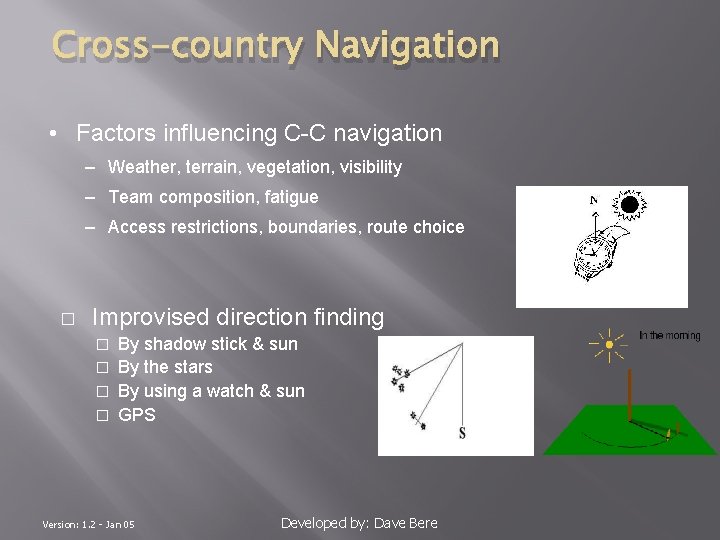
Cross-country Navigation • Factors influencing C-C navigation – Weather, terrain, vegetation, visibility – Team composition, fatigue – Access restrictions, boundaries, route choice � Improvised direction finding By shadow stick & sun � By the stars � By using a watch & sun � GPS � Version: 1. 2 - Jan 05 Developed by: Dave Bere
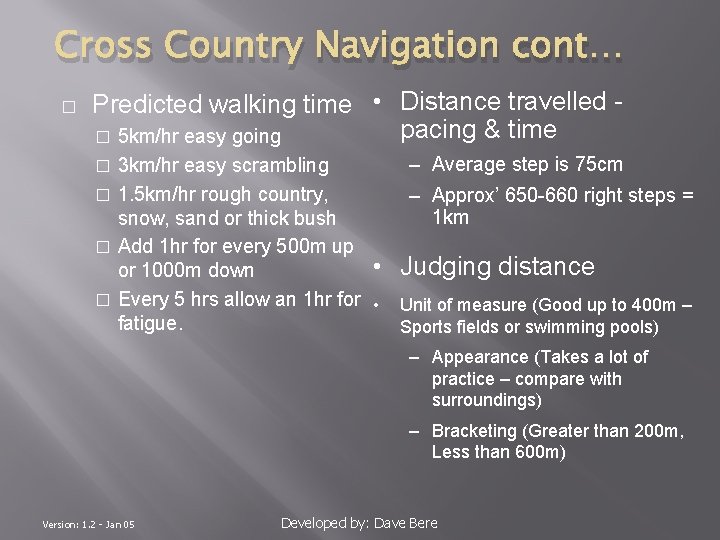
Cross Country Navigation cont… � Predicted walking time • Distance travelled pacing & time � 5 km/hr easy going – Average step is 75 cm 3 km/hr easy scrambling � 1. 5 km/hr rough country, – Approx’ 650 -660 right steps = 1 km snow, sand or thick bush � Add 1 hr for every 500 m up • Judging distance or 1000 m down � Every 5 hrs allow an 1 hr for • Unit of measure (Good up to 400 m – fatigue. Sports fields or swimming pools) � – Appearance (Takes a lot of practice – compare with surroundings) – Bracketing (Greater than 200 m, Less than 600 m) Version: 1. 2 - Jan 05 Developed by: Dave Bere
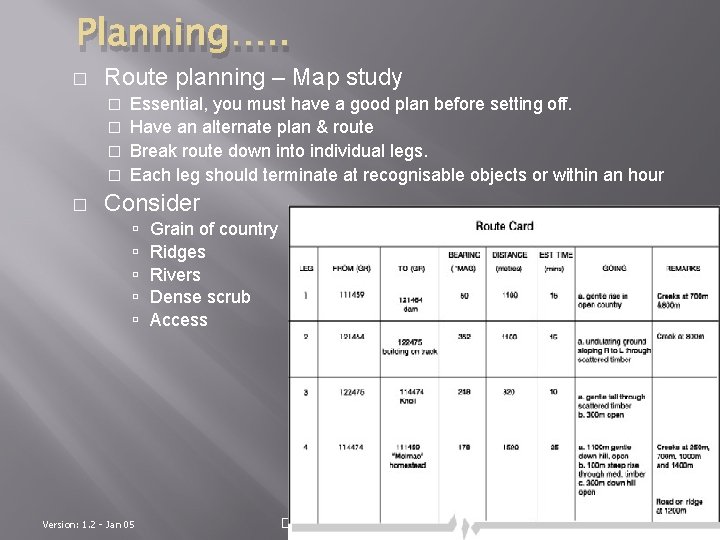
Planning…. . � Route planning – Map study Essential, you must have a good plan before setting off. � Have an alternate plan & route � Break route down into individual legs. � Each leg should terminate at recognisable objects or within an hour � � Consider Version: 1. 2 - Jan 05 Grain of country Ridges Rivers Dense scrub Access Developed by: Dave Bere
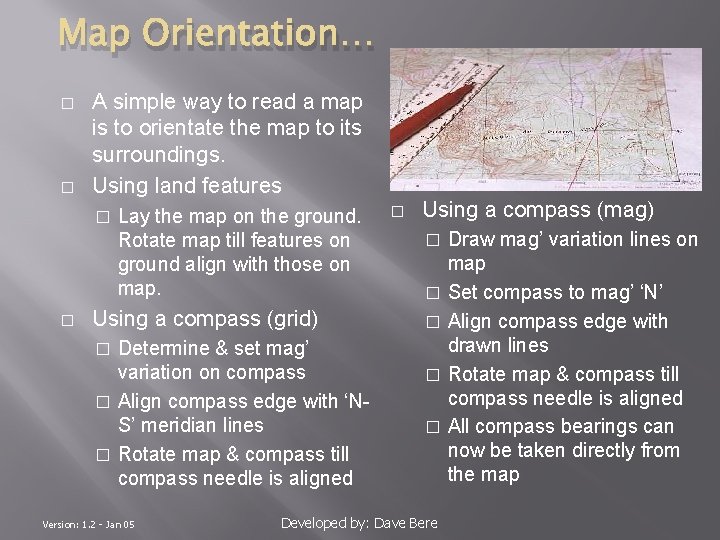
Map Orientation… � � A simple way to read a map is to orientate the map to its surroundings. Using land features � � Lay the map on the ground. Rotate map till features on ground align with those on map. Using a compass (grid) Determine & set mag’ variation on compass � Align compass edge with ‘NS’ meridian lines � Rotate map & compass till compass needle is aligned � Version: 1. 2 - Jan 05 � Using a compass (mag) Draw mag’ variation lines on map � Set compass to mag’ ‘N’ � Align compass edge with drawn lines � Rotate map & compass till compass needle is aligned � All compass bearings can now be taken directly from the map � Developed by: Dave Bere
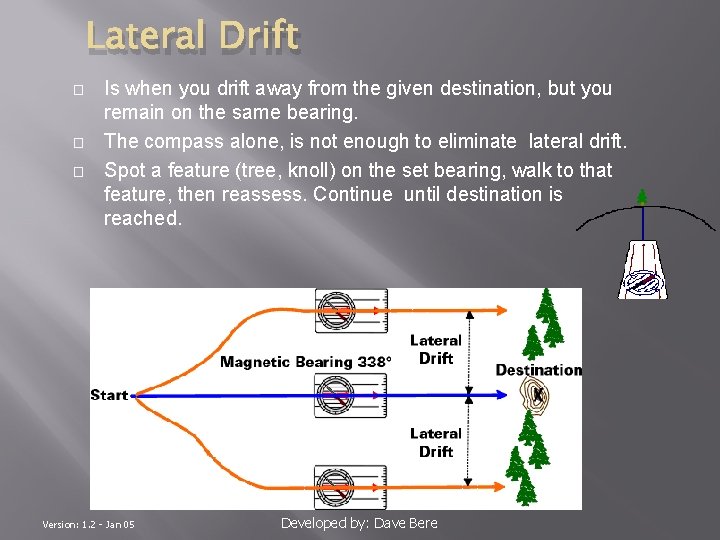
Lateral Drift � � � Is when you drift away from the given destination, but you remain on the same bearing. The compass alone, is not enough to eliminate lateral drift. Spot a feature (tree, knoll) on the set bearing, walk to that feature, then reassess. Continue until destination is reached. Version: 1. 2 - Jan 05 Developed by: Dave Bere
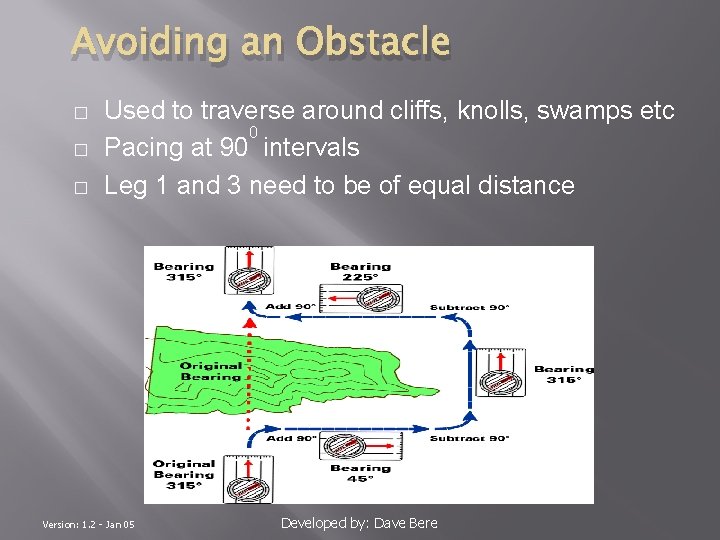
Avoiding an Obstacle � � � Used to traverse around cliffs, knolls, swamps etc 0 Pacing at 90 intervals Leg 1 and 3 need to be of equal distance Version: 1. 2 - Jan 05 Developed by: Dave Bere
Action If Lost!!! � � � Don’t PANIC, remain calm Re-think route & confirm ground covered Position fixing -resection Identify a bearing (track junction) & head for safety Unable to identify your position, set up camp & wait for rescue Initiate any distress beacons TIP Version: 1. 2 - Jan 05 Developed by: Dave Bere You’re never lost, just geographically misplaced
Remote Area Section… This section is not pitched at any level of expertise. Everyone should be well prepared before entering the bush. � � � 6 P’s = prior preparation and planning prevents poor performance. Learn the area before departing Have a navigational route planned Group details � Route details � Intended camp locations � ETD and ETA � Version: 1. 2 - Jan 05 Developed by: Dave Bere
Basic Requirements for Survival… � Water � Minimum 2 ltr/day � Is there water in the area � Carrying capacity � Quality Dry clothes � Thermals � Matches/lighter � Strategies/procedures to cope with the cold � � � Shelter Tent or hutchie � Ground sheet � Improvisation – E. G. Caves, overhangs, huts, sheds � Version: 1. 2 - Jan 05 Warmth � Food Enough food/nourishing � Hunting & gathering food � Rationing � Cooking/disease � Developed by: Dave Bere
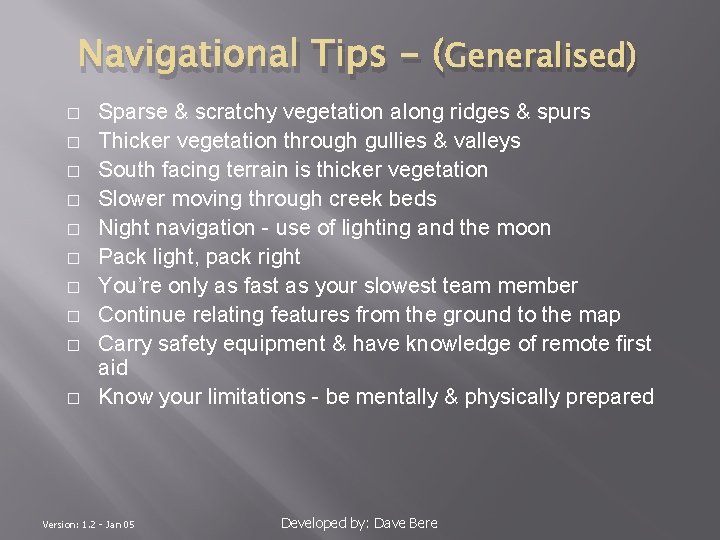
Navigational Tips - (Generalised) � � � � � Sparse & scratchy vegetation along ridges & spurs Thicker vegetation through gullies & valleys South facing terrain is thicker vegetation Slower moving through creek beds Night navigation - use of lighting and the moon Pack light, pack right You’re only as fast as your slowest team member Continue relating features from the ground to the map Carry safety equipment & have knowledge of remote first aid Know your limitations - be mentally & physically prepared Version: 1. 2 - Jan 05 Developed by: Dave Bere
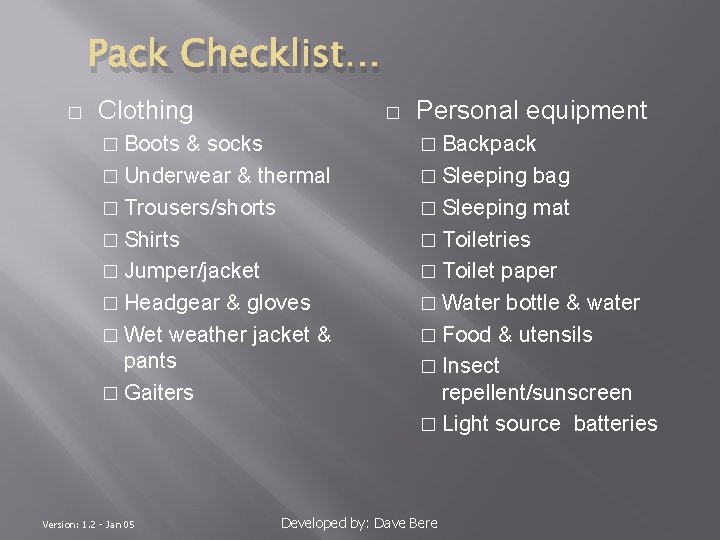
Pack Checklist… � Clothing � Boots � & socks � Underwear & thermal � Trousers/shorts � Shirts � Jumper/jacket � Headgear & gloves � Wet weather jacket & pants � Gaiters Version: 1. 2 - Jan 05 Personal equipment � Backpack � Sleeping bag � Sleeping mat � Toiletries � Toilet paper � Water bottle & water � Food & utensils � Insect repellent/sunscreen � Light source batteries Developed by: Dave Bere
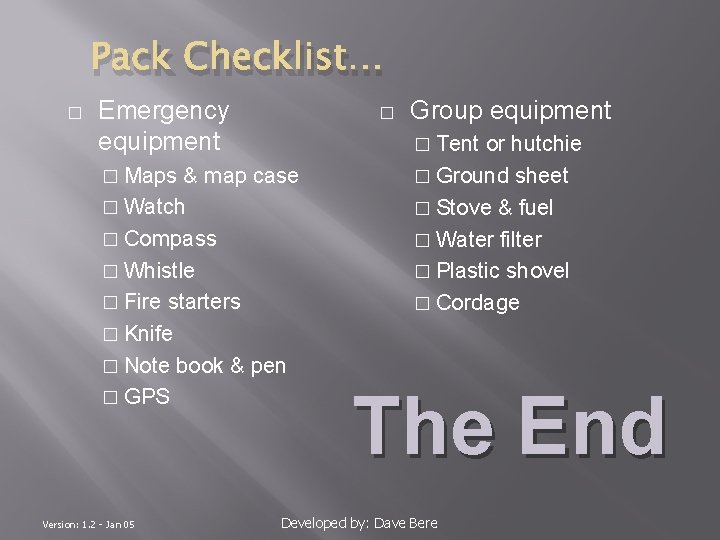
Pack Checklist… � Emergency equipment � Maps � � Tent & map case � Watch � Compass � Whistle � Fire starters � Knife � Note book & pen � GPS Version: 1. 2 - Jan 05 Group equipment or hutchie � Ground sheet � Stove & fuel � Water filter � Plastic shovel � Cordage The End Developed by: Dave Bere
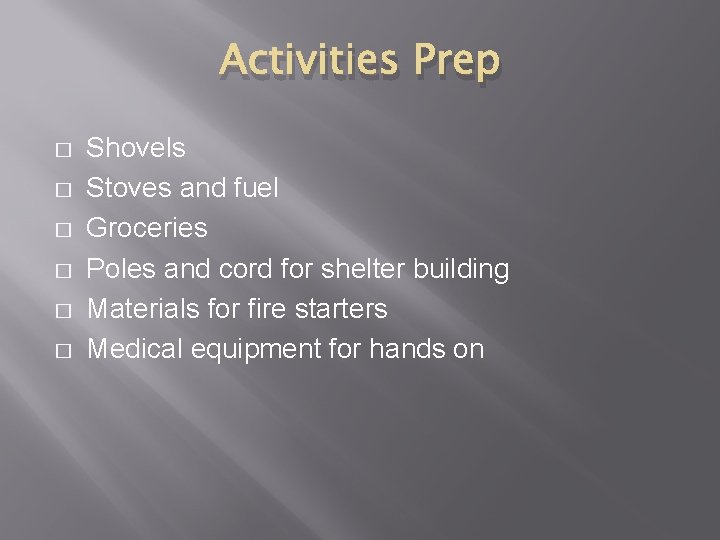
Activities Prep � � � Shovels Stoves and fuel Groceries Poles and cord for shelter building Materials for fire starters Medical equipment for hands on
Theory Prep � � � Unit tests Video Canoe unit Hiking unit Food unit Orienteering course