
Map Projections A map projection is used to
- Slides: 4
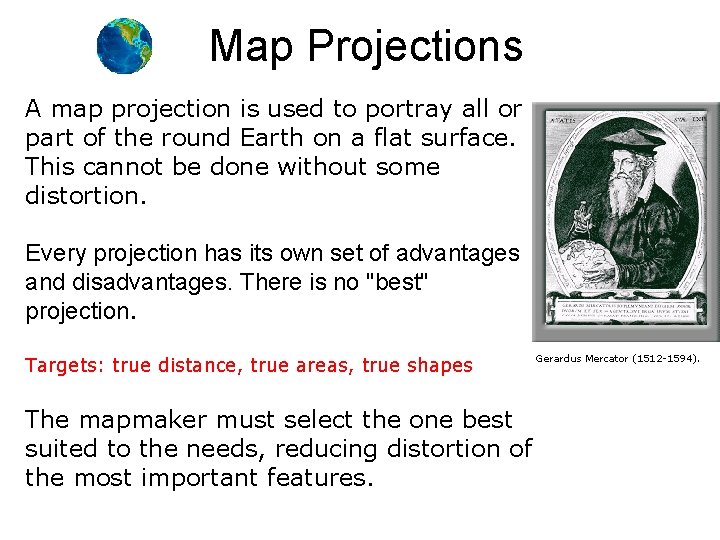
Map Projections A map projection is used to portray all or part of the round Earth on a flat surface. This cannot be done without some distortion. Every projection has its own set of advantages and disadvantages. There is no "best" projection. Targets: true distance, true areas, true shapes The mapmaker must select the one best suited to the needs, reducing distortion of the most important features. Gerardus Mercator (1512 -1594).
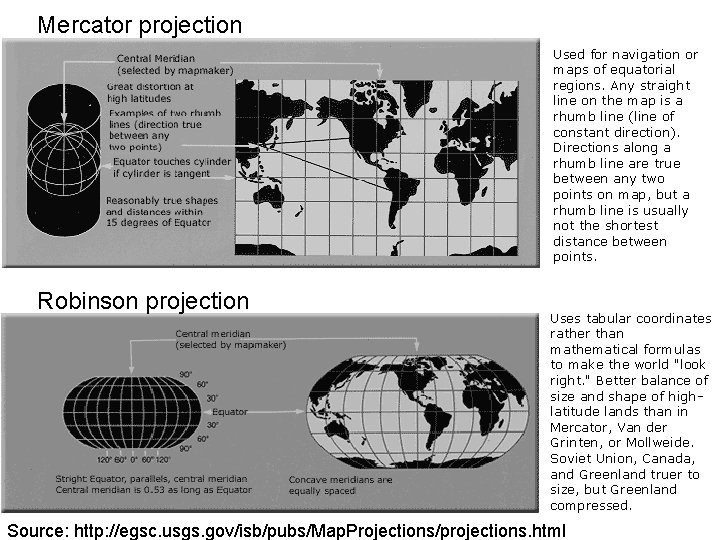
Mercator projection Used for navigation or maps of equatorial regions. Any straight line on the map is a rhumb line (line of constant direction). Directions along a rhumb line are true between any two points on map, but a rhumb line is usually not the shortest distance between points. Robinson projection Uses tabular coordinates rather than mathematical formulas to make the world "look right. " Better balance of size and shape of highlatitude lands than in Mercator, Van der Grinten, or Mollweide. Soviet Union, Canada, and Greenland truer to size, but Greenland compressed. Source: http: //egsc. usgs. gov/isb/pubs/Map. Projections/projections. html
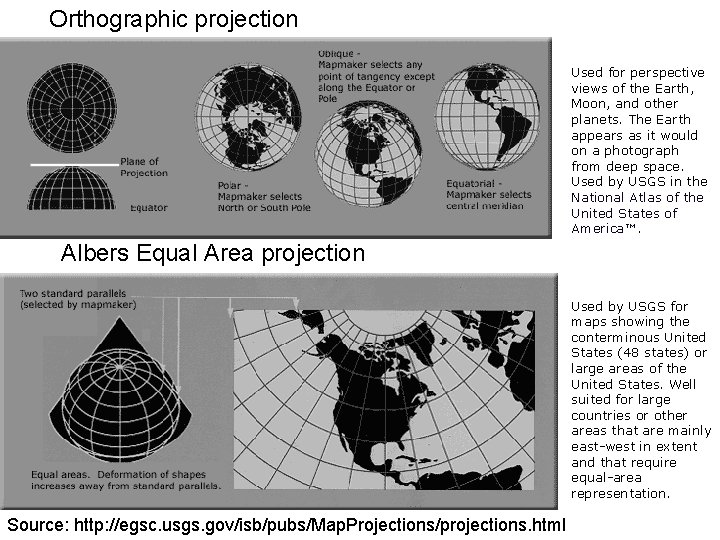
Orthographic projection Used for perspective views of the Earth, Moon, and other planets. The Earth appears as it would on a photograph from deep space. Used by USGS in the National Atlas of the United States of America™. Albers Equal Area projection Used by USGS for maps showing the conterminous United States (48 states) or large areas of the United States. Well suited for large countries or other areas that are mainly east-west in extent and that require equal-area representation. Source: http: //egsc. usgs. gov/isb/pubs/Map. Projections/projections. html
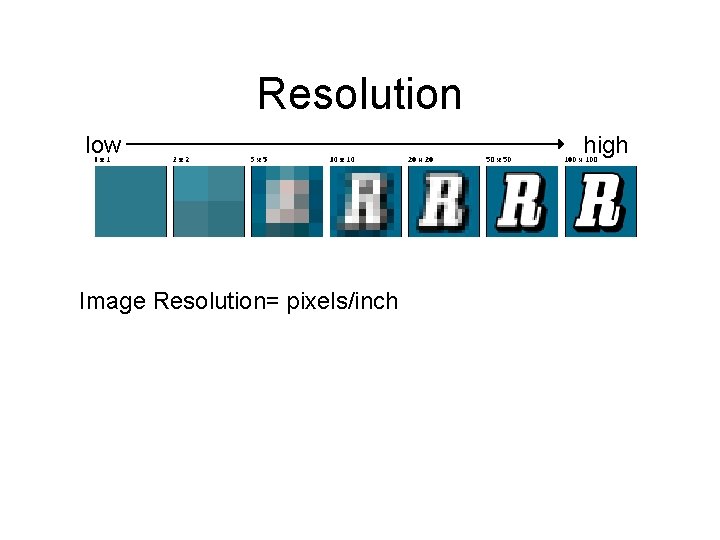
Resolution low Image Resolution= pixels/inch high