
MAOP and IVP November 13 2015 Jerry Rau
MAOP and IVP November 13, 2015 Jerry Rau RCP, Inc. PROFESSIONAL ENGINEERS. REGULATORY EXPERTS. TRUSTED PARTNERS. www. rcp. com
Professional Engineering Consulting Firm – Pipeline Regulatory Compliance & Engineering • • • Asset / Compliance Management Software Applications Pipeline Integrity Assessment Support Acquisition Due Diligence Long-Term Pipeline Compliance / Engineering Staff Support Hydrotest Planning & Certification – MAOP Services • MAOP Studies (as a service) • Turnkey MAOP Validation Services • MAOP Validation Software PROFESSIONAL ENGINEERS. REGULATORY EXPERTS. TRUSTED PARTNERS. www. rcp. com
Comprehensive Tool • • MAOP calculator tool – Analysis as a service & available to operators via license agreement – Comprehensive • Gas/Liquid, Onshore/Offshore, Steel/Plastic, Federal/State/Letters of Interpretation Identifies potential MAOP deficiencies – Data gaps – Source documentation (gaps and/or questionable quality) – Differences in calculated MAOP vs. established MAOP Links source documents to data (Traceability) – Creates a traceable association between data and source documentation Accepts data sets in various formats (. xls, PODS, APDM) – Historical documentation / manual edits to existing data sets –. xls templates (RCP pre-configured or operator/3 rd party developed) • Customizable to fit operator terminology or other specific needs – GIS data models (impartial to type or version) • Linear data (stationing/measurement) & non-linear (distribution networks) tolerant PROFESSIONAL ENGINEERS. REGULATORY EXPERTS. TRUSTED PARTNERS. www. rcp. com
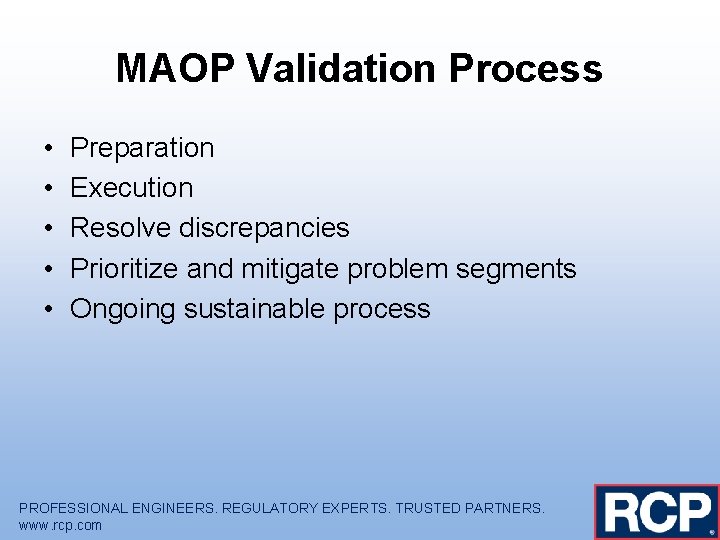
MAOP Validation Process • • • Preparation Execution Resolve discrepancies Prioritize and mitigate problem segments Ongoing sustainable process PROFESSIONAL ENGINEERS. REGULATORY EXPERTS. TRUSTED PARTNERS. www. rcp. com
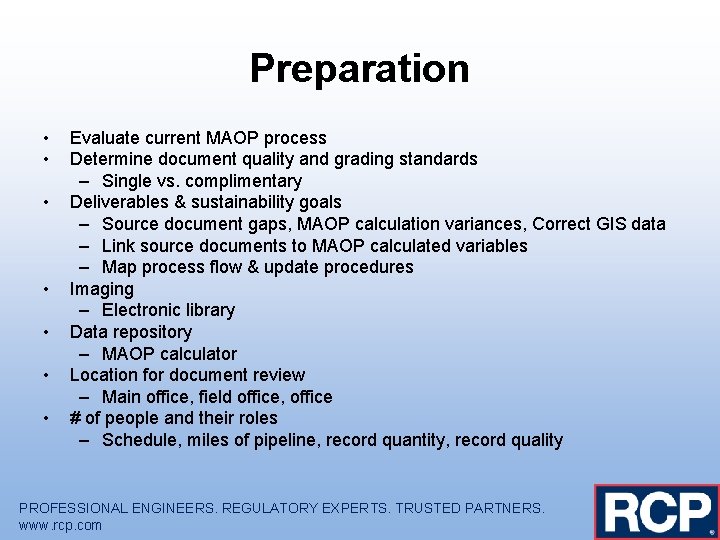
Preparation • • Evaluate current MAOP process Determine document quality and grading standards – Single vs. complimentary Deliverables & sustainability goals – Source document gaps, MAOP calculation variances, Correct GIS data – Link source documents to MAOP calculated variables – Map process flow & update procedures Imaging – Electronic library Data repository – MAOP calculator Location for document review – Main office, field office, office # of people and their roles – Schedule, miles of pipeline, record quantity, record quality PROFESSIONAL ENGINEERS. REGULATORY EXPERTS. TRUSTED PARTNERS. www. rcp. com
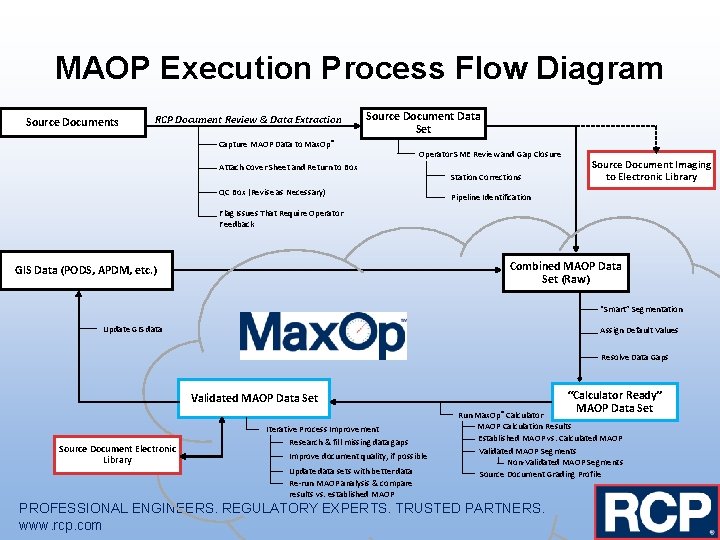
MAOP Execution Process Flow Diagram Source Documents RCP Document Review & Data Extraction Source Document Data Set Capture MAOP Data to Max. Op® Operator SME Review and Gap Closure Attach Cover Sheet and Return to Box QC Box (Revise as Necessary) Station Corrections Source Document Imaging to Electronic Library Pipeline Identification Flag Issues That Require Operator Feedback Combined MAOP Data Set (Raw) GIS Data (PODS, APDM, etc. ) “Smart” Segmentation Update GIS data Assign Default Values Resolve Data Gaps Validated MAOP Data Set Iterative Process Improvement Source Document Electronic Library Research & fill missing data gaps Improve document quality, if possible Update data sets with better data Re-run MAOP analysis & compare results vs. established MAOP “Calculator Ready” MAOP Data Set Run Max. Op® Calculator MAOP Calculation Results Established MAOP vs. Calculated MAOP Validated MAOP Segments Non-Validated MAOP Segments Source Document Grading Profile PROFESSIONAL ENGINEERS. REGULATORY EXPERTS. TRUSTED PARTNERS. www. rcp. com
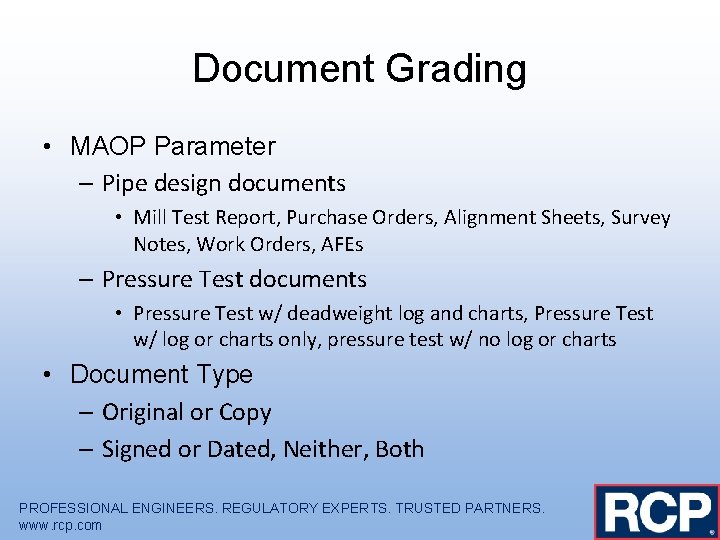
Document Grading • MAOP Parameter – Pipe design documents • Mill Test Report, Purchase Orders, Alignment Sheets, Survey Notes, Work Orders, AFEs – Pressure Test documents • Pressure Test w/ deadweight log and charts, Pressure Test w/ log or charts only, pressure test w/ no log or charts • Document Type – Original or Copy – Signed or Dated, Neither, Both PROFESSIONAL ENGINEERS. REGULATORY EXPERTS. TRUSTED PARTNERS. www. rcp. com
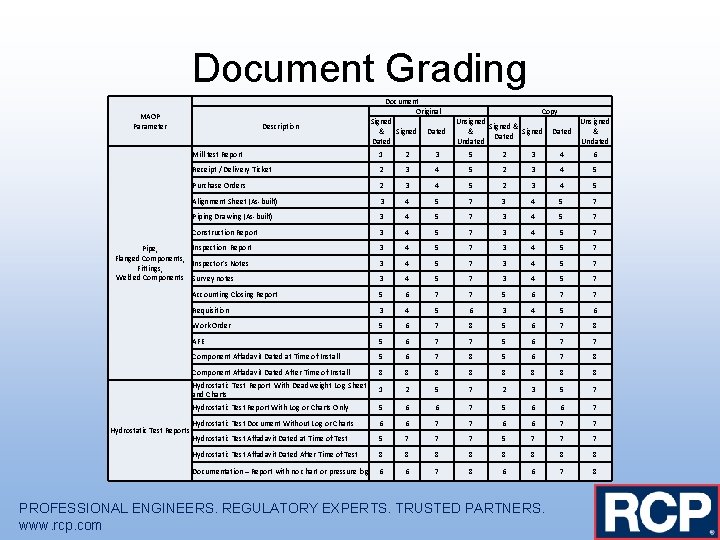
Document Grading MAOP Parameter Description Copy Unsigned Signed & & Signed Dated Undated Unsigned & Undated Mill test Report 1 2 3 5 2 3 4 6 Receipt / Delivery Ticket 2 3 4 5 Purchase Orders 2 3 4 5 Alignment Sheet (As-built) 3 4 5 7 Piping Drawing (As-built) 3 4 5 7 3 4 5 7 Construction Report 3 4 5 7 3 4 5 7 Accounting Closing Report 5 6 7 7 Requisition 3 4 5 6 Work Order 5 6 7 8 AFE 5 6 7 7 Component Affadavit Dated at Time of Install 5 6 7 8 Component Affadavit Dated After Time of Install 8 8 8 8 Hydrostatic Test Report With Deadweight Log Sheet and Charts 1 2 5 7 2 3 5 7 Hydrostatic Test Report With Log or Charts Only 5 6 6 7 Hydrostatic Test Document Without Log or Charts 6 6 7 7 Hydrostatic Test Affadavit Dated at Time of Test 5 7 7 7 Hydrostatic Test Affadavit Dated After Time of Test 8 8 8 8 Documentation – Report with no chart or pressure log. 6 6 7 8 Inspection Report Pipe, Flanged Components, Inspector's Notes Fittings, Welded Components Survey notes Hydrostatic Test Reports Document Original Signed & Signed Dated PROFESSIONAL ENGINEERS. REGULATORY EXPERTS. TRUSTED PARTNERS. www. rcp. com
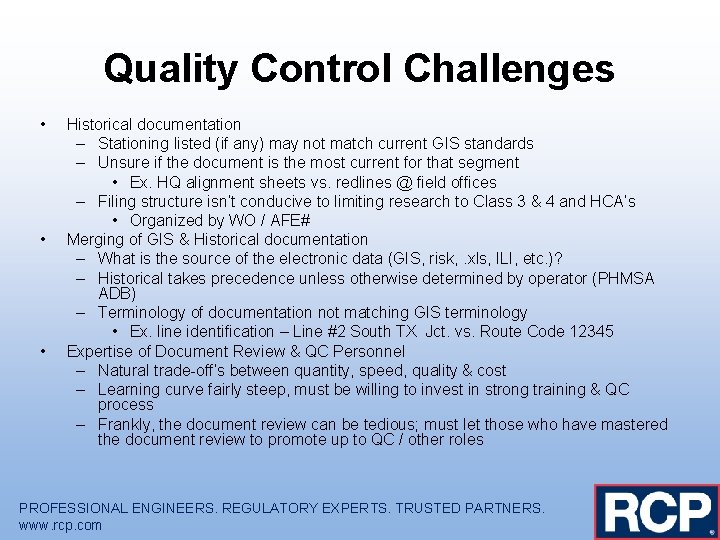
Quality Control Challenges • • • Historical documentation – Stationing listed (if any) may not match current GIS standards – Unsure if the document is the most current for that segment • Ex. HQ alignment sheets vs. redlines @ field offices – Filing structure isn’t conducive to limiting research to Class 3 & 4 and HCA’s • Organized by WO / AFE# Merging of GIS & Historical documentation – What is the source of the electronic data (GIS, risk, . xls, ILI, etc. )? – Historical takes precedence unless otherwise determined by operator (PHMSA ADB) – Terminology of documentation not matching GIS terminology • Ex. line identification – Line #2 South TX Jct. vs. Route Code 12345 Expertise of Document Review & QC Personnel – Natural trade-off’s between quantity, speed, quality & cost – Learning curve fairly steep, must be willing to invest in strong training & QC process – Frankly, the document review can be tedious; must let those who have mastered the document review to promote up to QC / other roles PROFESSIONAL ENGINEERS. REGULATORY EXPERTS. TRUSTED PARTNERS. www. rcp. com
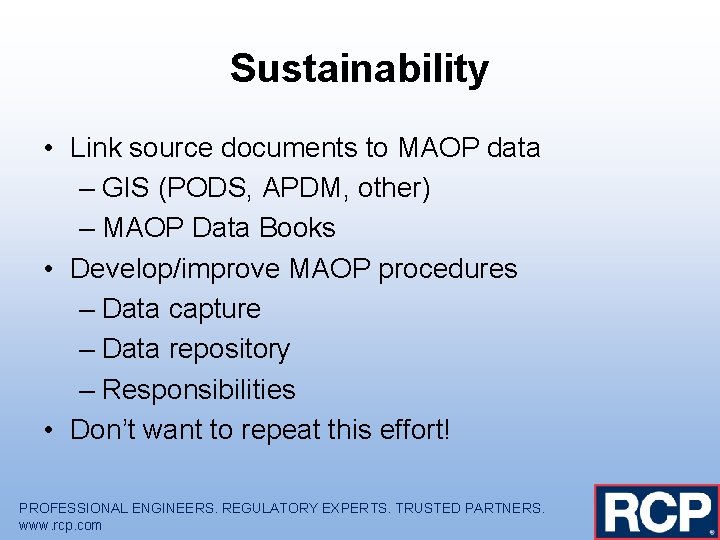
Sustainability • Link source documents to MAOP data – GIS (PODS, APDM, other) – MAOP Data Books • Develop/improve MAOP procedures – Data capture – Data repository – Responsibilities • Don’t want to repeat this effort! PROFESSIONAL ENGINEERS. REGULATORY EXPERTS. TRUSTED PARTNERS. www. rcp. com
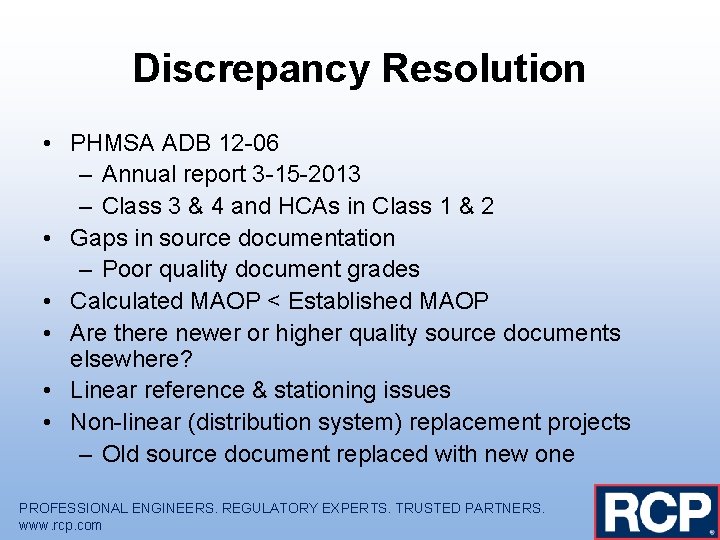
Discrepancy Resolution • PHMSA ADB 12 -06 – Annual report 3 -15 -2013 – Class 3 & 4 and HCAs in Class 1 & 2 • Gaps in source documentation – Poor quality document grades • Calculated MAOP < Established MAOP • Are there newer or higher quality source documents elsewhere? • Linear reference & stationing issues • Non-linear (distribution system) replacement projects – Old source document replaced with new one PROFESSIONAL ENGINEERS. REGULATORY EXPERTS. TRUSTED PARTNERS. www. rcp. com
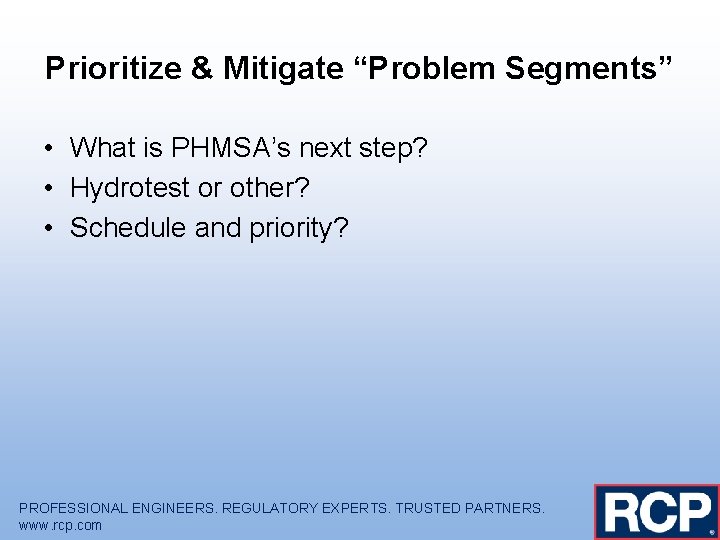
Prioritize & Mitigate “Problem Segments” • What is PHMSA’s next step? • Hydrotest or other? • Schedule and priority? PROFESSIONAL ENGINEERS. REGULATORY EXPERTS. TRUSTED PARTNERS. www. rcp. com
www. prci. org 13 MVA vs ECA? § Because of a multiplicity of definitions, the project team proposed a new acronym § MVA (MAOP / MOP Verification analysis) § MVA in context to IVP § An MVA is an analysis, based on integrity management principles, of whether or not a given pipeline has sufficient safety margins under specified loading conditions (MOP/MAOP).
www. prci. org 14 PRCI PROJECT IM 1‐ 4 § The goal is to develop guidelines for conducting ECA’s § Flexible and practical § Based on integrity principles / best practices § Suitable for both hazardous liquids and natural gas § One time exercise to support MAOP / MOP § Leverage new and future technology developments § The pipeline industry believes that: § We have a substantial volume of information and experience. § As the daily practitioners of Integrity Management, we’re well suited to develop them.
www. prci. org Drivers for development 15 § Some lines/segments will be challenged to confirm IVP § Meeting Subpart E/J for hydro § Material properties and TVC § Pipelines pre‐dating regulatory code § New technology is evolving rapidly § MVA guidelines will leverage technology to facilitate effective regulation.
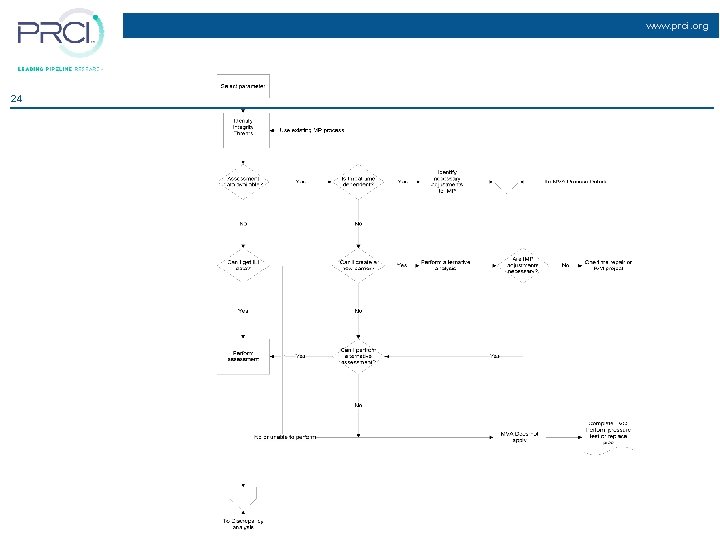
www. prci. org MVA Approach 16 § Identify all “parameters” subject to IVP § Identify each parameter’s relevancy to safety and integrity § Identify what integrity data can be used as a “substitute” for each parameter
www. prci. org 17 The Guidelines § Guidelines will be parameter specific and flexible for: § Different applicability of integrity threats § Different levels of relevancy for missing records § Differences in quality and quantity of supplemental records § Operational and Integrity history of the asset
www. prci. org MVA Approach 18 § Identify what technology and integrity processes are currently available and applicable to these substitutes § Identify what process and technology gaps currently exist and develop plan for filling these gaps § Develop parameter specific MVA guidelines (with options where possible).
www. prci. org IVP Parameters 19 § MAOP / MOP determination § Pressure Test Record requirements § Internal Design Pressure (IDP) material requirements • Test record examples • Test Charts • Test chart location & elevation • Test temperature • Instrument calibration • Description of facility • Responsible party • Et al. • Material documentation examples • Pipe Grade • Diameter • Wall Thickness • Seam Type
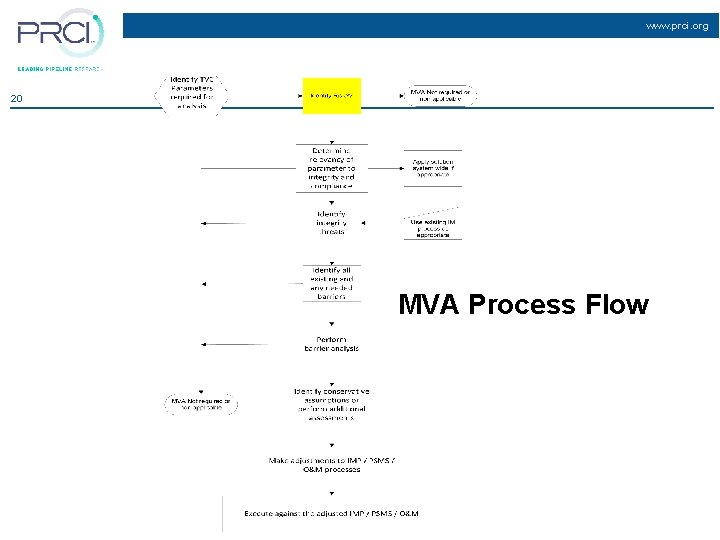
www. prci. org 20 MVA Process Flow
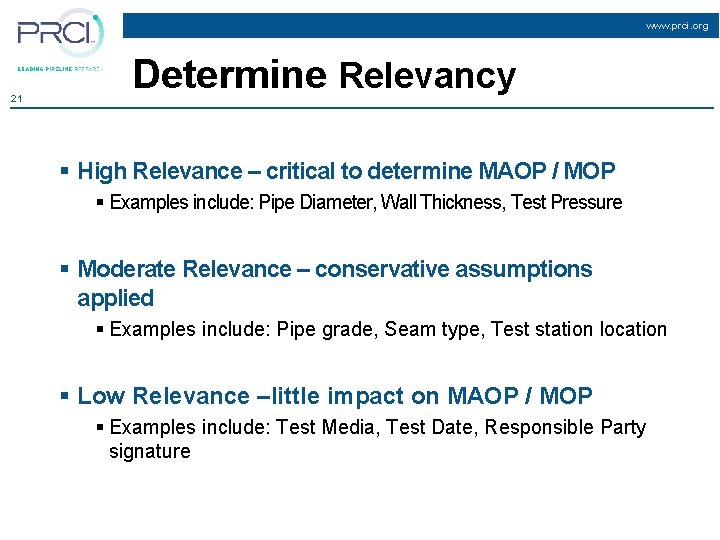
www. prci. org 21 Determine Relevancy § High Relevance – critical to determine MAOP / MOP § Examples include: Pipe Diameter, Wall Thickness, Test Pressure § Moderate Relevance – conservative assumptions applied § Examples include: Pipe grade, Seam type, Test station location § Low Relevance –little impact on MAOP / MOP § Examples include: Test Media, Test Date, Responsible Party signature
www. prci. org 22 Barrier Analysis § It is assumed barriers exist but may not be as robust when records are incomplete § Existing barriers can be reinforced or new barriers put in place § For each parameter, one or more sources of data (records, assessments or discrepancy analysis) will be identified that can analyzed and applied as a “substitute” for missing record information.
www. prci. org 23 Barrier Analysis § Requires threat analysis – substitute data will likely be threat specific § Focus will be on ILI data but will also include other testing data where applicable. § May identify that integrity data needs additional or different types of analysis than traditionally performed.
www. prci. org 24
www. prci. org 25 Process and technology gaps § Plans will be developed to fill identified gaps § Recent technological developments around determining material properties of pipe § In‐ditch methods for determining chemistry and physical properties § In‐line methods for identify pipe of similar properties § Processes need to be developed § Validation requirements, sampling protocols and confidence statistical analyses § Correlation of ILI data with in‐ditch data § Integration with other important data § Line Pipe Manufacturing History “Bible” § Construction and operational data § One‐off metallurgical analyses
www. prci. org 26 Example Scenario § No calibration certificate § This is required piece of documentation § This “parameter” has low relevancy § Could cause lower test pressure than targeted § Conservative assumptions can be made but: § What is expected / typical deviation? § What is most likely worst case? § Is MOP governed by pipe properties instead of test pressure? § If it was a 100% SMYS test, error in test chart pressure might have no impact on MOP
www. prci. org 27 Example Scenario § Utilize an ILI equivalency approach and existing IM practices § What is the remaining population of anomalies? § Repair to higher FPR? § Adjust ILI tolerance in anomaly analysis? § Guideline would recommend the following steps: § Determine appropriate potential gauge error § Compare this amount to current MOP and how it was established. § Adjust ILI response strategy (tolerance, dig criteria, repair level) to account for potential difference between actual and perceived test pressure.
Questions? Jerry Rau jrau@rcp. com Michael Berg mberg@rcp. com (713) 655 -8080 PROFESSIONAL ENGINEERS. REGULATORY EXPERTS. TRUSTED PARTNERS. www. rcp. com
- Slides: 28