
ManyBody Systems and Quantum Information Wade De Gottardi
Many-Body Systems and Quantum Information Wade De. Gottardi Texas Tech University TTU Workshop on Quantum Information and Quantum Computation August 10 th, 2020
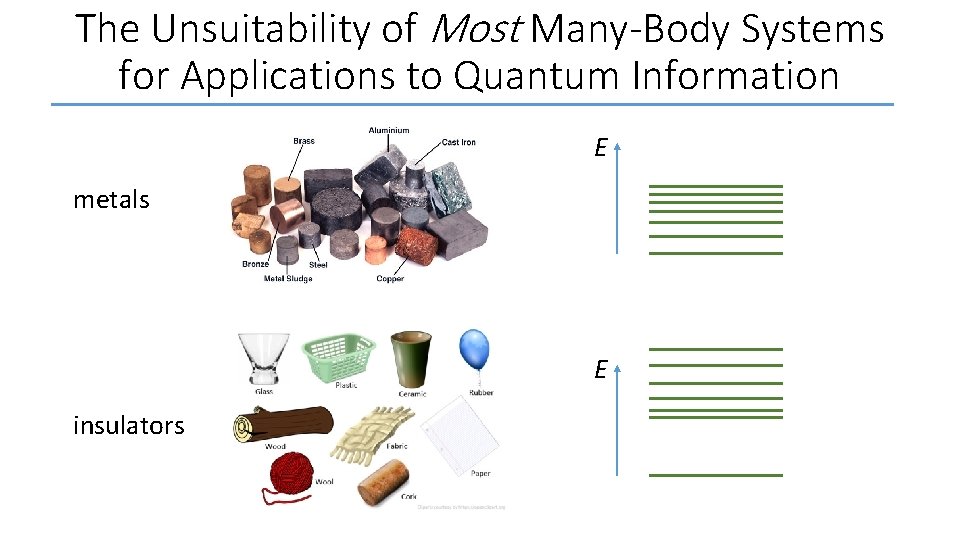
The Unsuitability of Most Many-Body Systems for Applications to Quantum Information E metals E insulators
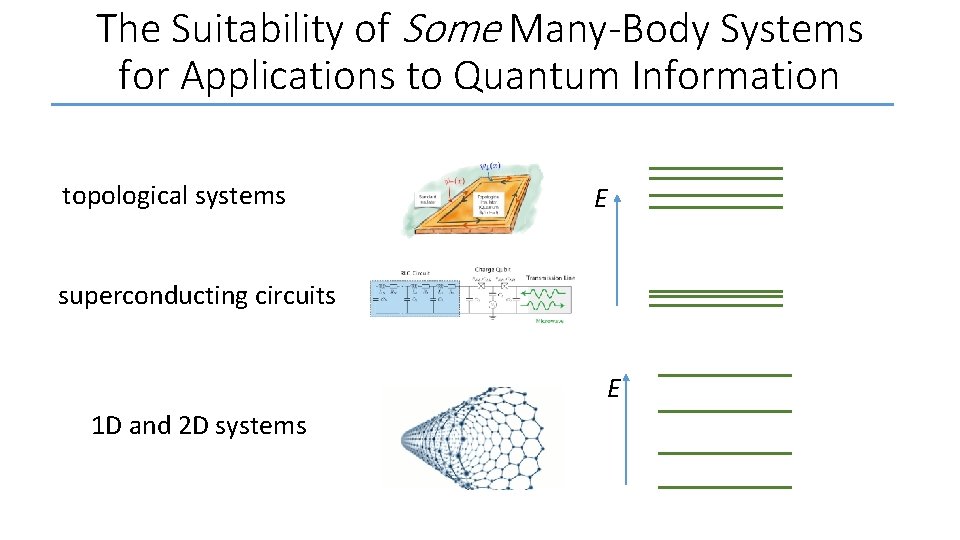
The Suitability of Some Many-Body Systems for Applications to Quantum Information topological systems E superconducting circuits E 1 D and 2 D systems
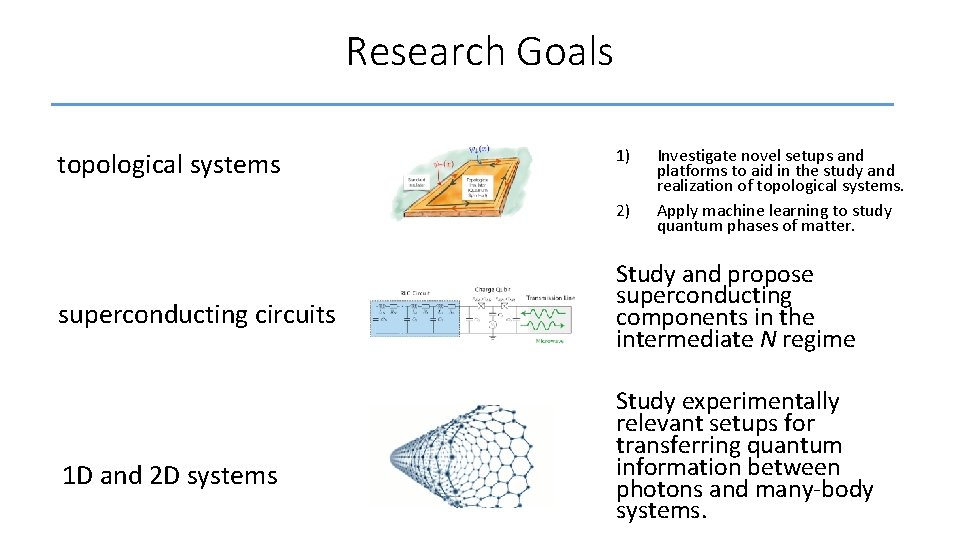
Research Goals topological systems 1) 2) superconducting circuits 1 D and 2 D systems Investigate novel setups and platforms to aid in the study and realization of topological systems. Apply machine learning to study quantum phases of matter. Study and propose superconducting components in the intermediate N regime Study experimentally relevant setups for transferring quantum information between photons and many-body systems.
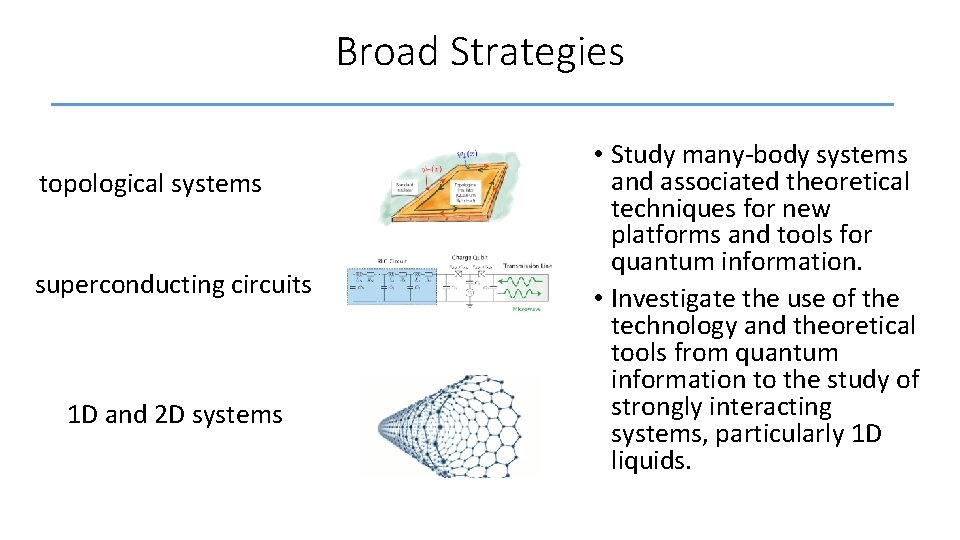
Broad Strategies topological systems superconducting circuits 1 D and 2 D systems • Study many-body systems and associated theoretical techniques for new platforms and tools for quantum information. • Investigate the use of the technology and theoretical tools from quantum information to the study of strongly interacting systems, particularly 1 D liquids.
Topological Systems • Previous and ongoing work investigated Majorana fermions, SSH ladders, and the collective behavior of coupled anyons. • Proposed research efforts focus on unveiling novel phenomena in electronic and engineered topological systems, such as photonic systems.
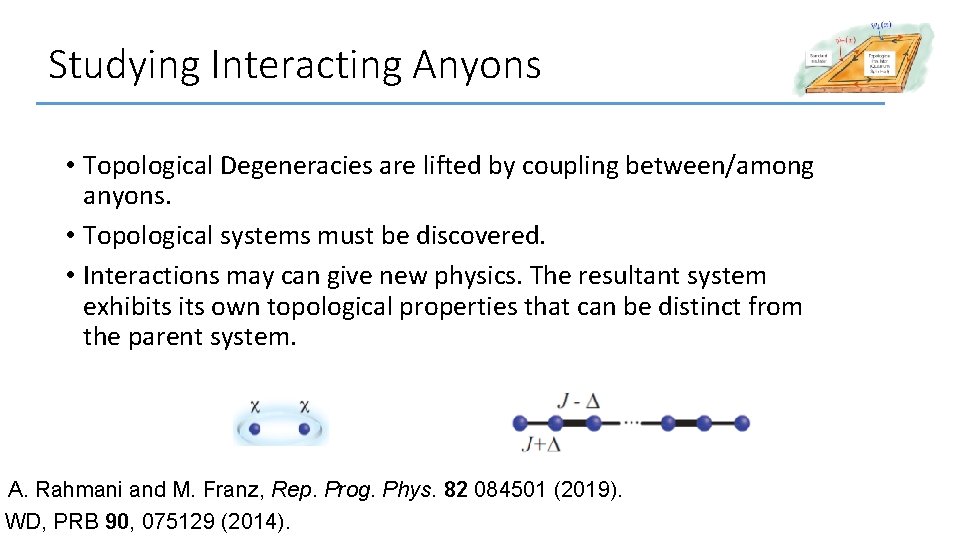
Studying Interacting Anyons • Topological Degeneracies are lifted by coupling between/among anyons. • Topological systems must be discovered. • Interactions may can give new physics. The resultant system exhibits own topological properties that can be distinct from the parent system. A. Rahmani and M. Franz, Rep. Prog. Phys. 82 084501 (2019). WD, PRB 90, 075129 (2014).
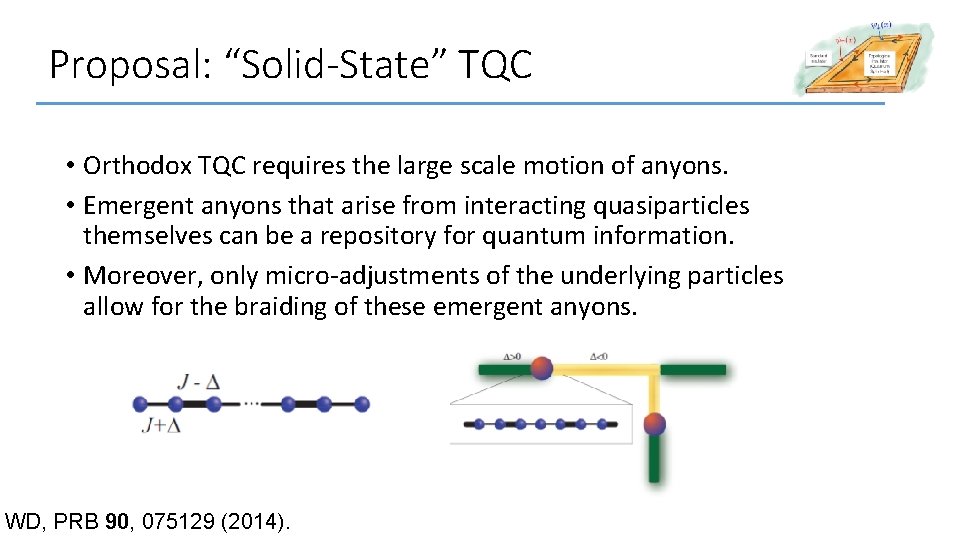
Proposal: “Solid-State” TQC • Orthodox TQC requires the large scale motion of anyons. • Emergent anyons that arise from interacting quasiparticles themselves can be a repository for quantum information. • Moreover, only micro-adjustments of the underlying particles allow for the braiding of these emergent anyons. WD, PRB 90, 075129 (2014).
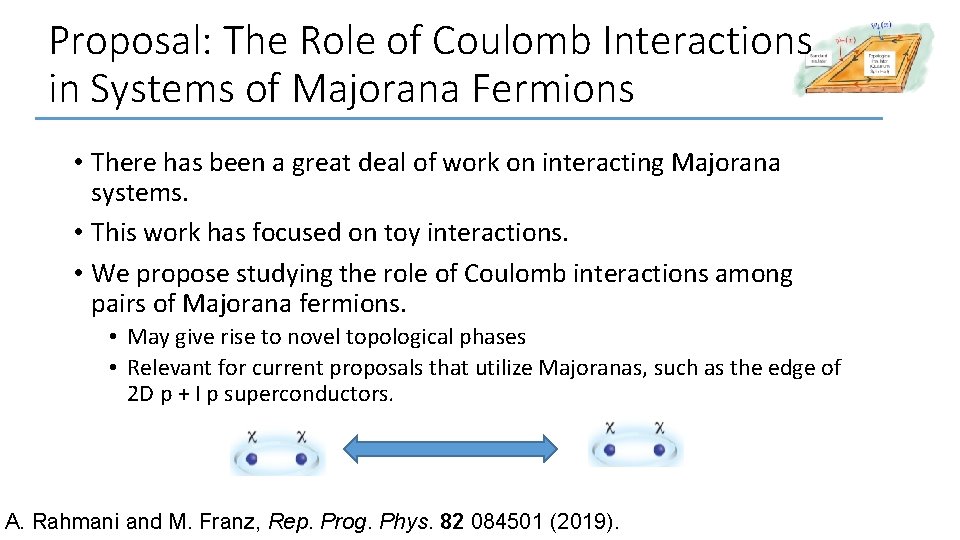
Proposal: The Role of Coulomb Interactions in Systems of Majorana Fermions • There has been a great deal of work on interacting Majorana systems. • This work has focused on toy interactions. • We propose studying the role of Coulomb interactions among pairs of Majorana fermions. • May give rise to novel topological phases • Relevant for current proposals that utilize Majoranas, such as the edge of 2 D p + I p superconductors. A. Rahmani and M. Franz, Rep. Prog. Phys. 82 084501 (2019).
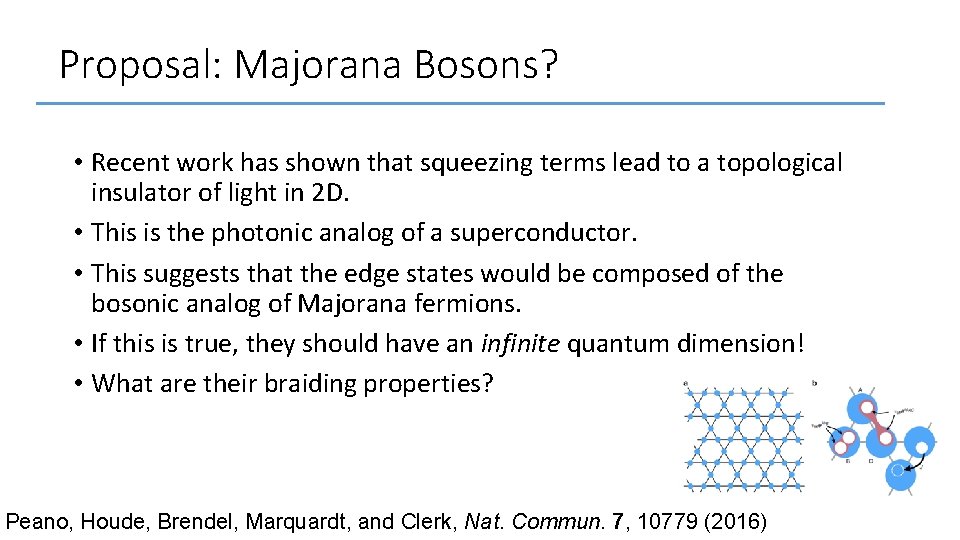
Proposal: Majorana Bosons? • Recent work has shown that squeezing terms lead to a topological insulator of light in 2 D. • This is the photonic analog of a superconductor. • This suggests that the edge states would be composed of the bosonic analog of Majorana fermions. • If this is true, they should have an infinite quantum dimension! • What are their braiding properties? Peano, Houde, Brendel, Marquardt, and Clerk, Nat. Commun. 7, 10779 (2016)
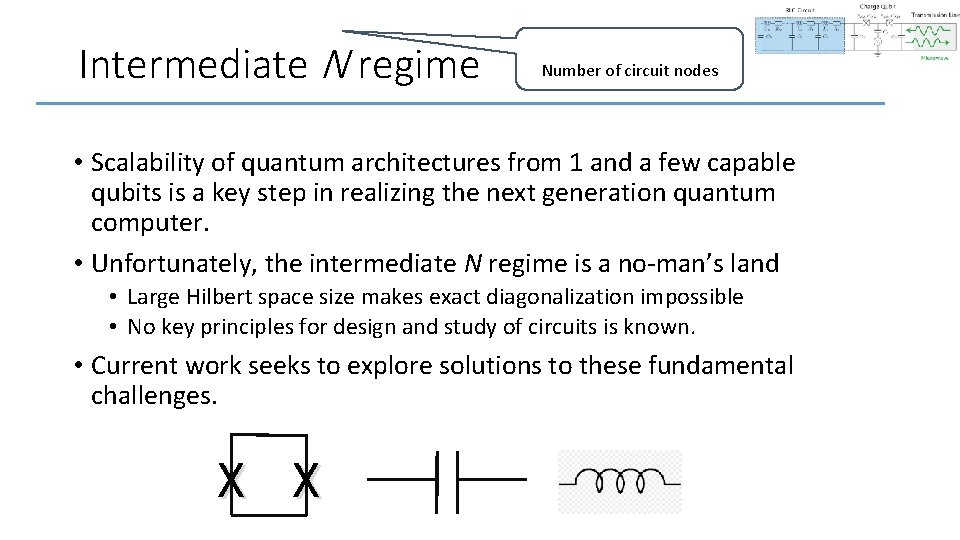
Intermediate N regime r of nodes in network) Number of circuit nodes • Scalability of quantum architectures from 1 and a few capable qubits is a key step in realizing the next generation quantum computer. • Unfortunately, the intermediate N regime is a no-man’s land • Large Hilbert space size makes exact diagonalization impossible • No key principles for design and study of circuits is known. • Current work seeks to explore solutions to these fundamental challenges. X X
Proposed Work: Applying Many-Body Techniques intermediate size circuits • Previous work investigated leveraging tight-binding “technology” to the study of circuits with Josephson junctions. • Can real-space renormalization group methods be used to make the study of circuits tractable? • What are the lessons to be learned from error-correcting codes and other topological systems? • Circuits can be mapped to Bose-Hubbard model. Are there techniques used for the study of this model that can be leveraged to circuits?
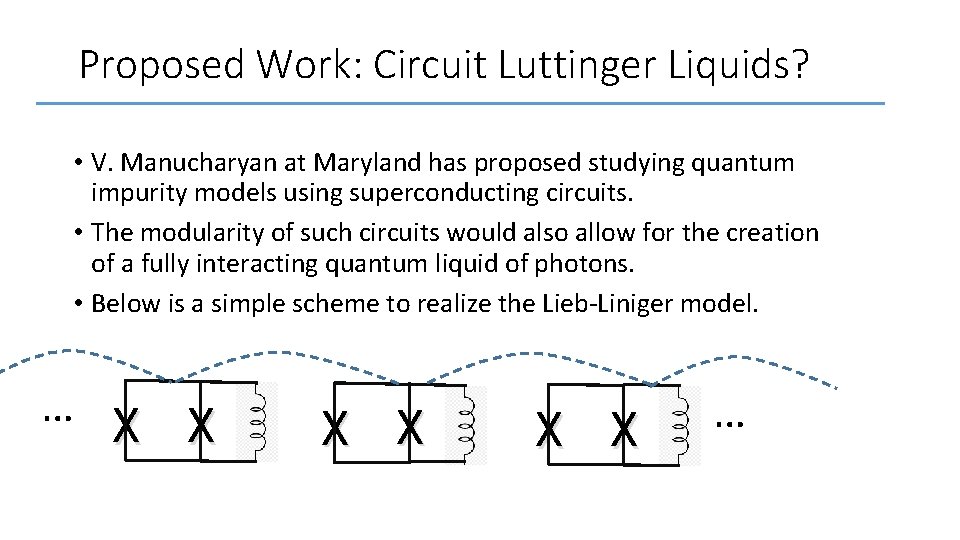
Proposed Work: Circuit Luttinger Liquids? • V. Manucharyan at Maryland has proposed studying quantum impurity models using superconducting circuits. • The modularity of such circuits would also allow for the creation of a fully interacting quantum liquid of photons. • Below is a simple scheme to realize the Lieb-Liniger model. … X X X …
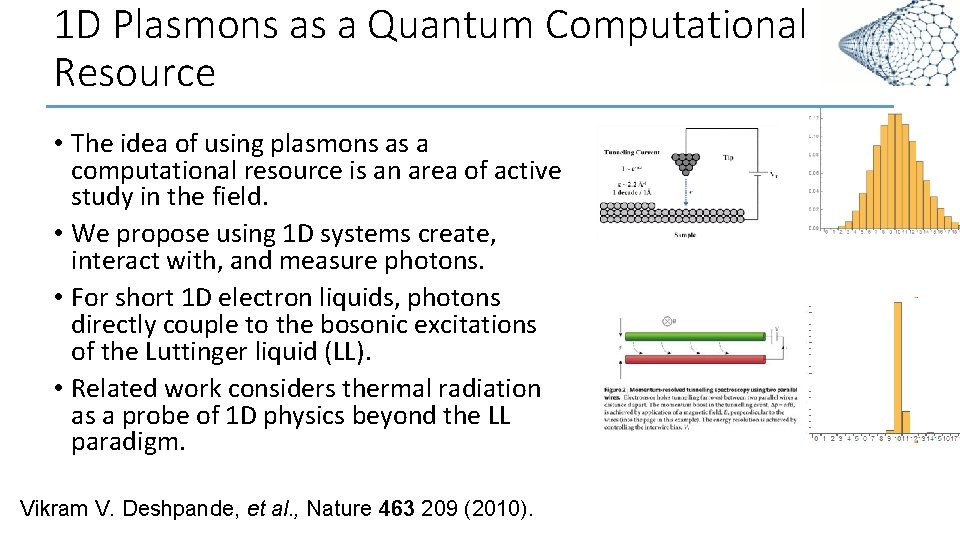
1 D Plasmons as a Quantum Computational Resource • The idea of using plasmons as a computational resource is an area of active study in the field. • We propose using 1 D systems create, interact with, and measure photons. • For short 1 D electron liquids, photons directly couple to the bosonic excitations of the Luttinger liquid (LL). • Related work considers thermal radiation as a probe of 1 D physics beyond the LL paradigm. Vikram V. Deshpande, et al. , Nature 463 209 (2010).
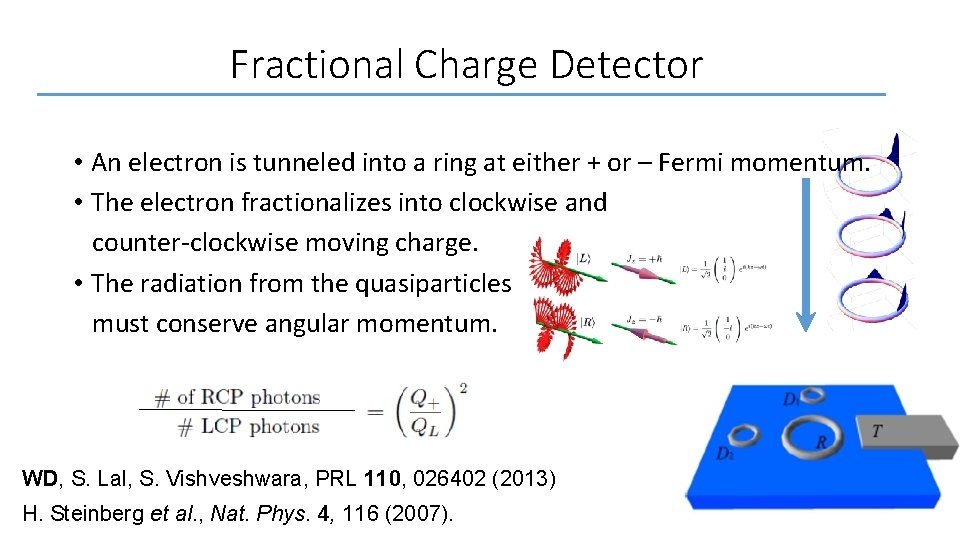
Fractional Charge Detector • An electron is tunneled into a ring at either + or – Fermi momentum. • The electron fractionalizes into clockwise and counter-clockwise moving charge. • The radiation from the quasiparticles must conserve angular momentum. WD, S. Lal, S. Vishveshwara, PRL 110, 026402 (2013) H. Steinberg et al. , Nat. Phys. 4, 116 (2007).
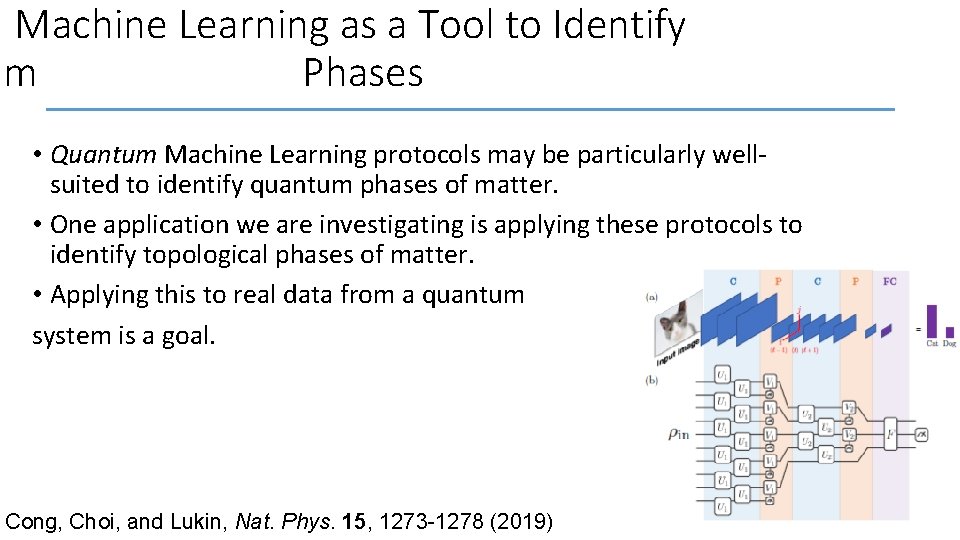
Machine Learning as a Tool to Identify um Phases • Quantum Machine Learning protocols may be particularly wellsuited to identify quantum phases of matter. • One application we are investigating is applying these protocols to identify topological phases of matter. • Applying this to real data from a quantum system is a goal. Cong, Choi, and Lukin, Nat. Phys. 15, 1273 -1278 (2019)
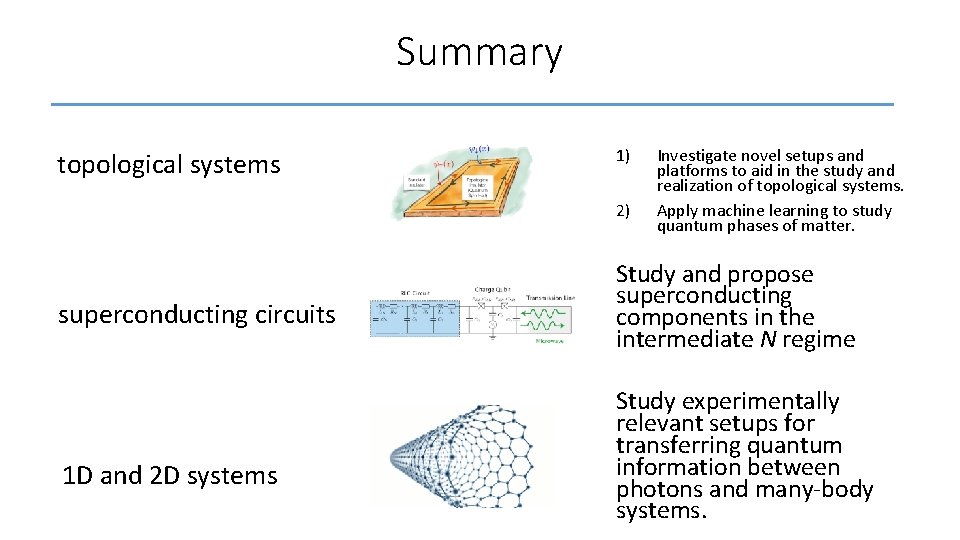
Summary topological systems 1) 2) superconducting circuits 1 D and 2 D systems Investigate novel setups and platforms to aid in the study and realization of topological systems. Apply machine learning to study quantum phases of matter. Study and propose superconducting components in the intermediate N regime Study experimentally relevant setups for transferring quantum information between photons and many-body systems.

Thanks!
- Slides: 18