
Manybody quench dynamics in ultracold atoms Surprising applications
Many-body quench dynamics in ultracold atoms Surprising applications to recent experiments Eugene Demler (Harvard) Harvard-MIT $$ NSF, AFOSR MURI, DARPA
Outline • Competition between pairing and ferromagnetic instabilities in ultracold Fermi gases near Feshbach resonances Motivated by experiments, Jo et al. , Science (2009) • Ramsey interference experiments in 1 d Probing many-body decoherence with quantum noise Motivated by experiments Widera et al. , PRL (2008) Hofferberth et al. , Nature (2007) + unpublished Vienna experiments
Competition between pairing and ferromagnetic instabilities in ultracold Fermi gases near Feshbach resonances ar. Xiv: 1005. 2366 D. Pekker, M. Babadi, R. Sensarma, N. Zinner, L. Pollet, M. Zwierlein, E. Demler
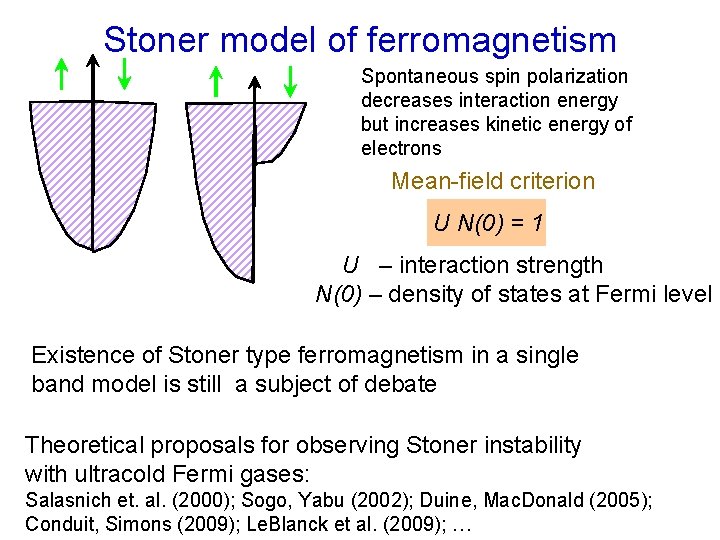
Stoner model of ferromagnetism Spontaneous spin polarization decreases interaction energy but increases kinetic energy of electrons Mean-field criterion U N(0) = 1 U – interaction strength N(0) – density of states at Fermi level Existence of Stoner type ferromagnetism in a single band model is still a subject of debate Theoretical proposals for observing Stoner instability with ultracold Fermi gases: Salasnich et. al. (2000); Sogo, Yabu (2002); Duine, Mac. Donald (2005); Conduit, Simons (2009); Le. Blanck et al. (2009); …
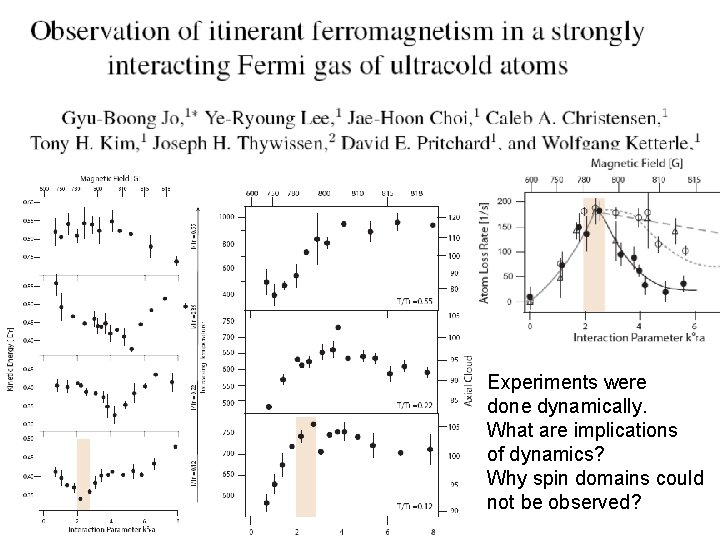
Experiments were done dynamically. What are implications of dynamics? Why spin domains could not be observed?
Is it sufficient to consider effective model with repulsive interactions when analyzing experiments? Feshbach physics beyond effective repulsive interaction
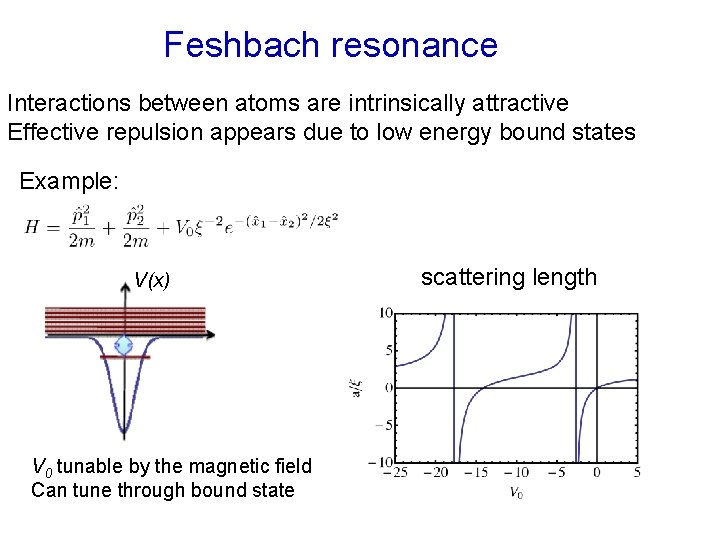
Feshbach resonance Interactions between atoms are intrinsically attractive Effective repulsion appears due to low energy bound states Example: V(x) V 0 tunable by the magnetic field Can tune through bound state scattering length

Feshbach resonance Two particle bound state formed in vacuum Stoner instability BCS instability Molecule formation and condensation This talk: Prepare Fermi state of weakly interacting atoms. Quench to the BEC side of Feshbach resonance. System unstable to both molecule formation and Stoner ferromagnetism. Which instability dominates ?
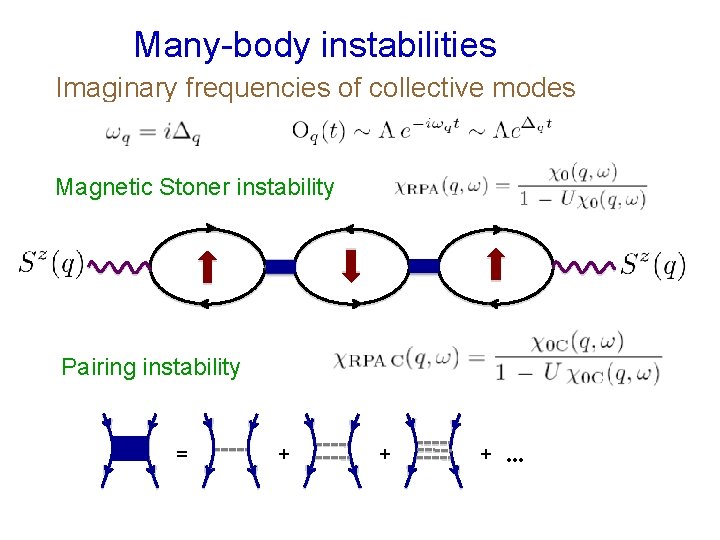
Many-body instabilities Imaginary frequencies of collective modes Magnetic Stoner instability Pairing instability = + + + …
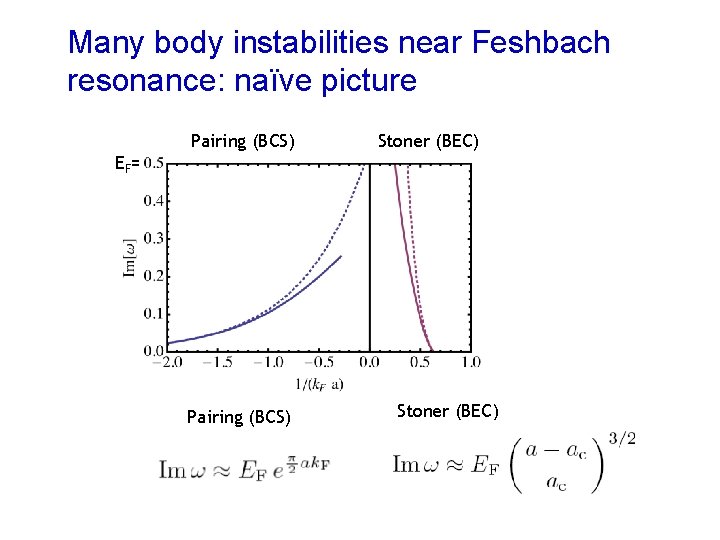
Many body instabilities near Feshbach resonance: naïve picture Pairing (BCS) Stoner (BEC) EF = Pairing (BCS) Stoner (BEC)
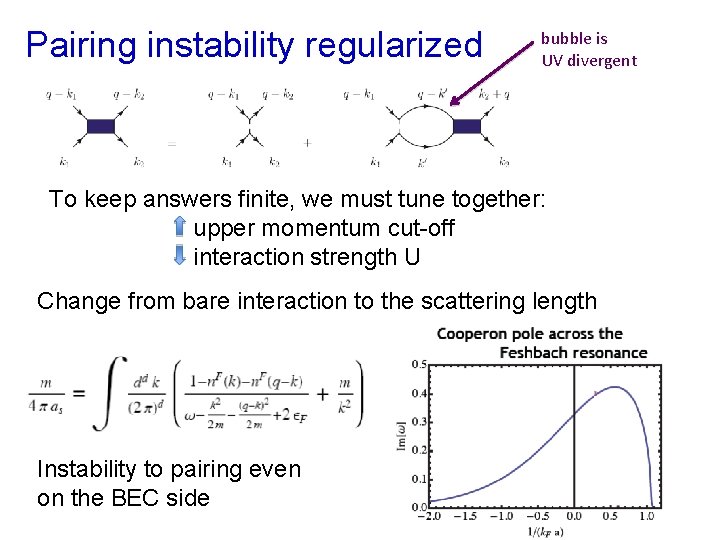
Pairing instability regularized bubble is UV divergent To keep answers finite, we must tune together: upper momentum cut-off interaction strength U Change from bare interaction to the scattering length Instability to pairing even on the BEC side

Pairing instability Intuition: two body collisions do not lead to molecule formation on the BEC side of Feshbach resonance. Energy and momentum conservation laws can not be satisfied. This argument applies in vacuum. Fermi sea prevents formation of real Feshbach molecules by Pauli blocking. Molecule Fermi sea
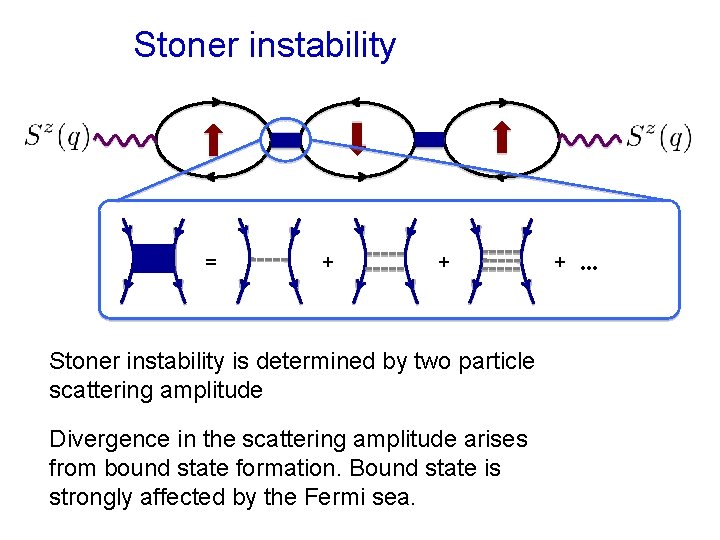
Stoner instability = + + Stoner instability is determined by two particle scattering amplitude Divergence in the scattering amplitude arises from bound state formation. Bound state is strongly affected by the Fermi sea. + …
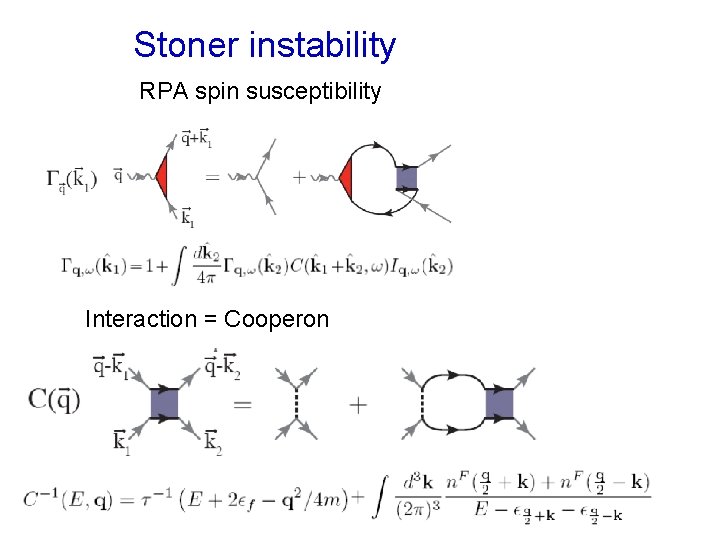
Stoner instability RPA spin susceptibility Interaction = Cooperon
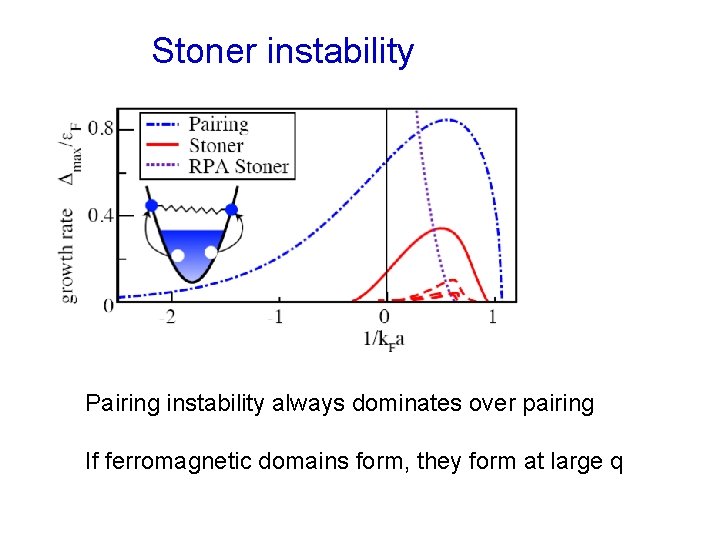
Stoner instability Pairing instability always dominates over pairing If ferromagnetic domains form, they form at large q
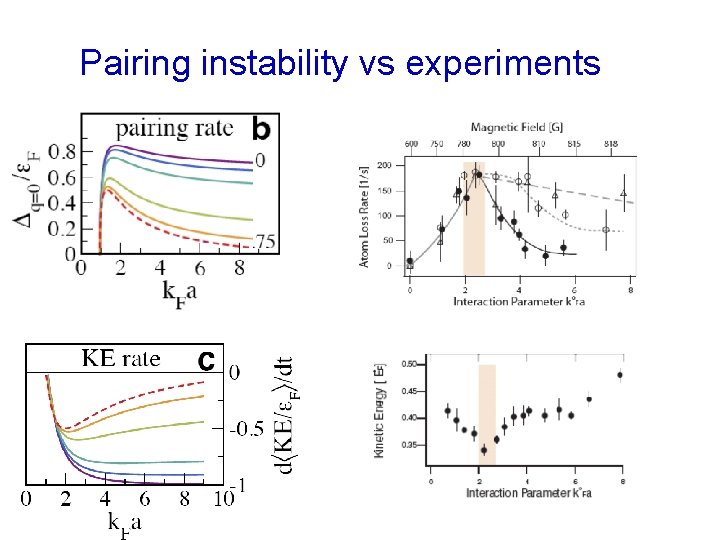
Pairing instability vs experiments
Conclusions to part I Competition of pairing and ferromagnetism near Feshbach resonance Dynamics of competing orders is important for understanding experiments Simple model with contact repulsive interactions may not be sufficient Strong suppression of Stoner instability by Feshbach resonance physics + Pauli blocking Alternative interpretation of experiments based on pair formation
Ramsey interference in one dimensional systems: The full distribution function of fringe contrast as a probe of many-body dynamics ar. Xiv: 0912. 4643 T. Kitagawa, S. Pielawa, A. Imambekov, J. Schmiedmayer, V. Gritsev, E. Demler
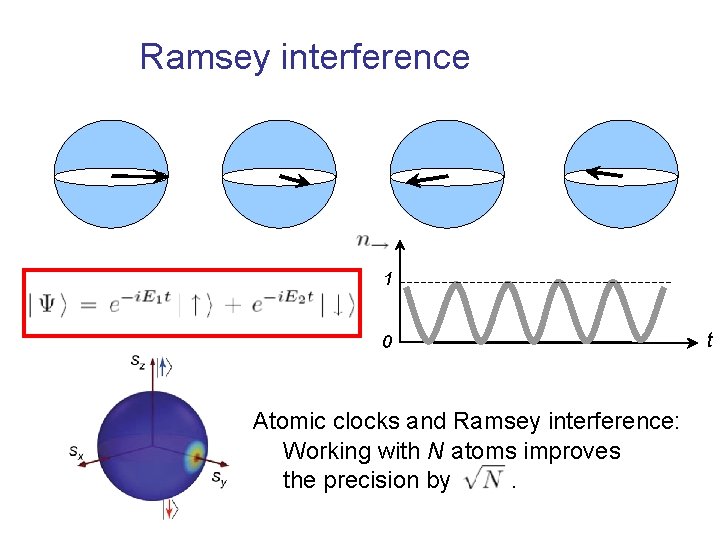
Ramsey interference 1 0 Atomic clocks and Ramsey interference: Working with N atoms improves the precision by. t
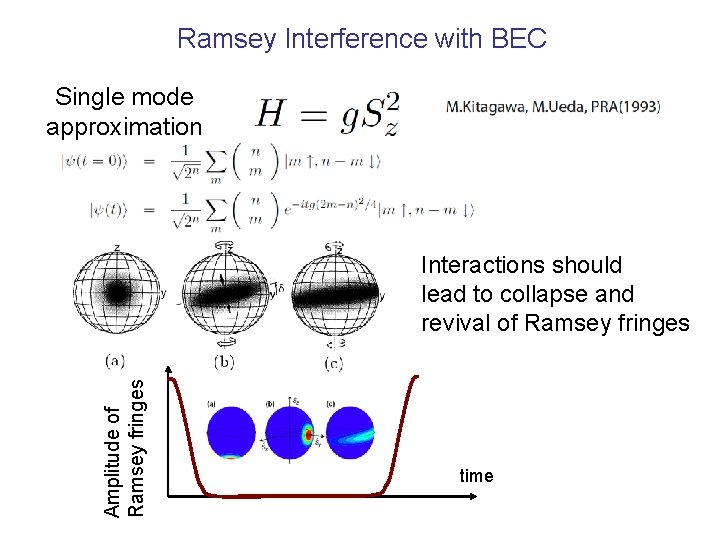
Ramsey Interference with BEC Single mode approximation Amplitude of Ramsey fringes Interactions should lead to collapse and revival of Ramsey fringes time
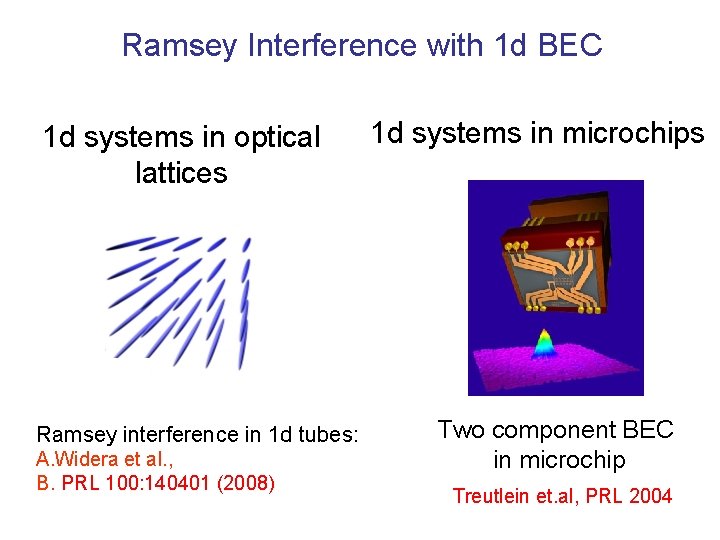
Ramsey Interference with 1 d BEC 1 d systems in optical lattices Ramsey interference in 1 d tubes: A. Widera et al. , B. PRL 100: 140401 (2008) 1 d systems in microchips Two component BEC in microchip Treutlein et. al, PRL 2004
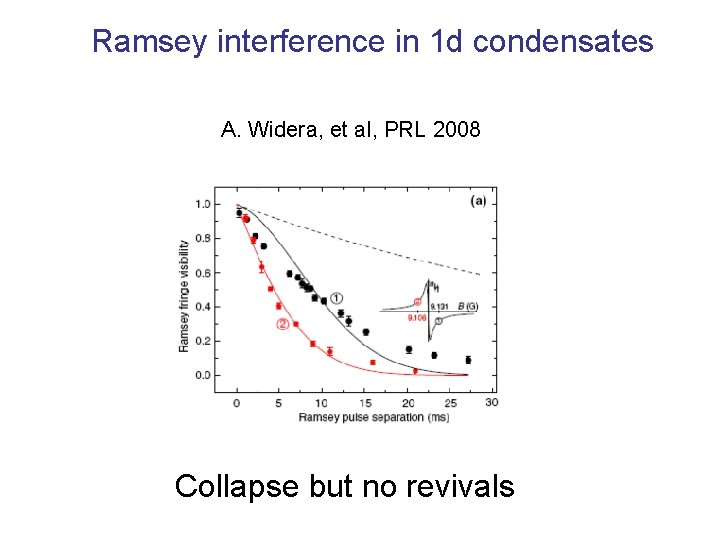
Ramsey interference in 1 d condensates A. Widera, et al, PRL 2008 Collapse but no revivals
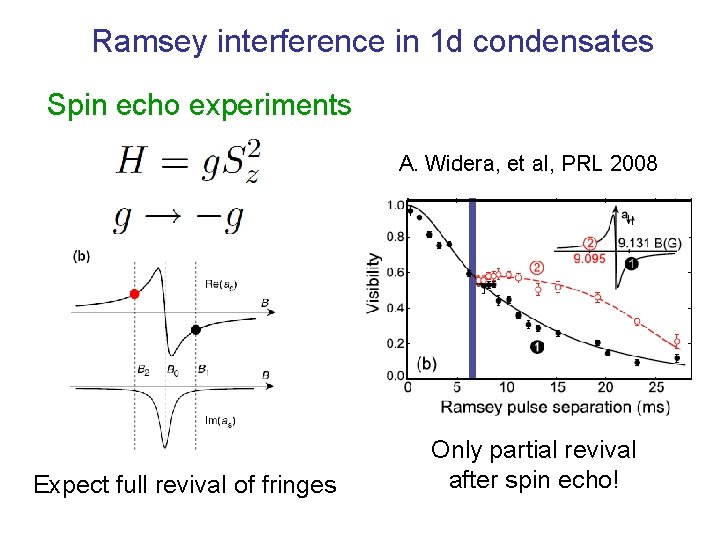
Ramsey interference in 1 d condensates Spin echo experiments A. Widera, et al, PRL 2008 Expect full revival of fringes Only partial revival after spin echo!
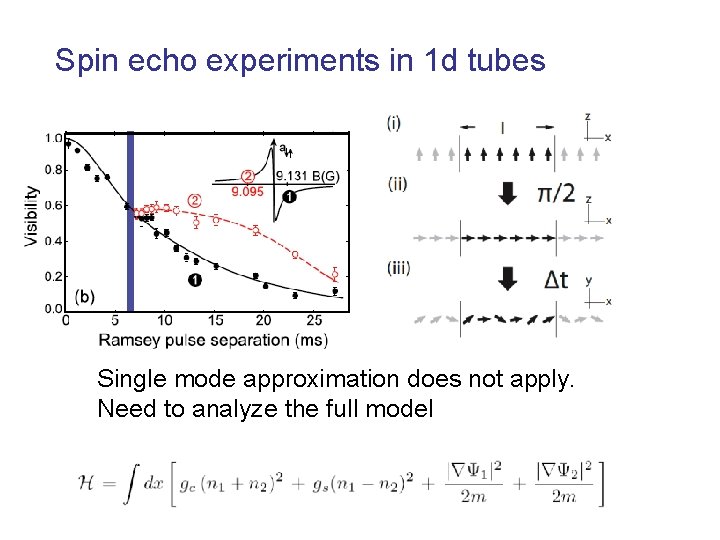
Spin echo experiments in 1 d tubes Single mode approximation does not apply. Need to analyze the full model
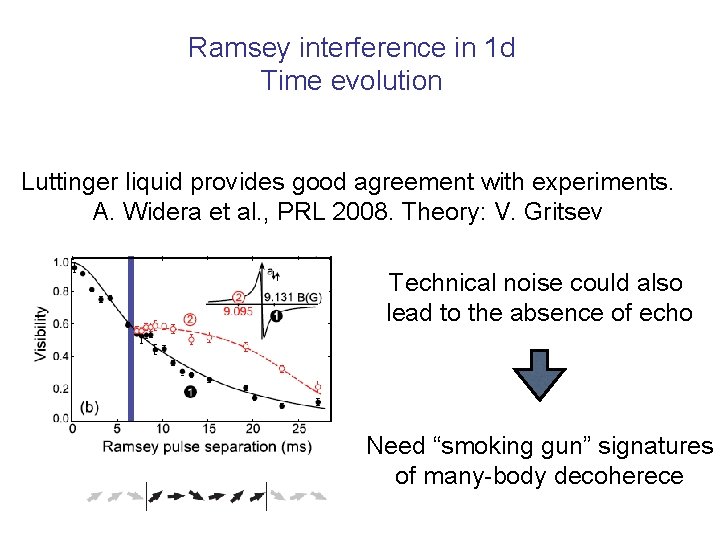
Ramsey interference in 1 d Time evolution Luttinger liquid provides good agreement with experiments. A. Widera et al. , PRL 2008. Theory: V. Gritsev Technical noise could also lead to the absence of echo Need “smoking gun” signatures of many-body decoherece
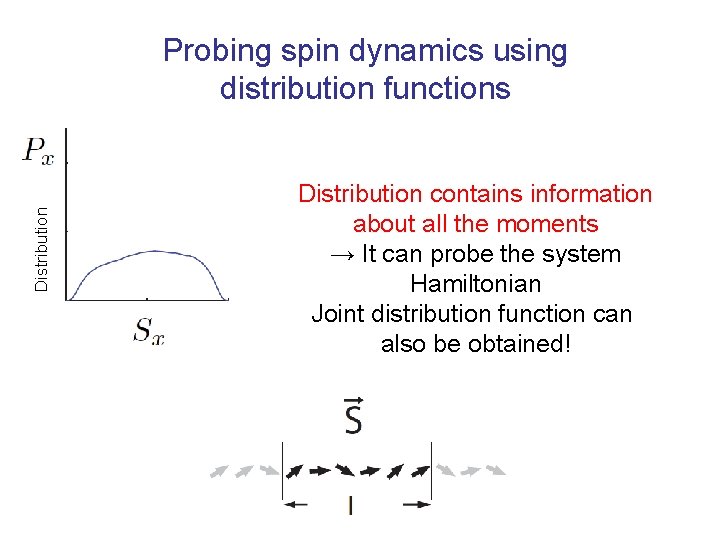
Distribution Probing spin dynamics using distribution functions Distribution contains information about all the moments → It can probe the system Hamiltonian Joint distribution function can also be obtained!
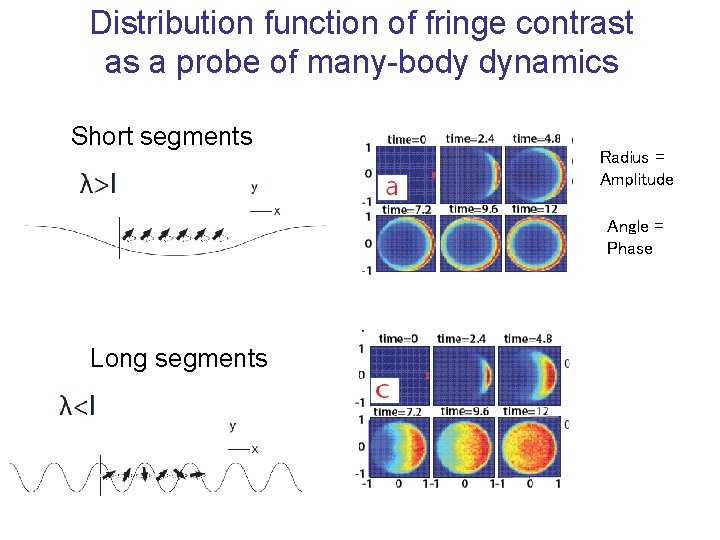
Distribution function of fringe contrast as a probe of many-body dynamics Short segments Radius = Amplitude Angle = Phase Long segments
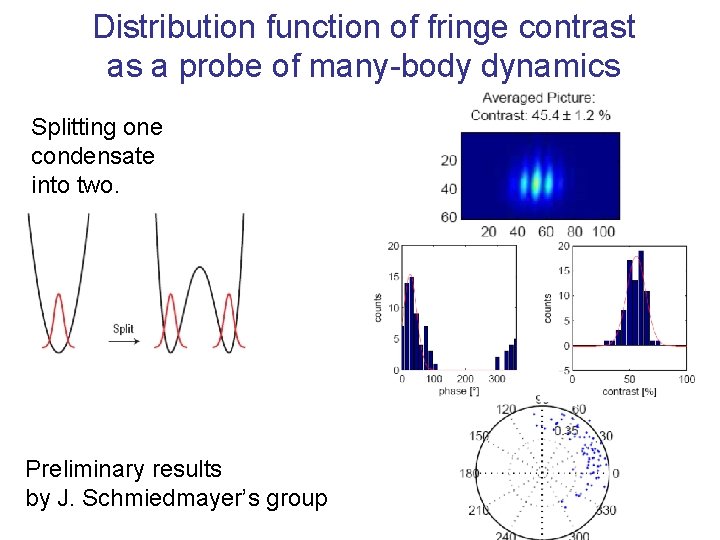
Distribution function of fringe contrast as a probe of many-body dynamics Splitting one condensate into two. Preliminary results by J. Schmiedmayer’s group
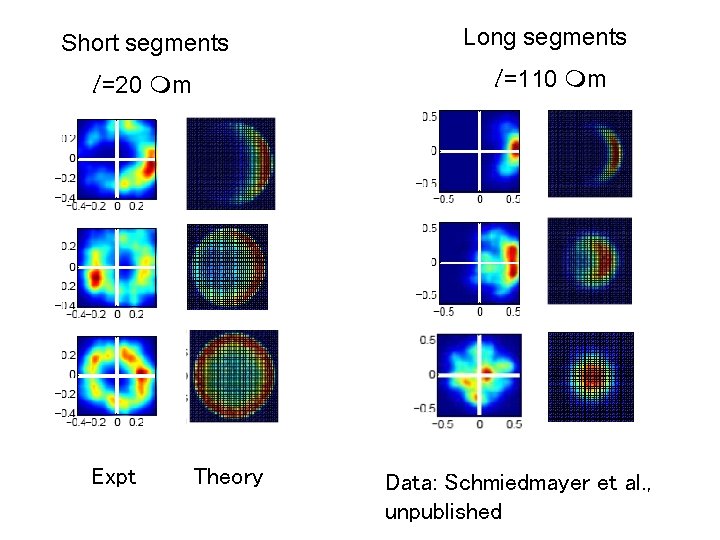
Short segments Long segments l =20 mm l =110 mm Expt Theory Data: Schmiedmayer et al. , unpublished
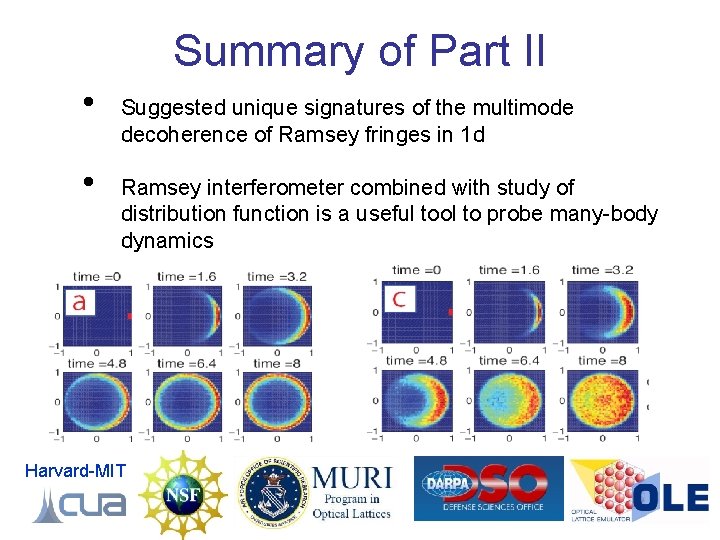
Summary of Part II • • Suggested unique signatures of the multimode decoherence of Ramsey fringes in 1 d Ramsey interferometer combined with study of distribution function is a useful tool to probe many-body dynamics Harvard-MIT

- Slides: 31