
Many cochlear ganglion cells to 1 inner hair



- Slides: 24
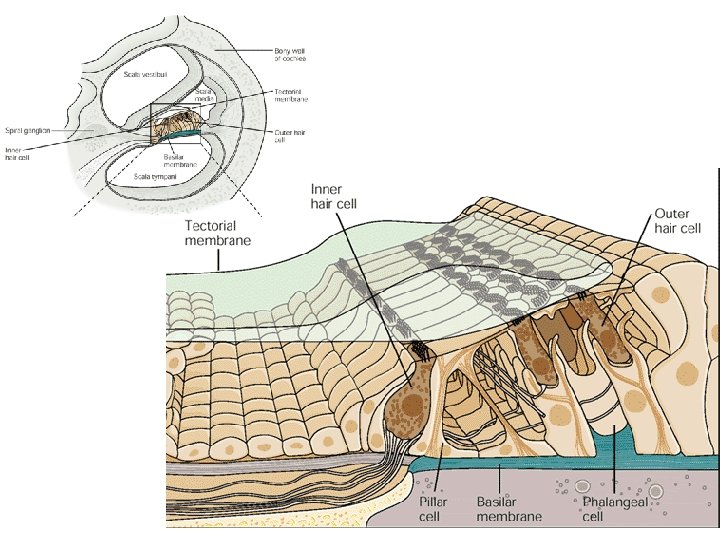
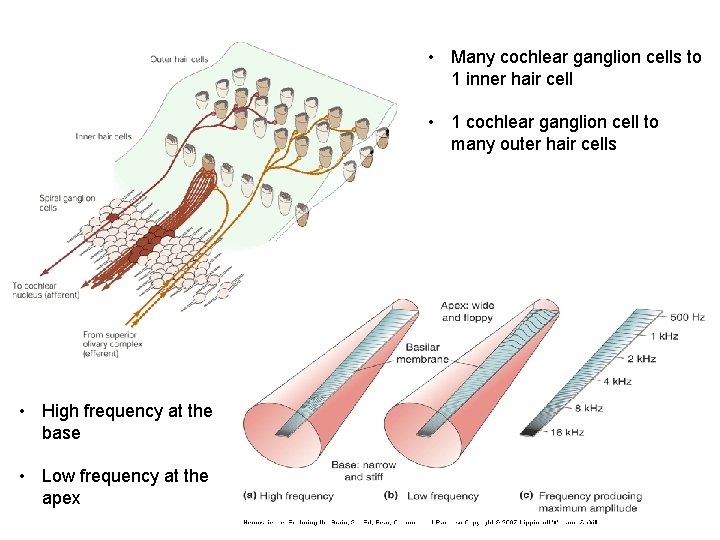
• Many cochlear ganglion cells to 1 inner hair cell • 1 cochlear ganglion cell to many outer hair cells • High frequency at the base • Low frequency at the apex
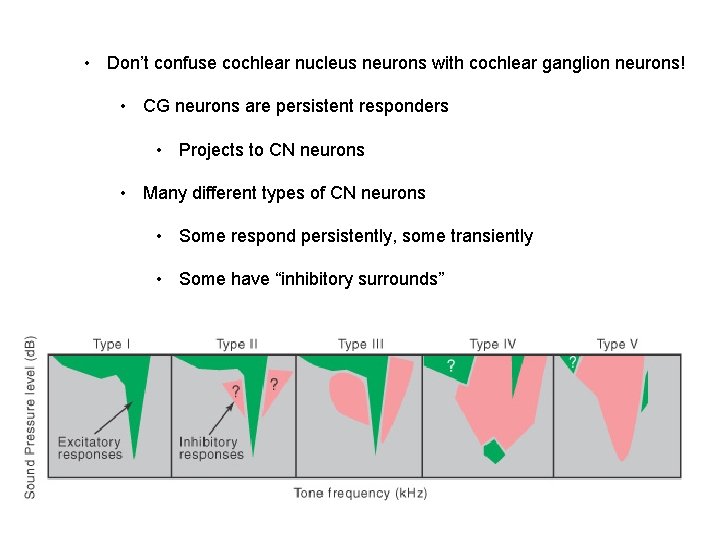
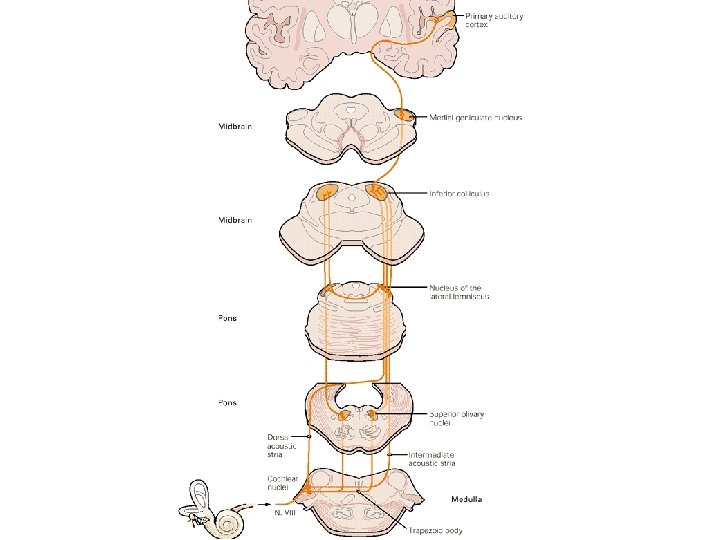
• Don’t confuse cochlear nucleus neurons with cochlear ganglion neurons! • CG neurons are persistent responders • Projects to CN neurons • Many different types of CN neurons • Some respond persistently, some transiently • Some have “inhibitory surrounds”
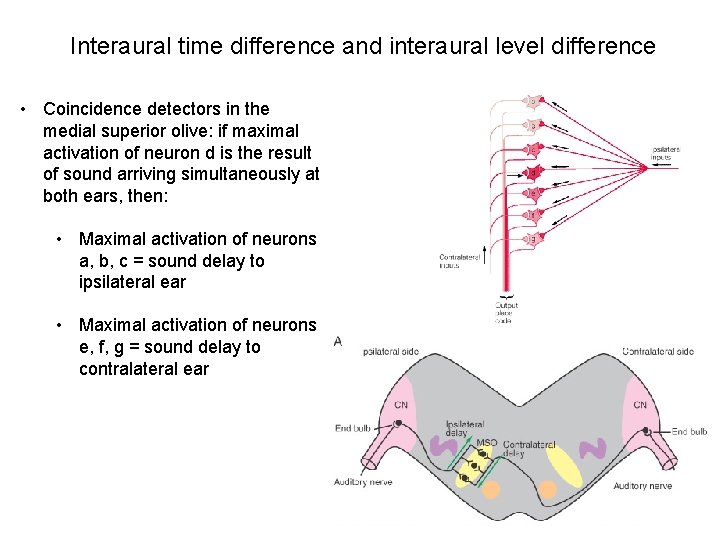
Interaural time difference and interaural level difference • Coincidence detectors in the medial superior olive: if maximal activation of neuron d is the result of sound arriving simultaneously at both ears, then: • Maximal activation of neurons a, b, c = sound delay to ipsilateral ear • Maximal activation of neurons e, f, g = sound delay to contralateral ear
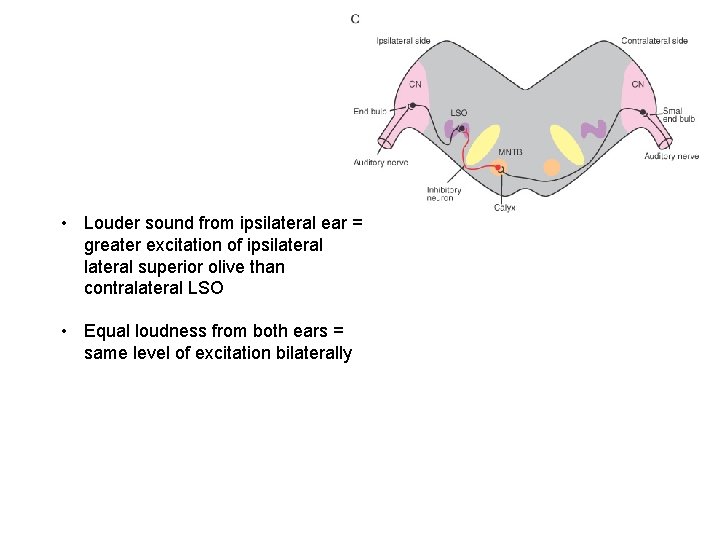
• Louder sound from ipsilateral ear = greater excitation of ipsilateral superior olive than contralateral LSO • Equal loudness from both ears = same level of excitation bilaterally
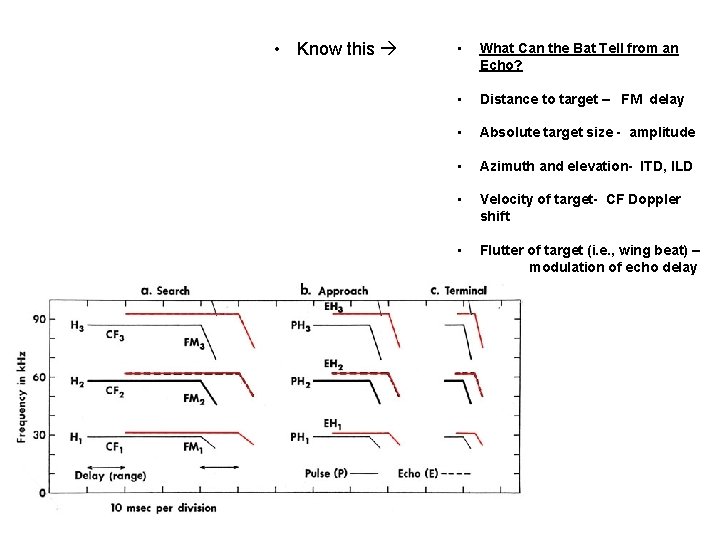
• Know this • What Can the Bat Tell from an Echo? • Distance to target – FM delay • Absolute target size - amplitude • Azimuth and elevation- ITD, ILD • Velocity of target- CF Doppler shift • Flutter of target (i. e. , wing beat) – modulation of echo delay
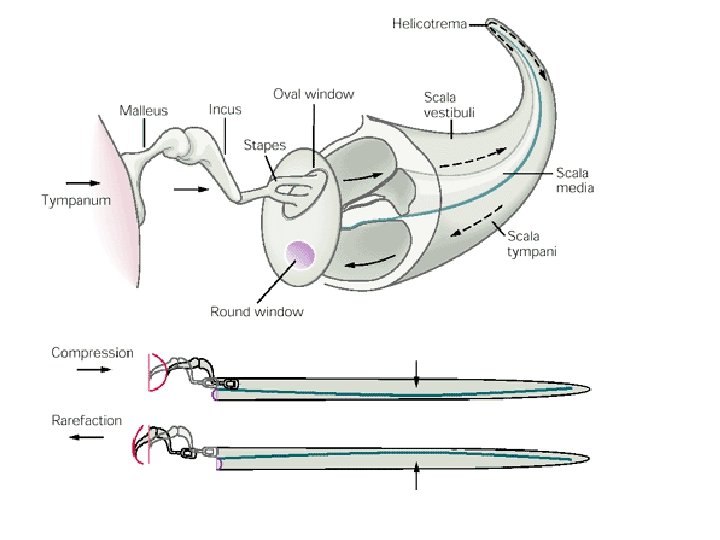
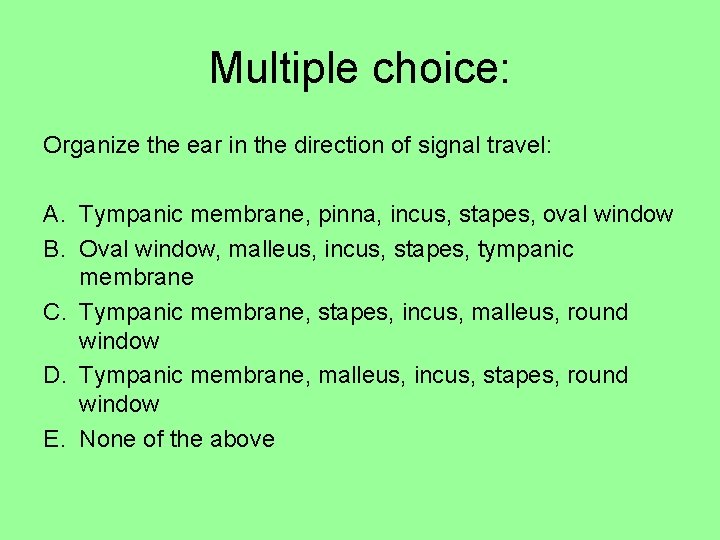
Multiple choice: Organize the ear in the direction of signal travel: A. Tympanic membrane, pinna, incus, stapes, oval window B. Oval window, malleus, incus, stapes, tympanic membrane C. Tympanic membrane, stapes, incus, malleus, round window D. Tympanic membrane, malleus, incus, stapes, round window E. None of the above
True or false? The basilar membrane is soft/floppy at the apex and stiff at the base.
Short answer: The ___ is important for discriminating sound sources along the vertical axis.
Short answer: What’s one of the hypothesized functions of the middle ear bones?
True or false? Hair cells release glutamate via graded potentials.
Short answer: The ___ accomplishes fourier transform.
True or false? A single inner hair cell synapses with a single cochlear ganglion cell.
True or false? The first site of signal integration for the auditory system is in the cochlear nucleus.
Short answer: The ___ component of a bat call is used to identify the velocity of the target while the ___ component is used to judge the distance.
Multiple choice: Localizing sound source using interaural time difference works better with (high/low) frequency sounds while interaural level difference works better with (high/low) frequency sounds.
True or false In the A 1, neurons with high characteristic frequency prefer low-to-high sweep preference.
True or false? In the cochlear nucleus, the order of sound frequencies can significantly increase or decrease neuronal response compared to playing a single sound by itself.
Short answer: The bat has a large area of cortical space dedicated to the ___ Hz range.
Short answer: Explain why low frequency sound is best for ITD and high frequency sound is best for ILD.
Short answer: The ___ is the first area in the auditory system that contains a mix of transient- and sustained-responding neurons.
Short answer: When the ___ membrane vibrates, the hair cells sitting on top of it bumps up against the ___ membrane.