
Manufacturing Study A Foundation for Developing Sector Strategies

- Slides: 21
Manufacturing Study: A Foundation for Developing Sector Strategies 2015 The Southeast Los Angeles County Workforce Development Board (SELACO WDB) would like to acknowledge the following people and organizations: Barbara Levine, Los Angeles Economic Development Corporation (LAEDC) Curtis Mello, Heraeus David Gonzales, El Camino College David Rosenfield, ROMAC PER Partners George Ray, La Fiell Manufacturing Leela Duggal, SONOCO Neil Moore, ASCO Sintering Pino Pathak, FTG, Inc. Terry Price, Cerritos College Tracy Polley, Kelco Sales & Engineering Mission The SELACO WDB provides personalized services that foster the progress of employers and encourages the potential of individuals to build a strong workforce for the Southeast Los Angeles County Region. A flexible and entrepreneurial staff uses current technology to stimulate the development of innovative programs and education. We link individuals to the training they need to gain self-sufficiency and collaborate with employers to enhance the economic vitality and the human resources of the community. 1|Page
Manufacturing Study: A Foundation for Developing Sector Strategies 2015 TABLE OF CONTENTS 2|Page
Manufacturing Study: A Foundation for Developing Sector Strategies 2015 Introduction The Southeast Los Angeles County Workforce Development Board (SELACO WDB) is one of seven WDBs in Los Angeles County serving the cities of: Artesia, Bellflower, Cerritos, Downey, Hawaiian Gardens, Lakewood and Norwalk. In partnership with local elected officials, the SELACO WDB administers and manages workforce development activities funded by the federal Workforce Innovation and Opportunity Act (WIOA) and other public and private funding sources. The workforce programs are overseen by a business-led board that represents key local industries, organized labor, economic development, and a wide variety of education, employment and training, and social services agencies. Since its founding in 1982, SELACO WDB has been working with businesses to connect job seekers to open positions that are in demand occupations – those jobs that have an existing need for workers and that provide a self-sustaining wage. For ŵore thaŶ ϭϱ LJears, ŵaŶufaĐturiŶg has ďeeŶ the foĐus of SELACO WDB’s efforts to develop and implement unique and effective training strategies through customized solutions involving traditional classroom instruction. The lioŶ’s share of this edžperieŶĐe Đoŵes ďLJǁ aLJ of SELACO WDB’s edžteŶsiǀ e experience delivering training under the State of California Employment Training Panel (ETP) program. This tax-funded initiative sets aside between $70 -100 million per year to assist businesses in training their workers in the precise skills that enable a company to compete in the marketplace, meet the challenges of out-of-state competition, and thrive and grow jobs in California. Since 1998, SELACO WDB has traiŶed ŶearlLJ ϭϲ, ϬϬϬ ǁ orkers at ŵore thaŶ ϰϬϬ ĐoŵpaŶies. SELACO WDB’s expertise in the realm of ETP training enhances our understanding of various real tiŵe Ŷeeds that businesses express for increasing the knowledge base of specific workers performing specific jobs. In many ways, SELACO WDB’s iŶteraĐtioŶ with business has been reactive to meet the eŵploLJers’ needs to hire trained workers and to increase the skill levels of their existing employees. By combining our knowledge and experience in the manufacturing sector with our experience in business engagement and the success of training job seekers and incumbent workers, SELACO WDB has taken a proactive approach to build partnerships and strategies in the Manufacturing sector to support the local industry that is driving recovery, growth, opportunities for self-supporting wages and career opportunities. 3|Page
Manufacturing Study: A Foundation for Developing Sector Strategies 2015 Purpose of Study The objective of this entire project is to develop a strong connection between SELACO WDB, the manufacturing industry and local educational systems to meet the workforce needs of companies and the community that will stimulate employment and the growth of local businesses. This report focuses more on in depth conversations, surveys, focus groups and panel presentations of manufacturing business owners, managers and education in order to determine workplace skills and training that will lead to a career pathway for job seekers as well as to develop ideas that would support the growth of manufacturing. At the onset of 2013 it became clear that the goal of SELACO WDB was to design a model with the Collaborative Community Network (CCN) that could leverage our combined resources to enhance a broader local collaboration among workforce development representatives and organizations in our region. The importance of leveraging these resources was to more effectively achieve our shared objectives and place job seekers in long term successful employment. We also envisioned the ability to collaboratively develop career pathways within 5 chosen industry sectors (Healthcare, Professional & Business Services, Hospitality, Trade/Transportation & Utilities, and Manufacturing). It was determined that these sectors have the maximum potential to support opportunities for long term career achievement. To accomplish these goals and objectives, numerous activities were planned so that all stakeholders could develop an understanding of the opportunities that exist in the identified industry sectors. It was decided that together we could more successfully evaluate and assess how to support employment and training in industry sectors that demonstrate the utmost promise for job seekers in our region. In our effort to address the needs of employers we determined that there should be a focus on the essential skill requirements of specific industries over an extended period, concentrating on specific occupations or a set of occupations within that industry. To accomplish this task it was determined by the participants involved in the discussion that the best course to follow would be to: undertake research to identify industry and worker needs and the root causes of labor market gaps design customized solutions such as career ladders, training programs, or technical assistance to help employers improve human resource practices leverage funding and resources evaluate progress consider opportunities for expansion, and promote change. 4|Page
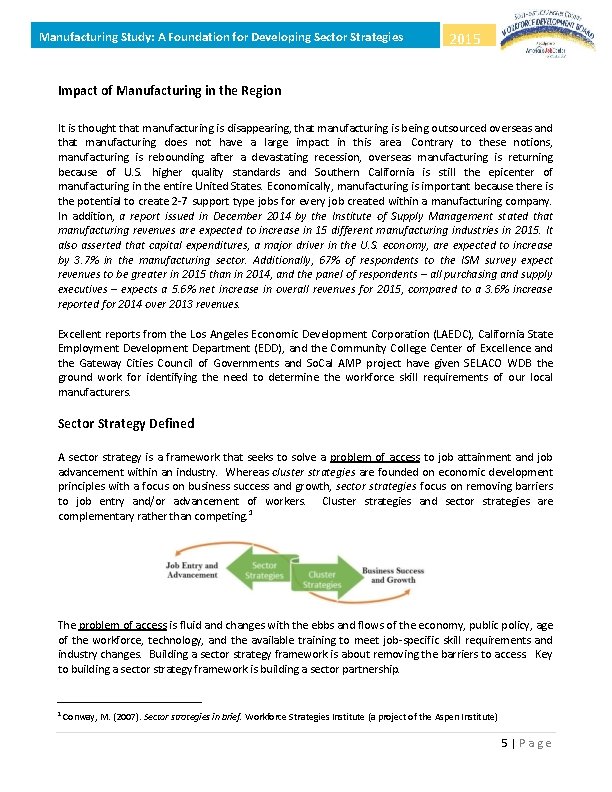
Manufacturing Study: A Foundation for Developing Sector Strategies 2015 Impact of Manufacturing in the Region It is thought that manufacturing is disappearing, that manufacturing is being outsourced overseas and that manufacturing does not have a large impact in this area. Contrary to these notions, manufacturing is rebounding after a devastating recession, overseas manufacturing is returning because of U. S. higher quality standards and Southern California is still the epicenter of manufacturing in the entire United States. Economically, manufacturing is important because there is the potential to create 2 -7 support type jobs for every job created within a manufacturing company. In addition, a report issued in December 2014 by the Institute of Supply Management stated that manufacturing revenues are expected to increase in 15 different manufacturing industries in 2015. It also asserted that capital expenditures, a major driver in the U. S. economy, are expected to increase by 3. 7% in the manufacturing sector. Additionally, 67% of respondents to the ISM survey expect revenues to be greater in 2015 than in 2014, and the panel of respondents – all purchasing and supply executives – expects a 5. 6% net increase in overall revenues for 2015, compared to a 3. 6% increase reported for 2014 over 2013 revenues. Excellent reports from the Los Angeles Economic Development Corporation (LAEDC), California State Employment Development Department (EDD), and the Community College Center of Excellence and the Gateway Cities Council of Governments and So. Cal AMP project have given SELACO WDB the ground work for identifying the need to determine the workforce skill requirements of our local manufacturers. Sector Strategy Defined A sector strategy is a framework that seeks to solve a problem of access to job attainment and job advancement within an industry. Whereas cluster strategies are founded on economic development principles with a focus on business success and growth, sector strategies focus on removing barriers to job entry and/or advancement of workers. Cluster strategies and sector strategies are complementary rather than competing. 1 The problem of access is fluid and changes with the ebbs and flows of the economy, public policy, age of the workforce, technology, and the available training to meet job-specific skill requirements and industry changes. Building a sector strategy framework is about removing the barriers to access. Key to building a sector strategy framework is building a sector partnership. 1 Conway, M. (2007). Sector strategies in brief. Workforce Strategies Institute (a project of the Aspen Institute) 5|Page
Manufacturing Study: A Foundation for Developing Sector Strategies 2015 Sector Partnership Defined The Workforce Innovation and Opportunity Act (WIOA) charges Workforce Development Boards ;forŵerlLJ WorkforĐe IŶǀestŵeŶt Boards� to develop, convene, or implement industry or sector partnerships. 2 Although this project was initiated under WIA and the directives of the State of California plan under WIA, the passing of WIOA reinforces the spirit of that directive and defines industry or sector partnership 3 as a workforce collaborative, convened by or acting in partnership with a State board or local board, that organizes key stakeholders in an industry cluster into a working group that focuses on the shared goals and human resource needs of the industry cluster. . . WIOA further defines the required sector partners (business, State recognized labor, and education) and additional partners that may participate in the collaborative (economic development, state and local governments and agencies, nonprofit and community based organizations, and any other organization as determined by the workforce collaborative). SELACO WDB’s Regional Sector Strategy Framework SELACO WDB initiated a 3 -tiered approach to develop and implement sector strategies that are aligŶed ǁ ith the State of CaliforŶia’s goals for regioŶal seĐtor strategies: Tier 1: Los Angeles Workforce Systems Collaborative (LAWSC): The LAWSC identifies and addresses workforce challenges throughout the greater Los Angeles region. Comprised of business, civic, education, workforce development and philanthropic leaders, LAWSC’s strategies and goals support economic development and sector intermediary initiatives to improve opportunities for job entry and advancement. The LAWSC ensures that the sector partnerships and strategies of each local workforce area will complement one another and avoid duplication of efforts. NOTE: The original intent of the project was to incorporate LAWSC as the top tier of our approach. Throughout the process we discovered numerous collaborative networks that were more closely aligned with our goals such as the Los Angeles Orange County Regional Consortium (LAOCRC), Los Angeles Community College Consortium/WIOA, as well as Gateway Cities Council of Governments and Advanced Manufacturing Partnership for Southern California (AMP So. Cal). 2 3 WIOA Section 134(c)(1)(A)(v) WIOA Section 3(26) 6|Page
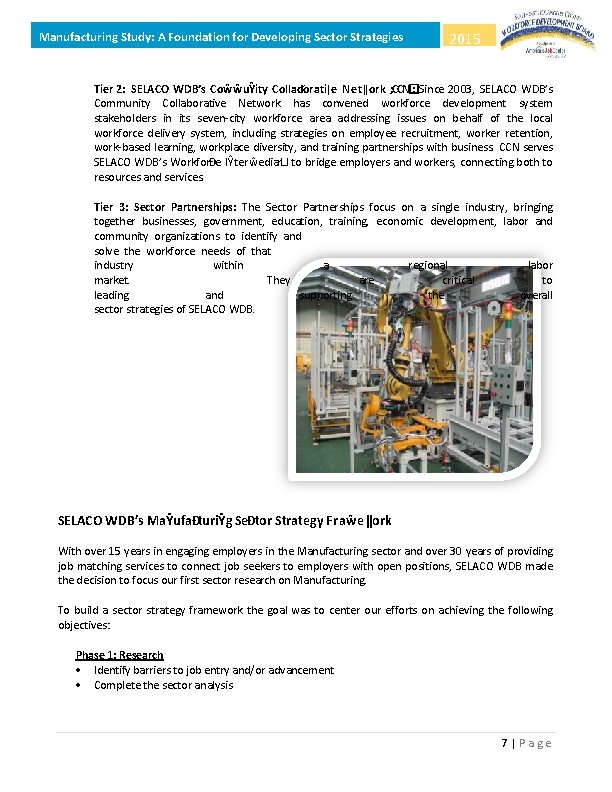
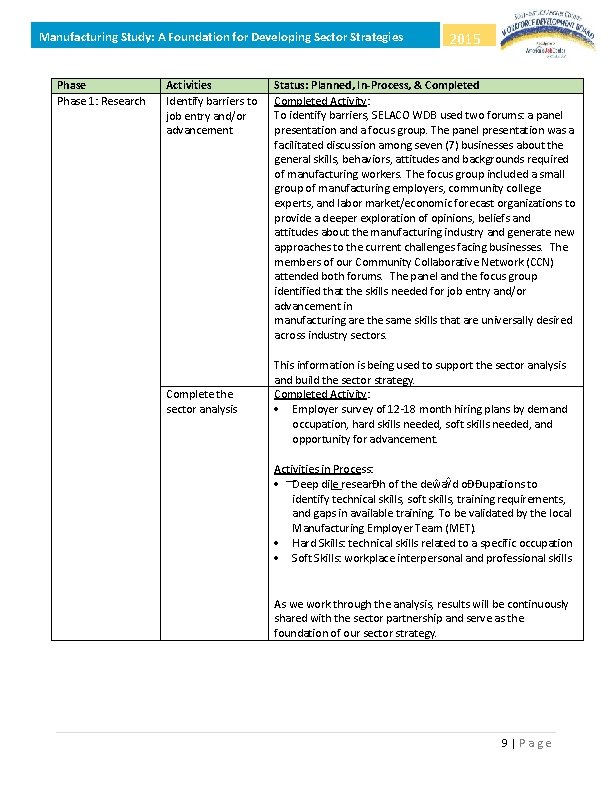
Manufacturing Study: A Foundation for Developing Sector Strategies 2015 Tier 2: SELACO WDB’s CoŵŵuŶity Collaďoratiǀ e Netǁork ;CCN� : Since 2003, SELACO WDB’s Community Collaborative Network has convened workforce development system stakeholders in its seven-city workforce area addressing issues on behalf of the local workforce delivery system, including strategies on employee recruitment, worker retention, work-based learning, workplace diversity, and training partnerships with business. CCN serves SELACO WDB’s WorkforĐe IŶterŵediarLJ to bridge employers and workers, connecting both to resources and services. Tier 3: Sector Partnerships: The Sector Partnerships focus on a single industry, bringing together businesses, government, education, training, economic development, labor and community organizations to identify and solve the workforce needs of that industry within a regional labor market. They are critical to leading and supporting the overall sector strategies of SELACO WDB’s MaŶufaĐturiŶg SeĐtor Strategy Fraŵeǁork With over 15 years in engaging employers in the Manufacturing sector and over 30 years of providing job matching services to connect job seekers to employers with open positions, SELACO WDB made the decision to focus our first sector research on Manufacturing. To build a sector strategy framework the goal was to center our efforts on achieving the following objectives: Phase 1: Research Identify barriers to job entry and/or advancement Complete the sector analysis 7|Page
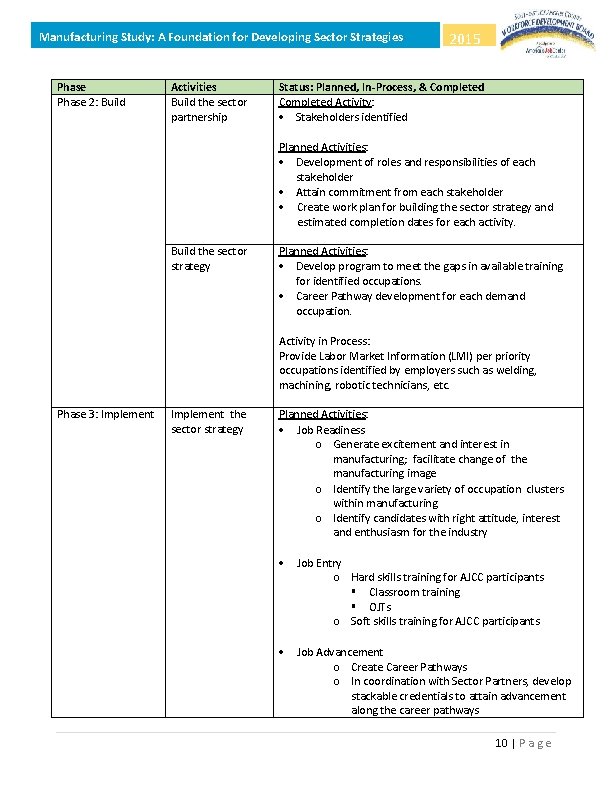
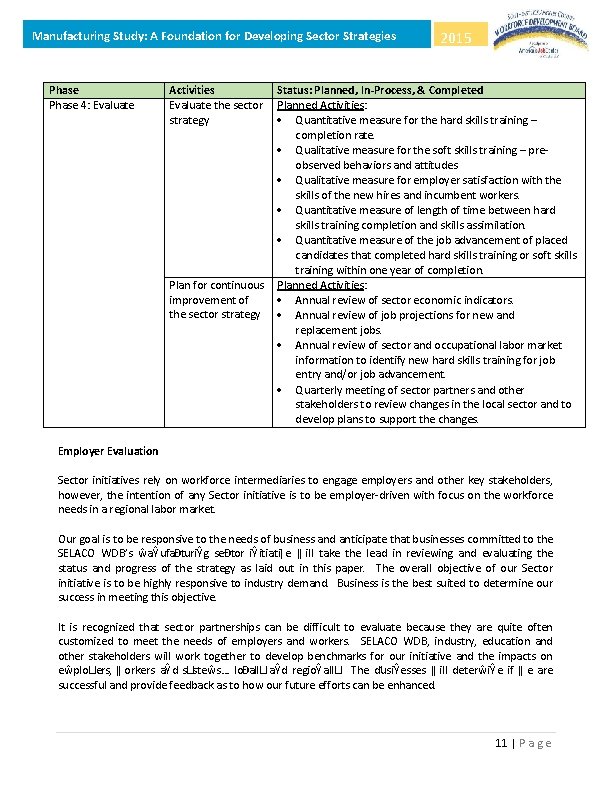
Manufacturing Study: A Foundation for Developing Sector Strategies 2015 Phase 2: Build the sector partnership Build the sector strategy Phase 3: Implement the sector strategy Phase 4: Evaluate the sector strategy Plan for continuous improvement of the sector strategy Our success would be measured by our ability to build a strong partnership between workforce development agencies, manufacturing companies, labor organizations and other important stakeholders that can examine and assess the workforce and training of the manufacturing industry and to develop strategies for advancement in this sector and promote business success and growth. 8|Page
Manufacturing Study: A Foundation for Developing Sector Strategies Phase 1: Research Activities Identify barriers to job entry and/or advancement Complete the sector analysis 2015 Status: Planned, In-Process, & Completed Activity: To identify barriers, SELACO WDB used two forums: a panel presentation and a focus group. The panel presentation was a facilitated discussion among seven (7) businesses about the general skills, behaviors, attitudes and backgrounds required of manufacturing workers. The focus group included a small group of manufacturing employers, community college experts, and labor market/economic forecast organizations to provide a deeper exploration of opinions, beliefs and attitudes about the manufacturing industry and generate new approaches to the current challenges facing businesses. The members of our Community Collaborative Network (CCN) attended both forums. The panel and the focus group identified that the skills needed for job entry and/or advancement in manufacturing are the same skills that are universally desired across industry sectors. This information is being used to support the sector analysis and build the sector strategy. Completed Activity: Employer survey of 12 -18 month hiring plans by demand occupation, hard skills needed, soft skills needed, and opportunity for advancement. Activities in Process: Deep diǀe researĐh of the deŵaŶd oĐĐupations to identify technical skills, soft skills, training requirements, and gaps in available training. To be validated by the local Manufacturing Employer Team (MET). Hard Skills: technical skills related to a specific occupation Soft Skills: workplace interpersonal and professional skills As we work through the analysis, results will be continuously shared with the sector partnership and serve as the foundation of our sector strategy. 9|Page
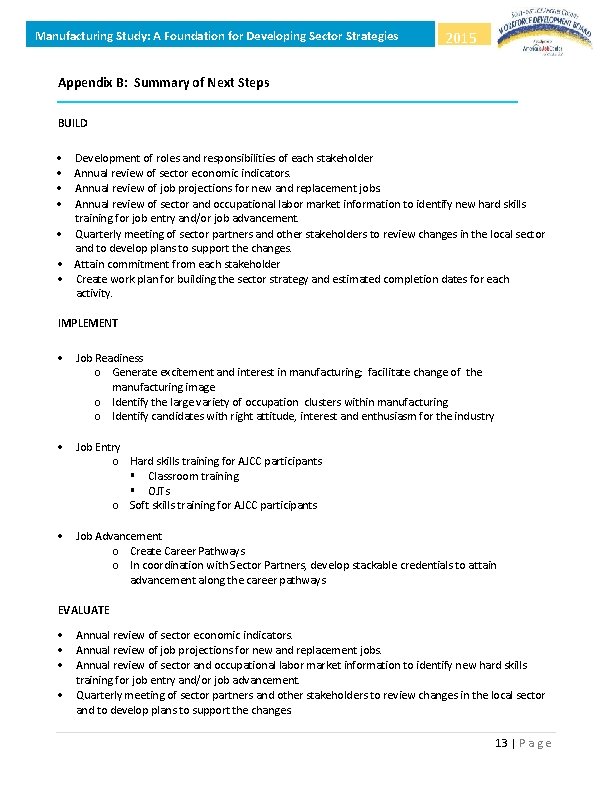
Manufacturing Study: A Foundation for Developing Sector Strategies Phase 2: Build Activities Build the sector partnership 2015 Status: Planned, In-Process, & Completed Activity: Stakeholders identified Planned Activities: Development of roles and responsibilities of each stakeholder Attain commitment from each stakeholder Create work plan for building the sector strategy and estimated completion dates for each activity. Build the sector strategy Planned Activities: Develop program to meet the gaps in available training for identified occupations. Career Pathway development for each demand occupation. Activity in Process: Provide Labor Market Information (LMI) per priority occupations identified by employers such as welding, machining, robotic technicians, etc. Phase 3: Implement the sector strategy Planned Activities: Job Readiness o Generate excitement and interest in manufacturing; facilitate change of the manufacturing image o Identify the large variety of occupation clusters within manufacturing o Identify candidates with right attitude, interest and enthusiasm for the industry Job Entry o Hard skills training for AJCC participants Classroom training OJTs o Soft skills training for AJCC participants Job Advancement o Create Career Pathways o In coordination with Sector Partners, develop stackable credentials to attain advancement along the career pathways 10 | P a g e
Manufacturing Study: A Foundation for Developing Sector Strategies Phase 4: Evaluate Activities Evaluate the sector strategy Plan for continuous improvement of the sector strategy 2015 Status: Planned, In-Process, & Completed Planned Activities: Quantitative measure for the hard skills training – completion rate. Qualitative measure for the soft skills training – preobserved behaviors and attitudes Qualitative measure for employer satisfaction with the skills of the new hires and incumbent workers. Quantitative measure of length of time between hard skills training completion and skills assimilation. Quantitative measure of the job advancement of placed candidates that completed hard skills training or soft skills training within one year of completion. Planned Activities: Annual review of sector economic indicators. Annual review of job projections for new and replacement jobs. Annual review of sector and occupational labor market information to identify new hard skills training for job entry and/or job advancement. Quarterly meeting of sector partners and other stakeholders to review changes in the local sector and to develop plans to support the changes. Employer Evaluation Sector initiatives rely on workforce intermediaries to engage employers and other key stakeholders, however, the intention of any Sector initiative is to be employer-driven with focus on the workforce needs in a regional labor market. Our goal is to be responsive to the needs of business and anticipate that businesses committed to the SELACO WDB’s ŵaŶufaĐturiŶg seĐtor iŶitiatiǀ e ǁ ill take the lead in reviewing and evaluating the status and progress of the strategy as laid out in this paper. The overall objective of our Sector initiative is to be highly responsive to industry demand. Business is the best suited to determine our success in meeting this objective. It is recognized that sector partnerships can be difficult to evaluate because they are quite often customized to meet the needs of employers and workers. SELACO WDB, industry, education and other stakeholders will work together to develop benchmarks for our initiative and the impacts on eŵploLJers, ǁ orkers aŶd sLJsteŵs… loĐallLJ aŶd regioŶallLJ. The ďusiŶesses ǁ ill deterŵiŶe if ǁ e are successful and provide feedback as to how our future efforts can be enhanced. 11 | P a g e
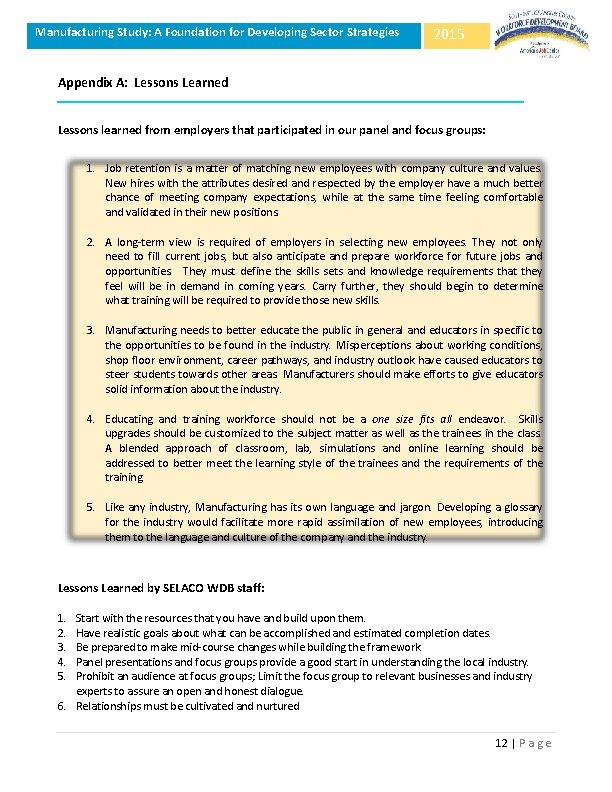
Manufacturing Study: A Foundation for Developing Sector Strategies 2015 Appendix A: Lessons Learned Lessons learned from employers that participated in our panel and focus groups: 1. Job retention is a matter of matching new employees with company culture and values. New hires with the attributes desired and respected by the employer have a much better chance of meeting company expectations, while at the same time feeling comfortable and validated in their new positions. 2. A long-term view is required of employers in selecting new employees. They not only need to fill current jobs, but also anticipate and prepare workforce for future jobs and opportunities. They must define the skills sets and knowledge requirements that they feel will be in demand in coming years. Carry further, they should begin to determine what training will be required to provide those new skills. 3. Manufacturing needs to better educate the public in general and educators in specific to the opportunities to be found in the industry. Misperceptions about working conditions, shop floor environment, career pathways, and industry outlook have caused educators to steer students towards other areas. Manufacturers should make efforts to give educators solid information about the industry. 4. Educating and training workforce should not be a one size fits all endeavor. Skills upgrades should be customized to the subject matter as well as the trainees in the class. A blended approach of classroom, lab, simulations and online learning should be addressed to better meet the learning style of the trainees and the requirements of the training. 5. Like any industry, Manufacturing has its own language and jargon. Developing a glossary for the industry would facilitate more rapid assimilation of new employees, introducing them to the language and culture of the company and the industry. Lessons Learned by SELACO WDB staff: 1. 2. 3. 4. 5. Start with the resources that you have and build upon them. Have realistic goals about what can be accomplished and estimated completion dates. Be prepared to make mid-course changes while building the framework. Panel presentations and focus groups provide a good start in understanding the local industry. Prohibit an audience at focus groups; Limit the focus group to relevant businesses and industry experts to assure an open and honest dialogue. 6. Relationships must be cultivated and nurtured 12 | P a g e
Manufacturing Study: A Foundation for Developing Sector Strategies 2015 Appendix B: Summary of Next Steps BUILD Development of roles and responsibilities of each stakeholder Annual review of sector economic indicators. Annual review of job projections for new and replacement jobs. Annual review of sector and occupational labor market information to identify new hard skills training for job entry and/or job advancement. Quarterly meeting of sector partners and other stakeholders to review changes in the local sector and to develop plans to support the changes. Attain commitment from each stakeholder Create work plan for building the sector strategy and estimated completion dates for each activity. IMPLEMENT Job Readiness o Generate excitement and interest in manufacturing; facilitate change of the manufacturing image o Identify the large variety of occupation clusters within manufacturing o Identify candidates with right attitude, interest and enthusiasm for the industry Job Entry o Hard skills training for AJCC participants Classroom training OJTs o Soft skills training for AJCC participants Job Advancement o Create Career Pathways o In coordination with Sector Partners, develop stackable credentials to attain advancement along the career pathways EVALUATE Annual review of sector economic indicators. Annual review of job projections for new and replacement jobs. Annual review of sector and occupational labor market information to identify new hard skills training for job entry and/or job advancement. Quarterly meeting of sector partners and other stakeholders to review changes in the local sector and to develop plans to support the changes. 13 | P a g e
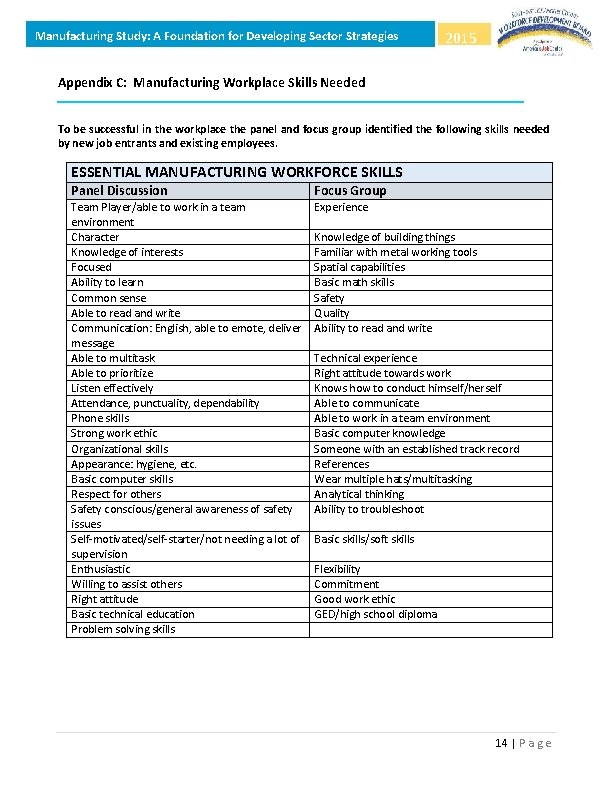
Manufacturing Study: A Foundation for Developing Sector Strategies 2015 Appendix C: Manufacturing Workplace Skills Needed To be successful in the workplace the panel and focus group identified the following skills needed by new job entrants and existing employees. ESSENTIAL MANUFACTURING WORKFORCE SKILLS Panel Discussion Focus Group Team Player/able to work in a team environment Character Knowledge of interests Focused Ability to learn Common sense Able to read and write Communication: English, able to emote, deliver message Able to multitask Able to prioritize Listen effectively Attendance, punctuality, dependability Phone skills Strong work ethic Organizational skills Appearance: hygiene, etc. Basic computer skills Respect for others Safety conscious/general awareness of safety issues Self-motivated/self-starter/not needing a lot of supervision Enthusiastic Willing to assist others Right attitude Basic technical education Problem solving skills Experience Knowledge of building things Familiar with metal working tools Spatial capabilities Basic math skills Safety Quality Ability to read and write Technical experience Right attitude towards work Knows how to conduct himself/herself Able to communicate Able to work in a team environment Basic computer knowledge Someone with an established track record References Wear multiple hats/multitasking Analytical thinking Ability to troubleshoot Basic skills/soft skills Flexibility Commitment Good work ethic GED/high school diploma 14 | P a g e
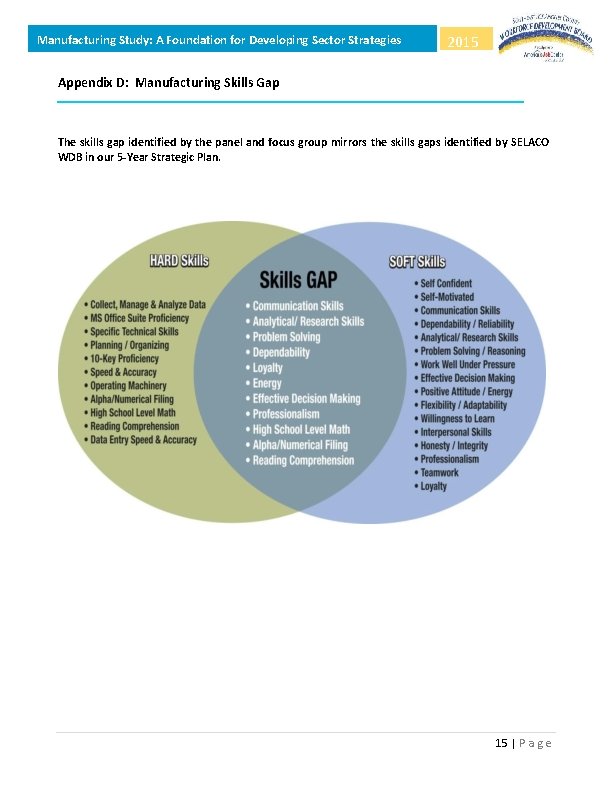
Manufacturing Study: A Foundation for Developing Sector Strategies 2015 Appendix D: Manufacturing Skills Gap The skills gap identified by the panel and focus group mirrors the skills gaps identified by SELACO WDB in our 5 -Year Strategic Plan. 15 | P a g e
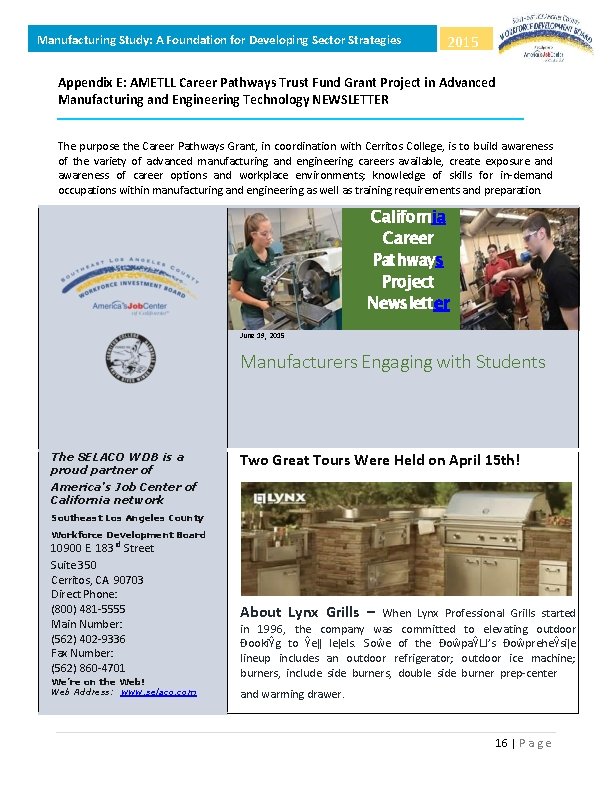
Manufacturing Study: A Foundation for Developing Sector Strategies 2015 Appendix E: AMETLL Career Pathways Trust Fund Grant Project in Advanced Manufacturing and Engineering Technology NEWSLETTER The purpose the Career Pathways Grant, in coordination with Cerritos College, is to build awareness of the variety of advanced manufacturing and engineering careers available, create exposure and awareness of career options and workplace environments; knowledge of skills for in-demand occupations within manufacturing and engineering as well as training requirements and preparation. California Career Pathways Project Newsletter June 19, 2015 Manufacturers Engaging with Students The SELACO WDB is a proud partner of America’s Job Center of California network Two Great Tours Were Held on April 15 th! Southeast Los Angeles County Workforce Development Board 10900 E. 183 rd Street Suite 350 Cerritos, CA 90703 Direct Phone: (800) 481 -5555 Main Number: (562) 402 -9336 Fax Number: (562) 860 -4701 We’re on the Web! Web Address: www. selaco. com About Lynx Grills – When Lynx Professional Grills started in 1996, the company was committed to elevating outdoor ĐookiŶg to Ŷeǁ leǀels. Soŵe of the ĐoŵpaŶLJ’s ĐoŵpreheŶsiǀe lineup includes an outdoor refrigerator; outdoor ice machine; burners, include side burners, double side burner prep-center and warming drawer. 16 | P a g e
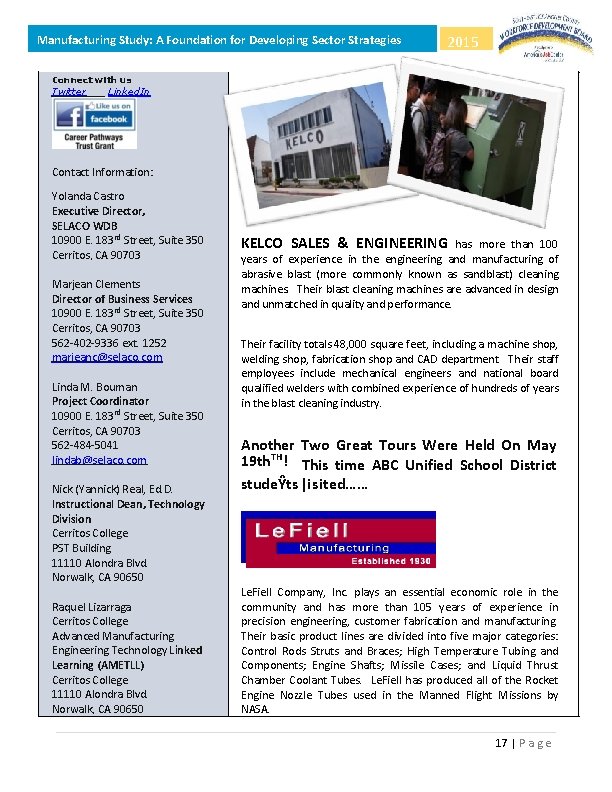
Manufacturing Study: A Foundation for Developing Sector Strategies 2015 Connect with us Twitter Linked. In Contact Information: Yolanda Castro Executive Director, SELACO WDB 10900 E. 183 rd Street, Suite 350 Cerritos, CA 90703 Marjean Clements Director of Business Services 10900 E. 183 rd Street, Suite 350 Cerritos, CA 90703 562 -402 -9336 ext. 1252 marjeanc@selaco. com Linda M. Bouman Project Coordinator 10900 E. 183 rd Street, Suite 350 Cerritos, CA 90703 562 -484 -5041 lindab@selaco. com Nick (Yannick) Real, Ed. D. Instructional Dean, Technology Division Cerritos College PST Building 11110 Alondra Blvd. Norwalk, CA 90650 Raquel Lizarraga Cerritos College Advanced Manufacturing Engineering Technology Linked Learning (AMETLL) Cerritos College 11110 Alondra Blvd. Norwalk, CA 90650 KELCO SALES & ENGINEERING has more than 100 years of experience in the engineering and manufacturing of abrasive blast (more commonly known as sandblast) cleaning machines. Their blast cleaning machines are advanced in design and unmatched in quality and performance. Their facility totals 48, 000 square feet, including a machine shop, welding shop, fabrication shop and CAD department. Their staff employees include mechanical engineers and national board qualified welders with combined experience of hundreds of years in the blast cleaning industry. Another Two Great Tours Were Held On May 19 th. TH! This time ABC Unified School District studeŶts ǀisited…… Le. Fiell Company, Inc. plays an essential economic role in the community and has more than 105 years of experience in precision engineering, customer fabrication and manufacturing. Their basic product lines are divided into five major categories: Control Rods Struts and Braces; High Temperature Tubing and Components; Engine Shafts; Missile Cases; and Liquid Thrust Chamber Coolant Tubes. Le. Fiell has produced all of the Rocket Engine Nozzle Tubes used in the Manned Flight Missions by NASA. 17 | P a g e
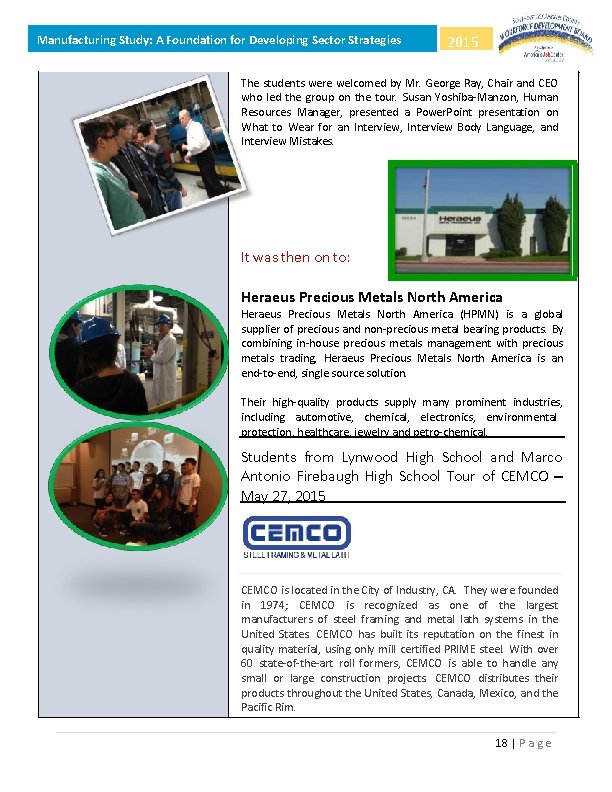
Manufacturing Study: A Foundation for Developing Sector Strategies 2015 The students were welcomed by Mr. George Ray, Chair and CEO who led the group on the tour. Susan Yoshiba-Manzon, Human Resources Manager, presented a Power. Point presentation on What to Wear for an Interview, Interview Body Language, and Interview Mistakes. It was then on to: Heraeus Precious Metals North America (HPMN) is a global supplier of precious and non-precious metal bearing products. By combining in-house precious metals management with precious metals trading, Heraeus Precious Metals North America is an end-to-end, single source solution. Their high-quality products supply many prominent industries, including automotive, chemical, electronics, environmental protection, healthcare, jewelry and petro-chemical. Students from Lynwood High School and Marco Antonio Firebaugh High School Tour of CEMCO – May 27, 2015 CEMCO is located in the City of Industry, CA. They were founded in 1974; CEMCO is recognized as one of the largest manufacturers of steel framing and metal lath systems in the United States. CEMCO has built its reputation on the finest in quality material, using only mill certified PRIME steel. With over 60 state-of-the-art roll formers, CEMCO is able to handle any small or large construction projects. CEMCO distributes their products throughout the United States, Canada, Mexico, and the Pacific Rim. 18 | P a g e
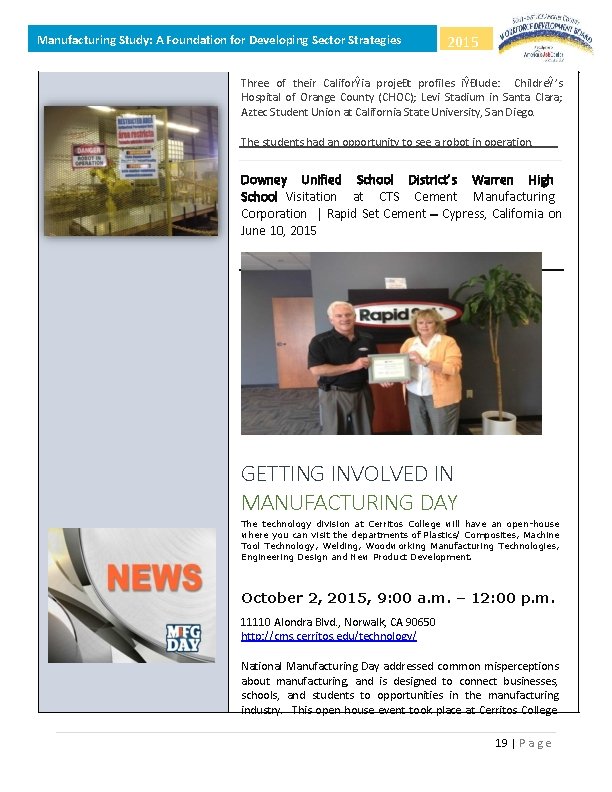
Manufacturing Study: A Foundation for Developing Sector Strategies 2015 Three of their CaliforŶia projeĐt profiles iŶĐlude: ChildreŶ’s Hospital of Orange County (CHOC); Levi Stadium in Santa Clara; Aztec Student Union at California State University, San Diego. The students had an opportunity to see a robot in operation. Downey Unified School District’s Warren High School Visitation at CTS Cement Manufacturing Corporation | Rapid Set Cement – Cypress, California on June 10, 2015 Presentation by John Salkowski, V. P. - Operations GETTING INVOLVED IN MANUFACTURING DAY The technology division at Cerritos College will have an open-house where you can visit the departments of Plastics/ Composites, Machine Tool Technology, Welding, Woodworking Manufacturing Technologies, Engineering Design and New Product Development. October 2, 2015, 9: 00 a. m. – 12: 00 p. m. 11110 Alondra Blvd. , Norwalk, CA 90650 http: //cms. cerritos. edu/technology/ National Manufacturing Day addressed common misperceptions about manufacturing, and is designed to connect businesses, schools, and students to opportunities in the manufacturing industry. This open house event took place at Cerritos College 19 | P a g e
Manufacturing Study: A Foundation for Developing Sector Strategies 2015 and was open to high school students, Educators, and Professionals. Make sure you register! For More Event Information: Raquel Lizarraga Cerritos College Manufacturing Advanced Engineering Technology Linked Learning (AMETLL) RLizarraga@cerritos. edu Did you know, for example, that Machine Tool Technology majors earn $58, 770 on average five years after they receive their certificate of achievement from a community college? This is 42% more than the national average starting salary of a 4 year university graduate at $41, 392. And the machine tool technology graduate from a community college is unlikely to carry the $29, 059 average debt of the 4 year university graduate! [http: //www. calstate. edu/value/systemwide/ and http: //salarysurfer. cccco. edu/Salary. Surfer. aspx] 20 | P a g e