
Manufacturing Planning Process LEAN SIX SIGMA TAGUCHI METHODS
- Slides: 32
Manufacturing Planning Process LEAN SIX SIGMA TAGUCHI METHODS
Lean Six Sigma (LSS) �Improvement Methods �Design for LSS (DFSS) �LSS Implementation Issues �Strategic LSS Roadmap �The Malcolm Baldrige Award “Quality begins with me. ” Phil Crosby
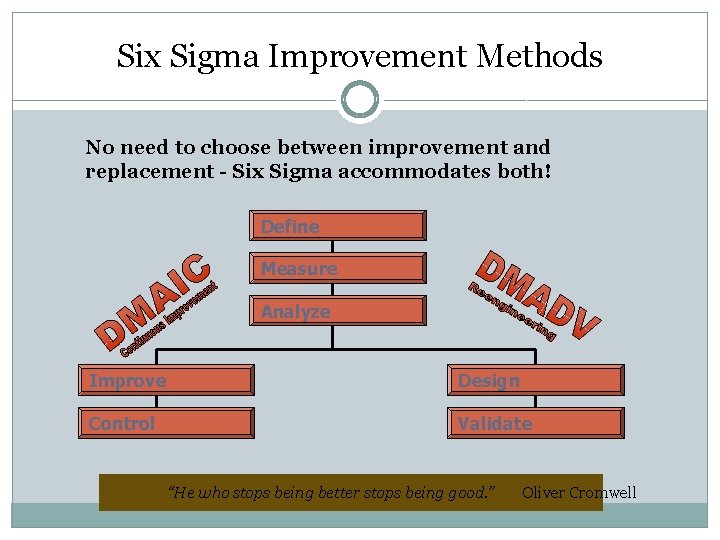
Six Sigma Improvement Methods No need to choose between improvement and replacement - Six Sigma accommodates both! Define Measure Analyze Improve Design Control Validate “He who stops being better stops being good. ” Oliver Cromwell
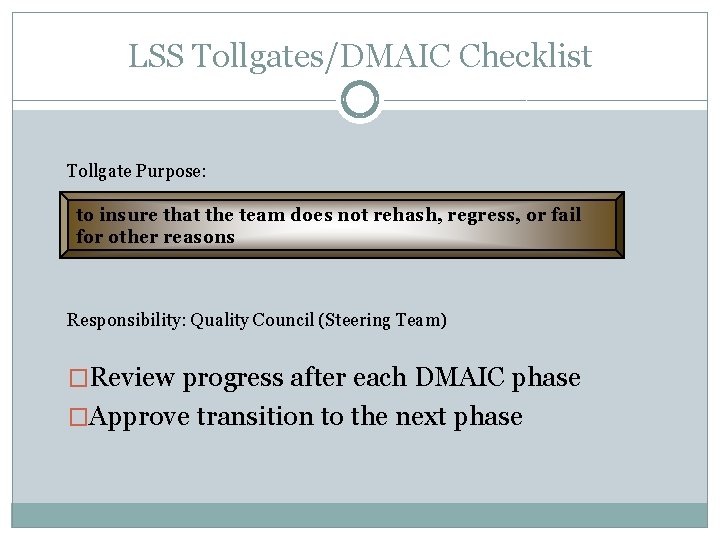
LSS Tollgates/DMAIC Checklist Tollgate Purpose: to insure that the team does not rehash, regress, or fail for other reasons Responsibility: Quality Council (Steering Team) �Review progress after each DMAIC phase �Approve transition to the next phase
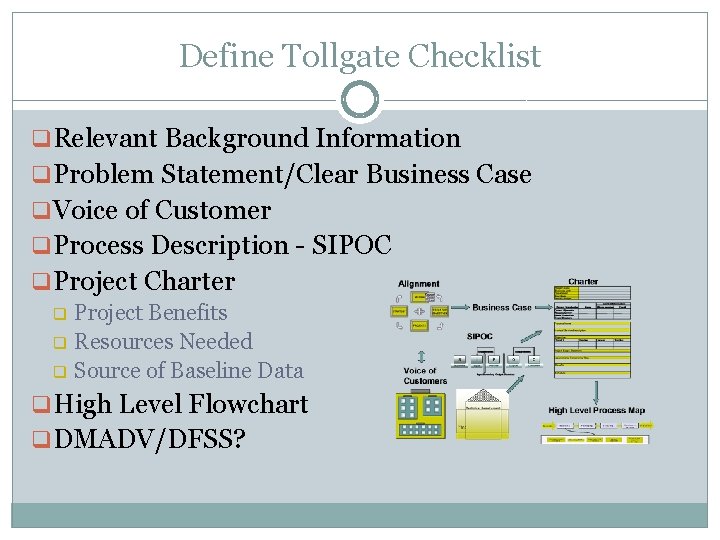
Define Tollgate Checklist q Relevant Background Information q Problem Statement/Clear Business Case q Voice of Customer q Process Description - SIPOC q Project Charter q q q Project Benefits Resources Needed Source of Baseline Data q High Level Flowchart q DMADV/DFSS?
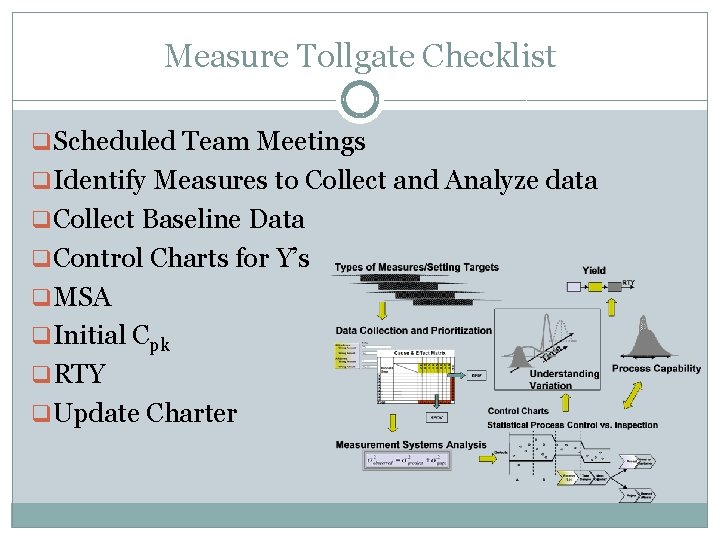
Measure Tollgate Checklist q Scheduled Team Meetings q Identify Measures to Collect and Analyze data q Collect Baseline Data q Control Charts for Y’s q MSA q Initial Cpk q RTY q Update Charter
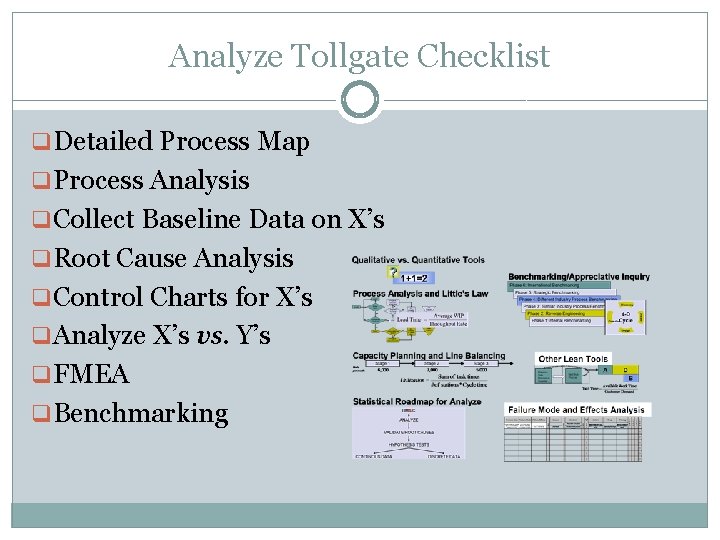
Analyze Tollgate Checklist q Detailed Process Map q Process Analysis q Collect Baseline Data on X’s q Root Cause Analysis q Control Charts for X’s q Analyze X’s vs. Y’s q FMEA q Benchmarking
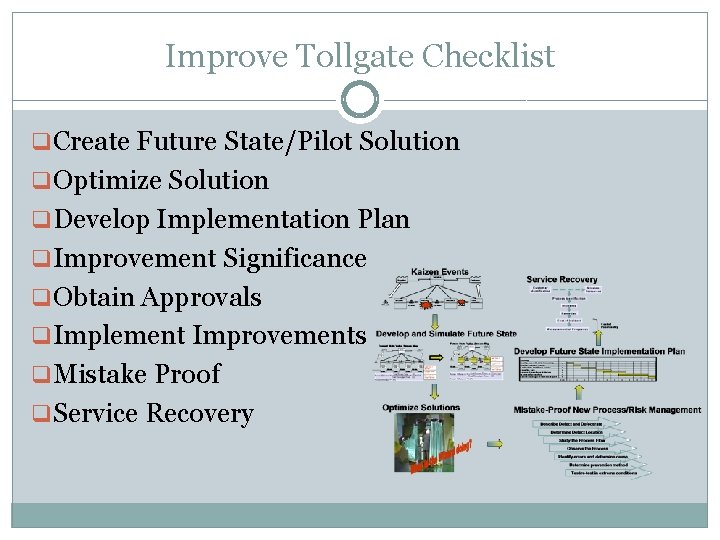
Improve Tollgate Checklist q Create Future State/Pilot Solution q Optimize Solution q Develop Implementation Plan q Improvement Significance q Obtain Approvals q Implement Improvements q Mistake Proof q Service Recovery
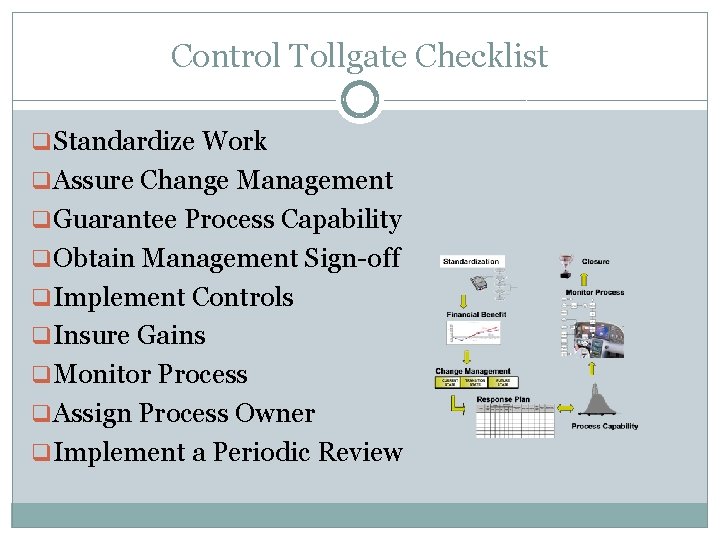
Control Tollgate Checklist q Standardize Work q Assure Change Management q Guarantee Process Capability q Obtain Management Sign-off q Implement Controls q Insure Gains q Monitor Process q Assign Process Owner q Implement a Periodic Review
Design for Lean Six Sigma (DFLSS) � A design process for re-engineering opportunities (DMADV) Objective is to design a new process with Six Sigma quality to start Focus is on “front-loading the pain” � Must be identified by management as major opportunities for savings and/or customer satisfaction � Projects will be longer; team members may need to be back-filled in their jobs for the duration of the project
Design for Lean Six Sigma (Continued) DFLSS Dimensions: � Design for Manufacture and Assembly � Design for Reliability � Design for Maintainability � Design for Serviceability � Design for Environmentality � Design for Life-Cycle Cost Benefits Include: � Reduced Life-Cycle Cost � Improved Quality � Increased Efficiency and Productivity “When organizations are considering making a change, they will consider associated costs, but will not give adequate consideration to the cost of not making the change. ” Source: F. Breyfogle, Implementing Six Sigma, 2003
Tools �QFD, Benchmarking, FMEA, Simulation, �Optimization, Life-Cycle Planning, DOE, Taguchi Loss Functions, and Triz
DFLSS Tools: Taguchi �Taguchi Methods are statistical methods developed largely by GENICHI TAGUCHI to improve quality of manufactured goods. �The philosophy of off-line quality control. �Innovations in the design of experiments.
Taguchi Loss Function �Taguchi defines Quality as “the loss imparted by the product to society from the time the product is shipped. ” �LOSS = Cost to operate, Failure to function, maintenance and repair cost, customer satisfaction, poor design. �Product to be produced “being within specification”
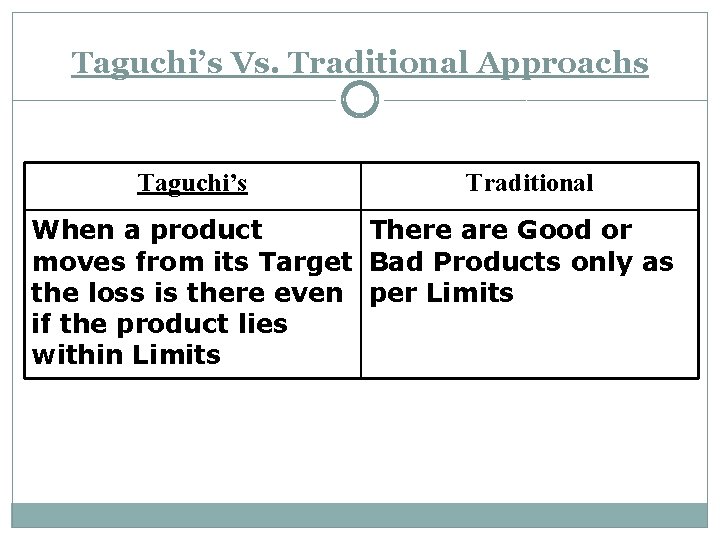
Taguchi’s Vs. Traditional Approachs Taguchi’s Traditional When a product There are Good or moves from its Target Bad Products only as the loss is there even per Limits if the product lies within Limits
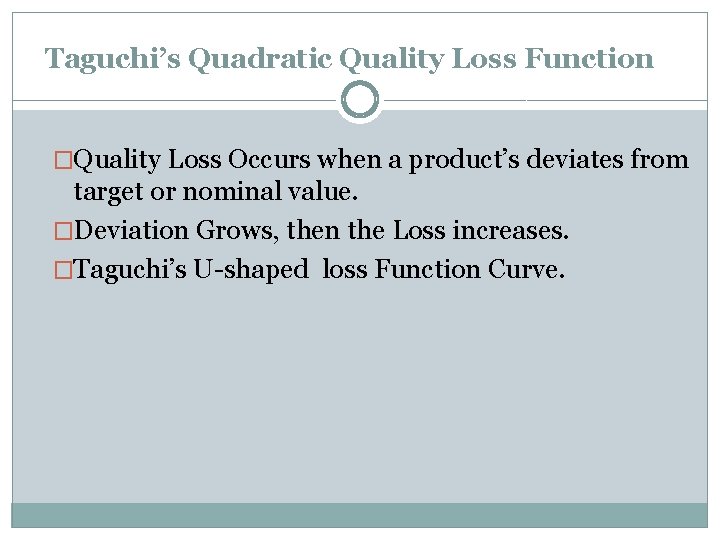
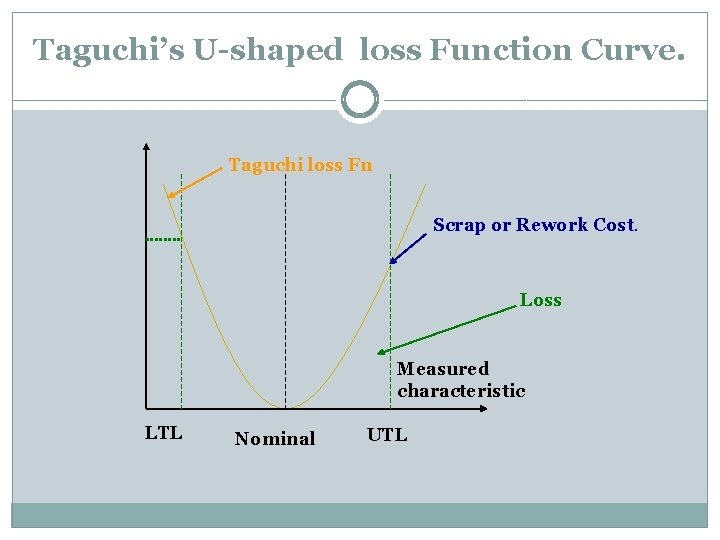
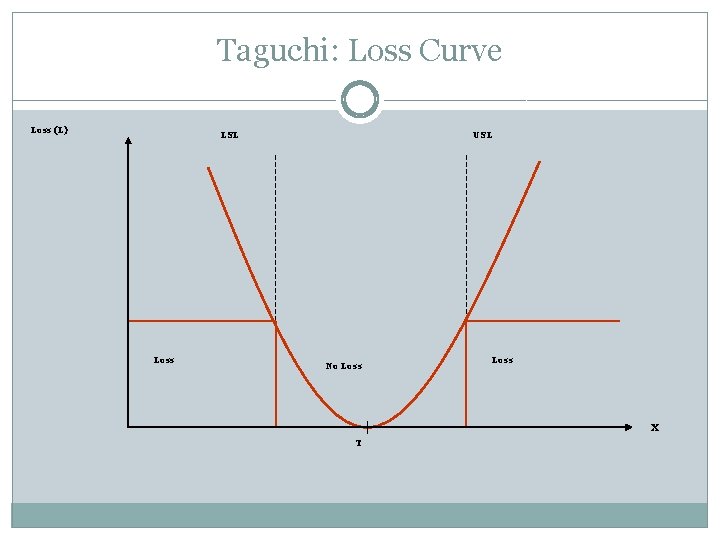
Taguchi’s Quadratic Quality Loss Function �Quality Loss Occurs when a product’s deviates from target or nominal value. �Deviation Grows, then the Loss increases. �Taguchi’s U-shaped loss Function Curve.
Taguchi’s U-shaped loss Function Curve. Taguchi loss Fn Scrap or Rework Cost. Loss Measured characteristic LTL Nominal UTL
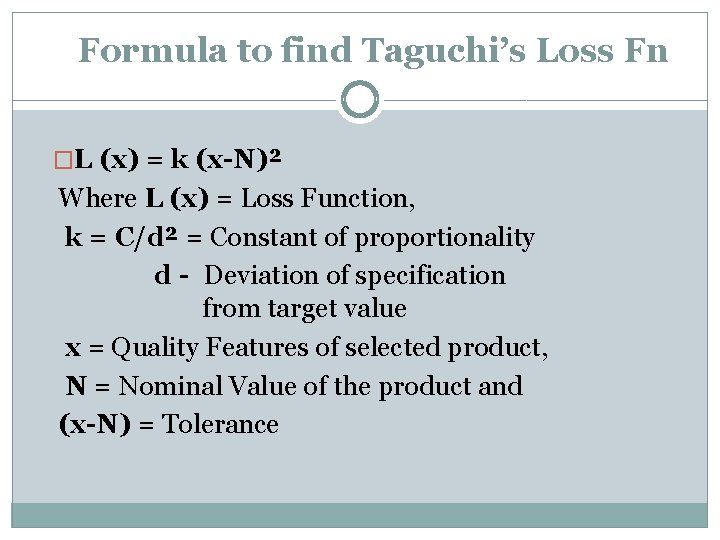
Formula to find Taguchi’s Loss Fn �L (x) = k (x-N)² Where L (x) = Loss Function, k = C/d² = Constant of proportionality d - Deviation of specification from target value x = Quality Features of selected product, N = Nominal Value of the product and (x-N) = Tolerance
Taguchi: Loss Curve Loss (L) LSL Loss USL No Loss x T
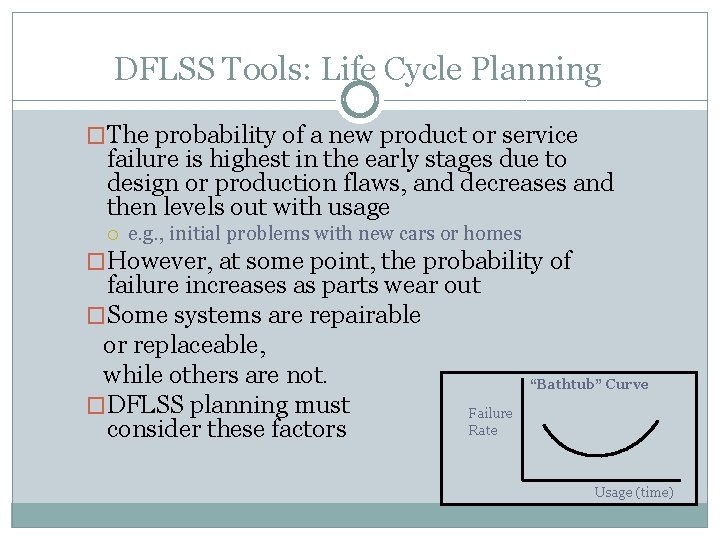
DFLSS Tools: Life Cycle Planning �The probability of a new product or service failure is highest in the early stages due to design or production flaws, and decreases and then levels out with usage e. g. , initial problems with new cars or homes �However, at some point, the probability of failure increases as parts wear out �Some systems are repairable or replaceable, while others are not. �DFLSS planning must Failure Rate consider these factors “Bathtub” Curve Usage (time)
DFLSS Tools: Simulation �A method for replicating real world relationships using a few factors, simply related �Typically done with the aid of a computer �Utilizes historical data or other knowledge to make assumptions about the likelihood of future events �Allows for the study of variation in processes �Enables analysis and learning without disrupting the real system under investigation by using random numbers to “simulate” events �Not an optimization technique; decision variables are inputs to a simulation
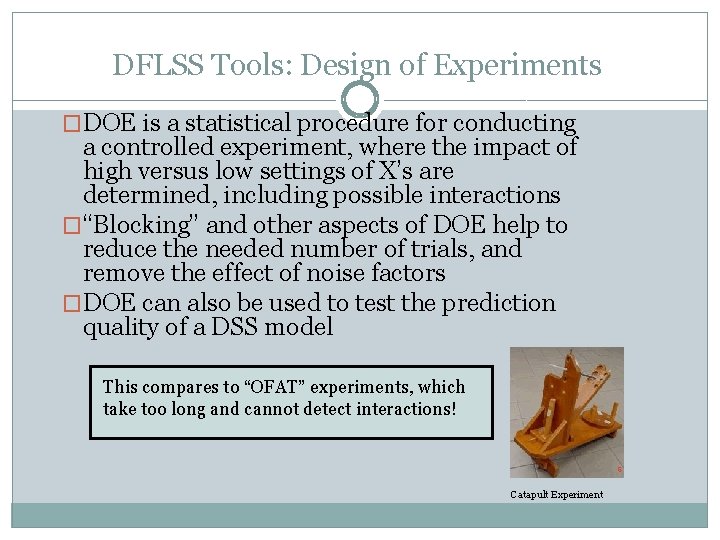
DFLSS Tools: Design of Experiments �DOE is a statistical procedure for conducting a controlled experiment, where the impact of high versus low settings of X’s are determined, including possible interactions �“Blocking” and other aspects of DOE help to reduce the needed number of trials, and remove the effect of noise factors �DOE can also be used to test the prediction quality of a DSS model This compares to “OFAT” experiments, which take too long and cannot detect interactions! Catapult Experiment
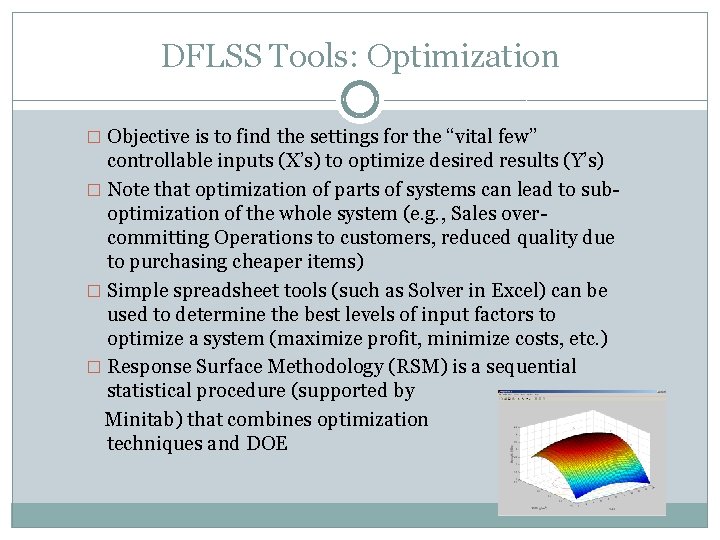
DFLSS Tools: Optimization � Objective is to find the settings for the “vital few” controllable inputs (X’s) to optimize desired results (Y’s) � Note that optimization of parts of systems can lead to suboptimization of the whole system (e. g. , Sales overcommitting Operations to customers, reduced quality due to purchasing cheaper items) � Simple spreadsheet tools (such as Solver in Excel) can be used to determine the best levels of input factors to optimize a system (maximize profit, minimize costs, etc. ) � Response Surface Methodology (RSM) is a sequential statistical procedure (supported by Minitab) that combines optimization techniques and DOE
DFLSS Tools: Theory of Inventive Problem Solving (TRIZ) � A combination of methods, tools, and a way of thinking developed in the Soviet Union in the 1940 s � Used for concept generation and problem-solving � Assumes that all inventions contain at least one contradiction e. g. , faster auto acceleration reduces fuel efficiency, productivity vs. accuracy, etc. � Success depends on resolution of contradiction � Involves trade-off between contradictory factors, or overcoming the contradiction Despite the immensity of problems, only 1250 typical system contradictions in 39 design parameters have been found to date Many Triz tools have been developed to deal with these contradictions Source: Design for Six Sigma, Yang and El-Haik, 2003
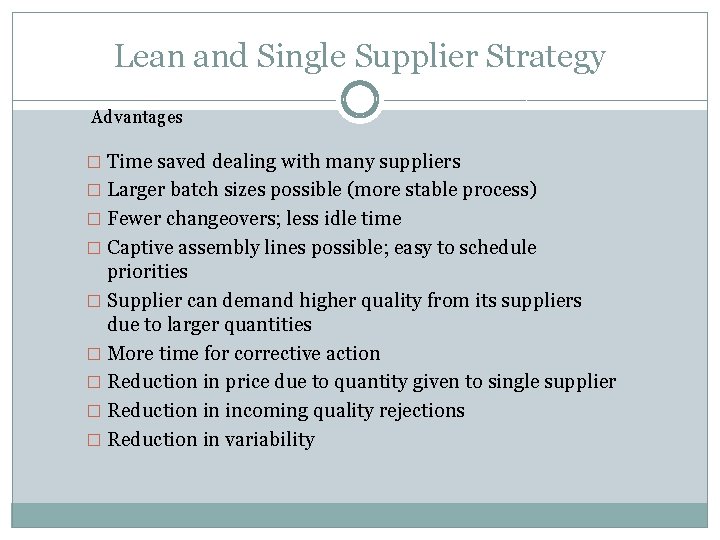
Lean and Single Supplier Strategy Advantages � Time saved dealing with many suppliers � Larger batch sizes possible (more stable process) � Fewer changeovers; less idle time � Captive assembly lines possible; easy to schedule priorities � Supplier can demand higher quality from its suppliers due to larger quantities � More time for corrective action � Reduction in price due to quantity given to single supplier � Reduction in incoming quality rejections � Reduction in variability
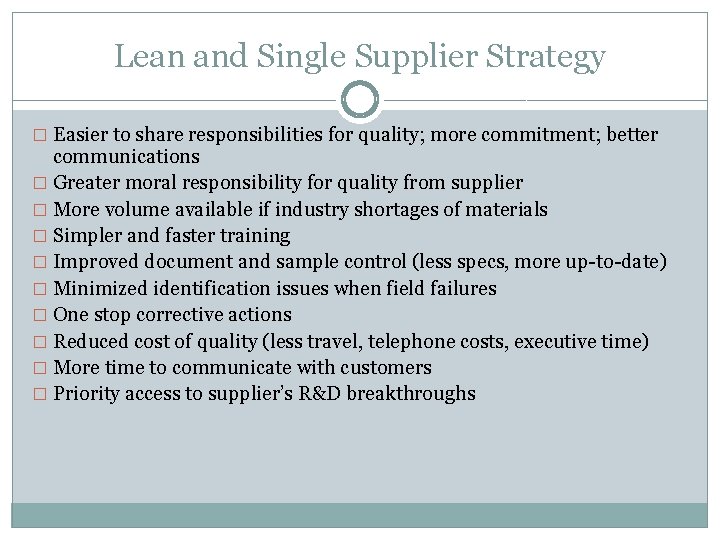
Lean and Single Supplier Strategy � Easier to share responsibilities for quality; more commitment; better communications � Greater moral responsibility for quality from supplier � More volume available if industry shortages of materials � Simpler and faster training � Improved document and sample control (less specs, more up-to-date) � Minimized identification issues when field failures � One stop corrective actions � Reduced cost of quality (less travel, telephone costs, executive time) � More time to communicate with customers � Priority access to supplier’s R&D breakthroughs
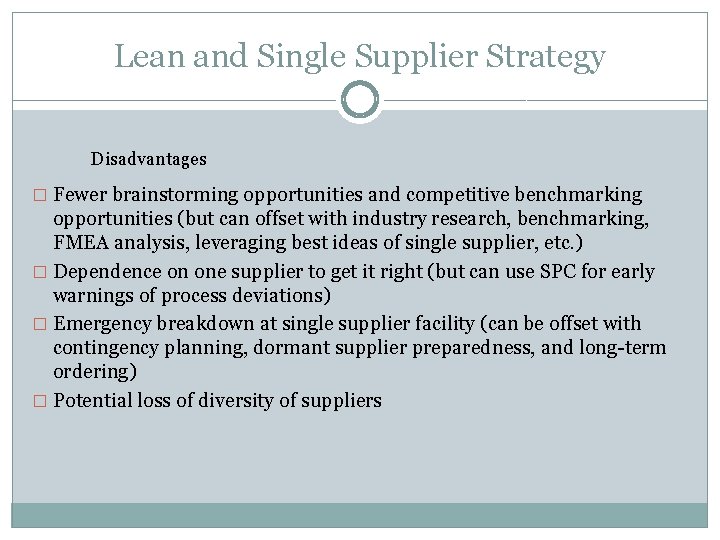
Lean and Single Supplier Strategy Disadvantages � Fewer brainstorming opportunities and competitive benchmarking opportunities (but can offset with industry research, benchmarking, FMEA analysis, leveraging best ideas of single supplier, etc. ) � Dependence on one supplier to get it right (but can use SPC for early warnings of process deviations) � Emergency breakdown at single supplier facility (can be offset with contingency planning, dormant supplier preparedness, and long-term ordering) � Potential loss of diversity of suppliers
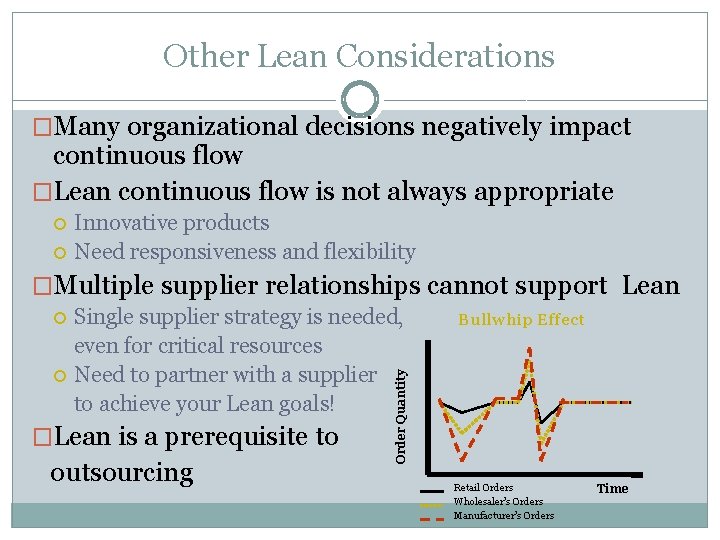
Other Lean Considerations �Many organizational decisions negatively impact continuous flow �Lean continuous flow is not always appropriate Innovative products Need responsiveness and flexibility �Multiple supplier relationships cannot support Lean Single supplier strategy is needed, even for critical resources Need to partner with a supplier to achieve your Lean goals! �Lean is a prerequisite to outsourcing Bullwhip Effect Order Quantity Retail Orders Wholesaler’s Orders Manufacturer’s Orders Time
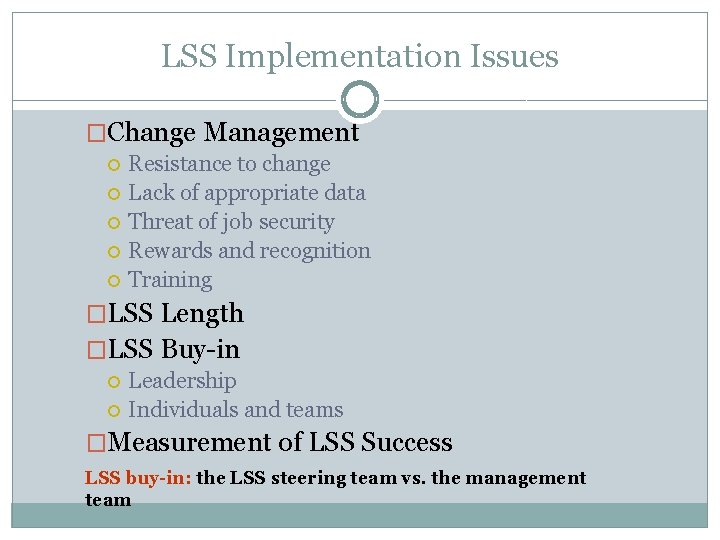
LSS Implementation Issues �Change Management Resistance to change Lack of appropriate data Threat of job security Rewards and recognition Training �LSS Length �LSS Buy-in Leadership Individuals and teams �Measurement of LSS Success LSS buy-in: the LSS steering team vs. the management team
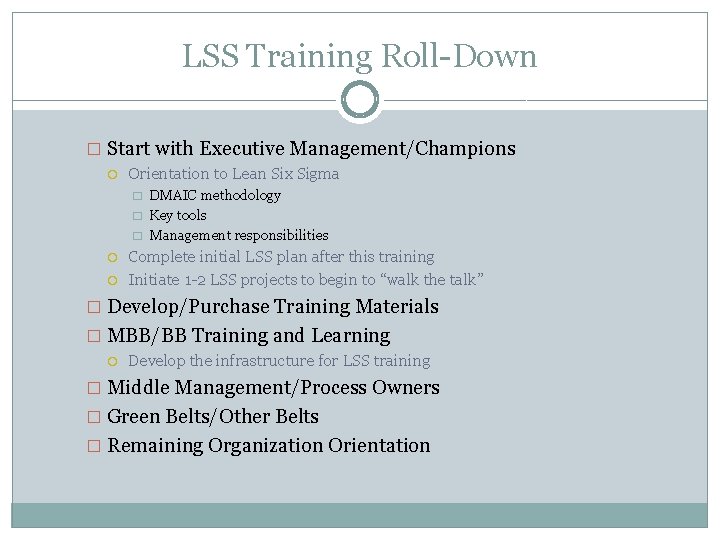
LSS Training Roll-Down � Start with Executive Management/Champions Orientation to Lean Six Sigma � � � DMAIC methodology Key tools Management responsibilities Complete initial LSS plan after this training Initiate 1 -2 LSS projects to begin to “walk the talk” � Develop/Purchase Training Materials � MBB/BB Training and Learning Develop the infrastructure for LSS training � Middle Management/Process Owners � Green Belts/Other Belts � Remaining Organization Orientation
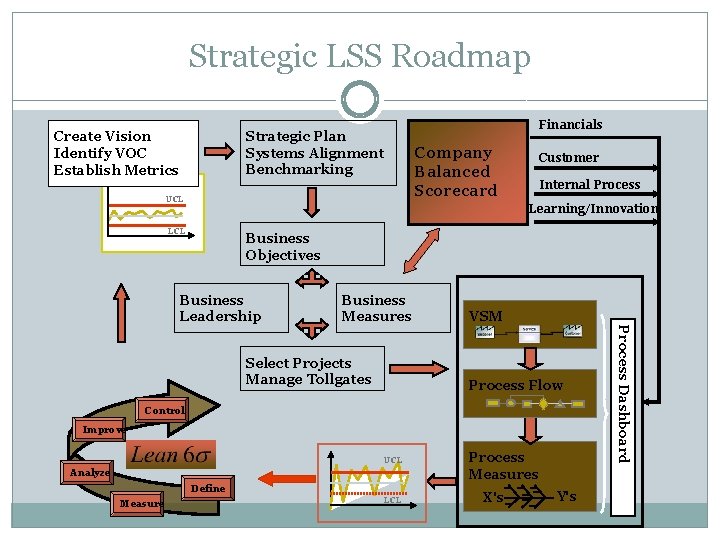
Strategic LSS Roadmap Strategic Plan Systems Alignment Benchmarking Create Vision Identify VOC Establish Metrics Gap UCL LCL Financials Company Balanced Scorecard Customer Internal Process Learning/Innovation Business Objectives Gap Business Leadership Business Measures Process Flow Control Improve UCL Analyze Define Measure LCL Process Measures X's Y's Process Dashboard Select Projects Manage Tollgates VSM
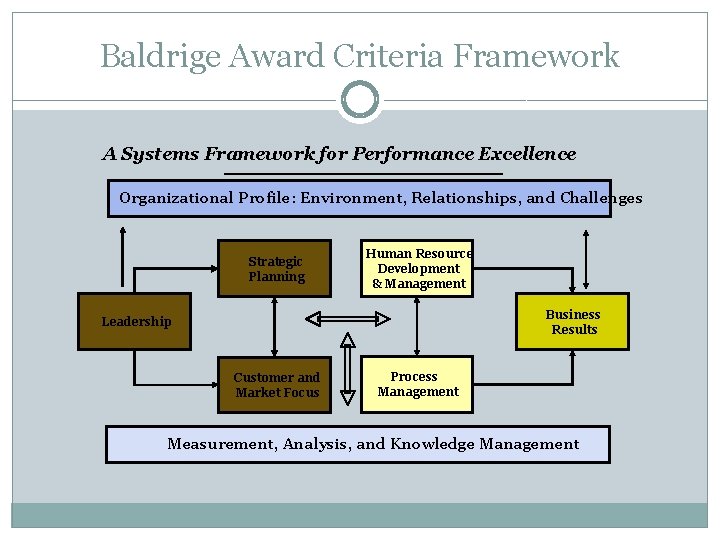
Baldrige Award Criteria Framework A Systems Framework for Performance Excellence Organizational Profile: Environment, Relationships, and Challenges Strategic Planning Human Resource Development & Management Business Results Leadership Customer and Market Focus Process Management Measurement, Analysis, and Knowledge Management