
Manufacturing Engineering II CHAPTER 2 4 FORGING Bulk
Manufacturing. Engineering II CHAPTER 2. 4 FORGING (Bulk deformation Process) (AAi. T) LECTURER : Dr Shanthakumar G C
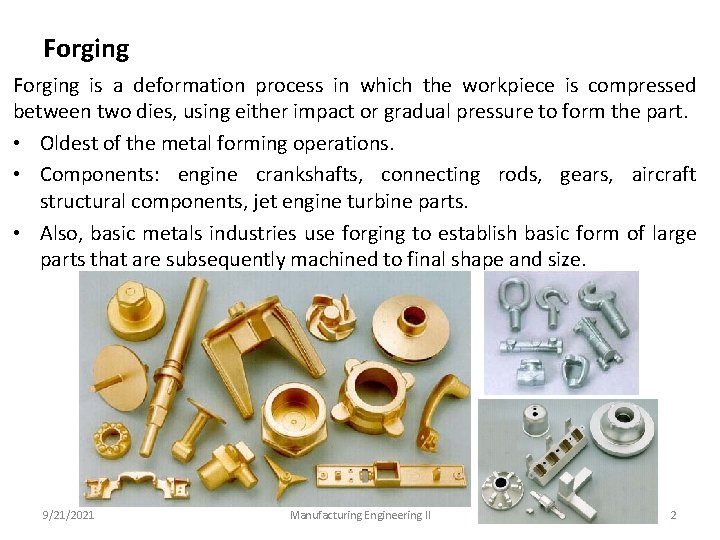
Forging is a deformation process in which the workpiece is compressed between two dies, using either impact or gradual pressure to form the part. • Oldest of the metal forming operations. • Components: engine crankshafts, connecting rods, gears, aircraft structural components, jet engine turbine parts. • Also, basic metals industries use forging to establish basic form of large parts that are subsequently machined to final shape and size. 9/21/2021 Manufacturing Engineering II 2
Classification of forging process Forging is carried out in many different ways. One way to classify it is by working temperature. Most forging operations are performed hot or warm. However, cold forging is also vary common for certain product in order to increase the strength. Either impact or gradual pressure is used in forging. The distinction derives more from the type of equipment used than differences technology: • Forge hammer -applies an impact load • Forge press -applies gradual pressure Another difference among forging operations is the degree to which the flow of the workpiece metal is constrained by the dies: • Open-die forging • Impression-die forging • Flashless 9/21/2021 Manufacturing Engineering II 3
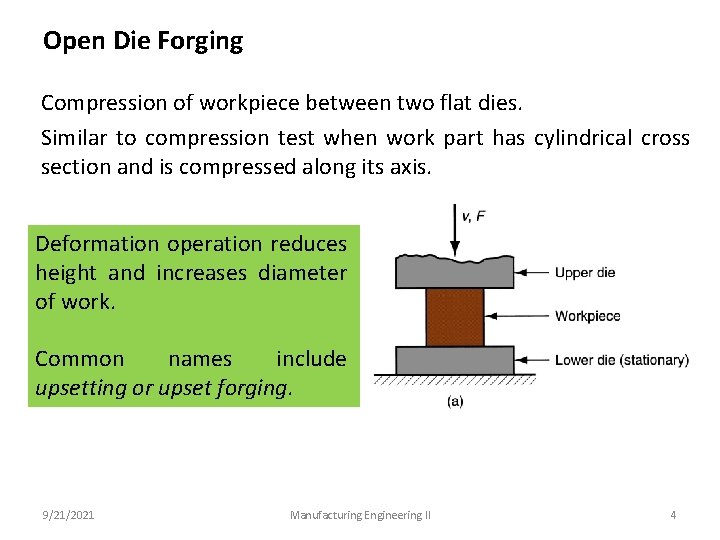
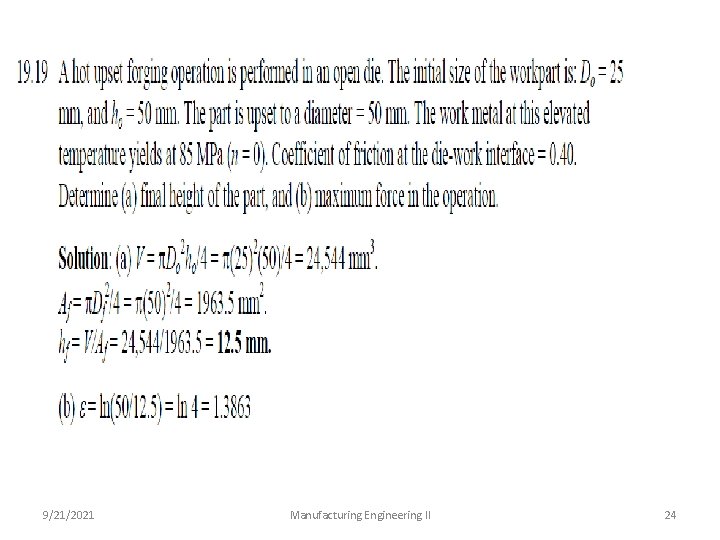
Open Die Forging Compression of workpiece between two flat dies. Similar to compression test when work part has cylindrical cross section and is compressed along its axis. Deformation operation reduces height and increases diameter of work. Common names include upsetting or upset forging. 9/21/2021 Manufacturing Engineering II 4
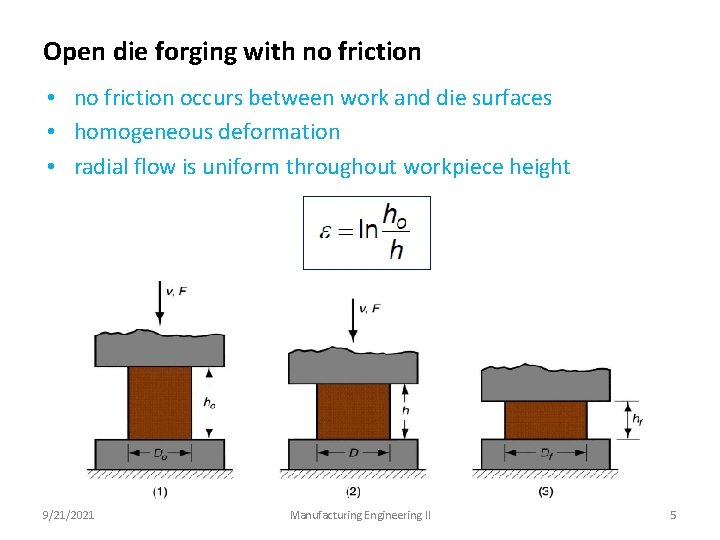
Open die forging with no friction • no friction occurs between work and die surfaces • homogeneous deformation • radial flow is uniform throughout workpiece height 9/21/2021 Manufacturing Engineering II 5
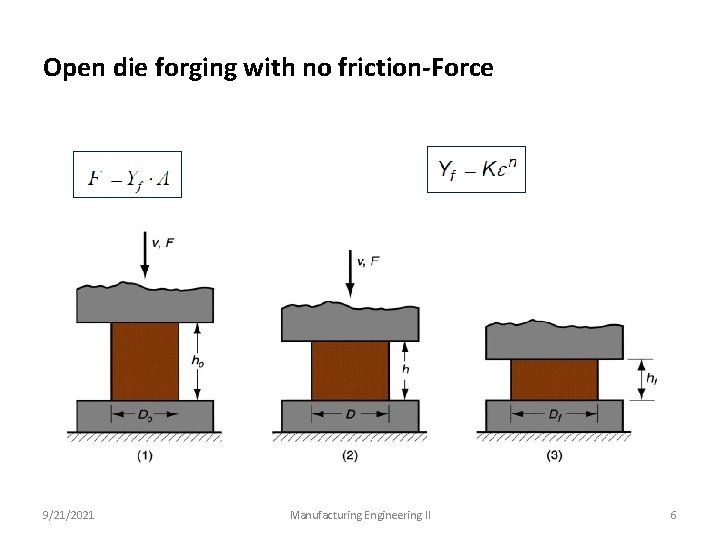
Open die forging with no friction-Force 9/21/2021 Manufacturing Engineering II 6
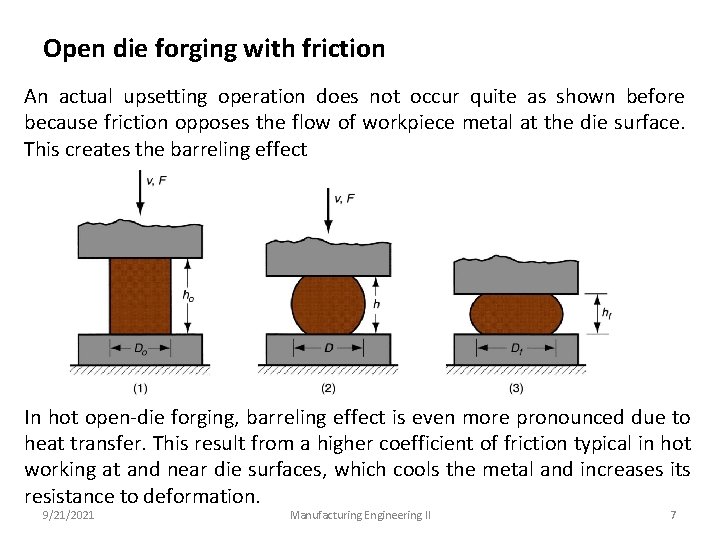
Open die forging with friction An actual upsetting operation does not occur quite as shown before because friction opposes the flow of workpiece metal at the die surface. This creates the barreling effect In hot open-die forging, barreling effect is even more pronounced due to heat transfer. This result from a higher coefficient of friction typical in hot working at and near die surfaces, which cools the metal and increases its resistance to deformation. 9/21/2021 Manufacturing Engineering II 7

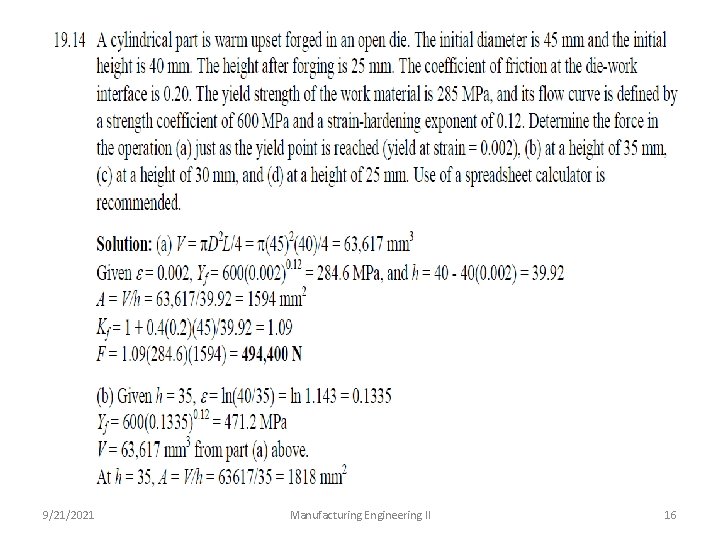
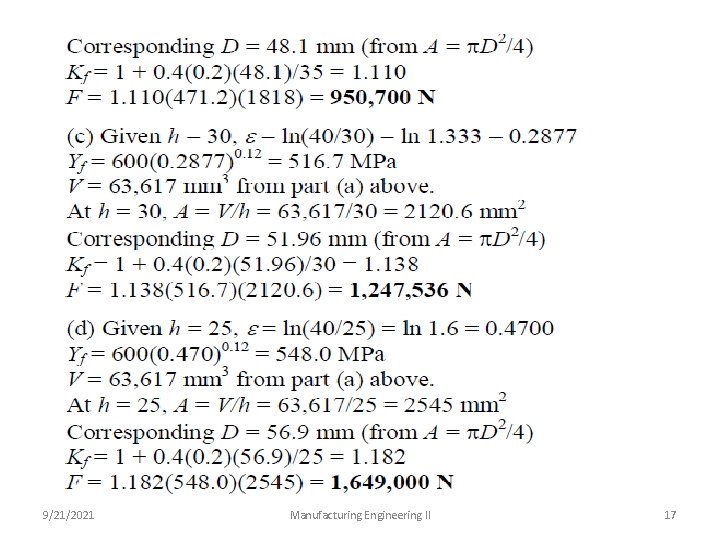
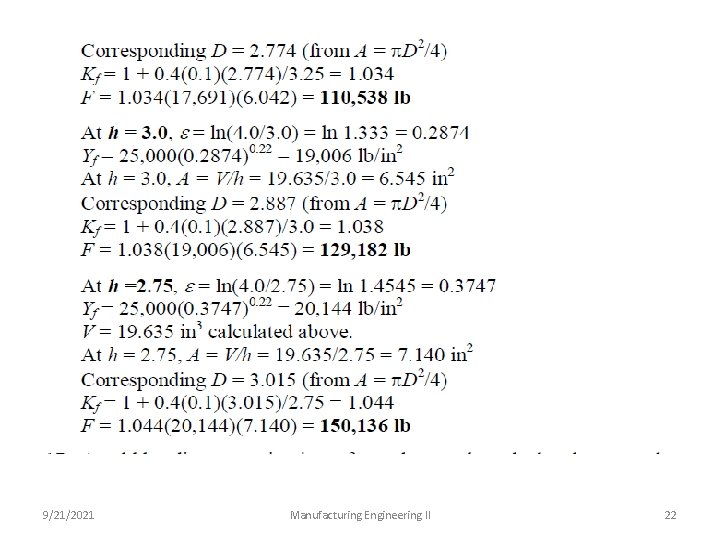
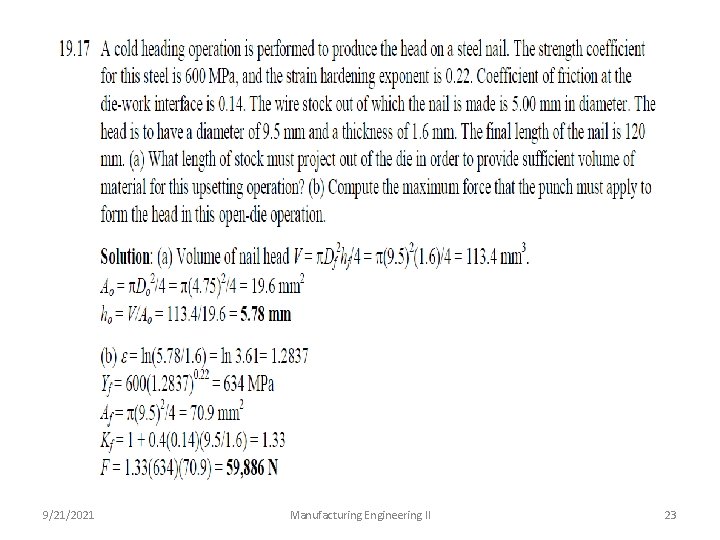
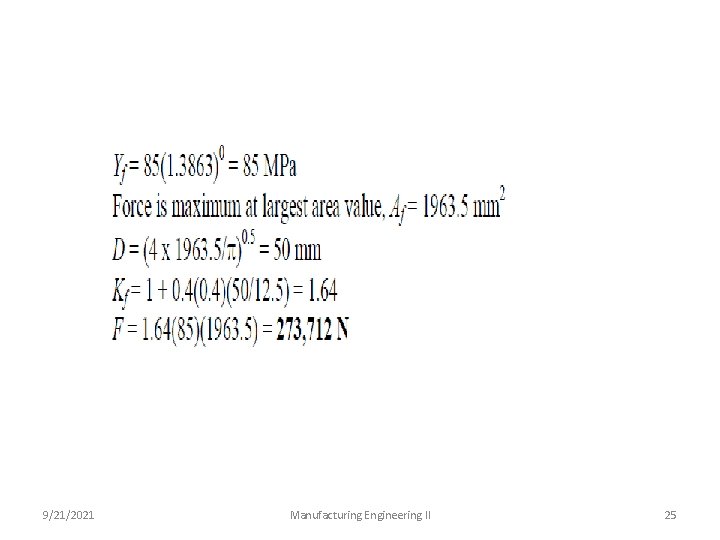
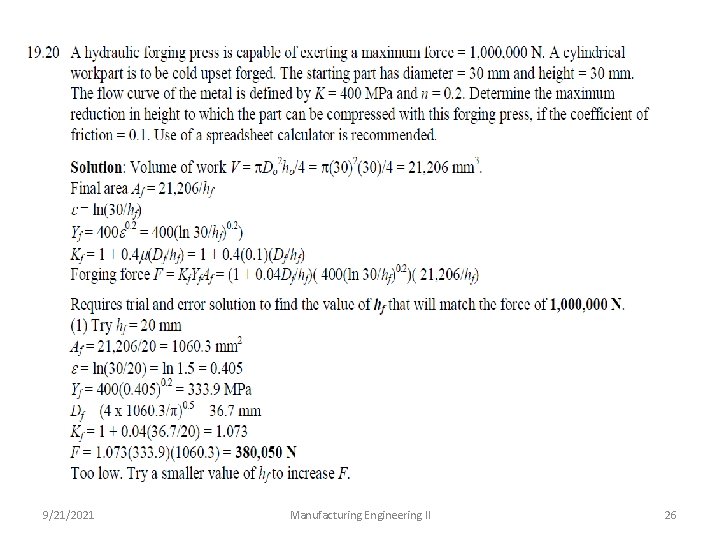
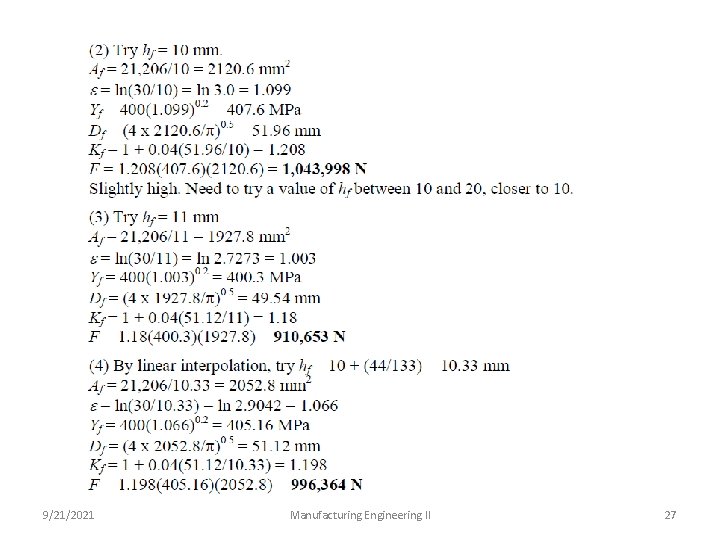
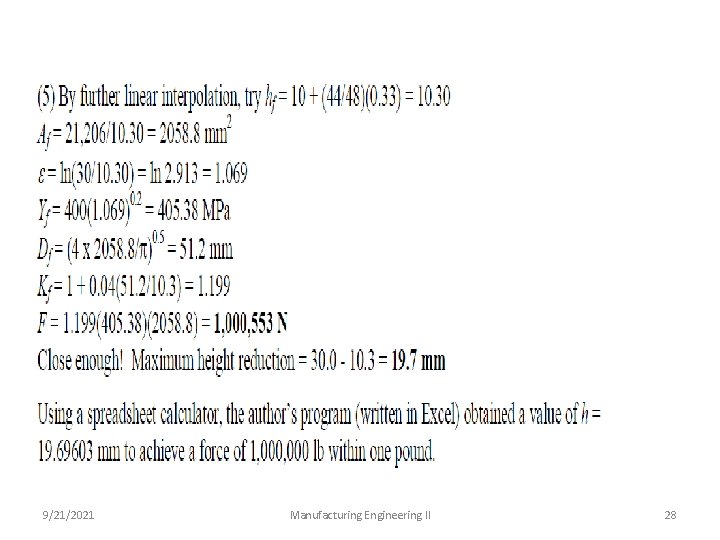
Open die forging with friction-Force This factor cause the actual upsetting force to be greater than what is predicted. As an approximation we can apply a shape factor to account for effects of the D/h ratio and friction. 9/21/2021 Manufacturing Engineering II 8
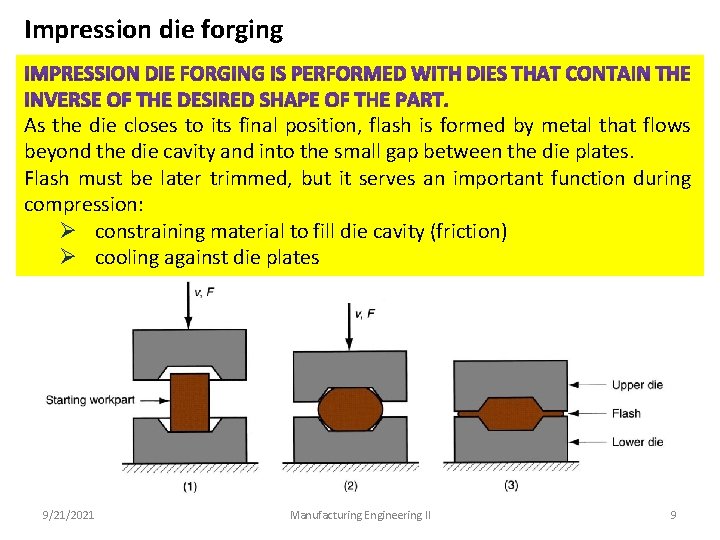
Impression die forging As the die closes to its final position, flash is formed by metal that flows beyond the die cavity and into the small gap between the die plates. Flash must be later trimmed, but it serves an important function during compression: Ø constraining material to fill die cavity (friction) Ø cooling against die plates 9/21/2021 Manufacturing Engineering II 9
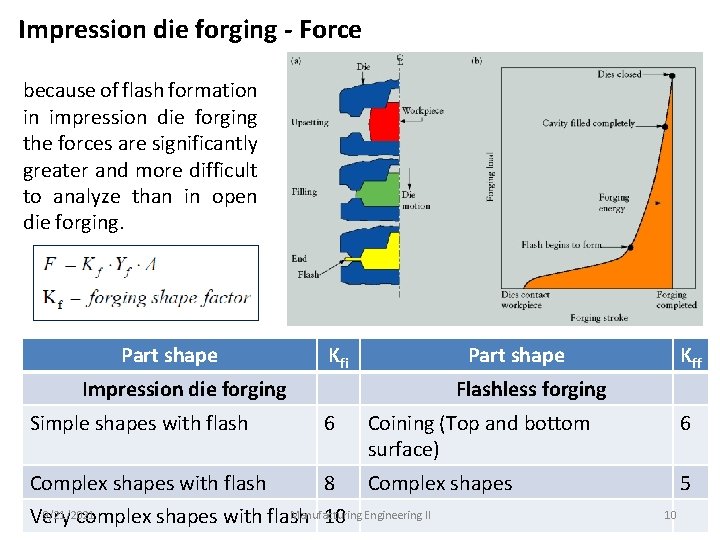
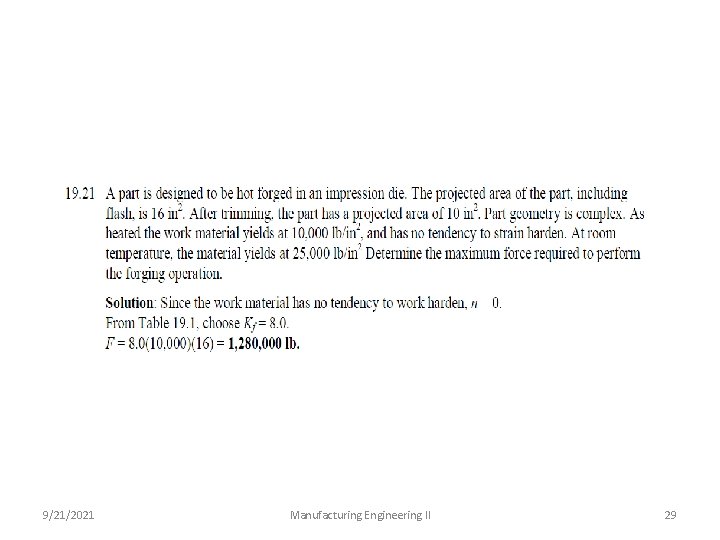
Impression die forging - Force because of flash formation in impression die forging the forces are significantly greater and more difficult to analyze than in open die forging. Part shape Kfi Part shape Impression die forging Kff Flashless forging Simple shapes with flash 6 Coining (Top and bottom surface) 6 Complex shapes with flash 8 Complex shapes 5 9/21/2021 Manufacturing Very complex shapes with flash 10 Engineering II 10
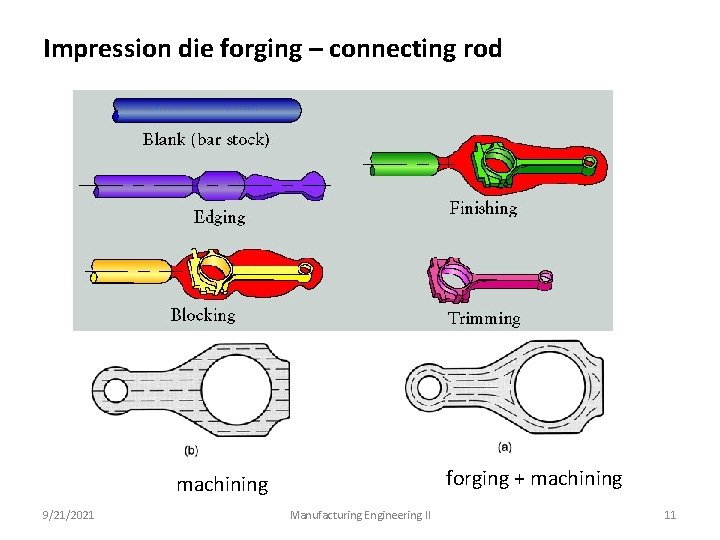
Impression die forging – connecting rod forging + machining 9/21/2021 Manufacturing Engineering II 11
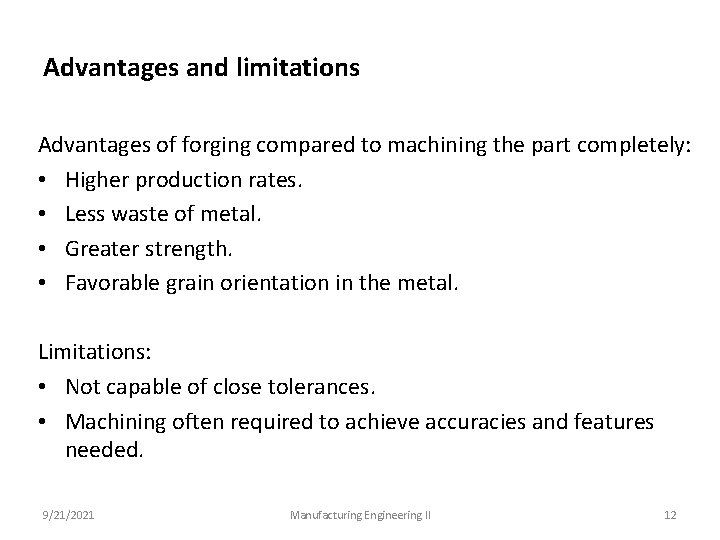
Advantages and limitations Advantages of forging compared to machining the part completely: • Higher production rates. • Less waste of metal. • Greater strength. • Favorable grain orientation in the metal. Limitations: • Not capable of close tolerances. • Machining often required to achieve accuracies and features needed. 9/21/2021 Manufacturing Engineering II 12
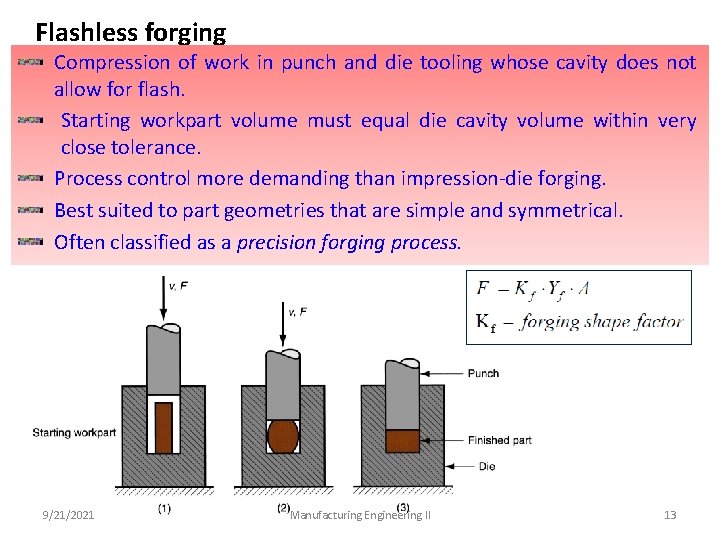
Flashless forging Compression of work in punch and die tooling whose cavity does not allow for flash. Starting workpart volume must equal die cavity volume within very close tolerance. Process control more demanding than impression-die forging. Best suited to part geometries that are simple and symmetrical. Often classified as a precision forging process. 9/21/2021 Manufacturing Engineering II 13
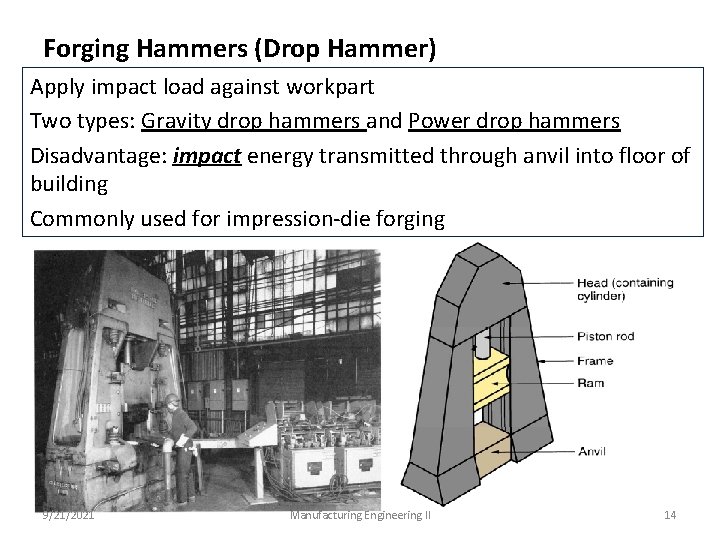
Forging Hammers (Drop Hammer) Apply impact load against workpart Two types: Gravity drop hammers and Power drop hammers Disadvantage: impact energy transmitted through anvil into floor of building Commonly used for impression-die forging 9/21/2021 Manufacturing Engineering II 14
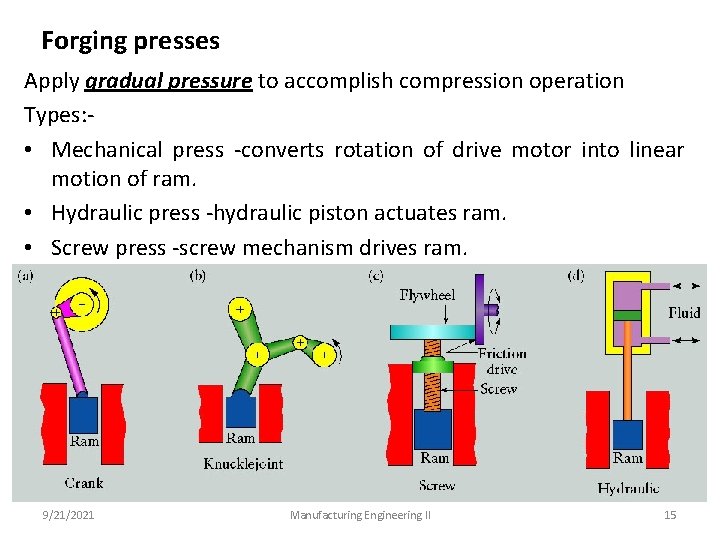
Forging presses Apply gradual pressure to accomplish compression operation Types: • Mechanical press -converts rotation of drive motor into linear motion of ram. • Hydraulic press -hydraulic piston actuates ram. • Screw press -screw mechanism drives ram. 9/21/2021 Manufacturing Engineering II 15
9/21/2021 Manufacturing Engineering II 16
9/21/2021 Manufacturing Engineering II 17
9/21/2021 Manufacturing Engineering II 18
9/21/2021 Manufacturing Engineering II 19
9/21/2021 Manufacturing Engineering II 20
9/21/2021 Manufacturing Engineering II 21
9/21/2021 Manufacturing Engineering II 22
9/21/2021 Manufacturing Engineering II 23
9/21/2021 Manufacturing Engineering II 24
9/21/2021 Manufacturing Engineering II 25
9/21/2021 Manufacturing Engineering II 26
9/21/2021 Manufacturing Engineering II 27
9/21/2021 Manufacturing Engineering II 28
9/21/2021 Manufacturing Engineering II 29
- Slides: 29