
Manuel Castells The Network Society Castells Triology Develops
- Slides: 14
Manuel Castells The “Network Society”
Castell’s Triology • Develops a “grand narrative of the present” where the entire planet is capitalist • Volume I - The Network society - outlines basic tenets of a “network society” • Volume II - The Power of Identity - outlines various processes of social change • Volume III - End of Millennium - processes of historical transformation
Basic Thesis • Relation between IT-Globalization-Social Development • Two key trends in the information age • New capitalism - global and informational • Challenged by social movements based on cultural singularity - affirming identity • Dialectical opposition of “self and the net”
Network Society • Network basic form of social structure • Social interactions take place in a “networking logic” • Example stock exchange • Not restricted to financial systems • Networks not new, informational basis is what is new
Castell’s IT Paradigm • Information - raw material also outcome • ITs are pervasive - all aspects of life • ITs foster a networking logic because it allows to deal with complexity, which in itself is increased by IT • Specific ITs converge into highly integrated systems
Theoretical Assumptions • Dialectical interaction of social relations (modes of production) and technological innovation (modes of development) • The way social groups define identity shapes the institutions of society (unlike Marxist view of identity as effect) • Production-Development dialectic
Modes of Production • Social relationship of the production process, class relations • Capitalist systems and institutions embody certain social relationships • Institutions for creation of surplus and regulation of distribution • Driven by a capitalist logic
Modes of Development • Technological arrangements to convert labor into a product • The dominant mechanism for this conversion is informational • Driven by a logic of its own- interface between science, technology and how organizations incorporate new knowledge
Network Society - Characteristics • Represents a structural transformation (production, power and experience) • Social processes organized around networks • Studying the logic of these networks • Logic based on the “power of flows” rather than “flows of power” (the “flow society”) • Social morphology dominates social action
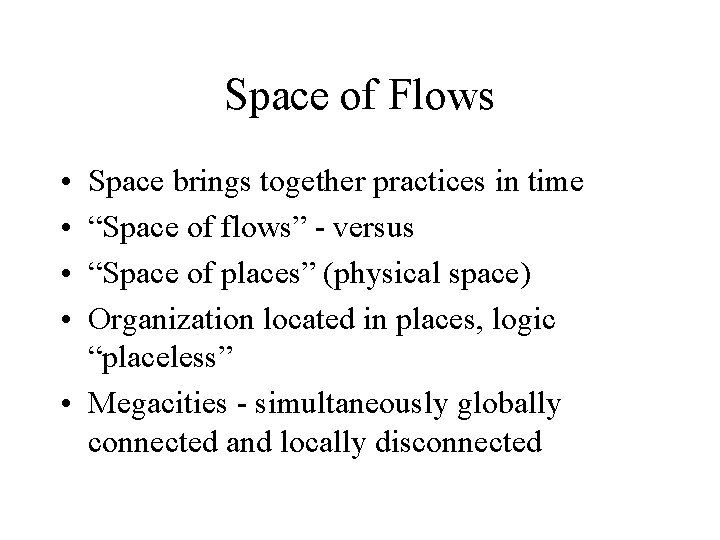
“Space of flows” • Global networks, comprising of: • Technology (infrastructure) places (hubs and nodes), and managerial elite • Topology defines inclusion/exclusion and also intensity of interactions • Space of flows defined by – timeless time – placeless space
Place and Space • Organizations are based in places • Organizational logic is “placeless” • Depend on space of flows of information networks • Increasing complexity of networks, more place-independent • “Structural schizophrenia”
The notion of “flows” • Material basis of society defined by “flows” • Flows of information asymmetric, powerridden • “Power of flows” more important than “flows of power” • Flows of - finance, information, technology, and images
Space of Flows • • Space brings together practices in time “Space of flows” - versus “Space of places” (physical space) Organization located in places, logic “placeless” • Megacities - simultaneously globally connected and locally disconnected
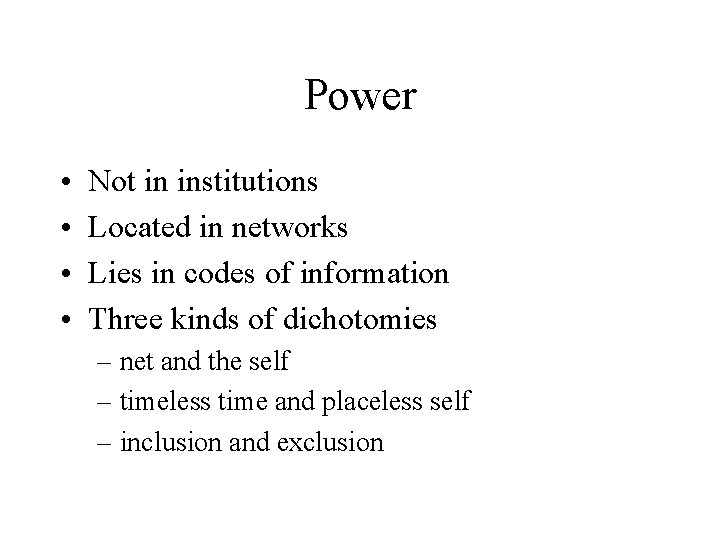
Power • • Not in institutions Located in networks Lies in codes of information Three kinds of dichotomies – net and the self – timeless time and placeless self – inclusion and exclusion