
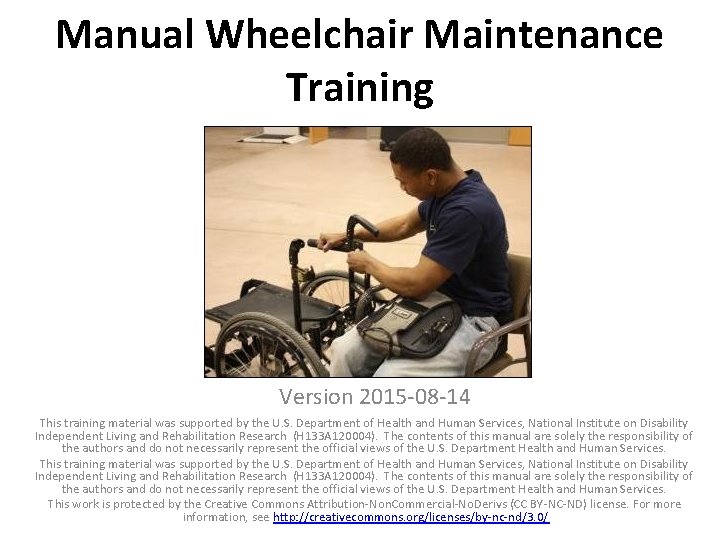
Manual Wheelchair Maintenance Training Version 2015 08 14








- Slides: 74
Manual Wheelchair Maintenance Training Version 2015 -08 -14 This training material was supported by the U. S. Department of Health and Human Services, National Institute on Disability Independent Living and Rehabilitation Research (H 133 A 120004). The contents of this manual are solely the responsibility of the authors and do not necessarily represent the official views of the U. S. Department Health and Human Services. This work is protected by the Creative Commons Attribution-Non. Commercial-No. Derivs (CC BY-NC-ND) license. For more information, see http: //creativecommons. org/licenses/by-nc-nd/3. 0/
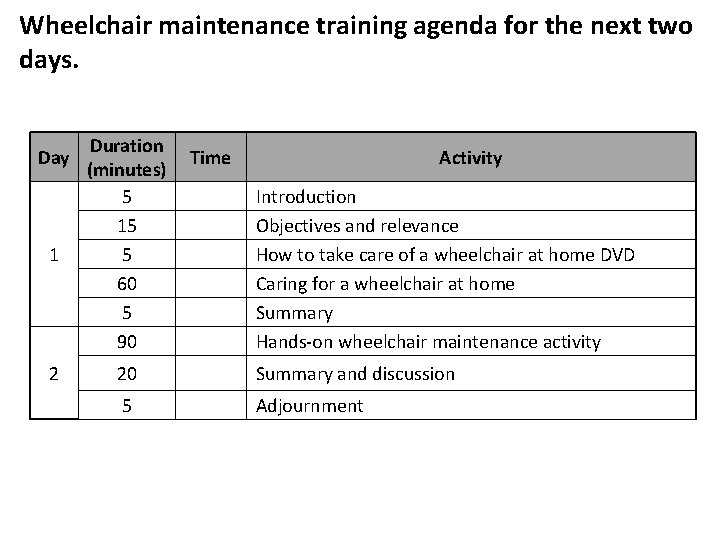
Wheelchair maintenance training agenda for the next two days. Day 1 2 Duration (minutes) 5 15 5 60 5 90 Time Activity Introduction Objectives and relevance How to take care of a wheelchair at home DVD Caring for a wheelchair at home Summary Hands-on wheelchair maintenance activity 20 Summary and discussion 5 Adjournment
We will teach you how to identify problems and how to do basic maintenance. These two sessions are not intended to be a wheelchair repair clinic.
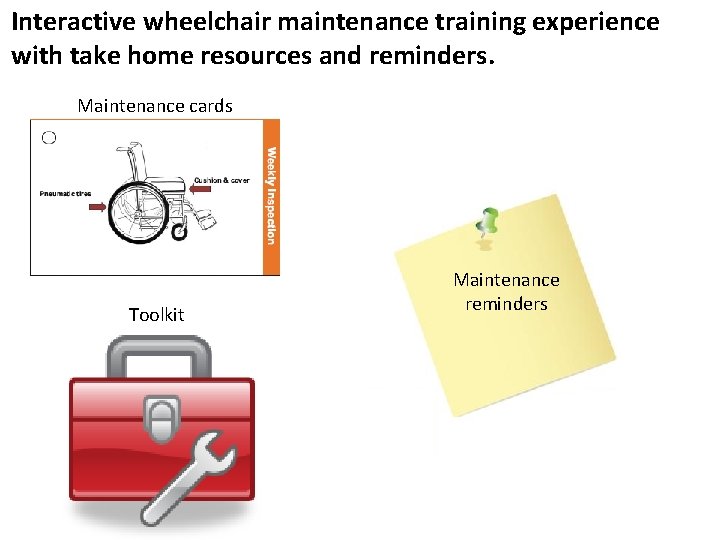
Interactive wheelchair maintenance training experience with take home resources and reminders. Maintenance cards Toolkit Maintenance reminders
Learning objectives • Recognize the importance of completing wheelchair maintenance • List the appropriate timing for wheelchair maintenance tasks • Demonstrate methods for maintaining your wheelchair • Demonstrate how to identify common technical wheelchair problems
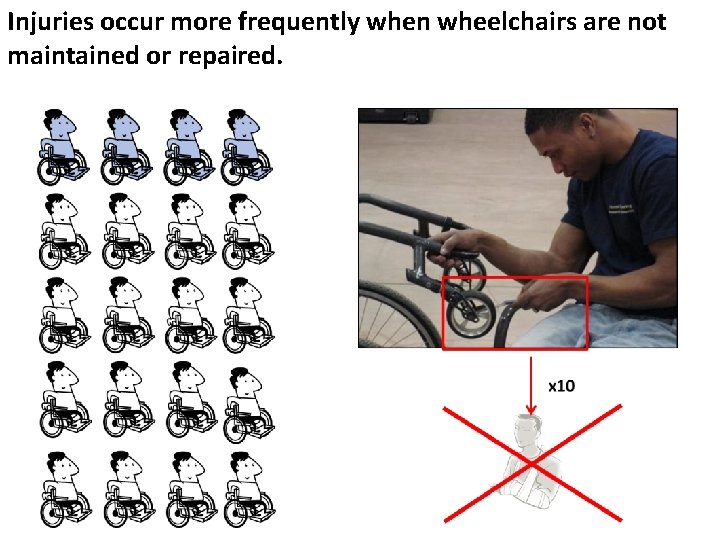
Injuries occur more frequently when wheelchairs are not maintained or repaired.
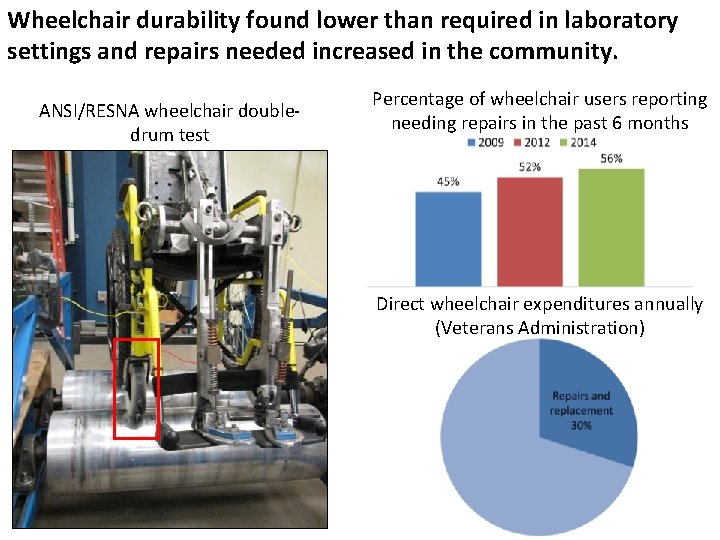
Wheelchair durability found lower than required in laboratory settings and repairs needed increased in the community. ANSI/RESNA wheelchair doubledrum test Percentage of wheelchair users reporting needing repairs in the past 6 months Direct wheelchair expenditures annually (Veterans Administration)
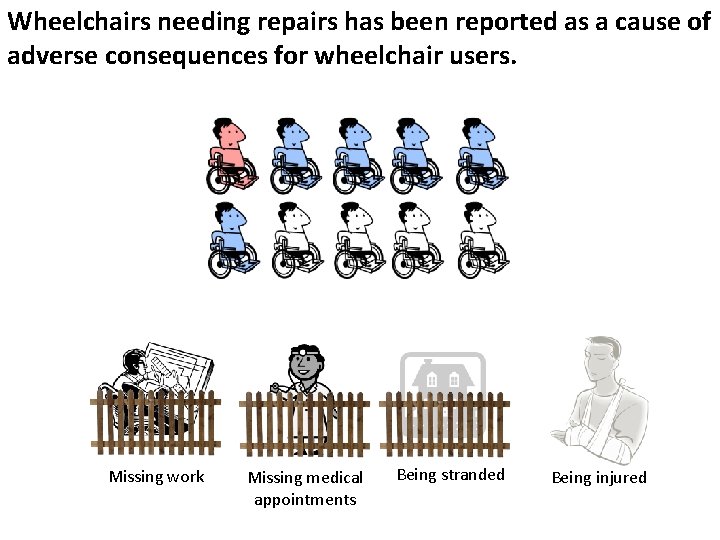
Wheelchairs needing repairs has been reported as a cause of adverse consequences for wheelchair users. Missing work Missing medical appointments Being stranded Being injured
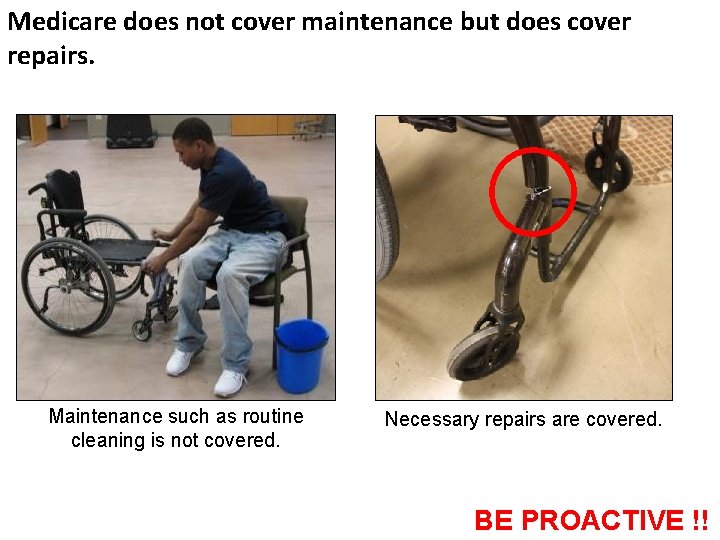
Medicare does not cover maintenance but does cover repairs. Maintenance such as routine cleaning is not covered. Wheelchair Maintenance Training Necessary repairs are covered. BE PROACTIVE !! Background Page 9
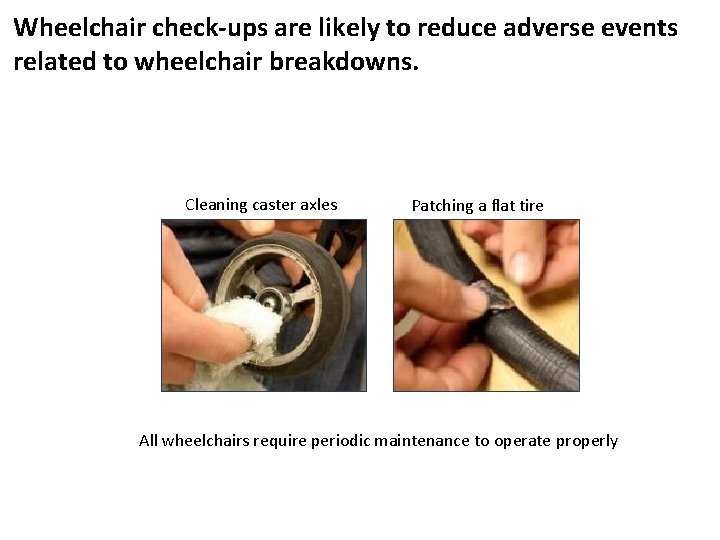
Wheelchair check-ups are likely to reduce adverse events related to wheelchair breakdowns. Cleaning caster axles Patching a flat tire All wheelchairs require periodic maintenance to operate properly Wheelchair Maintenance Training Background Page 10
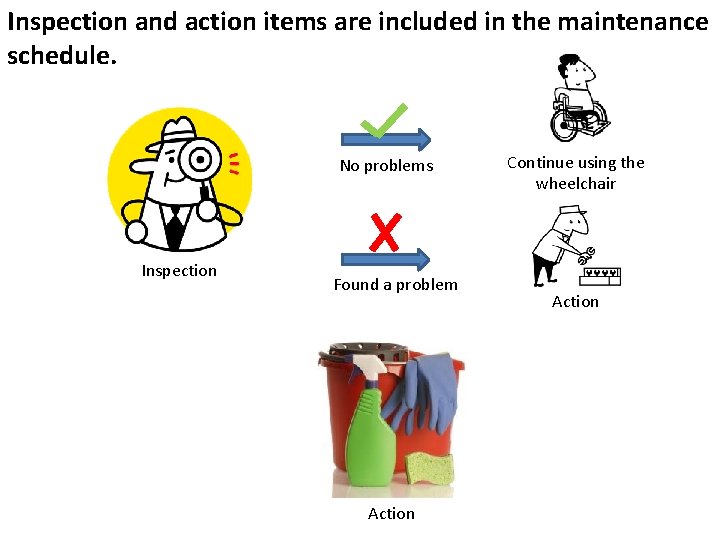
Inspection and action items are included in the maintenance schedule. No problems Inspection Found a problem Action Continue using the wheelchair Action
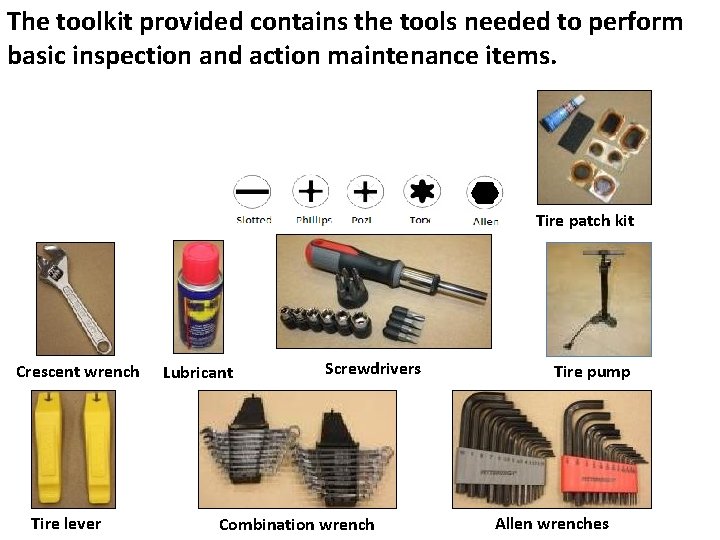
The toolkit provided contains the tools needed to perform basic inspection and action maintenance items. Tire patch kit Crescent wrench Lubricant Screwdrivers Tire lever Combination wrench Wheelchair Maintenance Training Tire pump Allen wrenches Overview Page 12
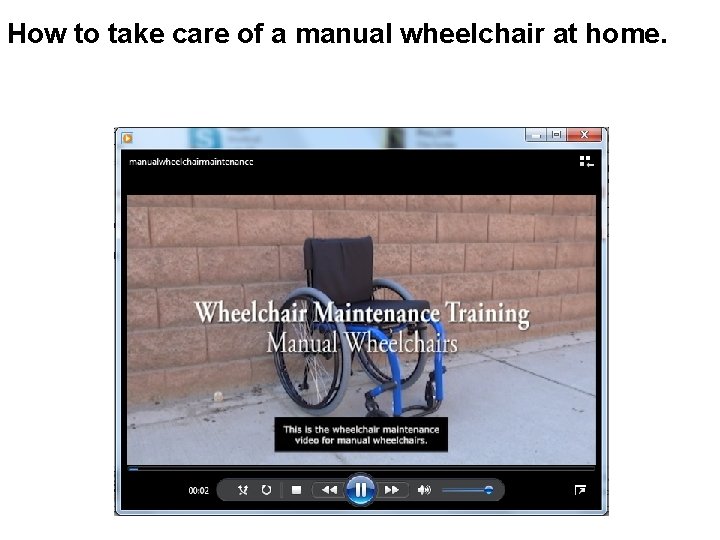
How to take care of a manual wheelchair at home. Wheelchair Maintenance Training: Manual Wheelchair Video Page 13
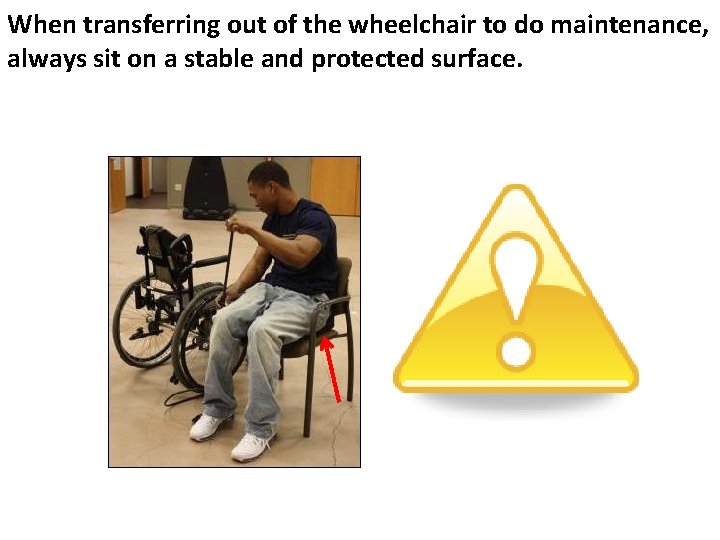
When transferring out of the wheelchair to do maintenance, always sit on a stable and protected surface.
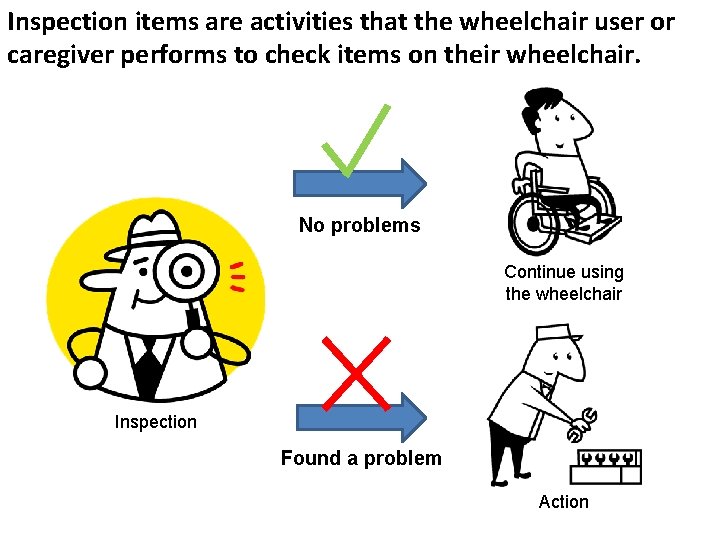
Inspection items are activities that the wheelchair user or Inspection items caregiver performs to check items on their wheelchair. No problems Continue using the wheelchair Inspection Found a problem Action Wheelchair Maintenance Training: Manual Wheelchair Maintenance at Home Page 15
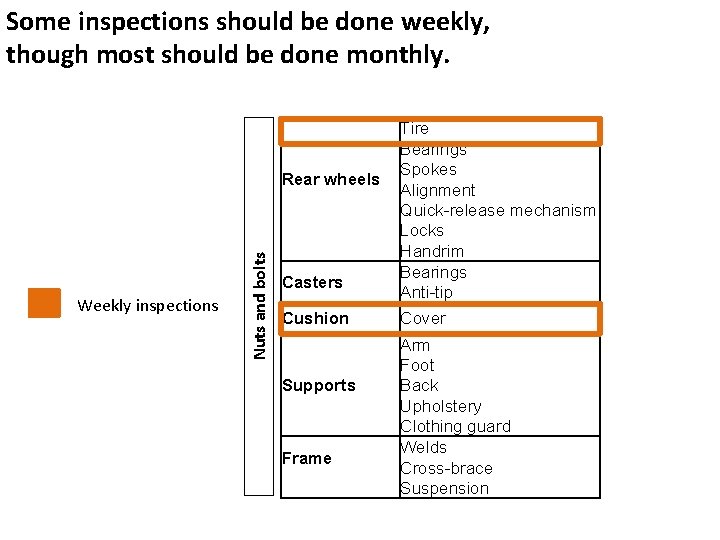
Some inspections should be done weekly, Inspection items though most should be done monthly. Weekly inspections Nuts and bolts Rear wheels Casters Cushion Supports Frame Wheelchair Maintenance Training: Manual Wheelchair Tire Bearings Spokes Alignment Quick-release mechanism Locks Handrim Bearings Anti-tip Cover Arm Foot Back Upholstery Clothing guard Welds Cross-brace Suspension Maintenance at Home Page 16
Pneumatic tires Weekly Inspections
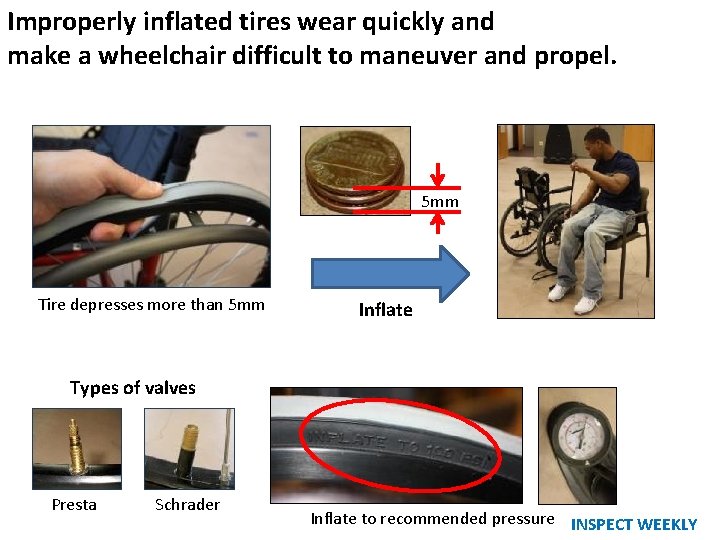
Improperly inflated tires wear quickly and Pneumatic tires make a wheelchair difficult to maneuver and propel. 5 mm Tire depresses more than 5 mm Inflate Types of valves Presta Schrader Inflate to recommended pressure INSPECT WEEKLY Wheelchair Maintenance Training: Manual Wheelchair
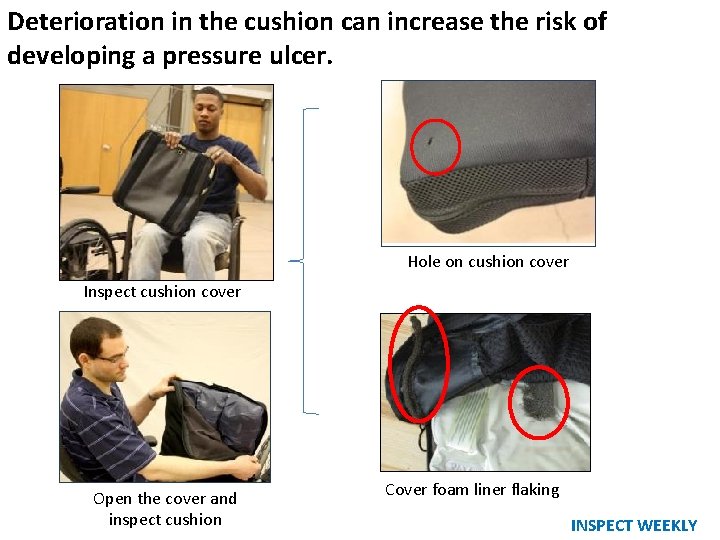
Deterioration in the cushion can increase the risk of developing a pressure ulcer. Hole on cushion cover Inspect cushion cover Open the cover and inspect cushion Wheelchair Maintenance Training: Manual Wheelchair Cover foam liner flaking INSPECT WEEKLY
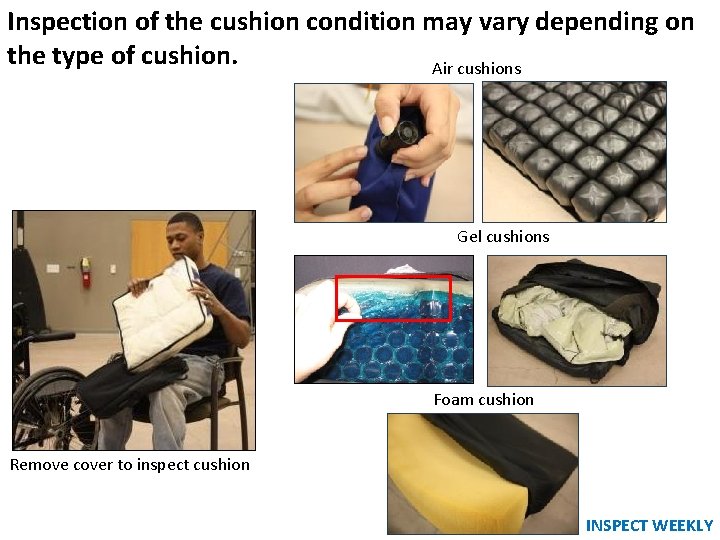
Inspection of the cushion condition may vary depending on Cushion and Cover the type of cushion. Air cushions Gel cushions Foam cushion Remove cover to inspect cushion Wheelchair Maintenance Training: Manual Wheelchair INSPECT WEEKLY Maintenance at Home Page 20
Pneumatic tires Monthly Inspections
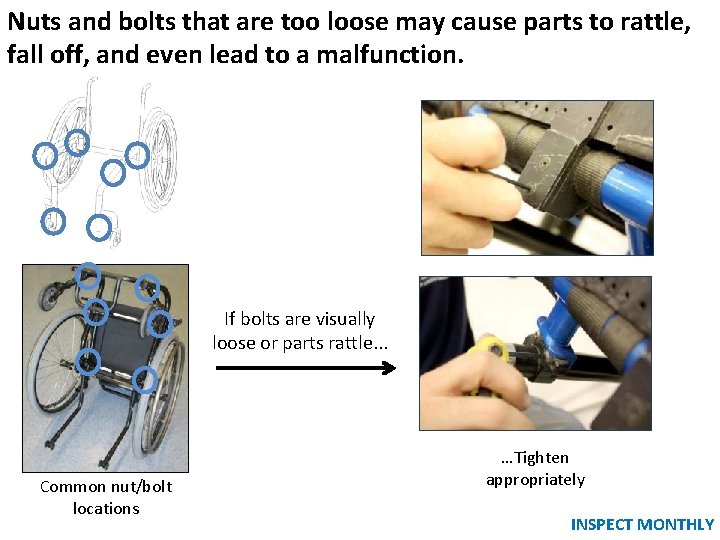
Nuts and bolts that are too loose may cause parts to rattle, Nuts and Bolts fall off, and even lead to a malfunction. If bolts are visually loose or parts rattle. . . Common nut/bolt locations …Tighten appropriately INSPECT MONTHLY
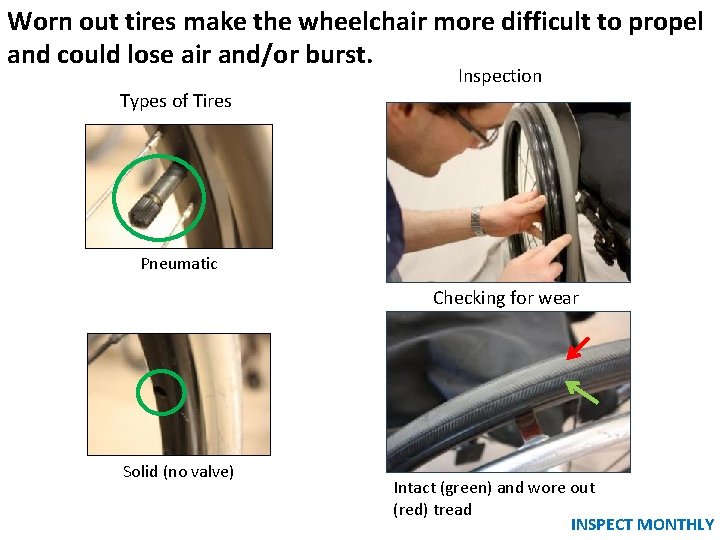
Worn out tires make the wheelchair more difficult to propel and could lose air and/or. Rear tires burst. Inspection Types of Tires Pneumatic Checking for wear Solid (no valve) Wheelchair Maintenance Training: Manual Wheelchair Intact (green) and wore out (red) tread INSPECT MONTHLY Maintenance at Home Page 23
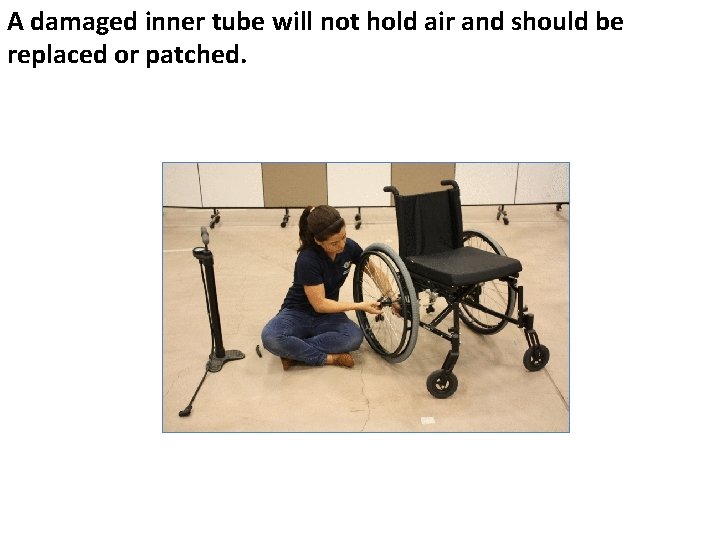
A damaged inner tube will not hold air and should be replaced or patched.
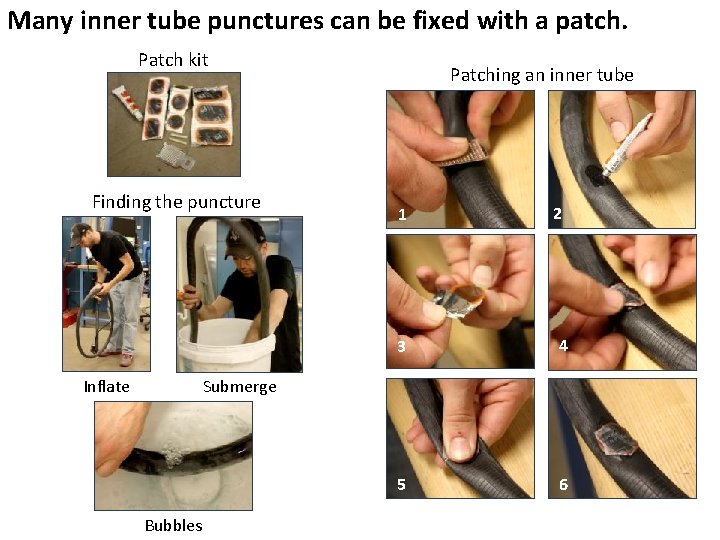
Many inner tube punctures can be fixed with a patch. Pneumatic Tires: patching a tube Patch kit Finding the puncture Inflate Patching an inner tube 1 2 3 4 5 6 Submerge Bubbles Wheelchair Maintenance Training: Manual Wheelchair Maintenance at Home Page 25
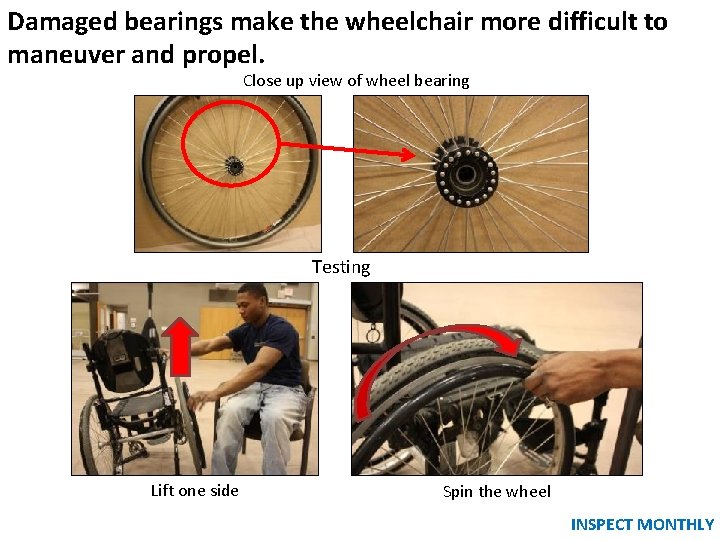
Damaged bearings make the wheelchair more difficult to Rear wheel bearings maneuver and propel. Close up view of wheel bearing Testing Lift one side Wheelchair Maintenance Training: Manual Wheelchair Spin the wheel INSPECT MONTHLY
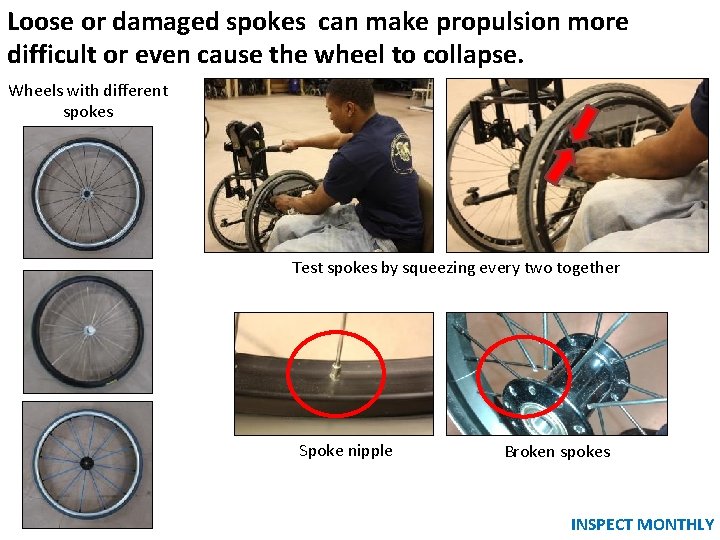
Loose or damaged spokes can make propulsion more Wheel Spokes difficult or even cause the wheel to collapse. Wheels with different spokes Test spokes by squeezing every two together Spoke nipple Wheelchair Maintenance Training: Manual Wheelchair Broken spokes INSPECT MONTHLY Maintenance at home Page 27
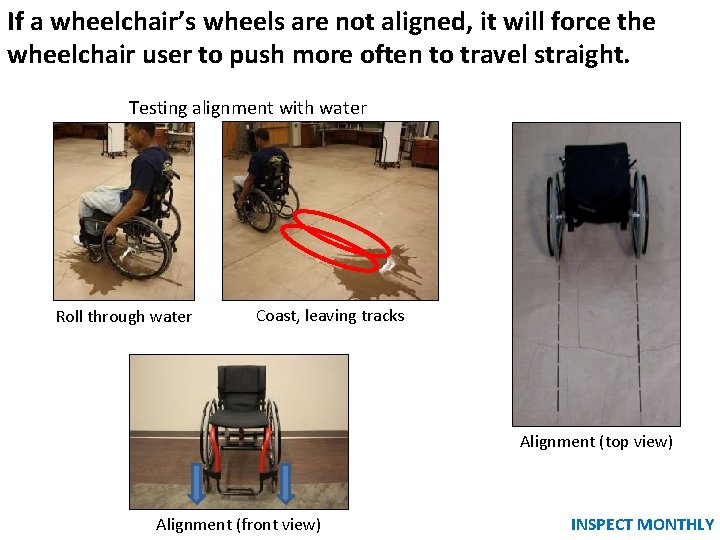
If a wheelchair’s wheels are not aligned, it will force the Wheel Alignment wheelchair user to push more often to travel straight. Testing alignment with water Roll through water Coast, leaving tracks Alignment (top view) Alignment (front view) Wheelchair Maintenance Training: Manual Wheelchair INSPECT MONTHLY Maintenance at Home Page 28
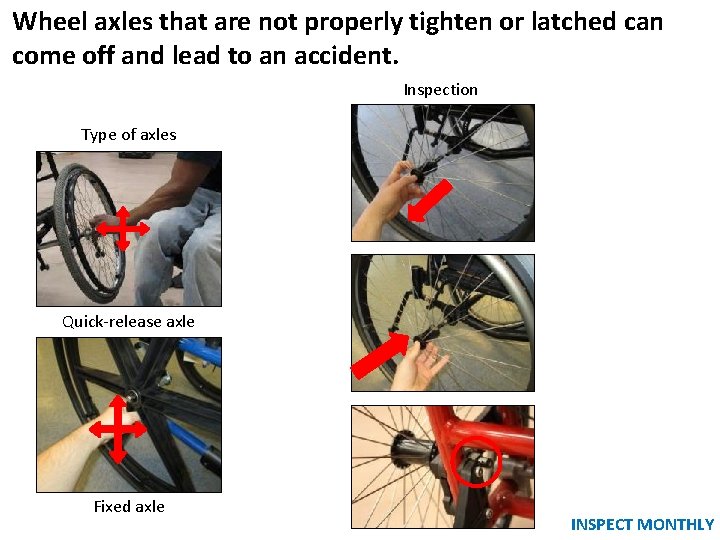
Wheel axles that are not properly tighten or latched can come off and lead to an accident. Inspection Type of axles Quick-release axle Fixed axle Wheelchair Maintenance Training: Manual Wheelchair INSPECT MONTHLY Maintenance at Home Page 29
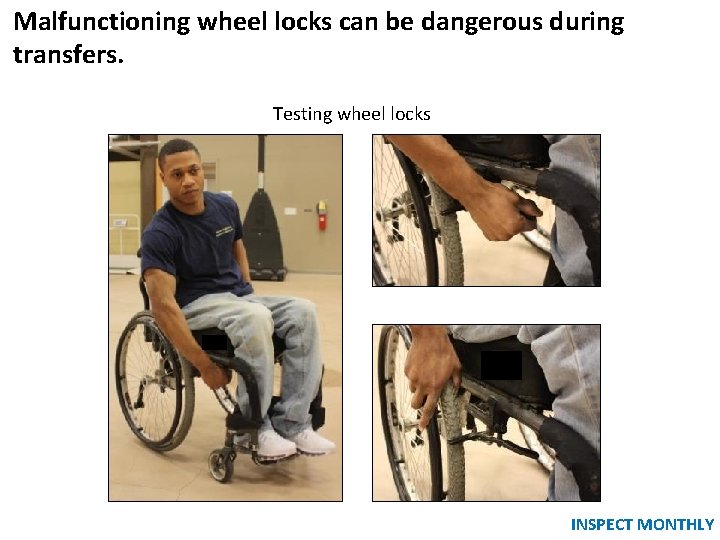
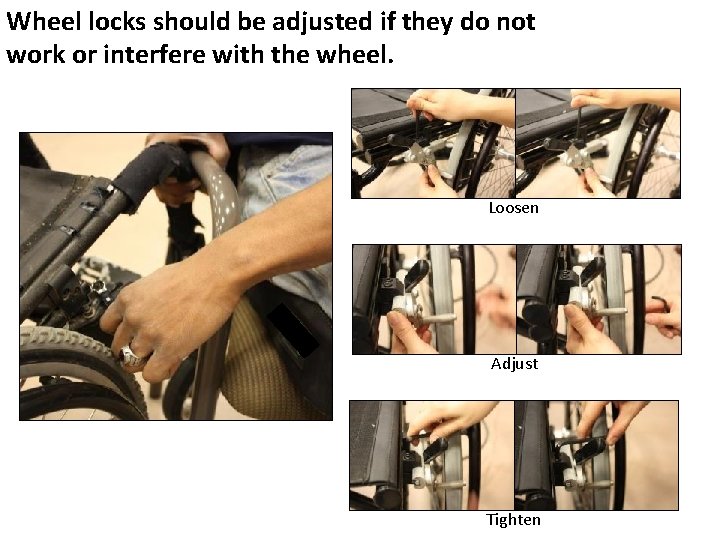
Malfunctioning wheel locks can be dangerous during Wheel Locks transfers. Testing wheel locks Wheelchair Maintenance Training: Manual Wheelchair INSPECT MONTHLY Maintenance at Home Page 30
Wheel locks should be adjusted if they do not Wheel Locks: adjustment work or interfere with the wheel. Loosen Adjust Wheelchair Maintenance Training: Manual Wheelchair Tighten Maintenance at Home Page 31
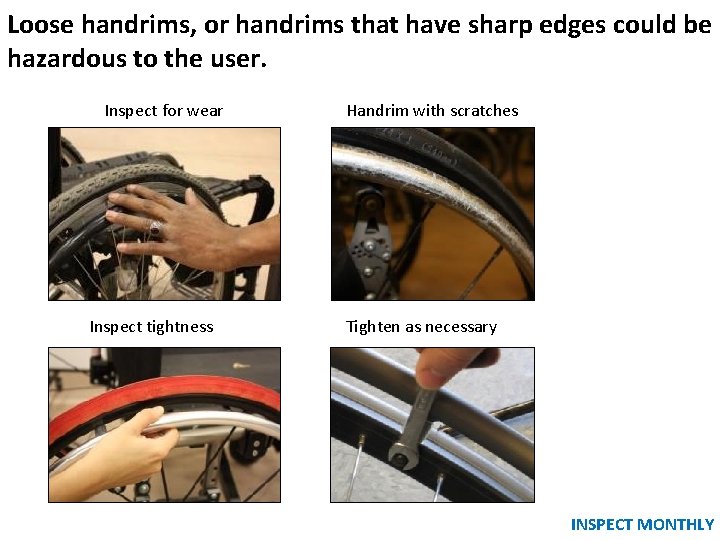
Loose handrims, or handrims that have sharp edges could be hazardous to the user. Inspect for wear Inspect tightness Handrim with scratches Tighten as necessary INSPECT MONTHLY
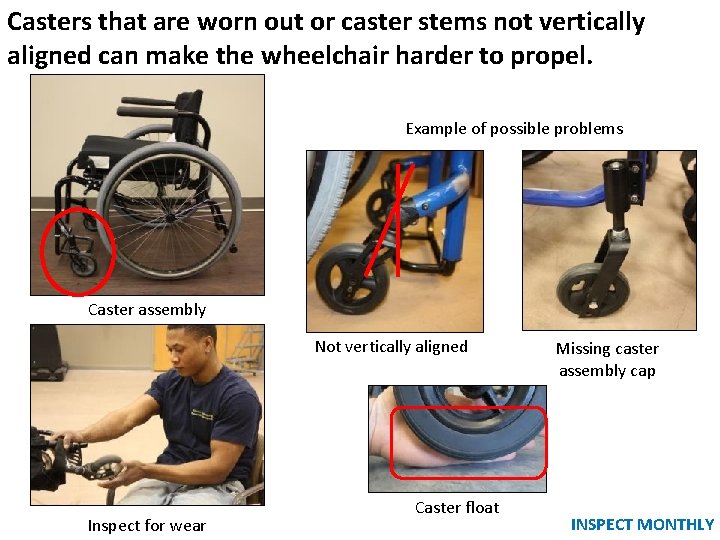
Casters that are worn out or caster stems not vertically aligned can make the wheelchair harder to propel. Example of possible problems Caster assembly Not vertically aligned Inspect for wear Wheelchair Maintenance Training: Manual Wheelchair Caster float Missing caster assembly cap INSPECT MONTHLY
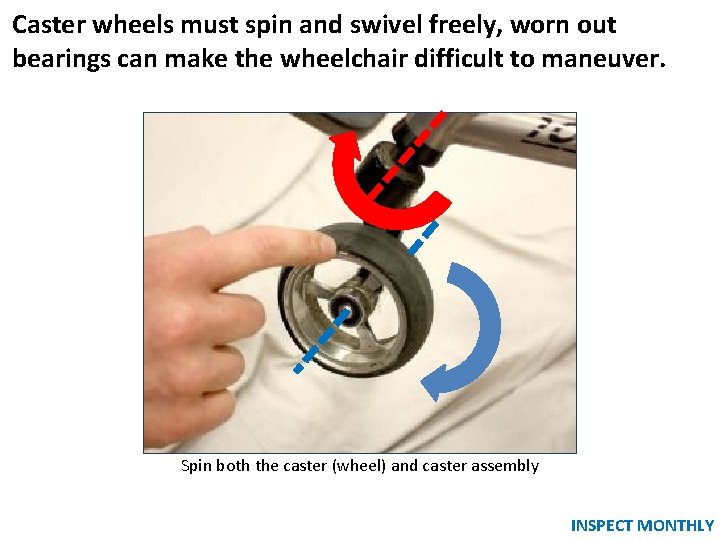
Caster wheels must spin and swivel freely, worn out bearings can make the wheelchair difficult to maneuver. Spin both the caster (wheel) and caster assembly INSPECT MONTHLY
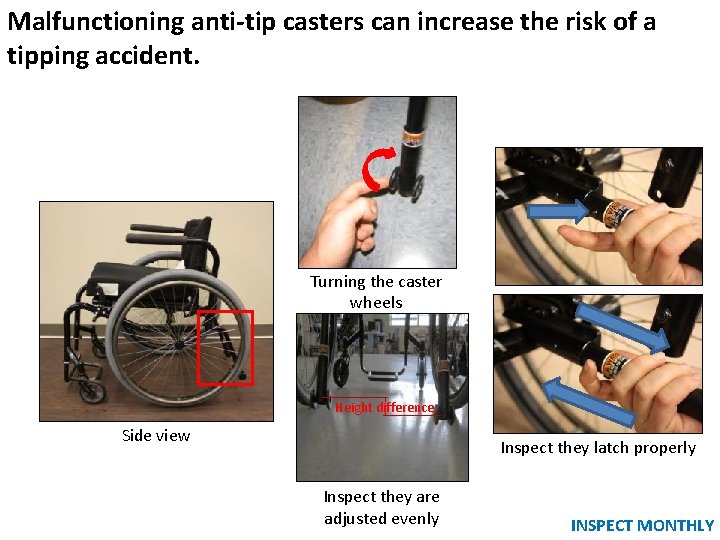
Malfunctioning anti-tip casters can increase the risk of a tipping accident. Turning the caster wheels Height difference Side view Inspect they latch properly Inspect they are adjusted evenly INSPECT MONTHLY
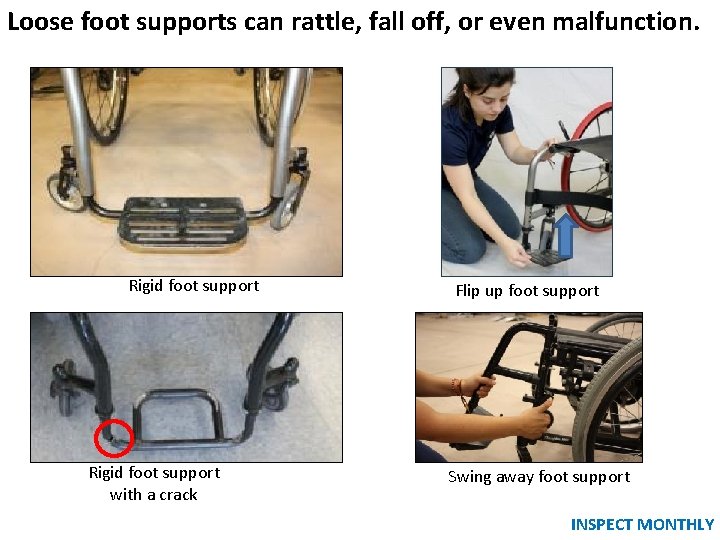
Loose foot supports can rattle, fall off, or even malfunction. Rigid foot support with a crack Wheelchair Maintenance Training: Manual Wheelchair Flip up foot support Swing away foot support INSPECT MONTHLY Maintenance at Home Page 36
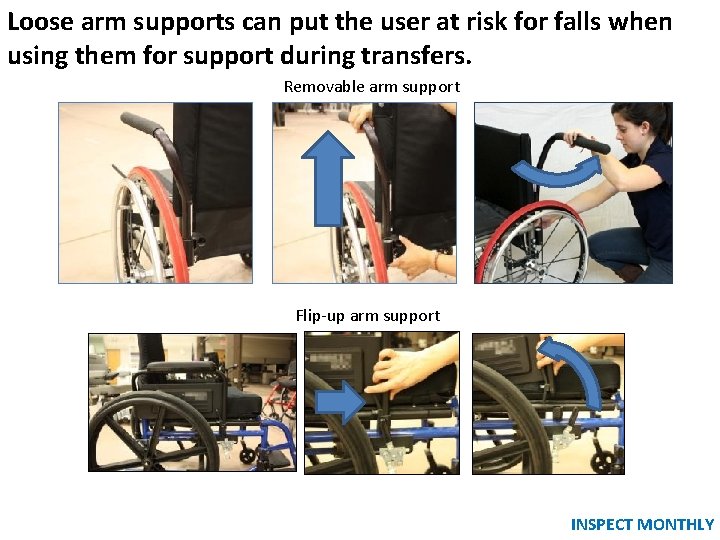
Loose arm supports can put the user at risk for falls when using them for support during transfers. Removable arm support Flip-up arm support Wheelchair Maintenance Training: Manual Wheelchair INSPECT MONTHLY Maintenance at Home Page 37
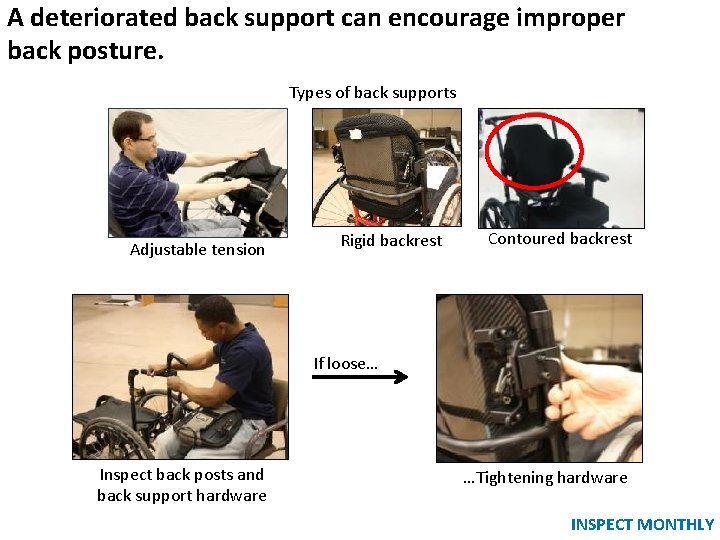
A deteriorated back support can encourage improper back posture. Types of back supports Adjustable tension Rigid backrest Contoured backrest If loose… Inspect back posts and back support hardware Wheelchair Maintenance Training: Manual Wheelchair …Tightening hardware INSPECT MONTHLY Maintenance at Home Page 38
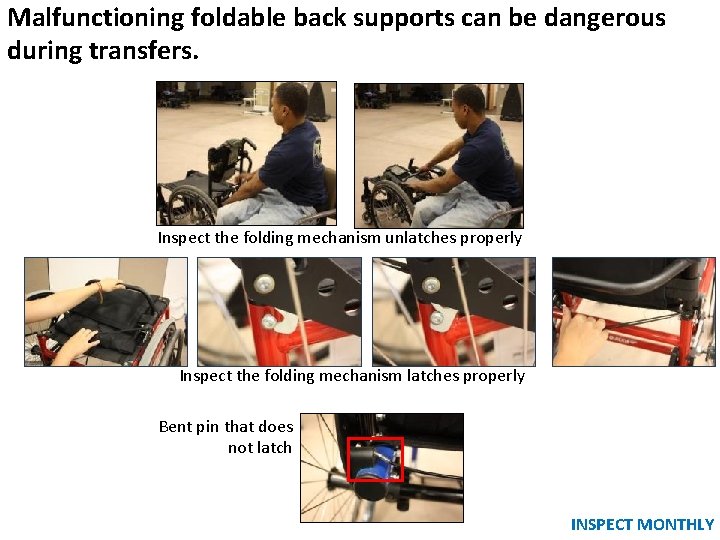
Malfunctioning foldable back supports can be dangerous during transfers. Inspect the folding mechanism unlatches properly Inspect the folding mechanism latches properly Bent pin that does not latch Wheelchair Maintenance Training: Manual Wheelchair INSPECT MONTHLY Maintenance at Home Page 39
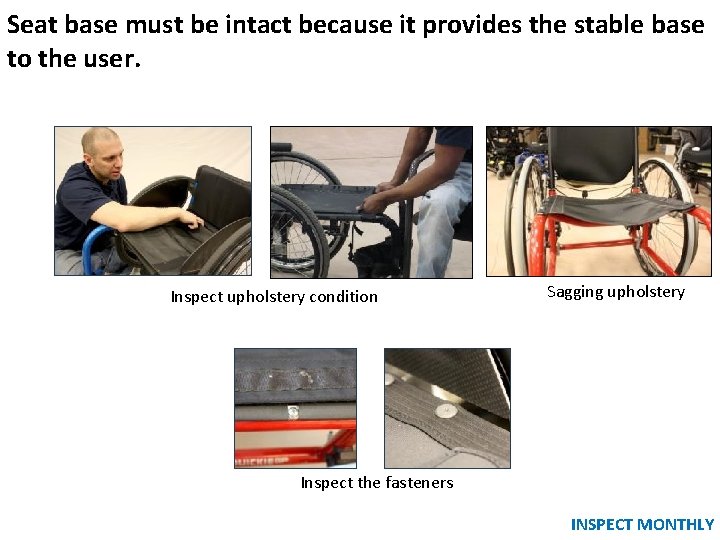
Seat base must be intact because it provides the stable base to the user. Inspect upholstery condition Sagging upholstery Inspect the fasteners Wheelchair Maintenance Training: Manual Wheelchair INSPECT MONTHLY
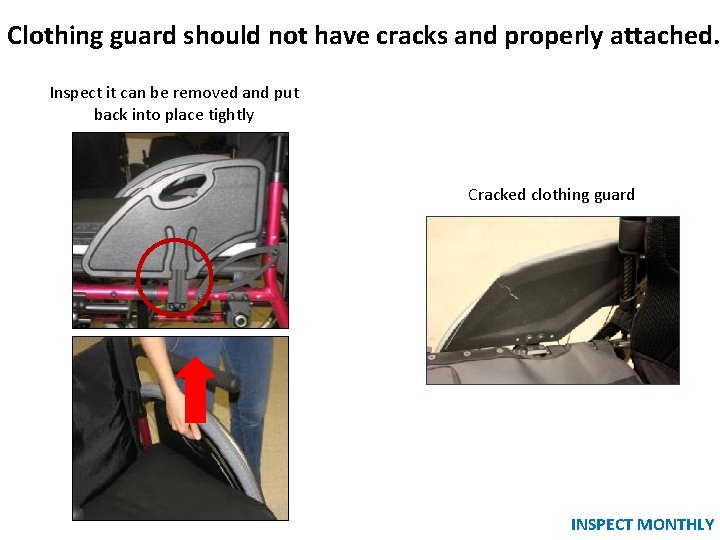
Clothing guard should not have cracks and properly attached. Inspect it can be removed and put back into place tightly Cracked clothing guard Wheelchair Maintenance Training: Manual Wheelchair INSPECT MONTHLY Maintenance at Home Page 41
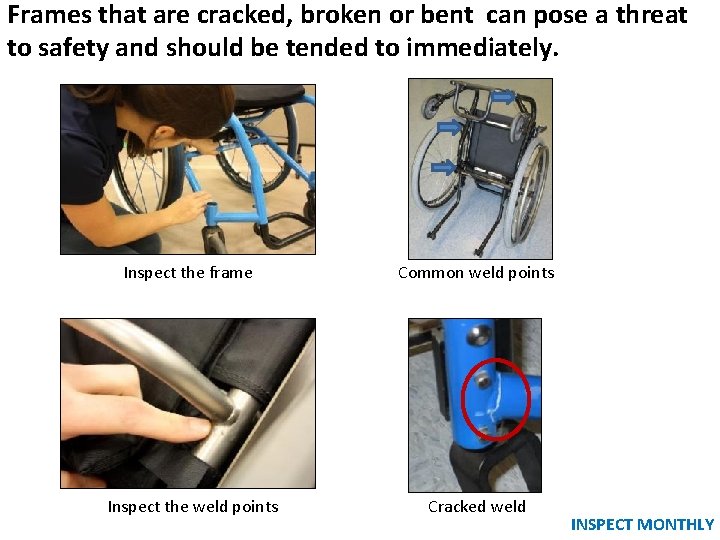
Frames that are cracked, broken or bent can pose a threat to safety and should be tended to immediately. Inspect the frame Common weld points Inspect the weld points Cracked weld INSPECT MONTHLY Maintenance at Home Page 42
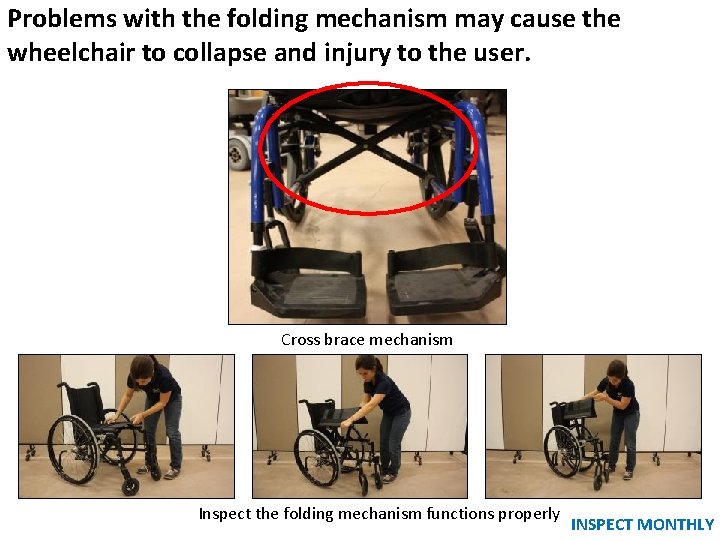
Problems with the folding mechanism may cause the wheelchair to collapse and injury to the user. Cross brace mechanism Inspect the folding mechanism functions properly Wheelchair Maintenance Training: Manual Wheelchair INSPECT MONTHLY Maintenance at Home Page 43
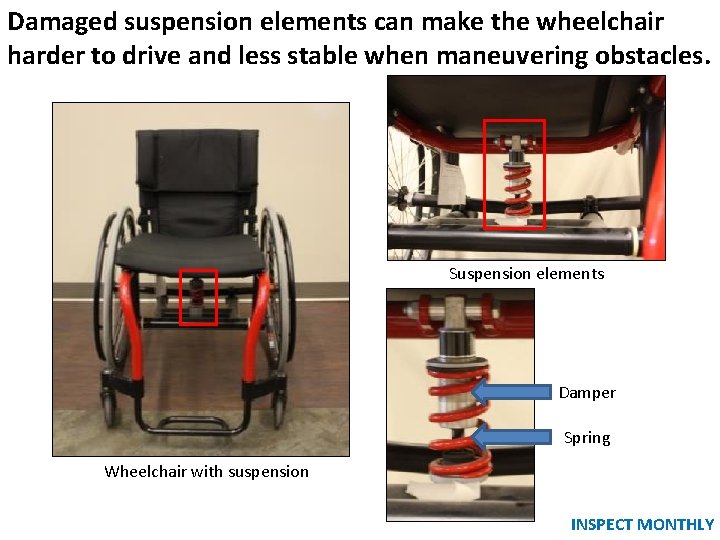
Damaged suspension elements can make the wheelchair Suspension elements harder to drive and less stable when maneuvering obstacles. Suspension elements Damper Spring Wheelchair with suspension Wheelchair Maintenance Training: Manual Wheelchair INSPECT MONTHLY Maintenance at Home Page 44
Caring for a manual wheelchair at home Action items: maintenance activities that the wheelchair user or caregiver performs on the wheelchair. Wheelchair Maintenance Training: Manual Wheelchair Maintenance at Home Page 45
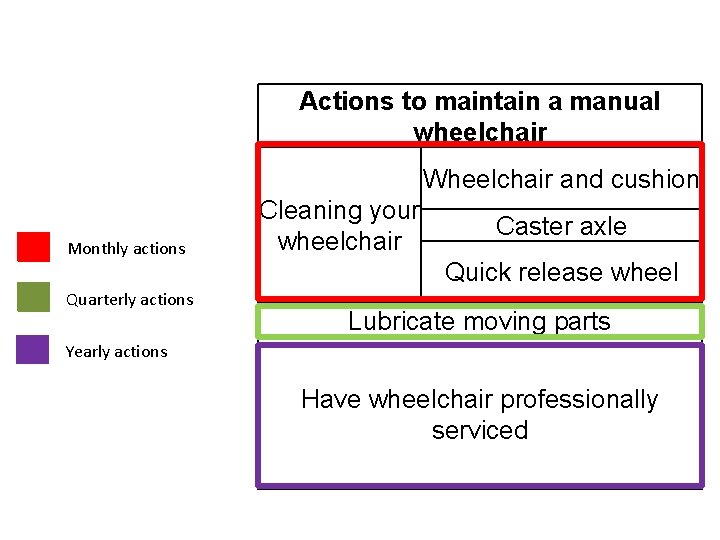
Action Items Actions to maintain a manual wheelchair Monthly actions Wheelchair and cushion Cleaning your Caster axle wheelchair Quick release wheel Quarterly actions Lubricate moving parts Yearly actions Have wheelchair professionally serviced Wheelchair Maintenance Training: Manual Wheelchair Maintenance at Home Page 46
Pneumatic tires Monthly Actions
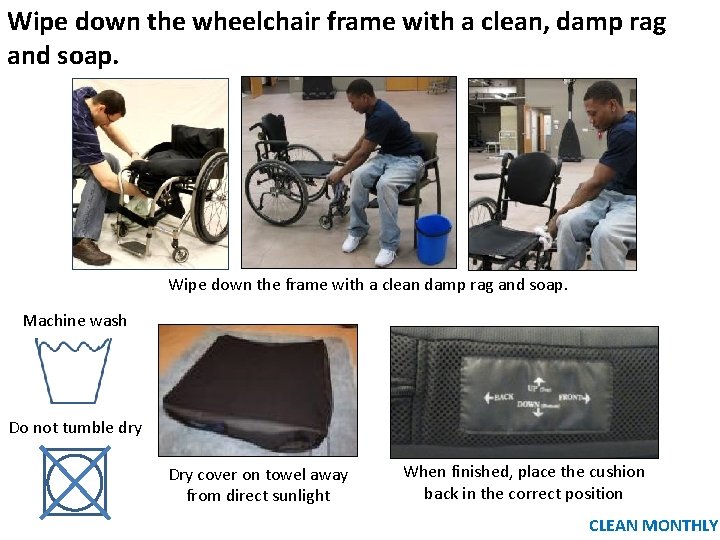
Wipe down the wheelchair frame with a clean, damp rag and soap. Wipe down the frame with a clean damp rag and soap. Machine wash Do not tumble dry Dry cover on towel away from direct sunlight Wheelchair Maintenance Training: Manual Wheelchair When finished, place the cushion back in the correct position CLEAN MONTHLY Maintenance at Home Page 48
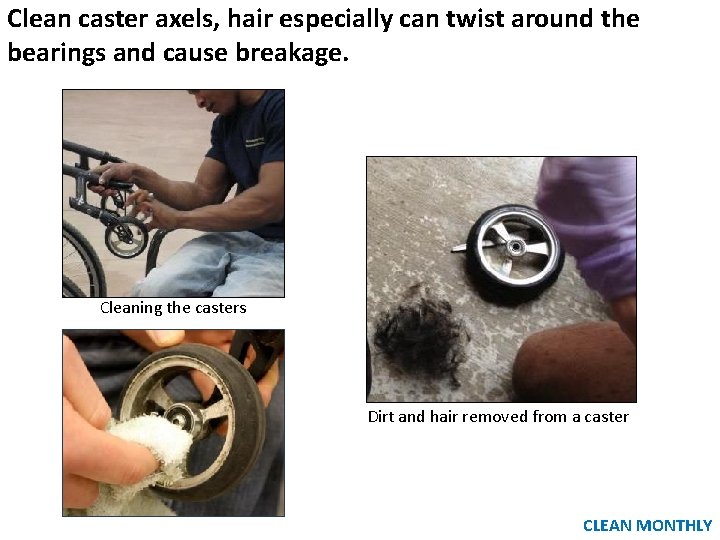
Clean caster axels, hair especially can twist around the bearings and cause breakage. Cleaning the casters Dirt and hair removed from a caster Wheelchair Maintenance Training: Manual Wheelchair CLEAN MONTHLY Maintenance at Home Page 49
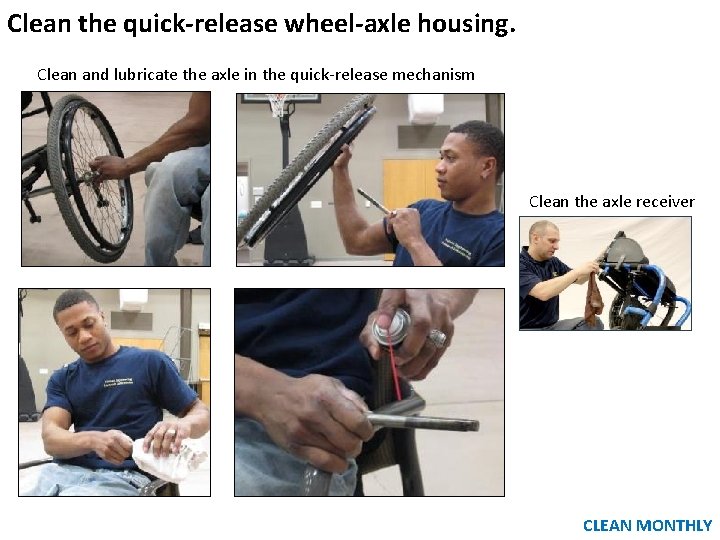
Clean the quick-release wheel-axle housing. Clean and lubricate the axle in the quick-release mechanism Clean the axle receiver Wheelchair Maintenance Training: Manual Wheelchair CLEAN MONTHLY Maintenance at Home Page 50
Pneumatic tires Quarterly Actions
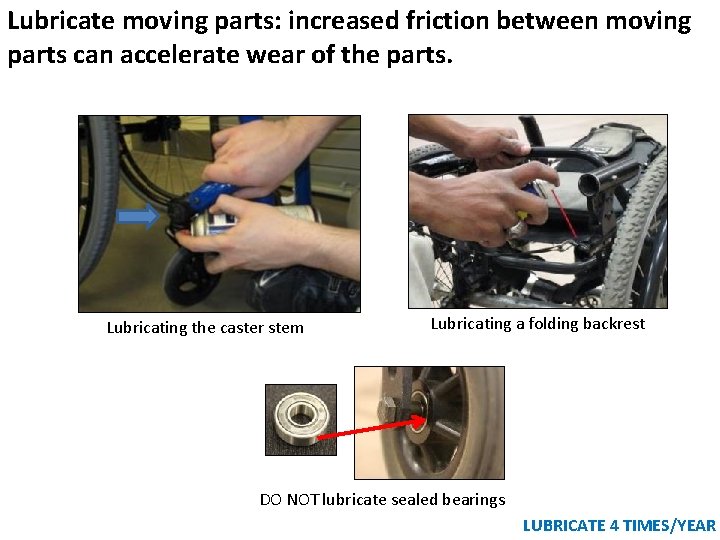
Lubricate moving parts: increased friction between moving parts can accelerate wear of the parts. Lubricating the caster stem Lubricating a folding backrest DO NOT lubricate sealed bearings Wheelchair Maintenance Training: Manual Wheelchair LUBRICATE 4 TIMES/YEAR Maintenance at Home Page 52
Pneumatic tires Yearly Actions
Have the wheelchair professionally serviced All wheelchairs should be professionally serviced at least once a year. In places with inclement weather conditions, wheelchairs should be professionally serviced twice a year. Wheelchair Maintenance Training: Manual Wheelchair Maintenance at Home Page 54
Learning Objectives • Recognize the importance of completing wheelchair maintenance • List the appropriate timing for wheelchair maintenance tasks • Demonstrate methods for maintaining your wheelchair • Demonstrate how to identify common technical wheelchair problems Wheelchair Maintenance Training Summary/homework Page 55
Thank you! See you next class
Manual Wheelchair User Maintenance Training Day 2
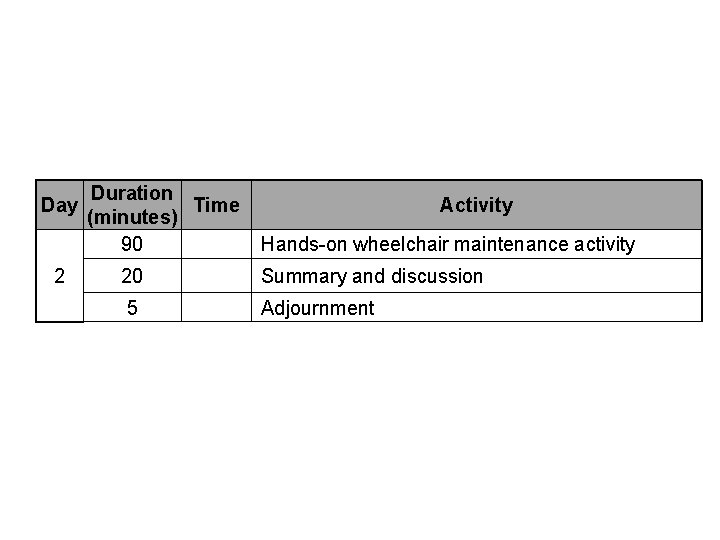
Day 2 Duration Time (minutes) 90 Activity Hands-on wheelchair maintenance activity 20 Summary and discussion 5 Adjournment Wheelchair Maintenance Training Agenda Page 58
Hands-on wheelchair activity • Bring your maintenance checklist and toolkit • If you identify maintenance issues on your wheelchairs, write them down on hands-on activity sheet • You will have 90 minutes to perform this activity • Let us know if you have questions or need assistance Wheelchair Maintenance Training Hands-on 2 Page 59
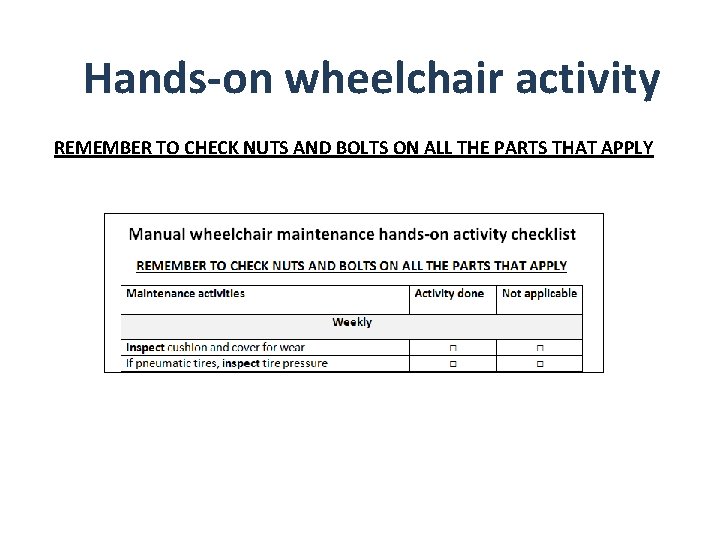
Hands-on wheelchair activity REMEMBER TO CHECK NUTS AND BOLTS ON ALL THE PARTS THAT APPLY
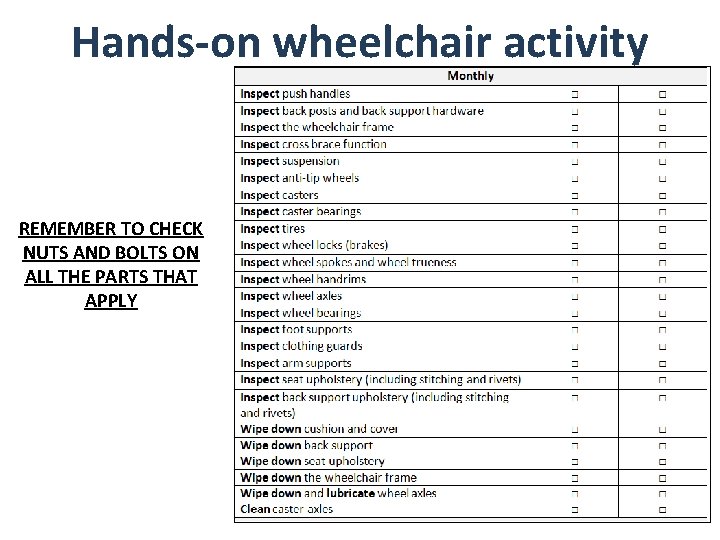
Hands-on wheelchair activity REMEMBER TO CHECK NUTS AND BOLTS ON ALL THE PARTS THAT APPLY
Hands-on wheelchair activity REMEMBER TO CHECK NUTS AND BOLTS ON ALL THE PARTS THAT APPLY
Summary and discussion Wheelchair Maintenance Training Summary/discussion Page 63
Weekly Inspection - Pneumatic tires - Cushion and cover Maximum estimated time: 30 minutes
Nuts and bolts Monthly Inspection - Wheel locks - Supports alignment and function - Wheels and casters condition and function - Spokes - Upholstery - Frame Action - Wipe down wheelchair and cushion - Clean caster axle - Clean quick release wheel axle housing Maximum estimated time: 60 minutes
Every three months Action - Lubricate moving parts Maximum estimated time: 15 minutes
Yearly Action - Have wheelchair professionally serviced Estimated time: 60 minutes
Learning objectives • Recognize the importance of completing wheelchair maintenance • List the appropriate timing for wheelchair maintenance tasks • Demonstrate methods for maintaining your wheelchair • Demonstrate how to identify common technical wheelchair problems
Reminders Wheelchair Maintenance Training Summary/homework Page 69
Reminders Remember that regular maintenance is important for your wheelchair to perform properly. Review the maintenance cards that you received in your toolkit and be sure that you are following the directions in a timely manner. If you are in need of a repair, remember to contact a wheelchair maintenance expert. Wheelchair Maintenance Training: Manual Wheelchair Summary/homework Page 70
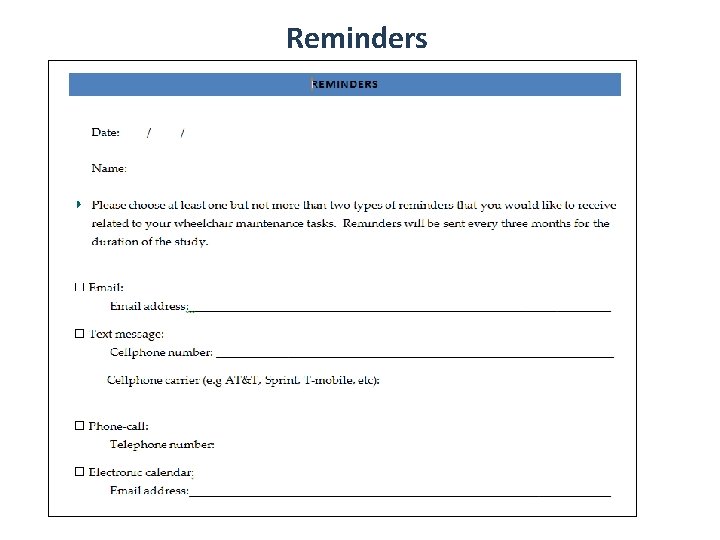
Remember you have with you • Maintenance cards • Toolkit • Reminders Ø Every 3 months for 1 year Wheelchair Maintenance Training Summary/discussion Page 71
Thank you! Don’t forget your resources Wheelchair Maintenance Training
References Berg K, Hines M, Allen S. Wheelchair users at home: few home modifications and many injurious falls. Am. J. Public Health 2002; 48. Calder CJ, Kirby RL. Fatal wheelchair-related accidents in the United States. Am. J. Phys. Med. Rehabil. 1990; 184 -90. Chen WY, Jang Y, Wang JD, Huang WN, Chang CC, Mao HF, Wang YH. Wheelchair related accidents: relationship with wheelchair-using behavior in active community wheelchair users. Arch. Phys. Med. Rehabil. 2011; 892 -8. Gaal RP, Rebholtz N, Hotchkiss RD, Pfaelzer PF. Wheelchair rider injuries: causes and consequences for wheelchair design and selection. J. Rehabil. Res. Dev. 1997; 58 -71. Hansen R, Tresse S, Gunnarsson RK. Fewer accidents and better maintenance with active wheelchair check-ups: a randomized controlled clinical trial. Clin. Rehabil. 2004; 631 -9. Kirby RL, Ackroyd-Stolarz SA, Brown MG, Kirkland SA, Mac. Leod DA. Wheelchair-related accidents caused by tips and falls among noninstitutionalized users of manually propelled wheelchairs in Nova Scotia. Am. J. Phys. Med. Rehabil. 1994; 319 -30.
References Mc. Clure LA, Boninger ML, Oyster ML, Williams S, Houlihan B, Lieberman JA, Cooper RA. Wheelchair repairs, breakdown, and adverse consequences for people with traumatic spinal cord injury. Arch. Phys. Med. Rehabil. 2009; 2034 -8. Nelson AL, Groer S, Palacios P, Mitchell D, Sabharwal S, Kirby RL, Gavin-Dreschnack D, Powell-Cope G. Wheelchair-related falls in veterans with spinal cord injury residing in the community: a prospective cohort study. Arch. Phys. Med. Rehabil. 2010; 1166 -73. Wang H, Liu HY, Pearlman J, Cooper R, Jefferds A, Connor S, Cooper RA. Relationship between wheelchair durability and wheelchair type and years of test. Disabil. Rehabil. Assist. Technol. 2010; 318 -22. World Health Organization. (Accessed 2013, May 8). Trainers Manual for Wheelchair Service Training Package: Basic Level [Online]. Available: http: //www. who. int/disabilities/technology/wheelchairpackage/en/ World Health Organization. (Accessed 2013, May 8). Reference Manual for Participants [Online]. Available: http: //www. who. int/disabilities/technology/wheelchairpackage/en/ Worobey L, Oyster ML, Nemunaitis G, Cooper R. A. , Boninger M. L. Increases in Wheelchair Repairs, Breakdown, and Adverse Consequences for People with traumatic Spinal Cord Injury. Am. J. Phys. Med. Rehab. 2012; 463 -9; .