
Manual Measurements of ECE 35 Transmitting Selective Receiving

- Slides: 14
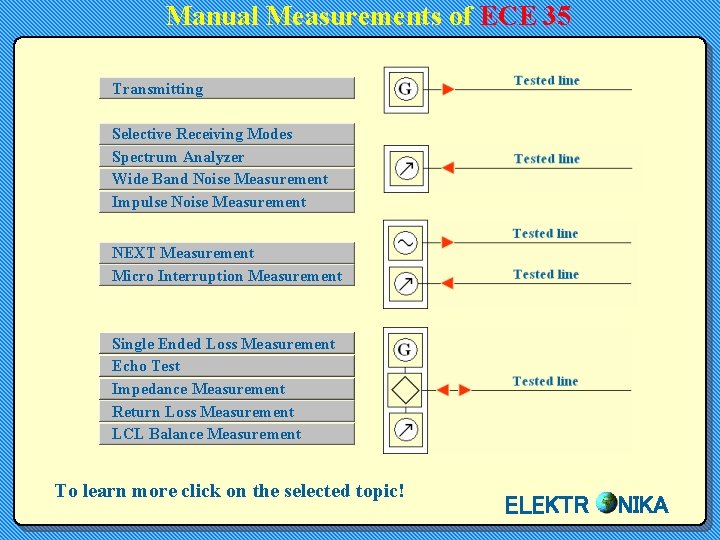
Manual Measurements of ECE 35 Transmitting Selective Receiving Modes Spectrum Analyzer Wide Band Noise Measurement Impulse Noise Measurement NEXT Measurement Micro Interruption Measurement Single Ended Loss Measurement Echo Test Measurement Impedance Measurement Return Loss Measurement LCL Balance Measurement To learn more click on the selected topic! ELEKTR NIKA
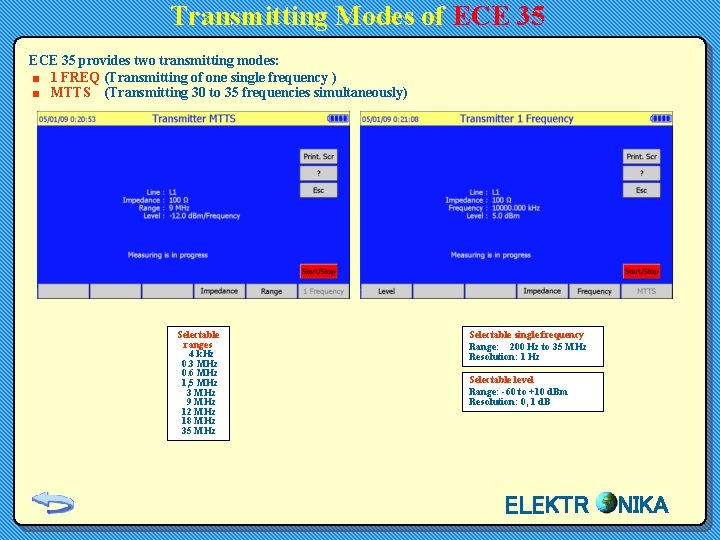
Transmitting Modes of ECE 35 provides two transmitting modes: ■ 1 FREQ (Transmitting of one single frequency ) ■ MTTS (Transmitting 30 to 35 frequencies simultaneously) Selectable ranges 4 k. Hz 0. 3 MHz 0. 6 MHz 1, 5 MHz 3 MHz 9 MHz 12 MHz 18 MHz 35 MHz Selectable single frequency Range: 200 Hz to 35 MHz Resolution: 1 Hz Selectable level Range: -60 to +10 d. Bm Resolution: 0, 1 d. B ELEKTR NIKA
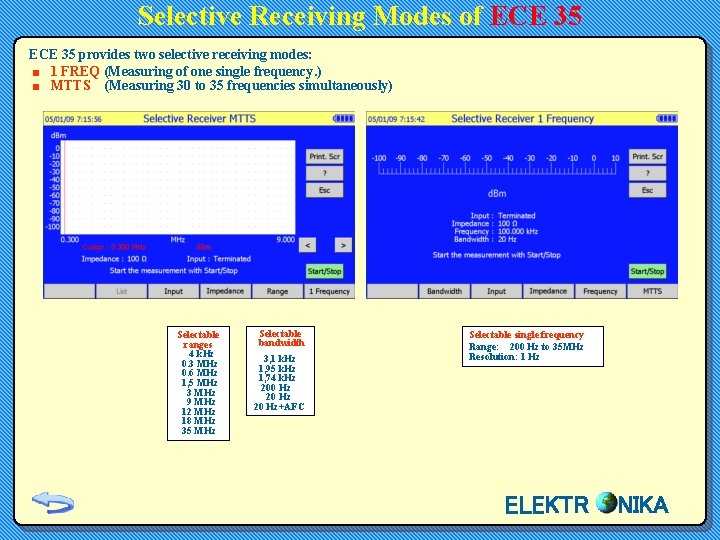
Selective Receiving Modes of ECE 35 provides two selective receiving modes: ■ 1 FREQ (Measuring of one single frequency. ) ■ MTTS (Measuring 30 to 35 frequencies simultaneously) Selectable ranges 4 k. Hz 0. 3 MHz 0. 6 MHz 1, 5 MHz 3 MHz 9 MHz 12 MHz 18 MHz 35 MHz Selectable bandwidth 3, 1 k. Hz 1, 95 k. Hz 1, 74 k. Hz 200 Hz 20 Hz+AFC Selectable single frequency Range: 200 Hz to 35 MHz Resolution: 1 Hz ELEKTR NIKA
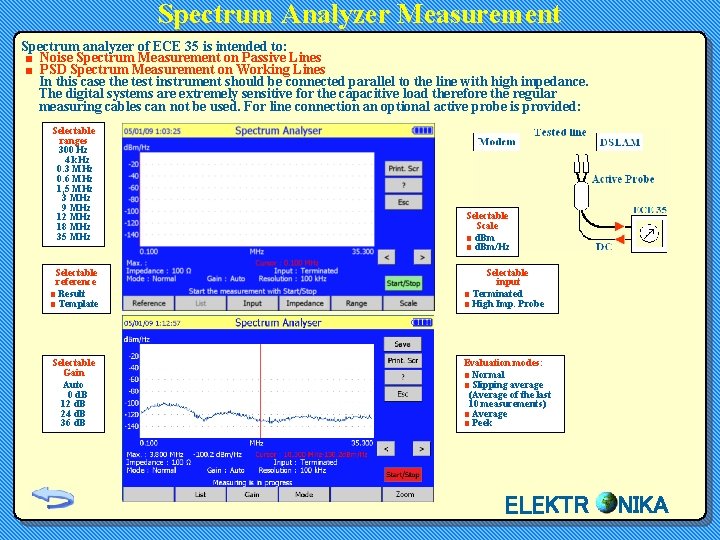
Spectrum Analyzer Measurement Spectrum analyzer of ECE 35 is intended to: ■ Noise Spectrum Measurement on Passive Lines ■ PSD Spectrum Measurement on Working Lines In this case the test instrument should be connected parallel to the line with high impedance. The digital systems are extremely sensitive for the capacitive load therefore the regular measuring cables can not be used. For line connection an optional active probe is provided: Selectable ranges 300 Hz 4 k. Hz 0. 3 MHz 0. 6 MHz 1, 5 MHz 3 MHz 9 MHz 12 MHz 18 MHz 35 MHz Selectable Scale ■ d. Bm/Hz Selectable reference ■ Result ■ Template Selectable input ■ Terminated ■ High Imp. Probe Selectable Gain Auto 0 d. B 12 d. B 24 d. B 36 d. B Evaluation modes: ■ Normal ■ Slipping average (Average of the last 10 measurements) ■ Average ■ Peek ELEKTR NIKA
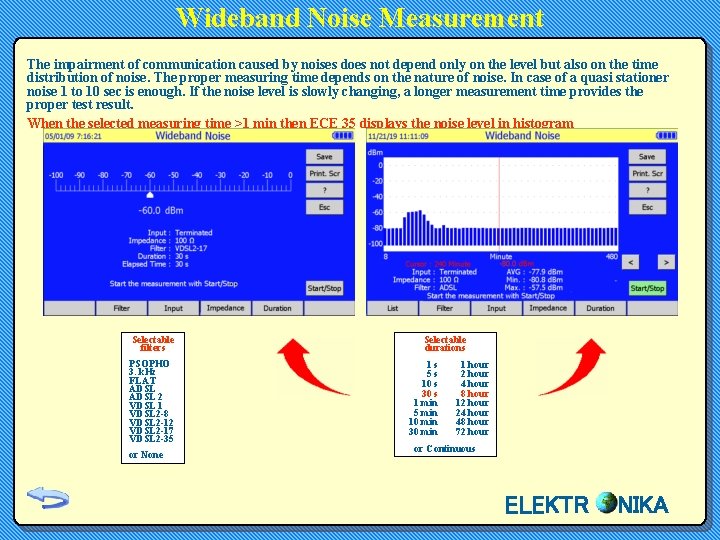
Wideband Noise Measurement The impairment of communication caused by noises does not depend only on the level but also on the time distribution of noise. The proper measuring time depends on the nature of noise. In case of a quasi stationer noise 1 to 10 sec is enough. If the noise level is slowly changing, a longer measurement time provides the proper test result. When the selected measuring time >1 min then ECE 35 displays the noise level in histogram Selectable filters PSOPHO 3. k. Hz FLAT ADSL 2 VDSL 1 VDSL 2 -8 VDSL 2 -12 VDSL 2 -17 VDSL 2 -35 or None Selectable durations 1 s 5 s 10 s 30 s 1 min 5 min 10 min 30 min 1 hour 2 hour 4 hour 8 hour 12 hour 24 hour 48 hour 72 hour or Continuous ELEKTR NIKA
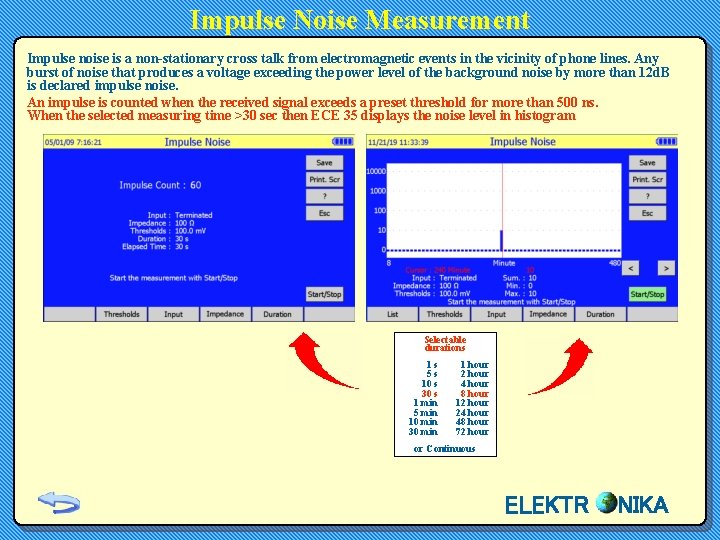
Impulse Noise Measurement Impulse noise is a non-stationary cross talk from electromagnetic events in the vicinity of phone lines. Any burst of noise that produces a voltage exceeding the power level of the background noise by more than 12 d. B is declared impulse noise. An impulse is counted when the received signal exceeds a preset threshold for more than 500 ns. When the selected measuring time >30 sec then ECE 35 displays the noise level in histogram Selectable durations 1 s 5 s 10 s 30 s 1 min 5 min 10 min 30 min 1 hour 2 hour 4 hour 8 hour 12 hour 24 hour 48 hour 72 hour or Continuous ELEKTR NIKA
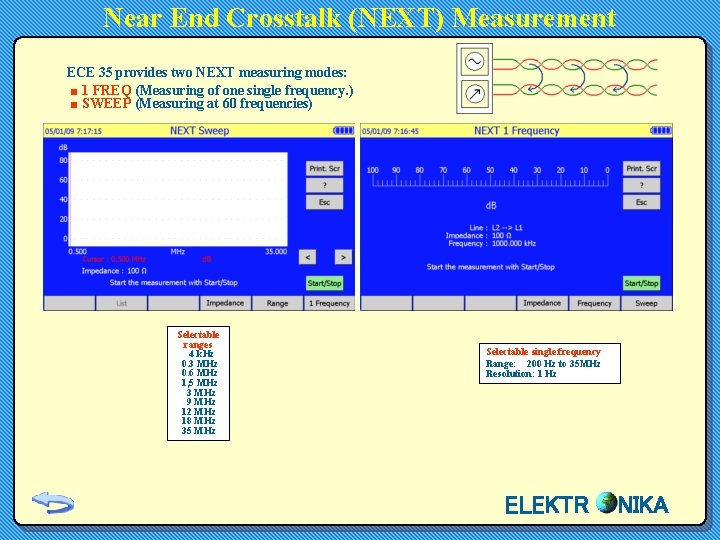
Near End Crosstalk (NEXT) Measurement ECE 35 provides two NEXT measuring modes: ■ 1 FREQ (Measuring of one single frequency. ) ■ SWEEP (Measuring at 60 frequencies) Selectable ranges 4 k. Hz 0. 3 MHz 0. 6 MHz 1, 5 MHz 3 MHz 9 MHz 12 MHz 18 MHz 35 MHz Selectable single frequency Range: 200 Hz to 35 MHz Resolution: 1 Hz ELEKTR NIKA
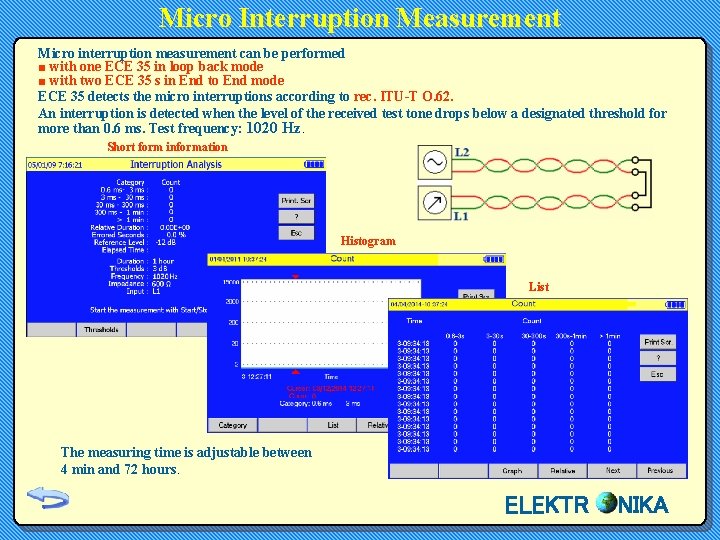
Micro Interruption Measurement Micro interruption measurement can be performed ■ with one ECE 35 in loop back mode ■ with two ECE 35 s in End to End mode ECE 35 detects the micro interruptions according to rec. ITU-T O. 62. An interruption is detected when the level of the received test tone drops below a designated threshold for more than 0. 6 ms. Test frequency: 1020 Hz. Short form information Histogram List The measuring time is adjustable between 4 min and 72 hours. ELEKTR NIKA
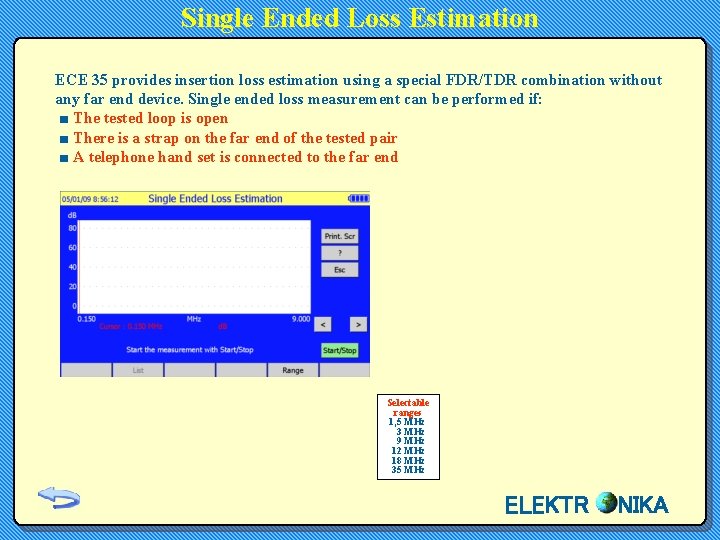
Single Ended Loss Estimation ECE 35 provides insertion loss estimation using a special FDR/TDR combination without any far end device. Single ended loss measurement can be performed if: ■ The tested loop is open ■ There is a strap on the far end of the tested pair ■ A telephone hand set is connected to the far end Selectable ranges 1, 5 MHz 3 MHz 9 MHz 12 MHz 18 MHz 35 MHz ELEKTR NIKA
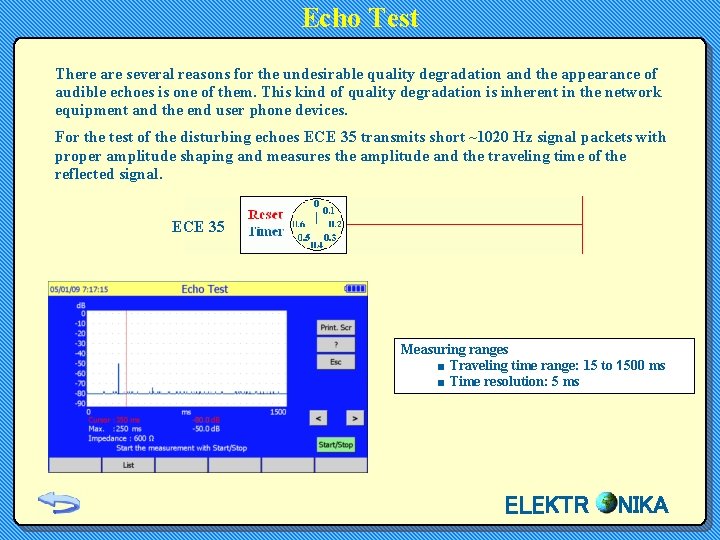
Echo Test There are several reasons for the undesirable quality degradation and the appearance of audible echoes is one of them. This kind of quality degradation is inherent in the network equipment and the end user phone devices. For the test of the disturbing echoes ECE 35 transmits short ~1020 Hz signal packets with proper amplitude shaping and measures the amplitude and the traveling time of the reflected signal. ECE 35 Measuring ranges ■ Traveling time range: 15 to 1500 ms ■ Time resolution: 5 ms ELEKTR NIKA
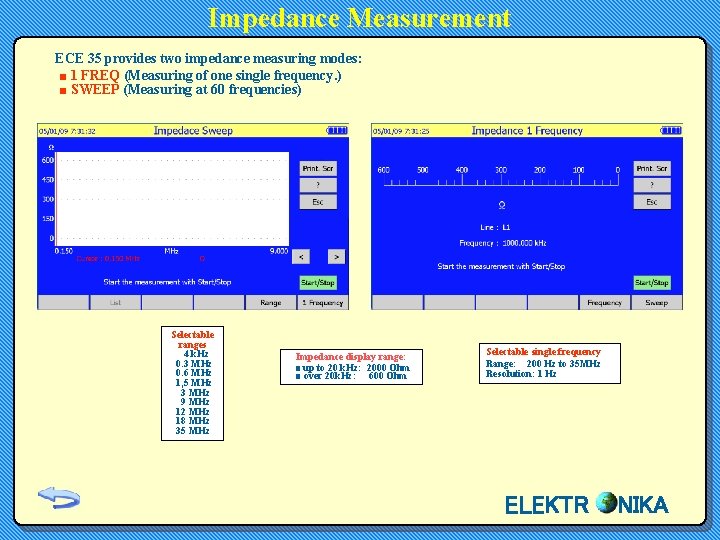
Impedance Measurement ECE 35 provides two impedance measuring modes: ■ 1 FREQ (Measuring of one single frequency. ) ■ SWEEP (Measuring at 60 frequencies) Selectable ranges 4 k. Hz 0. 3 MHz 0. 6 MHz 1, 5 MHz 3 MHz 9 MHz 12 MHz 18 MHz 35 MHz Impedance display range: ■ up to 20 k. Hz: 2000 Ohm ■ over 20 k. Hz: 600 Ohm Selectable single frequency Range: 200 Hz to 35 MHz Resolution: 1 Hz ELEKTR NIKA
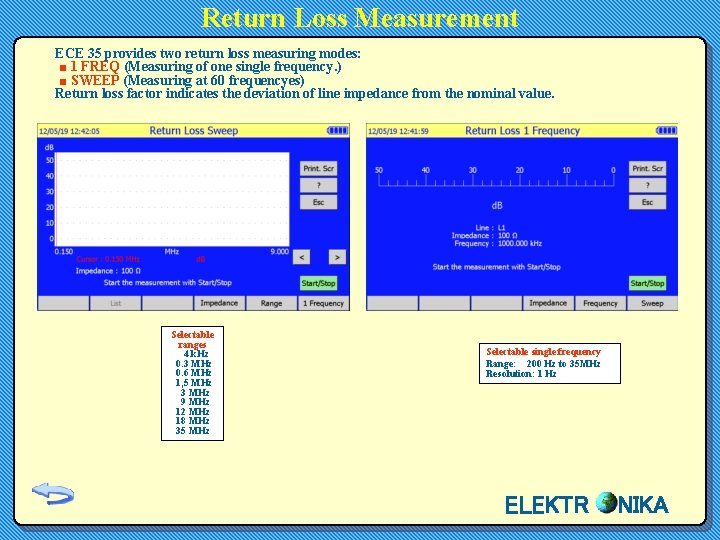
Return Loss Measurement ECE 35 provides two return loss measuring modes: ■ 1 FREQ (Measuring of one single frequency. ) ■ SWEEP (Measuring at 60 frequencyes) Return loss factor indicates the deviation of line impedance from the nominal value. Selectable ranges 4 k. Hz 0. 3 MHz 0. 6 MHz 1, 5 MHz 3 MHz 9 MHz 12 MHz 18 MHz 35 MHz Selectable single frequency Range: 200 Hz to 35 MHz Resolution: 1 Hz ELEKTR NIKA
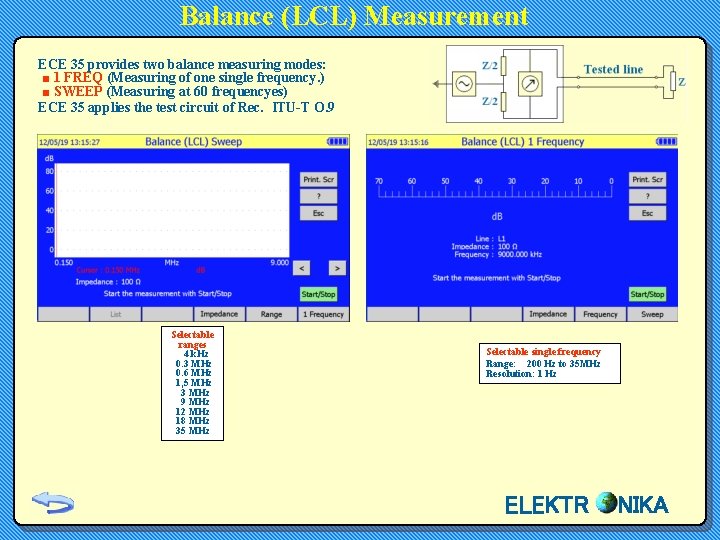
Balance (LCL) Measurement ECE 35 provides two balance measuring modes: ■ 1 FREQ (Measuring of one single frequency. ) ■ SWEEP (Measuring at 60 frequencyes) ECE 35 applies the test circuit of Rec. ITU-T O. 9 Selectable ranges 4 k. Hz 0. 3 MHz 0. 6 MHz 1, 5 MHz 3 MHz 9 MHz 12 MHz 18 MHz 35 MHz Selectable single frequency Range: 200 Hz to 35 MHz Resolution: 1 Hz ELEKTR NIKA
THANK YOU FOR YOUR ATTENTION!