
Manual Material Handling Effects 25 of accidents reported
- Slides: 20
Manual Material Handling Effects 25 % of accidents reported are due to manual material handling 60% of overexertion injuries are due to lifting and lowering 25 -44 year olds have the highest incidence of back pain Four avenues of research Epidemiological approach – approach characterizes the job and workplace along with other factors to derive significant trends that may lead to accidents Biomechanical approach – interested in characterizing the forces and moments on the various body elements in order to estimate task and load characteristics that may lead to injury Psychophysical methods – subjects adjust the load in order to arrive at a load that is acceptable to them Physiological approach – measure physiological measures to determine the level of stress imposed (heart rate, blood pressure, etc. ) Dept. of Biomedical, Industrial, & Human Factors Engineering 1
Occupational Biomechanics – concerned with the mechanical elements of living organisms Occupational Biomechanics – Deals with the mechanical and motion characteristics of the human body and its elements. The studies of the interrelationships between workers and their tools, workplaces, and so on. Inputs include: Engineering sciences Physical sciences Biological sciences Dept. of Biomedical, Industrial, & Human Factors Engineering 2
Occupational Biomechanics Multidisciplinary work entailing modeling with: Modeling – allows us to develop smaller-scale, simplistic representations of the real life events to solve the problem at hand Anthropometry – provides the human body and segment dimensions including masses and centers of gravity Kinesiology – covers the area of human motion. Body segment motions and triggering muscular actions can be described. Bioinstrumentation – deals with the data acquisition and analysis such as force plates, electromyography, goniometry, and linear measuring devices. Dept. of Biomedical, Industrial, & Human Factors Engineering 3
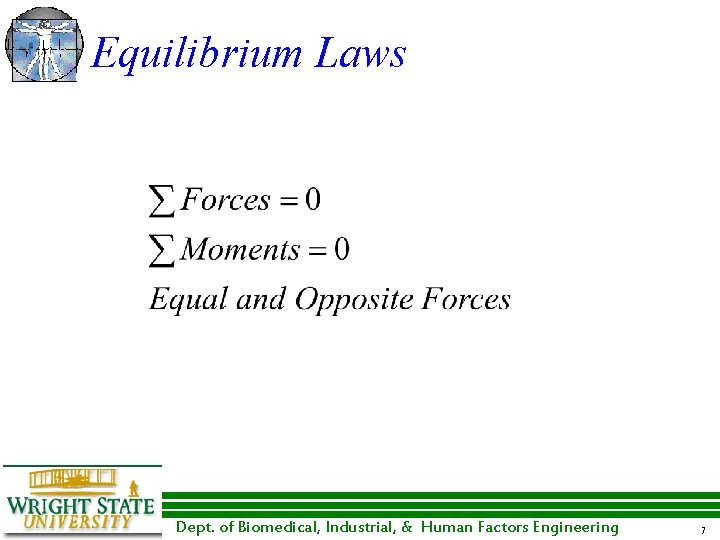
Occupational Biomechanics What does Biomechanics affect (better matching worker with the environment): Tool design Workplace design Job design Worker/task matching Material handling Newton’s laws are a basic ingredient of biomechanical analysis: A mass will remain at rest or in uniform motion unless an unbalanced external force acts on it. Force is proportional to the acceleration of a mass. Any action will be opposed by reaction of an equal magnitude. Newton’s laws are used to describe the state of a body (e. g. , a body not in motion-sum of all forces and moments acting are zero ---state of equilibrium) Dept. of Biomedical, Industrial, & Human Factors Engineering 4
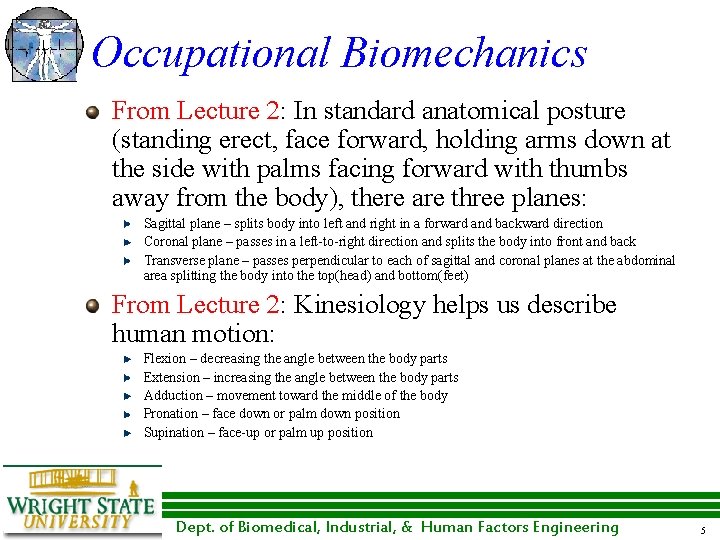
Occupational Biomechanics From Lecture 2: In standard anatomical posture (standing erect, face forward, holding arms down at the side with palms facing forward with thumbs away from the body), there are three planes: Sagittal plane – splits body into left and right in a forward and backward direction Coronal plane – passes in a left-to-right direction and splits the body into front and back Transverse plane – passes perpendicular to each of sagittal and coronal planes at the abdominal area splitting the body into the top(head) and bottom(feet) From Lecture 2: Kinesiology helps us describe human motion: Flexion – decreasing the angle between the body parts Extension – increasing the angle between the body parts Adduction – movement toward the middle of the body Pronation – face down or palm down position Supination – face-up or palm up position Dept. of Biomedical, Industrial, & Human Factors Engineering 5
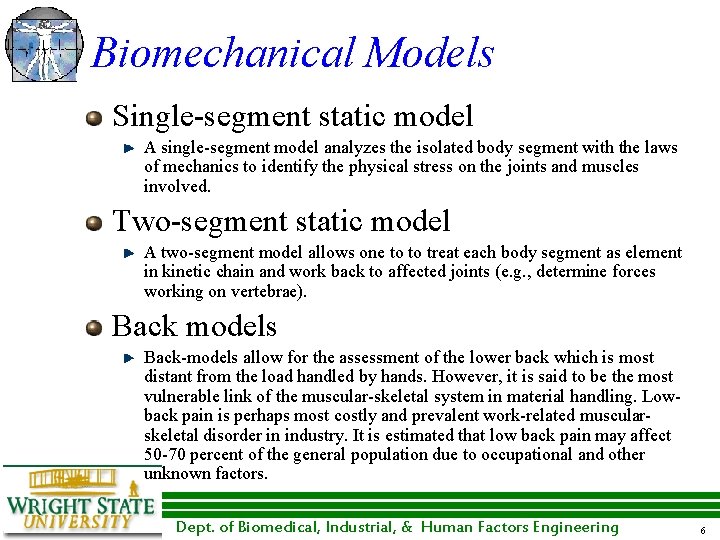
Biomechanical Models Single-segment static model A single-segment model analyzes the isolated body segment with the laws of mechanics to identify the physical stress on the joints and muscles involved. Two-segment static model A two-segment model allows one to to treat each body segment as element in kinetic chain and work back to affected joints (e. g. , determine forces working on vertebrae). Back models Back-models allow for the assessment of the lower back which is most distant from the load handled by hands. However, it is said to be the most vulnerable link of the muscular-skeletal system in material handling. Lowback pain is perhaps most costly and prevalent work-related muscularskeletal disorder in industry. It is estimated that low back pain may affect 50 -70 percent of the general population due to occupational and other unknown factors. Dept. of Biomedical, Industrial, & Human Factors Engineering 6
Equilibrium Laws Dept. of Biomedical, Industrial, & Human Factors Engineering 7
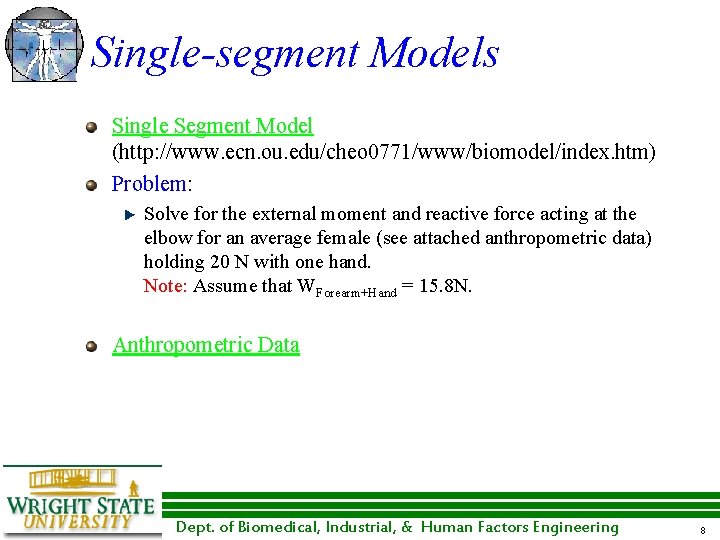
Single-segment Models Single Segment Model (http: //www. ecn. ou. edu/cheo 0771/www/biomodel/index. htm) Problem: Solve for the external moment and reactive force acting at the elbow for an average female (see attached anthropometric data) holding 20 N with one hand. Note: Assume that WForearm+Hand = 15. 8 N. Anthropometric Data Dept. of Biomedical, Industrial, & Human Factors Engineering 8
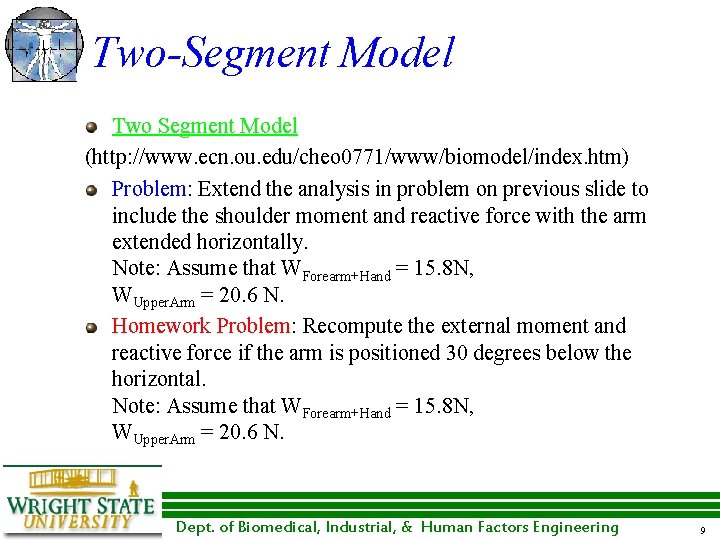
Two-Segment Model Two Segment Model (http: //www. ecn. ou. edu/cheo 0771/www/biomodel/index. htm) Problem: Extend the analysis in problem on previous slide to include the shoulder moment and reactive force with the arm extended horizontally. Note: Assume that WForearm+Hand = 15. 8 N, WUpper. Arm = 20. 6 N. Homework Problem: Recompute the external moment and reactive force if the arm is positioned 30 degrees below the horizontal. Note: Assume that WForearm+Hand = 15. 8 N, WUpper. Arm = 20. 6 N. Dept. of Biomedical, Industrial, & Human Factors Engineering 9
Simplified Back Model (http: //www. ecn. ou. edu/cheo 0771/www/biomodel/index. htm) Dept. of Biomedical, Industrial, & Human Factors Engineering 10
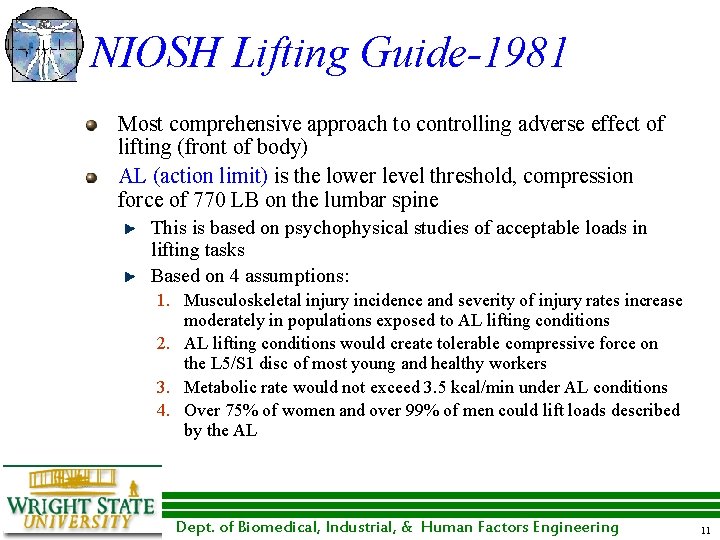
NIOSH Lifting Guide-1981 Most comprehensive approach to controlling adverse effect of lifting (front of body) AL (action limit) is the lower level threshold, compression force of 770 LB on the lumbar spine This is based on psychophysical studies of acceptable loads in lifting tasks Based on 4 assumptions: 1. Musculoskeletal injury incidence and severity of injury rates increase moderately in populations exposed to AL lifting conditions 2. AL lifting conditions would create tolerable compressive force on the L 5/S 1 disc of most young and healthy workers 3. Metabolic rate would not exceed 3. 5 kcal/min under AL conditions 4. Over 75% of women and over 99% of men could lift loads described by the AL Dept. of Biomedical, Industrial, & Human Factors Engineering 11
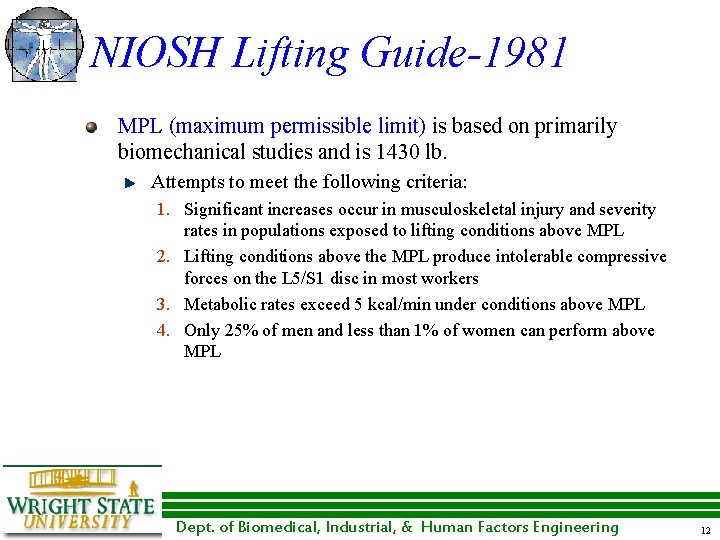
NIOSH Lifting Guide-1981 MPL (maximum permissible limit) is based on primarily biomechanical studies and is 1430 lb. Attempts to meet the following criteria: 1. Significant increases occur in musculoskeletal injury and severity rates in populations exposed to lifting conditions above MPL 2. Lifting conditions above the MPL produce intolerable compressive forces on the L 5/S 1 disc in most workers 3. Metabolic rates exceed 5 kcal/min under conditions above MPL 4. Only 25% of men and less than 1% of women can perform above MPL Dept. of Biomedical, Industrial, & Human Factors Engineering 12
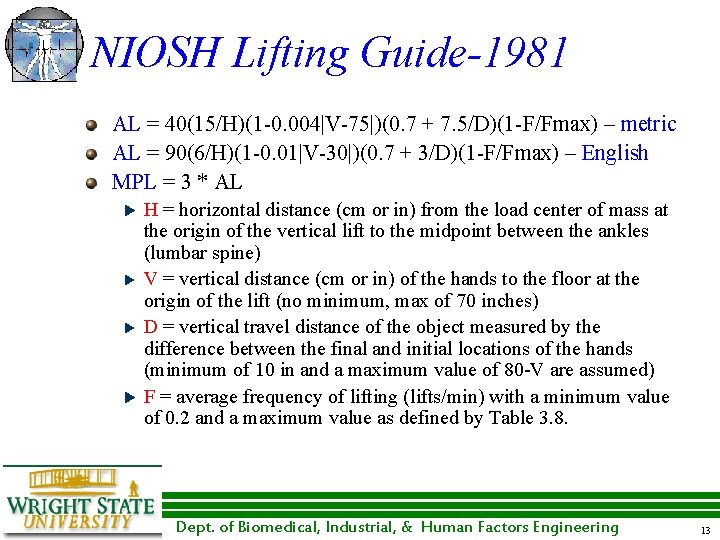
NIOSH Lifting Guide-1981 AL = 40(15/H)(1 -0. 004|V-75|)(0. 7 + 7. 5/D)(1 -F/Fmax) – metric AL = 90(6/H)(1 -0. 01|V-30|)(0. 7 + 3/D)(1 -F/Fmax) – English MPL = 3 * AL H = horizontal distance (cm or in) from the load center of mass at the origin of the vertical lift to the midpoint between the ankles (lumbar spine) V = vertical distance (cm or in) of the hands to the floor at the origin of the lift (no minimum, max of 70 inches) D = vertical travel distance of the object measured by the difference between the final and initial locations of the hands (minimum of 10 in and a maximum value of 80 -V are assumed) F = average frequency of lifting (lifts/min) with a minimum value of 0. 2 and a maximum value as defined by Table 3. 8. Dept. of Biomedical, Industrial, & Human Factors Engineering 13
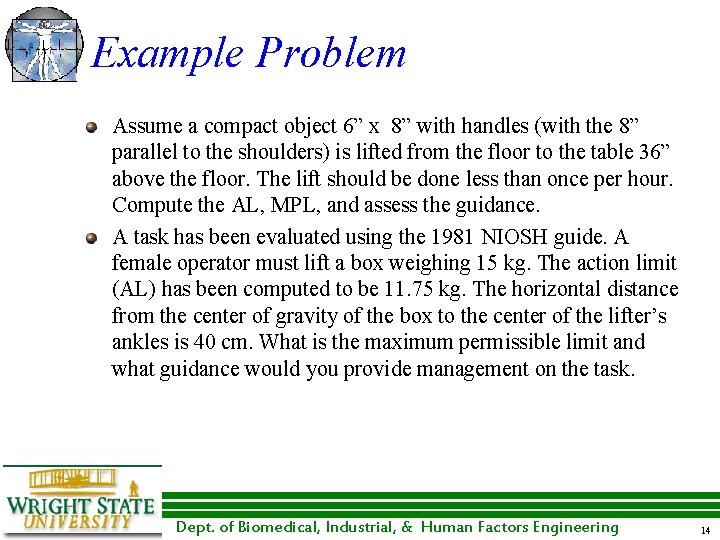
Example Problem Assume a compact object 6” x 8” with handles (with the 8” parallel to the shoulders) is lifted from the floor to the table 36” above the floor. The lift should be done less than once per hour. Compute the AL, MPL, and assess the guidance. A task has been evaluated using the 1981 NIOSH guide. A female operator must lift a box weighing 15 kg. The action limit (AL) has been computed to be 11. 75 kg. The horizontal distance from the center of gravity of the box to the center of the lifter’s ankles is 40 cm. What is the maximum permissible limit and what guidance would you provide management on the task. Dept. of Biomedical, Industrial, & Human Factors Engineering 14
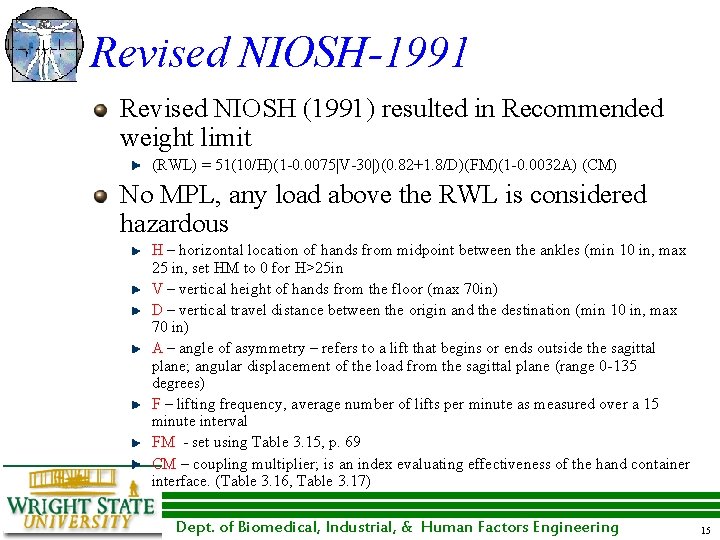
Revised NIOSH-1991 Revised NIOSH (1991) resulted in Recommended weight limit (RWL) = 51(10/H)(1 -0. 0075|V-30|)(0. 82+1. 8/D)(FM)(1 -0. 0032 A) (CM) No MPL, any load above the RWL is considered hazardous H – horizontal location of hands from midpoint between the ankles (min 10 in, max 25 in, set HM to 0 for H>25 in V – vertical height of hands from the floor (max 70 in) D – vertical travel distance between the origin and the destination (min 10 in, max 70 in) A – angle of asymmetry – refers to a lift that begins or ends outside the sagittal plane; angular displacement of the load from the sagittal plane (range 0 -135 degrees) F – lifting frequency, average number of lifts per minute as measured over a 15 minute interval FM - set using Table 3. 15, p. 69 CM – coupling multiplier; is an index evaluating effectiveness of the hand container interface. (Table 3. 16, Table 3. 17) Dept. of Biomedical, Industrial, & Human Factors Engineering 15
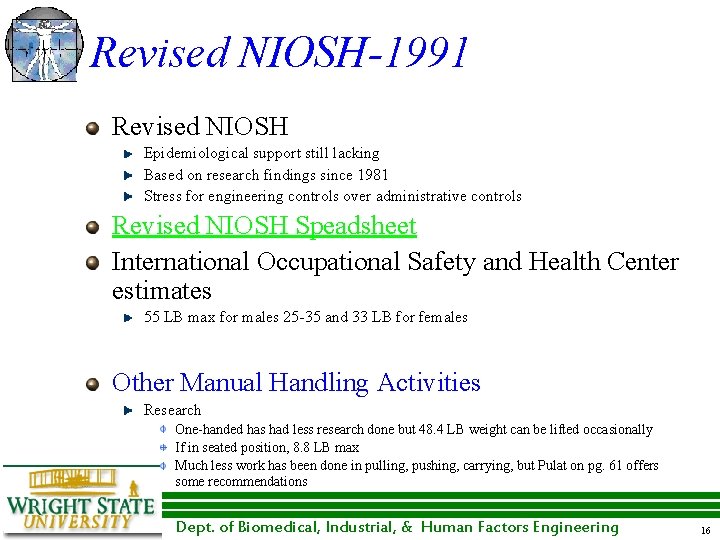
Revised NIOSH-1991 Revised NIOSH Epidemiological support still lacking Based on research findings since 1981 Stress for engineering controls over administrative controls Revised NIOSH Speadsheet International Occupational Safety and Health Center estimates 55 LB max for males 25 -35 and 33 LB for females Other Manual Handling Activities Research One-handed has had less research done but 48. 4 LB weight can be lifted occasionally If in seated position, 8. 8 LB max Much less work has been done in pulling, pushing, carrying, but Pulat on pg. 61 offers some recommendations Dept. of Biomedical, Industrial, & Human Factors Engineering 16
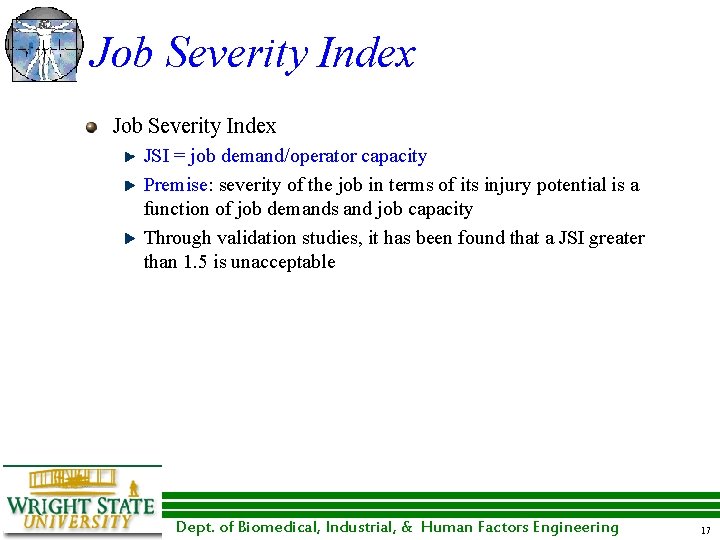
Job Severity Index JSI = job demand/operator capacity Premise: severity of the job in terms of its injury potential is a function of job demands and job capacity Through validation studies, it has been found that a JSI greater than 1. 5 is unacceptable Dept. of Biomedical, Industrial, & Human Factors Engineering 17
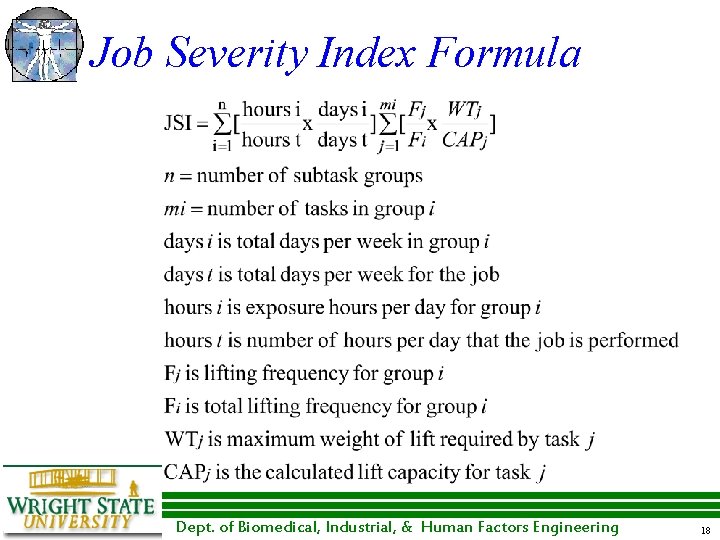
Job Severity Index Formula Dept. of Biomedical, Industrial, & Human Factors Engineering 18
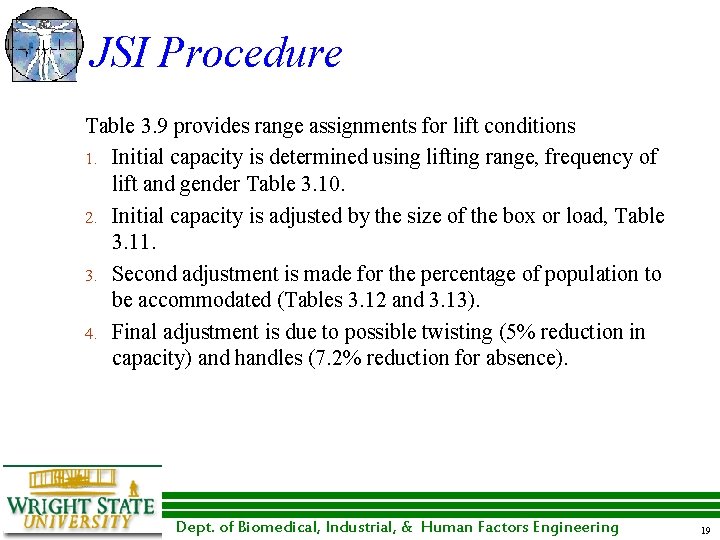
JSI Procedure Table 3. 9 provides range assignments for lift conditions 1. Initial capacity is determined using lifting range, frequency of lift and gender Table 3. 10. 2. Initial capacity is adjusted by the size of the box or load, Table 3. 11. 3. Second adjustment is made for the percentage of population to be accommodated (Tables 3. 12 and 3. 13). 4. Final adjustment is due to possible twisting (5% reduction in capacity) and handles (7. 2% reduction for absence). Dept. of Biomedical, Industrial, & Human Factors Engineering 19
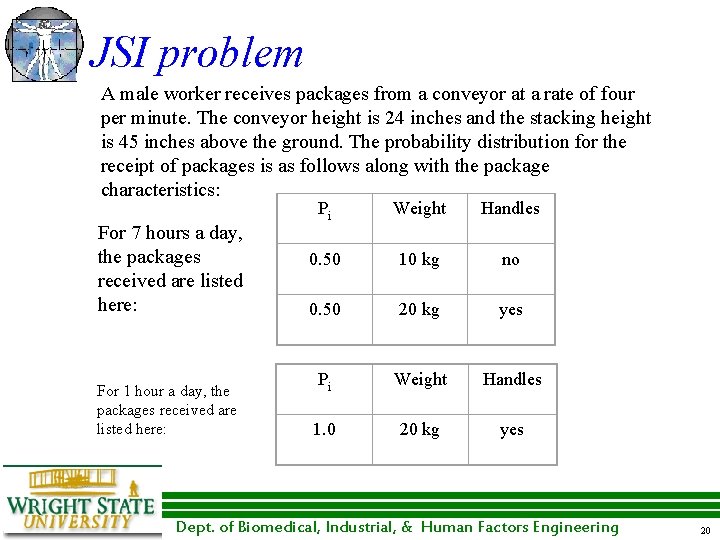
JSI problem A male worker receives packages from a conveyor at a rate of four per minute. The conveyor height is 24 inches and the stacking height is 45 inches above the ground. The probability distribution for the receipt of packages is as follows along with the package characteristics: For 7 hours a day, the packages received are listed here: For 1 hour a day, the packages received are listed here: Pi Weight Handles 0. 50 10 kg no 0. 50 20 kg yes Pi Weight Handles 1. 0 20 kg yes Dept. of Biomedical, Industrial, & Human Factors Engineering 20