
Mansa Musa and Islam Ghana Mali and Songhai
- Slides: 26
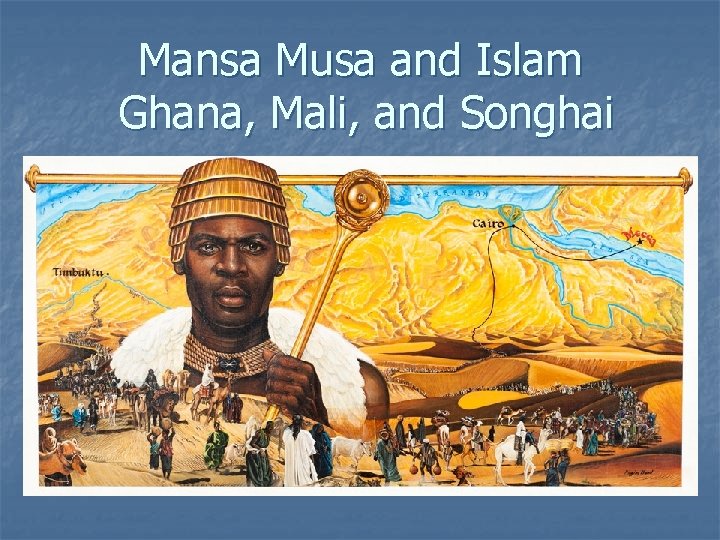
Mansa Musa and Islam Ghana, Mali, and Songhai
Objectives and State Standards n n I can explain the importance of Mansa Musa and his pilgrimage to Mecca. (7. 17) I can analyze the growth of Ghana, Mali, and Songhai kingdoms. (7. 13)
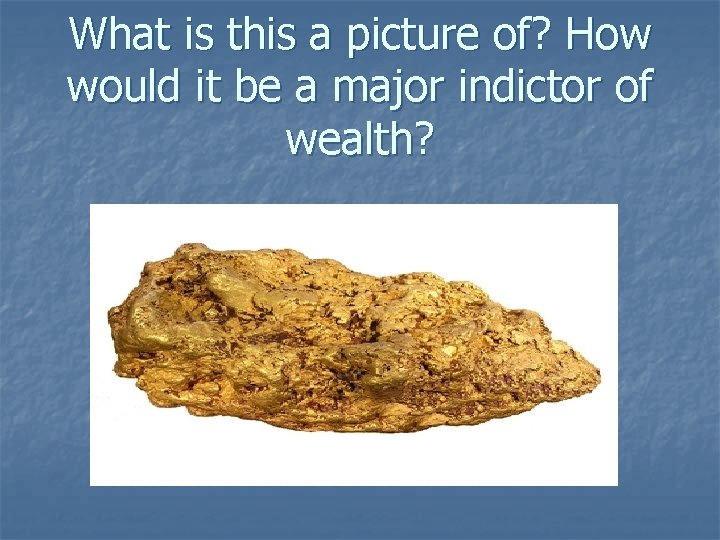
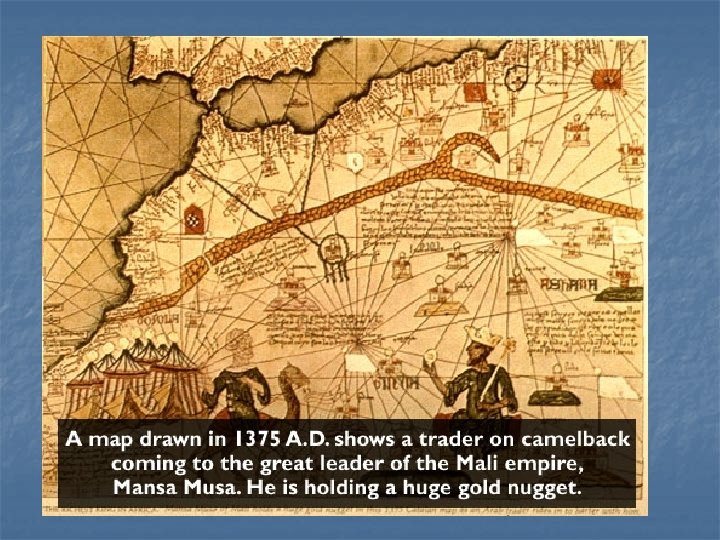
What is this a picture of? How would it be a major indictor of wealth?
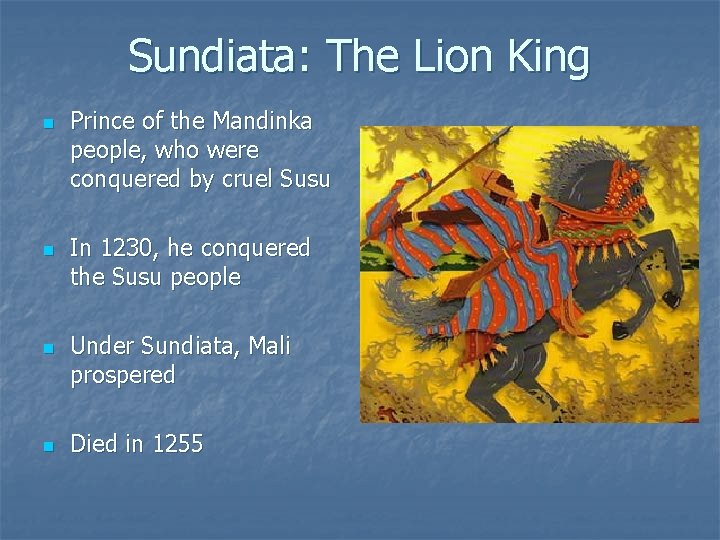
Sundiata: The Lion King n n Prince of the Mandinka people, who were conquered by cruel Susu In 1230, he conquered the Susu people Under Sundiata, Mali prospered Died in 1255
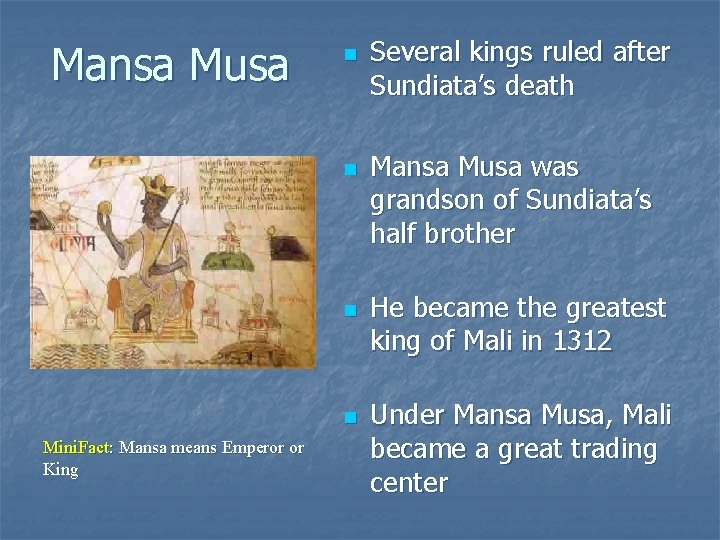
Mansa Musa n n Mini. Fact: Mansa means Emperor or King Several kings ruled after Sundiata’s death Mansa Musa was grandson of Sundiata’s half brother He became the greatest king of Mali in 1312 Under Mansa Musa, Mali became a great trading center
The Hajj n Mansa Musa was a devout Muslim n Muslims must make a journey to Mecca called a ‘hajj’ n Mansa Musa crossed Africa to reach Mecca n He took a huge caravan with him in 1324 After that, everyone knew about the wealth of Mali (Is this a good or bad? ) n
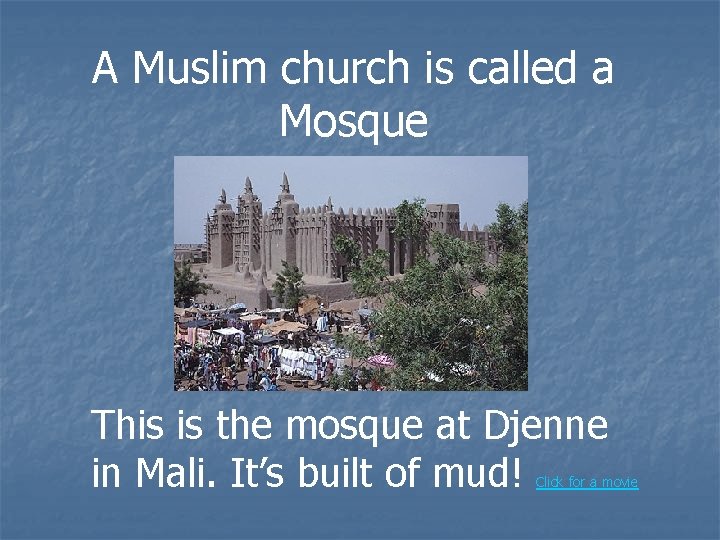
A Muslim church is called a Mosque This is the mosque at Djenne in Mali. It’s built of mud! Click for a movie
Just how wealthy was Mansa Musa?
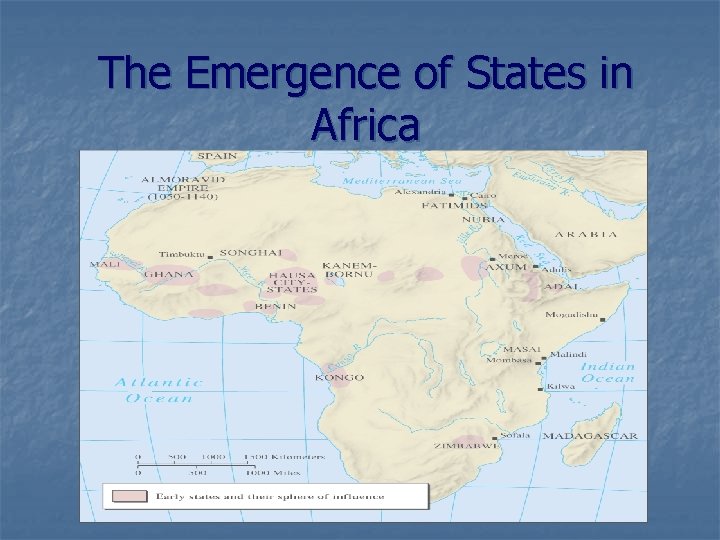
The Emergence of States in Africa
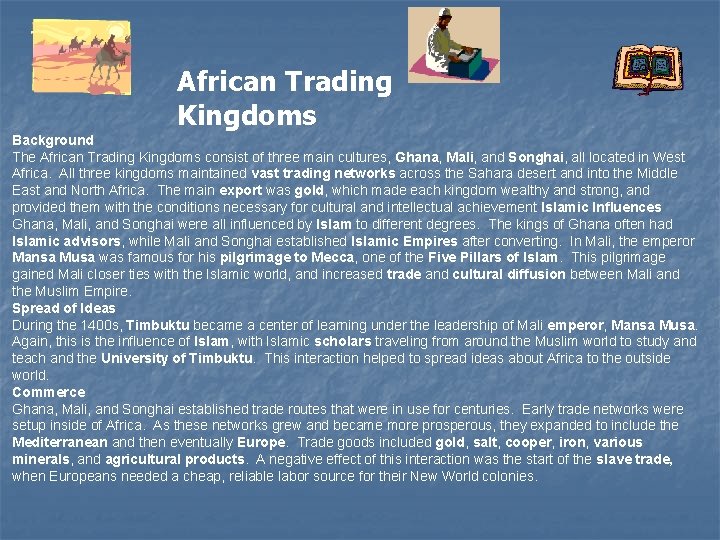
African Trading Kingdoms Background The African Trading Kingdoms consist of three main cultures, Ghana, Mali, and Songhai, all located in West Africa. All three kingdoms maintained vast trading networks across the Sahara desert and into the Middle East and North Africa. The main export was gold, which made each kingdom wealthy and strong, and provided them with the conditions necessary for cultural and intellectual achievement Islamic Influences Ghana, Mali, and Songhai were all influenced by Islam to different degrees. The kings of Ghana often had Islamic advisors, while Mali and Songhai established Islamic Empires after converting. In Mali, the emperor Mansa Musa was famous for his pilgrimage to Mecca, one of the Five Pillars of Islam. This pilgrimage gained Mali closer ties with the Islamic world, and increased trade and cultural diffusion between Mali and the Muslim Empire. Spread of Ideas During the 1400 s, Timbuktu became a center of learning under the leadership of Mali emperor, Mansa Musa. Again, this is the influence of Islam, with Islamic scholars traveling from around the Muslim world to study and teach and the University of Timbuktu. This interaction helped to spread ideas about Africa to the outside world. Commerce Ghana, Mali, and Songhai established trade routes that were in use for centuries. Early trade networks were setup inside of Africa. As these networks grew and became more prosperous, they expanded to include the Mediterranean and then eventually Europe. Trade goods included gold, salt, cooper, iron, various minerals, and agricultural products. A negative effect of this interaction was the start of the slave trade, when Europeans needed a cheap, reliable labor source for their New World colonies.
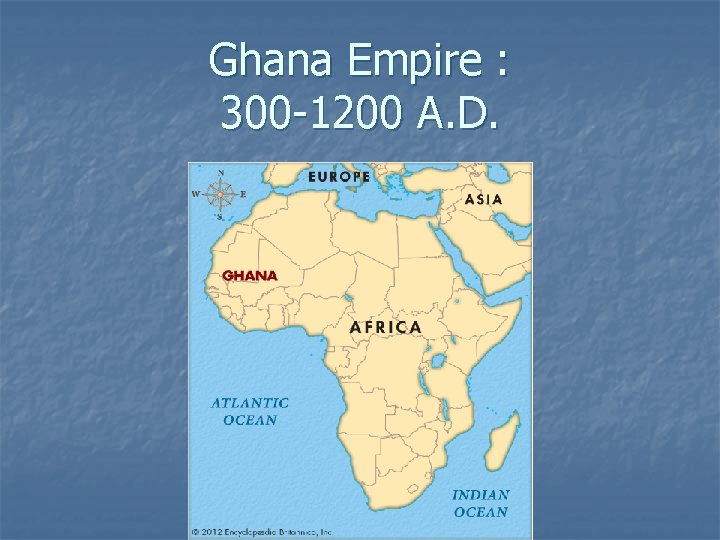
Ghana Empire : 300 -1200 A. D.
Ghana Empire The Ghana Empire was the best known and most powerful of the medieval trading empires in West Africa Ghana became very rich as a result of the “saltgold trade” between West and North Africa. This trade was very important, and Ghana came to control not only gold and salt but also the trade routes that went through their land.
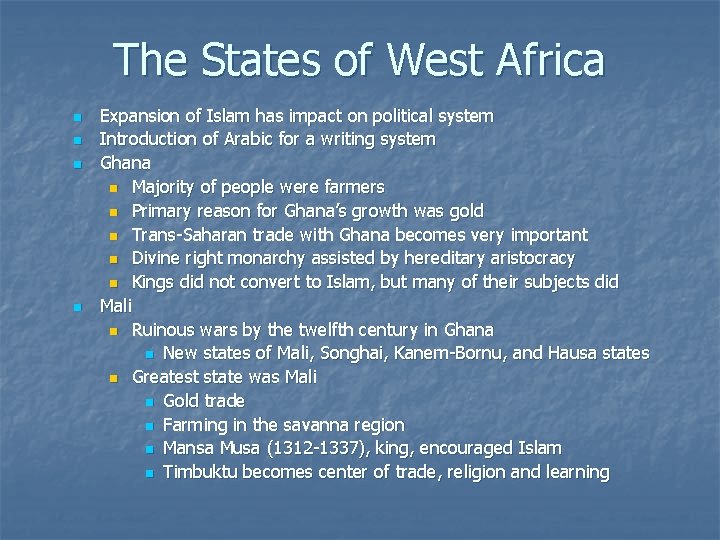
The States of West Africa n n Expansion of Islam has impact on political system Introduction of Arabic for a writing system Ghana n Majority of people were farmers n Primary reason for Ghana’s growth was gold n Trans-Saharan trade with Ghana becomes very important n Divine right monarchy assisted by hereditary aristocracy n Kings did not convert to Islam, but many of their subjects did Mali n Ruinous wars by the twelfth century in Ghana n New states of Mali, Songhai, Kanem-Bornu, and Hausa states n Greatest state was Mali n Gold trade n Farming in the savanna region n Mansa Musa (1312 -1337), king, encouraged Islam n Timbuktu becomes center of trade, religion and learning
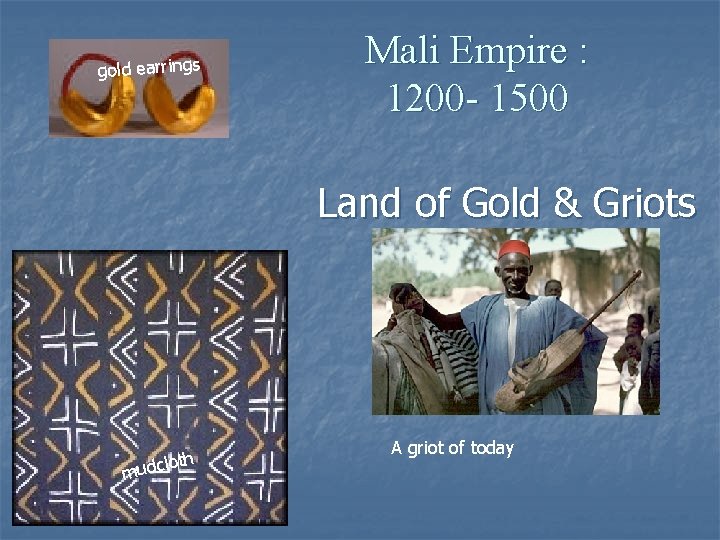
gold earrings Mali Empire : 1200 - 1500 Land of Gold & Griots mu dcloth A griot of today
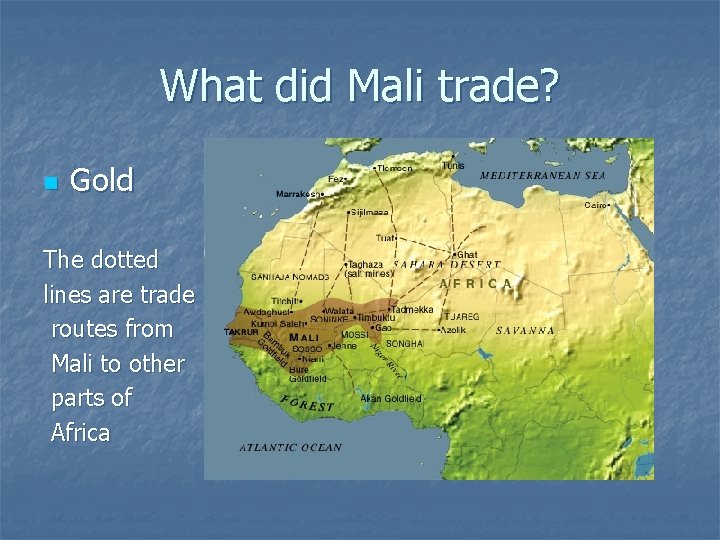
What did Mali trade? n Gold The dotted lines are trade routes from Mali to other parts of Africa
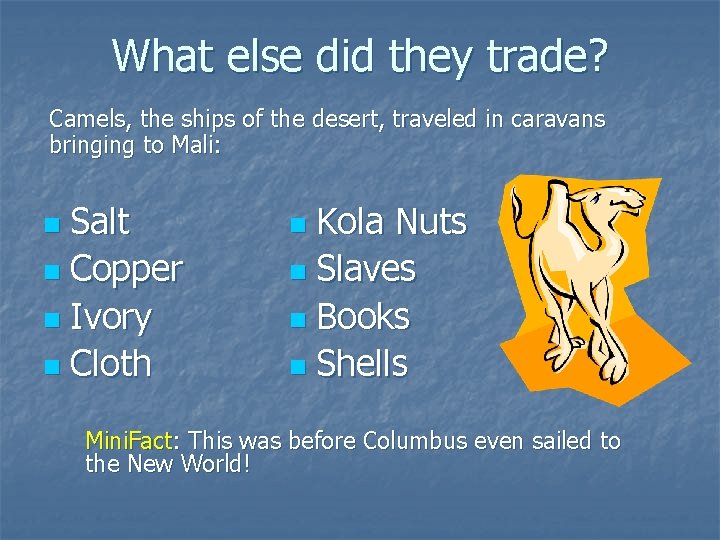
What else did they trade? Camels, the ships of the desert, traveled in caravans bringing to Mali: Salt n Copper n Ivory n Cloth n Kola Nuts n Slaves n Books n Shells n Mini. Fact: This was before Columbus even sailed to the New World!
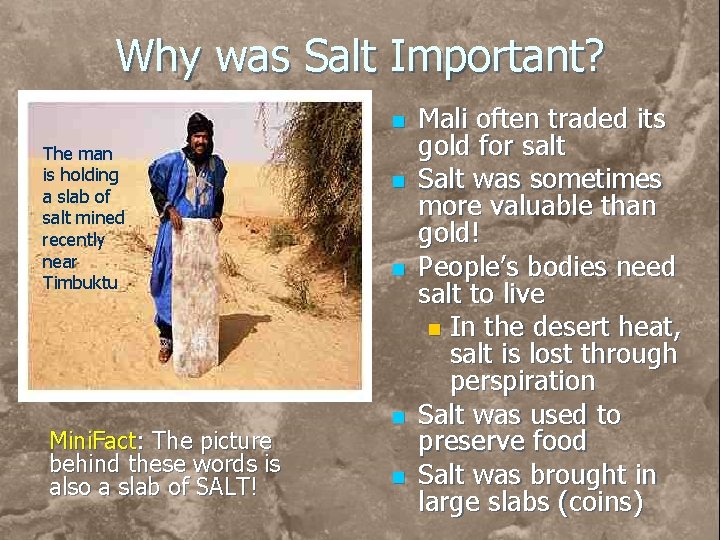
Why was Salt Important? n The man is holding a slab of salt mined recently near Timbuktu Mini. Fact: The picture behind these words is also a slab of SALT! n n Mali often traded its gold for salt Salt was sometimes more valuable than gold! People’s bodies need salt to live n In the desert heat, salt is lost through perspiration Salt was used to preserve food Salt was brought in large slabs (coins)
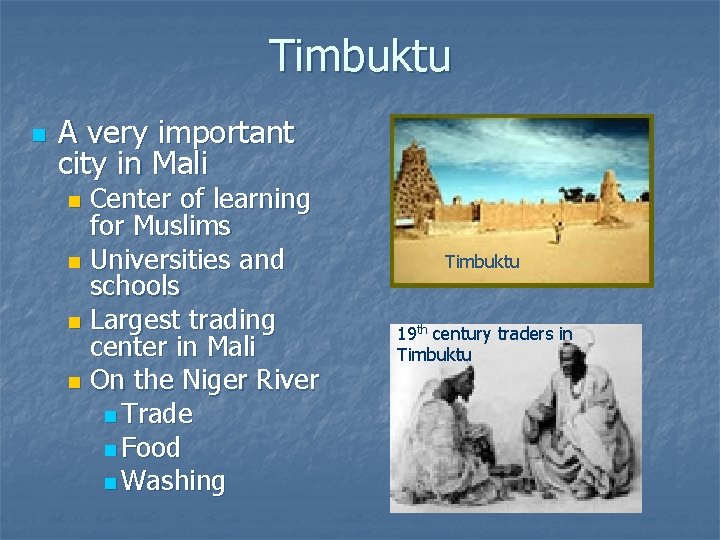
Timbuktu n A very important city in Mali Center of learning for Muslims n Universities and schools n Largest trading center in Mali n On the Niger River n Trade n Food n Washing n Timbuktu 19 th century traders in Timbuktu
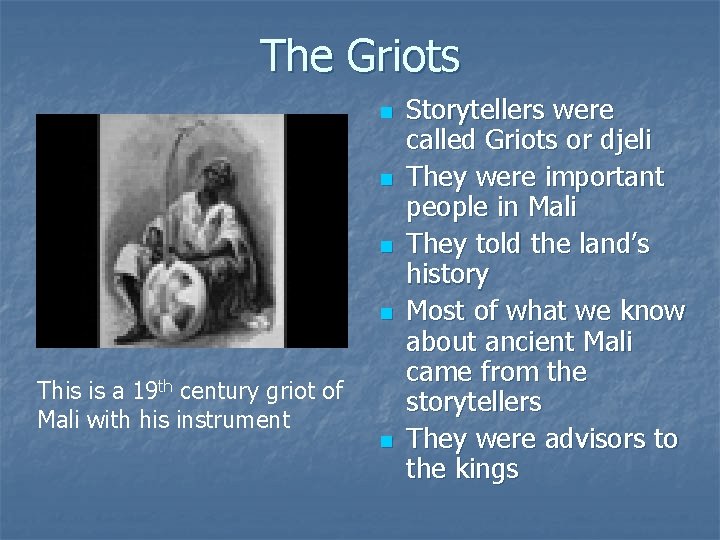
The Griots n n This is a 19 th century griot of Mali with his instrument n Storytellers were called Griots or djeli They were important people in Mali They told the land’s history Most of what we know about ancient Mali came from the storytellers They were advisors to the kings
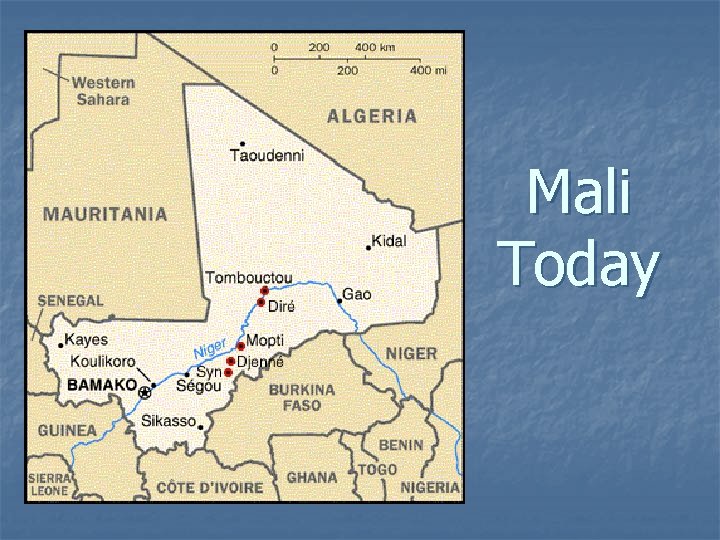
Mali Today
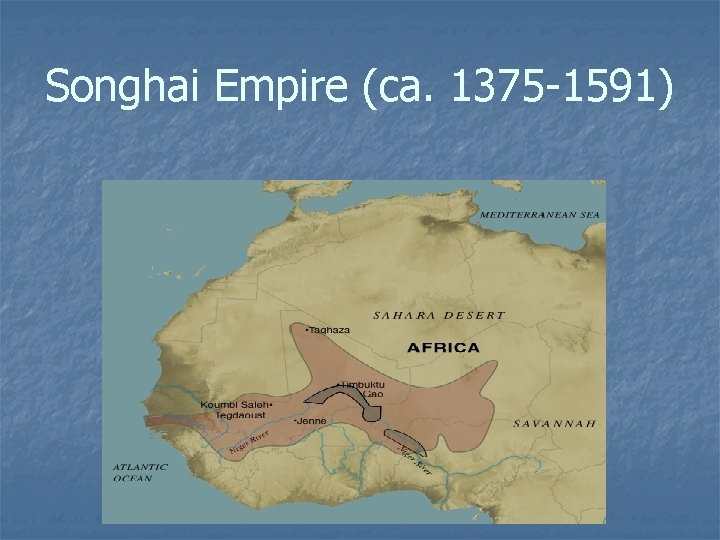
Songhai Empire (ca. 1375 -1591)
The Songhai Empire was the largest and last of the three major pre-colonial empires to emerge in West Africa. From its capital at Gao on the Niger River, Songhai expanded in all directions until it stretched from the Atlantic Ocean to what is now Northwest Nigeria and western Niger. Gao, Songhai’s capital, which remains to this day a small Niger River trading center, was home to the famous Goa Mosque and the Tomb of Askia, the most important of the Songhai emperors. The cities of Timbuktu and Djenne were the other major cultural and commercial centers of the empire. Under the Askias, the Songhai empire reached its zenith, Timbuktu and Jenne flourished as centers of Islamic learning, and Islam was actively promoted.
Sometimes history seems to repeat itself. The rise and fall of two medieval kingdoms of West Africa is an example of this. Mali and Songhai, as well as the smaller kingdom of Ghana before them, were once great trading kingdoms famous for their gold. Yet despite their greatness, they each declined for similar reasons. The rise and fall of Mali and Songhai The empire of Mali, which dated from the early thirteenth century to the late fifteenth century, rose out of what was once the empire of Ghana. Mali had been a state inside of the Ghanaian empire. After Ghana fell because of invading forces and internal disputes, Mali rose to greatness under the leadership of a legendary king named Sundiata, the "Lion King. " Later, another great leader named Mansa Musa extended the empire. After his death, however, his sons could not hold the empire together. The smaller states it had conquered broke off, and the empire crumbled.
As Mali's power waned, Songhai asserted its independence and rose to power in the area. Songhai had been an important trade center within Mali's empire, just as Mali had once been ruled by Ghana. Great Songhai kings such as Sunni Ali Ber and Askia Mohammed Toure extended the Songhai kingdom farther than Ghana or Mali had before it and brought an organized system of government to the area. It was the largest and most powerful kingdom in medieval West Africa. The riches of the gold and salt mines drew invaders, though, and in the late sixteenth century a Moroccan army attacked the capital. The Songhai empire, already weakened by internal political struggles, went into decline.
STOP! Collaborate and Answer n n Name the two major resources that helped Ghana, Mali, and Songhai become major empires. How wealth was Mansa Musa compared to Bill Gates?