
MANPOWER PLANNING Spirit of HR in 2 24
- Slides: 16
MANPOWER PLANNING Spirit of HR. in
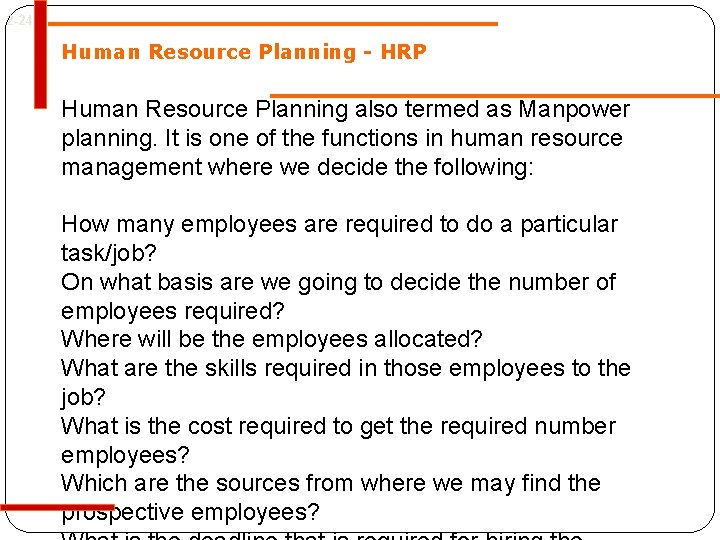
2 -24 Human Resource Planning - HRP Human Resource Planning also termed as Manpower planning. It is one of the functions in human resource management where we decide the following: How many employees are required to do a particular task/job? On what basis are we going to decide the number of employees required? Where will be the employees allocated? What are the skills required in those employees to the job? What is the cost required to get the required number employees? Which are the sources from where we may find the prospective employees?
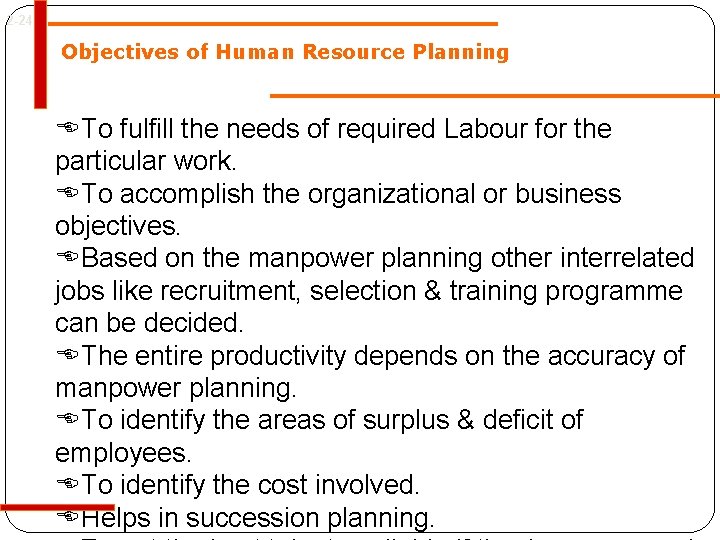
2 -24 Objectives of Human Resource Planning ETo fulfill the needs of required Labour for the particular work. ETo accomplish the organizational or business objectives. EBased on the manpower planning other interrelated jobs like recruitment, selection & training programme can be decided. EThe entire productivity depends on the accuracy of manpower planning. ETo identify the areas of surplus & deficit of employees. ETo identify the cost involved. EHelps in succession planning.
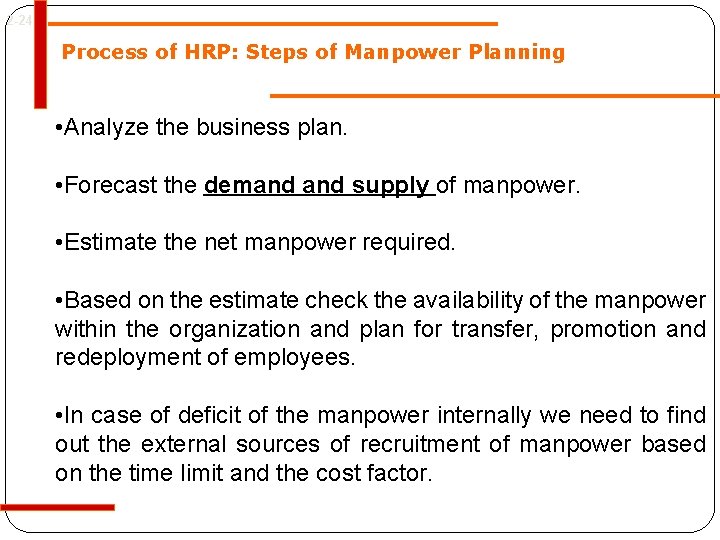
2 -24 Process of HRP: Steps of Manpower Planning • Analyze the business plan. • Forecast the demand supply of manpower. • Estimate the net manpower required. • Based on the estimate check the availability of the manpower within the organization and plan for transfer, promotion and redeployment of employees. • In case of deficit of the manpower internally we need to find out the external sources of recruitment of manpower based on the time limit and the cost factor.
2 -24 Workforce Demand Forecasting – Qualitative Methods Judgmental Methods: using a combined judgment of employees and management (employees -a down-up driven approach). (only managerial judgment -a top to down approach) Delphi Technique This technique uses the judgment of the experts. Generally a panel of experts is chosen. They are then polled for their forecasts. The average of such forecasts is then taken as the demand of workforce in that firm. This method is also known as Expert Forecasts.
2 -24 Workforce Demand Forecasting – Quantitative Methods a. Trend Analysis: Study the past staffing needs over a period of years to predict future needs. b. Workforce Analysis: All relevant factors in planning manpower flows in a firm such as transfers, promotions, new recruitments, retirement, resignation, dismissal etc are taken into account while estimating HR needs. c. Workload Analysis: A tool used to predict and plan future work and skills requirements(the number of persons required and the skills)based upon
2 -24 Workforce Demand Forecasting – Quantitative Methods d. Predictor Variable Method (regression method) i. e No. of Employees Recruited VS No. of units produced. Or Amount of units sold. This is done by using past records to estimate the future requirements. e. Markov Analysis: This technique of manpower planning is named after a Russian mathematician Andrei Andreyevich Markov. This model is used to determine the internal flow of human resources. It simply shows as probabilities the average rate of historical movement of employees from one job to another. f) Bottom Up Technique Each operations manager will give their requirement to the
2 -24 Workforce SUPPLY Forecasting - Internal labor supply: Manpower Inventory : terms of the size and quality of personnel available (their age, gender, education, training, experience, job performance, etc) is usually prepared by HR departments. Qualifications inventories Manual or computerized records listing employees’ education, career and development interests, languages, special skills etc to be used in selecting inside candidates for promotion. Personnel replacement charts Replacement charts are a forecasting technique used in succession planning. It is a visual representation of who will replace whom in the event of a job opening. Position replacement card A card prepared for each position in a company to show
5 -13 Workforce SUPPLY Forecasting - Internal Staffing table: Staffing tables are graphic representations of all organizational jobs, along with the numbers of employees currently occupying those jobs and future (monthly or yearly) employment requirements, which can be derived from demand forecasts. Skills inventory: It is a summary of the skills and abilities of employees used in forecasting supply. Human Resource Planning
5 -19 Workforce SUPPLY Forecasting - External B) External Labor supply: External hires need to be contacted when suitable internal replacements are not available. . Ex: Monster, Naukri, recruiting agencies. Human Resource Planning
5 -19 Important things to be kept in mind before doing any Manpower planning a) Do a complete work force analysis b) Check out the internal recruitment possibilities c) Time Span to hire. d) Cost/finance approved for the required manpower. e) Type of manpower required (permanent/contract). Human Resource Planning
5 -19 Factors that affect the manpower planning: 1) The type of business. 2) The demand supply of manpower available. 3) The budget allocated for the manpower procurement. 4) The time limit estimated for the manpower procurement. 5) The various barriers to manpower planning. Human Resource Planning
5 -19 Barriers to Manpower Planning 1) The accuracy of forecasting. 2) Unwanted absenteeism 3) Attrition 4) Under utilization of the manpower. 5) Extended Break timings. 6) Terminations and layoff Human Resource Planning
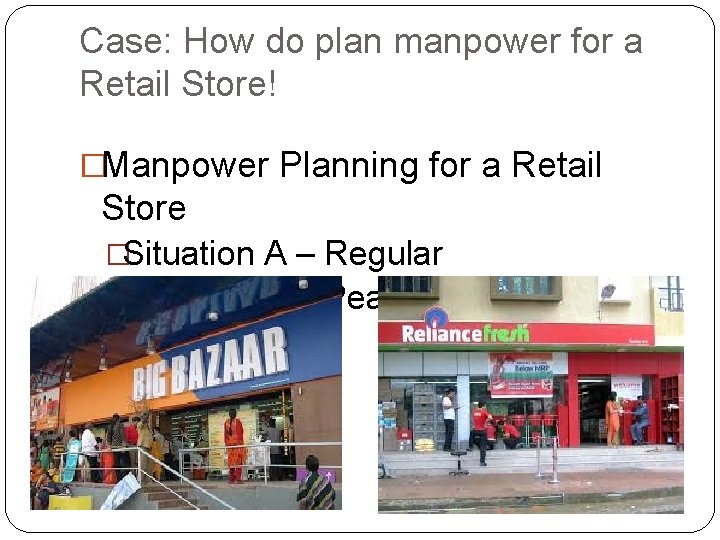
Case: How do plan manpower for a Retail Store! �Manpower Planning for a Retail Store �Situation A – Regular �Situation B – Peak Season
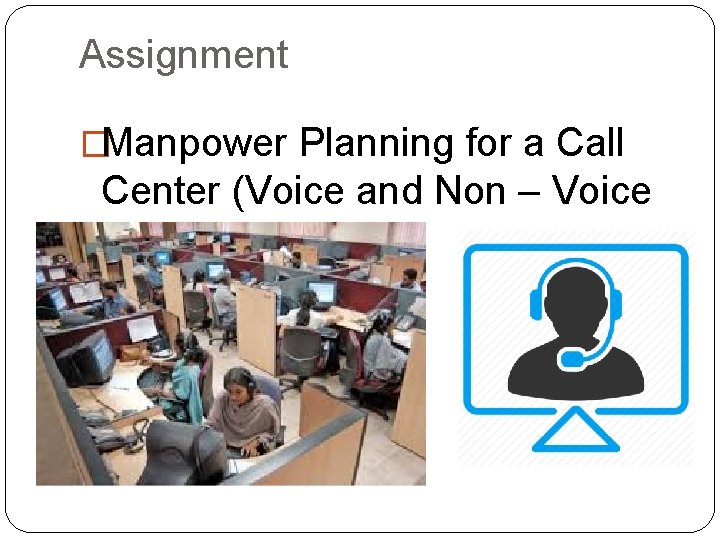
Assignment �Manpower Planning for a Call Center (Voice and Non – Voice Process)
Thank you…. Spirit of HR. in