
Manor Way 24117 Aims of the Session To



- Slides: 32
Manor Way 24/1/17
Aims of the Session To understand how we teach phonics To be clear about what is taught in different year groups Support and ideas to practice phonics in reading and writing at home
How will we work together ?
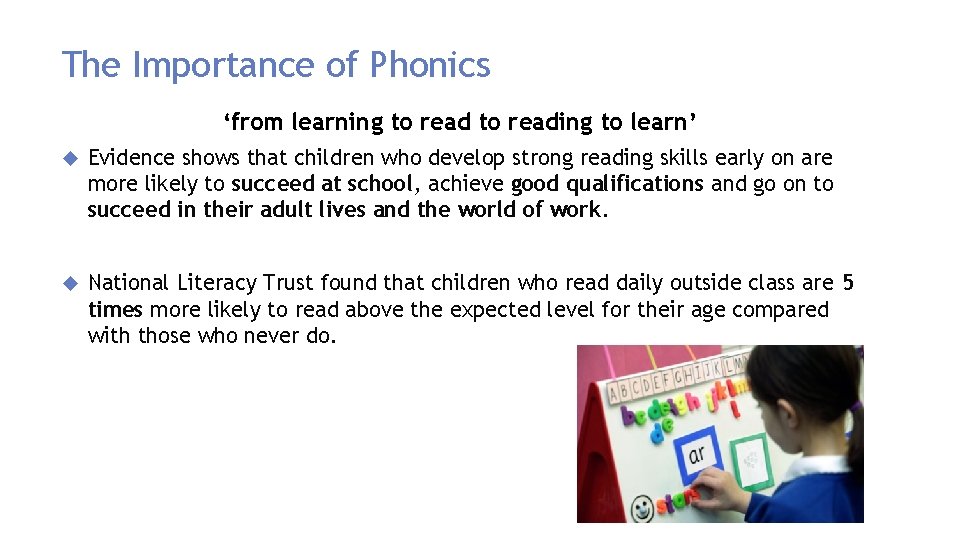
The Importance of Phonics ‘from learning to reading to learn’ Evidence shows that children who develop strong reading skills early on are more likely to succeed at school, achieve good qualifications and go on to succeed in their adult lives and the world of work. National Literacy Trust found that children who read daily outside class are 5 times more likely to read above the expected level for their age compared with those who never do.
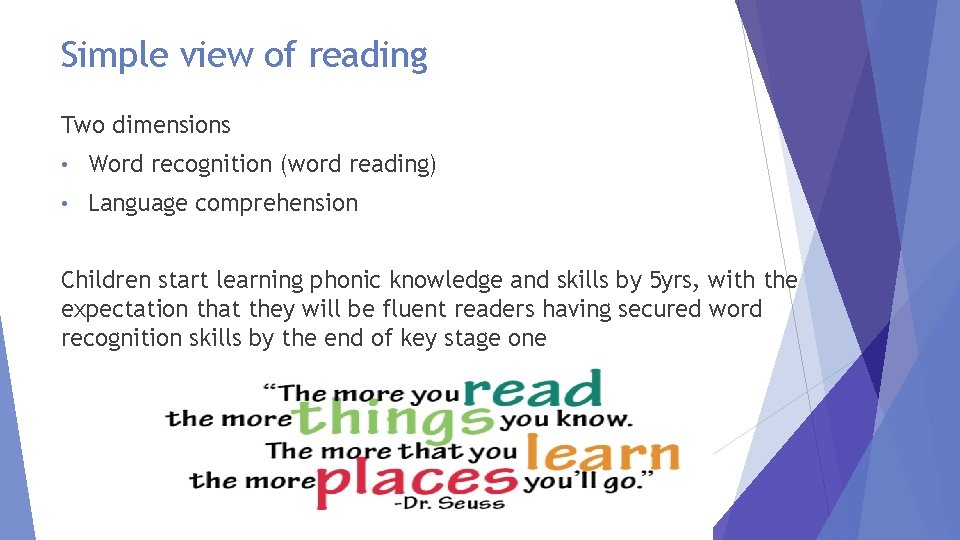
Simple view of reading Two dimensions • Word recognition (word reading) • Language comprehension Children start learning phonic knowledge and skills by 5 yrs, with the expectation that they will be fluent readers having secured word recognition skills by the end of key stage one
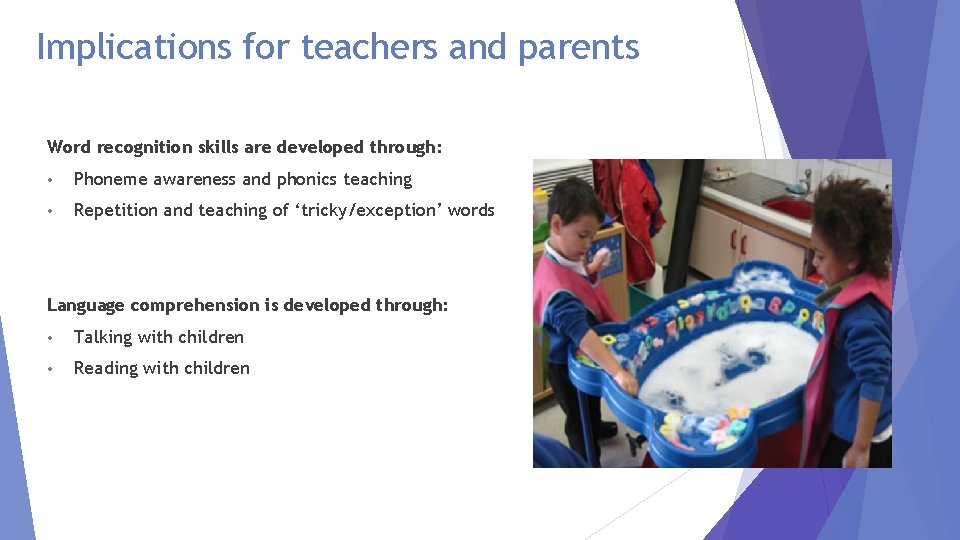
Implications for teachers and parents Word recognition skills are developed through: • Phoneme awareness and phonics teaching • Repetition and teaching of ‘tricky/exception’ words Language comprehension is developed through: • Talking with children • Reading with children
What is Phonics? Phonics consists of the knowledge of the skills of segmenting and blending, knowledge of the alphabet and how this is used in reading and writing.
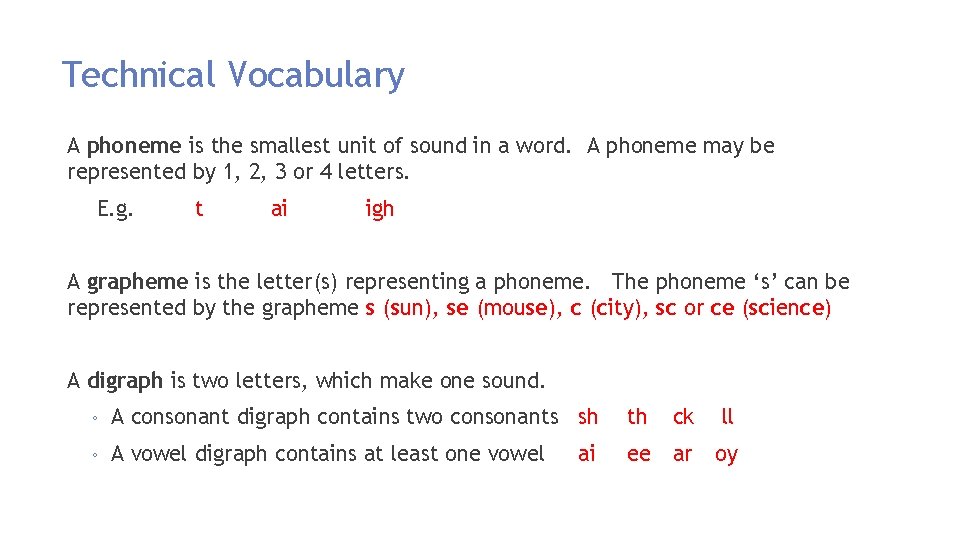
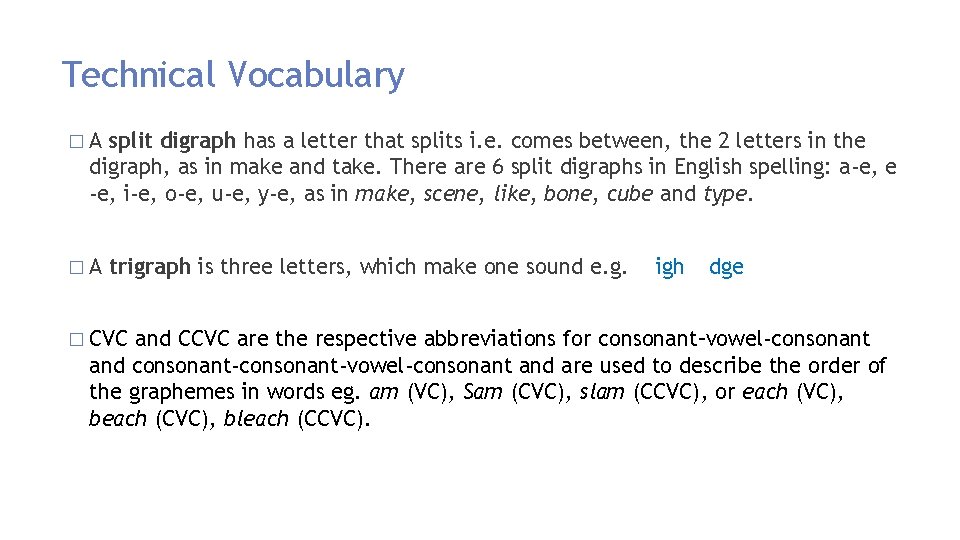
Technical Vocabulary A phoneme is the smallest unit of sound in a word. A phoneme may be represented by 1, 2, 3 or 4 letters. E. g. t ai igh A grapheme is the letter(s) representing a phoneme. The phoneme ‘s’ can be represented by the grapheme s (sun), se (mouse), c (city), sc or ce (science) A digraph is two letters, which make one sound. ◦ A consonant digraph contains two consonants sh th ck ll ◦ A vowel digraph contains at least one vowel ee ar oy ai
Technical Vocabulary �A split digraph has a letter that splits i. e. comes between, the 2 letters in the digraph, as in make and take. There are 6 split digraphs in English spelling: a-e, e -e, i-e, o-e, u-e, y-e, as in make, scene, like, bone, cube and type. �A trigraph is three letters, which make one sound e. g. � CVC igh dge and CCVC are the respective abbreviations for consonant–vowel-consonant and consonant-vowel-consonant and are used to describe the order of the graphemes in words eg. am (VC), Sam (CVC), slam (CCVC), or each (VC), beach (CVC), bleach (CCVC).
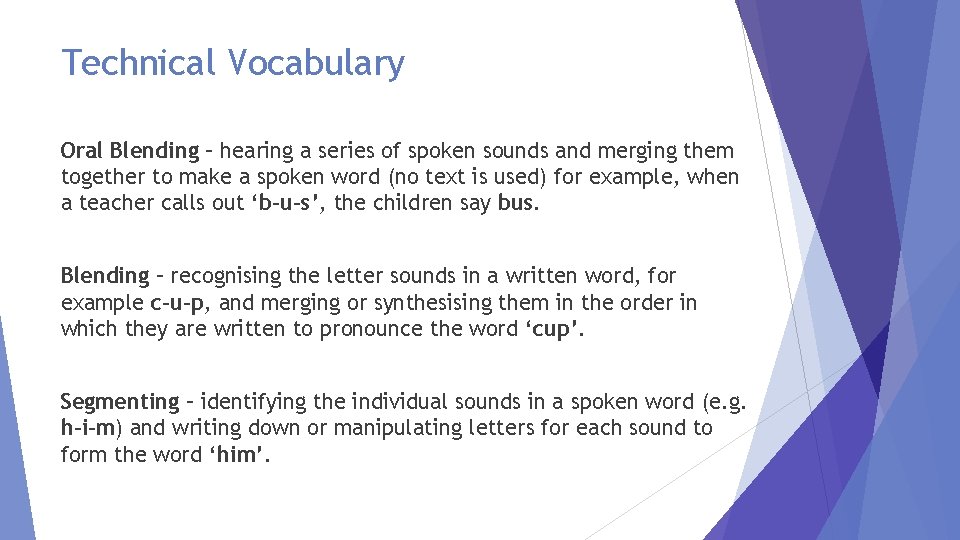
Technical Vocabulary Oral Blending – hearing a series of spoken sounds and merging them together to make a spoken word (no text is used) for example, when a teacher calls out ‘b-u-s’, the children say bus. Blending – recognising the letter sounds in a written word, for example c-u-p, and merging or synthesising them in the order in which they are written to pronounce the word ‘cup’. Segmenting – identifying the individual sounds in a spoken word (e. g. h-i-m) and writing down or manipulating letters for each sound to form the word ‘him’.
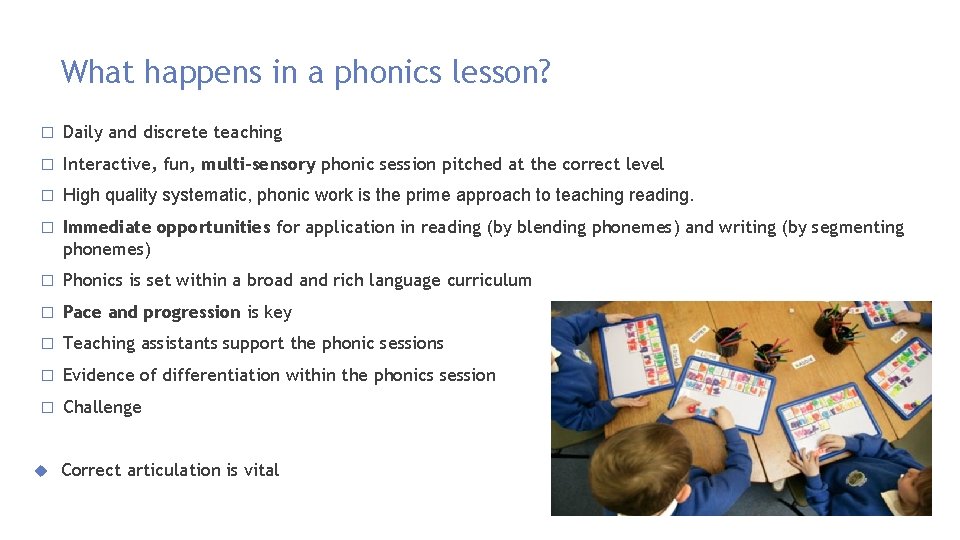
What happens in a phonics lesson? � Daily and discrete teaching � Interactive, fun, multi-sensory phonic session pitched at the correct level � High quality systematic, phonic work is the prime approach to teaching reading. � Immediate opportunities for application in reading (by blending phonemes) and writing (by segmenting phonemes) � Phonics is set within a broad and rich language curriculum � Pace and progression is key � Teaching assistants support the phonic sessions � Evidence of differentiation within the phonics session � Challenge Correct articulation is vital
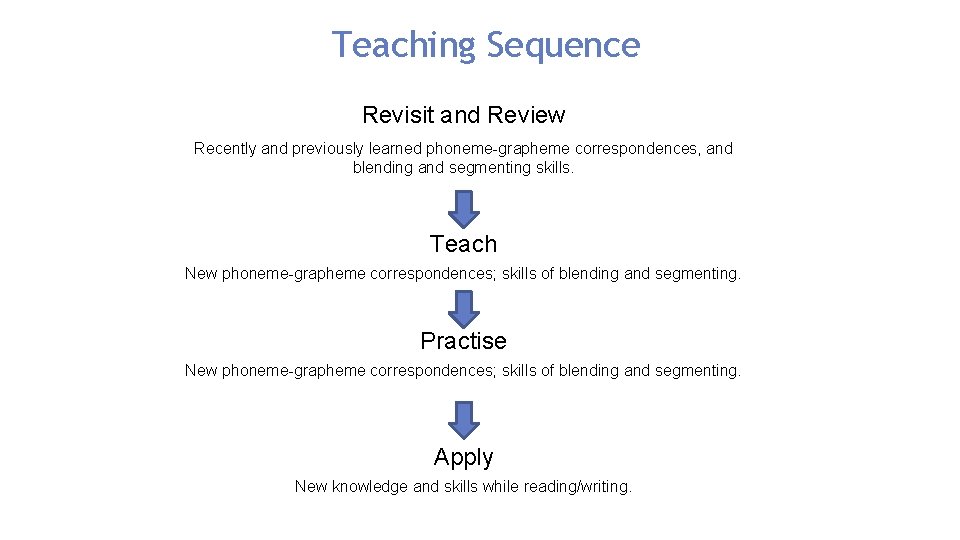
Teaching Sequence Revisit and Review Recently and previously learned phoneme-grapheme correspondences, and blending and segmenting skills. Teach New phoneme-grapheme correspondences; skills of blending and segmenting. Practise New phoneme-grapheme correspondences; skills of blending and segmenting. Apply New knowledge and skills while reading/writing.
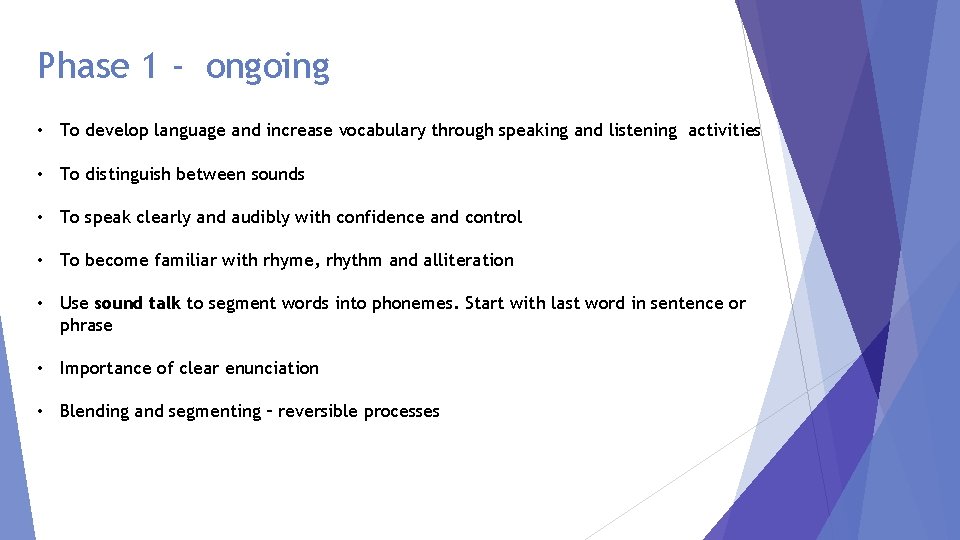
Phase 1 - ongoing • To develop language and increase vocabulary through speaking and listening activities • To distinguish between sounds • To speak clearly and audibly with confidence and control • To become familiar with rhyme, rhythm and alliteration • Use sound talk to segment words into phonemes. Start with last word in sentence or phrase • Importance of clear enunciation • Blending and segmenting – reversible processes
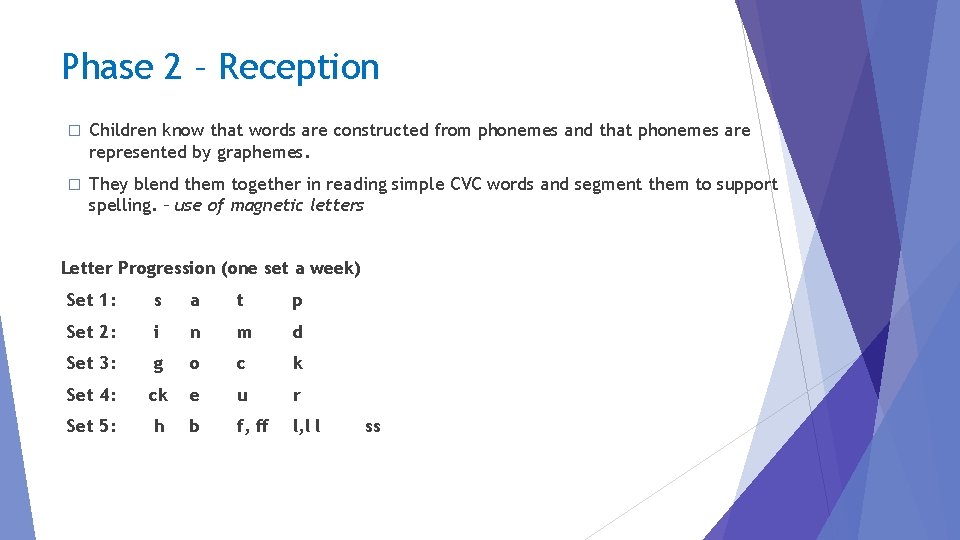
Phase 2 – Reception � Children know that words are constructed from phonemes and that phonemes are represented by graphemes. � They blend them together in reading simple CVC words and segment them to support spelling. – use of magnetic letters Letter Progression (one set a week) Set 1: s a t p Set 2: i n m d Set 3: g o c k Set 4: ck e u r Set 5: h b f, ff l, l l ss
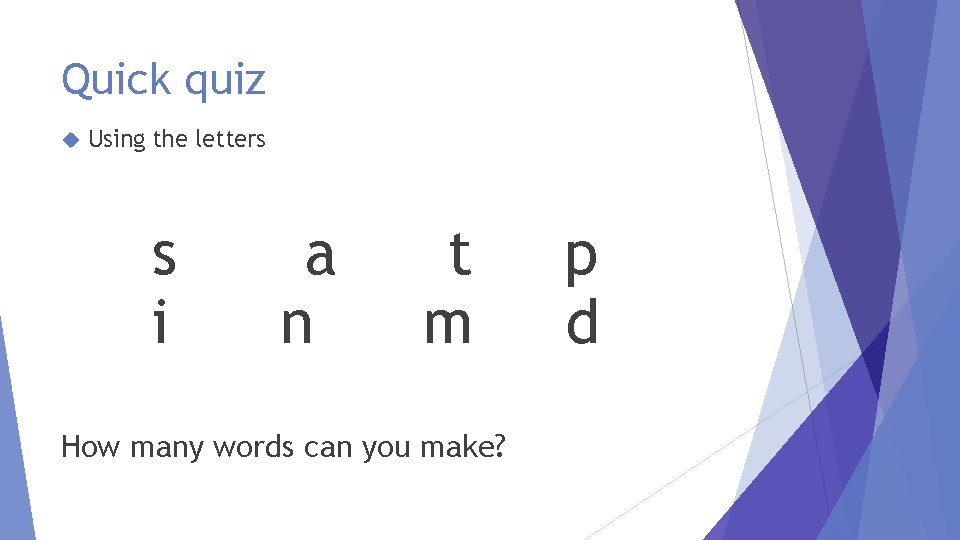
Quick quiz Using the letters s i a n t m How many words can you make? p d
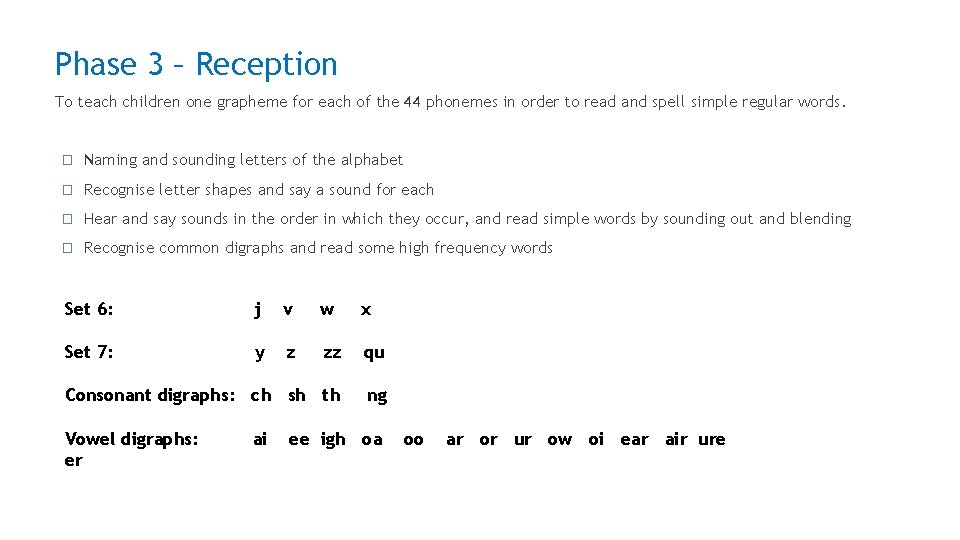
Phase 3 – Reception To teach children one grapheme for each of the 44 phonemes in order to read and spell simple regular words. � Naming and sounding letters of the alphabet � Recognise letter shapes and say a sound for each � Hear and say sounds in the order in which they occur, and read simple words by sounding out and blending � Recognise common digraphs and read some high frequency words Set 6: j v w x Set 7: y z zz qu Consonant digraphs: ch sh th ng Vowel digraphs: er ai ee igh oa oo ar or ur ow oi ear air ure
Correct Articulation of phonemes is essential! Articulation of Sounds http: //www. youtube. com/watch? v=5 J 2 Ddf_0 Om 8&safe=active
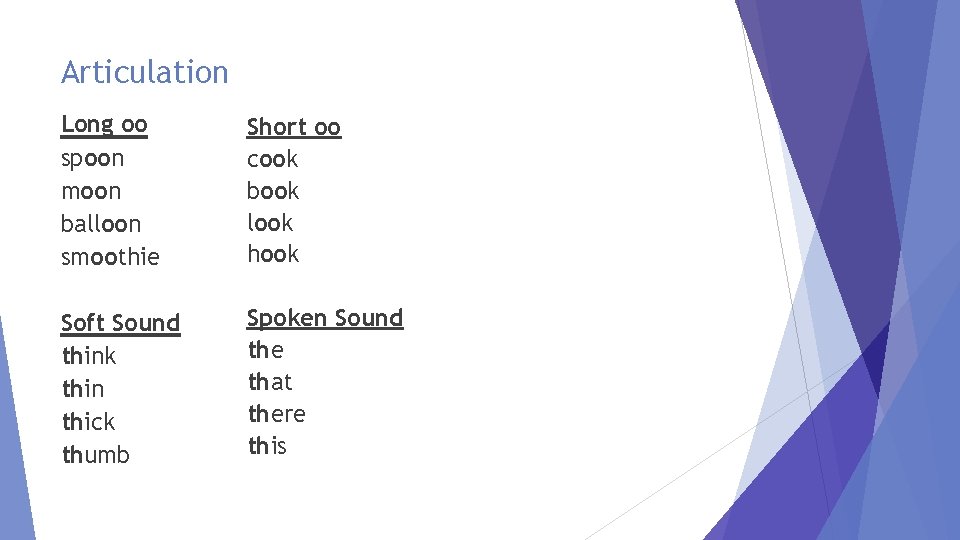
Articulation Long oo spoon moon balloon smoothie Short oo cook book look hook Soft Sound think thin thick thumb Spoken Sound the that there this
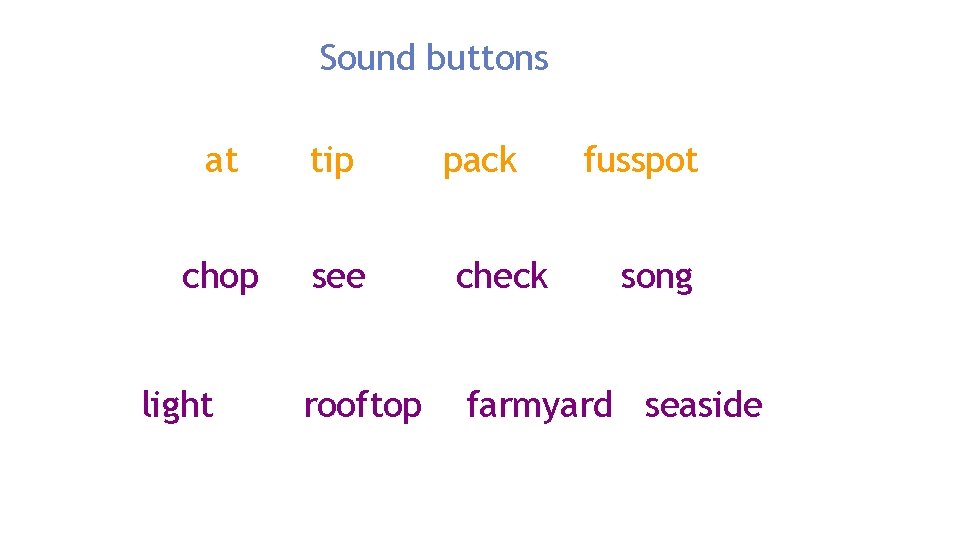
Sound buttons at tip chop see check rooftop farmyard seaside light pack fusspot song
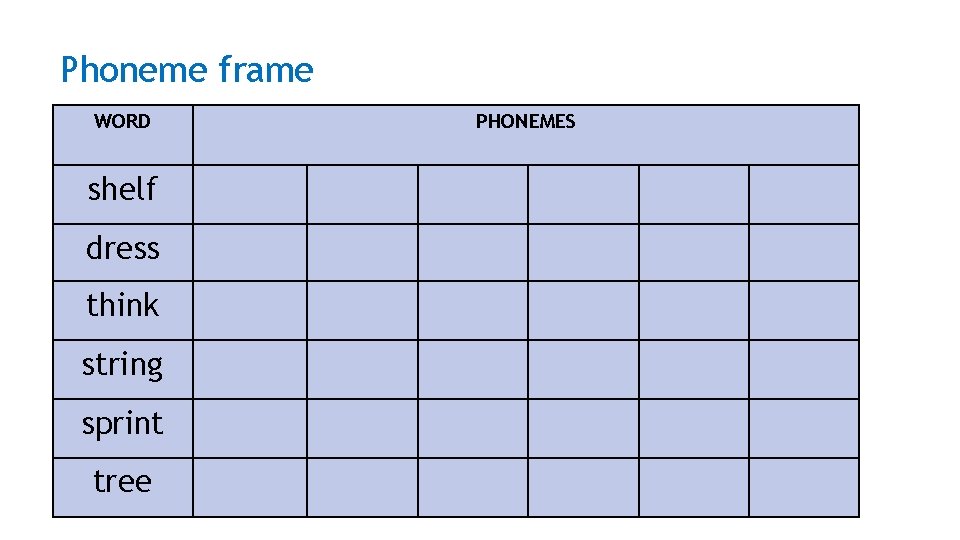
Phoneme frame WORD shelf dress think string sprint tree PHONEMES
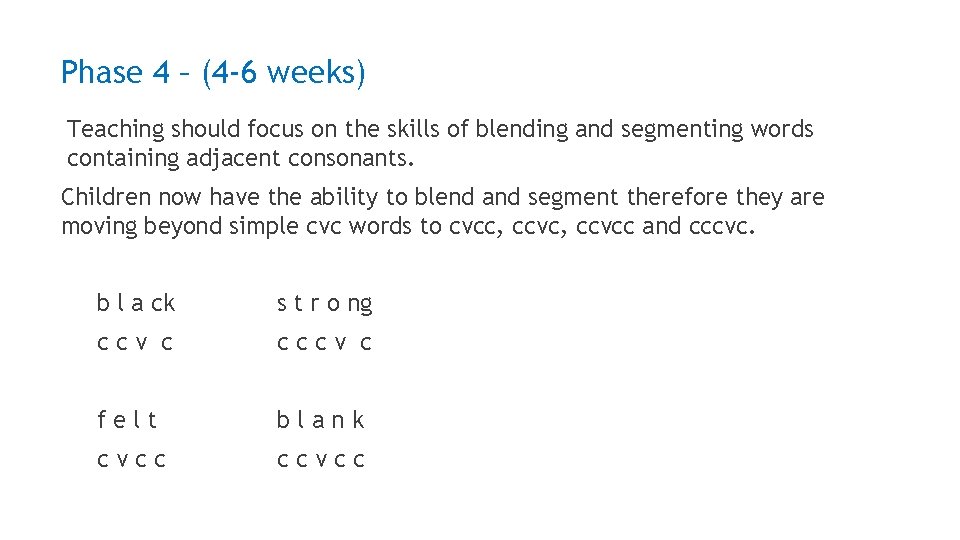
Phase 4 – (4 -6 weeks) Teaching should focus on the skills of blending and segmenting words containing adjacent consonants. Children now have the ability to blend and segment therefore they are moving beyond simple cvc words to cvcc, ccvcc and cccvc. b l a ck s t r o ng ccv c cccv c felt blank cvcc ccvcc
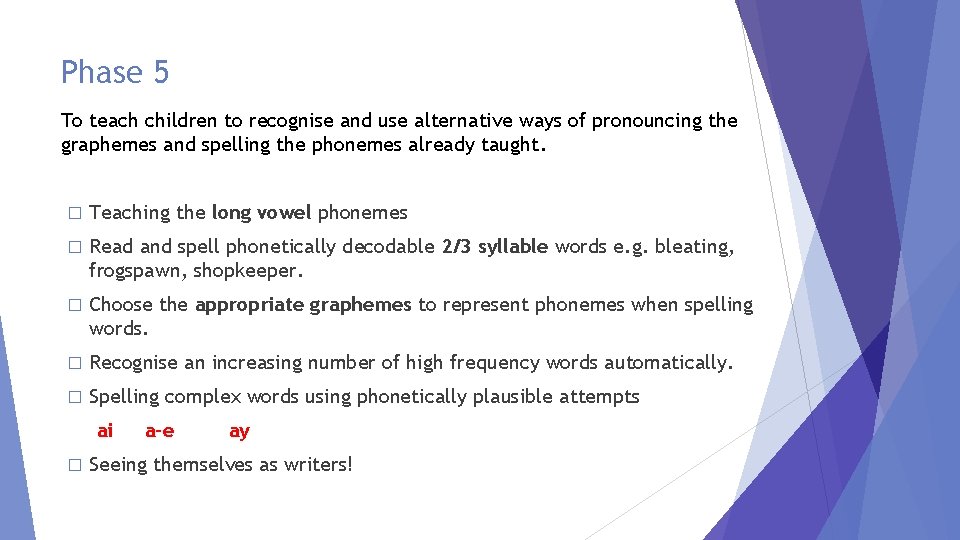
Phase 5 To teach children to recognise and use alternative ways of pronouncing the graphemes and spelling the phonemes already taught. � Teaching the long vowel phonemes � Read and spell phonetically decodable 2/3 syllable words e. g. bleating, frogspawn, shopkeeper. � Choose the appropriate graphemes to represent phonemes when spelling words. � Recognise an increasing number of high frequency words automatically. � Spelling complex words using phonetically plausible attempts ai � a-e ay Seeing themselves as writers!
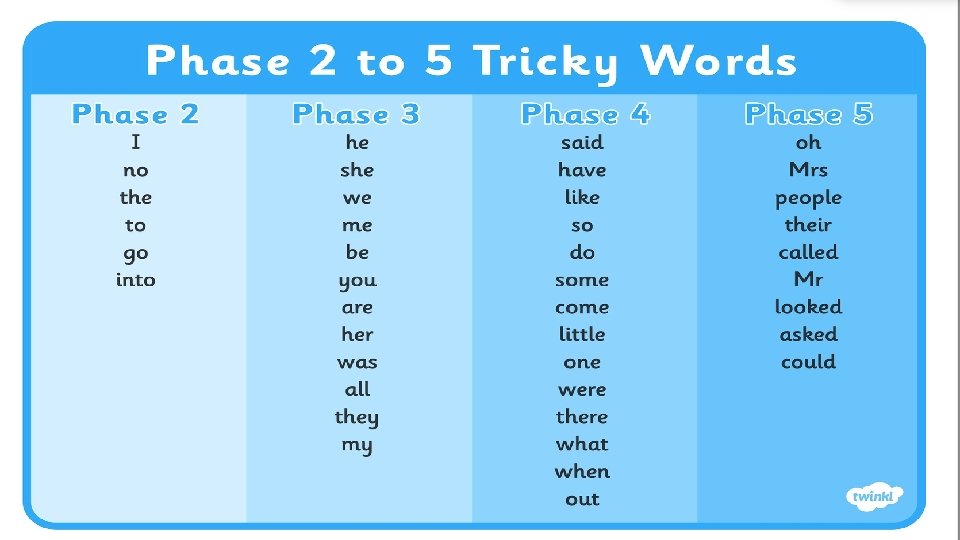
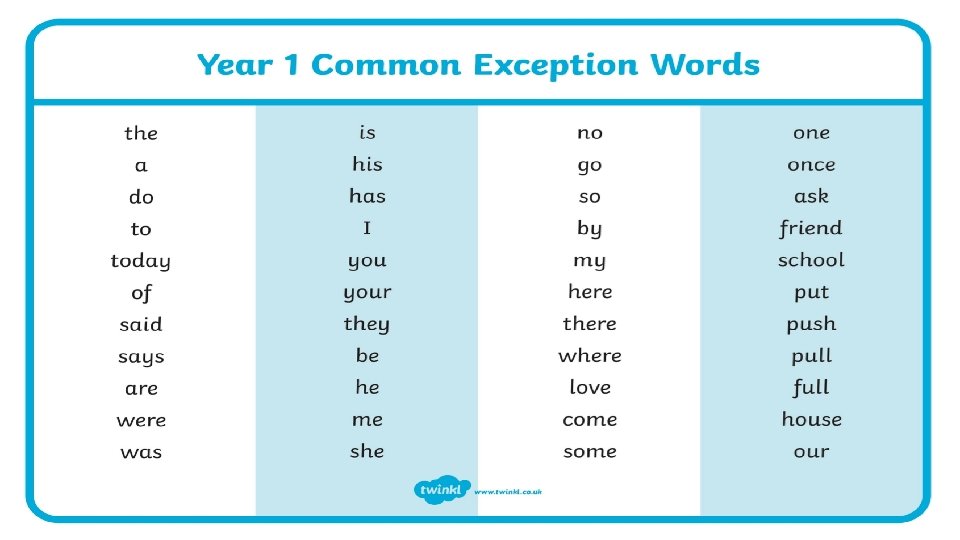
Tricky words and Common Exceptions words Reception Year 1
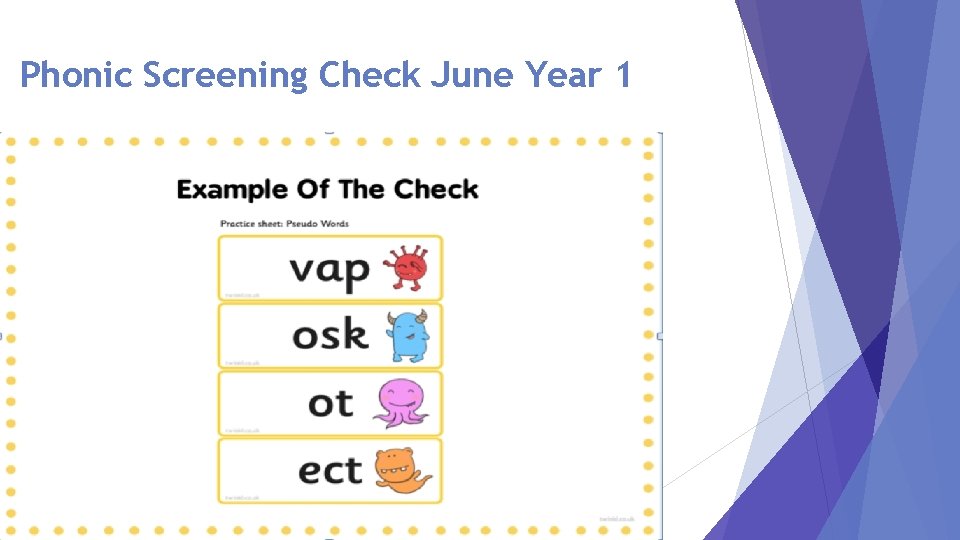
Phonic Screening Check June Year 1
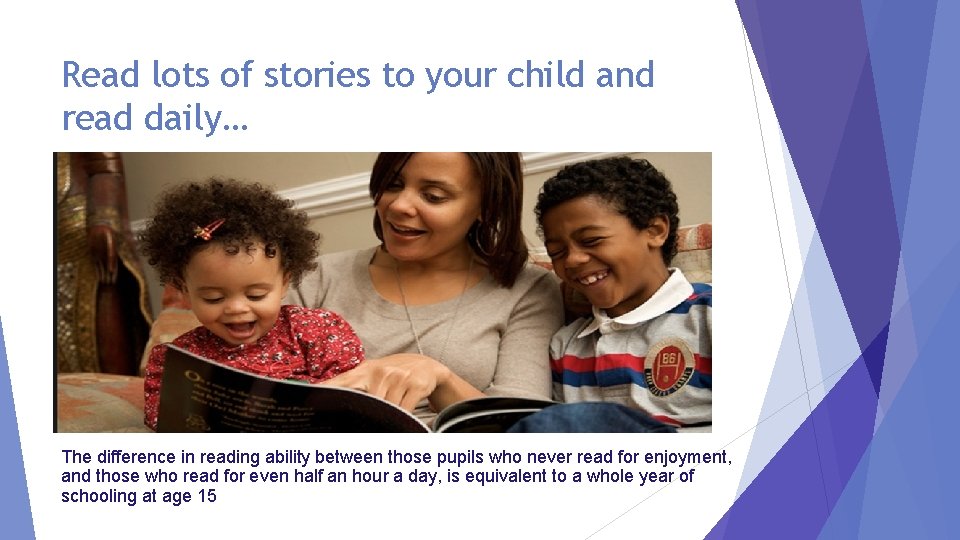
Read lots of stories to your child and read daily… The difference in reading ability between those pupils who never read for enjoyment, and those who read for even half an hour a day, is equivalent to a whole year of schooling at age 15
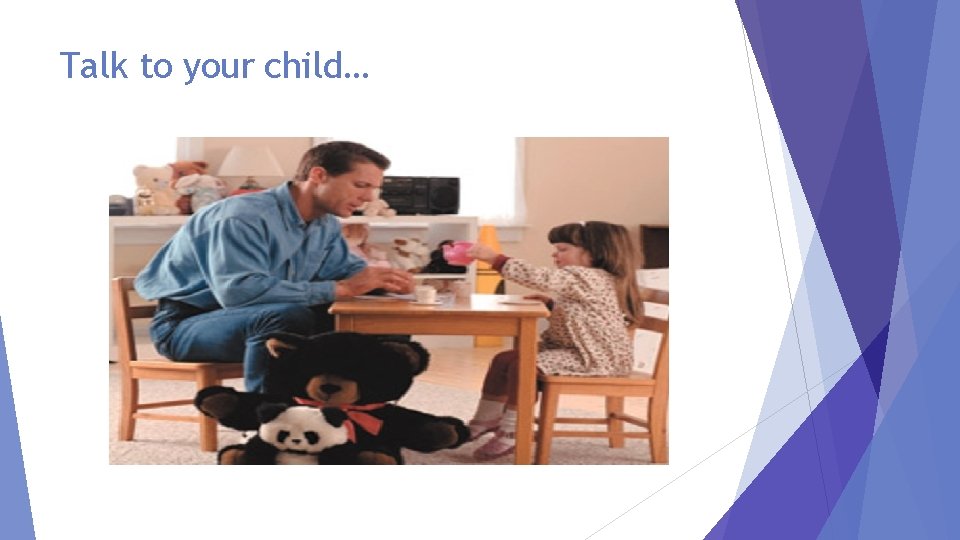
Talk to your child…
More ideas… Phonic reading books Spot phonemes in words Eye spy Letters and sounds website Phonicsplay. co. uk BBC phonics http: //www. youtube. com/watch? v=5 J 2 Ddf_0 Om 8&safe=active Mrthorn. com