
Mannings Equation Gauckler1867ManningStrickler 1923 n In 1889 Irish
- Slides: 11
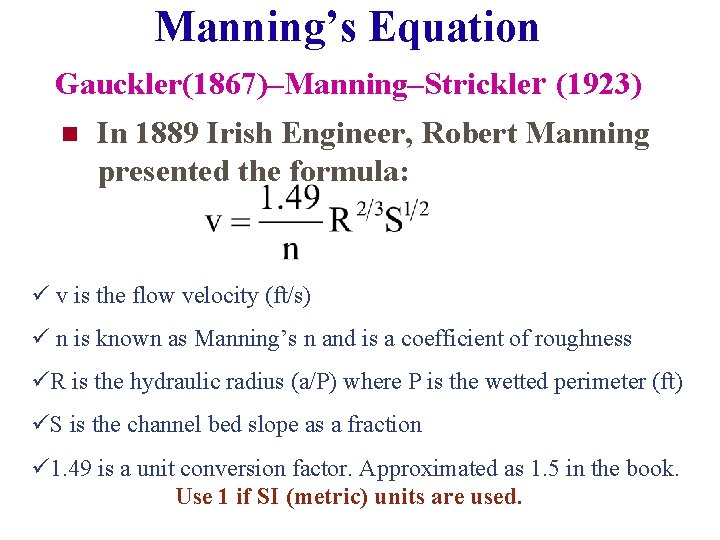
Manning’s Equation Gauckler(1867)–Manning–Strickler (1923) n In 1889 Irish Engineer, Robert Manning presented the formula: ü v is the flow velocity (ft/s) ü n is known as Manning’s n and is a coefficient of roughness üR is the hydraulic radius (a/P) where P is the wetted perimeter (ft) üS is the channel bed slope as a fraction ü 1. 49 is a unit conversion factor. Approximated as 1. 5 in the book. Use 1 if SI (metric) units are used.
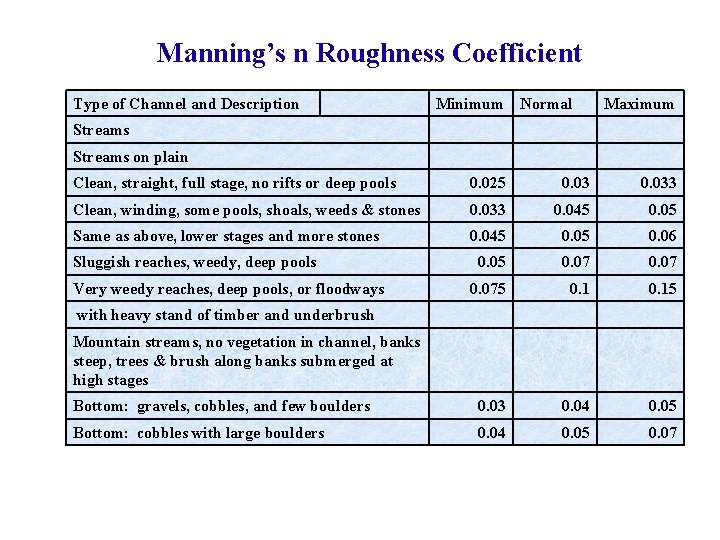
Manning’s n Roughness Coefficient Type of Channel and Description Minimum Normal Maximum Streams on plain Clean, straight, full stage, no rifts or deep pools 0. 025 0. 033 Clean, winding, some pools, shoals, weeds & stones 0. 033 0. 045 0. 05 Same as above, lower stages and more stones 0. 045 0. 06 0. 05 0. 075 0. 15 Bottom: gravels, cobbles, and few boulders 0. 03 0. 04 0. 05 Bottom: cobbles with large boulders 0. 04 0. 05 0. 07 Sluggish reaches, weedy, deep pools Very weedy reaches, deep pools, or floodways with heavy stand of timber and underbrush Mountain streams, no vegetation in channel, banks steep, trees & brush along banks submerged at high stages
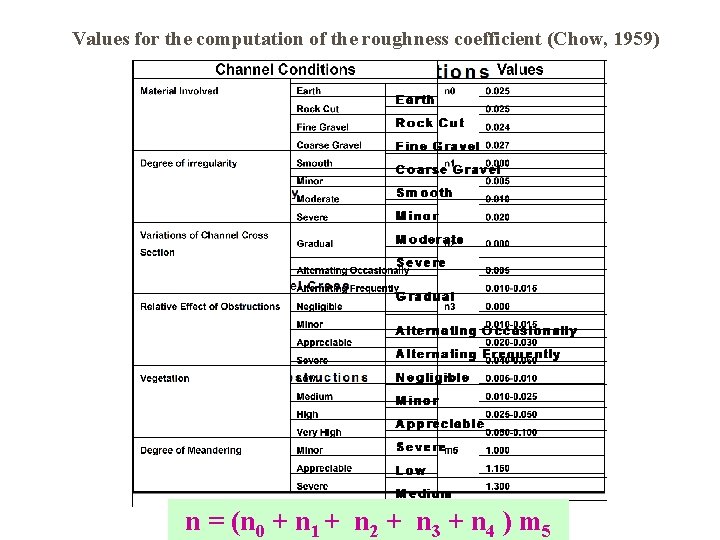
Values for the computation of the roughness coefficient (Chow, 1959) n = (n 0 + n 1 + n 2 + n 3 + n 4 ) m 5
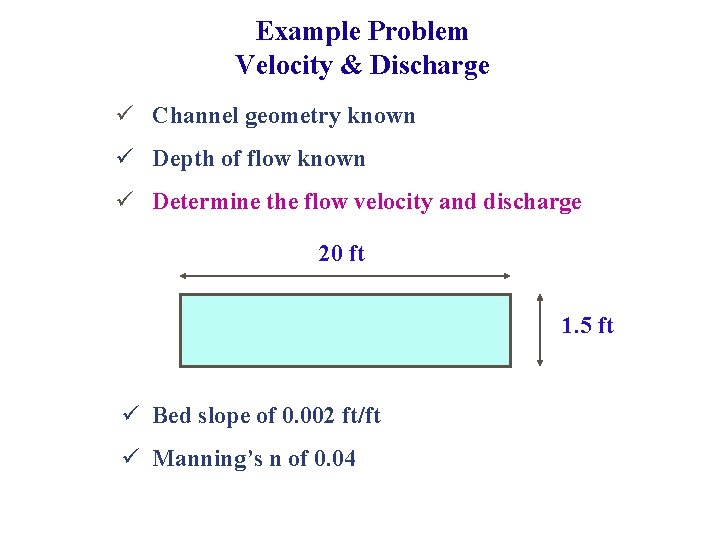
Example Problem Velocity & Discharge ü Channel geometry known ü Depth of flow known ü Determine the flow velocity and discharge 20 ft 1. 5 ft ü Bed slope of 0. 002 ft/ft ü Manning’s n of 0. 04
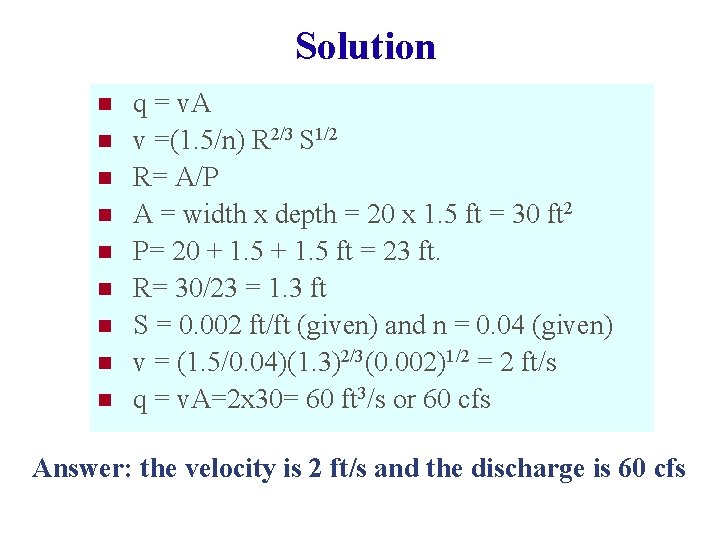
Solution n n n n q = v. A v =(1. 5/n) R 2/3 S 1/2 R= A/P A = width x depth = 20 x 1. 5 ft = 30 ft 2 P= 20 + 1. 5 ft = 23 ft. R= 30/23 = 1. 3 ft S = 0. 002 ft/ft (given) and n = 0. 04 (given) v = (1. 5/0. 04)(1. 3)2/3(0. 002)1/2 = 2 ft/s q = v. A=2 x 30= 60 ft 3/s or 60 cfs Answer: the velocity is 2 ft/s and the discharge is 60 cfs
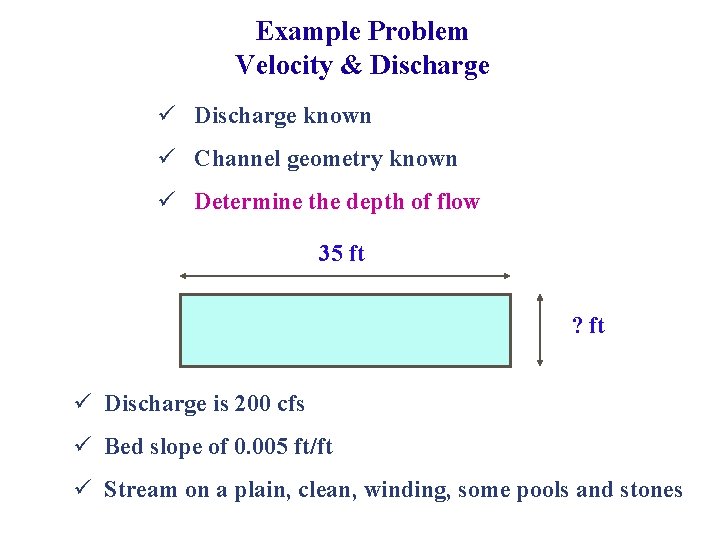
Example Problem Velocity & Discharge ü Discharge known ü Channel geometry known ü Determine the depth of flow 35 ft ? ft ü Discharge is 200 cfs ü Bed slope of 0. 005 ft/ft ü Stream on a plain, clean, winding, some pools and stones
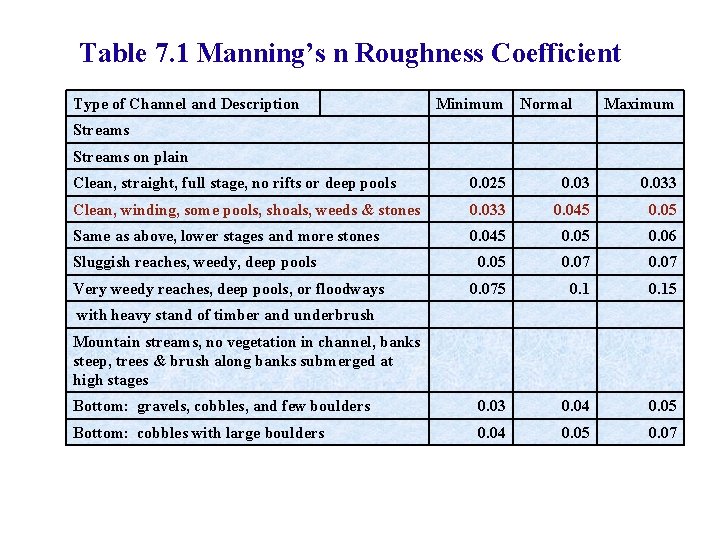
Table 7. 1 Manning’s n Roughness Coefficient Type of Channel and Description Minimum Normal Maximum Streams on plain Clean, straight, full stage, no rifts or deep pools 0. 025 0. 033 Clean, winding, some pools, shoals, weeds & stones 0. 033 0. 045 0. 05 Same as above, lower stages and more stones 0. 045 0. 06 0. 05 0. 075 0. 15 Bottom: gravels, cobbles, and few boulders 0. 03 0. 04 0. 05 Bottom: cobbles with large boulders 0. 04 0. 05 0. 07 Sluggish reaches, weedy, deep pools Very weedy reaches, deep pools, or floodways with heavy stand of timber and underbrush Mountain streams, no vegetation in channel, banks steep, trees & brush along banks submerged at high stages
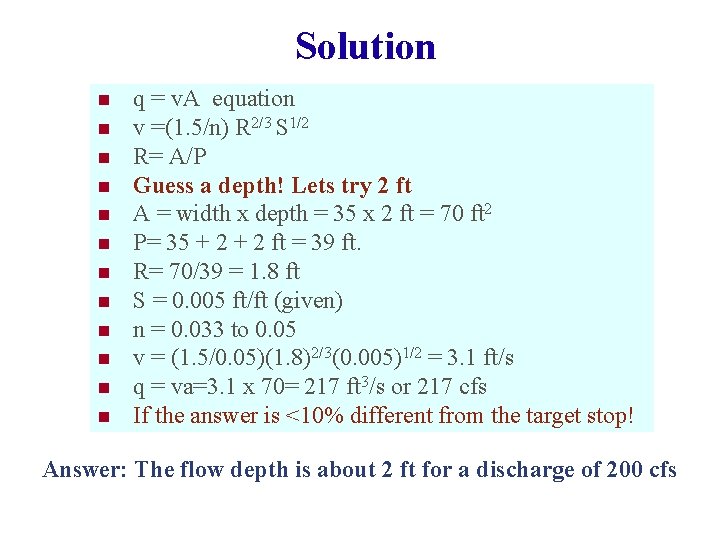
Solution n n n q = v. A equation v =(1. 5/n) R 2/3 S 1/2 R= A/P Guess a depth! Lets try 2 ft A = width x depth = 35 x 2 ft = 70 ft 2 P= 35 + 2 ft = 39 ft. R= 70/39 = 1. 8 ft S = 0. 005 ft/ft (given) n = 0. 033 to 0. 05 v = (1. 5/0. 05)(1. 8)2/3(0. 005)1/2 = 3. 1 ft/s q = va=3. 1 x 70= 217 ft 3/s or 217 cfs If the answer is <10% different from the target stop! Answer: The flow depth is about 2 ft for a discharge of 200 cfs
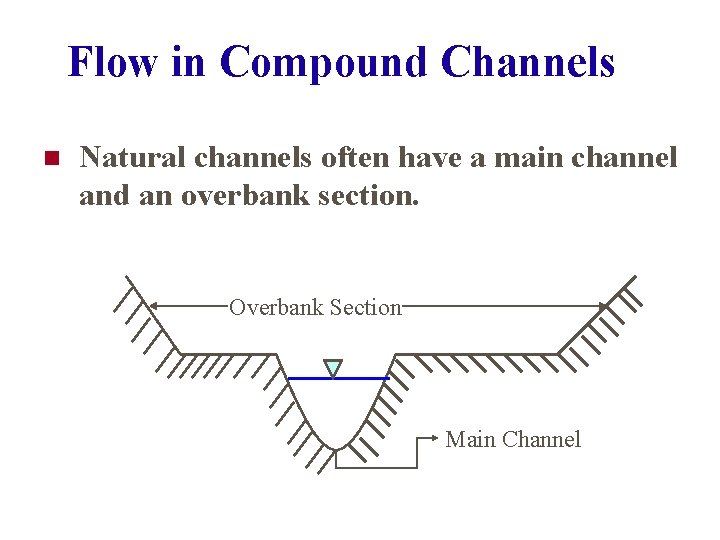
Flow in Compound Channels n Natural channels often have a main channel and an overbank section. Overbank Section Main Channel
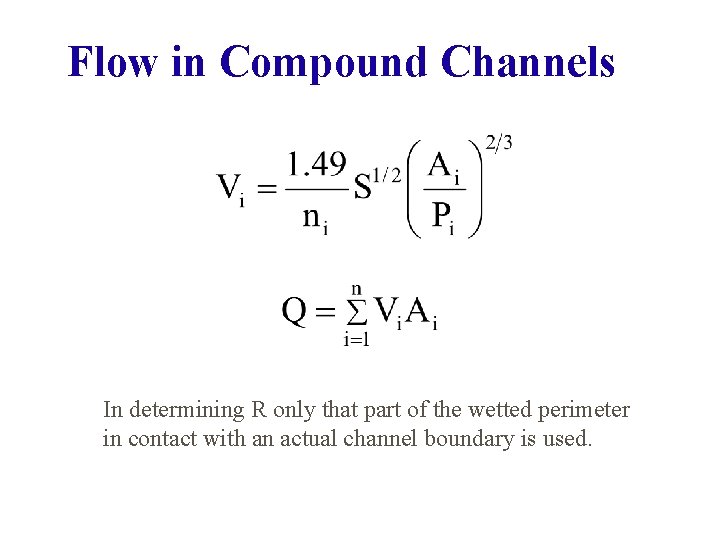
Flow in Compound Channels In determining R only that part of the wetted perimeter in contact with an actual channel boundary is used.
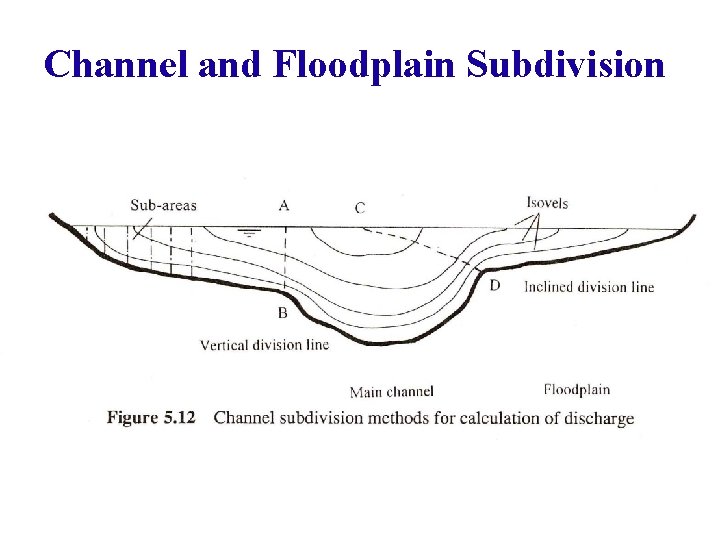
Channel and Floodplain Subdivision