
Manner of Articulation How sounds are produced Plosives
- Slides: 17
Manner of Articulation
• How sounds are produced?
Plosives • Plosive sounds involve complete closure at some point in the mouth. • Pressure builds up behind the closure and when the air is suddenly released, a plosive is made.
3 types of plosives 1. Bilabial plosives (two lips): producing two sounds: /p/ and /b/. 2. Alveolar plosives (tongue against alveolar ridge): producing two sounds: /t/ and /d/ 3. Velar plosives (back of tongue against soft palate): two sounds: /k/ and /g/
Fricatives • These are the result of incomplete closure at some point in the mouth. • The air escapes through a narrowed channel with audible friction.
1. When you approximate the upper teeth to the lower lip and allow air to escape, you can produce the labio-dental fricatives /f/ and /v/. 2. When you approximate the tip of the tongue to the alveolar ridge, you can produce the alveolar fricatives /s/ and /z/
Trills • Tapping the tongue against a point of contact. • When you roll the /r/ sounds in words like r. roaming, r. right, you are tapping the curled front of the tongue against the alveolar ridge.
Laterals • These sounds also involve partial closure in the mouth. • The air stream is blocked by the tip of the tongue but allowed to escape around the sides of the tongue.
• The initial Ill sound in 'light' is a lateral; so is the final sound in ‘full’
Nasals • Nasal sounds involve the complete closure of the mouth. • The velum is lowered, diverting the air through the nose. • In English, the vocal cords vibrate in the production of nasals and so English nasals are voiced.
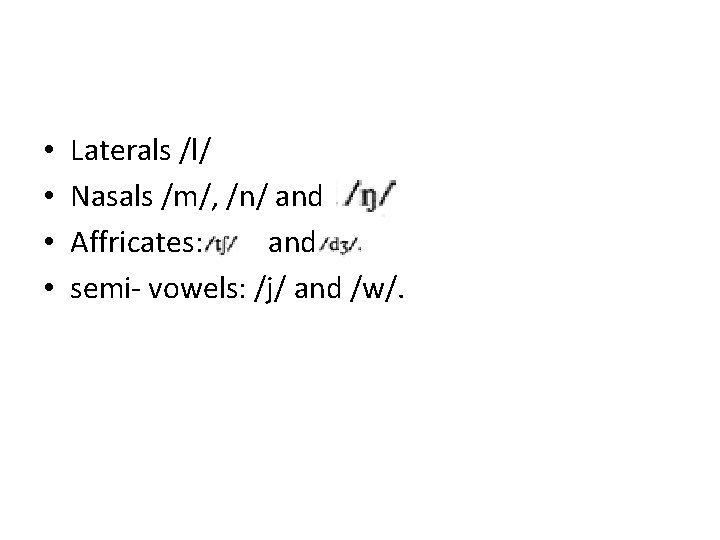
• There are three nasals in English 1. /m/ as in 'mat', ‘my’, ‘morning/ 2. /n/ as in 'no’ 3. and as in ‘sing’, ‘ring’, ‘wing’.
Affricates • Affricates represent a combination of sounds. • At the beginning, there is complete closure as for a plosive. • This is then followed by a slow release with friction, as for a fricative.
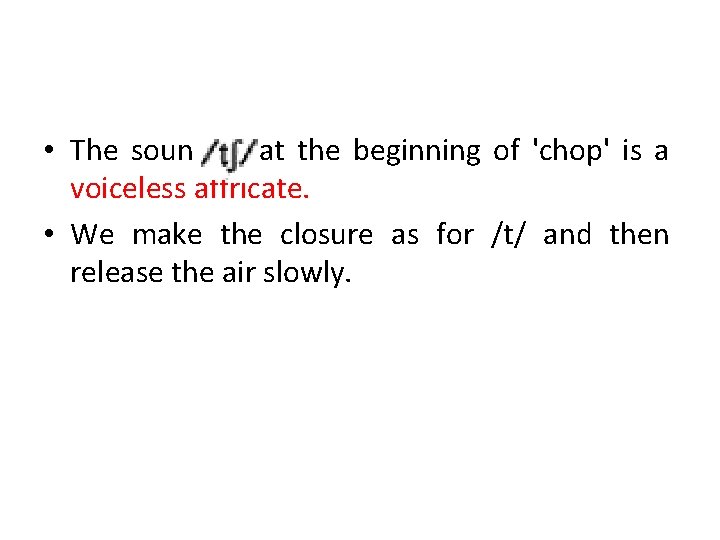
• The sound at the beginning of 'chop' is a voiceless affricate. • We make the closure as for /t/ and then release the air slowly.
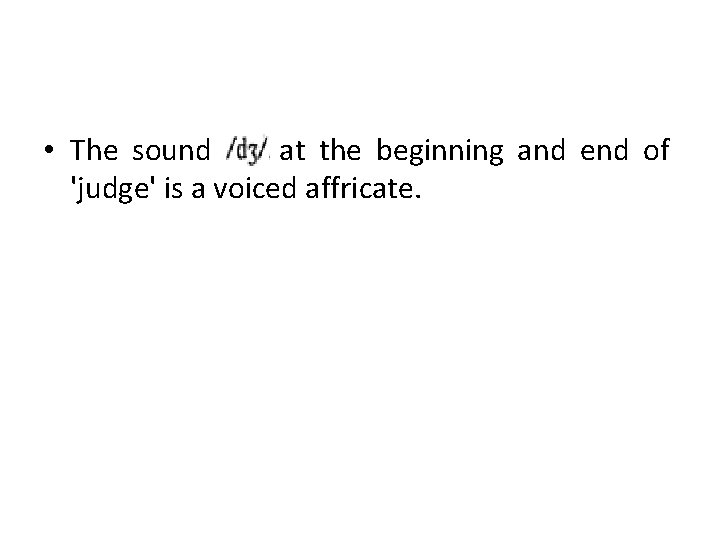
• The sound at the beginning and end of 'judge' is a voiced affricate.
Semi-vowels • The sounds at the beginning of words like 'you' and 'wet' are made without closure in the mouth. • they are vowel-like. • They normally occur at the beginning of a word or syllable. • They behave functionally like consonants. • The semivowels are represented by the symbols /j/ and /w/.
Summary • Plosives: bilabial /p/ and /b/ alveolar /t/ and /d/ velar /k/ and /g/ • Fricatives: labio-dental /f/ and /v/ alveolar /s/ and /z/ • Trills /r/
• • Laterals /l/ Nasals /m/, /n/ and Affricates: and semi- vowels: /j/ and /w/.