
Manner Of Articulation By Luay G Abbas Manner
Manner Of Articulation By: Luay G. Abbas
Manner Of Articulation • The places of articulation identified in Chapter 3 are approached in different ways by the active articulators, the different gestures producing different sound effects – different manners of articulation. Manners combine with voice and place to create individual speech sounds. Double articulations, and primary and secondary articulations are also introduced in this chapter, completing the range of terms needed to construct Voice-Place-Manner (VPM) labels. Ways of representing sounds are discussed (transcriptions, labels, diagrams), and instrumental-imaging of speech sounds (waveforms and spectrograms) introduced.
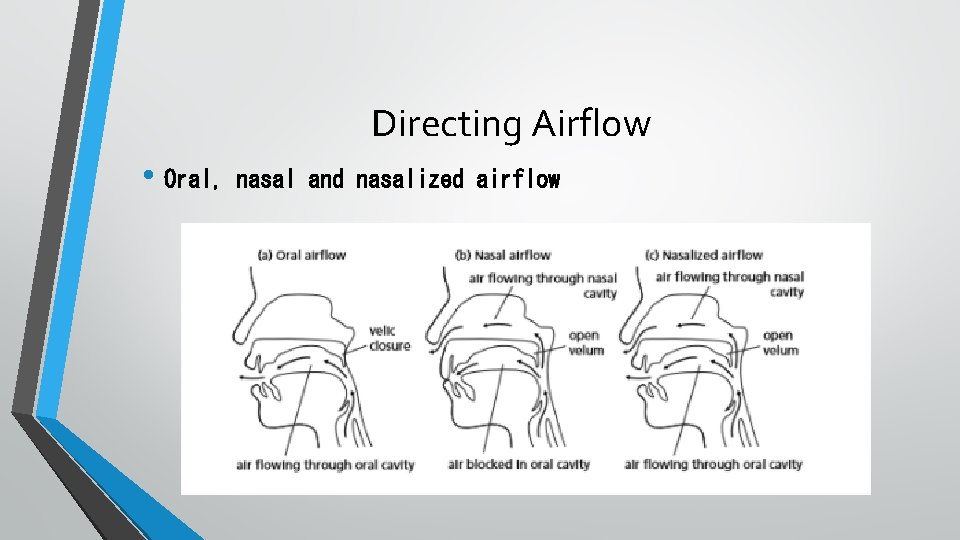
Directing Airflow • Oral, nasal and nasalized airflow
Central VS lateral airflow • Once flowing through the oral cavity, there is still a further possibility for diversion of the egressive pulmonic airstream. Oral consonants can be produced either with central airflow – the airstream passing straight along a central/median/midsagittal channel through the vocal tract, or with lateral airflow – air flowing across the lowered side rims of the tongue around some central obstruction.
Representing consonants • Transcription : the identification of speech sounds by symbols • Labelling : sounds are labelled by place and manner of articulation • Diagrams: a more elaborate way to represent sound is to make a vocal tract drawing • Instrumental outputs: Any speech sound can also be represented instrumentally in a variety of ways, including its waveform and its spectrogram.
Manner of Articulation • The manner of articulation is the way the airstream is affected as it flows from the lungs and out of the mouth and nose.
• Nasal - a nasal, also called a nasal occlusive, nasal stop in contrast with a nasal fricative, or nasal continuant, is an occlusive consonant produced with a lowered velum, allowing air to escape freely through the nose. • Plosive: - Stops or plosives are consonant sounds that airflow. Stop sounds can be voiceless, like the voiced, like /b/, /d/, and /g/. In phonetics, a blocking a part of the mouth so that no air can are formed by completely stopping sounds /p/, /t/, and /k/, or plosive consonant is made by pass through. • Fricative - Sounds which are produced with this kind of constriction entail a bringing together of the two articulators to the point where the airflow is not quite fully blocked: enough of a gap remains for air to escape but the articulators are so close together that friction is created as the air escape • Affricative: Affricates are consonant sounds that begin by fully stopping the air from leaving the vocal tract, then releasing it through a constricted opening. English has two affricate sounds, ’ch’ sound and ’j’ sound, just like "church" and "judge". • Approximant - Approximant: an articulation in which one articulator is close to another, but without the vocal tract being narrowed to such an extent that a turbulent airstream is produced.
Double and Secondary Articulation • A scale of strictures • Double articulation • Secondary articulation

Thank you
- Slides: 9