
Manitoba First Nations Full Implementation of Jordans Principle
Manitoba First Nations Full Implementation of Jordan’s Principle Presentation to the Western Canada First Nation Conference on Jordan’s Principle October 16 -18, 2017
BACKGROUND q q In 1967 Manitoba First Nations created the Manitoba Indian Brotherhood (MIB). It was created to coordinate political action and technical work on common issues. In 1988 the Assembly of Manitoba Chiefs (AMC) replaced the MIB. The AMC represents 62 of the 63 First Nations in Manitoba, consisting of over 150, 000 First Nations citizens. The AMC has a diversity of First Nations and Indigenous peoples, languages and cultures, including Anishinaabe (or Ojibway), Neheto (or Cree), Oji-Cree, Dene and Dakota.

BACKGROUND q Keewaywin: Our Way Home, Manitoba First Nations Engagement is a First-Nations led initiative. It was created to ensure First Nations design and deliver a regional response to the Canadian Human Rights Tribunal decision to stop discriminating against First Nations children that includes: q Full implementation of Jordan’s Principle; and q Reform the First Nations Child and Family Services Program. q Jordan’s Principle is a child-first principle to resolving jurisdictional disputes within and between federal and provincial / territorial governments. It applies to all government services available to children, youth and their families. Services covered include (but not limited to): Health; Education; Child Welfare; Childcare; Recreation; Infrastructure; and Culture and Language Services.
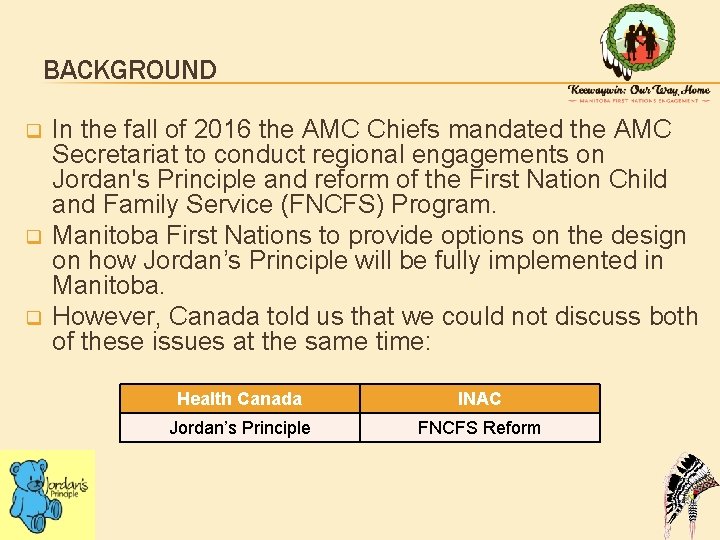
BACKGROUND q q q In the fall of 2016 the AMC Chiefs mandated the AMC Secretariat to conduct regional engagements on Jordan's Principle and reform of the First Nation Child and Family Service (FNCFS) Program. Manitoba First Nations to provide options on the design on how Jordan’s Principle will be fully implemented in Manitoba. However, Canada told us that we could not discuss both of these issues at the same time: Health Canada INAC Jordan’s Principle FNCFS Reform
BACKGROUND q q q The AMC began with a forum on Jordan’s Principle in Winnipeg, Manitoba in December of 2016. Health Canada provided the AMC with funding to bring in four representatives from the 63 First Nations representatives in the following areas: q Health q Education q Child and Family q Social Development / Social Assistance The AMC managed to leverage that existing FNCFS engagement and was able to get a broader range of input.

ENGAGEMENT PROCESS q Engagement sessions began December 2016 and ended June 2017. It involved: § § § 10 Southern First Nations and 10 Northern First Nations; 4 regional town hall sessions: Winnipeg, Brandon, The Pas and Thompson; 1 youth session; 2 CFS agency sessions; 1 Provincial and 1 Federal Government session; and Meetings with the AMC Chiefs Task Force on Child and Family Matters and Elder’s Council whom provide ongoing oversight of the implementation of Jordan’s Principle and reform of the FNCFS Program (which was later transferred to the AMC Women’s Council and AMC Grandmothers Council).
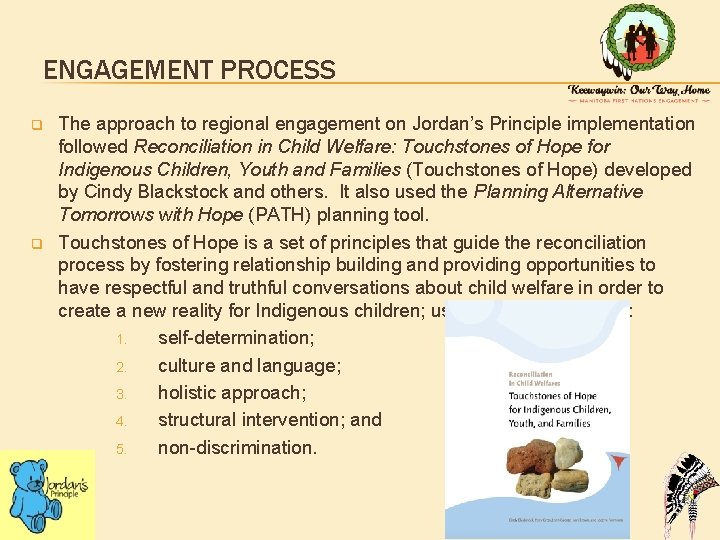
ENGAGEMENT PROCESS q q The approach to regional engagement on Jordan’s Principle implementation followed Reconciliation in Child Welfare: Touchstones of Hope for Indigenous Children, Youth and Families (Touchstones of Hope) developed by Cindy Blackstock and others. It also used the Planning Alternative Tomorrows with Hope (PATH) planning tool. Touchstones of Hope is a set of principles that guide the reconciliation process by fostering relationship building and providing opportunities to have respectful and truthful conversations about child welfare in order to create a new reality for Indigenous children; using the five principles: 1. self-determination; 2. culture and language; 3. holistic approach; 4. structural intervention; and 5. non-discrimination.
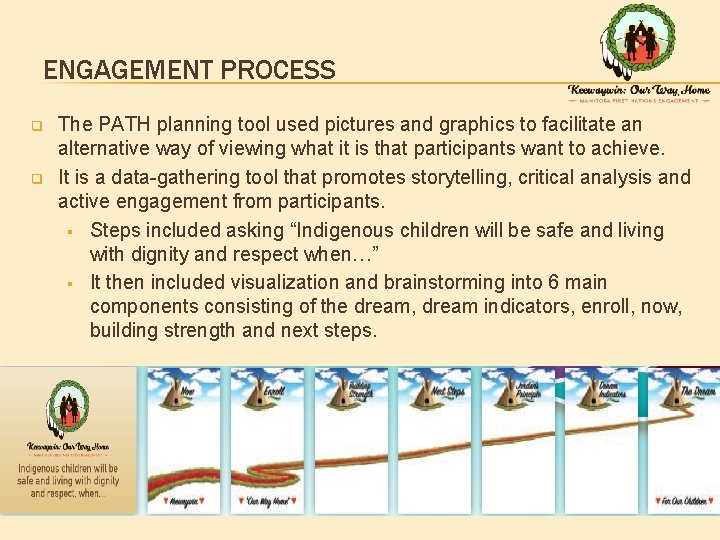
ENGAGEMENT PROCESS q q The PATH planning tool used pictures and graphics to facilitate an alternative way of viewing what it is that participants want to achieve. It is a data-gathering tool that promotes storytelling, critical analysis and active engagement from participants. § Steps included asking “Indigenous children will be safe and living with dignity and respect when…” § It then included visualization and brainstorming into 6 main components consisting of the dream, dream indicators, enroll, now, building strength and next steps.
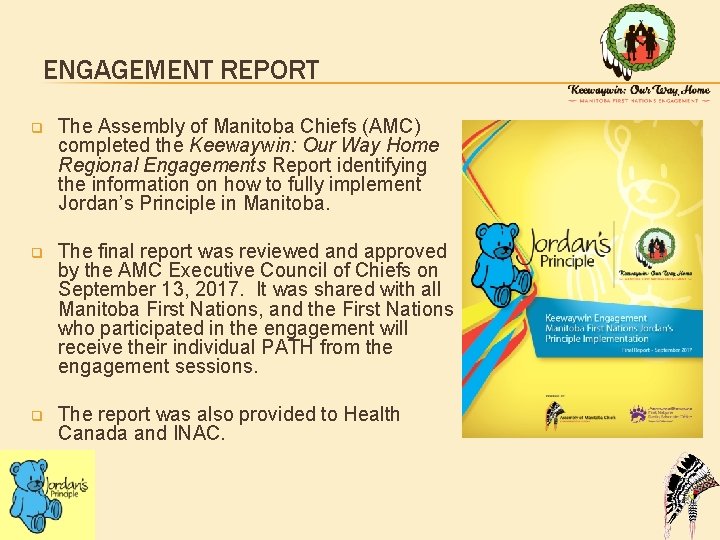
ENGAGEMENT REPORT q The Assembly of Manitoba Chiefs (AMC) completed the Keewaywin: Our Way Home Regional Engagements Report identifying the information on how to fully implement Jordan’s Principle in Manitoba. q The final report was reviewed and approved by the AMC Executive Council of Chiefs on September 13, 2017. It was shared with all Manitoba First Nations, and the First Nations who participated in the engagement will receive their individual PATH from the engagement sessions. q The report was also provided to Health Canada and INAC.
ENGAGEMENT REPORT q The AMC is currently finalizing a work plan to respond to the immediate, short and long term outcomes. This includes, but not limited to: q Restore First Nations’ jurisdiction of children. q Deconstruct child welfare system. q First Nation led and designed Jordan’s Principal system. q Establish Jordan’s Principle program, resource and medical centre. q Education and training of First Nations citizens in fields of medicine and working with children with special needs.
ENGAGEMENT REPORT q Creation of educational awareness campaign regarding challenges children with special needs face. q Basic human rights provided to Indigenous children and their families. q Infrastructure funding for First Nations. q Funnel prevention dollars towards bodies independent of CFS System. q Design of new funding model to support model of care approach. q Establish customary/kinship care in all First Nations. q Develop range of First Nations led options to fully implement Jordan’s Principle.

CURRENT SITUATION – OVERVIEW First Nation Community Based Services – Jordan’s Principle Case Managers Funders (Health Canada / INAC / Indigenous Relations / Indigenous Services) AMC and AMC mandated Entities – EUTC, FNFAO, FNHSSM, MFNERC Tribal Council & Independent First Nations Service Coordinators Specialized Professional Service Providers – FSD, MFNERC, MATC, SSCY, St. Amant Centre
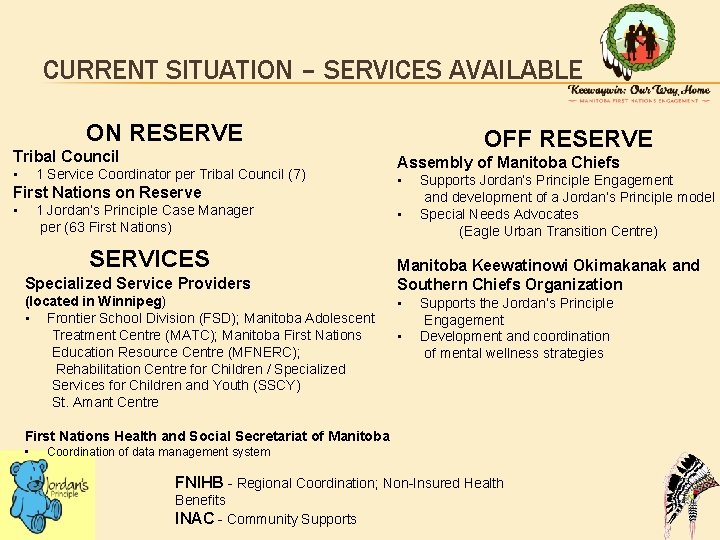
CURRENT SITUATION – SERVICES AVAILABLE ON RESERVE Tribal Council • 1 Service Coordinator per Tribal Council (7) First Nations on Reserve • 1 Jordan’s Principle Case Manager per (63 First Nations) SERVICES Specialized Service Providers (located in Winnipeg) • Frontier School Division (FSD); Manitoba Adolescent Treatment Centre (MATC); Manitoba First Nations Education Resource Centre (MFNERC); Rehabilitation Centre for Children / Specialized Services for Children and Youth (SSCY) St. Amant Centre OFF RESERVE Assembly of Manitoba Chiefs • Supports Jordan’s Principle Engagement and development of a Jordan’s Principle model • Special Needs Advocates (Eagle Urban Transition Centre) Manitoba Keewatinowi Okimakanak and Southern Chiefs Organization • Supports the Jordan’s Principle Engagement • Development and coordination of mental wellness strategies First Nations Health and Social Secretariat of Manitoba • Coordination of data management system FNIHB - Regional Coordination; Non-Insured Health Benefits INAC - Community Supports
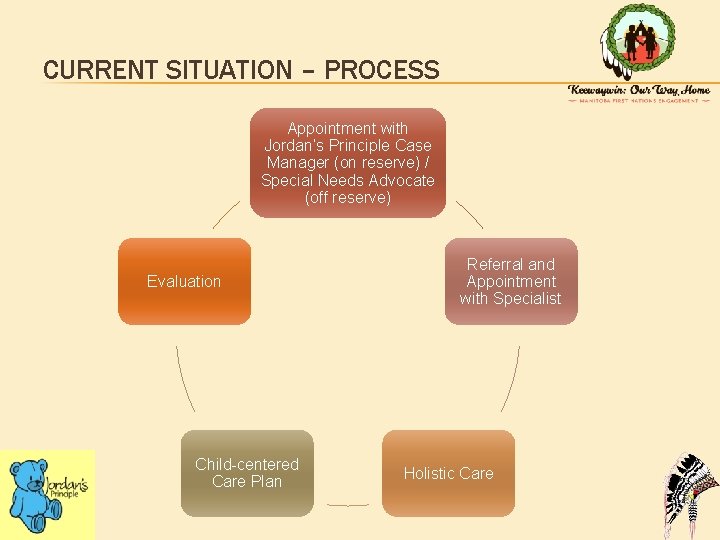
CURRENT SITUATION – PROCESS Appointment with Jordan’s Principle Case Manager (on reserve) / Special Needs Advocate (off reserve) Evaluation Child-centered Care Plan Referral and Appointment with Specialist Holistic Care
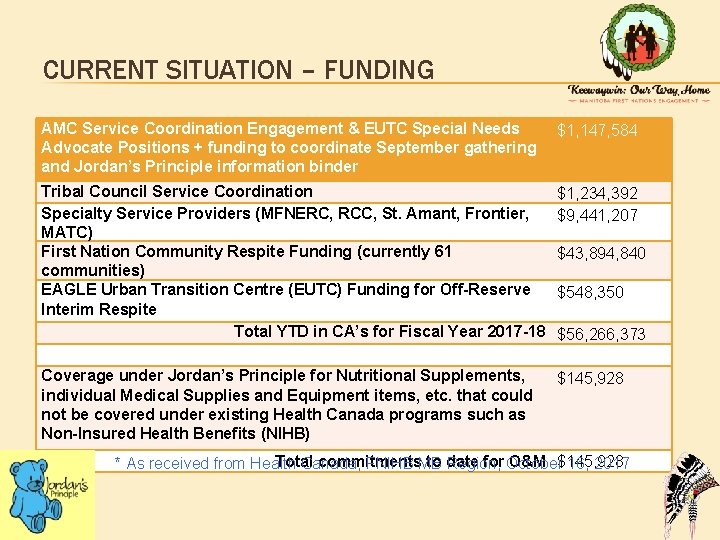
CURRENT SITUATION – FUNDING AMC Service Coordination Engagement & EUTC Special Needs Advocate Positions + funding to coordinate September gathering and Jordan’s Principle information binder $1, 147, 584 Tribal Council Service Coordination Specialty Service Providers (MFNERC, RCC, St. Amant, Frontier, MATC) First Nation Community Respite Funding (currently 61 communities) EAGLE Urban Transition Centre (EUTC) Funding for Off-Reserve Interim Respite Total YTD in CA’s for Fiscal Year 2017 -18 Coverage under Jordan’s Principle for Nutritional Supplements, individual Medical Supplies and Equipment items, etc. that could not be covered under existing Health Canada programs such as Non-Insured Health Benefits (NIHB) $1, 234, 392 $9, 441, 207 $43, 894, 840 $548, 350 $56, 266, 373 $145, 928 Total commitments to date for O&M $145, 928 * As received from Health Canada, FNIHB MB Region, October 16, 2017
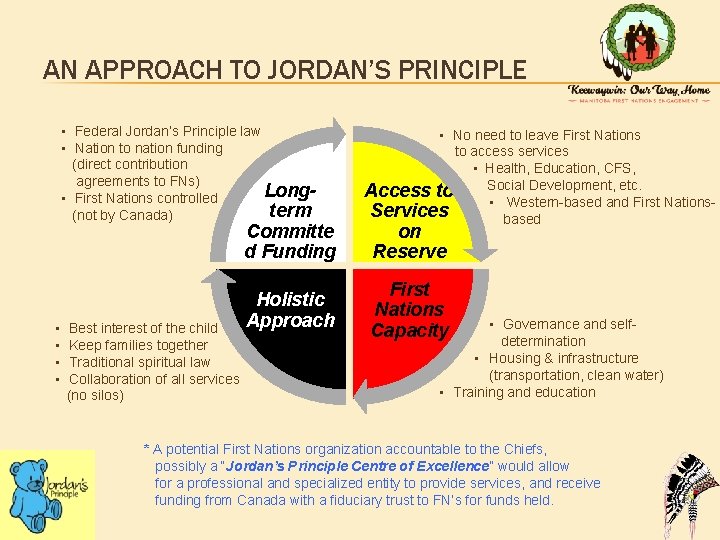
AN APPROACH TO JORDAN’S PRINCIPLE • Federal Jordan’s Principle law • Nation to nation funding (direct contribution agreements to FNs) Long • First Nations controlled term (not by Canada) Committe d Funding • Best interest of the child • Keep families together • Traditional spiritual law • Collaboration of all services (no silos) Holistic Approach • No need to leave First Nations to access services • Health, Education, CFS, Access to Social Development, etc. • Western-based and First Nations. Services based on Reserve First Nations Capacity • Governance and self determination • Housing & infrastructure (transportation, clean water) • Training and education * A potential First Nations organization accountable to the Chiefs, possibly a “Jordan’s Principle Centre of Excellence” would allow for a professional and specialized entity to provide services, and receive funding from Canada with a fiduciary trust to FN’s for funds held.
FIRST NATIONS CFS REFORM q In 1988 the Province of Manitoba created the Aboriginal Justice Inquiry (AJI). Co-chaired by Justice Alvin Hamilton and Justice Murray Sinclair: q q investigate the murder of Helen Betty Osborne from Norway House Cree Nation and the murder of JJ Harper from Wasagamack First Nation investigate the position of Aboriginal people in the criminal justice Scope was to examine policing, the court system, and opportunities for positive change Concluded that there was no justice in how Aboriginal people were treated and incarcerated, and were over-represented. Found many children who were apprehended and placed in foster homes “graduated” to group homes and eventually correctional institutions – “the ‘clients’ of one system (child welfare) became the ‘clients’ of the other (criminal justice system)”.
FIRST NATIONS CFS REFORM q The AJI recommendations included: q q First Nations control of our own child welfare Cultural ways with community and parental involvement Increased funding and training with prevention of children coming into care as the cornerstone In 2003, Manitoba passed The Child and Family Services Authorities Act setting out a new system: q q q Network of four Authorities: Northern First Nations; Southern First Nations; Metis; and General (for all other children). Agencies serving children and families would report to these Authorities, and would meet appropriate targets for training, cultural policies and programs. It was to have been temporary until First Nations develop their own system. It remains the status quo today.
FIRST NATIONS CFS REFORM q q q In December 2013 the Province of Manitoba received the report on the Inquiry into the death of baby Phoenix Sinclair The Legacy of Phoenix Sinclair Achieving the Best for All Our Children. Manitoba did not release it to the public until a month later. The AMC requested to work with Manitoba to develop a joint response to the recommendations. Manitoba did not bother to engage the AMC or Manitoba First Nations. As a result, the AMC held Open Citizen Forums that lead to the AMC Chiefs in Assembly reviewing and approving the 2014 report “Bringing Our Children Home. ”
FIRST NATIONS CFS REFORM q Bringing Our Children Home recommendations: 1. Focus on a model of care based on prevention 2. Establish a First Nations Family Advocate Office 3. Protect cultural identity 4. Re-learn traditional parenting ways 5. Respond to the youth voice 6. Promote First Nations solutions to keep children home 7. Transition to a First Nations system for child and family services 8. Revitalize original systems of life-long supports 9. Focus on First Nations social determinants of health 10. Revolutionize justice system practices
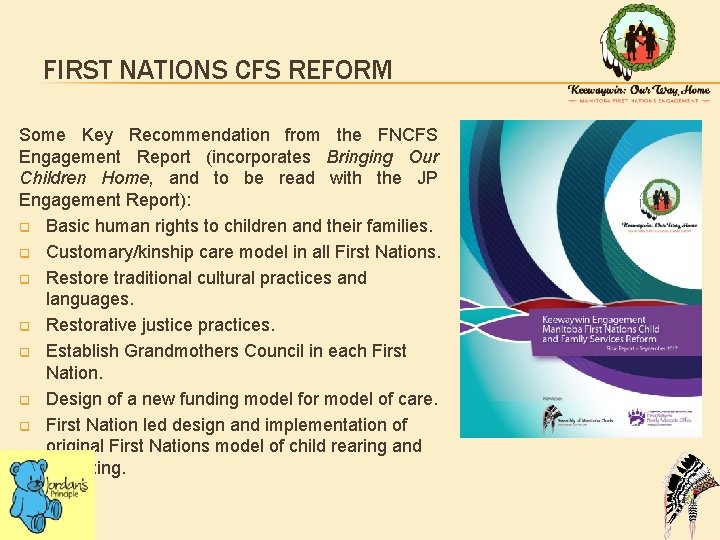
FIRST NATIONS CFS REFORM Some Key Recommendation from the FNCFS Engagement Report (incorporates Bringing Our Children Home, and to be read with the JP Engagement Report): q Basic human rights to children and their families. q Customary/kinship care model in all First Nations. q Restore traditional cultural practices and languages. q Restorative justice practices. q Establish Grandmothers Council in each First Nation. q Design of a new funding model for model of care. q First Nation led design and implementation of original First Nations model of child rearing and parenting.
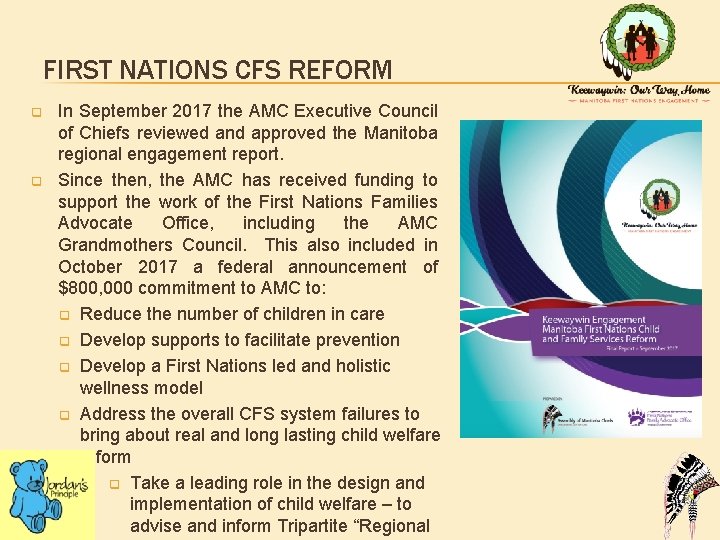
FIRST NATIONS CFS REFORM q q In September 2017 the AMC Executive Council of Chiefs reviewed and approved the Manitoba regional engagement report. Since then, the AMC has received funding to support the work of the First Nations Families Advocate Office, including the AMC Grandmothers Council. This also included in October 2017 a federal announcement of $800, 000 commitment to AMC to: q Reduce the number of children in care q Develop supports to facilitate prevention q Develop a First Nations led and holistic wellness model q Address the overall CFS system failures to bring about real and long lasting child welfare reform q Take a leading role in the design and implementation of child welfare – to advise and inform Tripartite “Regional
Ekosani Questions Contact Marcel Balfour AMC Senior Policy Analysit mbalfour@manitobachiefs. com Darlene Curci EUTC Special Needs Advocate dcurchi@manitobachiefs. com Kayla Frank AMC Policy Analyst kfrank@manitobachiefs. com Ryan Mc. Kay EUTC Special Needs Advocate rmckay@manitobachiefs. com
- Slides: 23