
Manifold Learning for Visualizing and Analyzing High Dimensional

- Slides: 9
Manifold Learning for Visualizing and Analyzing High -Dimensional Data Presenter: YU-TING LU Authors: Junping Zhang, Huang and Jue Wang 2010. IEEE INTELLIGENT SYSTEMS Intelligent Database Systems Lab
Outlines n Motivation n Objectives n Methodology n Applications n Conclusions n Comments Intelligent Database Systems Lab
Motivation • Handling large-scale, high-dimensional data is a challenging task in modern statistical data analysis. • Conventional approaches do not scale well to more than a few dozen dimensions. • Linear projection is still inadequate in capturing interesting structures in data if the data do not live in a linear subspace. Intelligent Database Systems Lab
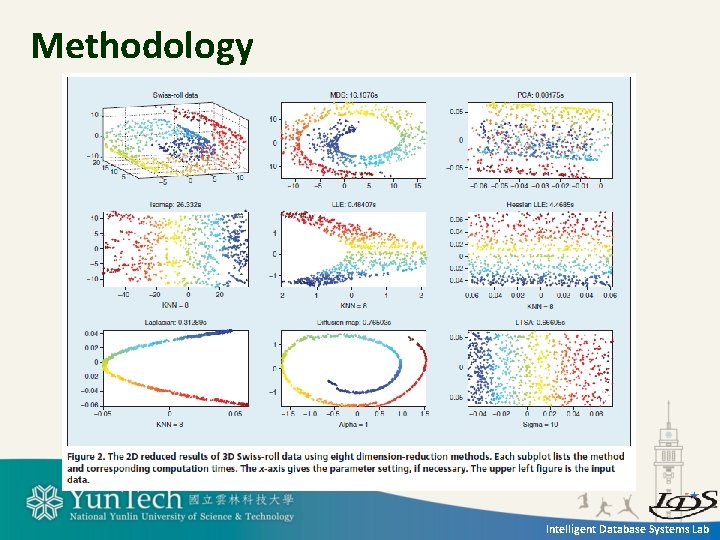
Objectives • Describes a few representative manifold-learning algorithms. • Demonstrates their utility in visualizing and analyzing high-dimensional data. • Discuss their strengths and weaknesses, along with strategies to avoid pitfalls. Intelligent Database Systems Lab
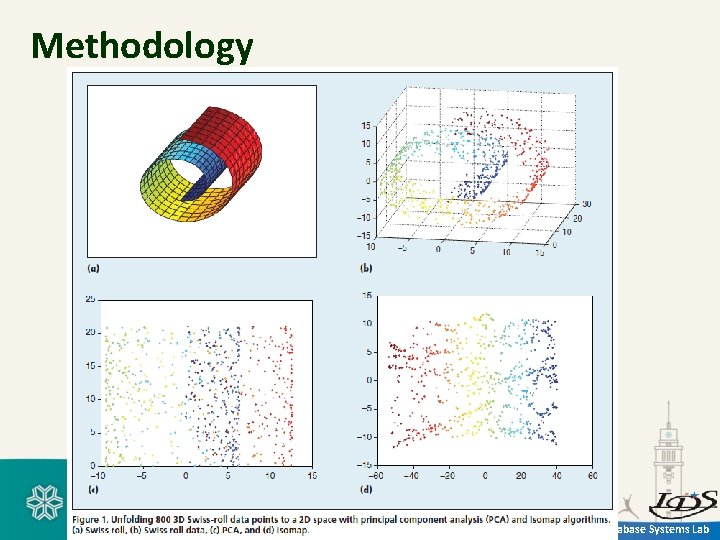
Methodology Intelligent Database Systems Lab
Methodology Intelligent Database Systems Lab
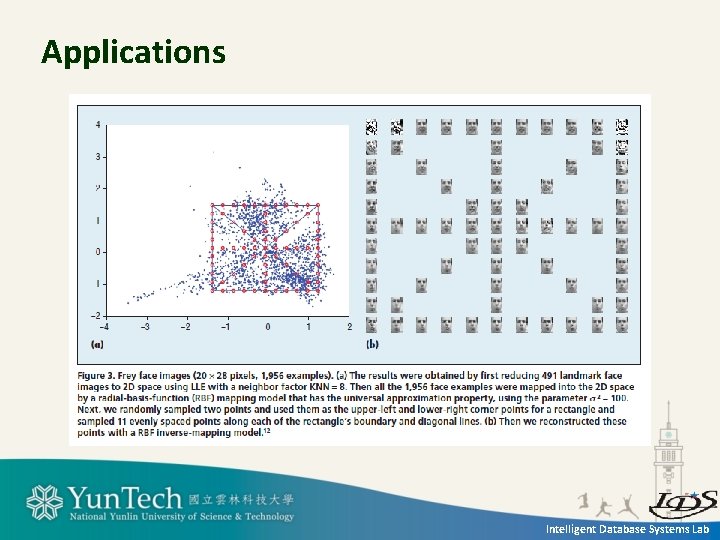
Applications Intelligent Database Systems Lab
Conclusions • Manifold-learning algorithms are problematic if data properties are not properly considered. • There must be more quantitative methods available to evaluate manifold-learning algorithms and better ways to automatically select intrinsic dimensions. Intelligent Database Systems Lab
Comments • Advantages - Faithfully visualizing non-metric similarity data • Applications - Data visualization. Intelligent Database Systems Lab