
MANIFEST DESTINY Westward Expansion in the 1800 s


- Slides: 33
MANIFEST DESTINY Westward Expansion in the 1800 s
Big Ideas • As the idea of Manifest Destiny spread it became necessary for the US to establish procedures for the admission of new states. • Settlers migrated west for a variety of reasons resulting in changing population patterns in the American West. • Throughout the nineteenth century the United States continued to acquire territory, including gaining land from Mexico following a war.
Big Questions • Why did the concept of Manifest Destiny develop in the United States? • What motivated many pioneers to migrate to the American West? • What territories were acquired that reflect the current organization of the United States?
What is “Manifest Destiny”? • Phrase is first used by newspaper editor John O’Sullivan in 1845… “Our manifest destiny is to overspread and possess the whole of the continent which providence (God) has given us for the development of the great experiment of liberty and…self government. ”
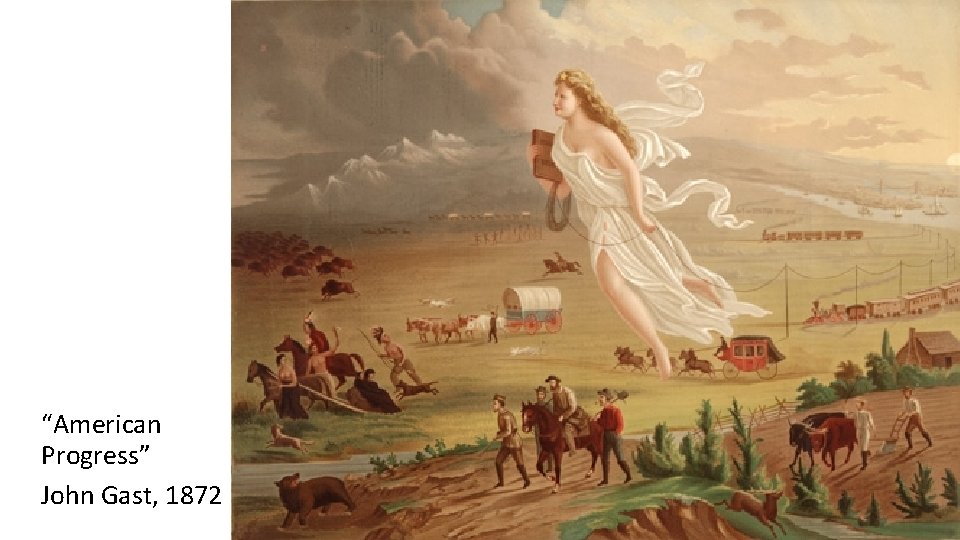
What is “Manifest Destiny”? “Manifest”- clear or obvious “Destiny”- fate, events that will happen Manifest Destiny is the idea that it was America’s God-given right to inhabit the land “from sea to shining sea”.
“American Progress” John Gast, 1872
Northwest Ordinance 1787 • The process for admitting new states into the United States was unclear in the 1780 s. • The Northwest Ordinance (1787) created an orderly procedure for establishing territories and applying for statehood
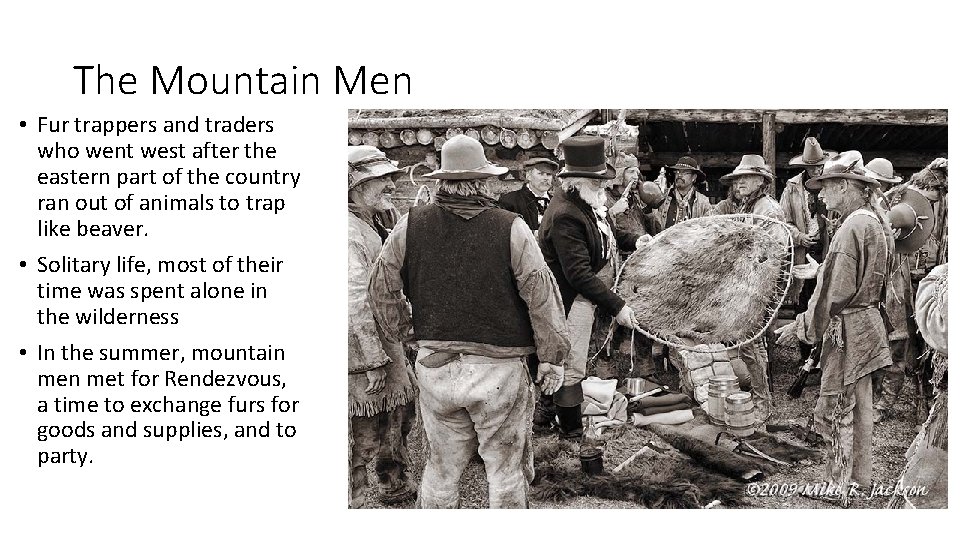
The Mountain Men • Fur trappers and traders who went west after the eastern part of the country ran out of animals to trap like beaver. • Solitary life, most of their time was spent alone in the wilderness • In the summer, mountain met for Rendezvous, a time to exchange furs for goods and supplies, and to party.
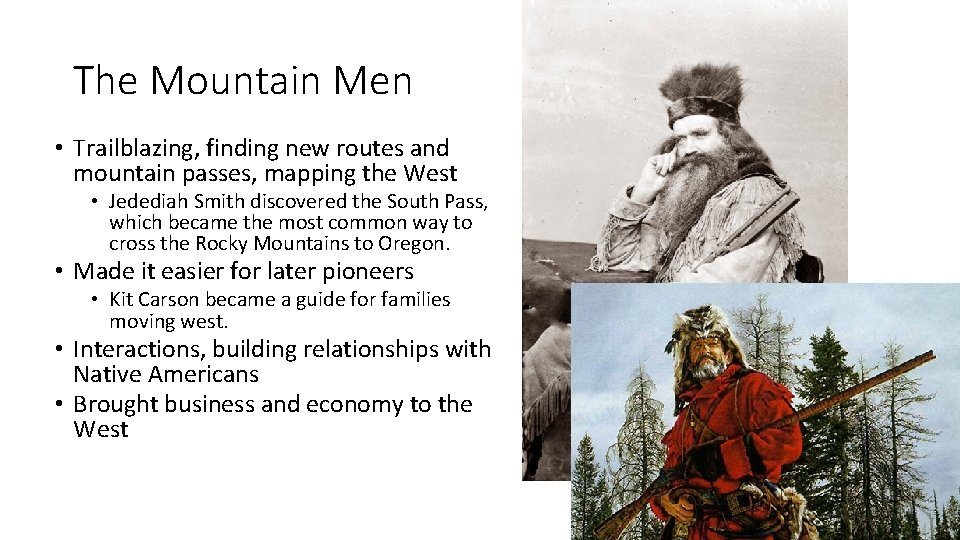
The Mountain Men • Trailblazing, finding new routes and mountain passes, mapping the West • Jedediah Smith discovered the South Pass, which became the most common way to cross the Rocky Mountains to Oregon. • Made it easier for later pioneers • Kit Carson became a guide for families moving west. • Interactions, building relationships with Native Americans • Brought business and economy to the West
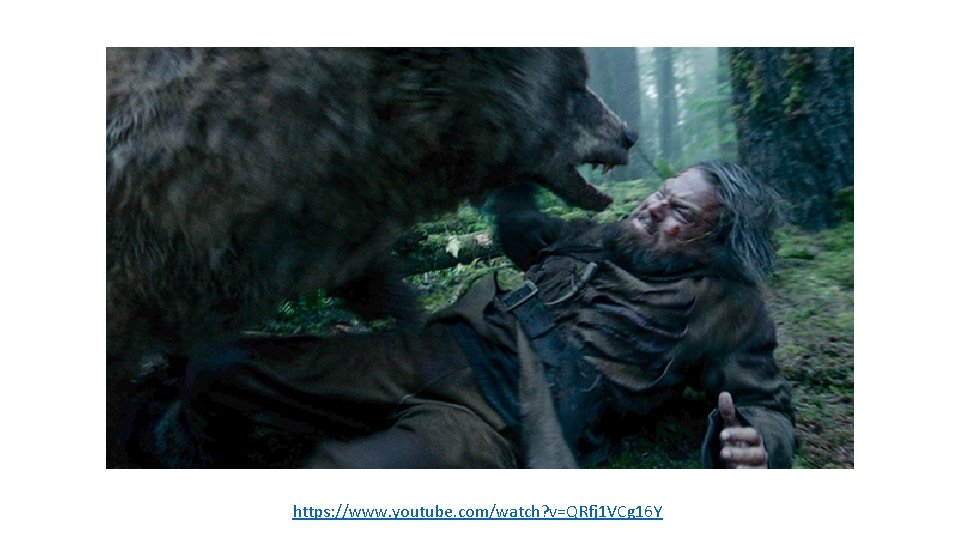
https: //www. youtube. com/watch? v=QRfj 1 VCg 16 Y
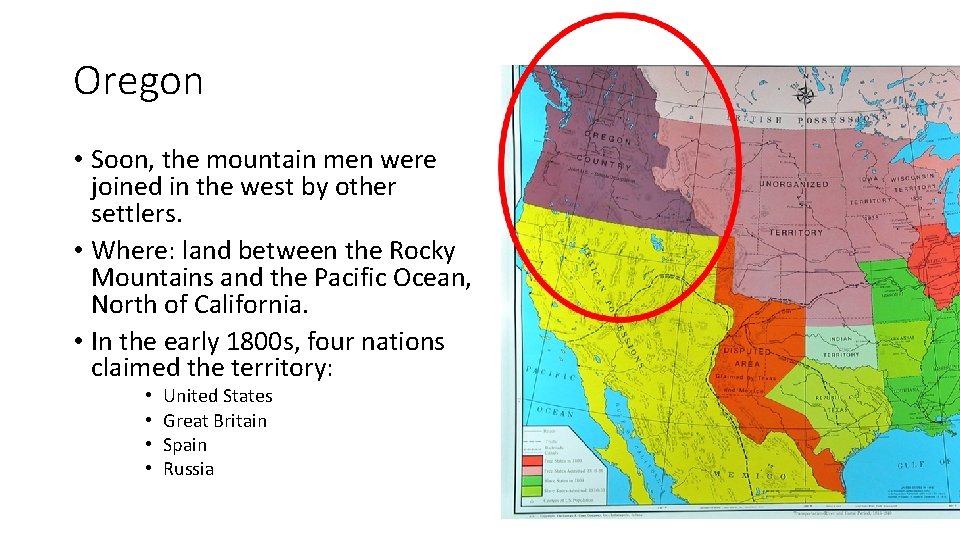
Oregon • Soon, the mountain men were joined in the west by other settlers. • Where: land between the Rocky Mountains and the Pacific Ocean, North of California. • In the early 1800 s, four nations claimed the territory: • • United States Great Britain Spain Russia
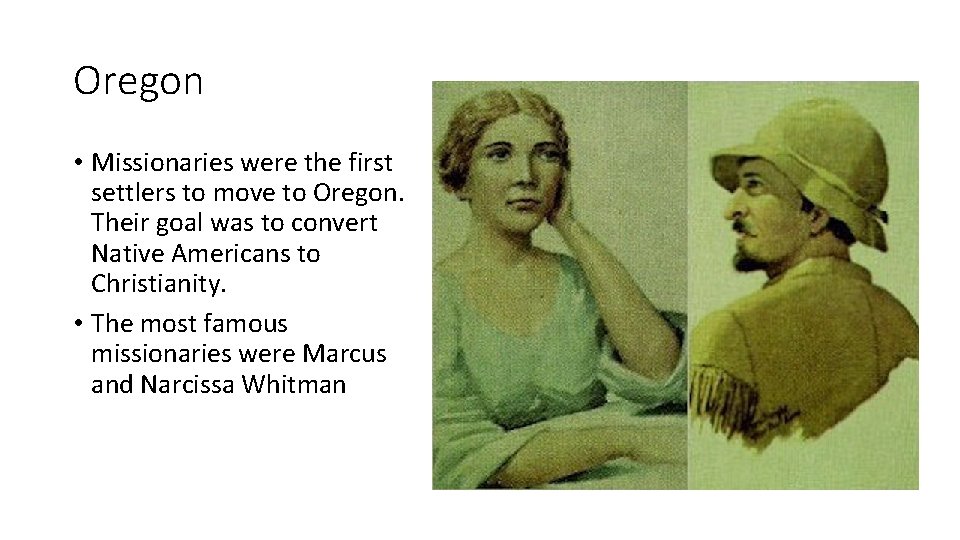
Oregon • Missionaries were the first settlers to move to Oregon. Their goal was to convert Native Americans to Christianity. • The most famous missionaries were Marcus and Narcissa Whitman
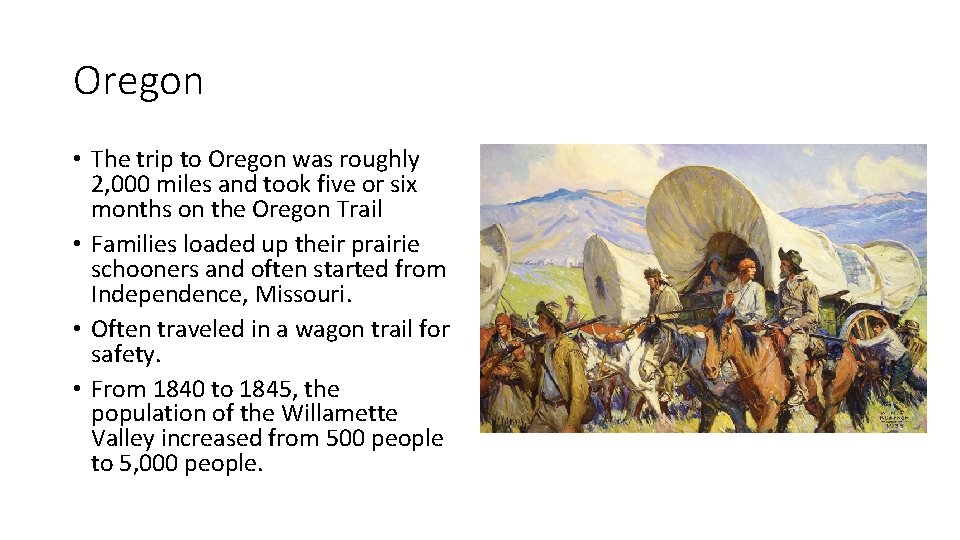
Oregon • The trip to Oregon was roughly 2, 000 miles and took five or six months on the Oregon Trail • Families loaded up their prairie schooners and often started from Independence, Missouri. • Often traveled in a wagon trail for safety. • From 1840 to 1845, the population of the Willamette Valley increased from 500 people to 5, 000 people.
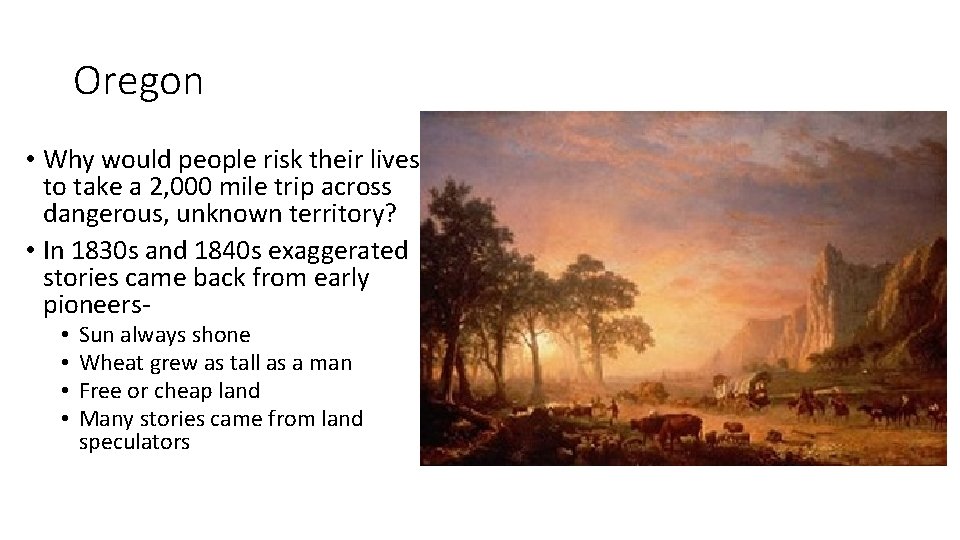
Oregon • Why would people risk their lives to take a 2, 000 mile trip across dangerous, unknown territory? • In 1830 s and 1840 s exaggerated stories came back from early pioneers • • Sun always shone Wheat grew as tall as a man Free or cheap land Many stories came from land speculators
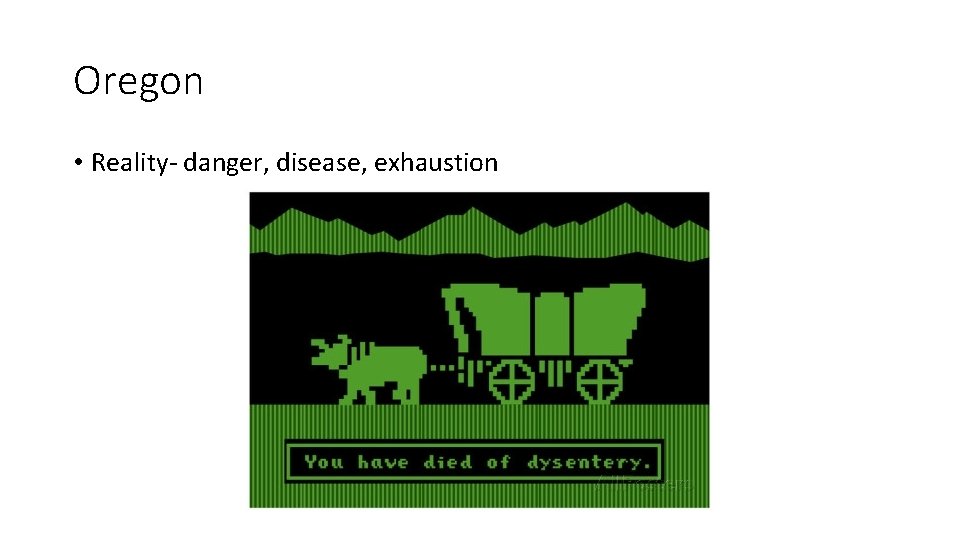
Oregon • Reality- danger, disease, exhaustion
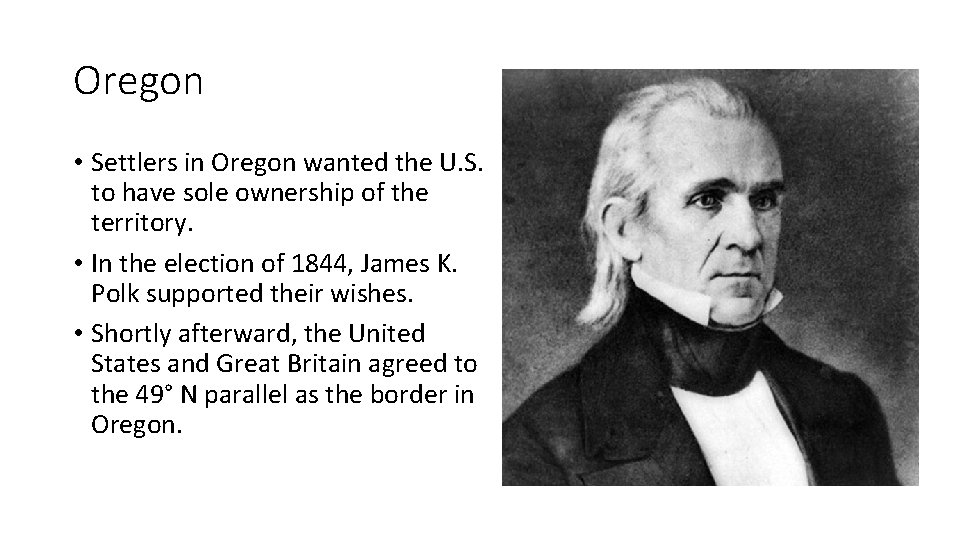
Oregon • Settlers in Oregon wanted the U. S. to have sole ownership of the territory. • In the election of 1844, James K. Polk supported their wishes. • Shortly afterward, the United States and Great Britain agreed to the 49° N parallel as the border in Oregon.
Texas • Conflict in Texas began in 1803 with the Louisiana Purchase. • Americans believed that Texas was part of the Louisiana Purchase. Spain protested. • In the Adams-Onís Treaty (1819), America dropped all claims to Spanish Texas.
Texas • Most of the residents of Texas at this time were Tejanos. To encourage settlement, the Mexican government offered land grants to empresarios. • Empresarios recruited families to settle in Texas.
Texas • The colonists who came to Texas promised to • • Learn Spanish Become Mexican citizens Convert to Catholicism Obey Mexican law • Most Texas settlers came from the United States. They soon outnumbered the Mexicans in Texas.
Texas • Americans refused to adopt Mexican ways. And the U. S. twice offered to purchase Texas from Mexico. • In 1830, Mexico passed a decree stopping all immigration from the United States and placing a tax on American made goods. • Americans were furious. They were also angry over Mexico’s plans to ban slavery in Texas. • After Santa Anna refused demands to make Texas a separate state, Stephen F. Austin encouraged Texans to prepare for independence. He was arrested.
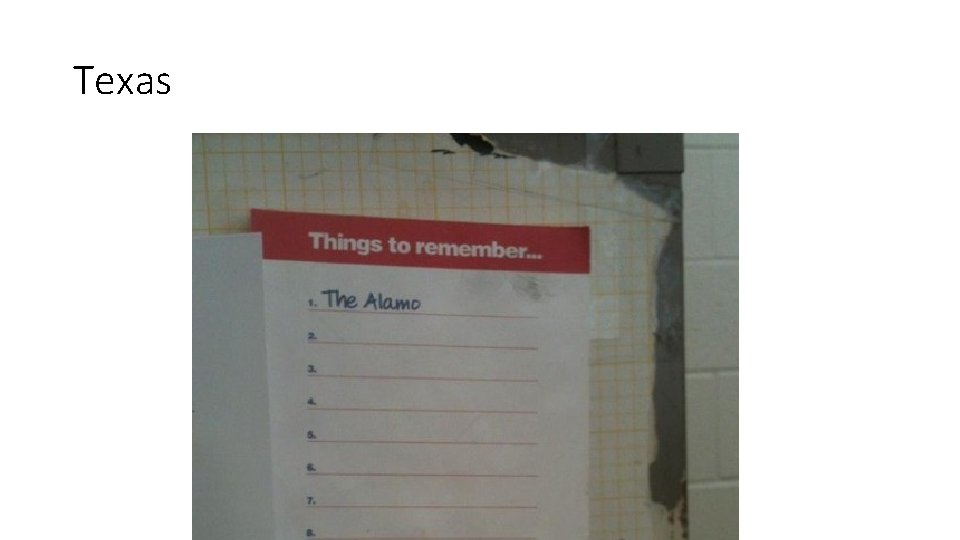
Texas
Texas • On March 2, 1836, the Texans declared independence. • Sam Houston was elected the first president of Texas. He asked the U. S. to annex Texas. • But Texas was a slave state, and it would upset the balance between slave and free states in the Union. • James K. Polk was elected president in 1844 and supported Manifest Destiny. • Texas was annexed to the United States in 1845, becoming the 28 th state.
New Mexico & California • William Becknell was the first American trader to reach Santa Fe in 1821. His route became known as the Santa Fe Trail. • Spanish explorers and missionaries were the first settlers in California.
Problems with Mexico • When the U. S. annexed Texas, tensions increased. In addition to claiming the annexation was illegal, they disagreed over the location of the border: • Mexico: Border was the Nueces River • United States: Border was the Rio Grande • Polk offered to buy Texas, New Mexico, and California from Mexico (twice) but was refused both times.
Problems with Mexico • President Polk plotted to pull Mexico into a war. If they started it, he could justify the war to Congress and the people. • President Polk sent Zachary Taylor to the disputed territory south of the Nueces River. The Mexican government sent troops north of the Rio Grande. • After the Mexican troops attacked, James K. Polk said that Mexico had shed American blood on American soil. On May 13, 1846, Congress declared war against Mexico. • Abraham Lincoln and Frederick Douglass both opposed the war with Mexico.
Mexican American War • Polk had a three part war plan: • Drive Mexico out of the disputed territory • Seize California and New Mexico • Take the capital, Mexico City
Mexican American War • All three parts were successful. • The U. S. lost 1721 men and 11, 000 to disease. • The war cost the U. S. $100 million.
Mexican American War • Treaty of Guadalupe Hidalgo- officially ends the war • • Mexico agrees Texas is part of U. S. Mexico gives U. S. CA, NV, UT, AZ, CO, WY U. S. pays Mexico $15 Million Promised to protect Mexicans living in cession areas
Mexican American War • Gadsden Purchase- U. S. buys one more strip of land in Southern AZ and NM for $10 Million
Gold Rush • In 1848 gold was discovered at Sutter’s Mill on the American River in California. • 80, 000 people came to California looking for gold in 1849. Those people were called forty-niners. • Many gold seekers came by sea. Some came overland.
Gold Rush • The Treaty of Guadalupe Hidalgo made Californios citizens of the U. S. and also guaranteed their rights to their land. • But Californios had to prove they owned the land or white settlers could move in and claim it. • People built boomtowns in California and cities flourished. • The Gold Rush doubled the world’s supply of gold.
Mormons • The Mormons moved to Utah to fulfill their visions of a godly life. • Joseph Smith founded the Mormon Church in New York in 1830. They supported polygamy. • The Mormons left New York because of opposition to their way of life and headed to Illinois. • Joseph Smith was killed by a mob in Illinois. Brigham Young took over, leading the Mormons to the Great Salt Lake in Utah.
Mormons • In 1846 12, 000 Mormons went to Utah in the single largest migration in American history. • They settled in Deseret, later known as Salt Lake City. They planned towns, built irrigation systems, and developed industries. • Utah became a territory in 1850 with Brigham Young as its governor. • Because of many conflicts with the American government, Utah did not become a state until 1896.