
Manifest Destiny The Growth of America Westward Expansion
- Slides: 26
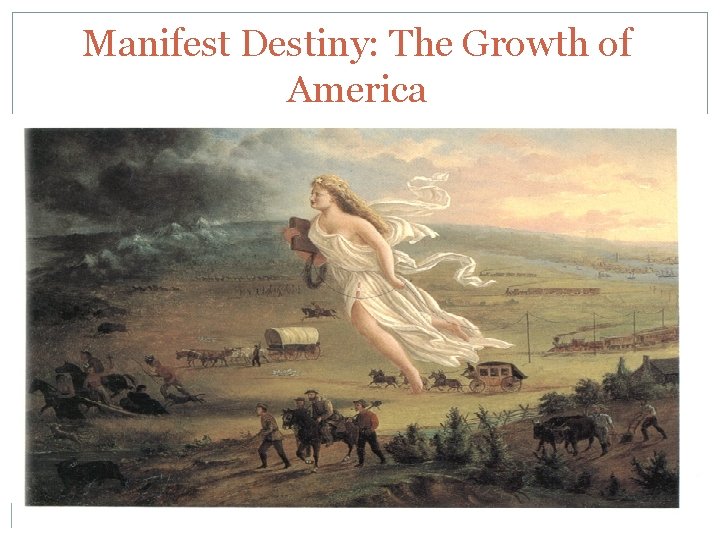
Manifest Destiny: The Growth of America
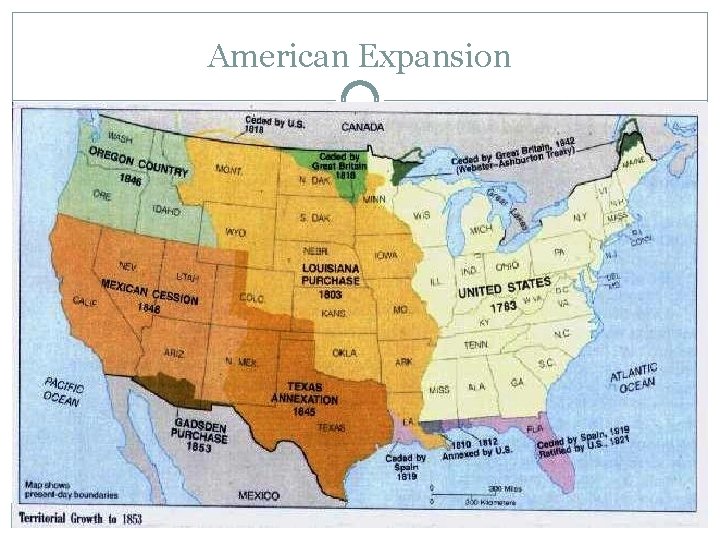
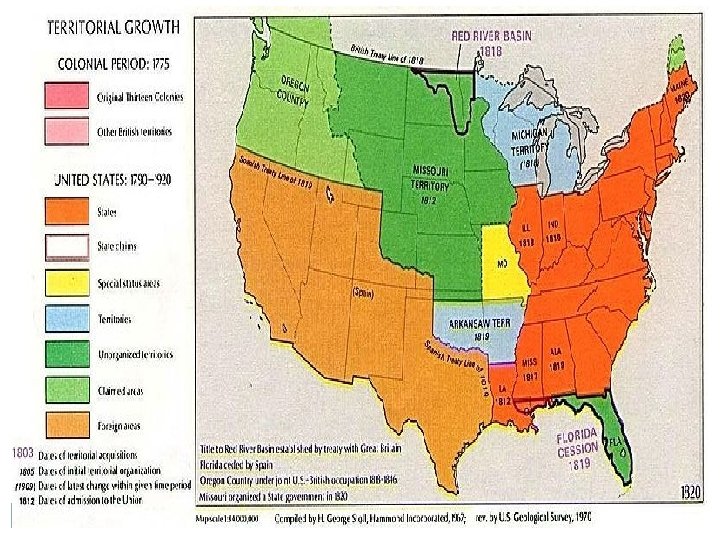
Westward Expansion Manifest Destiny – coined by the author John O’Sullivan, refers to the belief that Americans were destined to spread across the North American continent. Looked upon by many as a God-given right; even a sacred duty. The notion of American expansion was much older than Manifest Destiny, but the Louisiana Purchase really began the drive to cover the whole of the continent.
American Expansion
Texas Beginning in the 1820 s, the migration of Northeastern farmers and European migrants pushed settlers in the Ohio River Valley farther west. Following Mexican independence from Spain, the Mexican government encouraged settlement of Texas by Mexican citizens and American Migrants Led by Moses Austin, and later, his son Stephen F. Austin, established an American enclave in Texas. An 1829 exemption from the Mexican government allowed the Americans to own slaves.
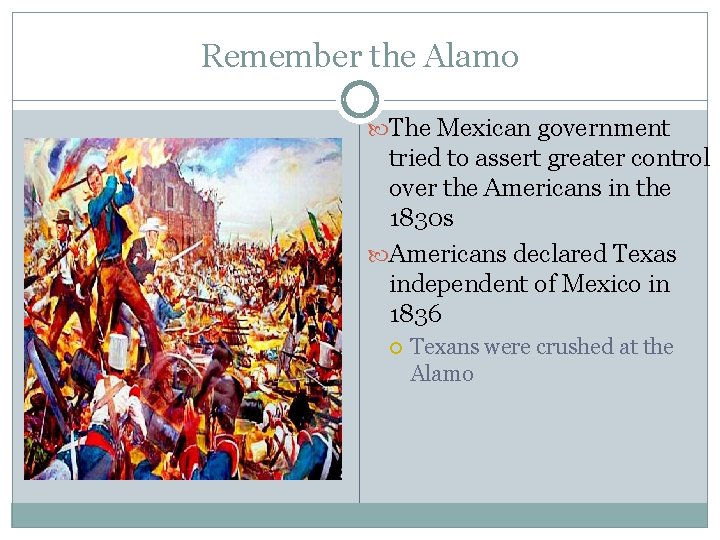
Remember the Alamo The Mexican government tried to assert greater control over the Americans in the 1830 s Americans declared Texas independent of Mexico in 1836 Texans were crushed at the Alamo
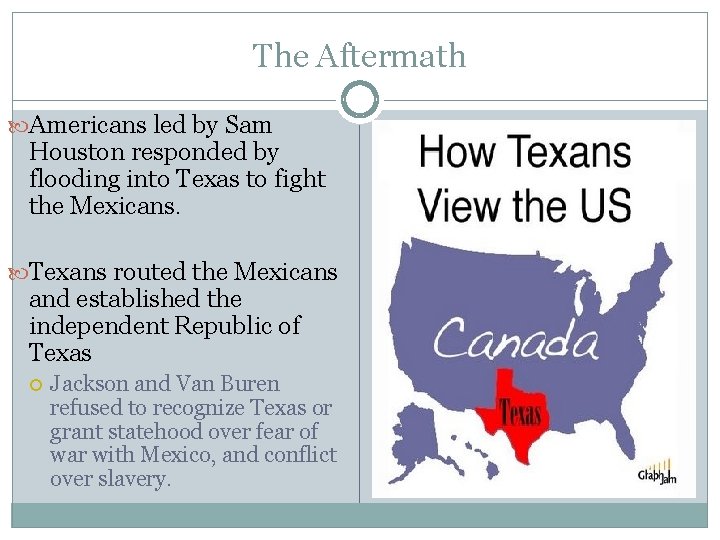
The Aftermath Americans led by Sam Houston responded by flooding into Texas to fight the Mexicans. Texans routed the Mexicans and established the independent Republic of Texas Jackson and Van Buren refused to recognize Texas or grant statehood over fear of war with Mexico, and conflict over slavery.
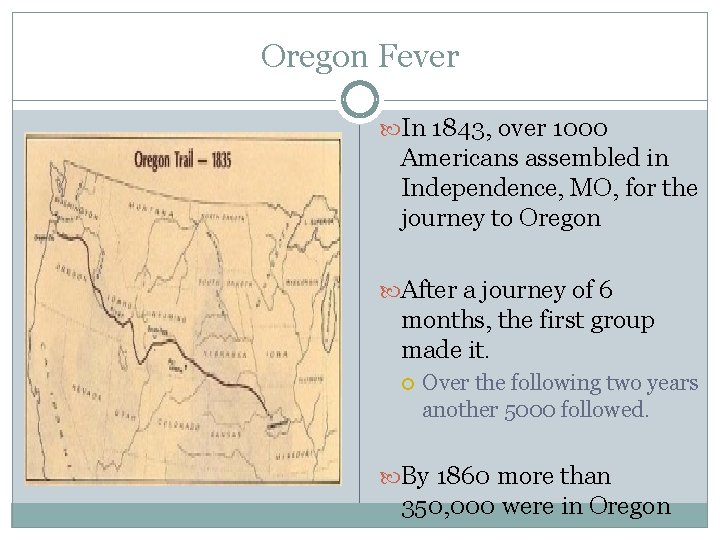
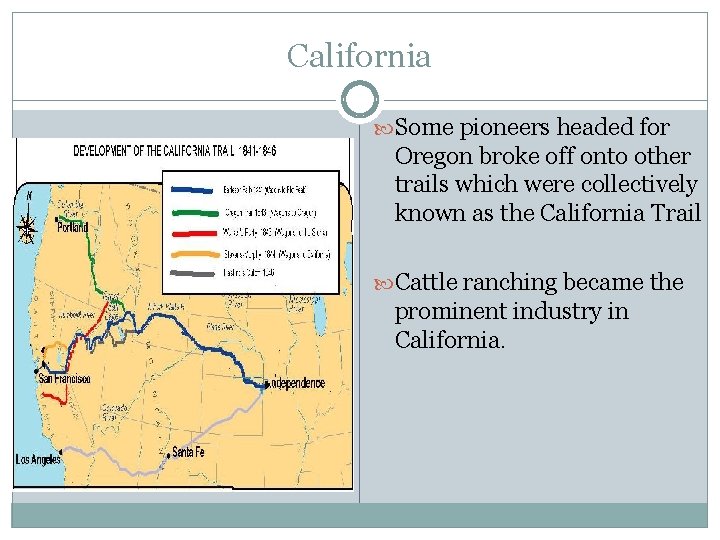
Oregon Fever In 1843, over 1000 Americans assembled in Independence, MO, for the journey to Oregon After a journey of 6 months, the first group made it. Over the following two years another 5000 followed. By 1860 more than 350, 000 were in Oregon
California Some pioneers headed for Oregon broke off onto other trails which were collectively known as the California Trail Cattle ranching became the prominent industry in California.
The Election of 1844 Most American settlers in California assimilated into Mexican society, unlike in Texas. One exception was New England transplant, Thomas Larkin, began plotting the eventual annexation of California to America Pro-slavery southerners were pushing for the annexation of Texas and the spread of slavery across the south. Southern democrats supported James Polk – a slave owner – because he was pro-annexation. Polk won.
The Result Democrats moved to bring Texas into the Union The Senate did not ratify the treaty bringing the Republic of Texas into the Union, but a joint Congressional resolution made it happen anyway. Not enough slave states to win in the Senate, but more than enough slave state representatives in the House. Polk now pushed a more ambitious plan – annexing all of Mexico between Texas and the Pacific Ocean. Polk was prepared to go to war to get this.
War with Mexico Texas accepted statehood on July 4, 1845, and Mexico broke off diplomatic relations with the U. S. Polk ordered an American force to occupy the disputed territory between the Nueces and Rio Grande rivers which had been claimed by Texans. Polk offered Mexico $30 million for the region, but Mexico refuses. Thomas Larkin was instructed to foment rebellion in California, and naval forces were sent to occupy California coastal cities. In May 1846, the Mexican army responded with force.
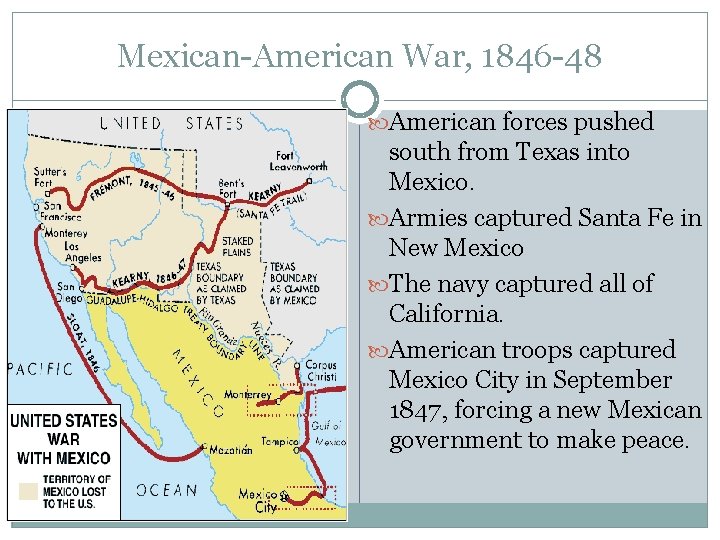
Mexican-American War, 1846 -48 American forces pushed south from Texas into Mexico. Armies captured Santa Fe in New Mexico The navy captured all of California. American troops captured Mexico City in September 1847, forcing a new Mexican government to make peace.
The Mexican War and Slavery Opponents of slavery realized that the territories taken from Mexico were likely to become slave states as they were south of the Missouri Compromise line. Anti-slavery congressmen supported the Wilmot Proviso, which would prohibit slavery in any land won from Mexico. Democrats voted it down. In the end, Polk signs the Treaty of Guadalupe Hidalgo.
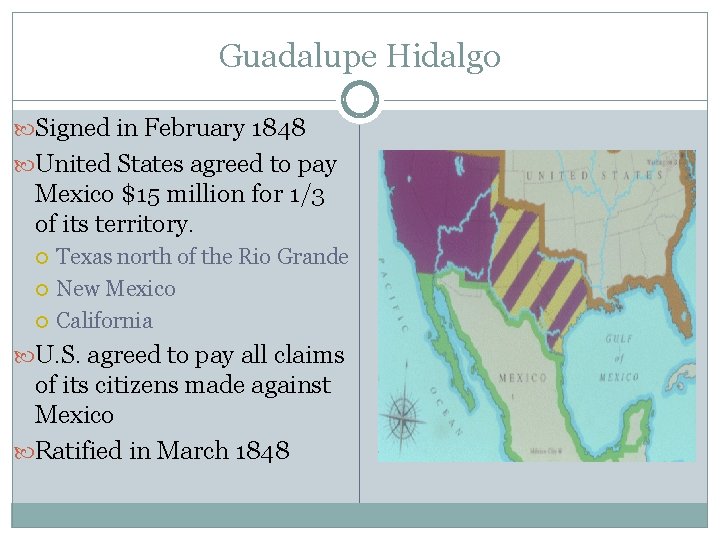
Guadalupe Hidalgo Signed in February 1848 United States agreed to pay Mexico $15 million for 1/3 of its territory. Texas north of the Rio Grande New Mexico California U. S. agreed to pay all claims of its citizens made against Mexico Ratified in March 1848
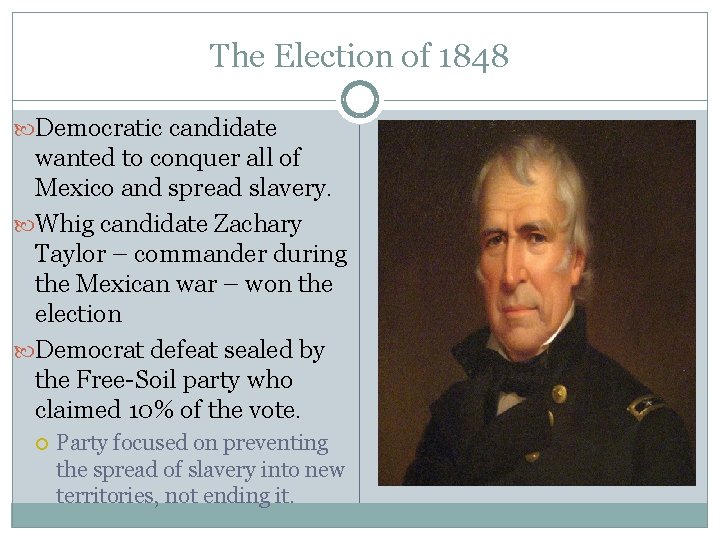
The Election of 1848 Democratic candidate wanted to conquer all of Mexico and spread slavery. Whig candidate Zachary Taylor – commander during the Mexican war – won the election Democrat defeat sealed by the Free-Soil party who claimed 10% of the vote. Party focused on preventing the spread of slavery into new territories, not ending it.
The 49 ers Gold discovered in California at Sutter’s Mill in January 1848. By May word was out, and Americans flocked from all over California By January 1849, 61 overcrowded ships had left New England, sailed around South America, and arrived in California to find gold. In 1849 alone, 80, 000 settlers arrived in California looking for gold.
Keeping the Balance Californians organized, wrote a state constitution prohibiting slavery, and applied for statehood. The number of slave and free states stood balanced at 15 to 15. Southern states voted against statehood for California Senator Stephen Douglass of Illinois, proposed the idea of popular sovereignty Popular Sovereignty would let settlers and their territorial governments determine whether or not they wanted slavery.
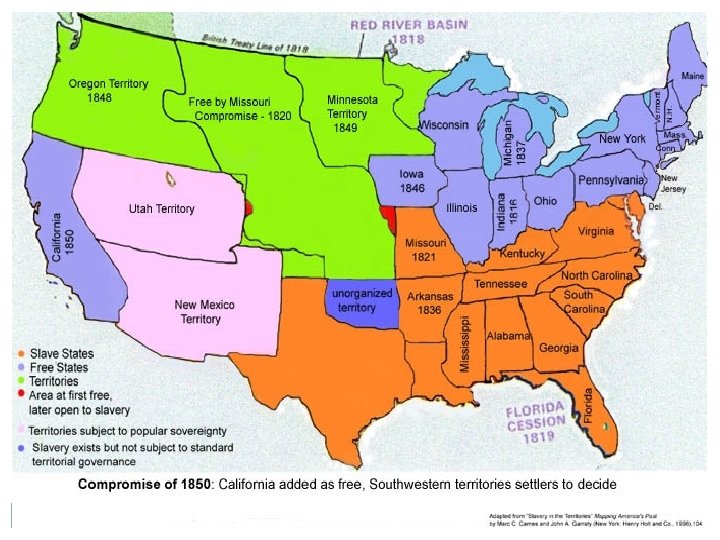
The Compromise of 1850 A collection of 6 acts aimed at preserving the Union. 1. 2. 3. 4. 5. 6. Fugitive Slave Act – federal authorities in free states to help return runaway slaves California admitted as a free state Boundary between New Mexico and Texas resolved Slave trade abolished in Washington D. C. New Mexico Territory organized on basis of popular sovereignty Utah Territory organized on basis of popular sovereignty Southern states held “Southern Rights” conventions calling for secession. Vowed to secede if any attempt to abolish slavery was made.
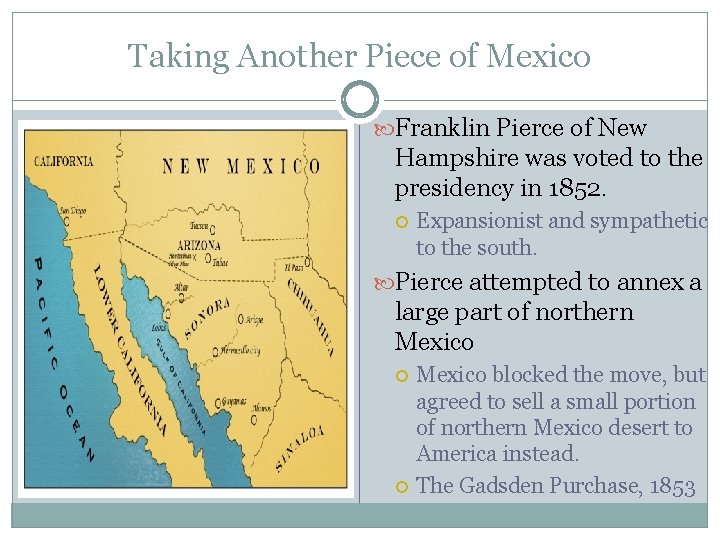
Taking Another Piece of Mexico Franklin Pierce of New Hampshire was voted to the presidency in 1852. Expansionist and sympathetic to the south. Pierce attempted to annex a large part of northern Mexico blocked the move, but agreed to sell a small portion of northern Mexico desert to America instead. The Gadsden Purchase, 1853
Southern Expansion and Bleeding Kansas Stephen Douglas called for native Americans to be pushed out of remaining Louisiana Purchase territory and the area be organized as Nebraska was above Missouri Compromise line and would be free. To win support, Douglas called for the repeal of the Missouri Compromise Douglas believed Kansas would be settled by non-slaveholders because of its climate.
Birth of the Republican Party The Kansas-Nebraska Act, as Douglas’ plan was called, signaled the end of the Whig Party and the birth of the Republican Party. Thousands of settlers flocked to the Kansas Territory The pro-slavery government of Missouri sent residents across the border to vote in crucial elections. Not to be outdone, New Englanders organized Free-Soilers to go and vote against slavery.
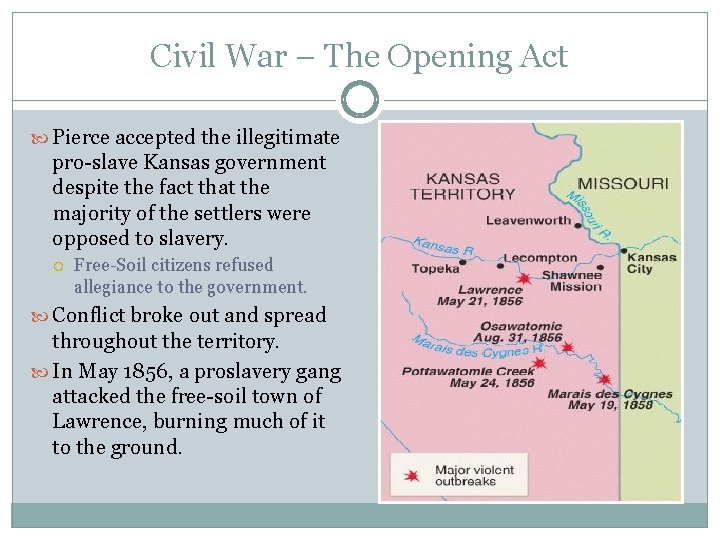
Civil War – The Opening Act Pierce accepted the illegitimate pro-slave Kansas government despite the fact that the majority of the settlers were opposed to slavery. Free-Soil citizens refused allegiance to the government. Conflict broke out and spread throughout the territory. In May 1856, a proslavery gang attacked the free-soil town of Lawrence, burning much of it to the ground.
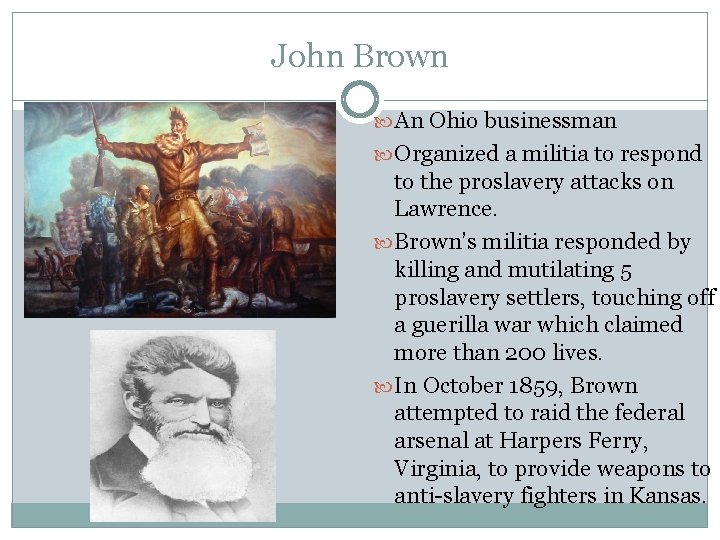
John Brown An Ohio businessman Organized a militia to respond to the proslavery attacks on Lawrence. Brown’s militia responded by killing and mutilating 5 proslavery settlers, touching off a guerilla war which claimed more than 200 lives. In October 1859, Brown attempted to raid the federal arsenal at Harpers Ferry, Virginia, to provide weapons to anti-slavery fighters in Kansas.
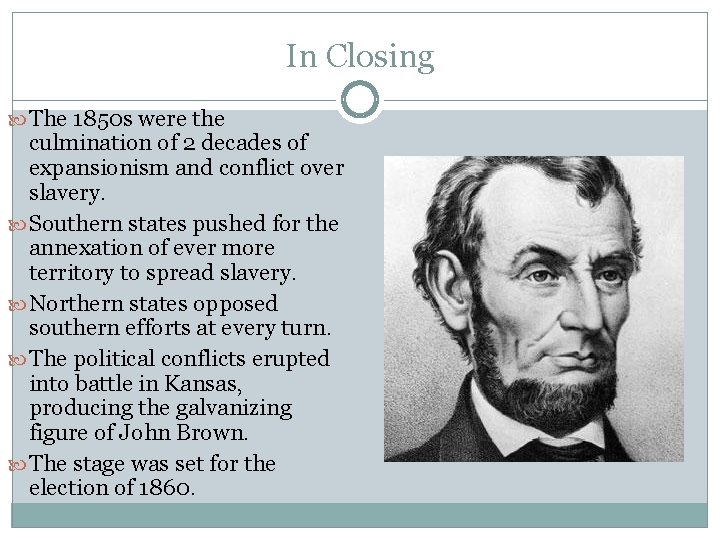
In Closing The 1850 s were the culmination of 2 decades of expansionism and conflict over slavery. Southern states pushed for the annexation of ever more territory to spread slavery. Northern states opposed southern efforts at every turn. The political conflicts erupted into battle in Kansas, producing the galvanizing figure of John Brown. The stage was set for the election of 1860.