
Manifest Destiny 1 Essential Question How did the

- Slides: 65
Manifest Destiny #1
Essential Question: • How did the United States pursue its goal of “manifest destiny? ” Objectives: 1) 2) 3) 4) 5) 6) 7) 8) #2 Why did American settlers head west during the 1800 s? What was the impact of westward expansion on Native Americans? Where were the western trails located and who used them? Why did Mexico encourage American settlement of Texas? Why did America and Mexico come into conflict over Texas? What were the conflicting American attitudes on waging war with Mexico? What were the key battles that helped America win the war with Mexico? What territories were gained from Mexico?
Manifest Destiny & Westward Expansion Although the term “Manifest Destiny” was not actually coined until 1844, the belief that the American nation was destined to eventually expand all the way to the Pacific Ocean, and to possibly embrace Canada and Mexico, had been voiced for years by many who believed that American liberty and ideals should be shared with everyone possible, by force if necessary. The rising sense of nationalism which followed the War of 1812 was fed by the rapidly expanding population, the reform movement of the 1830 s, and the desire to acquire new markets and resources for the blossoming economy of “Young America. ” #3
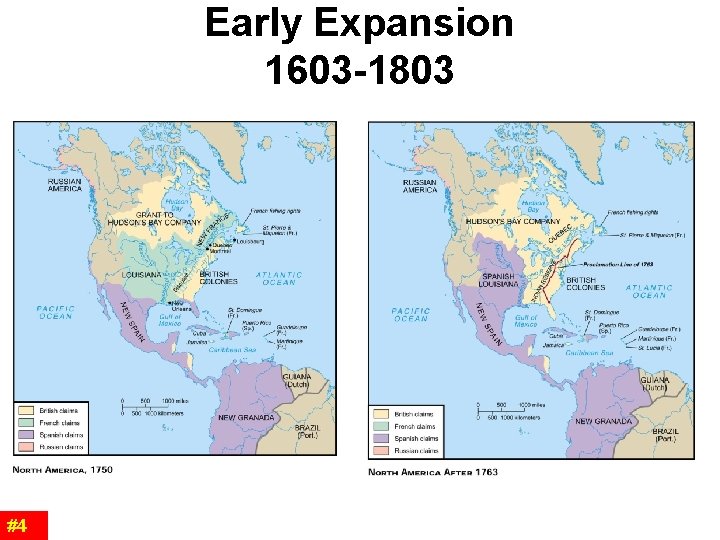
Early Expansion 1603 -1803 #4
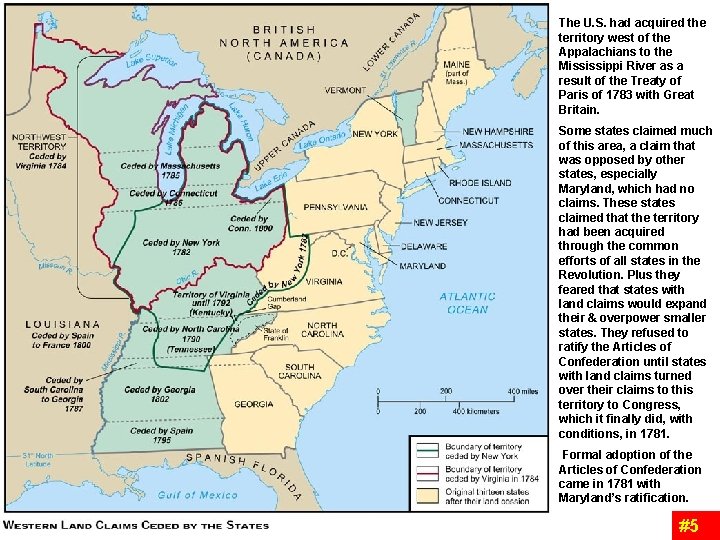
The U. S. had acquired the territory west of the Appalachians to the Mississippi River as a result of the Treaty of Paris of 1783 with Great Britain. Some states claimed much of this area, a claim that was opposed by other states, especially Maryland, which had no claims. These states claimed that the territory had been acquired through the common efforts of all states in the Revolution. Plus they feared that states with land claims would expand their & overpower smaller states. They refused to ratify the Articles of Confederation until states with land claims turned over their claims to this territory to Congress, which it finally did, with conditions, in 1781. Formal adoption of the Articles of Confederation came in 1781 with Maryland’s ratification. #5
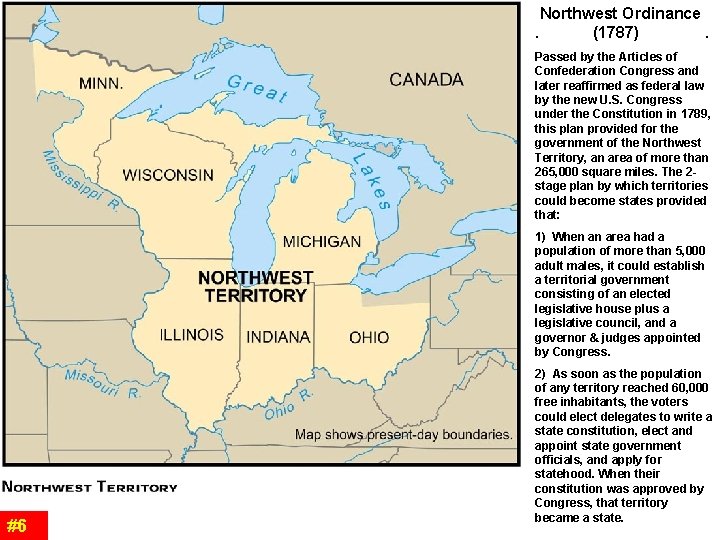
Northwest Ordinance . (1787) . Passed by the Articles of Confederation Congress and later reaffirmed as federal law by the new U. S. Congress under the Constitution in 1789, this plan provided for the government of the Northwest Territory, an area of more than 265, 000 square miles. The 2 stage plan by which territories could become states provided that: 1) When an area had a population of more than 5, 000 adult males, it could establish a territorial government consisting of an elected legislative house plus a legislative council, and a governor & judges appointed by Congress. #6 2) As soon as the population of any territory reached 60, 000 free inhabitants, the voters could elect delegates to write a state constitution, elect and appoint state government officials, and apply for statehood. When their constitution was approved by Congress, that territory became a state.
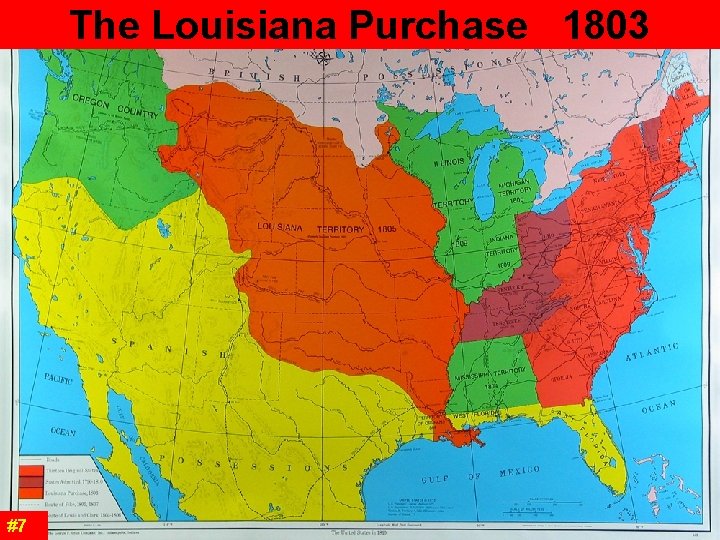
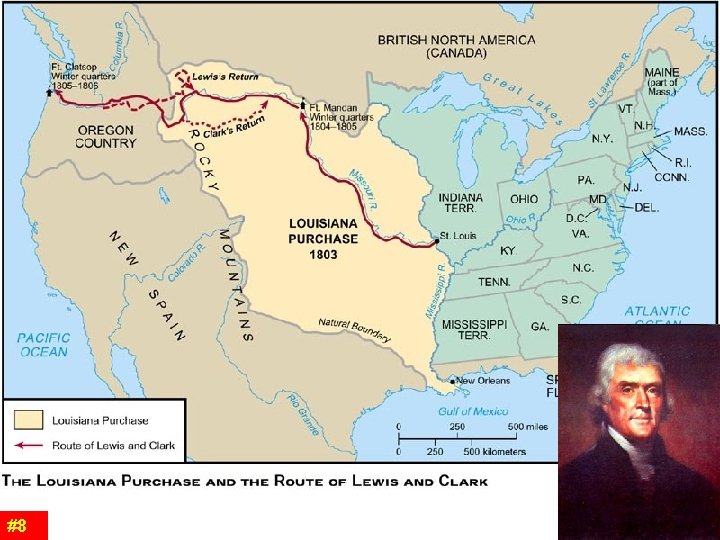
The Louisiana Purchase 1803 #7
#8
U. S. Constitution - Article 2 Section 2 Article 2 - The Executive Branch Section 2 - Civilian Power Over Military, Cabinet, Pardon Power, Appointments The President shall be Commander in Chief of the Army and Navy of the United States, and of the Militia of the several States, when called into the actual Service of the United States; he may require the Opinion, in writing, of the principal Officer in each of the executive Departments, upon any subject relating to the Duties of their respective Offices, and he shall have Power to Grant Reprieves and Pardons for Offenses against the United States, except in Cases of Impeachment. He shall have Power, by and with the Advice and Consent of the Senate, to make Treaties, provided two thirds of the Senators present concur; and he shall nominate, and by and with the Advice and Consent of the Senate, shall appoint Ambassadors, other public Ministers and Consuls, Judges of the supreme Court, and all other Officers of the United States, whose Appointments are not herein otherwise provided for, and which shall be established by Law: but the Congress may by Law vest the Appointment of such inferior Officers, as they think proper, in the President alone, in the Courts of Law, or in the Heads of Departments. The President shall have Power to fill up all Vacancies that may happen during the Recess of the Senate, by granting Commissions which shall expire at the End of their next Session. #9
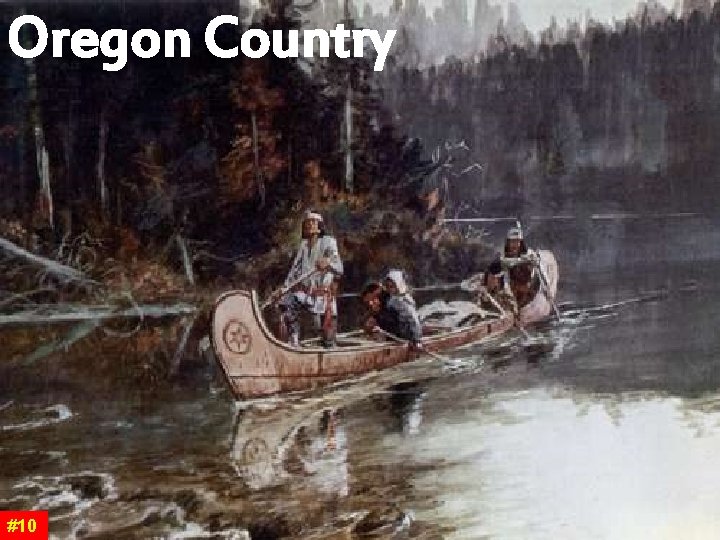
Oregon Country #10
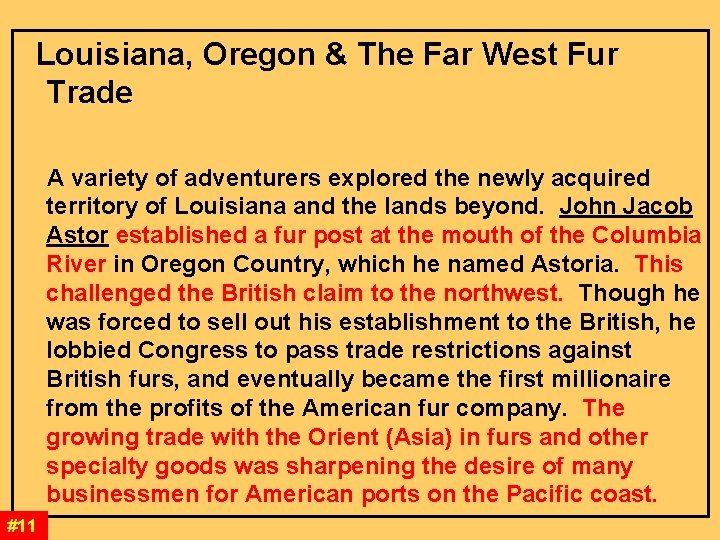
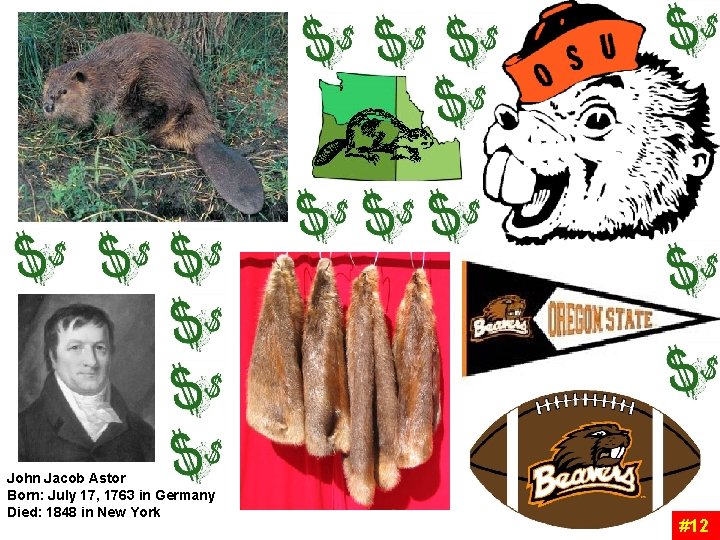
Louisiana, Oregon & The Far West Fur Trade A variety of adventurers explored the newly acquired territory of Louisiana and the lands beyond. John Jacob Astor established a fur post at the mouth of the Columbia River in Oregon Country, which he named Astoria. This challenged the British claim to the northwest. Though he was forced to sell out his establishment to the British, he lobbied Congress to pass trade restrictions against British furs, and eventually became the first millionaire from the profits of the American fur company. The growing trade with the Orient (Asia) in furs and other specialty goods was sharpening the desire of many businessmen for American ports on the Pacific coast. #11
John Jacob Astor Born: July 17, 1763 in Germany Died: 1848 in New York #12
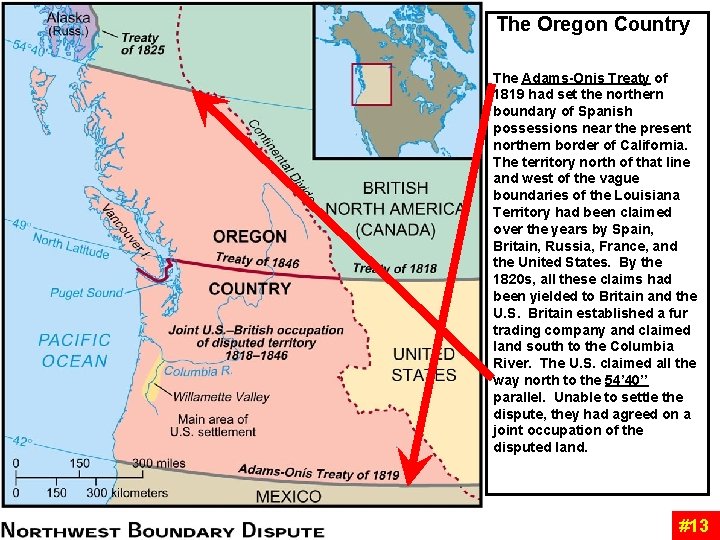
The Oregon Country The Adams-Onis Treaty of 1819 had set the northern boundary of Spanish possessions near the present northern border of California. The territory north of that line and west of the vague boundaries of the Louisiana Territory had been claimed over the years by Spain, Britain, Russia, France, and the United States. By the 1820 s, all these claims had been yielded to Britain and the U. S. Britain established a fur trading company and claimed land south to the Columbia River. The U. S. claimed all the way north to the 54’ 40’’ parallel. Unable to settle the dispute, they had agreed on a joint occupation of the disputed land. #13
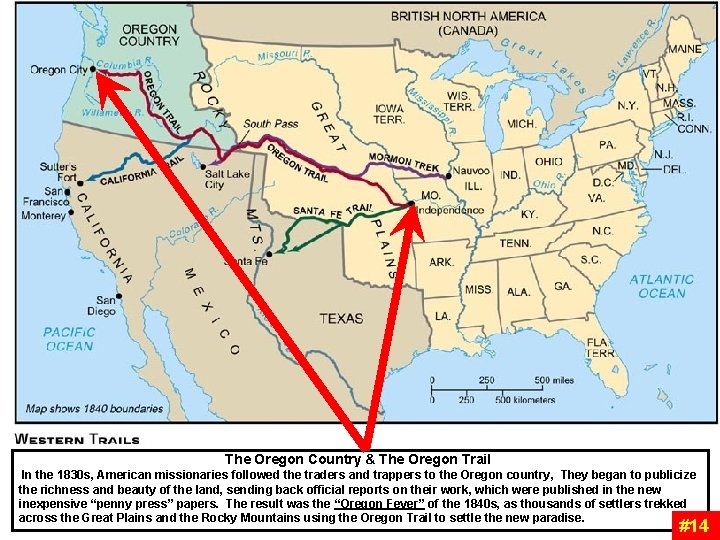
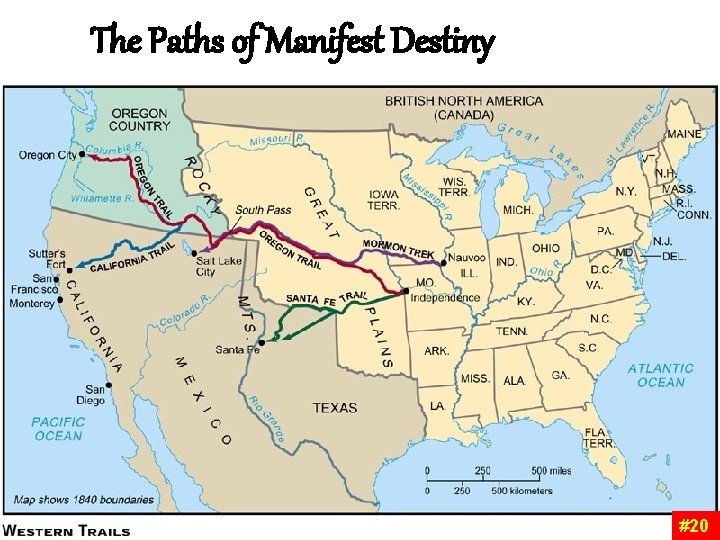
The Oregon Country & The Oregon Trail In the 1830 s, American missionaries followed the traders and trappers to the Oregon country, They began to publicize the richness and beauty of the land, sending back official reports on their work, which were published in the new inexpensive “penny press” papers. The result was the “Oregon Fever” of the 1840 s, as thousands of settlers trekked across the Great Plains and the Rocky Mountains using the Oregon Trail to settle the new paradise. #14
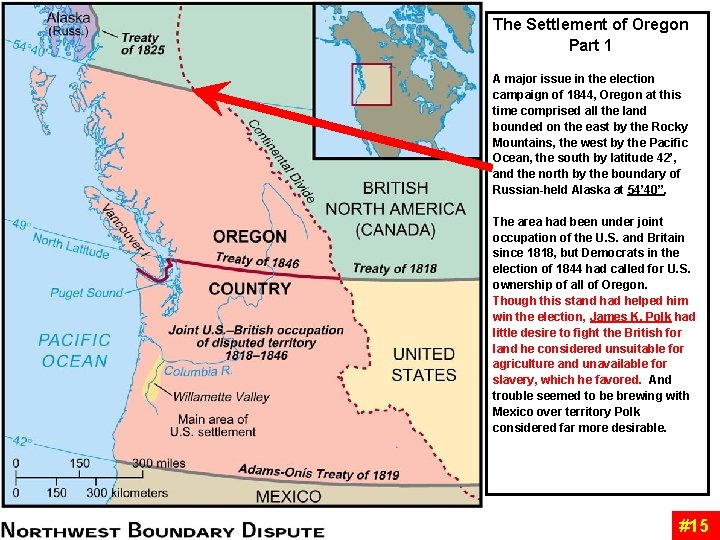
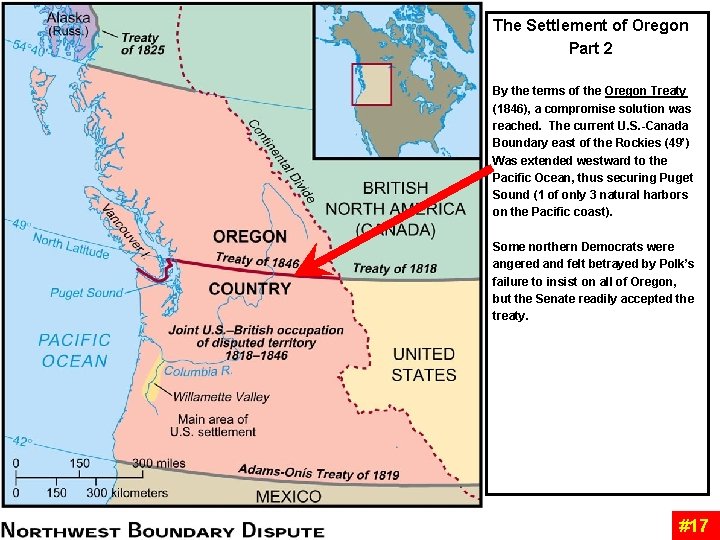
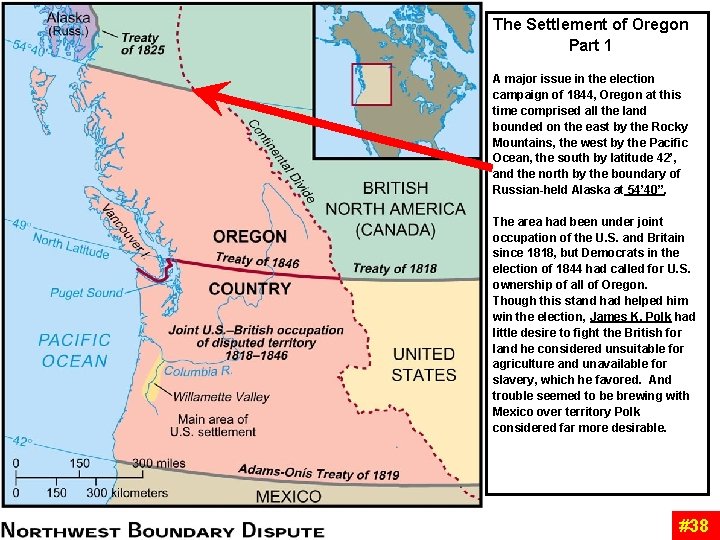
The Settlement of Oregon Part 1 A major issue in the election campaign of 1844, Oregon at this time comprised all the land bounded on the east by the Rocky Mountains, the west by the Pacific Ocean, the south by latitude 42’, and the north by the boundary of Russian-held Alaska at 54’ 40’’. The area had been under joint occupation of the U. S. and Britain since 1818, but Democrats in the election of 1844 had called for U. S. ownership of all of Oregon. Though this stand had helped him win the election, James K. Polk had little desire to fight the British for land he considered unsuitable for agriculture and unavailable for slavery, which he favored. And trouble seemed to be brewing with Mexico over territory Polk considered far more desirable. #15
. . . Besides the recovery of the country lost, or jeoparded [jeopardized] by our diplomacy of 1818, the settlers in Oregon will also recover and open for us the North American road to India! This road lies through the South Pass, and the mouth of the Oregon [River]; and as soon as the settlements are made, our portion of the North American continent will immediately commence its Asiatic trade on this new and national route. This great question I explored some years ago, and only refer to it now to give a glimpse of the brilliant destiny which awaits the population of the Oregon valley. Twenty-two years ago, President Monroe, in a message to the two Houses of Congress, proclaimed the principle as fundamental in American policy, that no part of North America was open to European colonization, domination, interference, or influence of any kind [Monroe Doctrine]. That declaration had its reference to Great Britain and the Oregon [region], and it found its response in the hearts of all Americans. Time has not weakened that response, but confirmed it; and if any European power develops a design upon Texas, the response will apply to it also. . Source: Senator Thomas Hart Benton, Speech to the Senate on the Oregon Territory, June 3, 1844, Congressional Globe, 28 th Congress, 1 st Session #16
The Settlement of Oregon Part 2 By the terms of the Oregon Treaty (1846), a compromise solution was reached. The current U. S. -Canada Boundary east of the Rockies (49’) Was extended westward to the Pacific Ocean, thus securing Puget Sound (1 of only 3 natural harbors on the Pacific coast). Some northern Democrats were angered and felt betrayed by Polk’s failure to insist on all of Oregon, but the Senate readily accepted the treaty. #17
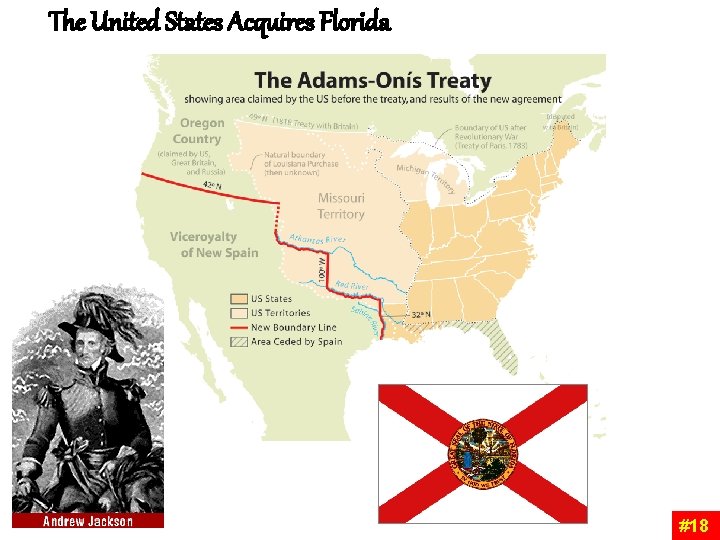
The United States Acquires Florida #18
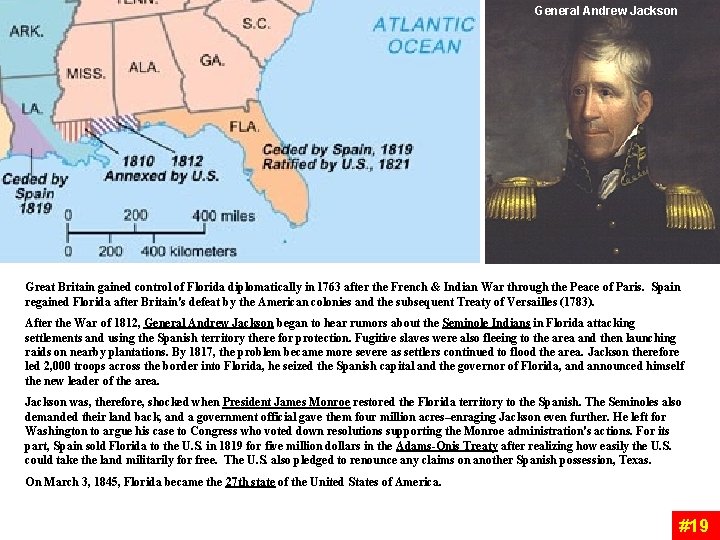
General Andrew Jackson Great Britain gained control of Florida diplomatically in 1763 after the French & Indian War through the Peace of Paris. Spain regained Florida after Britain's defeat by the American colonies and the subsequent Treaty of Versailles (1783). After the War of 1812, General Andrew Jackson began to hear rumors about the Seminole Indians in Florida attacking settlements and using the Spanish territory there for protection. Fugitive slaves were also fleeing to the area and then launching raids on nearby plantations. By 1817, the problem became more severe as settlers continued to flood the area. Jackson therefore led 2, 000 troops across the border into Florida, he seized the Spanish capital and the governor of Florida, and announced himself the new leader of the area. Jackson was, therefore, shocked when President James Monroe restored the Florida territory to the Spanish. The Seminoles also demanded their land back, and a government official gave them four million acres–enraging Jackson even further. He left for Washington to argue his case to Congress who voted down resolutions supporting the Monroe administration's actions. For its part, Spain sold Florida to the U. S. in 1819 for five million dollars in the Adams-Onis Treaty after realizing how easily the U. S. could take the land militarily for free. The U. S. also pledged to renounce any claims on another Spanish possession, Texas. On March 3, 1845, Florida became the 27 th state of the United States of America. #19
The Paths of Manifest Destiny #20
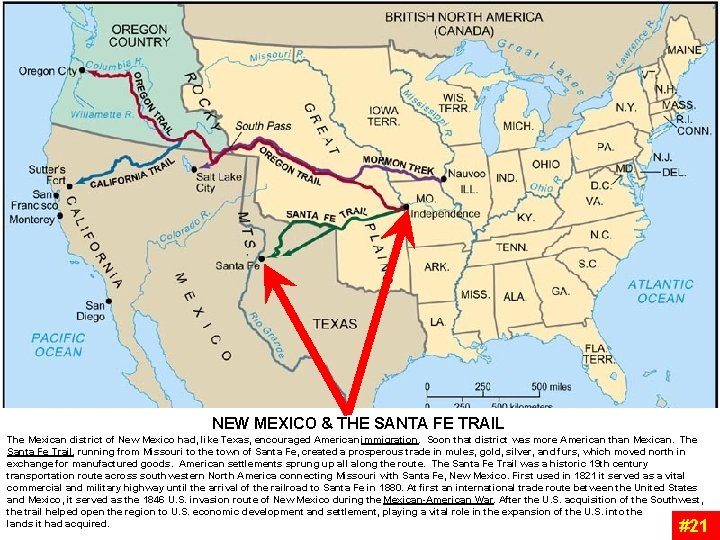
NEW MEXICO & THE SANTA FE TRAIL The Mexican district of New Mexico had, like Texas, encouraged American immigration. Soon that district was more American than Mexican. The Santa Fe Trail, running from Missouri to the town of Santa Fe, created a prosperous trade in mules, gold, silver, and furs, which moved north in exchange for manufactured goods. American settlements sprung up all along the route. The Santa Fe Trail was a historic 19 th century transportation route across southwestern North America connecting Missouri with Santa Fe, New Mexico. First used in 1821 it served as a vital commercial and military highway until the arrival of the railroad to Santa Fe in 1880. At first an international trade route between the United States and Mexico, it served as the 1846 U. S. invasion route of New Mexico during the Mexican-American War. After the U. S. acquisition of the Southwest, the trail helped open the region to U. S. economic development and settlement, playing a vital role in the expansion of the U. S. into the lands it had acquired. #21
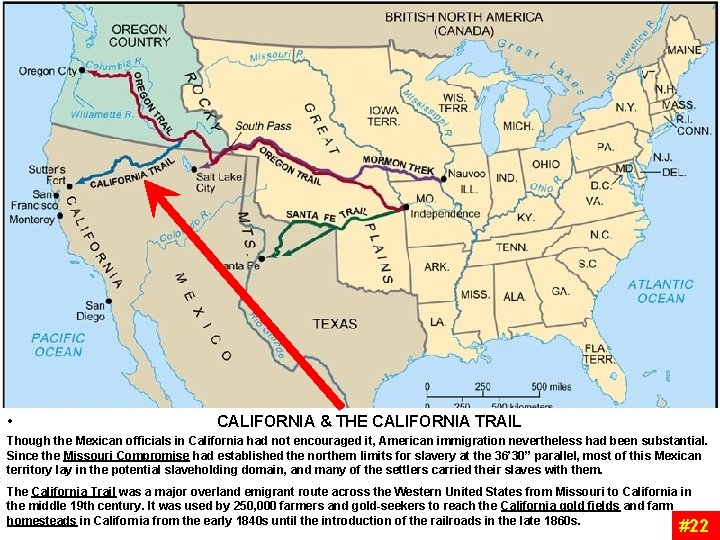
• CALIFORNIA & THE CALIFORNIA TRAIL Though the Mexican officials in California had not encouraged it, American immigration nevertheless had been substantial. Since the Missouri Compromise had established the northern limits for slavery at the 36’ 30’’ parallel, most of this Mexican territory lay in the potential slaveholding domain, and many of the settlers carried their slaves with them. The California Trail was a major overland emigrant route across the Western United States from Missouri to California in the middle 19 th century. It was used by 250, 000 farmers and gold-seekers to reach the California gold fields and farm homesteads in California from the early 1840 s until the introduction of the railroads in the late 1860 s. #22
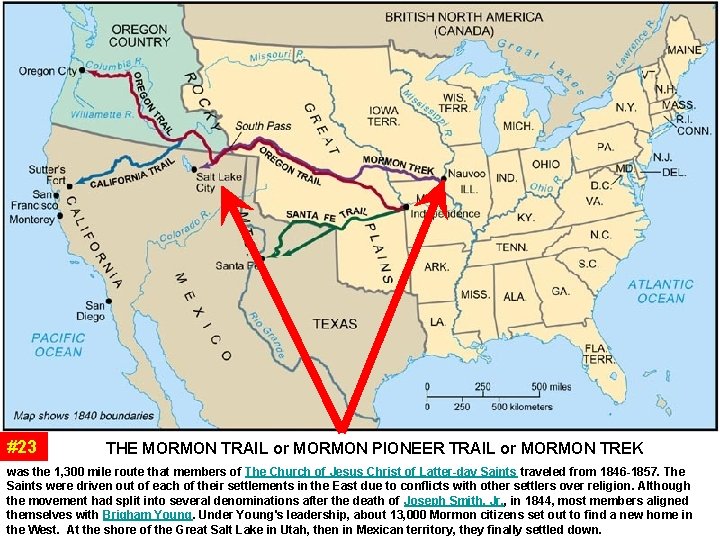
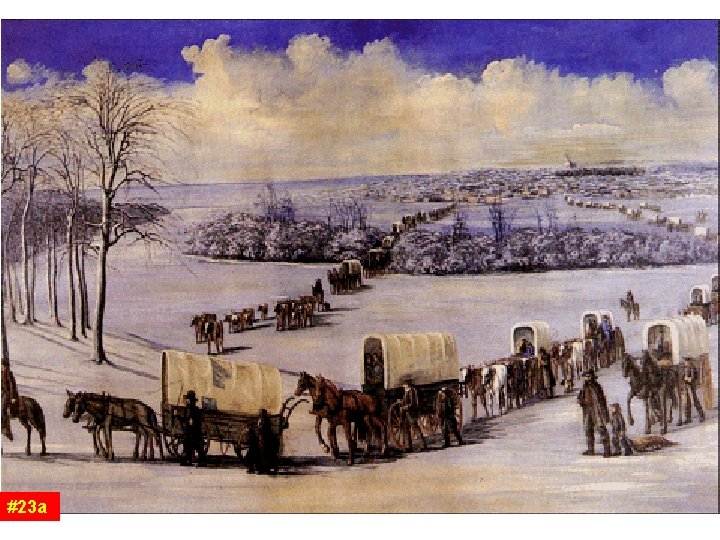
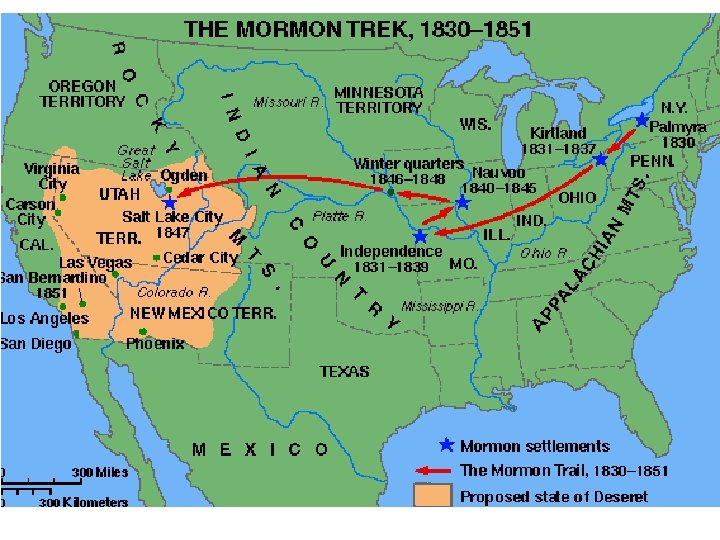
#23 • THE MORMON TRAIL or MORMON PIONEER TRAIL or MORMON TREK was the 1, 300 mile route that members of The Church of Jesus Christ of Latter-day Saints traveled from 1846 -1857. The Saints were driven out of each of their settlements in the East due to conflicts with other settlers over religion. Although the movement had split into several denominations after the death of Joseph Smith, Jr. , in 1844, most members aligned themselves with Brigham Young. Under Young's leadership, about 13, 000 Mormon citizens set out to find a new home in the West. At the shore of the Great Salt Lake in Utah, then in Mexican territory, they finally settled down.
#23 a
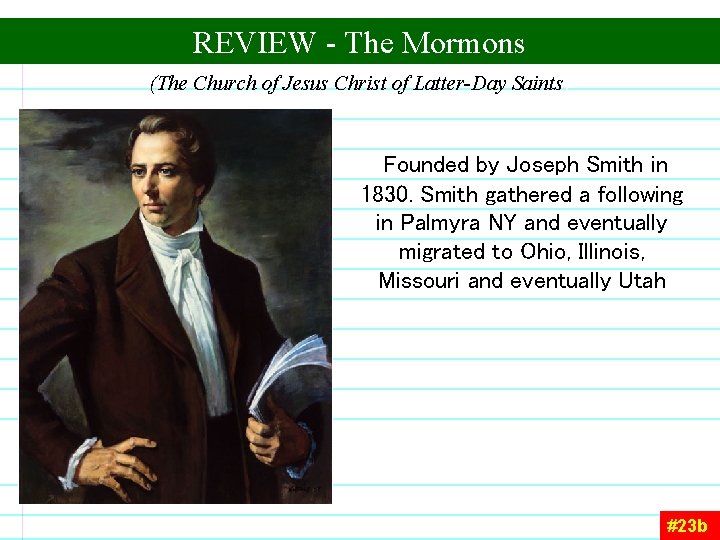
Charles G. Finney – REVIEW - The Mormons (The Church of Jesus Christ of Latter-Day Saints) Founded by Joseph Smith in 1830. Smith gathered a following in Palmyra NY and eventually migrated to Ohio, Illinois, Missouri and eventually Utah “soul-shaking” conversion #23 b
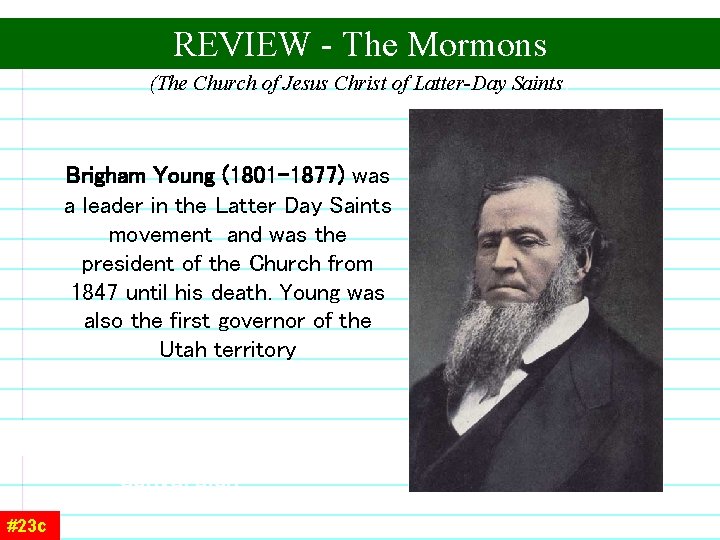
Charles G. Finney – REVIEW - The Mormons (The Church of Jesus Christ of Latter-Day Saints) Brigham Young (1801 -1877) was a leader in the Latter Day Saints movement and was the president of the Church from 1847 until his death. Young was also the first governor of the Utah territory “soul-shaking” conversion #23 c
The Texas. Question #24
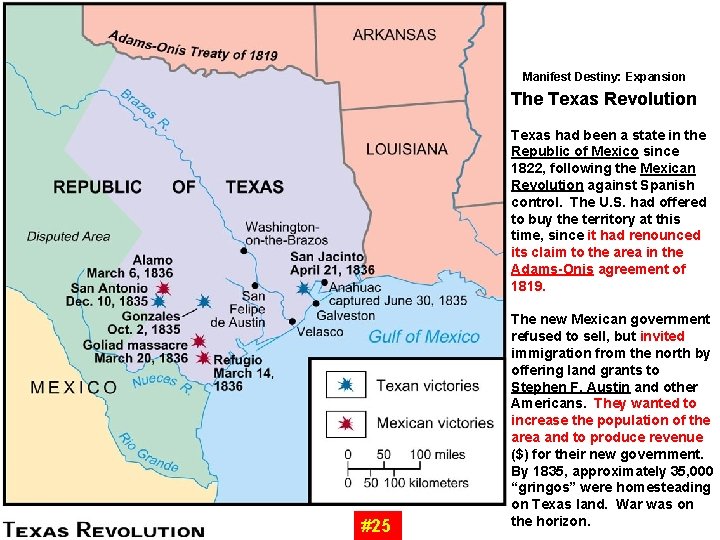
Manifest Destiny: Expansion The Texas Revolution Texas had been a state in the Republic of Mexico since 1822, following the Mexican Revolution against Spanish control. The U. S. had offered to buy the territory at this time, since it had renounced its claim to the area in the Adams-Onis agreement of 1819. #25 The new Mexican government refused to sell, but invited immigration from the north by offering land grants to Stephen F. Austin and other Americans. They wanted to increase the population of the area and to produce revenue ($) for their new government. By 1835, approximately 35, 000 “gringos” were homesteading on Texas land. War was on the horizon.
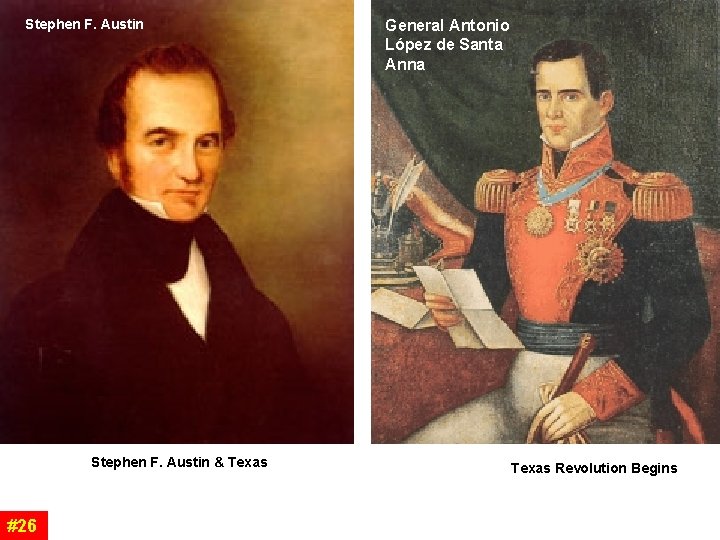
Stephen F. Austin & Texas #26 General Antonio López de Santa Anna Texas Revolution Begins
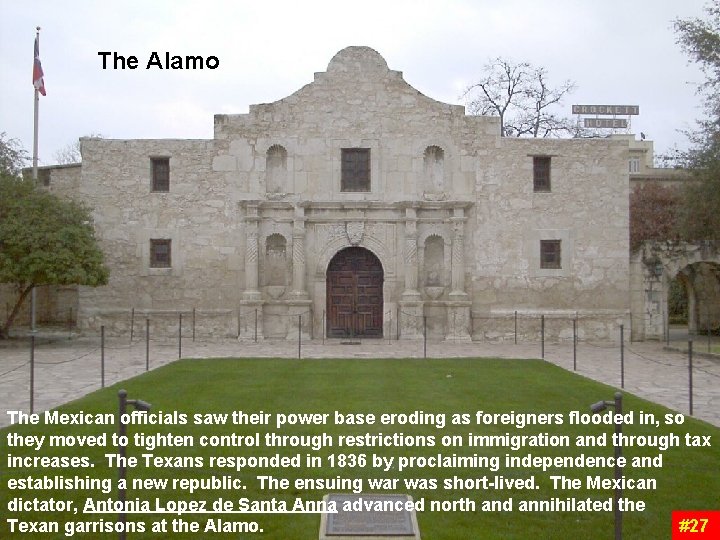
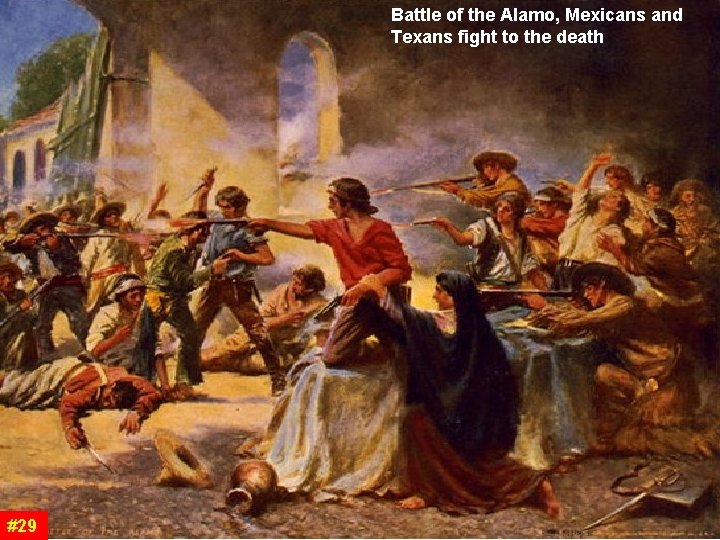
The Alamo The Mexican officials saw their power base eroding as foreigners flooded in, so they moved to tighten control through restrictions on immigration and through tax increases. The Texans responded in 1836 by proclaiming independence and establishing a new republic. The ensuing war was short-lived. The Mexican dictator, Antonia Lopez de Santa Anna advanced north and annihilated the Texan garrisons at the Alamo. #27
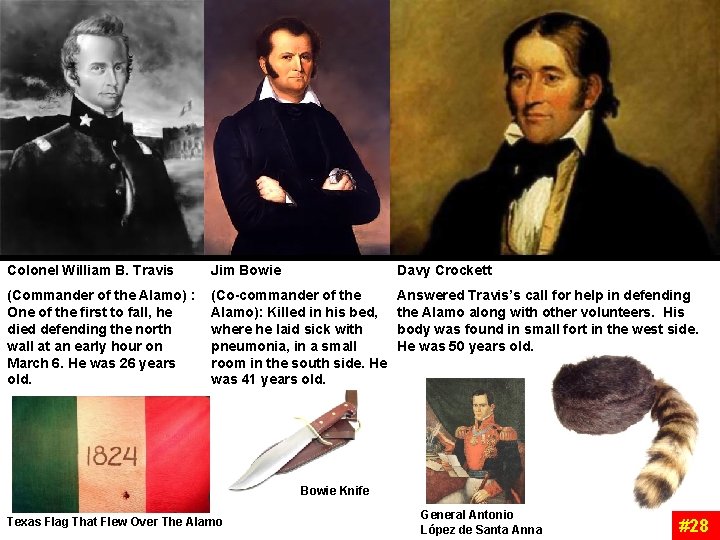
Colonel William B. Travis Jim Bowie Davy Crockett (Commander of the Alamo) : One of the first to fall, he died defending the north wall at an early hour on March 6. He was 26 years old. (Co-commander of the Alamo): Killed in his bed, where he laid sick with pneumonia, in a small room in the south side. He was 41 years old. Answered Travis’s call for help in defending the Alamo along with other volunteers. His body was found in small fort in the west side. He was 50 years old. Bowie Knife Texas Flag That Flew Over The Alamo General Antonio López de Santa Anna #28
Battle of the Alamo, Mexicans and Texans fight to the death #29
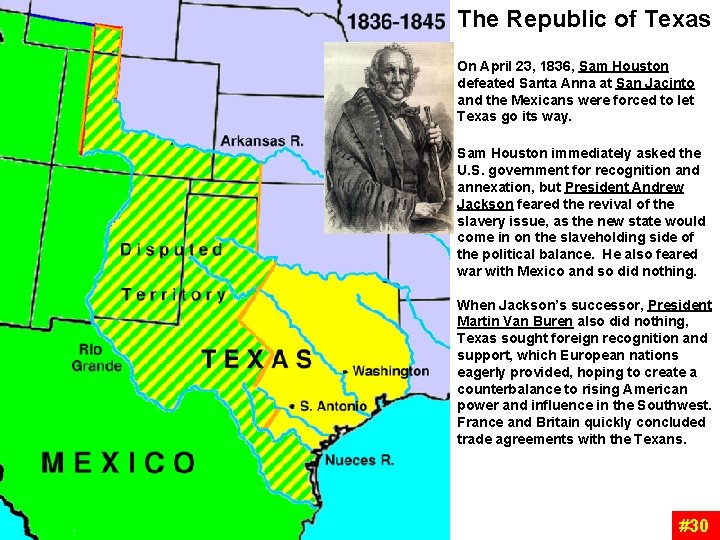
The Republic of Texas On April 23, 1836, Sam Houston defeated Santa Anna at San Jacinto and the Mexicans were forced to let Texas go its way. Sam Houston immediately asked the U. S. government for recognition and annexation, but President Andrew Jackson feared the revival of the slavery issue, as the new state would come in on the slaveholding side of the political balance. He also feared war with Mexico and so did nothing. When Jackson’s successor, President Martin Van Buren also did nothing, Texas sought foreign recognition and support, which European nations eagerly provided, hoping to create a counterbalance to rising American power and influence in the Southwest. France and Britain quickly concluded trade agreements with the Texans. #30
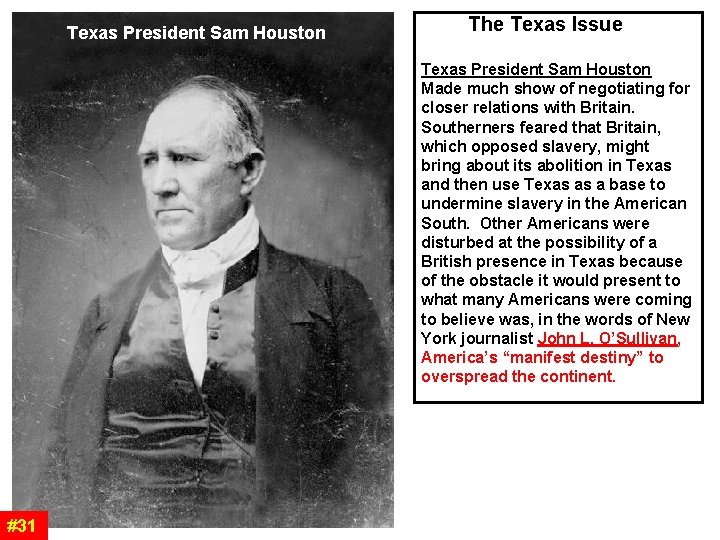
Texas President Sam Houston The Texas Issue Texas President Sam Houston Made much show of negotiating for closer relations with Britain. Southerners feared that Britain, which opposed slavery, might bring about its abolition in Texas and then use Texas as a base to undermine slavery in the American South. Other Americans were disturbed at the possibility of a British presence in Texas because of the obstacle it would present to what many Americans were coming to believe was, in the words of New York journalist John L. O’Sullivan, America’s “manifest destiny” to overspread the continent. #31
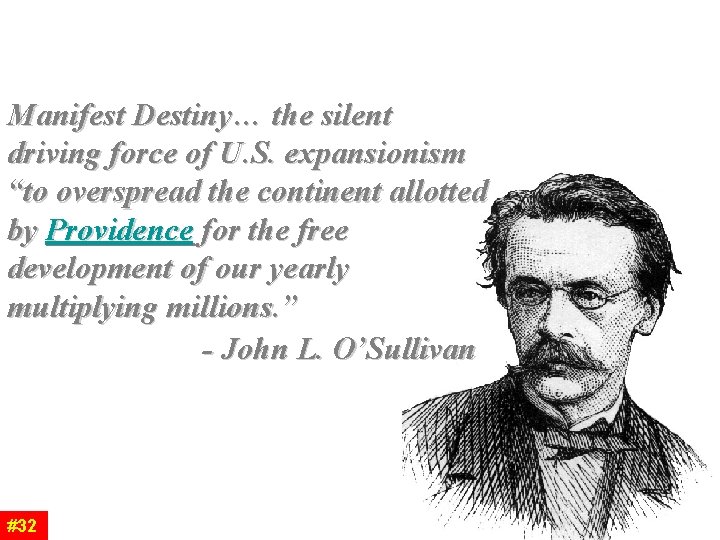
Manifest Destiny… the silent driving force of U. S. expansionism “to overspread the continent allotted by Providence for the free development of our yearly multiplying millions. ” - John L. O’Sullivan #32
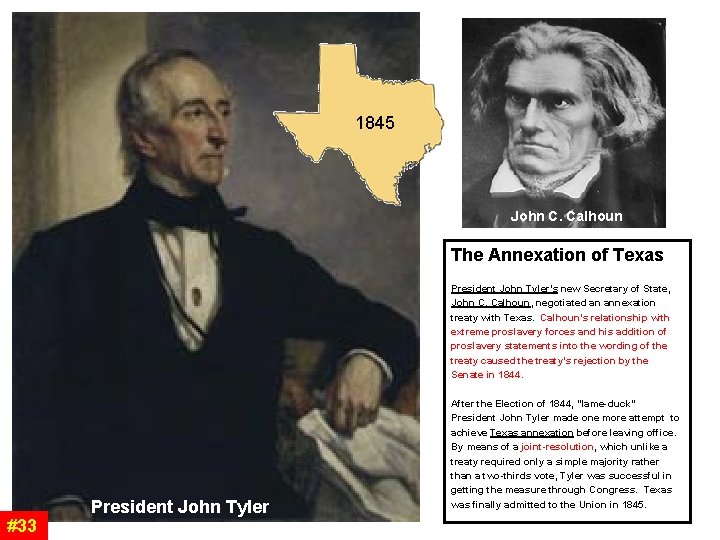
1845 John C. Calhoun The Annexation of Texas President John Tyler’s new Secretary of State, John C. Calhoun, negotiated an annexation treaty with Texas. Calhoun’s relationship with extreme proslavery forces and his addition of proslavery statements into the wording of the treaty caused the treaty’s rejection by the Senate in 1844. #33 President John Tyler After the Election of 1844, “lame-duck” President John Tyler made one more attempt to achieve Texas annexation before leaving office. By means of a joint-resolution, which unlike a treaty required only a simple majority rather than a two-thirds vote, Tyler was successful in getting the measure through Congress. Texas was finally admitted to the Union in 1845.
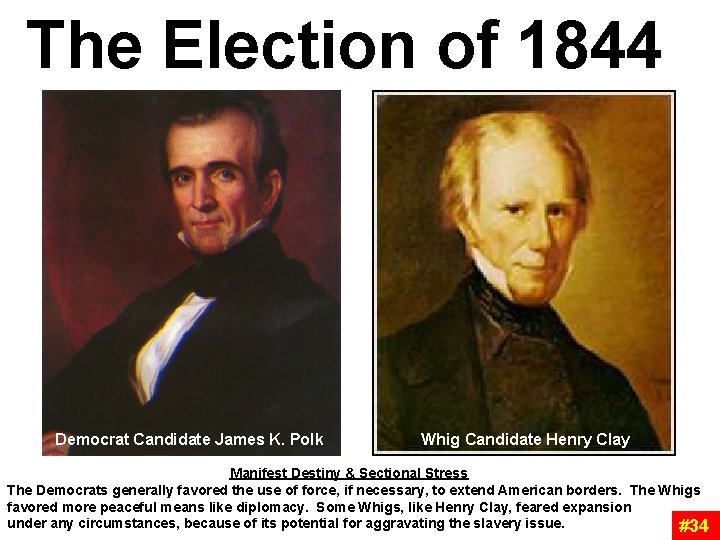
The Election of 1844 Democrat Candidate James K. Polk Whig Candidate Henry Clay Manifest Destiny & Sectional Stress The Democrats generally favored the use of force, if necessary, to extend American borders. The Whigs favored more peaceful means like diplomacy. Some Whigs, like Henry Clay, feared expansion under any circumstances, because of its potential for aggravating the slavery issue. #34
What’s A Whig? The Whig Party was a political party of the United States during the era of Jacksonian democracy. Considered integral to the Second Party System and operating from 1832 to 1856, the party was formed to oppose the policies of President Andrew Jackson and the Democratic Party. In particular, the Whigs supported the supremacy of Congress over the Executive Branch and favored a program of modernization and economic development. Their name was chosen to echo the American Whigs of the 1770 s who fought for independence. The Whig Party counted among its members such national political luminaries as Daniel Webster, William Henry Harrison, and their pre-eminent leader, Henry Clay of Kentucky. In addition to Harrison, the Whig Party also counted four war heroes among its ranks, including Generals Zachary Taylor and Winfield Scott. Its Illinois leader eventually became Abraham Lincoln. The party was ultimately destroyed by the question of whether to allow the expansion of slavery to the territories. Deep fissures in the party on this question led the party to run Winfield Scott over its own incumbent President Fillmore in the U. S. presidential election of 1852. The Whig Party never elected another President. Its leaders quit politics (as Lincoln did temporarily) or changed parties. The voter base defected to the nativist Know-Nothing Party, Republican Party, various coalition parties in some states, and even to the Democrats. #35
#36
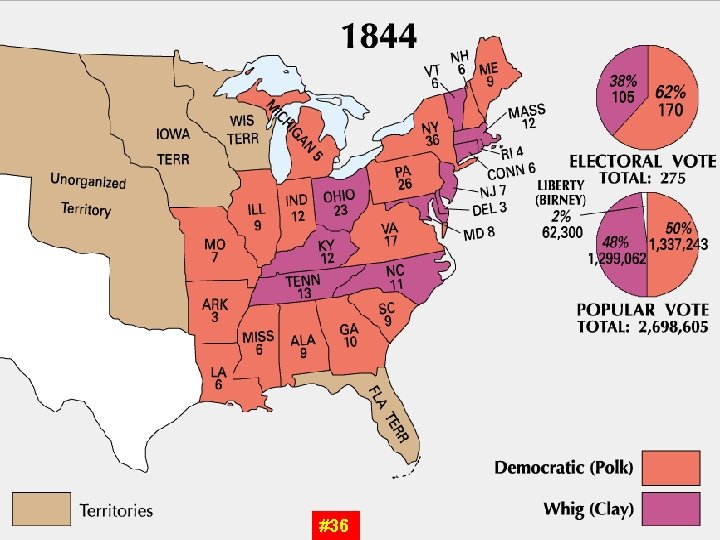
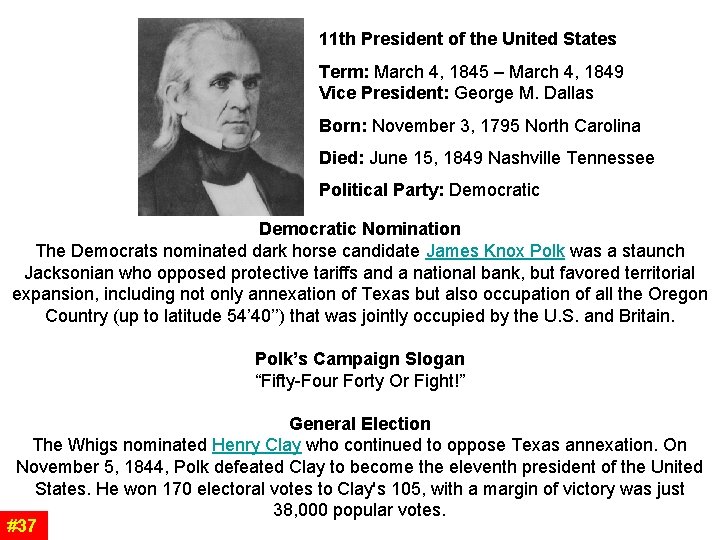
11 th President of the United States Term: March 4, 1845 – March 4, 1849 Vice President: George M. Dallas Born: November 3, 1795 North Carolina Died: June 15, 1849 Nashville Tennessee Political Party: Democratic Nomination The Democrats nominated dark horse candidate James Knox Polk was a staunch Jacksonian who opposed protective tariffs and a national bank, but favored territorial expansion, including not only annexation of Texas but also occupation of all the Oregon Country (up to latitude 54’ 40’’) that was jointly occupied by the U. S. and Britain. Polk’s Campaign Slogan “Fifty-Four Forty Or Fight!” General Election The Whigs nominated Henry Clay who continued to oppose Texas annexation. On November 5, 1844, Polk defeated Clay to become the eleventh president of the United States. He won 170 electoral votes to Clay's 105, with a margin of victory was just 38, 000 popular votes. #37
The Settlement of Oregon Part 1 A major issue in the election campaign of 1844, Oregon at this time comprised all the land bounded on the east by the Rocky Mountains, the west by the Pacific Ocean, the south by latitude 42’, and the north by the boundary of Russian-held Alaska at 54’ 40’’. The area had been under joint occupation of the U. S. and Britain since 1818, but Democrats in the election of 1844 had called for U. S. ownership of all of Oregon. Though this stand had helped him win the election, James K. Polk had little desire to fight the British for land he considered unsuitable for agriculture and unavailable for slavery, which he favored. And trouble seemed to be brewing with Mexico over territory Polk considered far more desirable. #38
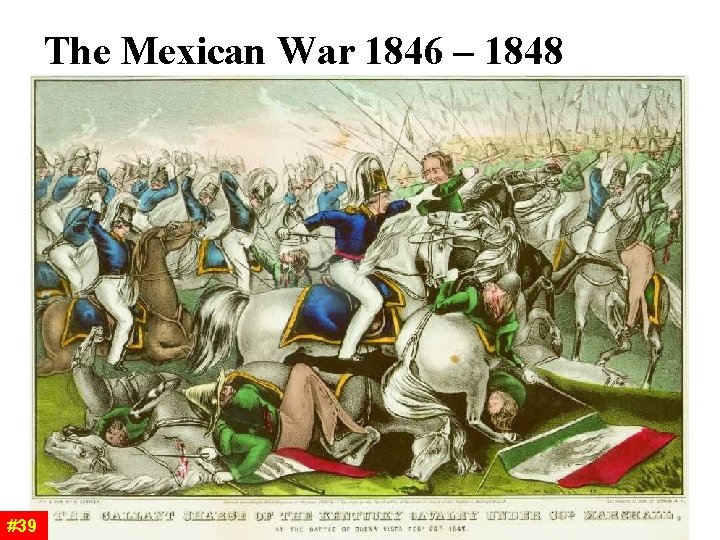
The Mexican War 1846 – 1848 #39
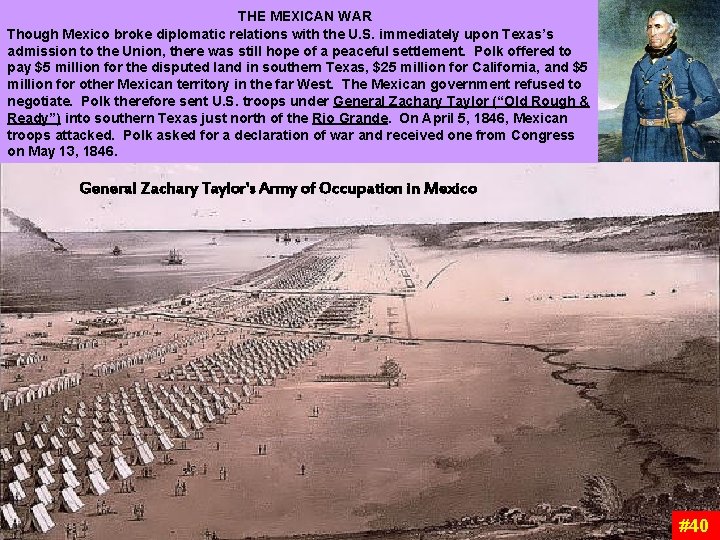
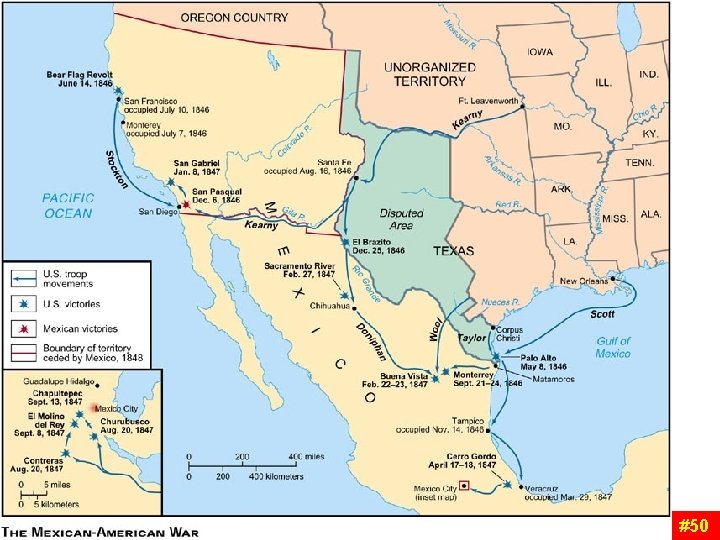
THE MEXICAN WAR Though Mexico broke diplomatic relations with the U. S. immediately upon Texas’s admission to the Union, there was still hope of a peaceful settlement. Polk offered to pay $5 million for the disputed land in southern Texas, $25 million for California, and $5 million for other Mexican territory in the far West. The Mexican government refused to negotiate. Polk therefore sent U. S. troops under General Zachary Taylor (“Old Rough & Ready”) into southern Texas just north of the Rio Grande. On April 5, 1846, Mexican troops attacked. Polk asked for a declaration of war and received one from Congress on May 13, 1846. General Zachary Taylor's Army of Occupation in Mexico #40
U. S. Constitution - Article 1 Section 8 Article 1 - The Legislative Branch Section 8 - Powers of Congress The Congress shall have Power To lay and collect Taxes, Duties, Imposts and Excises, to pay the Debts and provide for the common Defense and general Welfare of the United States; but all Duties, Imposts and Excises shall be uniform throughout the United States; To borrow money on the credit of the United States; To regulate Commerce with foreign Nations, and among the several States, and with the Indian Tribes; To establish an uniform Rule of Naturalization, and uniform Laws on the subject of Bankruptcies throughout the United States; To coin Money, regulate the Value thereof, and of foreign Coin, and fix the Standard of Weights and Measures; To provide for the Punishment of counterfeiting the Securities and current Coin of the United States; To establish Post Offices and Post Roads; To promote the Progress of Science and useful Arts, by securing for limited Times to Authors and Inventors the exclusive Right to their respective Writings and Discoveries; To constitute Tribunals inferior to the supreme Court; To define and punish Piracies and Felonies committed on the high Seas, and Offenses against the Law of Nations; To declare War, grant Letters of Marque and Reprisal, and make Rules concerning Captures on Land Water; To raise and support Armies, but no Appropriation of Money to that Use shall be for a longer Term than two Years; To provide and maintain a Navy; #41
. . . Instead of this, however, we have been exerting [putting forth] our best efforts to propitiate [gain] her [Mexico’s] good will. Upon the pretext that Texas, a nation as independent as herself, thought proper to unite its destinies with our own, she has affected to believe that we have severed [removed] her rightful territory, and in official proclamations and manifestoes has repeatedly threatened to make war upon us for the purpose of reconquering Texas. In the meantime we have tried every effort at reconciliation [restoring harmony]. The cup of forbearance [tolerance] had been exhausted even before the recent information from the frontier of the Del Norte [Mexican-American border]. But now, after reiterated [repeated] menaces, Mexico has passed the boundary of the United States, has invaded our territory and shed American blood upon the American soil. She has proclaimed that hostilities have commenced [begun], and that the two nations are now at war. . — President James K. Polk, Message to Congress, May 11, 1846 #42
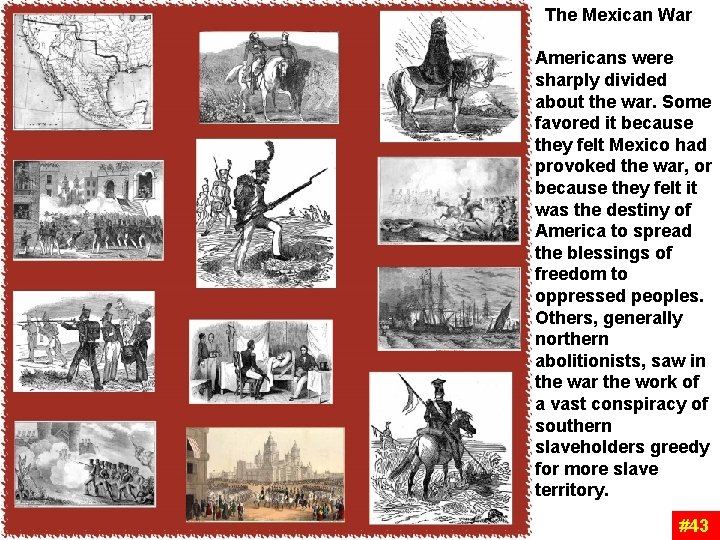
The Mexican War Americans were sharply divided about the war. Some favored it because they felt Mexico had provoked the war, or because they felt it was the destiny of America to spread the blessings of freedom to oppressed peoples. Others, generally northern abolitionists, saw in the war the work of a vast conspiracy of southern slaveholders greedy for more slave territory. #43
“On Our Way to Rio Grande” The Mexicans are on our soil In war they wish us to embroil They’ve tried their best and worst to vex [worry] us By murdering our brave men in Texas We’re on our way to Rio Grande On our way to Rio Grande And with arms [guns] they’ll find us handy. . Source: George Washington Dixon, 1846 song about the Mexican War; Erik Bruun and Jay Crosby, eds. Our Nation’s Archive, Black Dog & Leventhal Publishers, 1999 #44
Prior to the Mexican War, President Polk sent John Slidell, a United States negotiator, to Mexico to offer to settle the disputes between the two nations. . And yet again, in his [President Polk’s] message of December 7, 1847, that “the Mexican Government refused even to hear the terms of adjustment which he (our minister of peace) was authorized to propose, and finally, under wholly unjustifiable pretexts [reasons], involved the two countries in war, by invading the territory of the State of Texas, striking the first blow, and shedding the blood of our citizens on our own soil: ” And whereas this House [of Representatives] is desirous to obtain a full knowledge of all the facts which go to establish whether the particular spot on which the blood of our citizens was so shed was or was not at that time our own soil: . . #45 Source: Abraham Lincoln, “Spot” Resolutions in the House of Representatives, December 22, 1847; Congressional Globe, 30 th Congress, 1 st Session
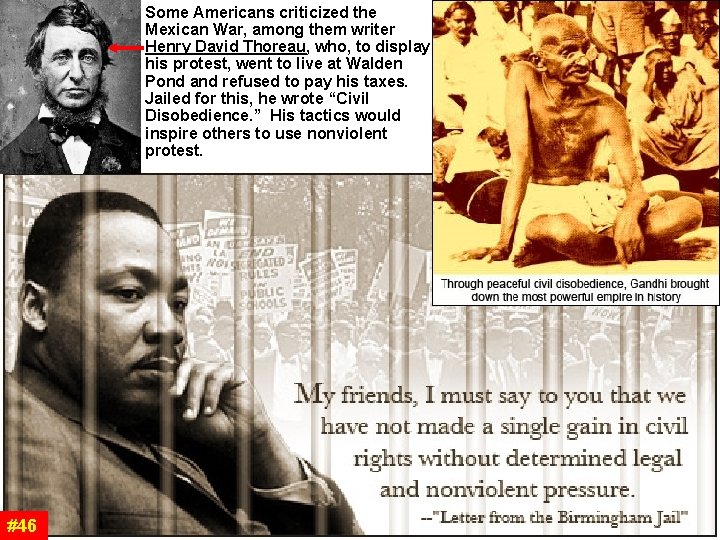
Some Americans criticized the Mexican War, among them writer Henry David Thoreau, who, to display his protest, went to live at Walden Pond and refused to pay his taxes. Jailed for this, he wrote “Civil Disobedience. ” His tactics would inspire others to use nonviolent protest. #46
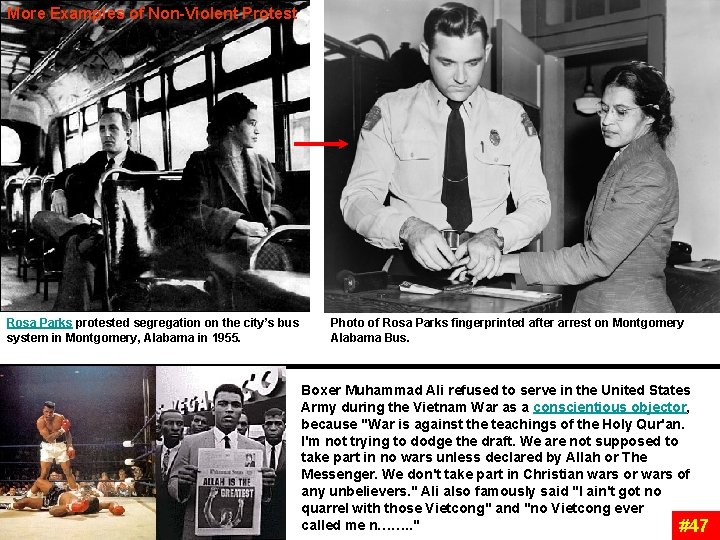
More Examples of Non-Violent Protest Rosa Parks protested segregation on the city’s bus system in Montgomery, Alabama in 1955. Photo of Rosa Parks fingerprinted after arrest on Montgomery Alabama Bus. Boxer Muhammad Ali refused to serve in the United States Army during the Vietnam War as a conscientious objector, because "War is against the teachings of the Holy Qur'an. I'm not trying to dodge the draft. We are not supposed to take part in no wars unless declared by Allah or The Messenger. We don't take part in Christian wars or wars of any unbelievers. " Ali also famously said "I ain't got no quarrel with those Vietcong" and "no Vietcong ever called me n……. . " #47
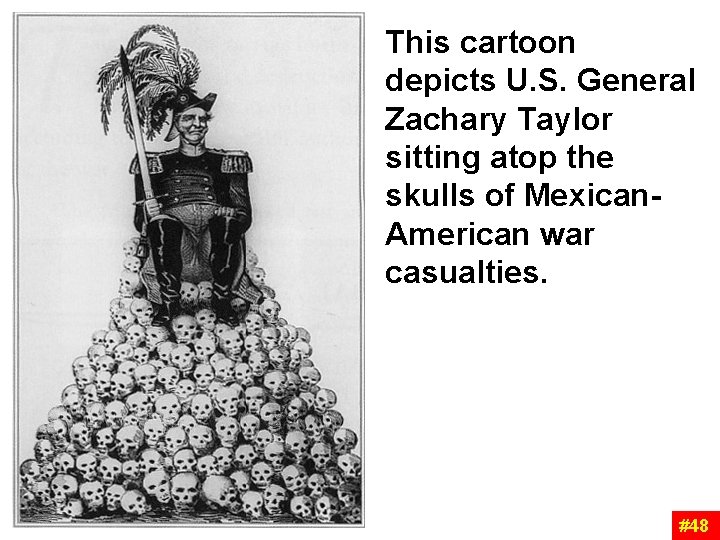
This cartoon depicts U. S. General Zachary Taylor sitting atop the skulls of Mexican. American war casualties. #48
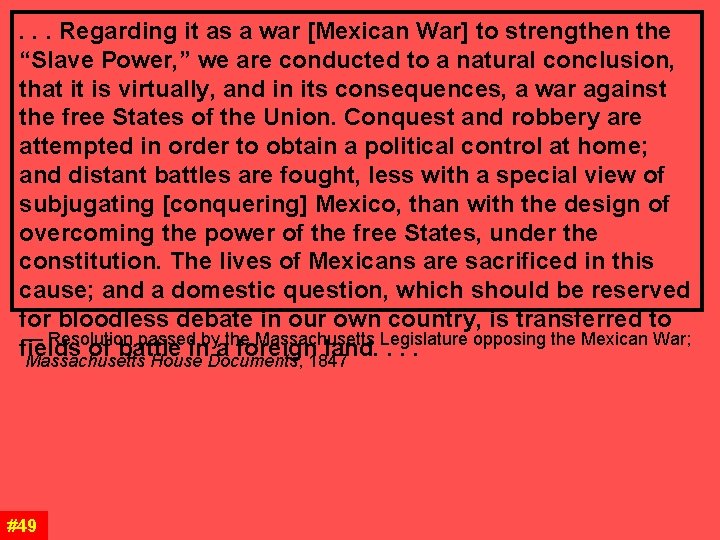
. . . Regarding it as a war [Mexican War] to strengthen the “Slave Power, ” we are conducted to a natural conclusion, that it is virtually, and in its consequences, a war against the free States of the Union. Conquest and robbery are attempted in order to obtain a political control at home; and distant battles are fought, less with a special view of subjugating [conquering] Mexico, than with the design of overcoming the power of the free States, under the constitution. The lives of Mexicans are sacrificed in this cause; and a domestic question, which should be reserved for bloodless debate in our own country, is transferred to — Resolution passed by the Massachusetts Legislature opposing the Mexican War; fields of battle in a foreign land. . Massachusetts House Documents, 1847 #49
#50
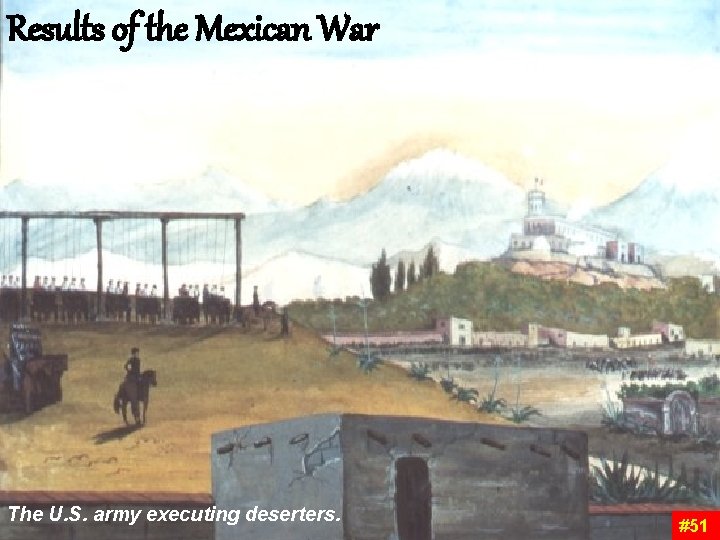
Results of the Mexican War The U. S. army executing deserters. #51
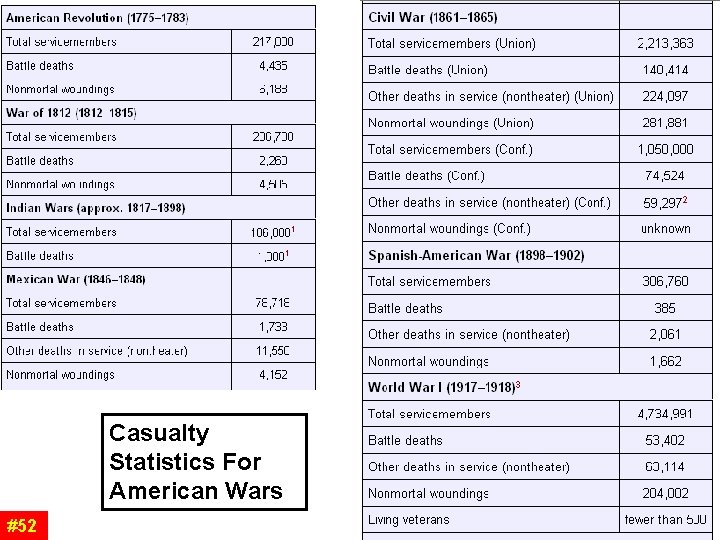
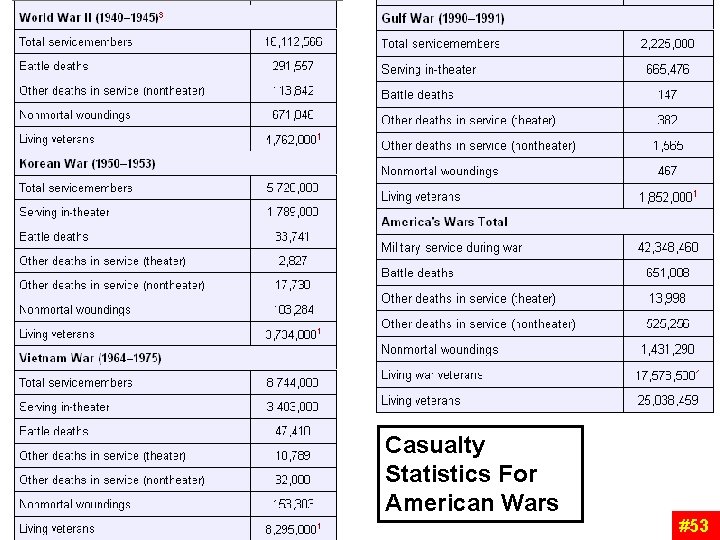
Casualty Statistics For American Wars #52
Casualty Statistics For American Wars #53
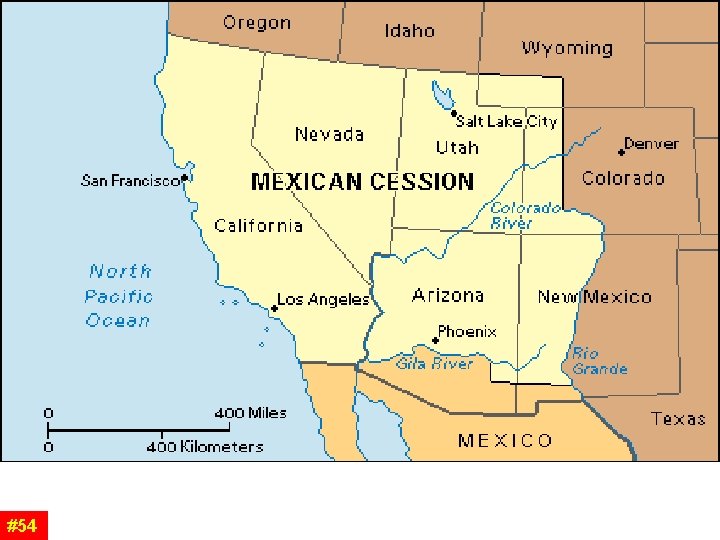
#54
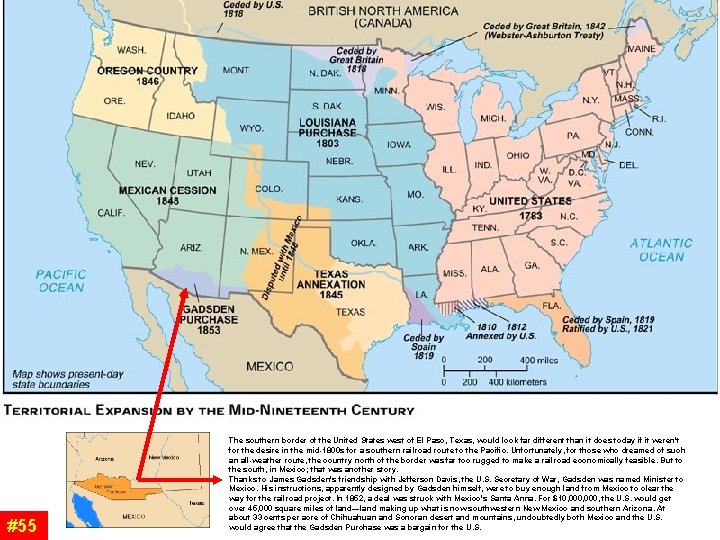
#55 The southern border of the United States west of El Paso, Texas, would look far different than it does today if it weren't for the desire in the mid-1800 s for a southern railroad route to the Pacific. Unfortunately, for those who dreamed of such an all-weather route, the country north of the border was far too rugged to make a railroad economically feasible. But to the south, in Mexico; that was another story. Thanks to James Gadsden's friendship with Jefferson Davis, the U. S. Secretary of War, Gadsden was named Minister to Mexico. His instructions, apparently designed by Gadsden himself, were to buy enough land from Mexico to clear the way for the railroad project. In 1852, a deal was struck with Mexico's Santa Anna. For $10, 000, the U. S. would get over 45, 000 square miles of land—land making up what is now southwestern New Mexico and southern Arizona. At about 33 cents per acre of Chihuahuan and Sonoran desert and mountains, undoubtedly both Mexico and the U. S. would agree that the Gadsden Purchase was a bargain for the U. S.
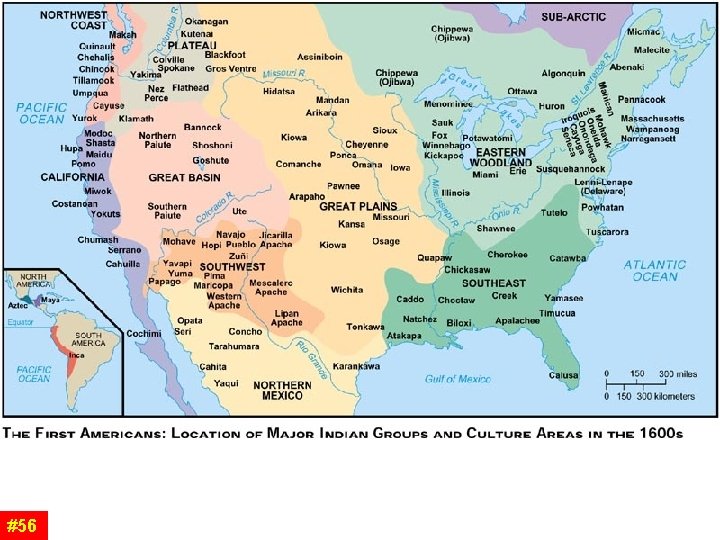
#56
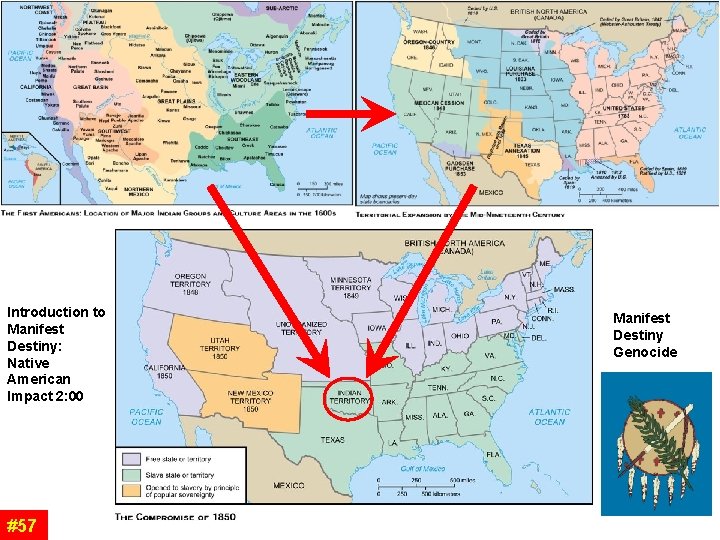
Introduction to Manifest Destiny: Native American Impact 2: 00 #57 Manifest Destiny Genocide
The Dave Matthews Band Album: Before These Crowded Streets Date: 1998 Lyrics for: Don't Drink The Water Come out come out No use in hiding Come now come now Can you not see? There's no place here What were you expecting Not room for both Just room for me So you will lay your arms down Yes I will call this home Away away You have been banished Your land is gone And given me And here I will spread my wings Yes I will call this home What's this you say You feel a right to remain Then stay and I will bury you What's that you say Your father's spirit still lives in this place I will silence you #58 Here's the hitch Your horse is leaving Don't miss your boat It's leaving now And as you go I will spread my wings Yes I will call this home I have no time to justify to you Fool you're blind, move aside for me All I can say to you my new neighbor Is you must move on or I will bury you Now as I rest my feet by this fire Those hands once warmed here I have retired them I can breathe my own air I can sleep more soundly Upon these poor souls I'll build heaven and call it home 'Cause you're all dead now I live with my justice I live with my greedy need I live with no mercy I live with my frenzied feeding I live with my hatred I live with my jealousy I live with the notion That I don't need anyone but me Don't drink the water There's blood in the water
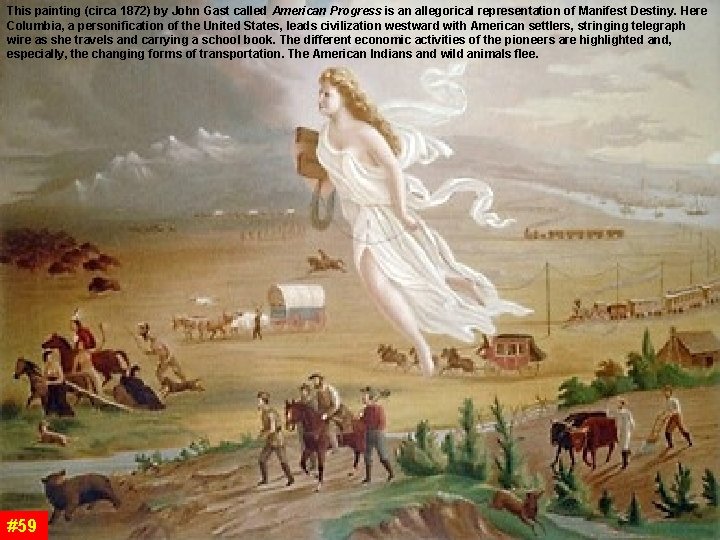
This painting (circa 1872) by John Gast called American Progress is an allegorical representation of Manifest Destiny. Here Columbia, a personification of the United States, leads civilization westward with American settlers, stringing telegraph wire as she travels and carrying a school book. The different economic activities of the pioneers are highlighted and, especially, the changing forms of transportation. The American Indians and wild animals flee. #59
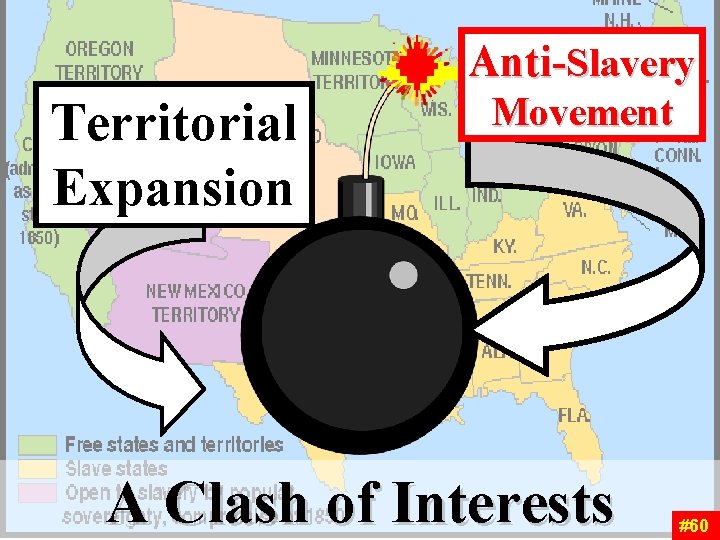
Anti-Slavery Territorial Expansion Movement A Clash of Interests #60
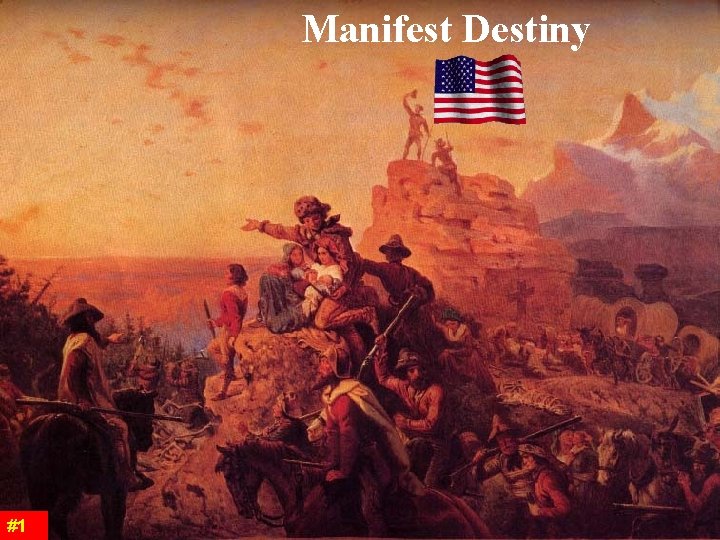
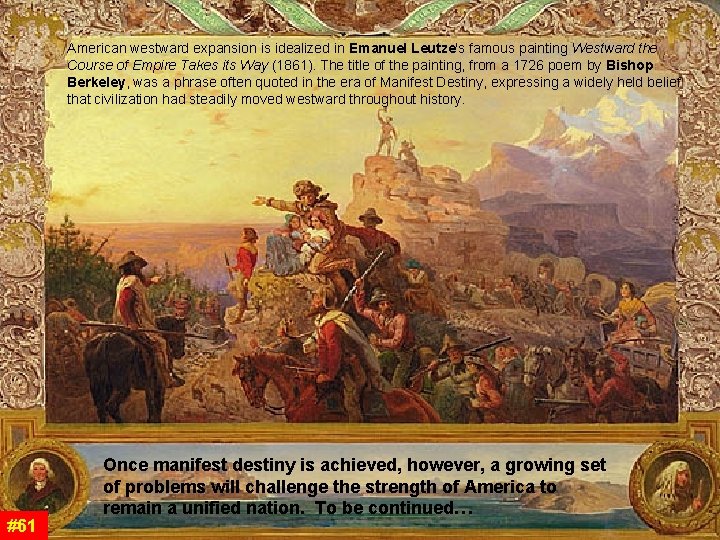
American westward expansion is idealized in Emanuel Leutze's famous painting Westward the Course of Empire Takes its Way (1861). The title of the painting, from a 1726 poem by Bishop Berkeley, was a phrase often quoted in the era of Manifest Destiny, expressing a widely held belief that civilization had steadily moved westward throughout history. #61 Once manifest destiny is achieved, however, a growing set of problems will challenge the strength of America to remain a unified nation. To be continued…