
MANGROVES True mangroves sensu Tomlinson 1986 are tropical



- Slides: 27
MANGROVES - True mangroves (sensu Tomlinson 1986) are tropical trees restricted to intertidal and adjacent communities, growing in saline, generally anoxic soils, under climatic conditions characterized by a combination of high temperature and irradiance (Stewart and Popp 1987) - Mangrove forests constitute the sea-land interface in all tropical and subtropical coastlines protected against wave impact, and without frost - Mangrove forests play critical roles in coastal biological productivity, coastal protection, and processing of organic matter transported in terrestrial run-off
- Mangroves are typical halophytes developing up to reproductive stage in sea water, accumulating large amounts of sodium chloride in their cell vacuoles (Walter and Steiner 1936) - Salt, water, and energy balances, constitute simultaneous constraints for mangrove photosynthetic productivity, particularly in mangal habitats where supply of fresh water through rainfall or riverine flow is restricted - Nutrient supply modulates the responses of mangroves to environmental stresses (Boto 1983) - Nutrient supply to mangrove ecosystems is predominantly associated with terrestrial drainage, comparatively richer than sea water (Lugo et al. 1976)
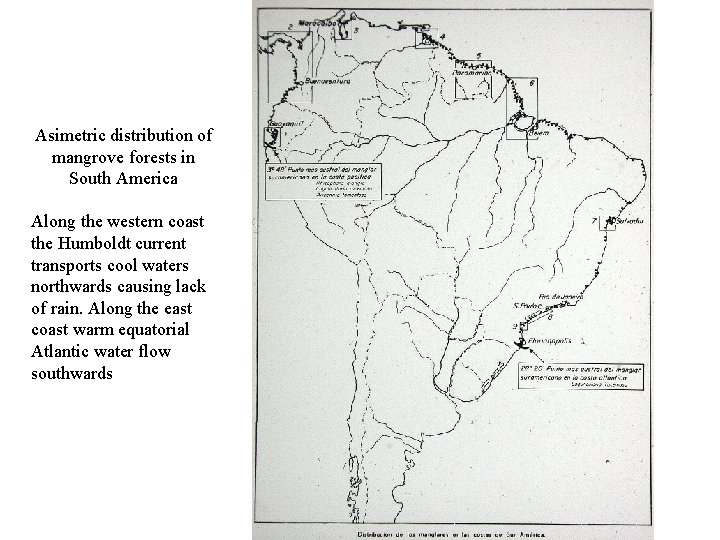
Asimetric distribution of mangrove forests in South America Along the western coast the Humboldt current transports cool waters northwards causing lack of rain. Along the east coast warm equatorial Atlantic water flow southwards
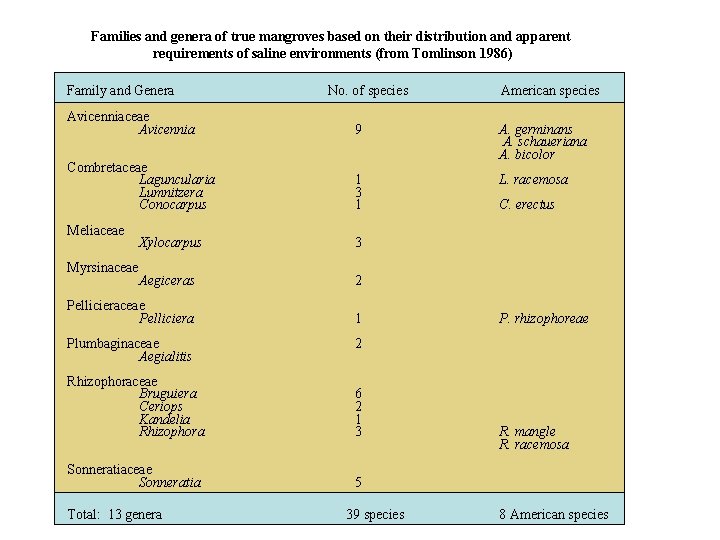
Families and genera of true mangroves based on their distribution and apparent requirements of saline environments (from Tomlinson 1986) Family and Genera No. of species American species Avicenniaceae Avicennia 9 Combretaceae Laguncularia Lumnitzera Conocarpus A. germinans A. schaueriana A. bicolor 1 3 1 L. racemosa Meliaceae Xylocarpus 3 Aegiceras 2 Pellicieraceae Pelliciera 1 Plumbaginaceae Aegialitis 2 Rhizophoraceae Bruguiera Ceriops Kandelia Rhizophora 6 2 1 3 Sonneratiaceae Sonneratia 5 Myrsinaceae Total: 13 genera 39 species C. erectus P. rhizophoreae R. mangle R. racemosa 8 American species
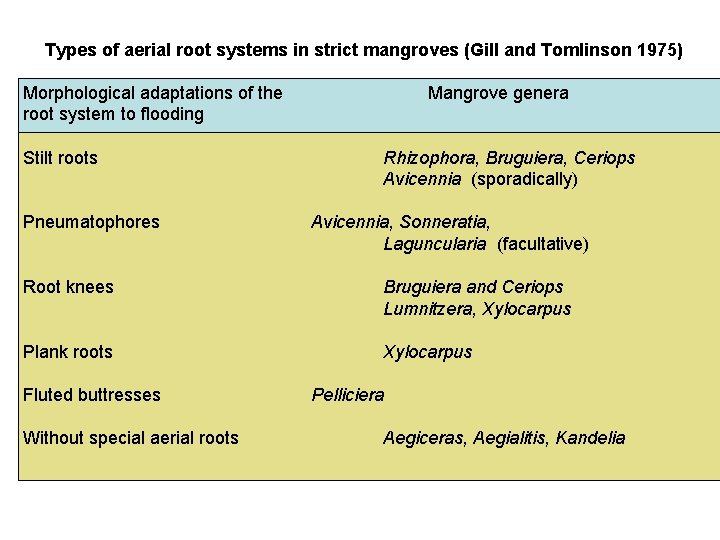
Types of aerial root systems in strict mangroves (Gill and Tomlinson 1975) Morphological adaptations of the root system to flooding Stilt roots Pneumatophores Mangrove genera Rhizophora, Bruguiera, Ceriops Avicennia (sporadically) Avicennia, Sonneratia, Laguncularia (facultative) Root knees Bruguiera and Ceriops Lumnitzera, Xylocarpus Plank roots Xylocarpus Fluted buttresses Without special aerial roots Pelliciera Aegiceras, Aegialitis, Kandelia
Samples from natural mangrove communities in the Caribbean
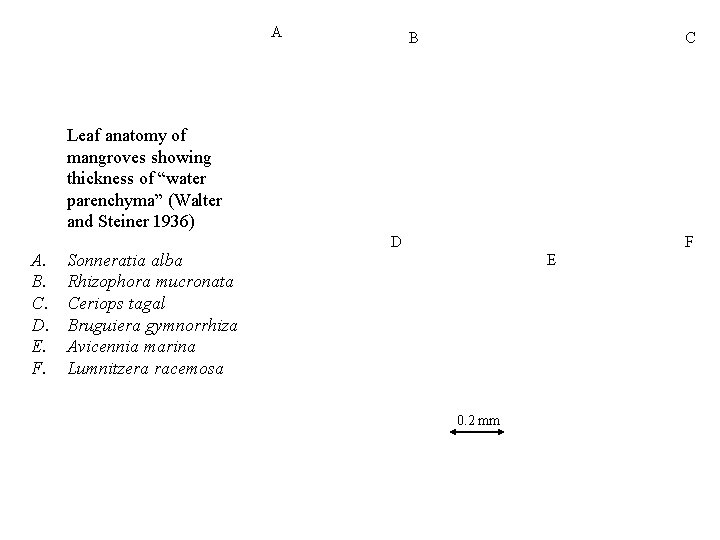
A B C Leaf anatomy of mangroves showing thickness of “water parenchyma” (Walter and Steiner 1936) A. B. C. D. E. F. Sonneratia alba Rhizophora mucronata Ceriops tagal Bruguiera gymnorrhiza Avicennia marina Lumnitzera racemosa D F E 0. 2 mm
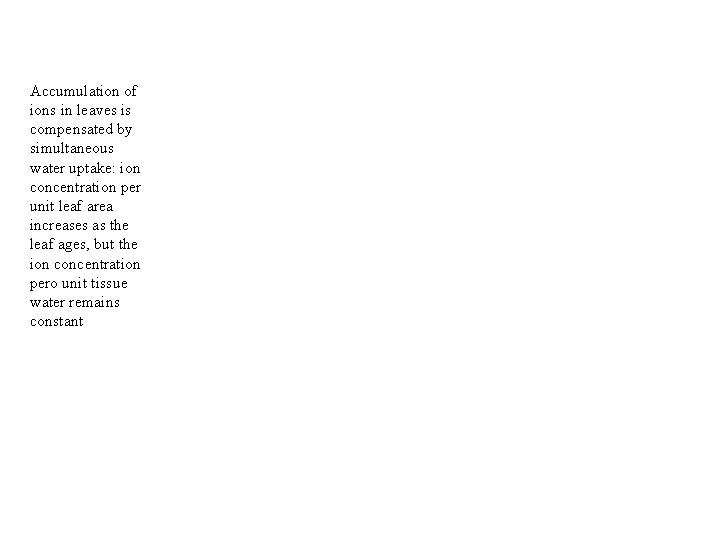
Accumulation of ions in leaves is compensated by simultaneous water uptake: ion concentration per unit leaf area increases as the leaf ages, but the ion concentration pero unit tissue water remains constant
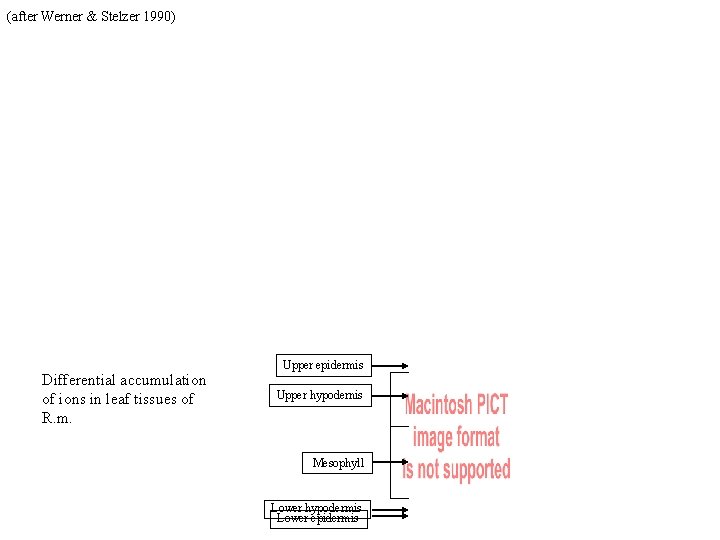
(after Werner & Stelzer 1990) Differential accumulation of ions in leaf tissues of R. m. Upper epidermis Upper hypodernis Mesophyll Lower hypodermis Lower epidermis
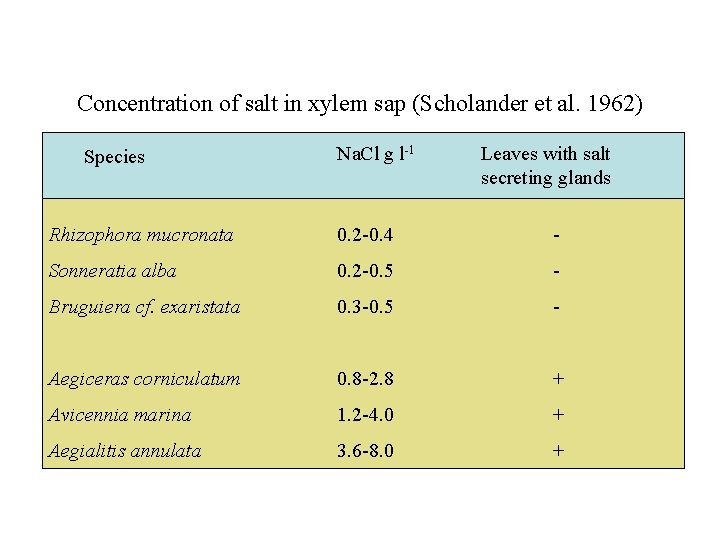
Concentration of salt in xylem sap (Scholander et al. 1962) Species Na. Cl g l-1 Leaves with salt secreting glands Rhizophora mucronata 0. 2 -0. 4 - Sonneratia alba 0. 2 -0. 5 - Bruguiera cf. exaristata 0. 3 -0. 5 - Aegiceras corniculatum 0. 8 -2. 8 + Avicennia marina 1. 2 -4. 0 + Aegialitis annulata 3. 6 -8. 0 +
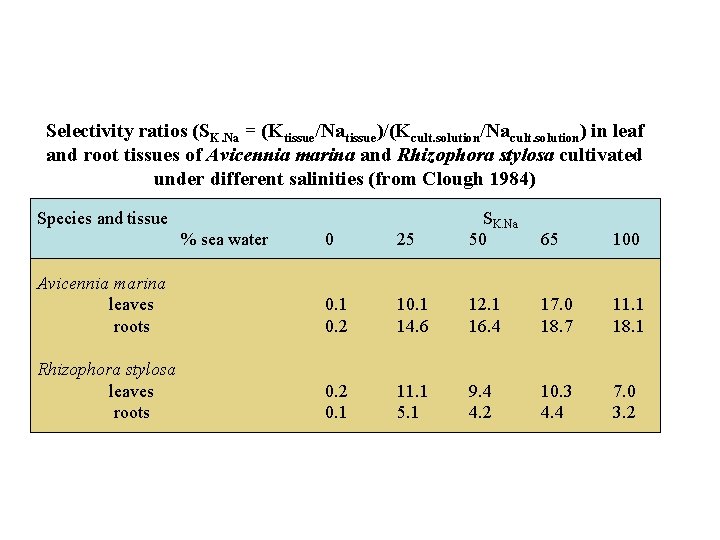
Selectivity ratios (SK. Na = (Ktissue/Natissue)/(Kcult. solution/Nacult. solution) in leaf and root tissues of Avicennia marina and Rhizophora stylosa cultivated under different salinities (from Clough 1984) Species and tissue 0 25 SK. Na 50 Avicennia marina leaves roots 0. 1 0. 2 10. 1 14. 6 12. 1 16. 4 17. 0 18. 7 11. 1 18. 1 Rhizophora stylosa leaves roots 0. 2 0. 1 11. 1 5. 1 9. 4 4. 2 10. 3 4. 4 7. 0 3. 2 % sea water 65 100
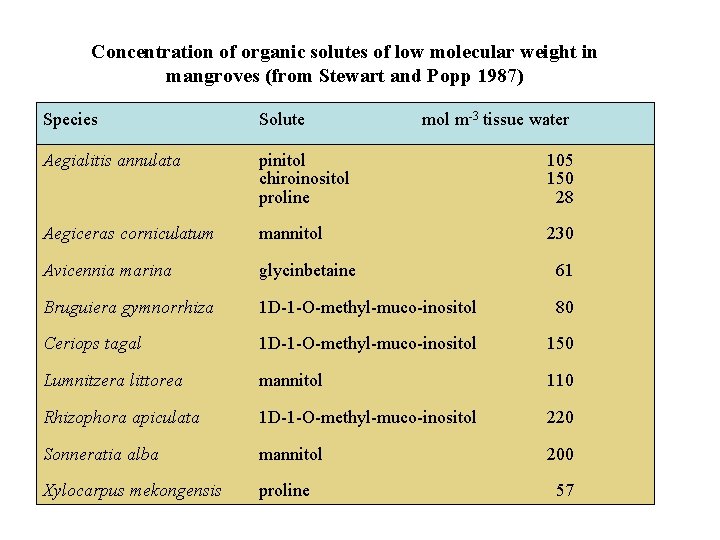
Concentration of organic solutes of low molecular weight in mangroves (from Stewart and Popp 1987) Species Solute mol m-3 tissue water Aegialitis annulata pinitol chiroinositol proline 105 150 28 Aegiceras corniculatum mannitol 230 Avicennia marina glycinbetaine 61 Bruguiera gymnorrhiza 1 D-1 -O-methyl-muco-inositol 80 Ceriops tagal 1 D-1 -O-methyl-muco-inositol 150 Lumnitzera littorea mannitol 110 Rhizophora apiculata 1 D-1 -O-methyl-muco-inositol 220 Sonneratia alba mannitol 200 Xylocarpus mekongensis proline 57
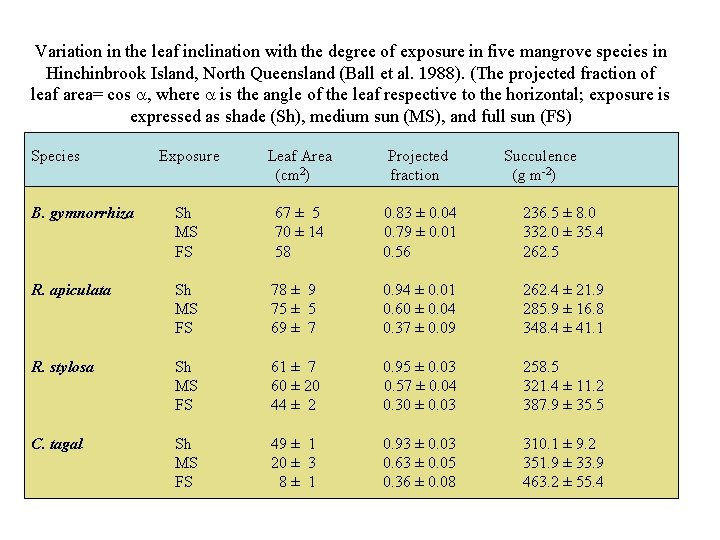
Variation in the leaf inclination with the degree of exposure in five mangrove species in Hinchinbrook Island, North Queensland (Ball et al. 1988). (The projected fraction of leaf area= cos a, where a is the angle of the leaf respective to the horizontal; exposure is expressed as shade (Sh), medium sun (MS), and full sun (FS) Species Exposure Leaf Area (cm 2) Projected fraction Succulence (g m-2) B. gymnorrhiza Sh MS FS 67 ± 5 70 ± 14 58 0. 83 ± 0. 04 0. 79 ± 0. 01 0. 56 236. 5 ± 8. 0 332. 0 ± 35. 4 262. 5 R. apiculata Sh MS FS 78 ± 9 75 ± 5 69 ± 7 0. 94 ± 0. 01 0. 60 ± 0. 04 0. 37 ± 0. 09 262. 4 ± 21. 9 285. 9 ± 16. 8 348. 4 ± 41. 1 R. stylosa Sh MS FS 61 ± 7 60 ± 20 44 ± 2 0. 95 ± 0. 03 0. 57 ± 0. 04 0. 30 ± 0. 03 258. 5 321. 4 ± 11. 2 387. 9 ± 35. 5 C. tagal Sh MS FS 49 ± 1 20 ± 3 8± 1 0. 93 ± 0. 03 0. 63 ± 0. 05 0. 36 ± 0. 08 310. 1 ± 9. 2 351. 9 ± 33. 9 463. 2 ± 55. 4
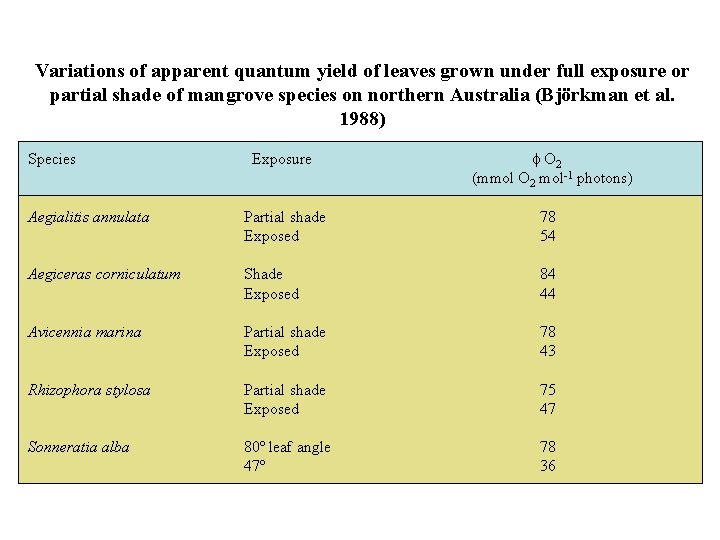
Variations of apparent quantum yield of leaves grown under full exposure or partial shade of mangrove species on northern Australia (Björkman et al. 1988) Exposure f O 2 (mmol O 2 mol-1 photons) Aegialitis annulata Partial shade Exposed 78 54 Aegiceras corniculatum Shade Exposed 84 44 Avicennia marina Partial shade Exposed 78 43 Rhizophora stylosa Partial shade Exposed 75 47 Sonneratia alba 80º leaf angle 47º 78 36 Species
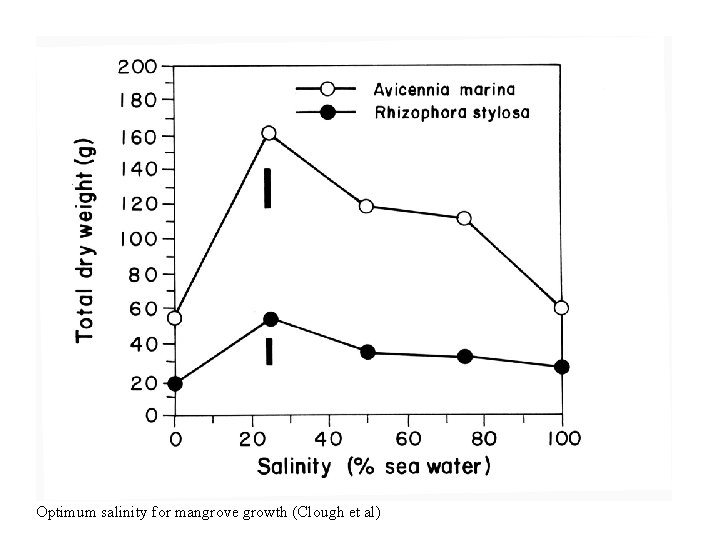
Optimum salinity for mangrove growth (Clough et al)
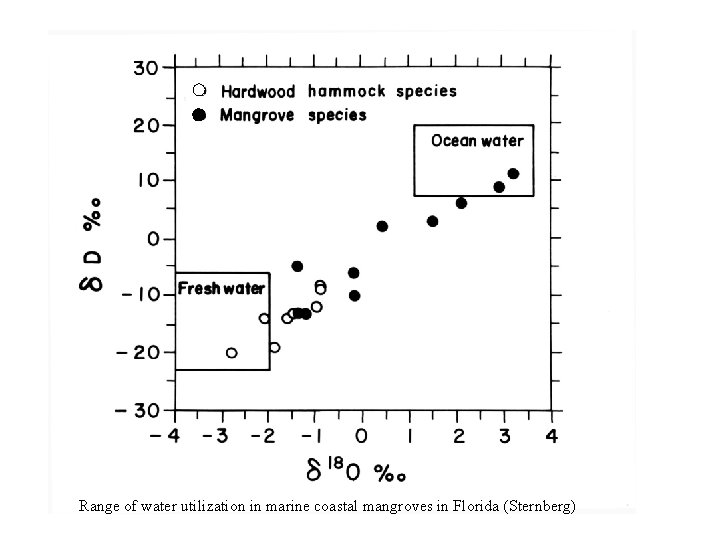
Range of water utilization in marine coastal mangroves in Florida (Sternberg)
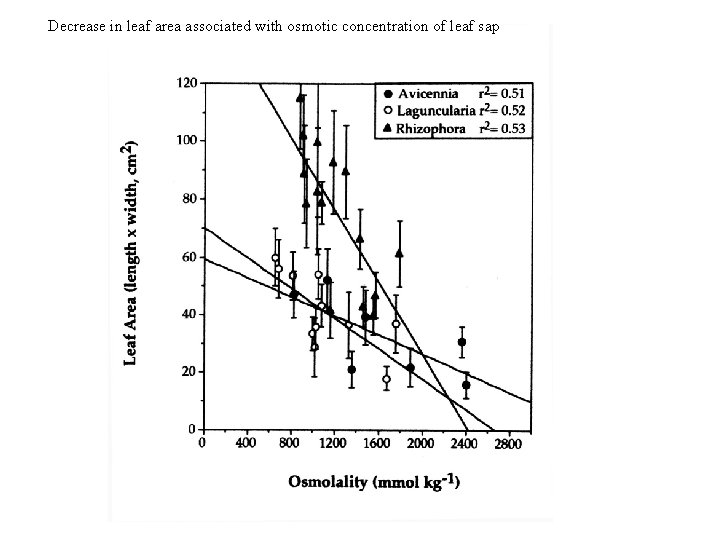
Decrease in leaf area associated with osmotic concentration of leaf sap
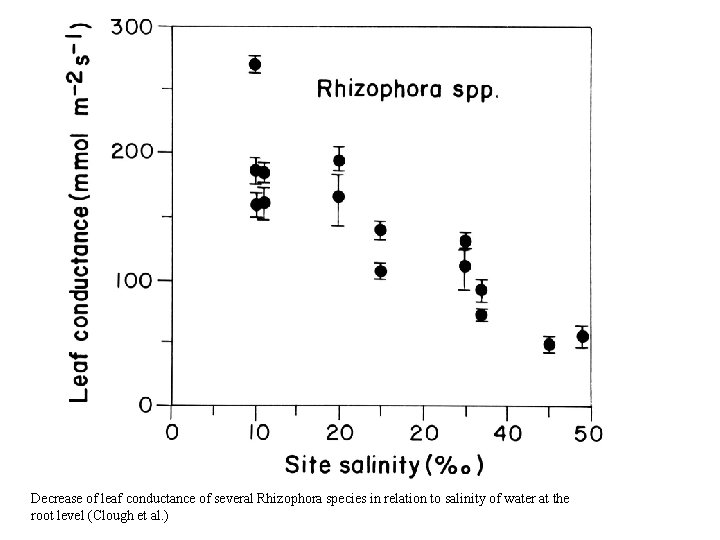
Decrease of leaf conductance of several Rhizophora species in relation to salinity of water at the root level (Clough et al. )
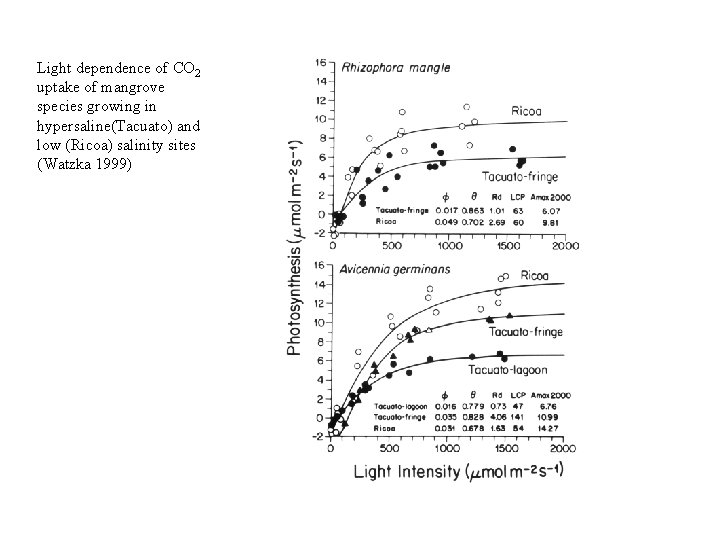
Light dependence of CO 2 uptake of mangrove species growing in hypersaline(Tacuato) and low (Ricoa) salinity sites (Watzka 1999)
Mangrove occurrence in wet and dry coastal habitats (after Walter & Steiner 1936)
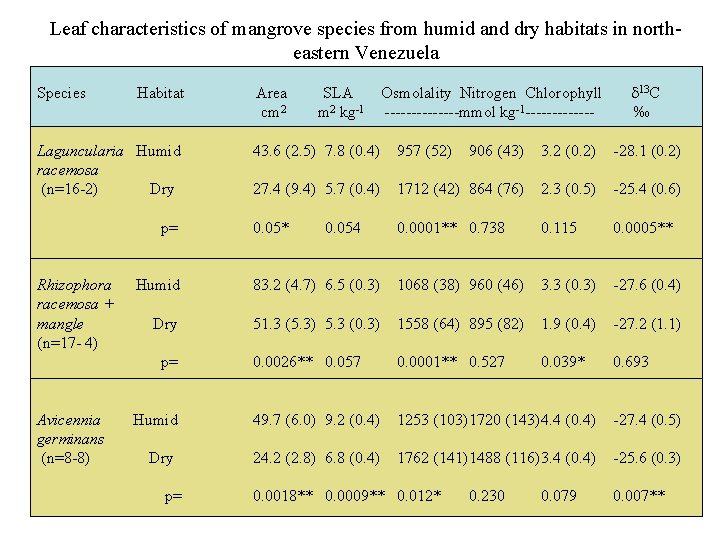
Leaf characteristics of mangrove species from humid and dry habitats in northeastern Venezuela Species Habitat Laguncularia Humid racemosa (n=16 -2) Dry p= Rhizophora racemosa + mangle (n=17 - 4) SLA m 2 kg-1 Osmolality Nitrogen Chlorophyll -------mmol kg-1 ------- d 13 C ‰ 43. 6 (2. 5) 7. 8 (0. 4) 957 (52) 906 (43) 3. 2 (0. 2) -28. 1 (0. 2) 27. 4 (9. 4) 5. 7 (0. 4) 1712 (42) 864 (76) 2. 3 (0. 5) -25. 4 (0. 6) 0. 05* 0. 0001** 0. 738 0. 115 0. 0005** 0. 054 Humid 83. 2 (4. 7) 6. 5 (0. 3) 1068 (38) 960 (46) 3. 3 (0. 3) -27. 6 (0. 4) Dry 51. 3 (5. 3) 5. 3 (0. 3) 1558 (64) 895 (82) 1. 9 (0. 4) -27. 2 (1. 1) 0. 0026** 0. 057 0. 0001** 0. 527 0. 039* 0. 693 Humid 49. 7 (6. 0) 9. 2 (0. 4) 1253 (103)1720 (143)4. 4 (0. 4) -27. 4 (0. 5) Dry 24. 2 (2. 8) 6. 8 (0. 4) 1762 (141)1488 (116)3. 4 (0. 4) -25. 6 (0. 3) p= Avicennia germinans (n=8 -8) Area cm 2 p= 0. 0018** 0. 0009** 0. 012* 0. 230 0. 079 0. 007**
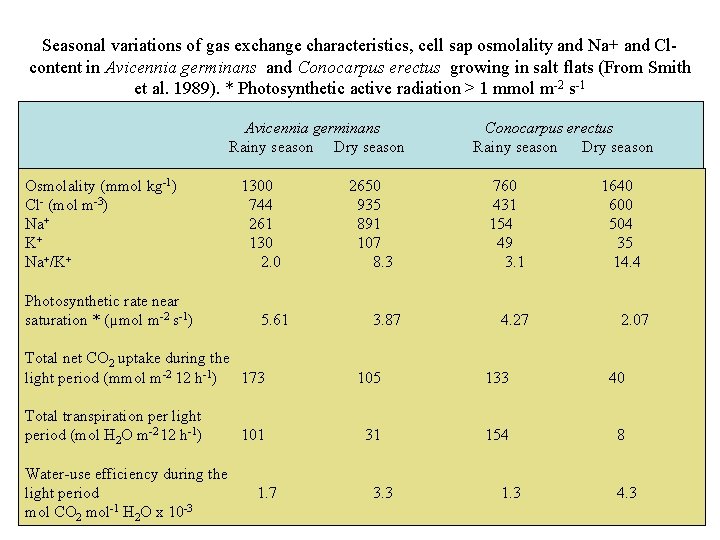
Seasonal variations of gas exchange characteristics, cell sap osmolality and Na+ and Clcontent in Avicennia germinans and Conocarpus erectus growing in salt flats (From Smith et al. 1989). * Photosynthetic active radiation > 1 mmol m-2 s-1 Avicennia germinans Rainy season Dry season Osmolality (mmol kg-1) Cl- (mol m-3) Na+ K+ Na+/K+ Photosynthetic rate near saturation * (µmol m-2 s-1) 1300 744 261 130 2. 0 5. 61 Total net CO 2 uptake during the light period (mmol m-2 12 h-1) 173 Total transpiration per light period (mol H 2 O m-2 12 h-1) Water-use efficiency during the light period mol CO 2 mol-1 H 2 O x 10 -3 101 1. 7 2650 935 891 107 8. 3 3. 87 Conocarpus erectus Rainy season Dry season 760 431 154 49 3. 1 4. 27 1640 600 504 35 14. 4 2. 07 105 133 40 31 154 8 3. 3 1. 3 4. 3
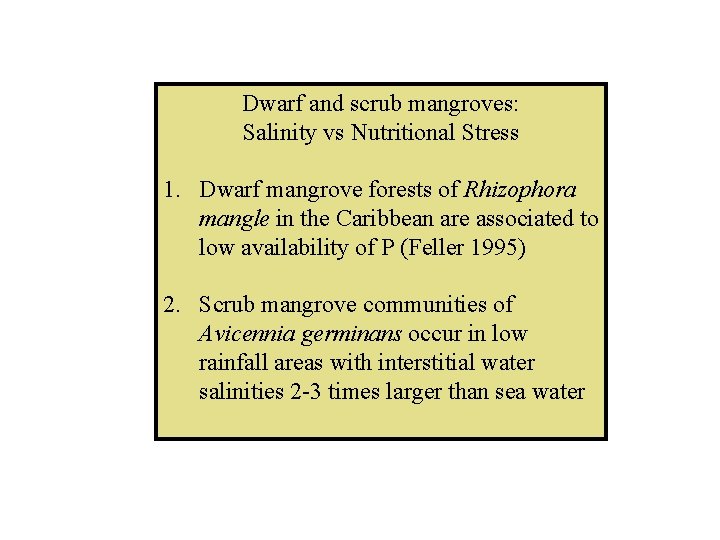
Dwarf and scrub mangroves: Salinity vs Nutritional Stress 1. Dwarf mangrove forests of Rhizophora mangle in the Caribbean are associated to low availability of P (Feller 1995) 2. Scrub mangrove communities of Avicennia germinans occur in low rainfall areas with interstitial water salinities 2 -3 times larger than sea water
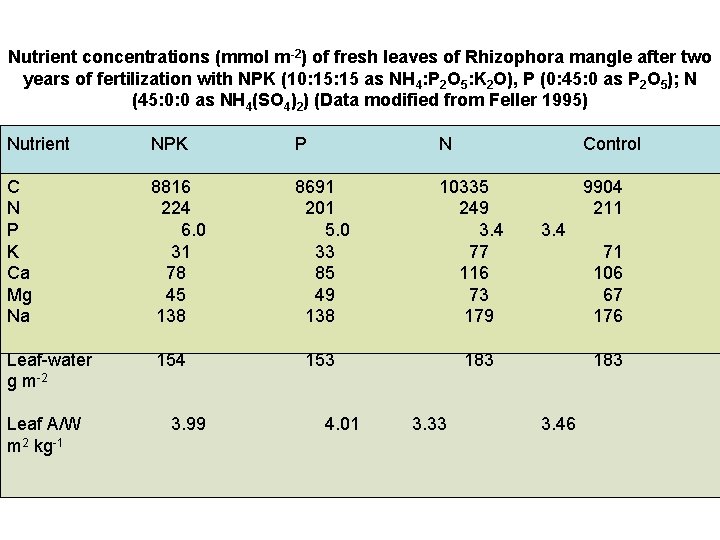
Nutrient concentrations (mmol m-2) of fresh leaves of Rhizophora mangle after two years of fertilization with NPK (10: 15 as NH 4: P 2 O 5: K 2 O), P (0: 45: 0 as P 2 O 5); N (45: 0: 0 as NH 4(SO 4)2) (Data modified from Feller 1995) Nutrient NPK P N Control C N P K Ca Mg Na 8816 224 6. 0 31 78 45 138 8691 201 5. 0 33 85 49 138 10335 249 3. 4 77 116 73 179 9904 211 Leaf-water g m-2 154 Leaf A/W m 2 kg-1 3. 99 153 4. 01 3. 4 71 106 67 176 183 3. 33 183 3. 46
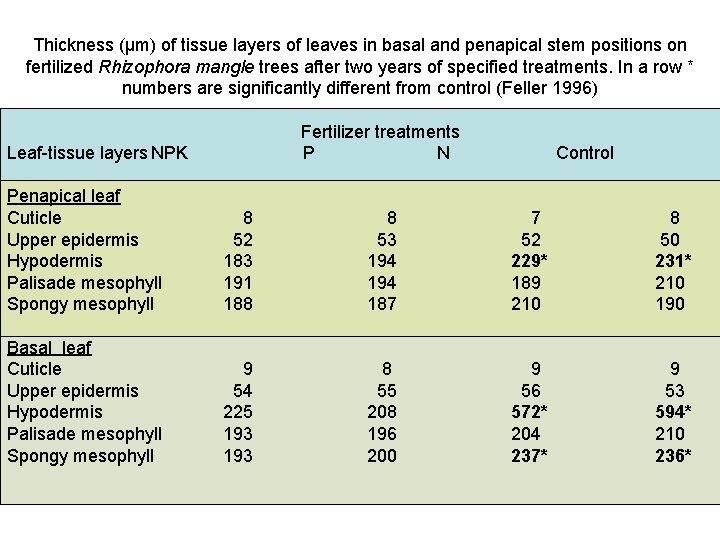
Thickness (µm) of tissue layers of leaves in basal and penapical stem positions on fertilized Rhizophora mangle trees after two years of specified treatments. In a row * numbers are significantly different from control (Feller 1996) Fertilizer treatments P N Leaf-tissue layers NPK Control Penapical leaf Cuticle Upper epidermis Hypodermis Palisade mesophyll Spongy mesophyll 8 52 183 191 188 8 53 194 187 7 52 229* 189 210 8 50 231* 210 190 Basal leaf Cuticle Upper epidermis Hypodermis Palisade mesophyll Spongy mesophyll 9 54 225 193 8 55 208 196 200 9 56 572* 204 237* 9 53 594* 210 236*