
MANGO VARITIES FOR DIFFERENT AGRO ECOLOGICAL CONDITIONS TOLERANCE


- Slides: 47
MANGO VARITIES FOR DIFFERENT AGRO ECOLOGICAL CONDITIONS, TOLERANCE AND PURPOSE Next End
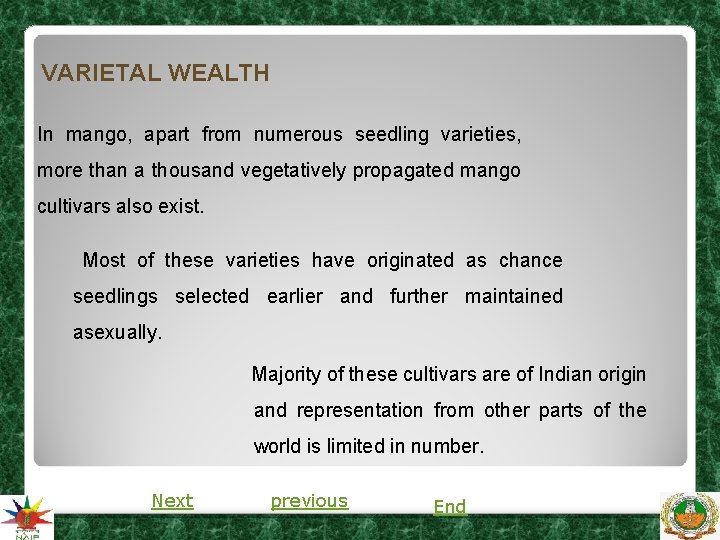
VARIETAL WEALTH In mango, apart from numerous seedling varieties, more than a thousand vegetatively propagated mango cultivars also exist. Most of these varieties have originated as chance seedlings selected earlier and further maintained asexually. Majority of these cultivars are of Indian origin and representation from other parts of the world is limited in number. Next previous End
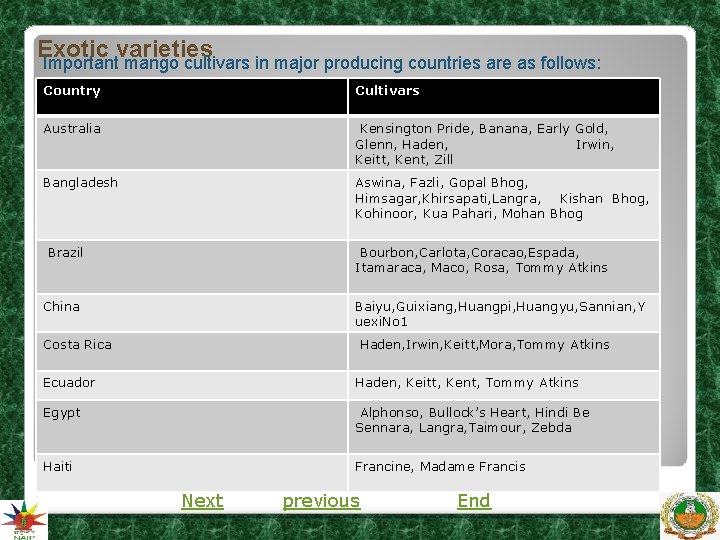
Exotic varieties Important mango cultivars in major producing countries are as follows: Country Cultivars Australia Kensington Pride, Banana, Early Gold, Glenn, Haden, Irwin, Keitt, Kent, Zill Bangladesh Aswina, Fazli, Gopal Bhog, Himsagar, Khirsapati, Langra, Kishan Bhog, Kohinoor, Kua Pahari, Mohan Bhog Brazil Bourbon, Carlota, Coracao, Espada, Itamaraca, Maco, Rosa, Tommy Atkins China Baiyu, Guixiang, Huangpi, Huangyu, Sannian, Y uexi. No 1 Costa Rica Haden, Irwin, Keitt, Mora, Tommy Atkins Ecuador Haden, Keitt, Kent, Tommy Atkins Egypt Alphonso, Bullock’s Heart, Hindi Be Sennara, Langra, Taimour, Zebda Haiti Francine, Madame Francis Next previous End
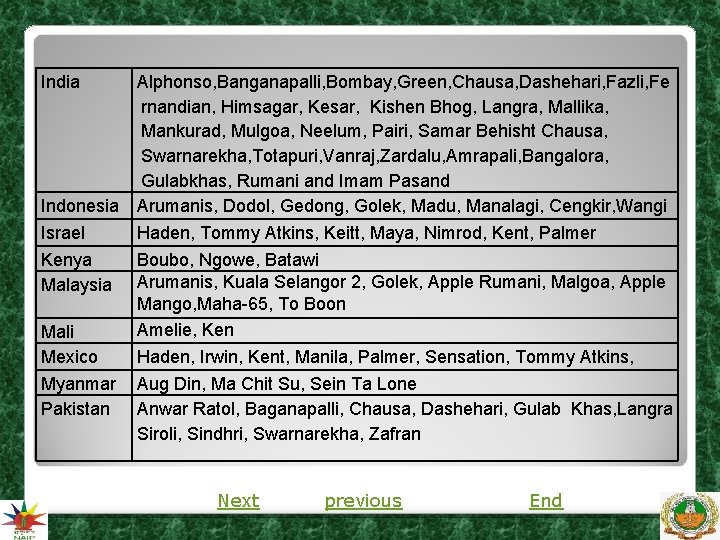
India Alphonso, Banganapalli, Bombay, Green, Chausa, Dashehari, Fazli, Fe rnandian, Himsagar, Kesar, Kishen Bhog, Langra, Mallika, Mankurad, Mulgoa, Neelum, Pairi, Samar Behisht Chausa, Swarnarekha, Totapuri, Vanraj, Zardalu, Amrapali, Bangalora, Gulabkhas, Rumani and Imam Pasand Indonesia Arumanis, Dodol, Gedong, Golek, Madu, Manalagi, Cengkir, Wangi Israel Haden, Tommy Atkins, Keitt, Maya, Nimrod, Kent, Palmer Kenya Malaysia Mali Mexico Myanmar Pakistan Boubo, Ngowe, Batawi Arumanis, Kuala Selangor 2, Golek, Apple Rumani, Malgoa, Apple Mango, Maha-65, To Boon Amelie, Ken Haden, Irwin, Kent, Manila, Palmer, Sensation, Tommy Atkins, Aug Din, Ma Chit Su, Sein Ta Lone Anwar Ratol, Baganapalli, Chausa, Dashehari, Gulab Khas, Langra Siroli, Sindhri, Swarnarekha, Zafran Next previous End
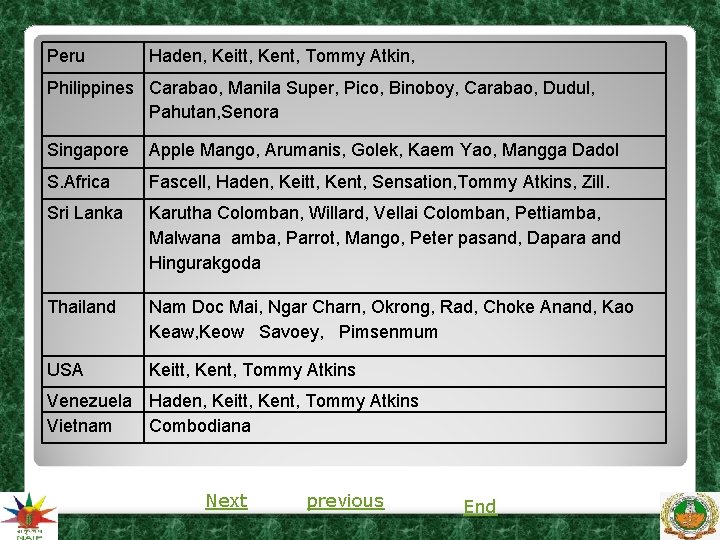
Peru Haden, Keitt, Kent, Tommy Atkin, Philippines Carabao, Manila Super, Pico, Binoboy, Carabao, Dudul, Pahutan, Senora Singapore Apple Mango, Arumanis, Golek, Kaem Yao, Mangga Dadol S. Africa Fascell, Haden, Keitt, Kent, Sensation, Tommy Atkins, Zill. Sri Lanka Karutha Colomban, Willard, Vellai Colomban, Pettiamba, Malwana amba, Parrot, Mango, Peter pasand, Dapara and Hingurakgoda Thailand Nam Doc Mai, Ngar Charn, Okrong, Rad, Choke Anand, Kao Keaw, Keow Savoey, Pimsenmum USA Keitt, Kent, Tommy Atkins Venezuela Haden, Keitt, Kent, Tommy Atkins Vietnam Combodiana Next previous End
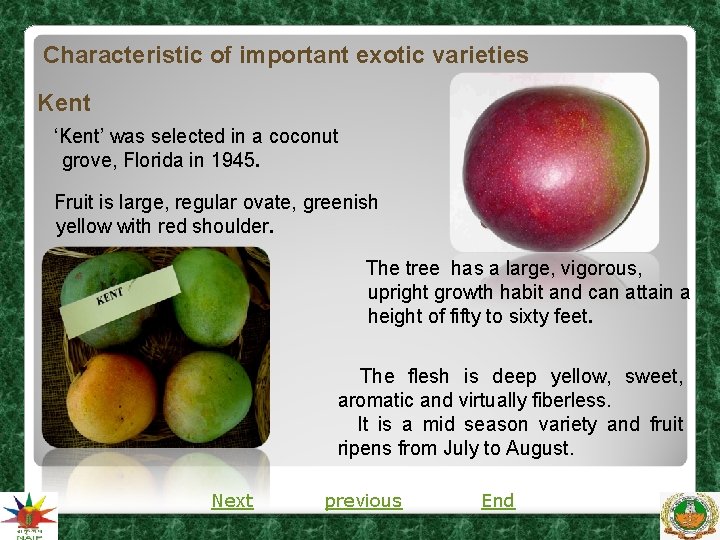
Characteristic of important exotic varieties Kent ‘Kent’ was selected in a coconut grove, Florida in 1945. Fruit is large, regular ovate, greenish yellow with red shoulder. The tree has a large, vigorous, upright growth habit and can attain a height of fifty to sixty feet. The flesh is deep yellow, sweet, aromatic and virtually fiberless. It is a mid season variety and fruit ripens from July to August. Next previous End
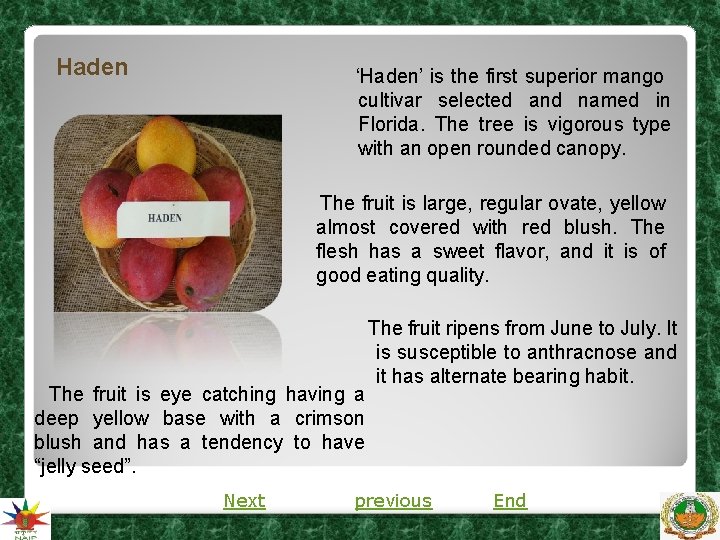
Haden ‘Haden’ is the first superior mango cultivar selected and named in Florida. The tree is vigorous type with an open rounded canopy. The fruit is large, regular ovate, yellow almost covered with red blush. The flesh has a sweet flavor, and it is of good eating quality. The fruit is eye catching having a deep yellow base with a crimson blush and has a tendency to have “jelly seed”. Next The fruit ripens from June to July. It is susceptible to anthracnose and it has alternate bearing habit. previous End
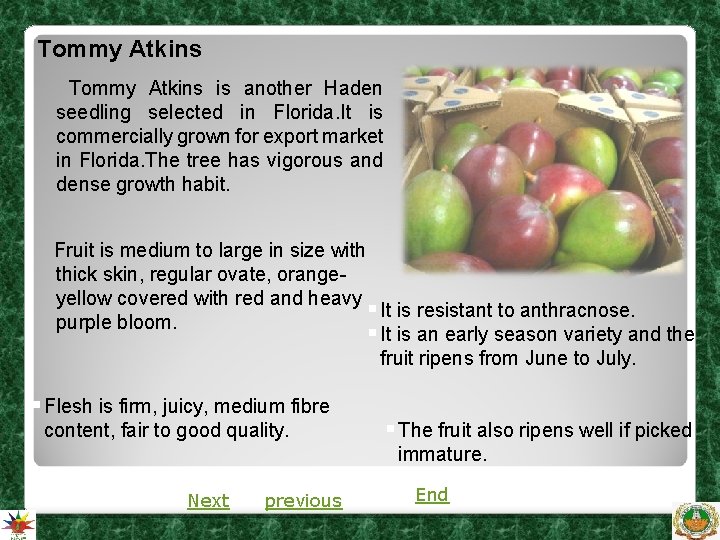
Tommy Atkins is another Haden seedling selected in Florida. It is commercially grown for export market in Florida. The tree has vigorous and dense growth habit. Fruit is medium to large in size with thick skin, regular ovate, orangeyellow covered with red and heavy § It is resistant to anthracnose. purple bloom. § It is an early season variety and the fruit ripens from June to July. § Flesh is firm, juicy, medium fibre content, fair to good quality. § The fruit also ripens well if picked immature. Next previous End
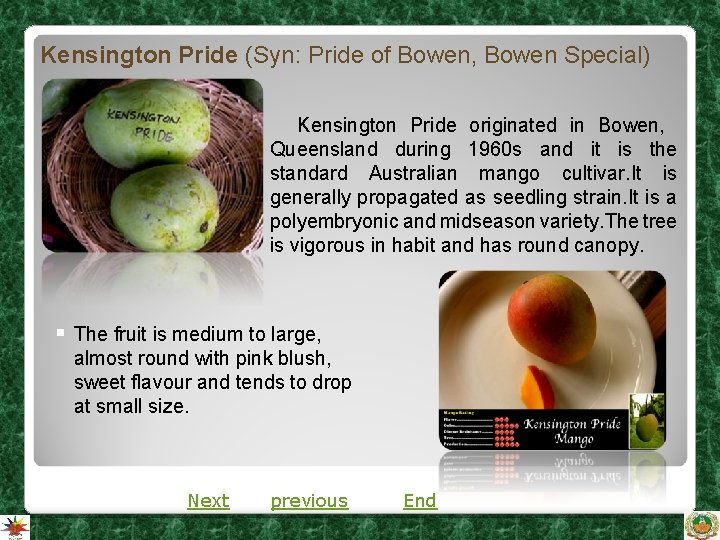
Kensington Pride (Syn: Pride of Bowen, Bowen Special) Kensington Pride originated in Bowen, Queensland during 1960 s and it is the standard Australian mango cultivar. It is generally propagated as seedling strain. It is a polyembryonic and midseason variety. The tree is vigorous in habit and has round canopy. § The fruit is medium to large, almost round with pink blush, sweet flavour and tends to drop at small size. Next previous End
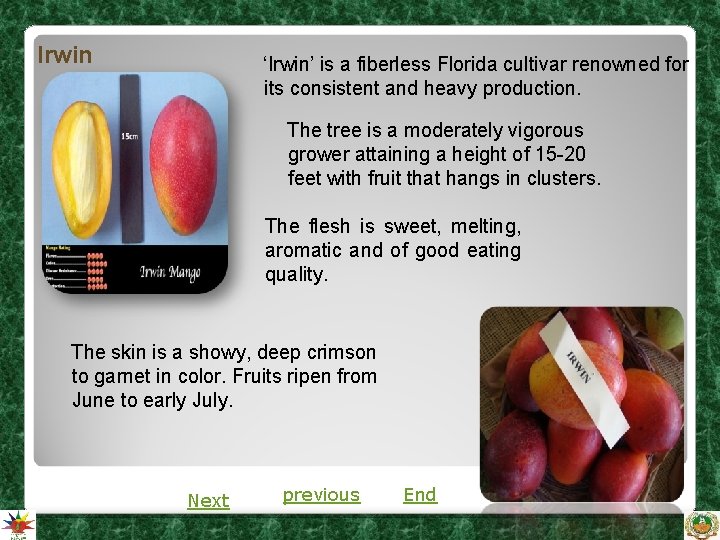
Irwin ‘Irwin’ is a fiberless Florida cultivar renowned for its consistent and heavy production. The tree is a moderately vigorous grower attaining a height of 15 -20 feet with fruit that hangs in clusters. The flesh is sweet, melting, aromatic and of good eating quality. The skin is a showy, deep crimson to garnet in color. Fruits ripen from June to early July. Next previous End
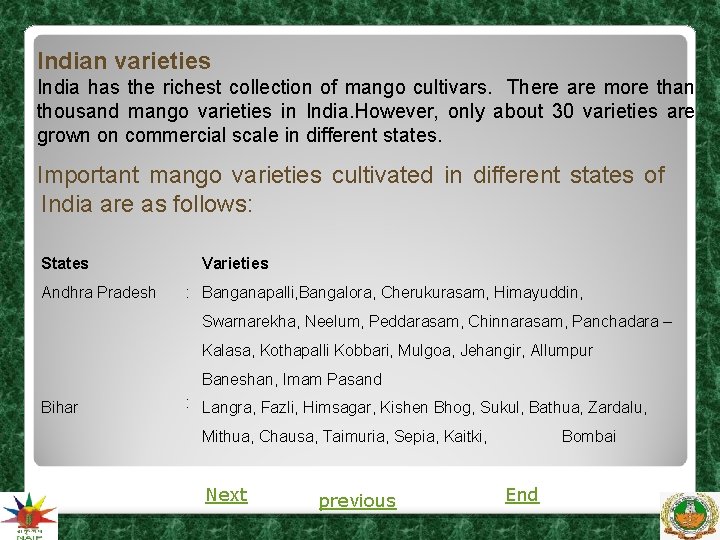
Indian varieties India has the richest collection of mango cultivars. There are more than thousand mango varieties in India. However, only about 30 varieties are grown on commercial scale in different states. Important mango varieties cultivated in different states of India are as follows: States Andhra Pradesh Varieties : Banganapalli, Bangalora, Cherukurasam, Himayuddin, Swarnarekha, Neelum, Peddarasam, Chinnarasam, Panchadara – Kalasa, Kothapalli Kobbari, Mulgoa, Jehangir, Allumpur Baneshan, Imam Pasand Bihar : Langra, Fazli, Himsagar, Kishen Bhog, Sukul, Bathua, Zardalu, Mithua, Chausa, Taimuria, Sepia, Kaitki, Next previous Bombai End
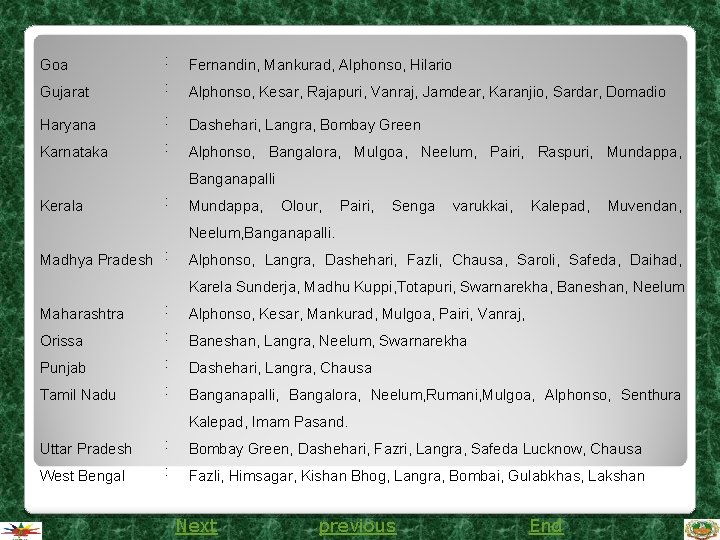
Goa : Fernandin, Mankurad, Alphonso, Hilario Gujarat : Alphonso, Kesar, Rajapuri, Vanraj, Jamdear, Karanjio, Sardar, Domadio Haryana : Dashehari, Langra, Bombay Green Karnataka : Alphonso, Bangalora, Mulgoa, Neelum, Pairi, Raspuri, Mundappa, Banganapalli Kerala : Mundappa, Olour, Pairi, Senga varukkai, Kalepad, Muvendan, Neelum, Banganapalli. Madhya Pradesh : Alphonso, Langra, Dashehari, Fazli, Chausa, Saroli, Safeda, Daihad, Karela Sunderja, Madhu Kuppi, Totapuri, Swarnarekha, Baneshan, Neelum Maharashtra : Alphonso, Kesar, Mankurad, Mulgoa, Pairi, Vanraj, Orissa : Baneshan, Langra, Neelum, Swarnarekha Punjab : Dashehari, Langra, Chausa Tamil Nadu : Banganapalli, Bangalora, Neelum, Rumani, Mulgoa, Alphonso, Senthura Kalepad, Imam Pasand. Uttar Pradesh : Bombay Green, Dashehari, Fazri, Langra, Safeda Lucknow, Chausa West Bengal : Fazli, Himsagar, Kishan Bhog, Langra, Bombai, Gulabkhas, Lakshan Next previous End
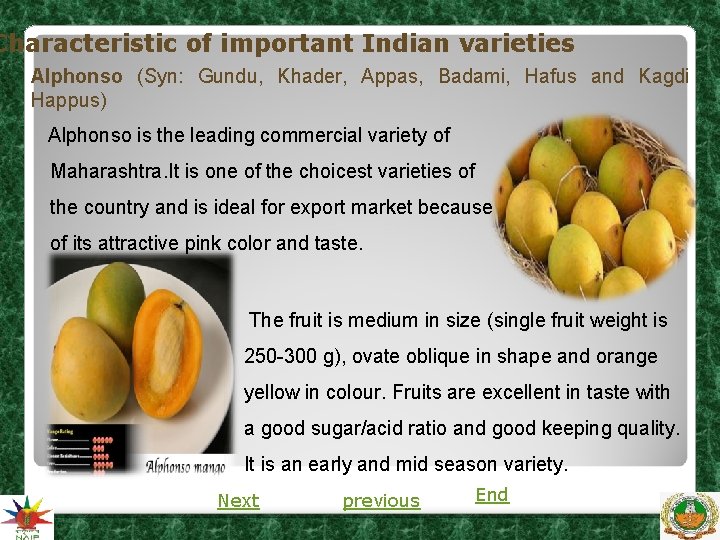
Characteristic of important Indian varieties Alphonso (Syn: Gundu, Khader, Appas, Badami, Hafus and Kagdi Happus) Alphonso is the leading commercial variety of Maharashtra. It is one of the choicest varieties of the country and is ideal for export market because of its attractive pink color and taste. The fruit is medium in size (single fruit weight is 250 -300 g), ovate oblique in shape and orange yellow in colour. Fruits are excellent in taste with a good sugar/acid ratio and good keeping quality. It is an early and mid season variety. Next previous End
Bangalora (Syn: Kilimookku, Sundar Shaw, Kallamai, Totapuri) § Bangalora is a commercial variety of South India. § The fruit size is medium to large. Shape of the fruit is oblong with necked base and golden yellow in colour. § Fruit quality is poor but with very good keeping quality. § It is widely used for processing. § The pulp is used for mixing with other varieties to form different flavor and taste. § It is a mid season variety and regular in bearing. Next previous End
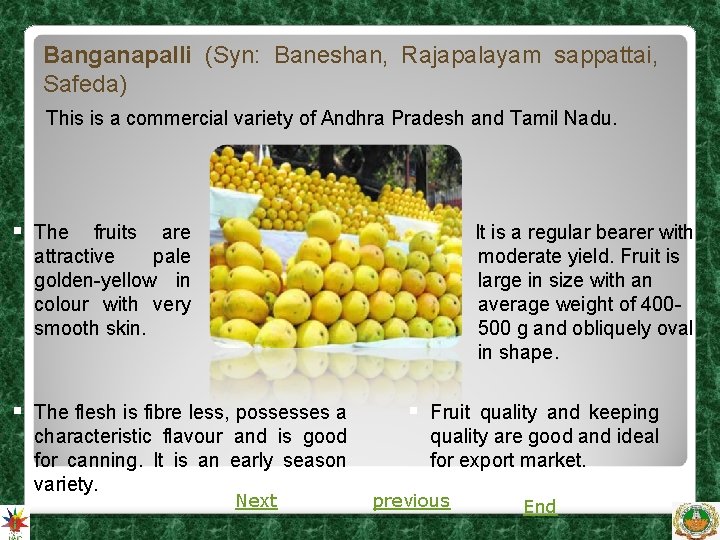
Banganapalli (Syn: Baneshan, Rajapalayam sappattai, Safeda) § This is a commercial variety of Andhra Pradesh and Tamil Nadu. § The fruits are attractive pale golden-yellow in colour with very smooth skin. It is a regular bearer with moderate yield. Fruit is large in size with an average weight of 400500 g and obliquely oval in shape. § The flesh is fibre less, possesses a § Fruit quality and keeping characteristic flavour and is good for canning. It is an early season variety. quality are good and ideal for export market. Next previous End
Bombay Green (Syn: Malda) This is commonly grown in North India due to its early ripening habit. Fruit is medium in size, ovate oblong in shape and spinach green in colour. Fruit quality is good and keeping quality is medium. It is a very early variety. It yields moderately but has biennial bearing habit Incidence of malformation is high in this variety. Next previous End
Chausa (Syn: Khajri, Samar Bahisht) • • • Chausa originated as a chance seedling in the orchard of Sandila district, Uttar Pradesh It is commonly grown in North India due to its characteristic flavour and taste. Fruit is large in size, ovate to oval oblique in shape and light yellow in colour with sweet but fibrous flesh. Fruit quality is good and keeping quality is medium. It is a late season variety, moderate yielder but an alternate bearer. Incidence of malformation is comparatively more in this variety. Next previous End
Chinnarasam is a juice variety and bears large size fruits having oblong shape Skin is light cadmium in color and has smooth surface. It is mainly grown for juice purpose. Pulp is primuline yellow and is sweet to taste Next previous End
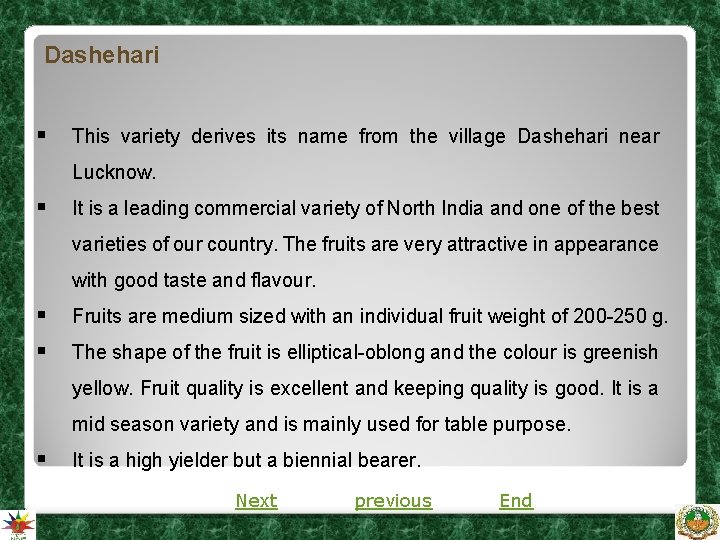
Dashehari § This variety derives its name from the village Dashehari near Lucknow. § It is a leading commercial variety of North India and one of the best varieties of our country. The fruits are very attractive in appearance with good taste and flavour. § § Fruits are medium sized with an individual fruit weight of 200 -250 g. The shape of the fruit is elliptical-oblong and the colour is greenish yellow. Fruit quality is excellent and keeping quality is good. It is a mid season variety and is mainly used for table purpose. § It is a high yielder but a biennial bearer. Next previous End
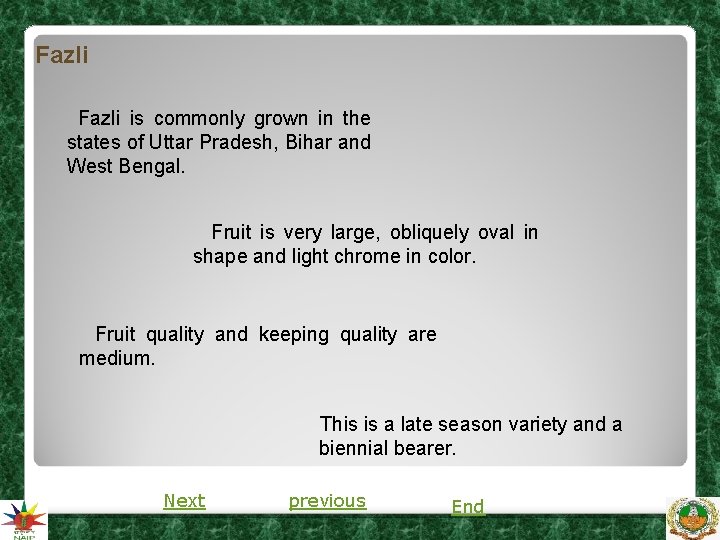
Fazli is commonly grown in the states of Uttar Pradesh, Bihar and West Bengal. Fruit is very large, obliquely oval in shape and light chrome in color. Fruit quality and keeping quality are medium. This is a late season variety and a biennial bearer. Next previous End
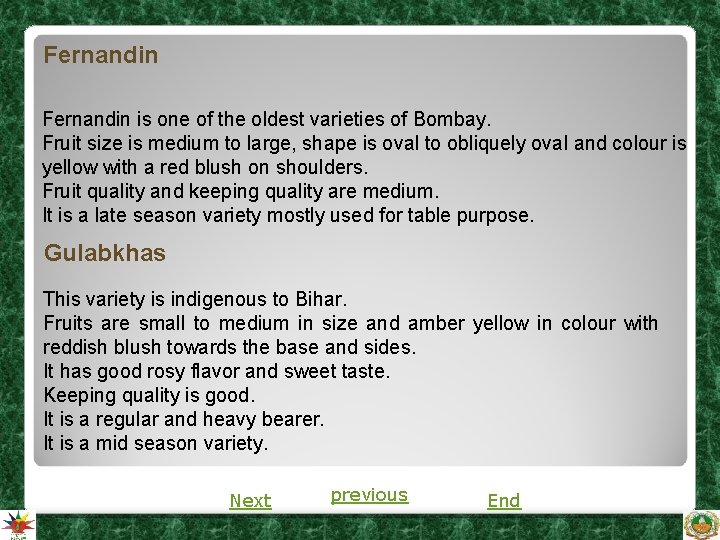
Fernandin is one of the oldest varieties of Bombay. Fruit size is medium to large, shape is oval to obliquely oval and colour is yellow with a red blush on shoulders. Fruit quality and keeping quality are medium. It is a late season variety mostly used for table purpose. Gulabkhas This variety is indigenous to Bihar. Fruits are small to medium in size and amber yellow in colour with reddish blush towards the base and sides. It has good rosy flavor and sweet taste. Keeping quality is good. It is a regular and heavy bearer. It is a mid season variety. Next previous End
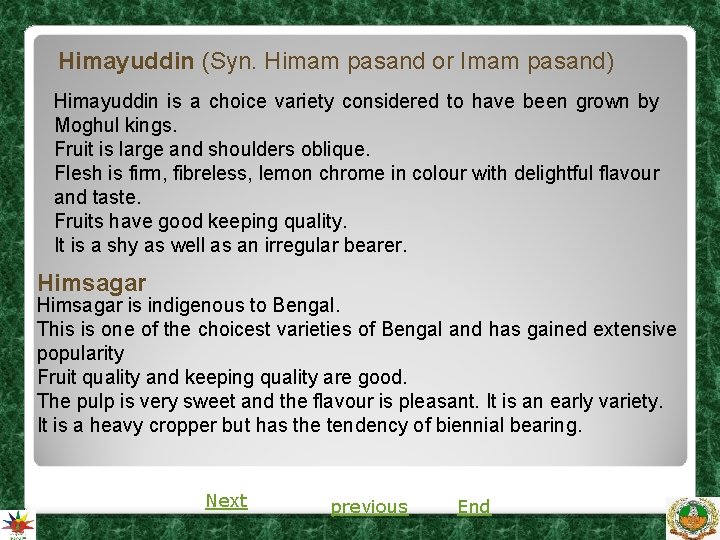
Himayuddin (Syn. Himam pasand or Imam pasand) Himayuddin is a choice variety considered to have been grown by Moghul kings. Fruit is large and shoulders oblique. Flesh is firm, fibreless, lemon chrome in colour with delightful flavour and taste. Fruits have good keeping quality. It is a shy as well as an irregular bearer. Himsagar is indigenous to Bengal. This is one of the choicest varieties of Bengal and has gained extensive popularity Fruit quality and keeping quality are good. The pulp is very sweet and the flavour is pleasant. It is an early variety. It is a heavy cropper but has the tendency of biennial bearing. Next previous End
Jehangir is a choice variety. Fruits are large with high quality and ovate in shape. Flesh is firm and fibreless, lemon chrome in colour with delightful flavour. It is a shy and irregular bearer. Janardhan pasand is a late season variety producing medium sized attractive fruits. Fruits are oblong in shape with yellow skin having red blush. Pulp is yellow coloured and fibreless. Next previous End
Jamadar is a famous variety of Gujarat. Fruit is medium in size with good quality. Flesh is firm, yellow in colour and fibreless with pleasant flavour. Keeping quality is good. It is a heavy and regular bearing variety. Kalepad Fruits resemble Neelum in all respects except the skin colour which is dark green turning to light green after complete ripening. Fruits do not develop deep yellow skin colour as in Neelum. The flesh is yellow, very sweet and juicy. Next previous End
Kesar is a leading variety of Gujarat with a red blush on the shoulders. Fruit size is medium, shape oblong and keeping quality is good. It is an early variety. Kishen Bhog is indigenous to Murshidabad in West Bengal. Fruit is medium in size, roundish oblique in shape and yellow in colour. Fruit quality and keeping quality are good. It is a mid season variety. Next previous End
Langra is indigenous to Varanasi in Uttar Pradesh. It is extensively grown in North India. Fruits are medium to large in size each weighing 250 -300 g. The fruits are lime green in colour and oblong oval in shape. The taste is excellent with good sugar/acid blend and pleasant flavour. Keeping quality is medium. It is a heavy yielder but a biennial bearer. It is a mid season variety. Next previous End
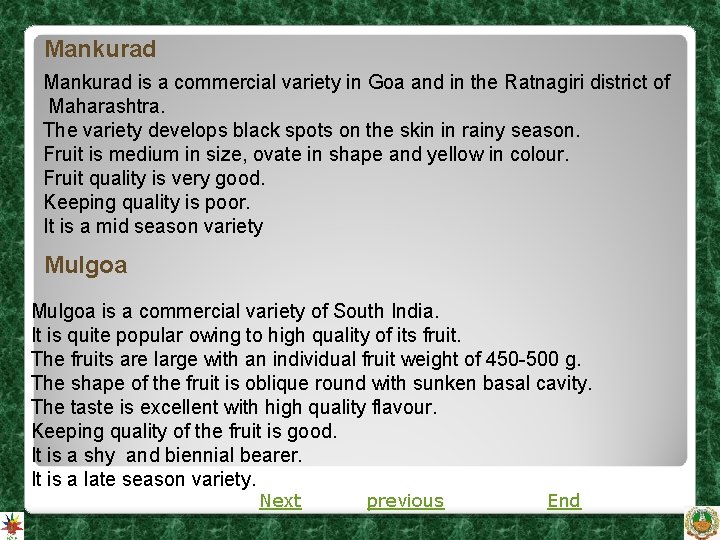
Mankurad is a commercial variety in Goa and in the Ratnagiri district of Maharashtra. The variety develops black spots on the skin in rainy season. Fruit is medium in size, ovate in shape and yellow in colour. Fruit quality is very good. Keeping quality is poor. It is a mid season variety Mulgoa is a commercial variety of South India. It is quite popular owing to high quality of its fruit. The fruits are large with an individual fruit weight of 450 -500 g. The shape of the fruit is oblique round with sunken basal cavity. The taste is excellent with high quality flavour. Keeping quality of the fruit is good. It is a shy and biennial bearer. It is a late season variety. Next previous End
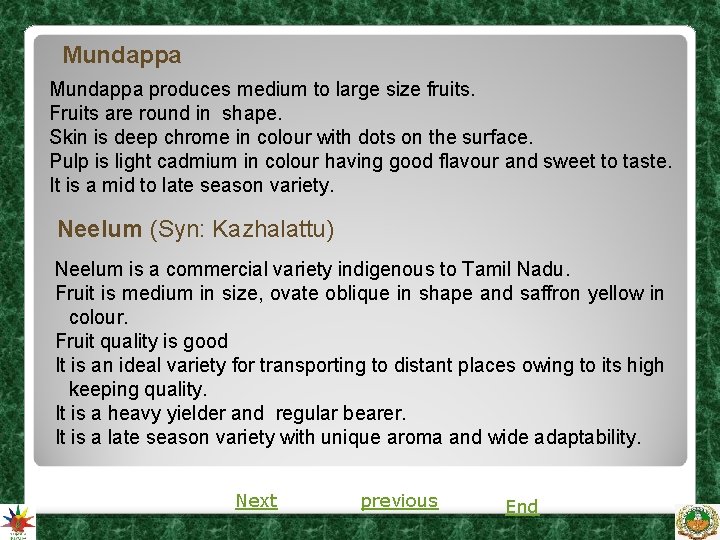
Mundappa produces medium to large size fruits. Fruits are round in shape. Skin is deep chrome in colour with dots on the surface. Pulp is light cadmium in colour having good flavour and sweet to taste. It is a mid to late season variety. Neelum (Syn: Kazhalattu) Neelum is a commercial variety indigenous to Tamil Nadu. Fruit is medium in size, ovate oblique in shape and saffron yellow in colour. Fruit quality is good It is an ideal variety for transporting to distant places owing to its high keeping quality. It is a heavy yielder and regular bearer. It is a late season variety with unique aroma and wide adaptability. Next previous End
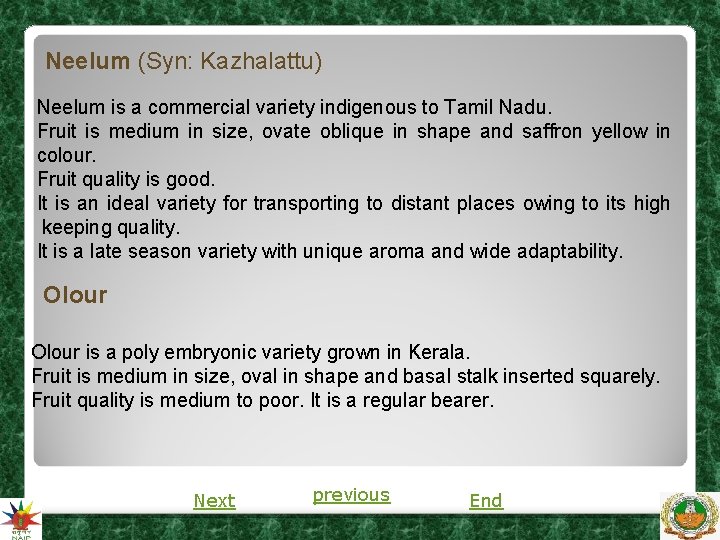
Neelum (Syn: Kazhalattu) Neelum is a commercial variety indigenous to Tamil Nadu. Fruit is medium in size, ovate oblique in shape and saffron yellow in colour. Fruit quality is good. It is an ideal variety for transporting to distant places owing to its high keeping quality. It is a late season variety with unique aroma and wide adaptability. Olour is a poly embryonic variety grown in Kerala. Fruit is medium in size, oval in shape and basal stalk inserted squarely. Fruit quality is medium to poor. It is a regular bearer. Next previous End
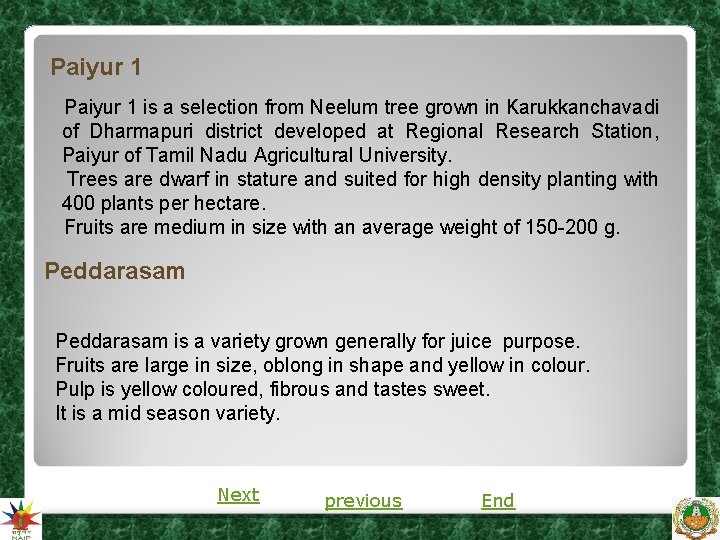
Paiyur 1 is a selection from Neelum tree grown in Karukkanchavadi of Dharmapuri district developed at Regional Research Station, Paiyur of Tamil Nadu Agricultural University. Trees are dwarf in stature and suited for high density planting with 400 plants per hectare. Fruits are medium in size with an average weight of 150 -200 g. Peddarasam is a variety grown generally for juice purpose. Fruits are large in size, oblong in shape and yellow in colour. Pulp is yellow coloured, fibrous and tastes sweet. It is a mid season variety. Next previous End
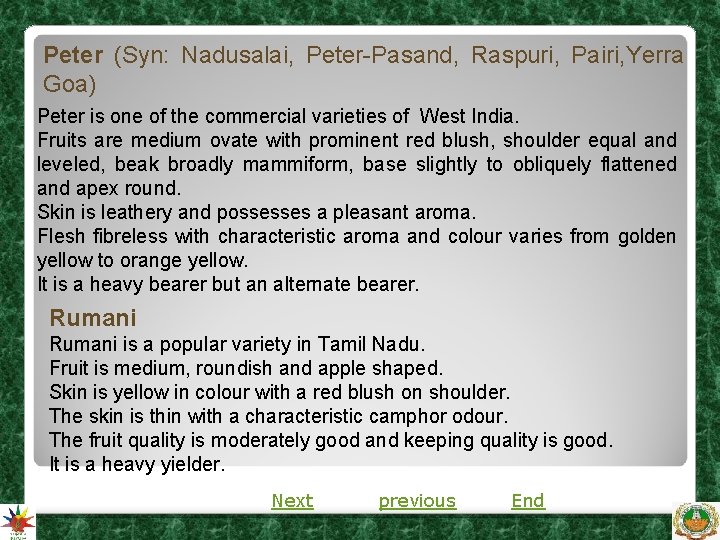
Peter (Syn: Nadusalai, Peter-Pasand, Raspuri, Pairi, Yerra Goa) Peter is one of the commercial varieties of West India. Fruits are medium ovate with prominent red blush, shoulder equal and leveled, beak broadly mammiform, base slightly to obliquely flattened and apex round. Skin is leathery and possesses a pleasant aroma. Flesh fibreless with characteristic aroma and colour varies from golden yellow to orange yellow. It is a heavy bearer but an alternate bearer. Rumani is a popular variety in Tamil Nadu. Fruit is medium, roundish and apple shaped. Skin is yellow in colour with a red blush on shoulder. The skin is thin with a characteristic camphor odour. The fruit quality is moderately good and keeping quality is good. It is a heavy yielder. Next previous End
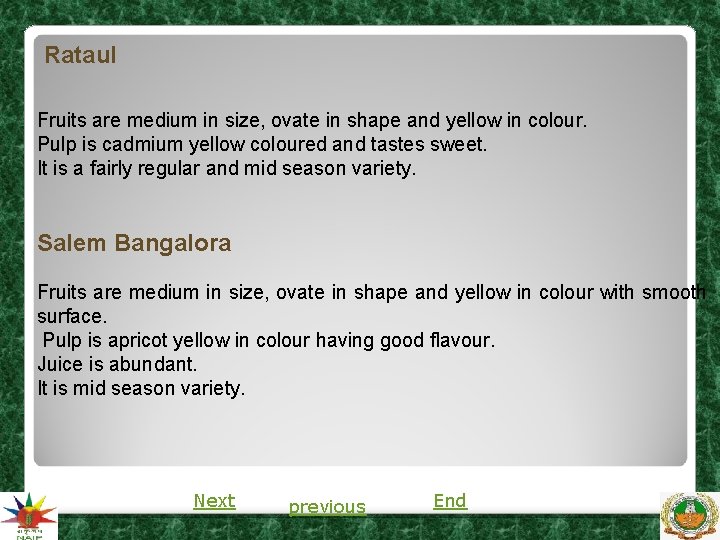
Rataul Fruits are medium in size, ovate in shape and yellow in colour. Pulp is cadmium yellow coloured and tastes sweet. It is a fairly regular and mid season variety. Salem Bangalora Fruits are medium in size, ovate in shape and yellow in colour with smooth surface. Pulp is apricot yellow in colour having good flavour. Juice is abundant. It is mid season variety. Next previous End
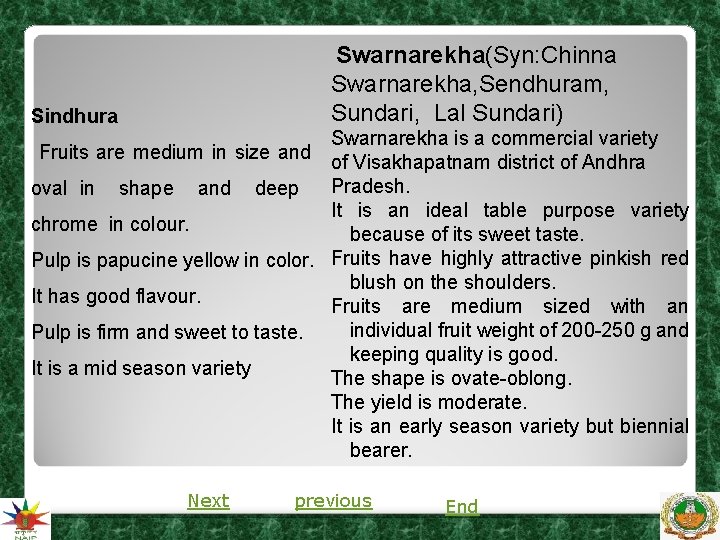
Swarnarekha(Syn: Chinna Swarnarekha, Sendhuram, Sundari, Lal Sundari) Sindhura Swarnarekha is a commercial variety of Visakhapatnam district of Andhra Pradesh. oval in shape and deep It is an ideal table purpose variety chrome in colour. because of its sweet taste. Pulp is papucine yellow in color. Fruits have highly attractive pinkish red blush on the shoulders. It has good flavour. Fruits are medium sized with an individual fruit weight of 200 -250 g and Pulp is firm and sweet to taste. keeping quality is good. It is a mid season variety The shape is ovate-oblong. The yield is moderate. It is an early season variety but biennial bearer. Fruits are medium in size and Next previous End
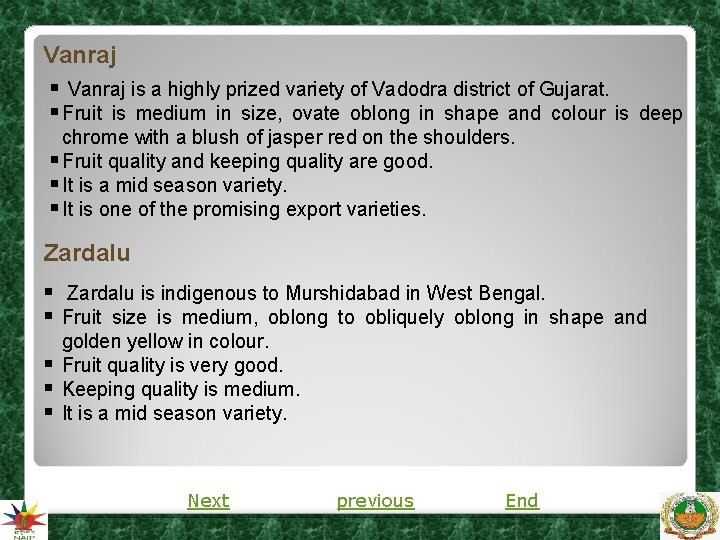
Vanraj § Vanraj is a highly prized variety of Vadodra district of Gujarat. § Fruit is medium in size, ovate oblong in shape and colour is deep chrome with a blush of jasper red on the shoulders. § Fruit quality and keeping quality are good. § It is a mid season variety. § It is one of the promising export varieties. Zardalu § Zardalu is indigenous to Murshidabad in West Bengal. § Fruit size is medium, oblong to obliquely oblong in shape and § § § golden yellow in colour. Fruit quality is very good. Keeping quality is medium. It is a mid season variety. Next previous End
Menaka is selected as a chance seedling from Gulabkhas at Sabour and released in 1991. Due to its attractive colour, name Menaka was given. Fruit is medium in size (300 g) with very attractive red blush on yellow back ground. Fruits have firm pulp, 200 TSS and 0. 14 percent acidity. Keeping quality is good. It is a late maturating variety. Next previous End
Indian hybrid mangoes Alfazli § Alfazli is from a cross of Alphonso x Fazali, developed at Bihar § § § Agricultural College, Sabour in 1981. Tree is tall and regular bearer. Fruit is medium to large in size (228. 70 to 460 g) with 79% pulp, moderate TSS content (16. 20 to 18. 5 0 Brix) 0. 24 % acidity. Keeping quality is good. Fruit characteristics are similar to Fazali, but the maturity of fruits is earlier. It is late maturing cultivar and free from malformation and fruit fly. Next previous End
Amrapali Amrapalli is from a cross of Dashehari x Neelum, developed at IARI, New Delhi. It is dwarf, regular bearing and late maturing variety. The variety is suitable for high density planting and about 1600 plants may be planted in a hectare. It yields on an average 16 tonnes per hectare Ambika § Ambika is from a cross between Amrapali and Janaradhan Pasand. § Fruits are medium sized with an average weight of 225 g, oblong in § § shape with slight sinus and beak broadly pointed apex, smooth and tough skin. Colour of the fruit is bright yellow with dark red blush, flesh dark yellow, firm with scanty fibre and TSS 210 Brix. It is a late season variety. Next previous End
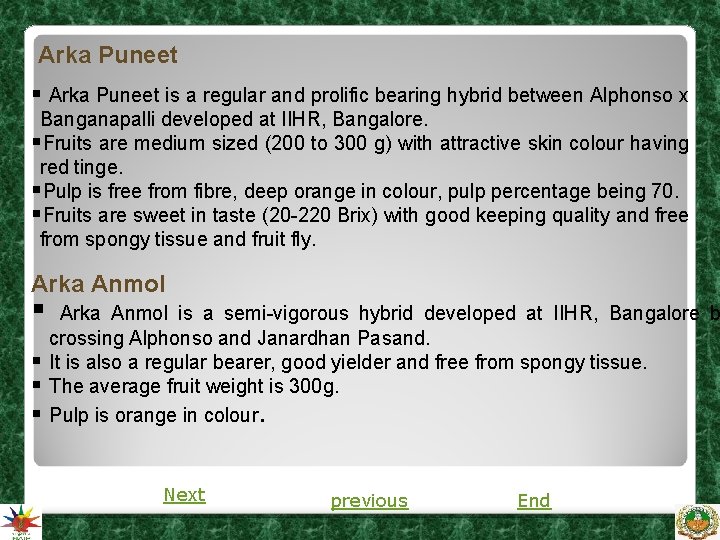
Arka Aruna § Arka Aruna is a progeny of the cross between Banganapalli x Alphonso developed at Indian Institute of Horticultural Research, Bangalore. § It is a regular bearer with a dwarf stature suitable for high density planting. § Fruits are large sized (400 g) with attractive reddish tinge on the skin. § Pulp is fibreless, cream in colour with good consistency as that of Alphonso, sweet with 20 -220 Brix TSS. § Pulp percentage is 80 and the fruits are free from spongy tissue. Next previous End
Arka Puneet § Arka Puneet is a regular and prolific bearing hybrid between Alphonso x Banganapalli developed at IIHR, Bangalore. §Fruits are medium sized (200 to 300 g) with attractive skin colour having red tinge. §Pulp is free from fibre, deep orange in colour, pulp percentage being 70. §Fruits are sweet in taste (20 -220 Brix) with good keeping quality and free from spongy tissue and fruit fly. Arka Anmol § § Arka Anmol is a semi-vigorous hybrid developed at IIHR, Bangalore b crossing Alphonso and Janardhan Pasand. It is also a regular bearer, good yielder and free from spongy tissue. The average fruit weight is 300 g. Pulp is orange in colour. Next previous End
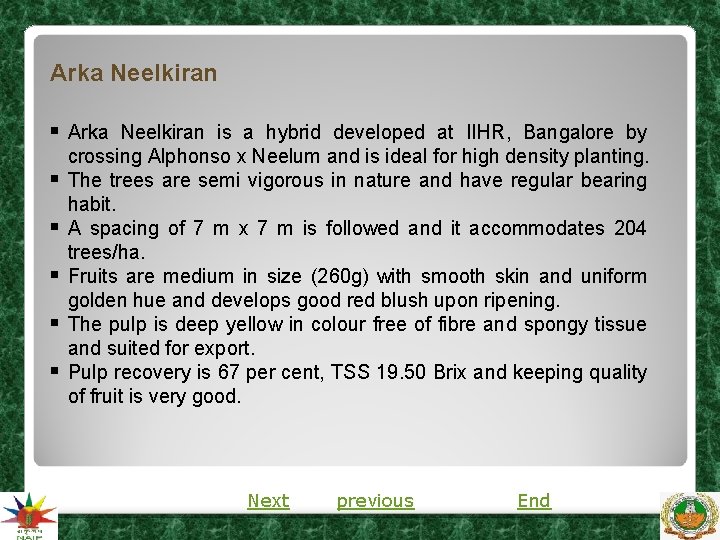
Arka Neelkiran § Arka Neelkiran is a hybrid developed at IIHR, Bangalore by § § § crossing Alphonso x Neelum and is ideal for high density planting. The trees are semi vigorous in nature and have regular bearing habit. A spacing of 7 m x 7 m is followed and it accommodates 204 trees/ha. Fruits are medium in size (260 g) with smooth skin and uniform golden hue and develops good red blush upon ripening. The pulp is deep yellow in colour free of fibre and spongy tissue and suited for export. Pulp recovery is 67 per cent, TSS 19. 50 Brix and keeping quality of fruit is very good. Next previous End
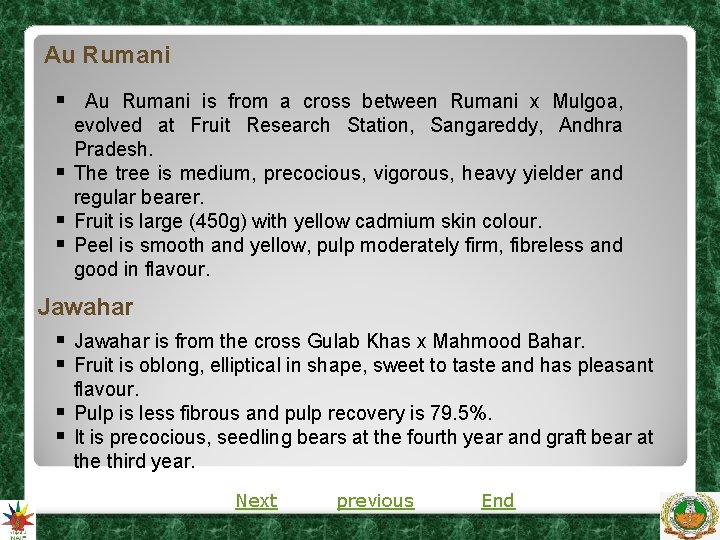
Au Rumani § Au Rumani is from a cross between Rumani x Mulgoa, § § § evolved at Fruit Research Station, Sangareddy, Andhra Pradesh. The tree is medium, precocious, vigorous, heavy yielder and regular bearer. Fruit is large (450 g) with yellow cadmium skin colour. Peel is smooth and yellow, pulp moderately firm, fibreless and good in flavour. Jawahar § Jawahar is from the cross Gulab Khas x Mahmood Bahar. § Fruit is oblong, elliptical in shape, sweet to taste and has pleasant § § flavour. Pulp is less fibrous and pulp recovery is 79. 5%. It is precocious, seedling bears at the fourth year and graft bear at the third year. Next previous End
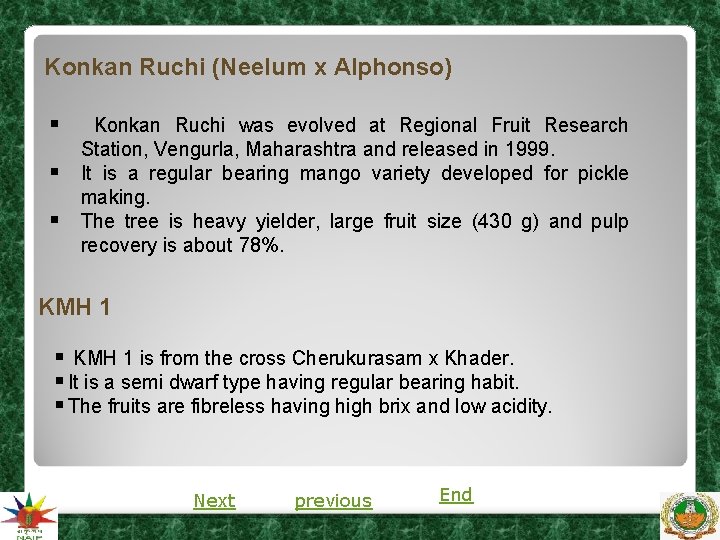
Konkan Ruchi (Neelum x Alphonso) § § § Konkan Ruchi was evolved at Regional Fruit Research Station, Vengurla, Maharashtra and released in 1999. It is a regular bearing mango variety developed for pickle making. The tree is heavy yielder, large fruit size (430 g) and pulp recovery is about 78%. KMH 1 § KMH 1 is from the cross Cherukurasam x Khader. § It is a semi dwarf type having regular bearing habit. § The fruits are fibreless having high brix and low acidity. Next previous End
Mallika § Mallika is a cross between Neelum x Dashehari developed at IARI, New Delhi. § Fruit is large in size, oblong elliptical in shape and cadmium yellow in colour. § Keeping quality of the fruit is good. § It is a mid season variety and a regular bearer. Manjeera § Manjeera was evolved from a cross between Rumani x Neelum § § and released at Fruit Research Station, Sangareddy, Andhra Pradesh. Fruit is very attractive and large in size (300 – 350 g) and looks like Rumani. The peel is light yellow, pulp is firm, fibreless and sweet. Average yield varies from 120 -150 kg/tree from 10 years old tree. Next previous End
Neelphonso § Neelphanso was evolved at Agricultural Experiment Station, Partia, § § § Gujarat from a cross between Neelum x Alphonso and released in 1986. Tree is moderately vigorous, moderately regular bearer with late ripening tendency (120 -140 days after flowering i. e. , 2 nd week of July). Fruit is medium in size (196 g), thick peel with apricot colour at ripening. The pulp texture is firm and non fibrous. Fruit quality is excellent, TSS 19. 0 0 brix, total sugar 13. 13 percent, acidity 0. 07 percent and vitamin C content 22. 80 mg/100 g pulp. It is suitable for table and juice purpose. Next previous End
PKM l § PKM 1 is a hybrid between Chinnaswarnarekha x Neelum, developed at the Horticultural Research Station, Periyakulam of Tamil Nadu Agricultural University. § Individual fruit weighs 250 -300 g. § Fruits are long and narrow with prominent beak. § It is a regular and cluster bearing variety and highly suitable for long distant transport. § It is a mid-season variety. PKM 2 § PKM 2 is a hybrid between Neelum x Mulgoa developed at Horticultural College and Research Institute, Periyakulam of Tamil Nadu Agricultural University. § Fruits are large with vertical stalk insertion, long ovate, base slightly oblique and flattened, basal sinus marked, ventral shoulder not prominent and apex obtuse. § Each fruit weighs 650 -700 g. § It exhibits hybrid vigour in yield over Neelum and Mulgoa. Next previous End
Ratna § Ratna is a hybrid developed at Konkan Krishi Vidyapeeth, Dapoli, Maharashtra by crossing Neelum x Alphonso. § Tree is vigorous and a precocious bearer. § Fruits are medium sized, attractive in colour and free from spongy tissue. § Fruits have excellent taste and flavour. Sabri §Sabri is a hybrid from the cross Gulab Khas x Bombai. §It has the shape of Bombai and the colour of Gulab Khas. . §Pulp is deep orange in colour, very sweet with flavour, firm and less fibrous and pulp recovery is 74%. §It has a good keeping quality. §It is a irregular bearer and no malformation has been observed. Next previous End
Sindhu is a cross between Ratna x Alphonso, released from Fruit Research Station, Vengurla. It is a regular bearer, fruits are medium sized, free from spongy tissue with high pulp to stone ratio. Seeds are papery thin and almost seedless. Next previous End