
Mango Family Genus Species Anacardiaceae Mangifera indica Readings










- Slides: 38
Mango Family Genus Species Anacardiaceae Mangifera indica
Readings w Crane and Campbell. 1994. • The Mango • Univ. Florida, IFAS, Fact Sheet HS-2. w Pernezny and Marlatt. 1993. • Common diseases of Mango in Florida • Univ. Florida, IFAS, PP-23. Tropical Horticulture - Texas A&M University
Taxonomy w Related plants in the Anacardiaceae • Cashew • Pistachio • Poison Ivy w Origin -Indo-Burma Region • About 40 related species Tropical Horticulture - Texas A&M University
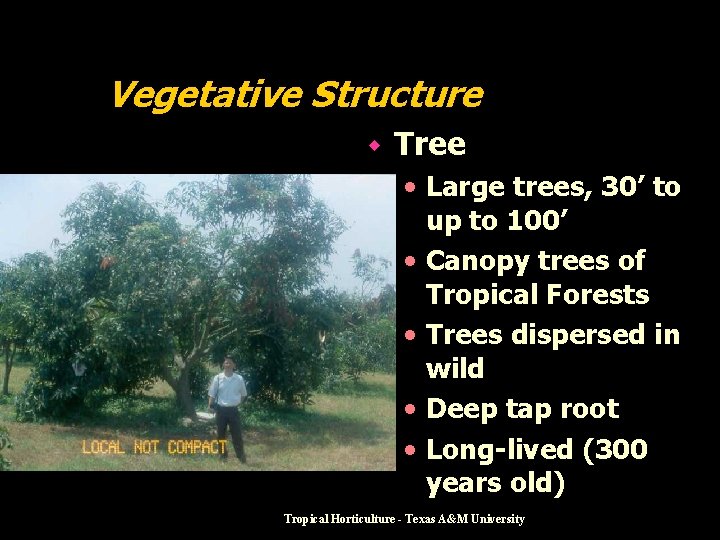
Vegetative Structure w Tree • Large trees, 30’ to up to 100’ • Canopy trees of Tropical Forests • Trees dispersed in wild • Deep tap root • Long-lived (300 years old) Tropical Horticulture - Texas A&M University
Flowers w Inflorescence • Terminal panicles • Up to 4, 000 flowers w Flowers • Most male • Few hermaphroditic • Insect pollinated • Flies, thrips Ability to set fruit related to # hermphroditic flowers w Flower over 4 -6 weeks w Tropical Horticulture - Texas A&M University
Flowers w Alexander, 1986. The Mango in Australia, CSIRO. Tropical Horticulture - Texas A&M University
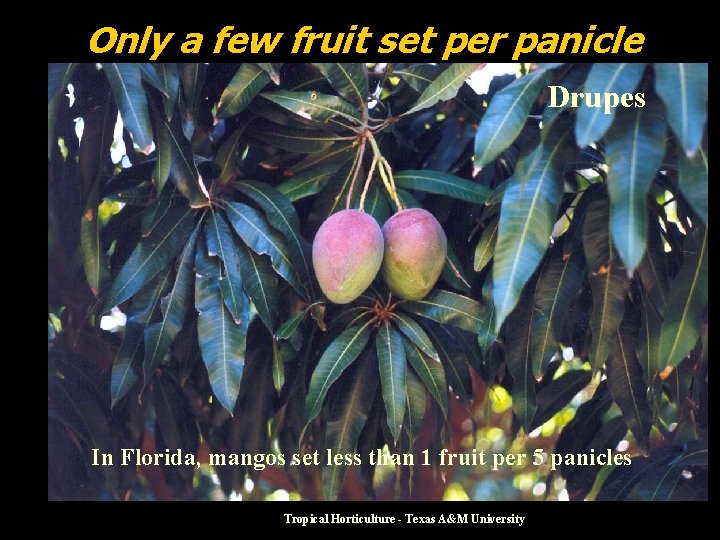
Only a few fruit set per panicle Drupes In Florida, mangos set less than 1 fruit per 5 panicles Tropical Horticulture - Texas A&M University
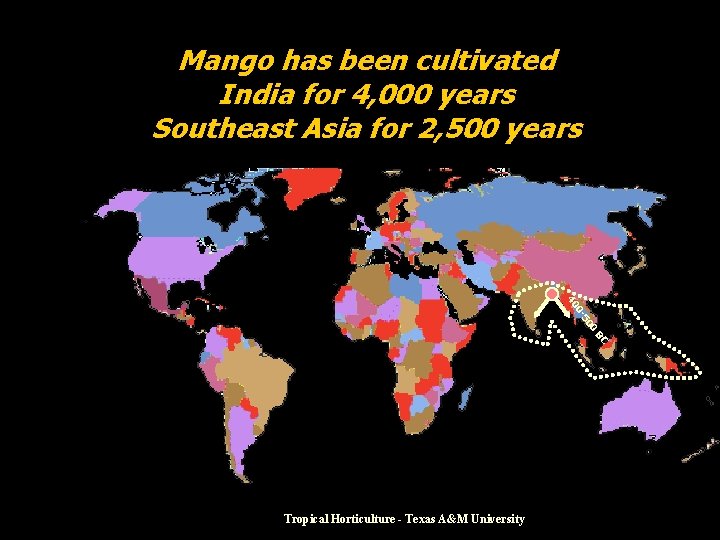
Mango has been cultivated in India for 4, 000 years 10 th cen 1861 00 5 0 - 40 1800 s - Spanish tury? t 16 h n ce ry tu Tropical Horticulture - Texas A&M University BC 1700 - Portuguese
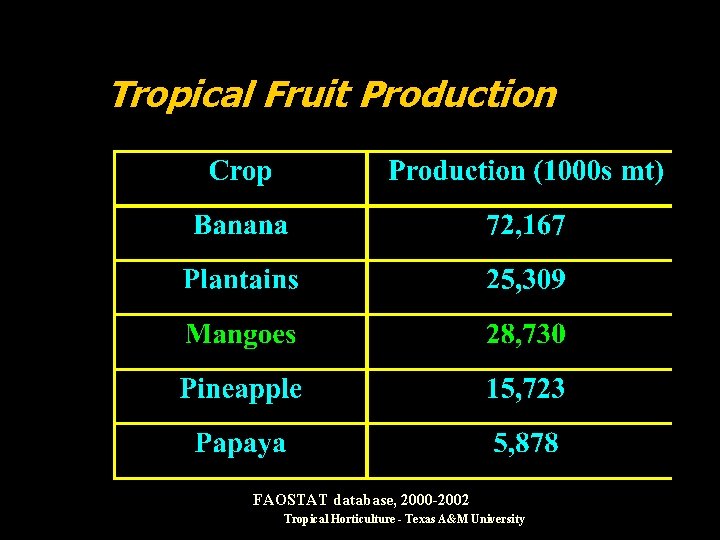
Tropical Fruit Production FAOSTAT database, 2000 -2002 Tropical Horticulture - Texas A&M University
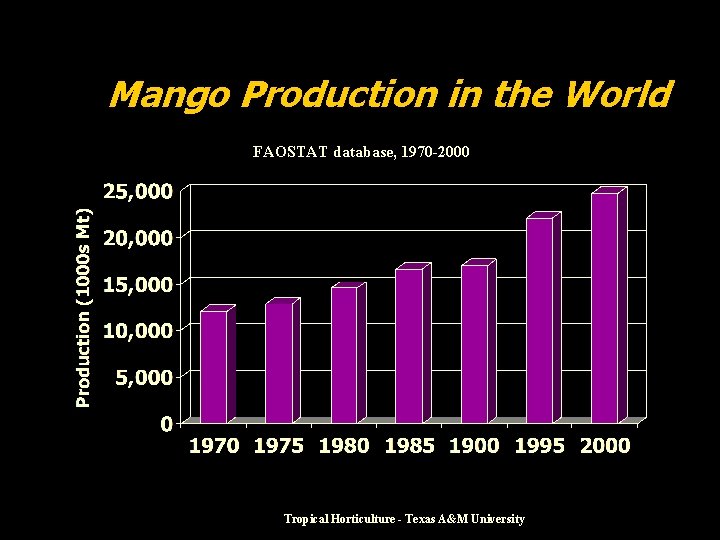
Mango Production in the World FAOSTAT database, 1970 -2000 Tropical Horticulture - Texas A&M University
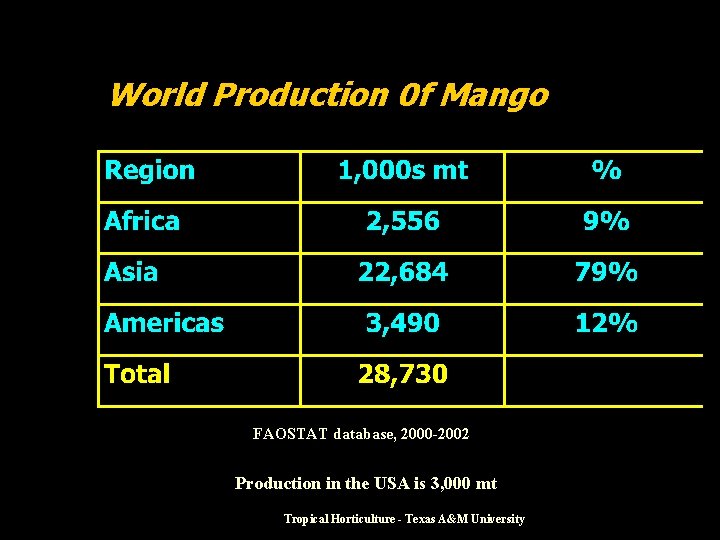
World Production 0 f Mango FAOSTAT database, 2000 -2002 Production in the USA is 3, 000 mt Tropical Horticulture - Texas A&M University
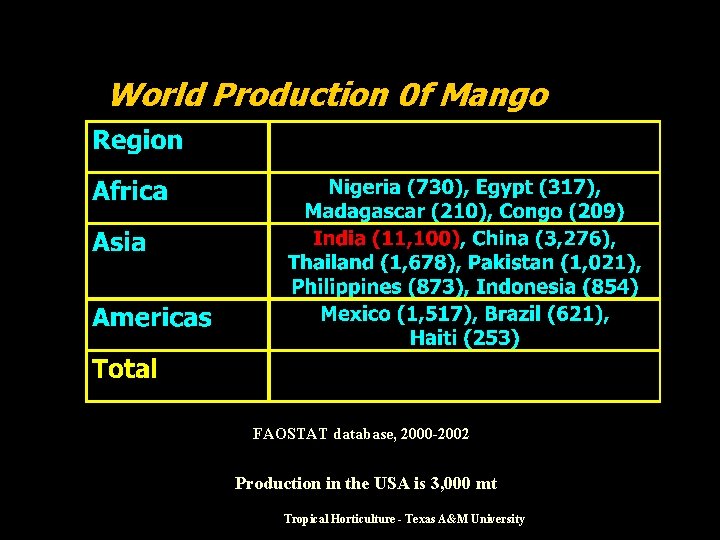
World Production 0 f Mango FAOSTAT database, 2000 -2002 Production in the USA is 3, 000 mt Tropical Horticulture - Texas A&M University
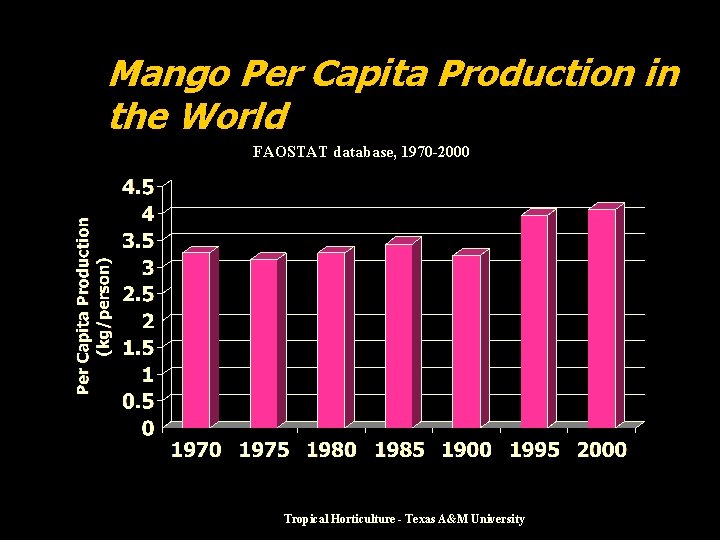
Mango Per Capita Production in the World FAOSTAT database, 1970 -2000 Tropical Horticulture - Texas A&M University
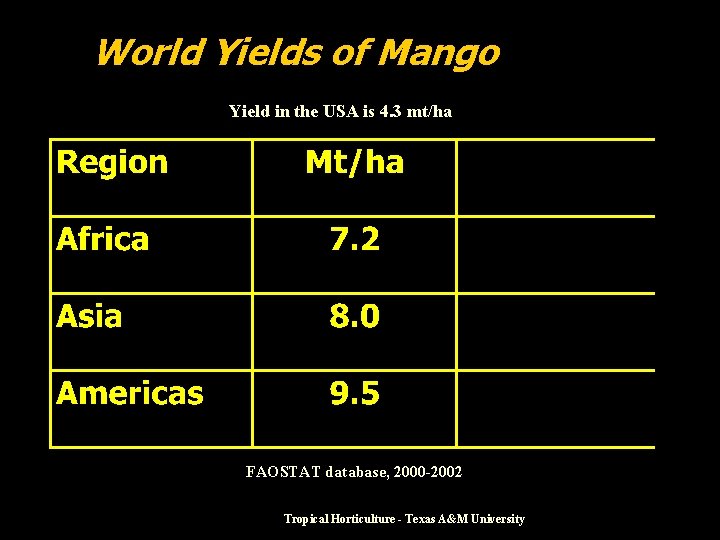
World Yields of Mango Yield in the USA is 4. 3 mt/ha FAOSTAT database, 2000 -2002 Tropical Horticulture - Texas A&M University
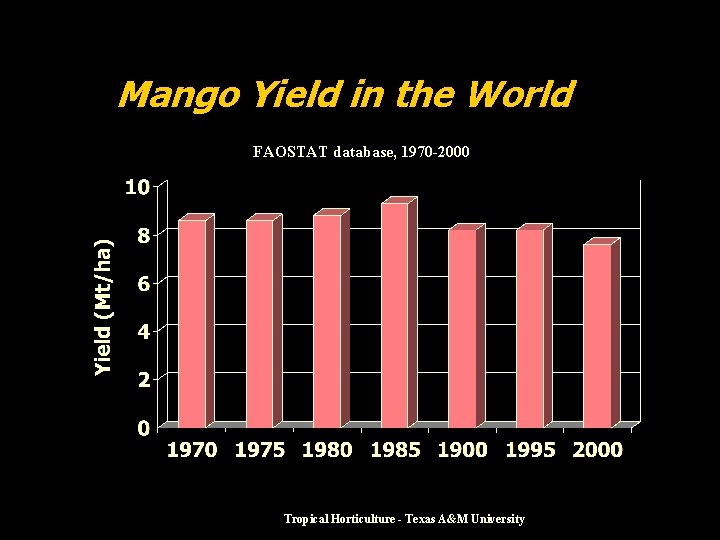
Mango Yield in the World FAOSTAT database, 1970 -2000 Tropical Horticulture - Texas A&M University
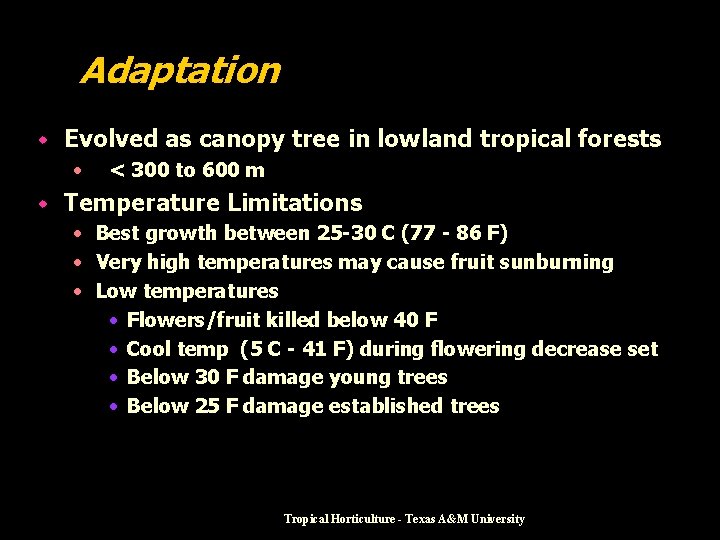
Adaptation w Evolved as canopy tree in lowland tropical forests • w < 300 to 600 m Temperature Limitations • Best growth between 25 -30 C (77 - 86 F) • Very high temperatures may cause fruit sunburning • Low temperatures • Flowers/fruit killed below 40 F • Cool temp (5 C - 41 F) during flowering decrease set • Below 30 F damage young trees • Below 25 F damage established trees Tropical Horticulture - Texas A&M University
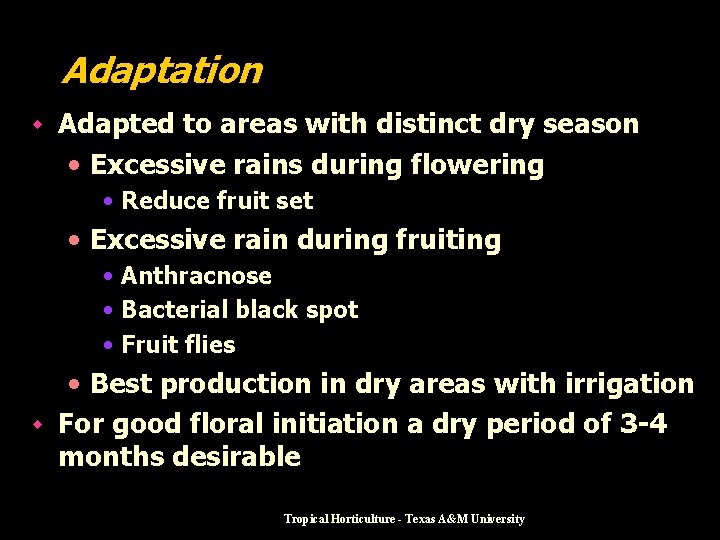
Adaptation w Adapted to areas with distinct dry season • Excessive rains during flowering • Reduce fruit set • Excessive rain during fruiting • Anthracnose • Bacterial black spot • Fruit flies • Best production in dry areas with irrigation w For good floral initiation a dry period of 3 -4 months desirable Tropical Horticulture - Texas A&M University
Adaptation w Best soils • Deep , well drained, fertile, loam, high OM • p. H 6. 0 to 7. 0 w Tolerant of soils that are • Infertile sands, volcanic ash, limestone based soil • Excessively drained or periodically flooded • p. H range of 4. 5 to 7. 5 Sensitive to saline and sodic soils w Windbreaks used to minimize wind damage w • Protect young trees by staking • Older trees • Limb breakage • Poor pollination, flower/fruit drop if dry wind • Leaf rub Tropical Horticulture - Texas A&M University
Mango has been cultivated India for 4, 000 years Southeast Asia for 2, 500 years 00 5 0 - 40 BC Tropical Horticulture - Texas A&M University
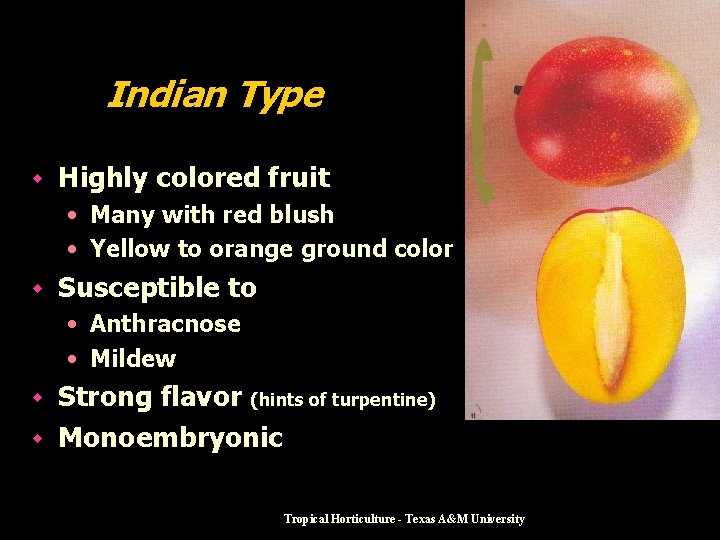
Indian Type w Highly colored fruit • Many with red blush • Yellow to orange ground color w Susceptible to • Anthracnose • Mildew Strong flavor (hints of turpentine) w Monoembryonic w Tropical Horticulture - Texas A&M University
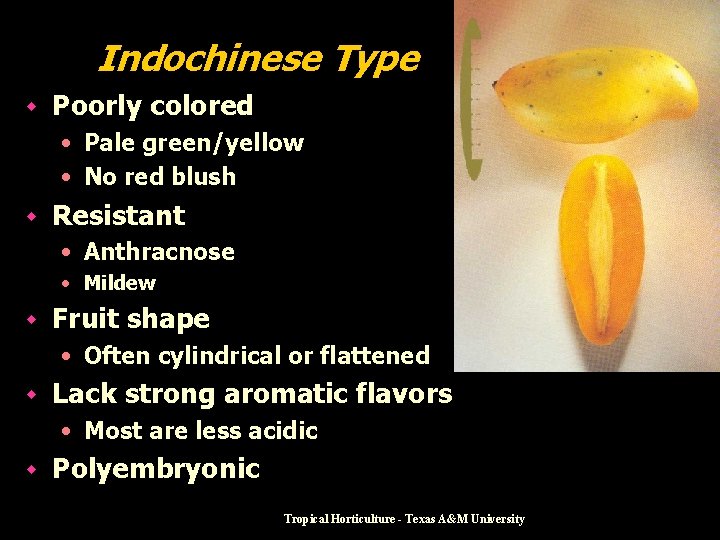
Indochinese Type w Poorly colored • Pale green/yellow • No red blush w Resistant • Anthracnose • Mildew w Fruit shape • Often cylindrical or flattened w Lack strong aromatic flavors • Most are less acidic w Polyembryonic Tropical Horticulture - Texas A&M University
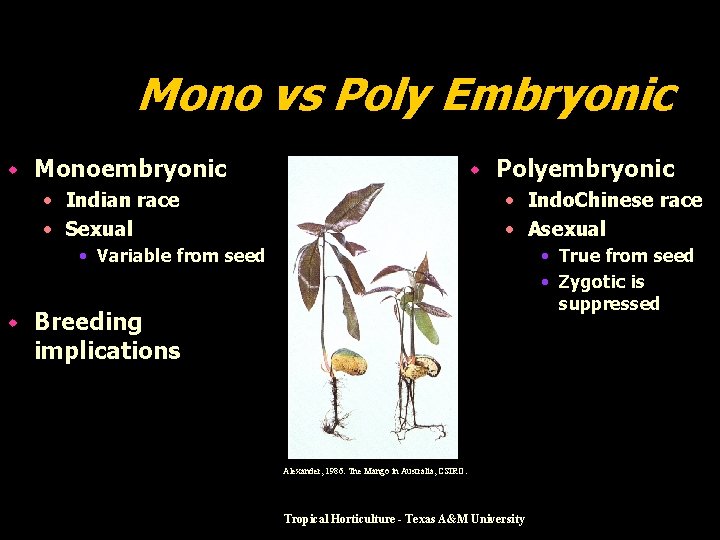
Mono vs Poly Embryonic Alexander, 1986. The Mango in Australia, CSIRO. Tropical Horticulture - Texas A&M University
Mono vs Poly Embryonic w Monoembryonic w • Indian race • Sexual Polyembryonic • Indo. Chinese race • Asexual • Variable from seed w • True from seed • Zygotic is suppressed Breeding implications Alexander, 1986. The Mango in Australia, CSIRO. Tropical Horticulture - Texas A&M University
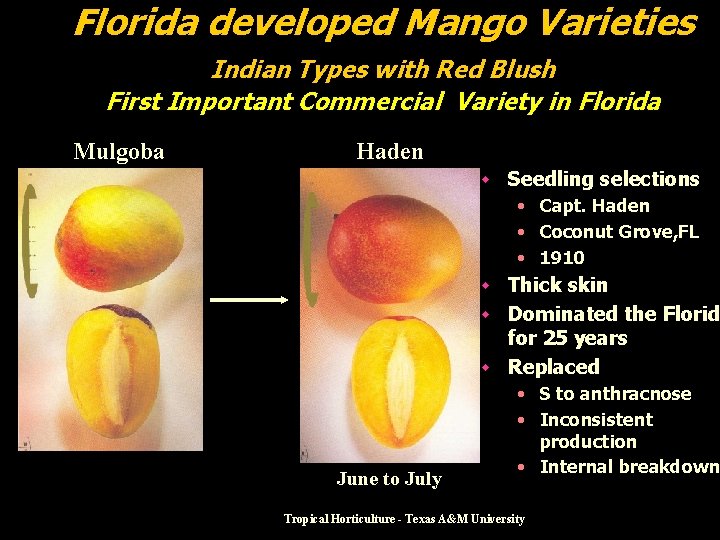
Florida developed Mango Varieties Indian Types with Red Blush First Important Commercial Variety in Florida Mulgoba Haden w Seedling selections • Capt. Haden • Coconut Grove, FL • 1910 Thick skin w Dominated the Florid for 25 years w Replaced w June to July • S to anthracnose • Inconsistent production • Internal breakdown Tropical Horticulture - Texas A&M University
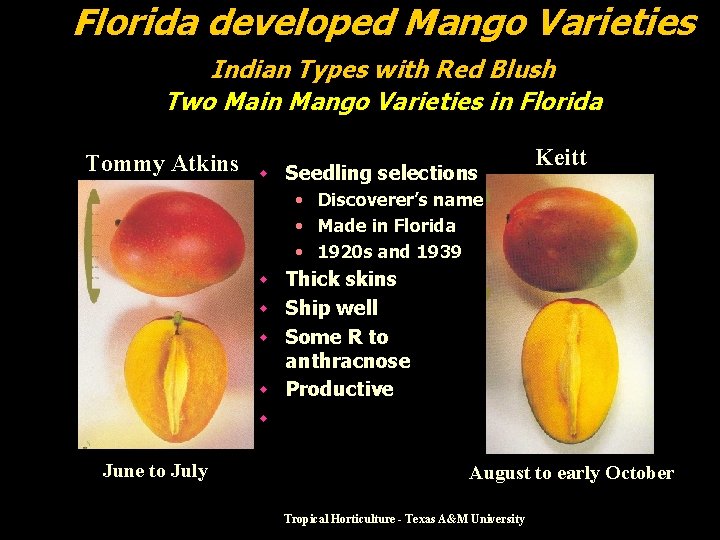
Florida developed Mango Varieties Indian Types with Red Blush Two Main Mango Varieties in Florida Tommy Atkins w Seedling selections Keitt • Discoverer’s name • Made in Florida • 1920 s and 1939 Thick skins w Ship well w Some R to anthracnose w Productive w w June to July August to early October Tropical Horticulture - Texas A&M University
Florida developed Mango Varieties Indian Types with Red Blush Used Commercially throughout the Americas Tommy Atkins Haden June to July Kent Keitt July to August to early October Susceptible to Anthracnose Tropical Horticulture - Texas A&M University
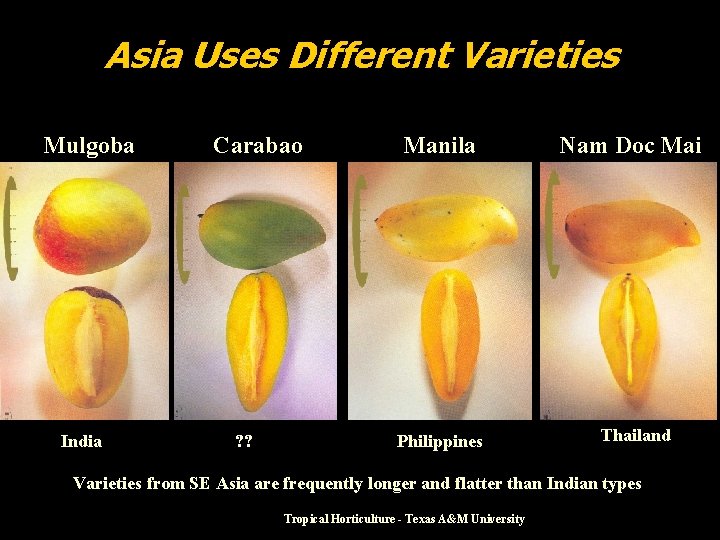
Asia Uses Different Varieties Mulgoba India Carabao ? ? Manila Philippines Nam Doc Mai Thailand Varieties from SE Asia are frequently longer and flatter than Indian types Tropical Horticulture - Texas A&M University
Propagation w Seed • • w Viable for 80 - 100 days 3 - 10 years to bearing Rootstocks Scions if polyembryonic Vegetative - Monoembryonic varieties • Grafting • 4 years to full production Tropical Horticulture - Texas A&M University
Production w Transplanting - clear cut forest • Spacing 10 x 10 M Standard trees • 6 x 6 M Dwarf trees w Pruning varies • Open center with frequent tipping to induce more terminals • Minimal Tropical Horticulture - Texas A&M University
Fertilization Mango can usually absorb adequate nutrients from fertile soil w Heavy N appl can cause Soft Nose w • Corrected with Soil appl of Ca. NO 3, Ca. SO 4, Ca. CO 3 w Zn deficiency corrected with 1 pt NZN per 100 gal H 2 O Tropical Horticulture - Texas A&M University
Forcing Flowering w Cessation of vegetative growth needed to induce vegetative to reproductive transformation • Water stress • Cold period w Induction of early flowering • Reduce irrigation to induce water stress • Foliar applications of • KNO 3 (2 - 8%, 1 or 2 times) • NH 4 NO 3 (1 -4%, 1 or 2 times) Tropical Horticulture - Texas A&M University
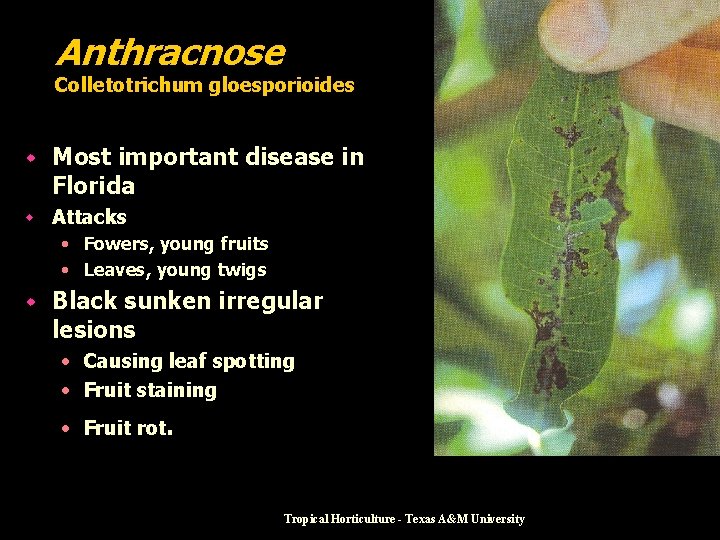
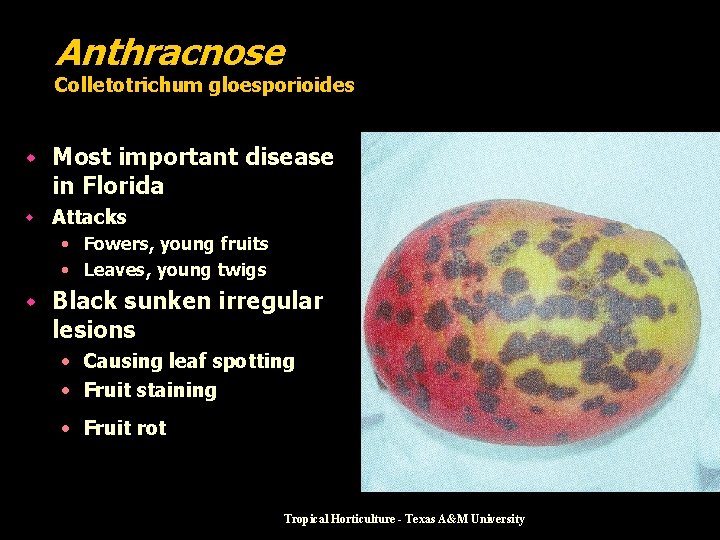
Anthracnose Colletotrichum gloesporioides w Most important disease in Florida w Attacks • Fowers, young fruits • Leaves, young twigs w Black sunken irregular lesions • Causing leaf spotting • Fruit staining • Fruit rot. Tropical Horticulture - Texas A&M University
Anthracnose Colletotrichum gloesporioides w Most important disease in Florida w Attacks • Fowers, young fruits • Leaves, young twigs w Black sunken irregular lesions • Causing leaf spotting • Fruit staining • Fruit rot Tropical Horticulture - Texas A&M University
Anthracnose Spread and Control Spread by rains w Controlled by weekly Cu sprays* w • From panicle appearance until fruit set. • Follow with mid May & mid June Cu sprays until harvest. w * Neutral Cu at 1. 5 to 2 lbs metallic Cu. Tropical Horticulture - Texas A&M University
Harvesting - by hand w First harvest in 4 th year • Remove fruit first 3 years • Fruit set < 1% w Fruit development period • 100 -150 days w Harvest over 6 -8 week period • Bloom over 6 -8 week period w Pole harvesting Tropical Horticulture - Texas A&M University
Harvesting w N latitudes - begins in April • Peak in summer months Pole harvesting w Water bath for latex w Tropical Horticulture - Texas A&M University
Marketing w Perishable - Quality problem • • w Necessity to harvest immature Need more rapid shipping Lowest storage temperature - 55 F Below 50 F - chilling injury Heat treatment for fruit flies Tropical Horticulture - Texas A&M University
Any Questions about Mango? Tropical Horticulture - Texas A&M University