
Manejo y seleccin de frmacos antihiperglucemiantes en pacientes


- Slides: 14
Manejo y selección de fármacos antihiperglucemiantes en pacientes con ERC Juan José Gorgojo Martínez Unidad de Endocrinología y Nutrición 1
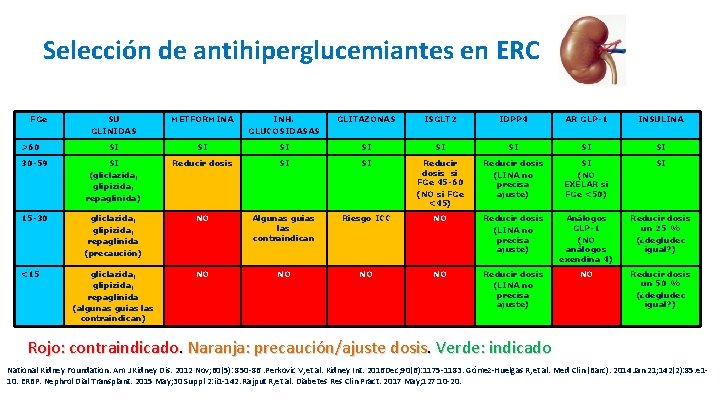
Selección de antihiperglucemiantes en ERC FGe SU GLINIDAS METFORMINA INH. GLUCOSIDASAS GLITAZONAS ISGLT 2 IDPP 4 AR GLP-1 INSULINA SI SI 30 -59 SI (gliclazida, glipizida, repaglinida) Reducir dosis SI SI Reducir dosis si FGe 45 -60 (NO si FGe <45) Reducir dosis (LINA no precisa ajuste) SI (NO EXELAR si FGe <50) SI 15 -30 gliclazida, glipizida, repaglinida (precaución) NO Algunas guías las contraindican Riesgo ICC NO Reducir dosis (LINA no precisa ajuste) Análogos GLP-1 (NO análogos exendina 4) Reducir dosis un 25 % (¿degludec igual? ) gliclazida, glipizida, repaglinida (algunas guías las contraindican) NO NO Reducir dosis (LINA no precisa ajuste) NO Reducir dosis un 50 % (¿degludec igual? ) >60 <15 Rojo: contraindicado. Naranja: precaución/ajuste dosis. Verde: indicado National Kidney Foundation. Am J Kidney Dis. 2012 Nov; 60(5): 850 -86. Perkovic V, et al. Kidney Int. 2016 Dec; 90(6): 1175 -1183. Gómez-Huelgas R, et al. Med Clin (Barc). 2014 Jan 21; 142(2): 85. e 110. ERBP. Nephrol Dial Transplant. 2015 May; 30 Suppl 2: ii 1 -142. Rajput R, et al. Diabetes Res Clin Pract. 2017 May; 127: 10 -20.
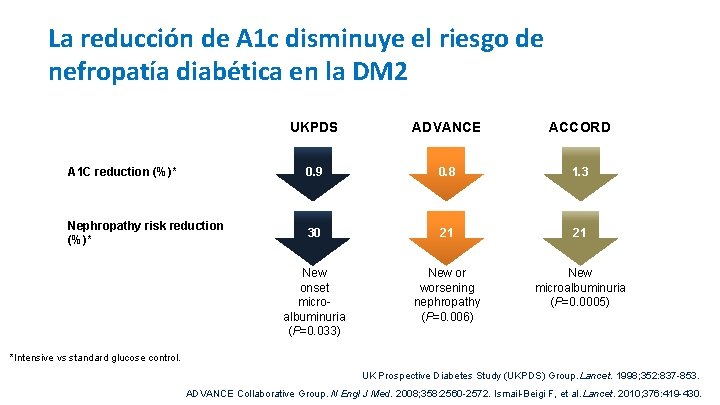
La reducción de A 1 c disminuye el riesgo de nefropatía diabética en la DM 2 UKPDS ADVANCE ACCORD A 1 C reduction (%)* 0. 9 0. 8 1. 3 Nephropathy risk reduction (%)* 30 21 21 New onset microalbuminuria (P=0. 033) New or worsening nephropathy (P=0. 006) New microalbuminuria (P=0. 0005) *Intensive vs standard glucose control. UK Prospective Diabetes Study (UKPDS) Group. Lancet. 1998; 352: 837 -853. ADVANCE Collaborative Group. N Engl J Med. 2008; 358: 2560 -2572. Ismail-Beigi F, et al. Lancet. 2010; 376: 419 -430.
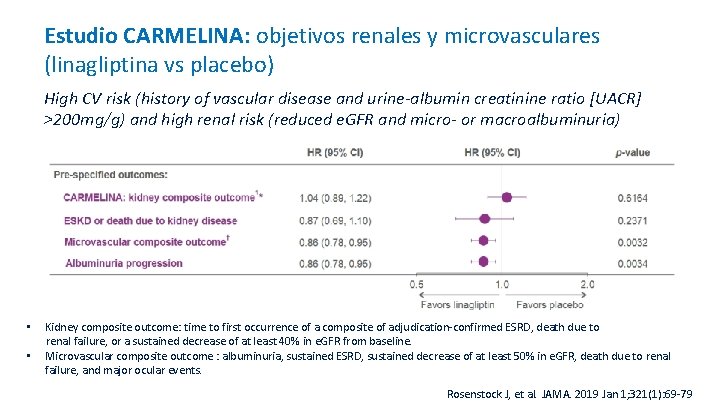
Estudio CARMELINA: objetivos renales y microvasculares (linagliptina vs placebo) High CV risk (history of vascular disease and urine-albumin creatinine ratio [UACR] >200 mg/g) and high renal risk (reduced e. GFR and micro- or macroalbuminuria) • • Kidney composite outcome: time to first occurrence of a composite of adjudication-confirmed ESRD, death due to renal failure, or a sustained decrease of at least 40% in e. GFR from baseline. Microvascular composite outcome : albuminuria, sustained ESRD, sustained decrease of at least 50% in e. GFR, death due to renal failure, and major ocular events. Rosenstock J, et al. JAMA. 2019 Jan 1; 321(1): 69 -79
Tres i. SGLT-2 reducen la progresión de la ERC. . . EMPAREG (-39%) CANVAS (-40%) DECLARE (-24%) JJ GORGOJO. Elaborada a partir de datos de: Zinman B, et al. N Engl J Med. 2015 Nov 26; 373(22): 2117 -28. Neal B, et al. N Engl J Med. 2017 Aug 17; 377(7): 644 -657. 644657. Wiviott SD et al. NEJM. DOI: 10. 1056/NEJMoa 1812389
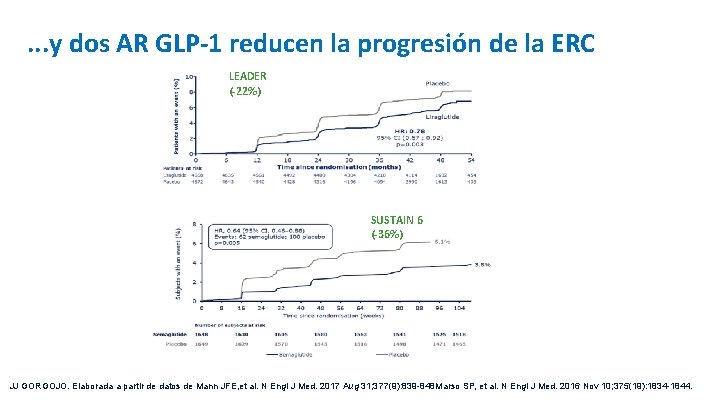
. . . y dos AR GLP-1 reducen la progresión de la ERC LEADER (-22%) SUSTAIN 6 (-36%) JJ GORGOJO. Elaborada a partir de datos de Mann JFE, et al. N Engl J Med. 2017 Aug 31; 377(9): 839 -848 Marso SP, et al. N Engl J Med. 2016 Nov 10; 375(19): 1834 -1844.
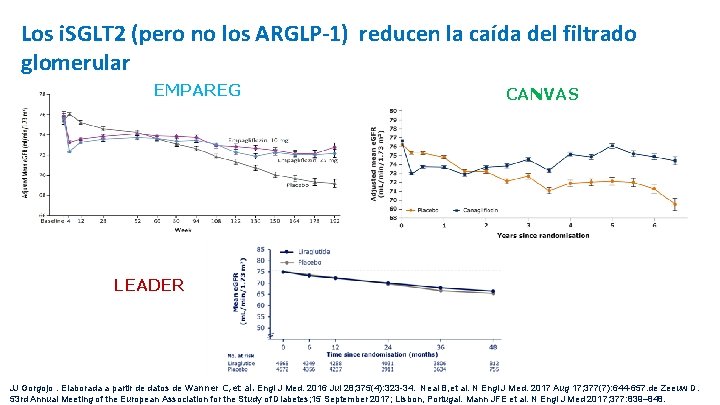
Los i. SGLT 2 (pero no los ARGLP-1) reducen la caída del filtrado glomerular EMPAREG CANVAS LEADER JJ Gorgojo. Elaborada a partir de datos de Wanner C, et al. Engl J Med. 2016 Jul 28; 375(4): 323 -34. Neal B, et al. N Engl J Med. 2017 Aug 17; 377(7): 644 -657. de Zeeuw D. 53 rd Annual Meeting of the European Association for the Study of Diabetes; 15 September 2017; Lisbon, Portugal. Mann JFE et al. N Engl J Med 2017; 377: 839– 848.
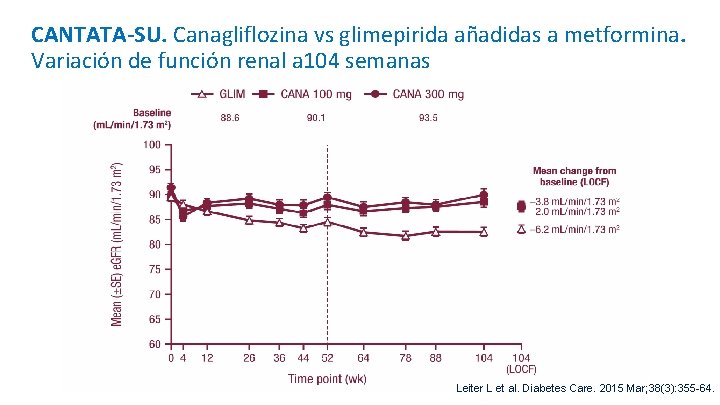
CANTATA-SU. Canagliflozina vs glimepirida añadidas a metformina. Variación de función renal a 104 semanas Leiter L et al. Diabetes Care. 2015 Mar; 38(3): 355 -64.
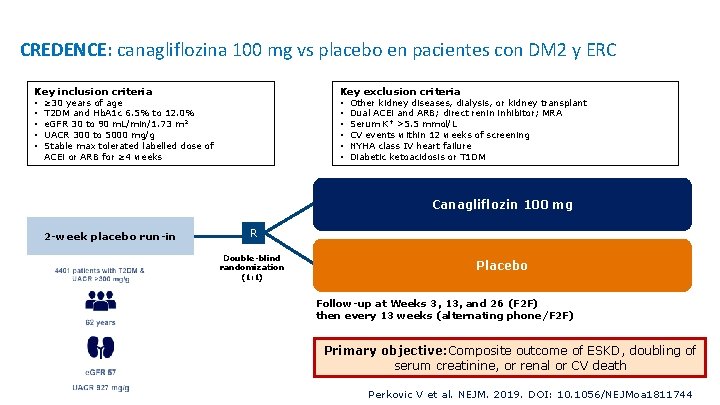
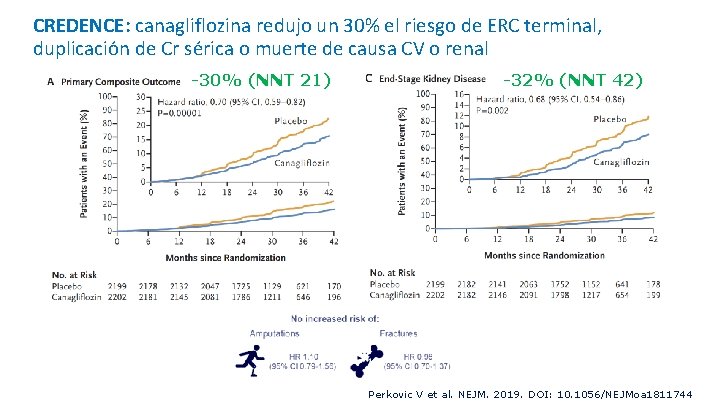
CREDENCE: canagliflozina 100 mg vs placebo en pacientes con DM 2 y ERC Key inclusion criteria Key exclusion criteria • • • ≥ 30 years of age T 2 DM and Hb. A 1 c 6. 5% to 12. 0% e. GFR 30 to 90 m. L/min/1. 73 m 2 UACR 300 to 5000 mg/g Stable max tolerated labelled dose of ACEi or ARB for ≥ 4 weeks Other kidney diseases, dialysis, or kidney transplant Dual ACEi and ARB; direct renin inhibitor; MRA Serum K+ >5. 5 mmol/L CV events within 12 weeks of screening NYHA class IV heart failure Diabetic ketoacidosis or T 1 DM Canagliflozin 100 mg 2 -week placebo run-in R Double-blind randomization (1: 1) Placebo Follow-up at Weeks 3, 13, and 26 (F 2 F) then every 13 weeks (alternating phone/F 2 F) Primary objective: Composite outcome of ESKD, doubling of serum creatinine, or renal or CV death Jardine MJ, et al. Am J Nephrol. 2017; 46(6): 462 -472. Perkovic V et al. NEJM. 2019. DOI: 10. 1056/NEJMoa 1811744
CREDENCE: canagliflozina redujo un 30% el riesgo de ERC terminal, duplicación de Cr sérica o muerte de causa CV o renal -30% (NNT 21) -32% (NNT 42) Perkovic V et al. NEJM. 2019. DOI: 10. 1056/NEJMoa 1811744
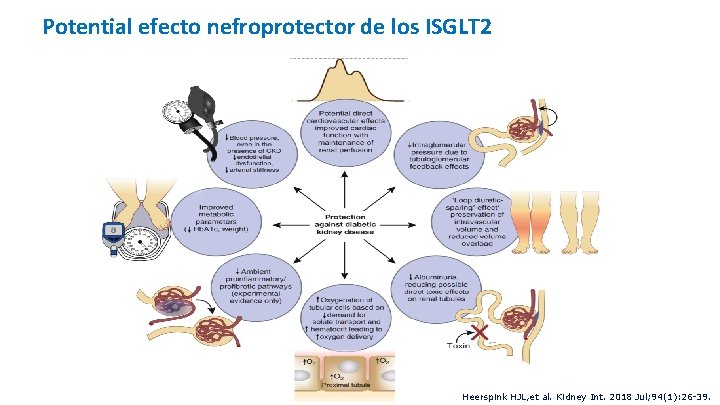
Potential efecto nefroprotector de los ISGLT 2 Heerspink HJL, et al. Kidney Int. 2018 Jul; 94(1): 26 -39.
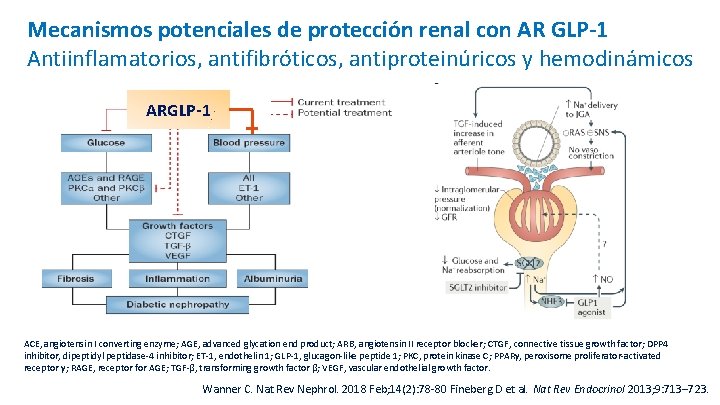
Mecanismos potenciales de protección renal con AR GLP-1 Antiinflamatorios, antifibróticos, antiproteinúricos y hemodinámicos ARGLP-1 ACE, angiotensin I converting enzyme; AGE, advanced glycation end product; ARB, angiotensin II receptor blocker; CTGF, connective tissue growth factor; DPP 4 inhibitor, dipeptidyl peptidase-4 inhibitor; ET-1, endothelin 1; GLP-1, glucagon-like peptide 1; PKC, protein kinase C; PPARγ, peroxisome proliferator-activated receptor γ; RAGE, receptor for AGE; TGF-β, transforming growth factor β; VEGF, vascular endothelial growth factor. Wanner C. Nat Rev Nephrol. 2018 Feb; 14(2): 78 -80 Fineberg D et al. Nat Rev Endocrinol 2013; 9: 713– 723.
Consenso ADA/EASD 2018 Fármacos de elección en pacientes con IC ó ERC HF OR CKD predominates PREFERABLY SGLT-2 i with evidence of reducing HF and/or CKD progression in CVOT if e. GFR adequate‡ OR If SGLT-2 i not tolerated or contraindicated or if e. GFR less than adequate† add GLP-1 RA with proven CV benefit*# • SGLT-2 i Canagliflozin/Empagliflozin/Dapagliflozin If Hb. A 1 c above target Avoid TZD in the setting of HF Choose agents demonstrating CV safety: • Consider adding the other class with proven CVD benefit* • DPP-4 i (not saxagliptin) in the setting of HF (if not on GLP 1 RA) • Basal insulin § • SU|| • • SGLT-2 is preferred over GLP-1 RAs as significant, consistent reductions in hospitalisation for HF have been seen in SGLT-2 i trials • GLP-1 RA Liraglutide Semaglutide Exenatide ER †Be aware that SGLT-2 i vary by region and individual agent with regard to indicated level of e. GFR for initiation and continued use; ‡Empagliflozin, canagliflozin and dapagliflozin have shown reduction in HF and reduction in CKD progression in CVOTs; §Degludec or U 100 glargine have demonstrated CVD safety; ||Choose later generation SU with lower risk of hypoglycaemia; #Caution with GLP-1 RA in ESRD Davies MJ, et al. Diabetologia. 2018 Dec; 61(12): 2461 -2498. American Diabetes Association. [web annotation]. Diabetes Care 2019; 42(Suppl. 1): S 90–S 102.
Conclusiones • • • En los últimos años han aparecido nuevas clases de fármacos antihiperglucemiantes, cuyo metabolismo y excreción renal es preciso conocer para su correcto manejo en pacientes con ERC La reducción de Hb. A 1 c disminuye el riesgo de aparición y progresión de ERC Los i. SGLT-2 y algunos análogos de GLP-1 humano han demostrado protección renal en estudios de seguridad CV Sólo los i. SGLT-2 han demostrado frenar el descenso del filtrado glomerular i. SGLT-2 y ARGLP-1 son fármacos de elección en pacientes con ERC, salvo limitación por FGe en ficha técnica Canagliflozina es el primer fármaco antihiperglucemiante que demuestra una reducción de la morbimortalidad renal y CV en pacientes con ERC