
MANE 4240 CIVL 4240 Introduction to Finite Elements
- Slides: 33
MANE 4240 & CIVL 4240 Introduction to Finite Elements Prof. Suvranu De Constant Strain Triangle (CST)
Reading assignment: Logan 6. 2 -6. 5 + Lecture notes Summary: • Computation of shape functions for constant strain triangle • Properties of the shape functions • Computation of strain-displacement matrix • Computation of element stiffness matrix • Computation of nodal loads due to body forces • Computation of nodal loads due to traction • Recommendations for use • Example problems
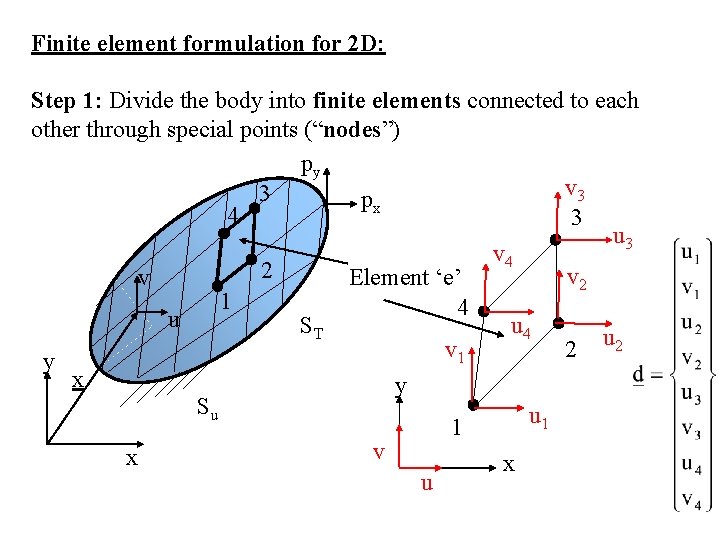
Finite element formulation for 2 D: Step 1: Divide the body into finite elements connected to each other through special points (“nodes”) py v 3 3 px 4 3 u 3 v 4 2 v 2 Element ‘e’ v 1 4 u u 4 ST u 2 v 1 2 y x y Su u 1 1 x v u x
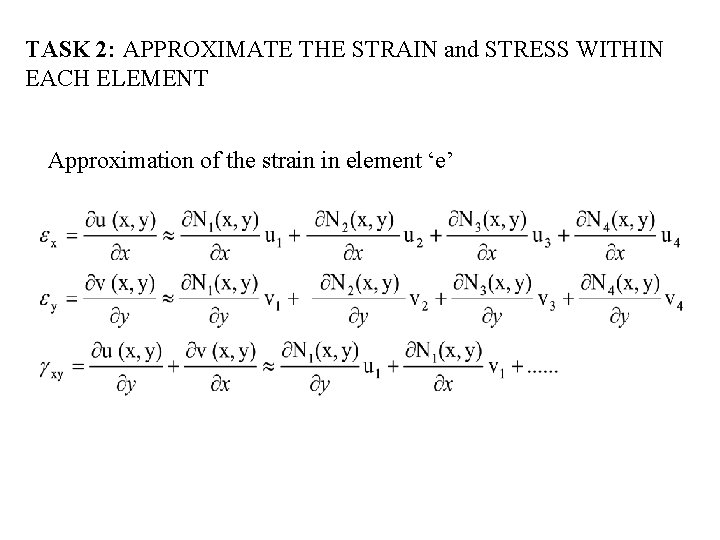
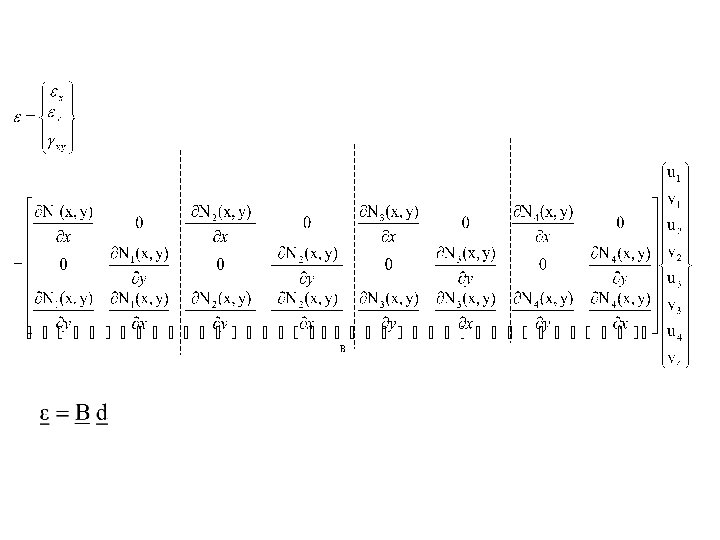
TASK 2: APPROXIMATE THE STRAIN and STRESS WITHIN EACH ELEMENT Approximation of the strain in element ‘e’
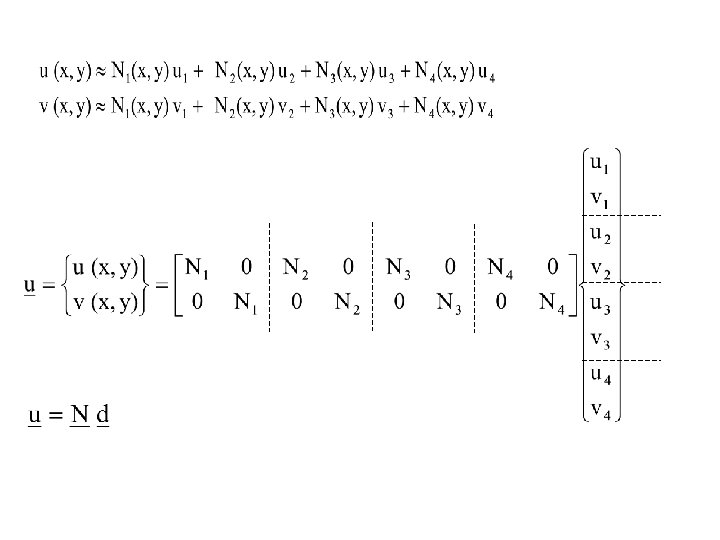
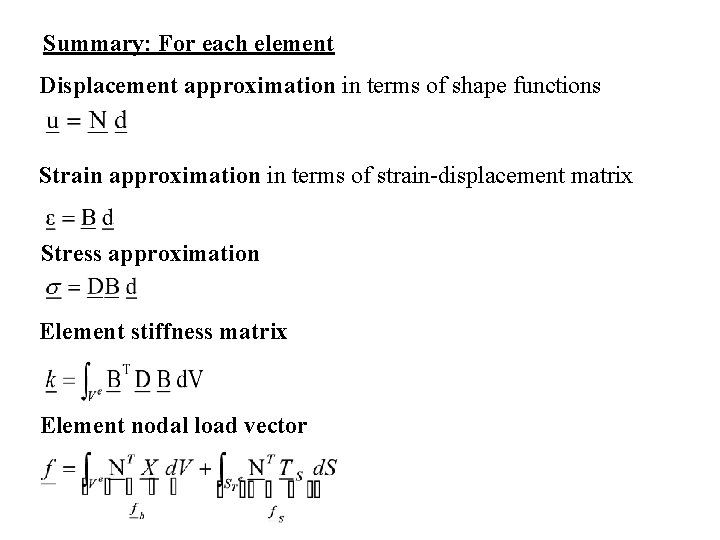
Summary: For each element Displacement approximation in terms of shape functions Strain approximation in terms of strain-displacement matrix Stress approximation Element stiffness matrix Element nodal load vector
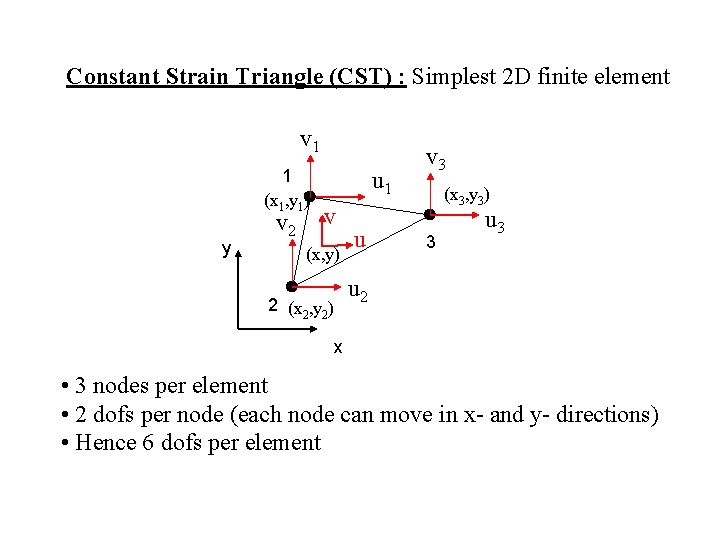
Constant Strain Triangle (CST) : Simplest 2 D finite element v 1 1 (x 1, y 1) y v 2 u 1 v (x, y) u v 3 (x 3, y 3) 3 u 2 2 (x 2, y 2) x • 3 nodes per element • 2 dofs per node (each node can move in x- and y- directions) • Hence 6 dofs per element
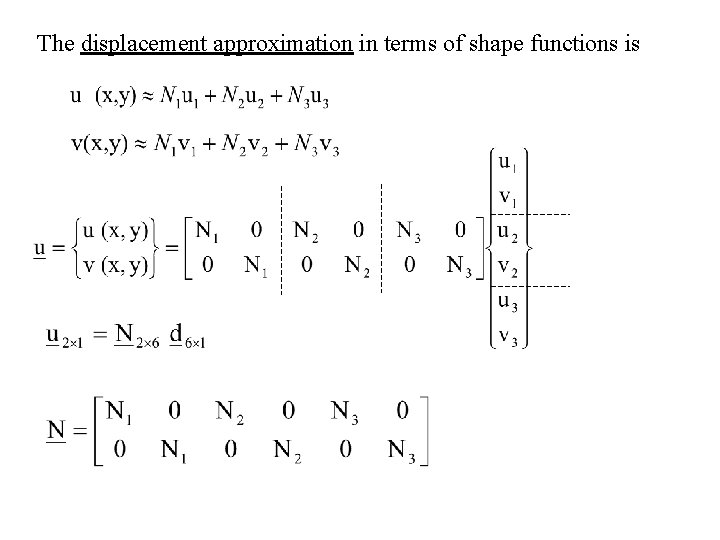
The displacement approximation in terms of shape functions is
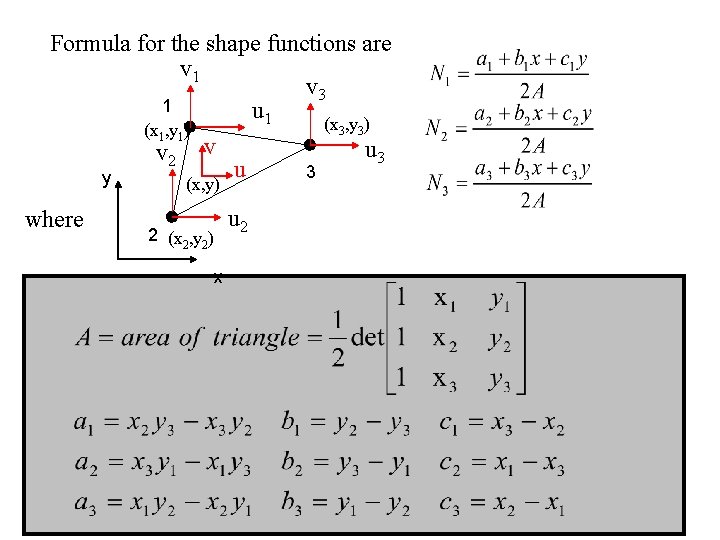
Formula for the shape functions are v 1 v 3 1 u 1 (x 3, y 3) (x 1, y 1) u 3 v 2 v u 3 y (x, y) where u 2 2 (x 2, y 2) x
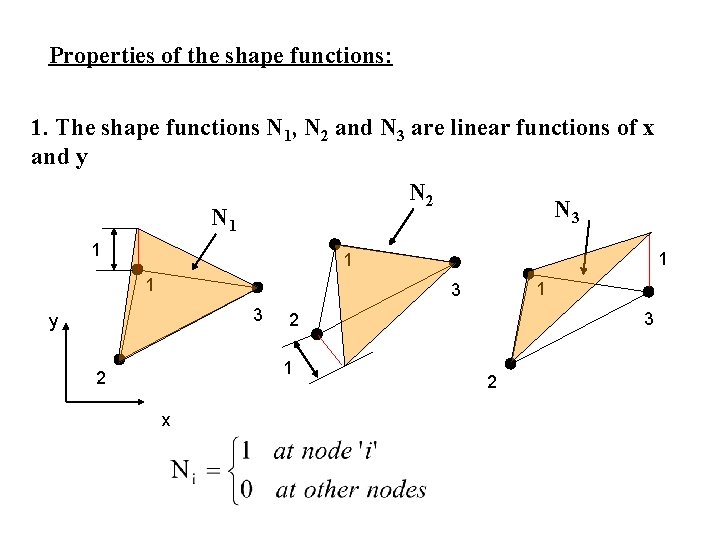
Properties of the shape functions: 1. The shape functions N 1, N 2 and N 3 are linear functions of x and y N 2 N 1 1 N 3 1 1 3 3 y 1 2 x 3 2 2
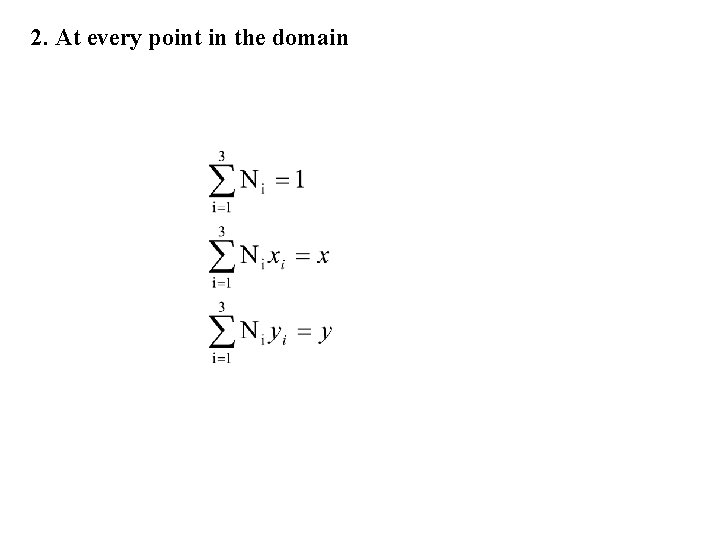
2. At every point in the domain
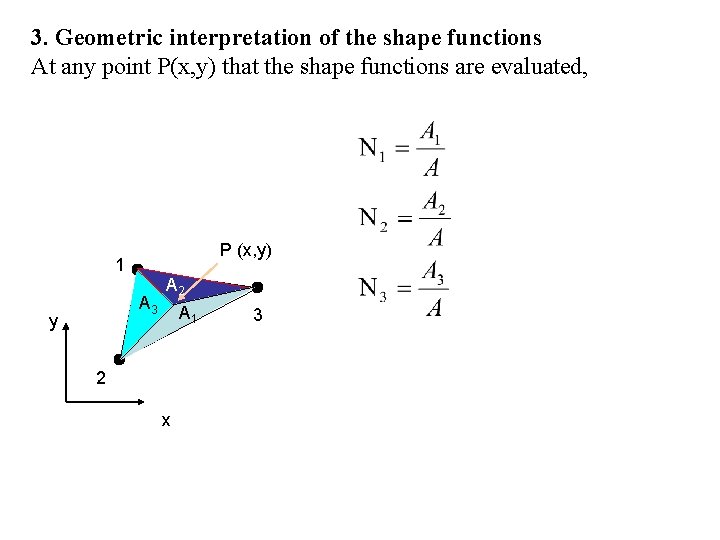
3. Geometric interpretation of the shape functions At any point P(x, y) that the shape functions are evaluated, P (x, y) 1 A 3 y A 2 A 1 2 x 3
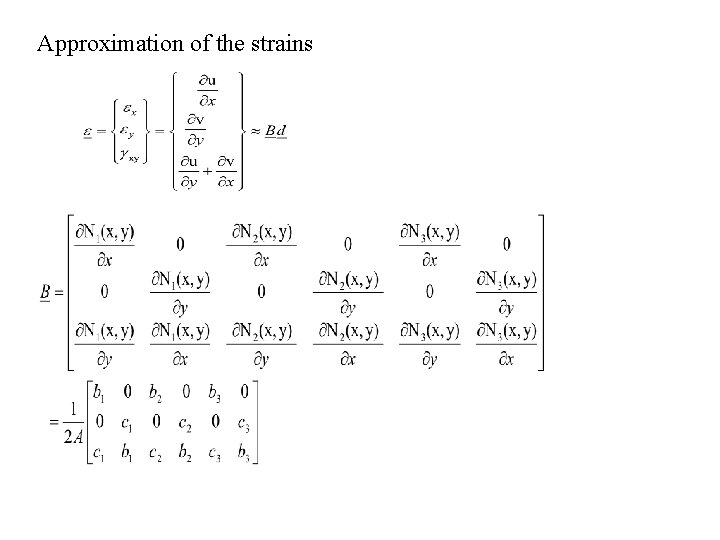
Approximation of the strains
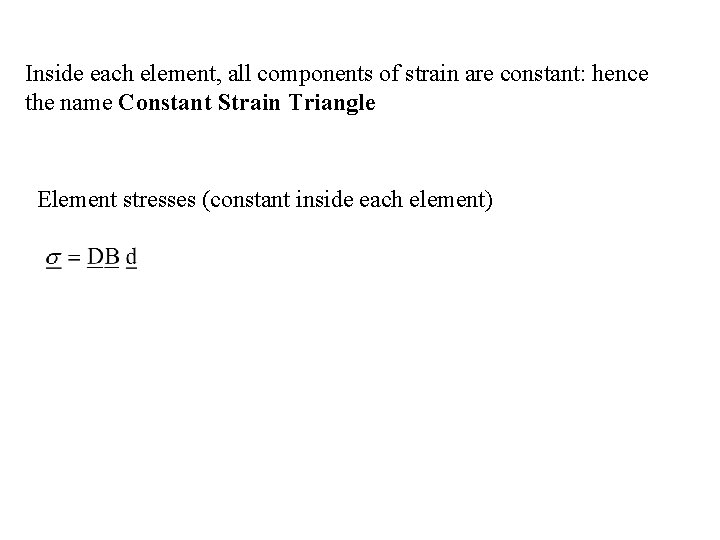
Inside each element, all components of strain are constant: hence the name Constant Strain Triangle Element stresses (constant inside each element)
IMPORTANT NOTE: 1. The displacement field is continuous across element boundaries 2. The strains and stresses are NOT continuous across element boundaries
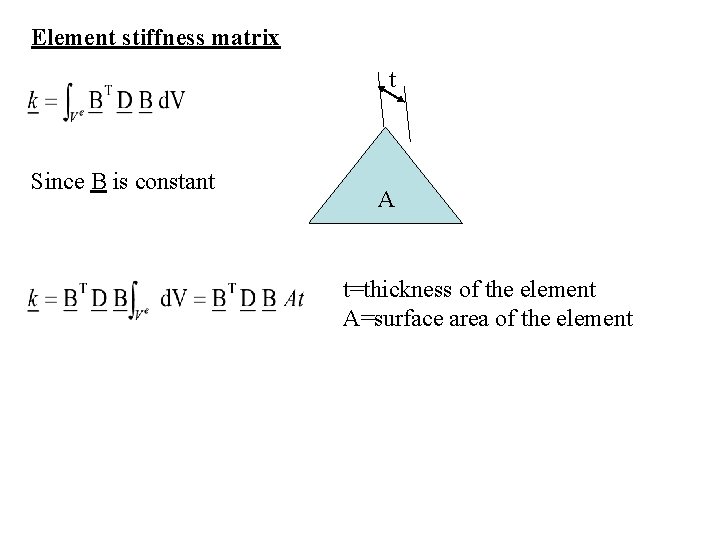
Element stiffness matrix t Since B is constant A t=thickness of the element A=surface area of the element
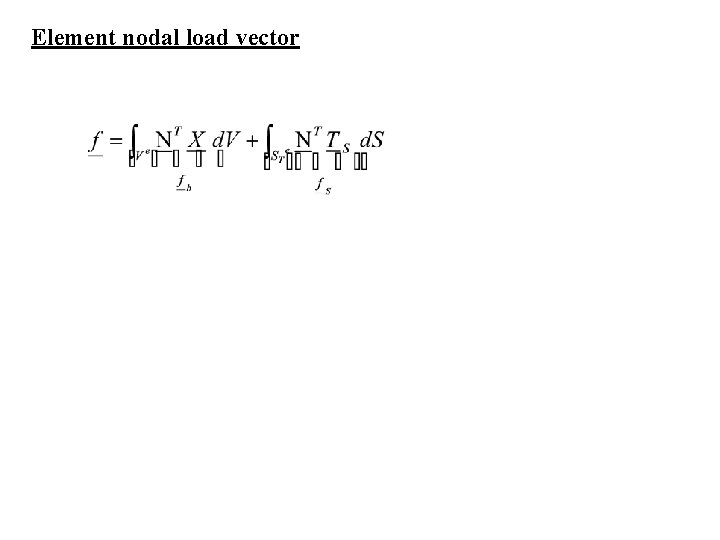
Element nodal load vector
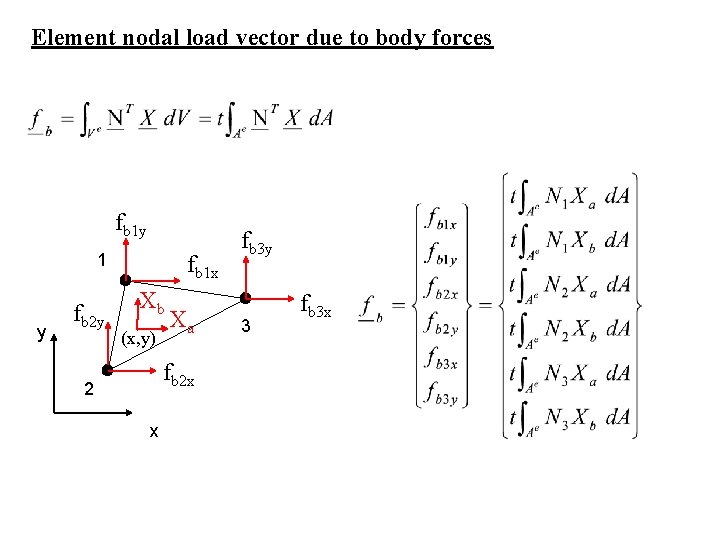
Element nodal load vector due to body forces fb 1 y 1 y fb 2 y fb 1 x Xb (x, y) Xa fb 2 x 2 x fb 3 y 3 fb 3 x
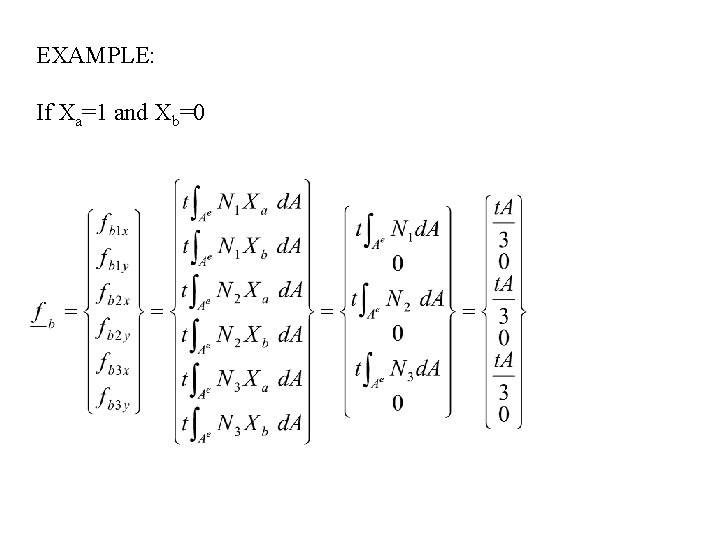
EXAMPLE: If Xa=1 and Xb=0
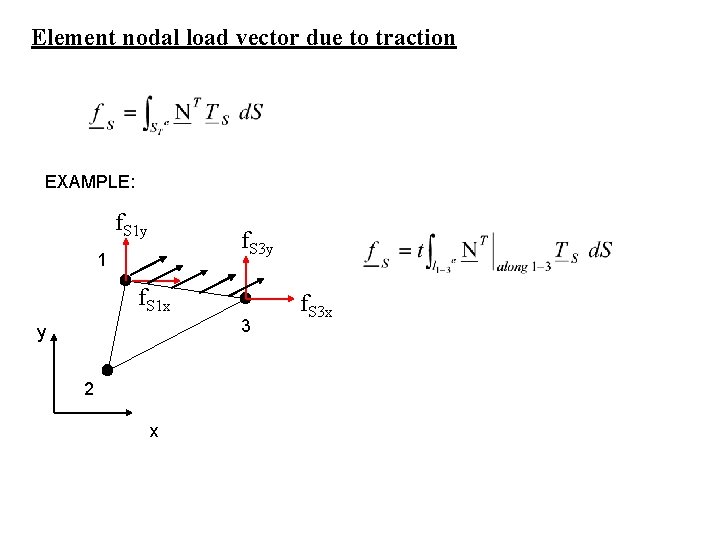
Element nodal load vector due to traction EXAMPLE: f. S 1 y f. S 3 y 1 f. S 1 x 3 y 2 x f. S 3 x
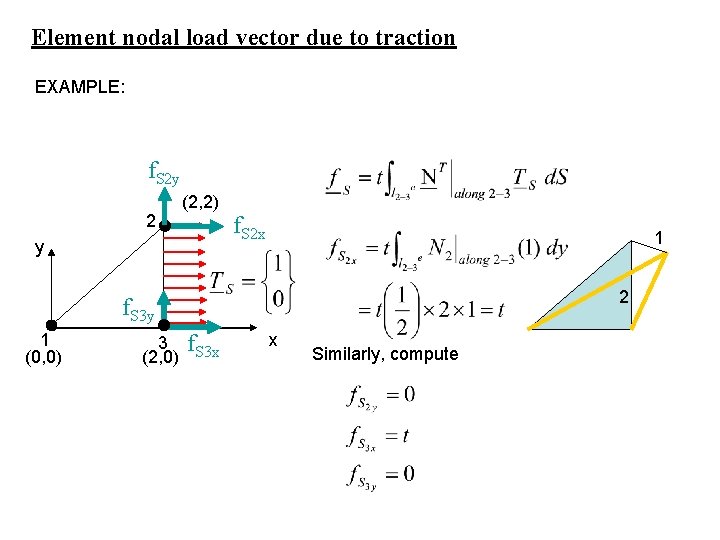
Element nodal load vector due to traction EXAMPLE: f. S 2 y 2 (2, 2) y f. S 2 x 1 2 f. S 3 y 1 (0, 0) 3 f (2, 0) S 3 x x Similarly, compute
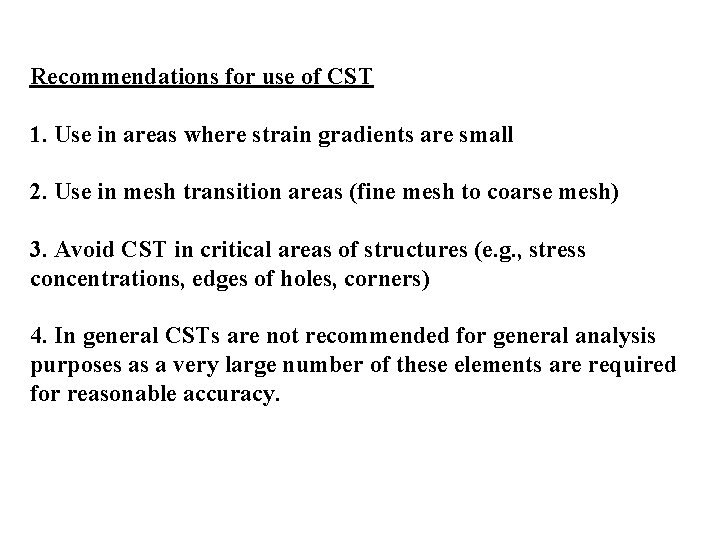
Recommendations for use of CST 1. Use in areas where strain gradients are small 2. Use in mesh transition areas (fine mesh to coarse mesh) 3. Avoid CST in critical areas of structures (e. g. , stress concentrations, edges of holes, corners) 4. In general CSTs are not recommended for general analysis purposes as a very large number of these elements are required for reasonable accuracy.
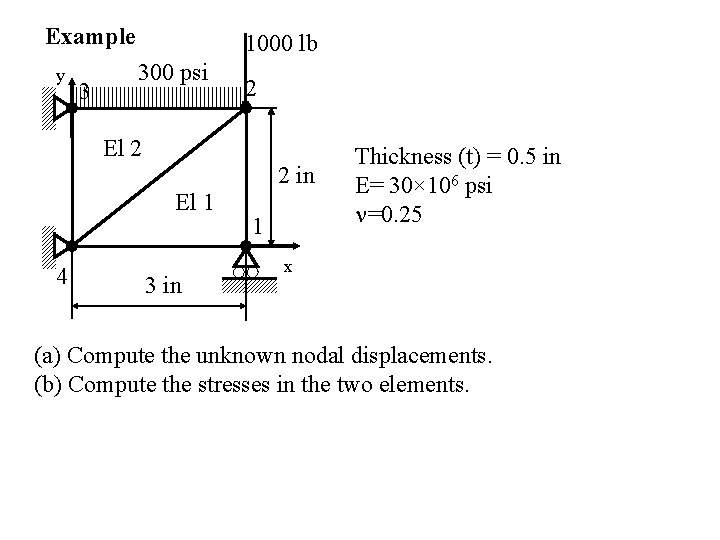
Example y 3 1000 lb 300 psi 2 El 2 2 in El 1 4 3 in 1 Thickness (t) = 0. 5 in E= 30× 106 psi n=0. 25 x (a) Compute the unknown nodal displacements. (b) Compute the stresses in the two elements.
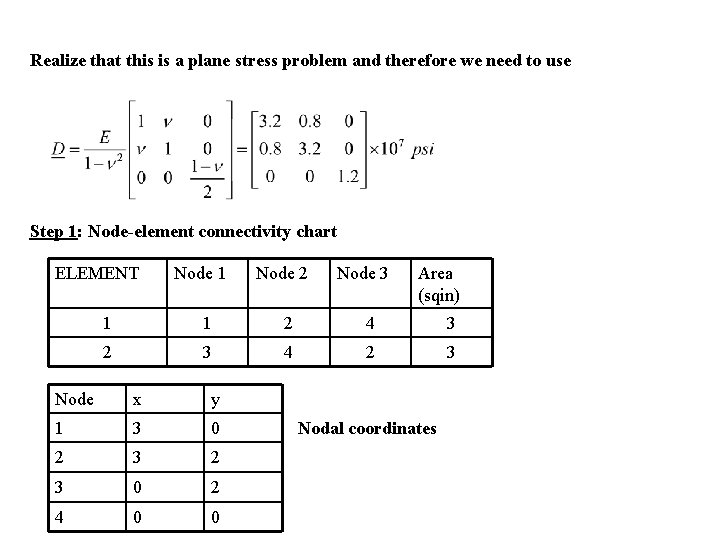
Realize that this is a plane stress problem and therefore we need to use Step 1: Node-element connectivity chart ELEMENT Node 1 Node 2 Node 3 Area (sqin) 1 1 2 4 3 2 3 4 2 3 Node x y 1 3 0 2 4 0 0 Nodal coordinates
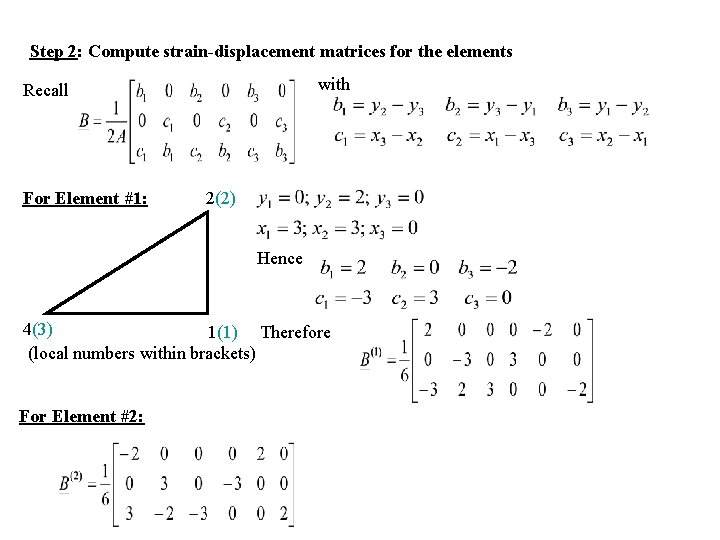
Step 2: Compute strain-displacement matrices for the elements with Recall For Element #1: 2(2) Hence 4(3) 1(1) Therefore (local numbers within brackets) For Element #2:
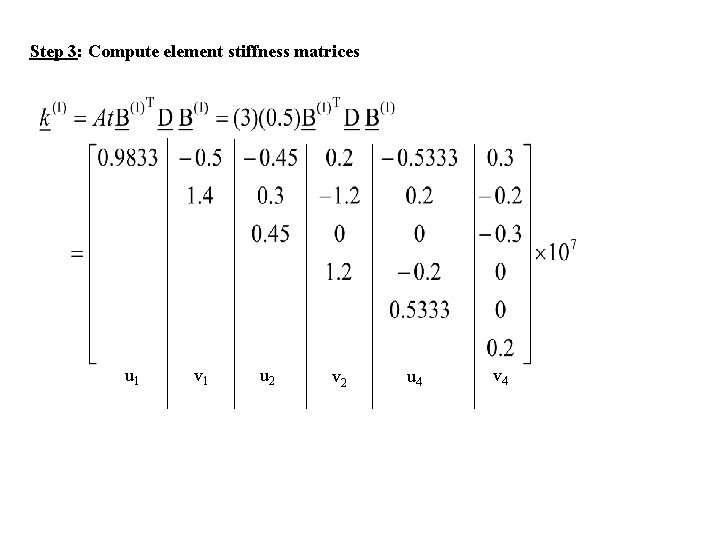
Step 3: Compute element stiffness matrices u 1 v 1 u 2 v 2 u 4 v 4
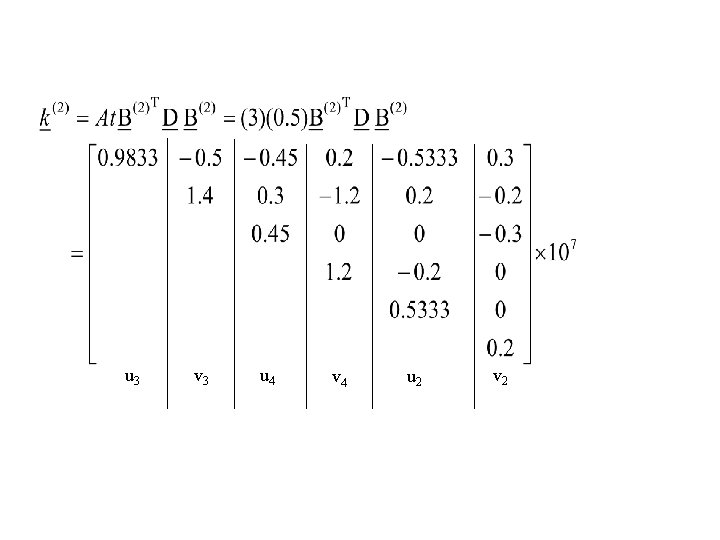
u 3 v 3 u 4 v 4 u 2 v 2
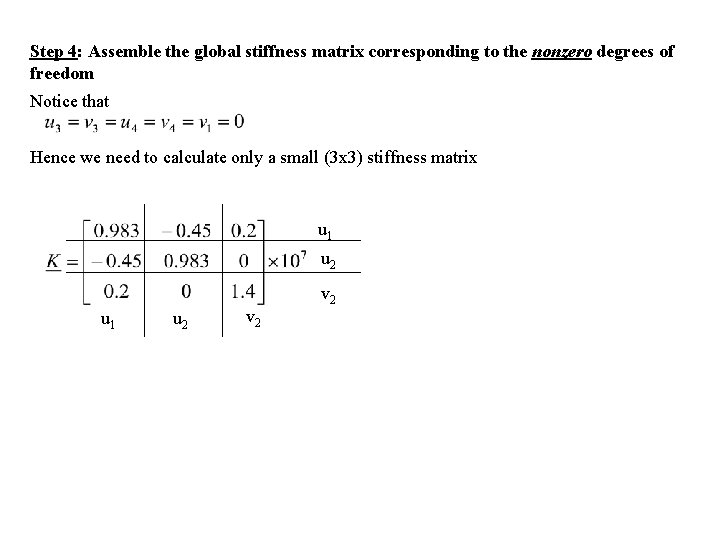
Step 4: Assemble the global stiffness matrix corresponding to the nonzero degrees of freedom Notice that Hence we need to calculate only a small (3 x 3) stiffness matrix u 1 u 2 v 2
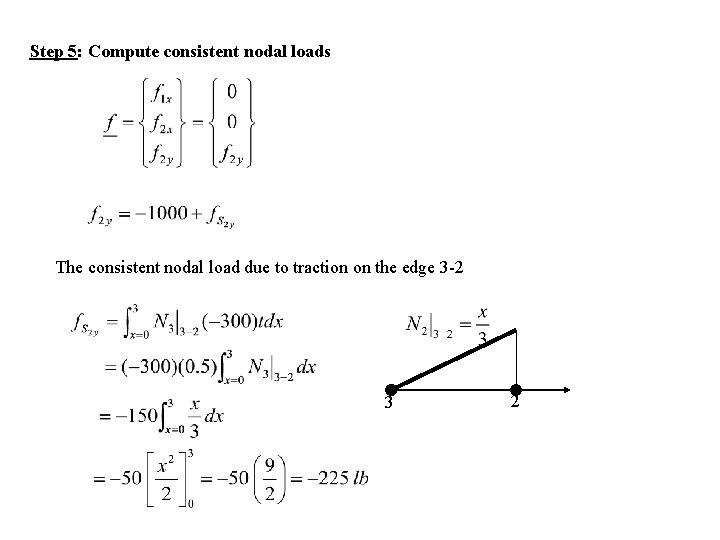
Step 5: Compute consistent nodal loads The consistent nodal load due to traction on the edge 3 -2 3 2
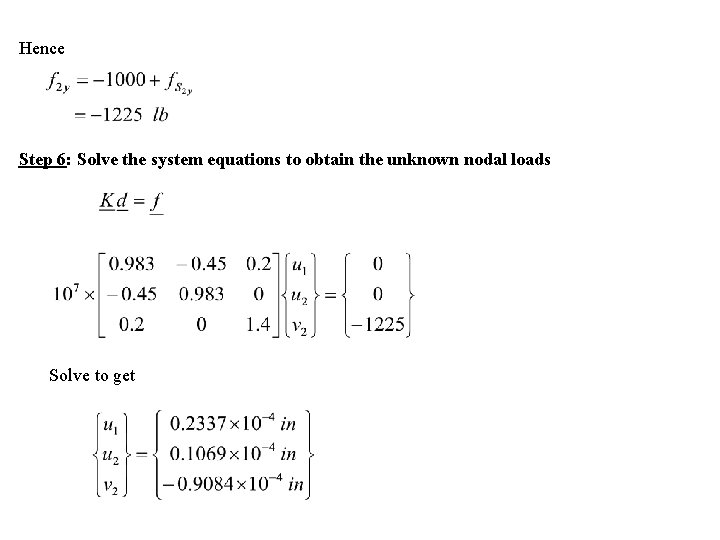
Hence Step 6: Solve the system equations to obtain the unknown nodal loads Solve to get
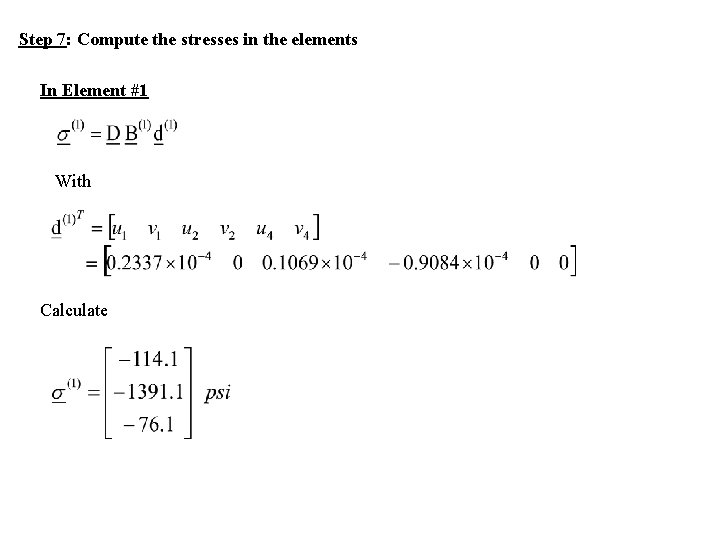
Step 7: Compute the stresses in the elements In Element #1 With Calculate
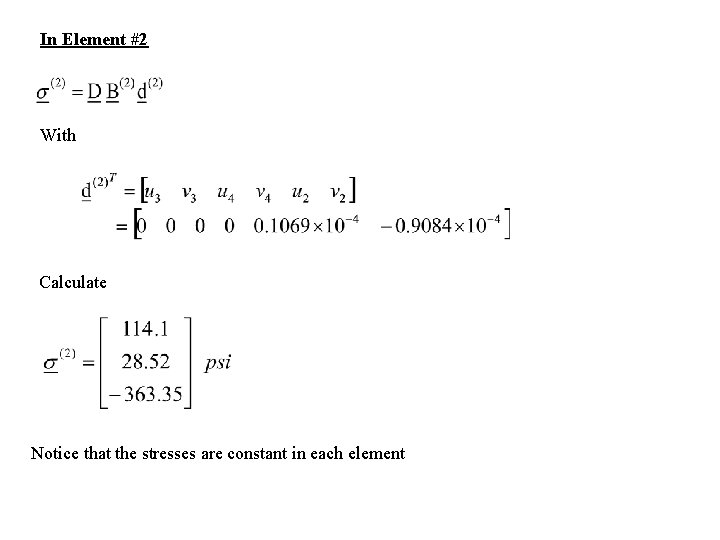
In Element #2 With Calculate Notice that the stresses are constant in each element