
Mandibular Central Lateral Incisor Incisors n Common Characteristics
Mandibular Central & Lateral Incisor
Incisors n Common Characteristics: 1.crown: 4 axial surfaces, 1 incisal ridge labiolingual :quadrangular proximal:triangle 2.root:single, straight
Mandibular central incisors n n n n Nomenclature FDI system 31 - Mandibular right central incisor 41 - Mandibular left central incisor First evidence of calcification- 3 to 4 months Enamel completed- 4 to 5 years Eruption – 6 to 7 years Root completed- 9 years
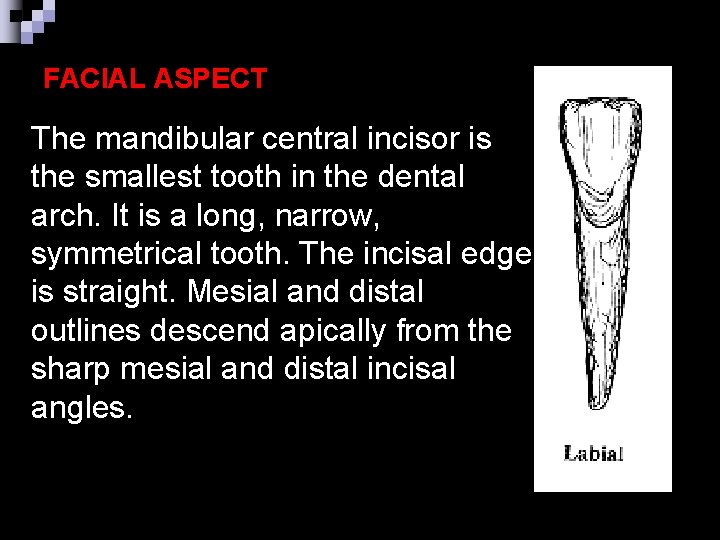
FACIAL ASPECT The mandibular central incisor is the smallest tooth in the dental arch. It is a long, narrow, symmetrical tooth. The incisal edge is straight. Mesial and distal outlines descend apically from the sharp mesial and distal incisal angles.
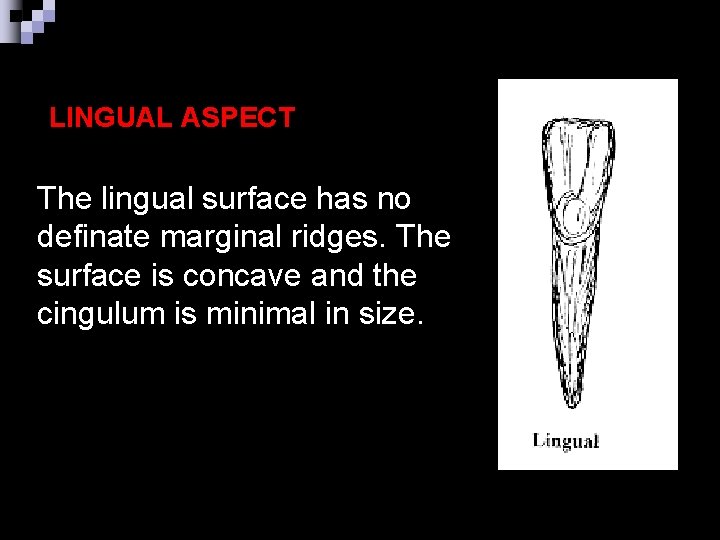
LINGUAL ASPECT The lingual surface has no definate marginal ridges. The surface is concave and the cingulum is minimal in size.
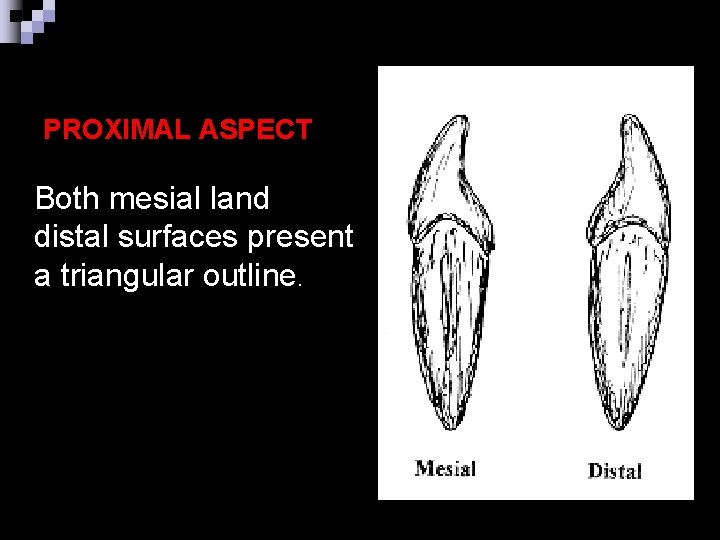
PROXIMAL ASPECT Both mesial land distal surfaces present a triangular outline.
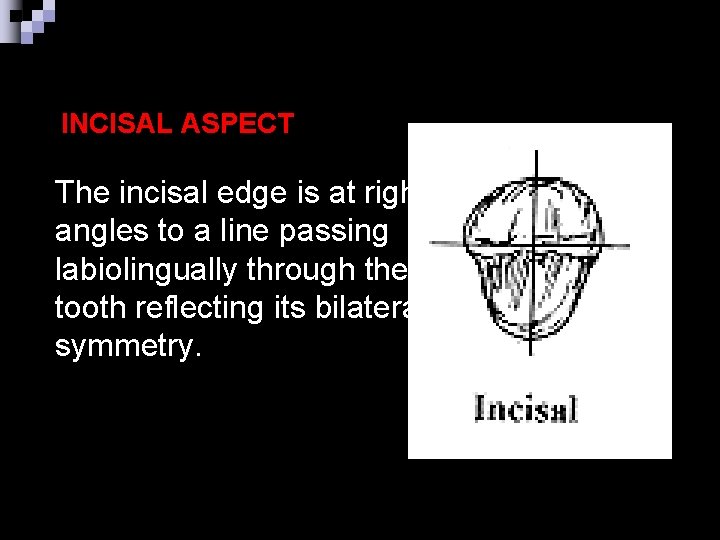
INCISAL ASPECT The incisal edge is at right angles to a line passing labiolingually through the tooth reflecting its bilateral symmetry.
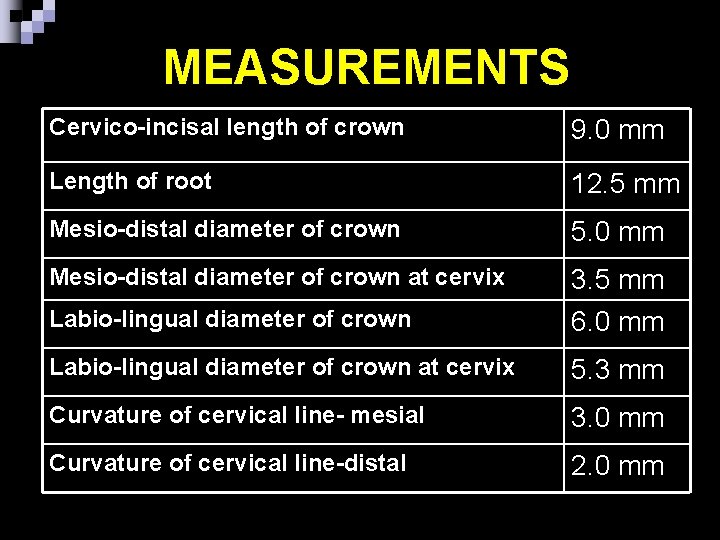
MEASUREMENTS Cervico-incisal length of crown 9. 0 mm Length of root 12. 5 mm Mesio-distal diameter of crown 5. 0 mm Mesio-distal diameter of crown at cervix Labio-lingual diameter of crown 3. 5 mm 6. 0 mm Labio-lingual diameter of crown at cervix 5. 3 mm Curvature of cervical line- mesial 3. 0 mm Curvature of cervical line-distal 2. 0 mm
Mandibular lateral incisors Nomenclature FDI systemn 32 - Mandibular left lateral incisor n 42 - Mandibular right lateral incisor n First evidence of calcification- 3 to 4 months n Enamel completed- 4 to 5 years n Eruption – 7 to 8 years n Root completed- 10 years n
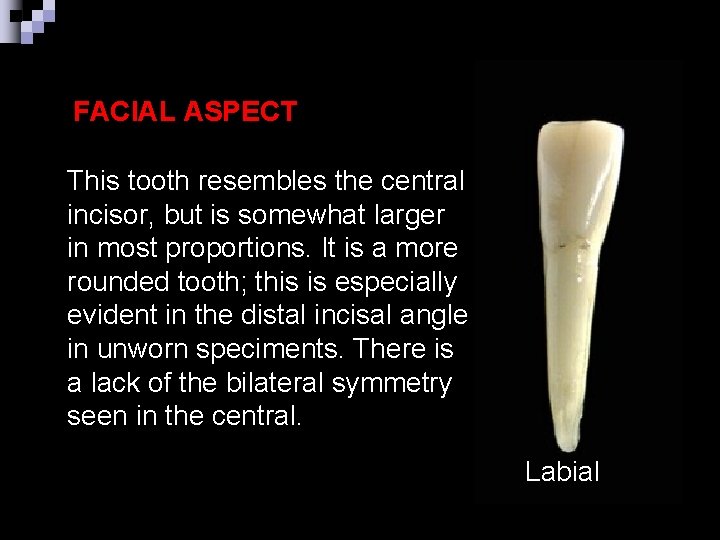
FACIAL ASPECT This tooth resembles the central incisor, but is somewhat larger in most proportions. It is a more rounded tooth; this is especially evident in the distal incisal angle in unworn speciments. There is a lack of the bilateral symmetry seen in the central. Labial
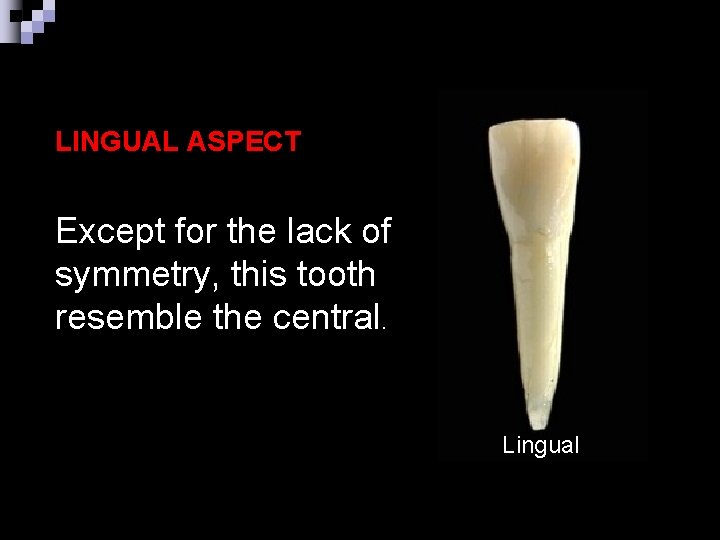
LINGUAL ASPECT Except for the lack of symmetry, this tooth resemble the central. Lingual
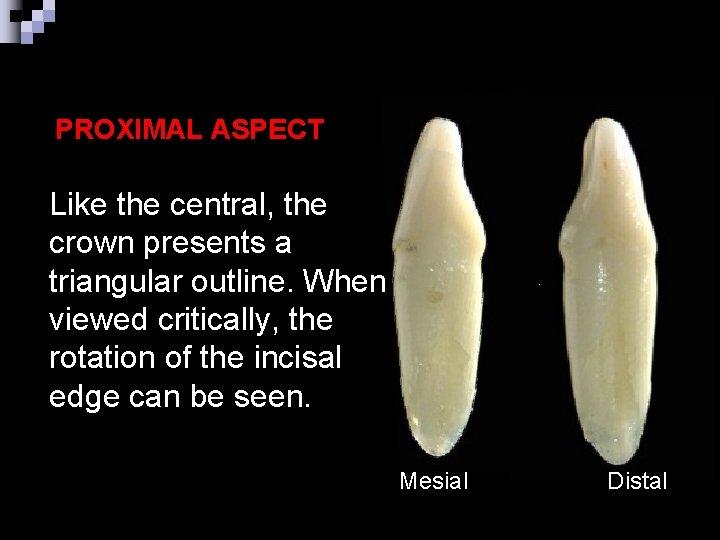
PROXIMAL ASPECT Like the central, the crown presents a triangular outline. When viewed critically, the rotation of the incisal edge can be seen. Mesial Distal
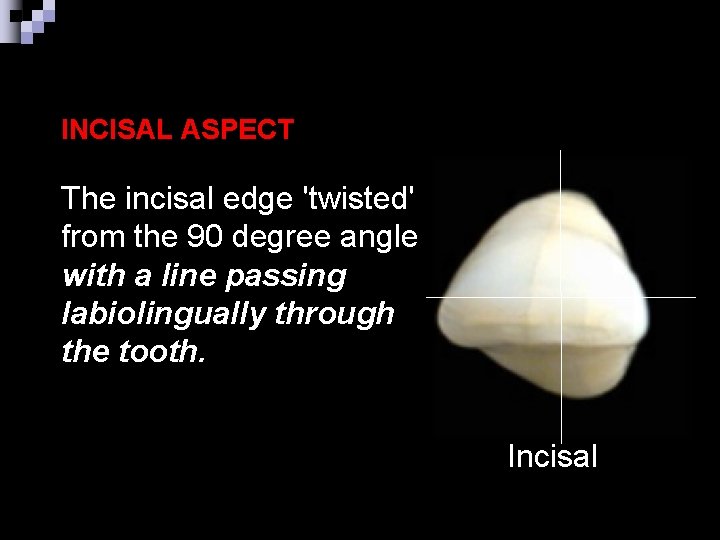
INCISAL ASPECT The incisal edge 'twisted' from the 90 degree angle with a line passing labiolingually through the tooth. Incisal
Differences between Mandibular Central & Mandibular Lateral Incisor § Mandibular central incisors are very symmetrical as compared to lateral § In central incisors mesio and disto-incisal angles are quite similar where as in lateral incisor the disto-incisal angle are more rounded. § The contact points in central incisors are at the same level where as in the lateral incisors the distal proximal contacts are more apical than mesial.
n Central incisors have their incisal edges at right angle to the bisecting line where as incisal edges of lateral incisor have a slight disto-lingual twist relative to a line bisecting the cingulum. Cingulum is slightly distal in lateral incisors. n The crown of the mandibular lateral tips slightly to the distal relative to the root.
VARIATIONS q Most common anterior teeth to have 2 root canals. q In some mongoloids deep groove is seen in cervico-incisal area. And these grooves are often the site of dental caries.
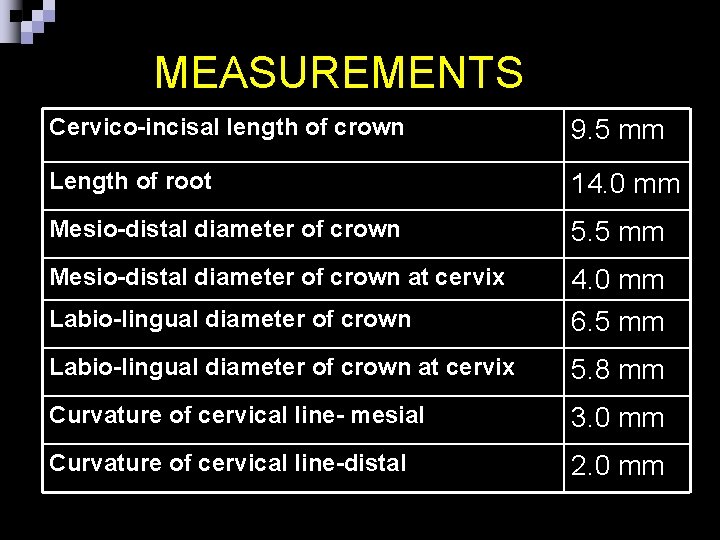
MEASUREMENTS Cervico-incisal length of crown 9. 5 mm Length of root 14. 0 mm Mesio-distal diameter of crown 5. 5 mm Mesio-distal diameter of crown at cervix Labio-lingual diameter of crown 4. 0 mm 6. 5 mm Labio-lingual diameter of crown at cervix 5. 8 mm Curvature of cervical line- mesial 3. 0 mm Curvature of cervical line-distal 2. 0 mm

Thank You
- Slides: 18