
Managing Your Weight Ch 6 Lesson 1 Prepared
- Slides: 16
Managing Your Weight Ch. 6 Lesson 1 Prepared by V. Morrissey
EQ: Explain calories, their role as the body’s fuel, and how they affect body weight Objectives: n Contrast overweight and obesity and identify the impact of obesity on overall health n Discuss healthful weight-loss and weight-gain strategies
The Calorie n A calorie (kilocalorie) is a unit to measure energy. n the energy available in different foods
Calories n How many calories you need depends on: n Rate of growth n Body size n Gender n Age n Metabolic rate n Activity level
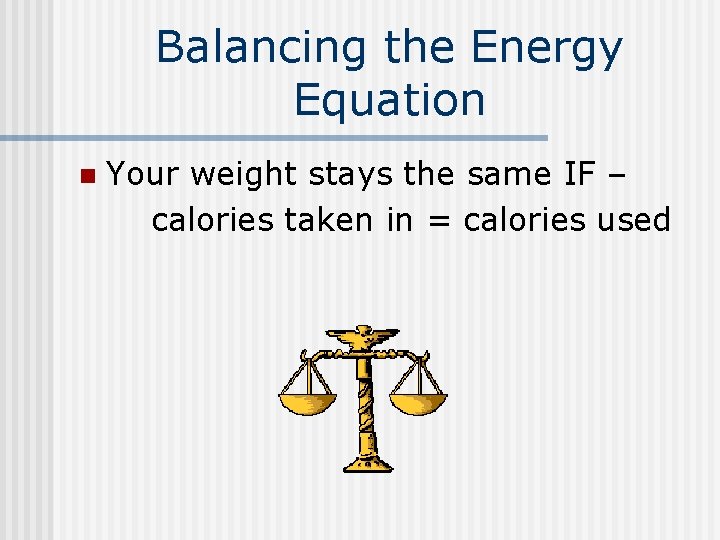
Balancing the Energy Equation n Your weight stays the same IF – calories taken in = calories used
Weight Problems n Too heavy or too thin can be a health risk
Obesity Strains the body frame n Increases the workload of the heart and lungs n Why do people gain too much weight? n Sedentary lifestyle n Poor food habits n
Underweight Less energy reserve n Harder to fight off infections n Increased risk of deficiencies n
A Healthy Weight n Desired weight (weight that’s best for you) is based on: n Gender n Height n Body Frame
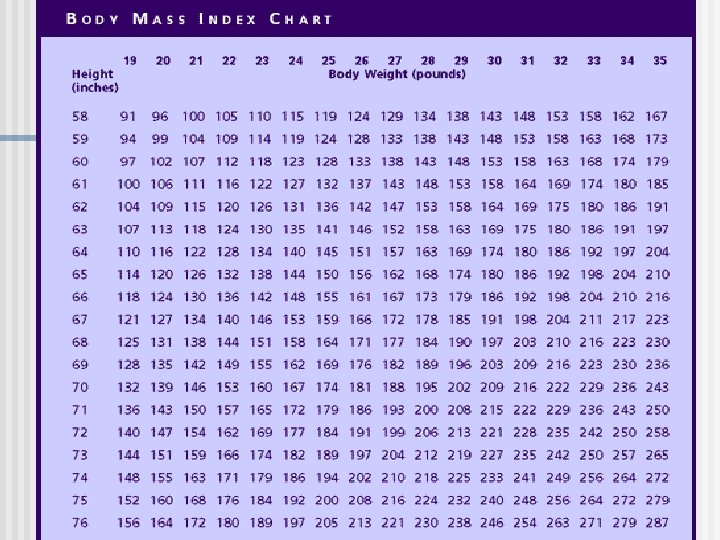
Body Mass Index Body mass index (BMI) is the ratio of weight to height. n Gauges total body fat n
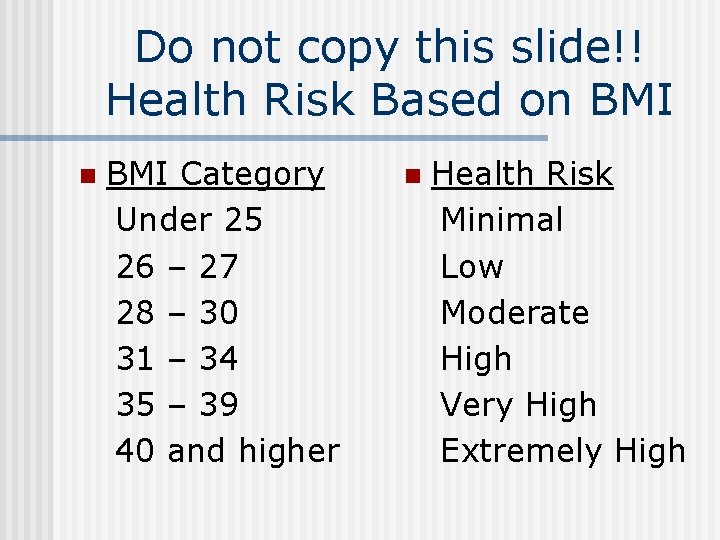
Do not copy this slide!! Health Risk Based on BMI Category Under 25 26 – 27 28 – 30 31 – 34 35 – 39 40 and higher n Health Risk Minimal Low Moderate High Very High Extremely High
Managing Body Weight n Losing weight requires lifestyle changes n Decrease calories consumed • Not below 1400 – 1600 calories daily • Eat low-calorie foods from the five food groups n Increase energy used
Managing Body Weight n Gaining weight requires lifestyle changes n Eat more complex carbohydrates n Eat more frequently n Eat nutritious snacks n Exercise
The Plan Target your weight n Set smart goals n Make a personal plan n Stick to your plan n
Remember Think Positively!